My latest book is a collection of essays from this blog on how the film industry tackled the subject of fascism.
President Franklin D. Roosevelt’s remark in 1936 memorialized, even when they were still just teenagers, the generation that would later be called The Greatest Generation: “There is a mysterious cycle in human events. To some generations much is given. Of other generations much is expected. This generation of Americans has a rendezvous with destiny.”
There were many hurdles and many adventures in the lifespan of these individuals, including the Great Depression, wars, Cold War, and often bewildering changes in society that always seemed to come too quickly and followed by more. The chief horror of the twentieth century, that century to which they were born and only a small number outlived, was fascism.
The Greatest Generation received instruction, inspiration, and, of course, entertainment from a source that affected them perhaps more than even the generations to follow, who grew up with greater technology: the movies.
This book is a collection of essays
adapted from this blog which strives to examine classic
films in the context of the eras in which they were made. The movies of the day
tell us a lot about that generation, what was expected of them, what they hoped
to achieve, and how they saw themselves. It is not a perfect measuring stick,
but the movies of the day show a passion for fighting fascism by everyday
people that may shame their twenty-first century descendants. Or at least, it should.
I invite you to join my beta readers squad and get a free eBook before publication. (Please consider leaving a review on Amazon - but this is not required, and any review must be your honest opinion.)
There will also be an opportunity to pre-order on Amazon. A print version of the book will also be available.
In this era of repulsive politicizing of a simple, commonsense act of wearing a mask, we might do well to recall an era where citizens on the home front during World War II were called upon to do much more. Urged, reminded, hounded, and haunted by their patriotic duty, the level of homework on the home front would probably not be tolerated by the whining, selfish, stupid brats today who refuse to do so much as wear a mask in a store to save the lives of their fellow Americans.
Have a look at these posters. They speak to another generation, but before you laugh at the images, remember the ultimate sacrifice occurring on foreign shores made the folks on the home front willing to shoulder any responsibility for the greater good. They had a shared purpose: to survive.
Orson Welles, famous for his War of the Worlds broadcast on radio in 1938, actually delivered a far more daring, even inflammatory, radio program eight years later. Listen to this remarkable episode below of Orson Welles
Commentaries, an ABC radio program broadcast July 29, 1946. It is remarkable for Mr. Welles’ articulate
and noble prose forcefully and intelligently delivered (such eloquence, courage, not to
say moral clarity, is sadly lacking by some in our media today). It is remarkable for the rage of a white man
in protest for the brutal beating and blinding of a Black veteran by cops.
In February of that year, Sergeant Isaac Woodward, Jr., a
decorated soldier who had served in the South Pacific, had been discharged from
the Army only hours before he suffered a brutal attack by the police. He traveled on a Greyhound bus to his home in
South Carolina when, at a planned rest stop, Sgt. Woodward asked if there would
be time for him to use the restroom. The driver argued with him, but held the
bus for him so he could use the restroom.At another stop in the town of Batesburg near Aiken, the driver
contacted the local police and had Sgt. Woodward forcibly removed from the bus.
Police Chief Lynwood Shull and a few of his men beat up Sgt.
Woodward for having the temerity of being Black and insisting he be allowed to
use a planned rest stop. They beat him with nightsticks and took him to jail.
While in jail, Chief Shull continued to beat Sgt. Woodward for responding with “Yes”
instead of “Yes, sir.”He repeatedly
jabbed his nightstick into both of Sgt. Woodward’s eyes.
He was blinded for life.
Two days later, they allowed a doctor to come to the jail to
look at him.He was taken to a hospital,
and his family, awaiting his return from the war and expecting him to arrive, had to endure three more
weeks before they found out what happened to him. He was finally taken to an
Army hospital in Spartanburg, but his sight was gone forever.
President Harry S. Truman, furious at the treatment of Sgt.
Woodward and the lack of punishment of the police involved, directed Justice
Department to investigate.South
Carolina was reluctant to put the police on trial.
A jury trial was finally held that November. Police Chief Shull admitted blinding Sgt.
Woodward.Still, he was acquitted by an
all-white jury.In the days of Jim Crow,
Blacks were not allowed to serve on juries.When he went free, the courtroom burst into applause.He was never punished.
Orson Welles knew it back then: Black Lives Matter.
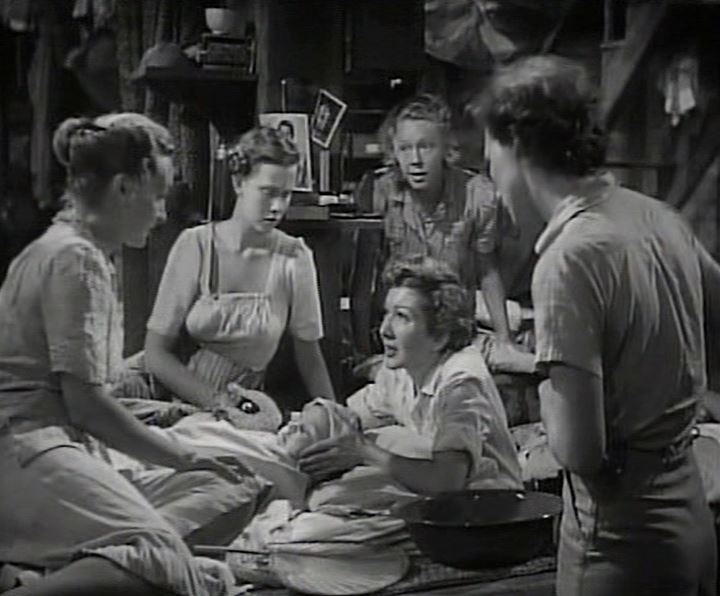
Three Came Home (1950) is notable
for its presentation of courageous women struggling to survive in a Japanese
prison camp during World War II, and for its presentation of their captors in a
way that is not a racist caricature.
Both are a big accomplishment for Hollywood at the time.
Claudette Colbert
stars as Agnes Newton Keith, on whose memoir, Three Came Home, the movie
is based. Miss Colbert had long since been a giant in Hollywood, whose ability
to play drama or comedy was equal and impeccable. This movie benefitted especially
from another quality she displayed which was more subtle: a kind of impression
of being unassuming. Another actress might have played this role chewing the
palm tree and barbed wire scenery, but Colbert moves from one incredible
situation to the next like a person who at once has no idea how she got here,
but is intellectually open to every experience. As such, she is our stand-in.
Agnes Newton Keith,
an American, is the wife of a British official, the Conservator of Forests and
Director of Agriculture, in Borneo. Agnes herself is a writer, having authored
a book on her experiences as a Yank in Borneo. She is the only American among a
colony of Dutch and English government workers and their families.It is a world of wearing tropical whites and delegating
labor to native servants. War breaks out, and the Japanese Army reaches them
far sooner than they’d imagined.
Patric Knowles plays
Colbert’s husband, and little Mark Keuning plays their son. He was about six
when he did this role, and played in only one other movie, in the same
year.When it appears the Japanese are
on their way, Mr. Knowles encourages his wife to take their son and leave for her
home country, the U.S., but she wants to stay.We listen to the bombing of Pearl Harbor on the radio, and a month later,
everyone in their small community is taken prisoner.
Sessue Hayakawa,
whose film career dates back to the ‘teens when he was a matinee idol in silent
movies, appears as Colonel Suga, who will figure prominently as Colbert’s
counterpart in the story. Hayakawa has read her book on Borneo, and he is very
impressed with her, “You were very sympathetic with Orientals,” he remarks, “It’s
not usual, you know.”We have the suggestion that racism is a subplot to the story.
Mr. Hayakawa’s
character studied in the United States as a young man, and he and Colbert
reminisce about their college years.It
is one of those moments where Colbert’s quality of being unassuming makes the scene
almost otherworldly for her being able to take in his surprising words and gentlemanly
behavior (he lights her cigarette) while being scared to death at the soldiers with
their bayonets about to herd them into a concentration camp.
The Japanese
soldiers are present everywhere, some are stony-faced and stoic, some are
cruel, some are bumbling, but all are human. That is one of the achievements of
this movie, made only five years after the war ended.Agnes Keith in her book was clear that she felt
barbarism was to be found not in people, but in war, and the movie seems to
have followed the spirit of her book.
The other aspect
of Keith’s book well replicated in the film, as Colbert remarks, “Life was
reduced to one simple, stubborn purpose – to keep alive.”
They are brought
on trucks down the jungle island to a camp where they spend nine months, the
women and children separated from the men.The men’s camp is nearby and they sometimes catch glimpses of them out
in forced labor parties or are left notes. There is a harrowing scene where Colbert sneaks
out at night to meet her husband in the bush, while she is weak with fever, having not seen him for five months.
There are scant
rations, working in rice paddies, beatings.Colbert clings to her son and cuddles him.Her friend Betty, played by Florence Desmond,
sneaks her food from the garbage. There
is more in the book about the Dutch and English communities and the sometimes
rancor between them, but the movie flows along quickly and with dramatic
visuals of the muddy camps in the rain, of a group of British women singing “God
Save the King” in their bunks at night while Colbert and her son, giggling, substitute
the words for “My Country, ‘Tis of Thee,” of the threat of death always
present.
They are moved to
a new camp where they will spend the rest of the war, and will not be near the men anymore. They are allowed a distant goodbye
with a ditch between them, barely allowed to touch their fingers if they can reach
far enough.
The commander at
the new camp, Lt. Nekata, is played by Howard Chuman. He is sadistic.One night, Claudette Colbert is outside the
hut retrieving laundry when a guard tries to rape her.She reports the incident to Mr. Chuman, who
wants her to sign a confession that nothing happened and that she lied.She refuses, and Chuman has one of his men
beat her.The scene is about to
be repeated the next day, when Sessue Hayakawa shows up unexpectedly, is
delighted to see her, and he seems like a hero because we know she will be safe if he is near.
Though he is obviously
strict and authoritarian, he behaves kindly to the children in the camp, and insists Colbert sign a copy of her book to him.Toward the end of the war, in August 1945,
they know that Allies will eventually arrive.Hayakawa is stunned, almost somnambulant, but not because the Japanese
have lost the war and he will likely face retribution; it is because, as he confesses
to her, his family have all died at Hiroshima.He says of his three kids, “Three of the dearest children you ever saw.”
Later, while watching Colbert’s son and
some other kids playing in his garden and eating fruit he gives them, he will
break down and sob.
A month later, in
September, 1945, they are liberated, with a long scene of reuniting with the
men prisoners that is more suspenseful than jubilant as we discover some of the
women will not see their husbands again. Colbert at last spots her husband,
stumbling down the dirt road on crutches.
The film was
directed by Jean Negulesco with a smooth, rather quick pace and many dramatic
visuals, but one aspect to the book was left out of the movie.It is not dramatic, but it is important to
the character Colbert plays.Agnes Keith
made secret notes and left them on bits of paper stuffed into cans, buried in
the camp, sewed into her son’s teddy bear, hidden all over, and when she was
liberated, she made stubbornly certain that she was not going to leave this
part of her behind.She was a
writer.She scrounged up all her
notes and took them with her, and they eventually became her book.
The story of women
in a Japanese concentration camp is reminiscent of our look here at A Town
Like Alice (1956), which took place on the Malay peninsula.Nevil Shute’s novel was based on stories of
women’s real-life experiences as prisoners of war, but because he was a
novelist, that story made more of a full arc in the telling.Agnes Keith’s memoir was nonfiction, so it
was detailed and precise, and less concerned with dramatic arcs, more concerned
with chronicling a record. Nunnally Johnson’s script is necessarily episodic.The movie does not tell us, as the book does,
that Colonel Suga committed suicide in his Allied cell by cutting his throat on
the day Agnes Keith, her husband, and son, left for the United States.
Claudette Colbert,
despite her reputation for crisp, aristocratic elegance, had an everywoman
quality that lent itself to her achieving a full spectrum of strong women’s
roles during World War II: A nurse on Bataan here in So Proudly We Hail!
(1943), a wife and mother keeping the homes fires burning—and eventually going
to work as a Rosie the Riveter here in Since You Went Away (1944), and in
this film, certainly an impressive trilogy.
The Shocking Miss
Pilgrim
(1947) is an affectionate spoof of a suffragette (or suffragist, as they
actually called themselves) and her mission to become independent and
self-supporting as a first step to gaining the right to vote, which, as we
know, was a long way off. We celebrate
the 100th anniversary of the 19th Amendment this week,
which gave women the right to vote in all federal and state elections. It was not “universal.” The poll tax and civil rights abuses kept
women (and men) of color, and Native Americans, from voting in certain parts of
the country until the late 1950s and finally, until the Voting Rights Act of
1965, which prohibited discrimination in registering to vote and being able to
vote.
The real story of
the fight for women to achieve full voting rights in this country, which took
several generations, is a frustrating and often harrowing, even horrific,
series of events. Recently, PBS tackled the subject in an excellent two-part
documentary, “The Vote,” as part of its American Experienceseries. Have a look at the clips on the website, and
don’t miss the chance of watching it the next time you see it scheduled on your
local PBS station. It is a well-told examination of the truly dramatic and inspirational
fight that women endured to gain this most basic right of citizenship.
The Shocking Miss
Pilgrim,
obviously, does not tell the story of women’s suffrage in all its fullness, or grim
realities. To give it its due, it does
show strong, intelligent women bucking the powers that be to gain respect
(which, without civil rights, no respect would be required), and it shows the
men to be grudging, but ultimately won over by the ladies’ perseverance. And charm. That, it seems, would always be a
necessary element. Hollywood was certainly frank about that.
Classic films were
not dismissive of the 19th Amendment, but on the few occasions Hollywood
tackled the subject, it was always in this quaint, stereopticon view of The
Good Old Days and my, wasn’t Grandma spunky?
We covered The Strawberry Blonde (1941) here, which showed Olivia
de Havilland’s suffragette as a foil and a mere subplot to James Cagney’s
aspiring dentist dealing with legal issues who didn’t get the girl of his
dreams. Again, the story is quaint and affectionate, down to the singalong
ending. The suffragette theme is mere
window dressing.
When it comes to
this cozy view of the fight to gain suffrage, I think my favorite example is
from Mary Poppins (1964), where Glynis Johns sings with ladylike gusto, “Well
done, Sister Suffragettes!” My favorite
line, delivered with gentle sincerity: “Though we adore men individually, we
agree that as a group – they’re rather stooopid.”
Her jubilant,
sunny, marching rant in the foyer of her home is turned into a party when the
servants, Reta Shaw and Hermione Baddeley join in, dragging into the chorus the
reluctant Elsa Lanchester (the children’s nanny who is about to quit, thereby creating
a job opening for the new nanny, Mary Poppins).
The background to Glynis
Johns’ suffragette activities is sketched out for us by her husband, played by
David Tomlinson, who sings with self-satisfaction, “King Edward’s on the
throne; it’s the age of men!” He is
lordly, and therefore is somewhat clownish, but his wife is equally clownish, hiding
her activities from him, stuffing her sash in a closet before he comes home. “You
know how the cause infuriates Mr. Banks.”
At the end of the movie, she will give up her sash to make a tail for
her son’s kite.
Interestingly, the
magical, yet no-nonsense Mary Poppins is the ultimate feminist in the movie –
independent, self-assured, not taking orders.But she is humanized for us by being vain in a typically feminine
manner.
It is 1910 in Mary
Poppins, but The Shocking Miss Pilgrim takes us back to 1874. Female independence from men is tied to, for
me, a beloved object—the typewriter. Betty
Grable stars as Miss Cynthia Pilgrim, a new graduate of a business school in New
York which has admitted women for the first time. She and the other female students are admonished
at the beginning of their course of study: “Until now, the business world has been
a man’s world. If you fail, it will remain so!”
That’s quite a
burden on their shoulders, but they are courageous pioneers, and Betty becomes
the class champion at typing. The
students are referred to prospective employers (in an immediate job placement
program that might be enviable for any college student today) and Betty draws a shipping company in Boston
run by Dick Haymes.
Mr. Haymes runs
his family firm, which is actually owned by his suffragette aunt, played by
Anne Revere. Haymes, however, thinks
that women do not belong in the workplace and is surprised when Miss Grable shows
up for work, as he thought he would be sent a male typewriter (or typist, when the
person doing the work was finally viewed as separate from the machine).
Another person in
the all-male office who disdains women in the workplace is Gene Lockhart, who
plays the office manager. The guys at
first mock her, but her moxie, and her good-natured ability to take kidding endears
her to them. They put on their suit coats
in a gentlemanly effort to not show her disrespect by working in the same room
with her in their shirtsleeves. Ah, me,
but such niceties are lost to us today.
All are fascinated
by her clatter on the typewriter, which was introduced in this same year of
1874 to commercial offices, though it would be a long time before they became common
in workplaces or even had a standard keyboard.
Though Betty was the class champ in typing,
we can see she does not know how to touch-type.
She does the old hunt-and-peck with two fingers. Actually, the touch-typing system was not invented until 1888, so this is not an error.
You will notice also that her typewriter appears to be operated with a foot treadle; this is because the first typewriters put out this year of 1874 were mounted on sewing machine stands and the foot treadle operated the carriage return. They typed only in capital letters. So all your business correspondence would be screaming.
Betty takes a room
at one of the few lodging houses in Boston that accepts women office workers,
who are shunned as undesirables, women of probably questionable virtue. Like actresses.
Elizabeth
Patterson is her kindly landlady who takes her in and who belligerently accepts
all outcasts from Boston society, including artists and writers. Gad! Arthur
Shields and Allyn Joslyn are two of her vagabond lodgers, and together they
make up a happy family.
Anne Revere recruits
Betty into the local suffrage movement and Betty makes a hit making speeches.
She drags the reluctant Dick Haymes along, and we have our obligatory, if
clunky, romance budding between them. Dick introduces Betty to his mother, a
high society lady played by Elisabeth Risdon, who is also a closet suffragette
and who will, at the end of the film, buy her own typewriter. I love the line when Betty, who is surprised
to discover the great lady is a kindred spirit, is answered by Miss Risdon, “You
expected to find a witch burner.” This,
of course, a nod to a period in Massachusetts history when intolerance, as it
will, brought ghastly tragedy. (It’s a common
euphemism, of course. Nobody was burned in
Salem for witchcraft; nineteen were hung, one was pressed to death, and others
died in jail. Burning at the stake in Europe,
of course, was another matter.)
As long as we’re being
sticklers on accuracy on my home state, I’d like to congratulate those
responsible for this film for the correct pronunciation of “Peabody.” Hereabouts, it is not pea-body. It’s PEAbudee. One of the men in the office, Mr. Peabody, who presents her flowers, corrects Betty on her pronunciation.
Like Glynis Johns,
Betty Grable dons her “Votes for Women” sash and heads out for another rally. True love does not run smooth, especially
when the ardent young man thinks suffragettes are frustrated old maids. But Betty
is sensible, not flighty or shrewish. She thinks women should gain equality by entering many careers, rather than just protesting. When he tries to replace her with male secretaries, he finds them
lacking in…uh, charm. Finally reverting
back to female secretaries, he finds them plain, unattractive, and none suit
him. He goes to the Boston Academy of
Typewriting for a new graduate. Our old
friend Mary Field is the receptionist who refers him to the manager—Betty Grable. Ah, Dick Haymes sees the light. It is implied, rather than stated, that he
has come around to the idea that women are just as capable in business as are
men. Will they marry? Will she give up
her job if she does marry him?
How old will she
be when she finally gets to vote in 1920?
Many social issues
were covered across a broad spectrum in films from the 1920s through the 1950s,
yet women’s suffrage was not really addressed except in parody.
There is a line in
the “Sister Suffragette” song from Mary Poppins that Glynis Johns sings:
“Our daughters’ daughters will adore us, and they’ll sing in grateful chorus, ‘Well
done, sister suffragette!’”
Hollywood has
never really said, “Well done,” or given them their due, and perhaps even
today, neither have we. Watch the PBS
documentary. Then go vote, each and
every election you can. It took a lot of sacrifice and fighting to get that
right. If circumstances arising from the
pandemic makes it more difficult for you to vote, or the current traitorous administration of criminals tries to stop you,
then move heaven and earth to do it.
Ann Blyth: Actress. Singer. Star., my book on the career of multitalented actress Ann Blyth is on SALE until Monday, August 17th (in celebration of Ann Blyth's 92nd birthday on August 16th). The eBook is reduced to $4.99 (regularly priced at $9.99), and the print book is reduced to $19.99 (regularly priced at $25.00)
Multitalented and remarkably versatile, Blyth began on radio as a child, appeared on Broadway at the age of twelve in Lillian Hellman's WATCH ON THE RHINE, and enjoyed a long and diverse career in films, theatre, television, and concerts. A sensitive dramatic actress, the youngest at the time to be nominated for her role in MILDRED PIERCE (1945), she also displayed a gift for comedy, and was especially endeared to fans for her expressive and exquisite lyric soprano, which was showcased in many film and stage musicals.
The incomparable Olivia de Havilland has exited this world after celebrating her 104th birthday, leaving us breathless, as usual, with the sum total of her talent, her elegance, her grace, and an unusual quality of self-knowing. Among her films we've discussed here are The Heiress (1949), for which she won one of her two Oscars and was made in the period where she did her strongest work; The Strawberry Blonde (1941), one of her last pretty young ingenue roles before her court fight with Warner Bros. resulting in her win and "the de Havilland decision"; and A Midsummer Night's Dream (1935), a lovely example of her early work, so mature, which brought her to Hollywood as a teenager.
Of all the greats we've lost this year, her career stretches farthest back to the Golden Age of Hollywood. Sometimes interviewers ask stars if they watch their old movies, but I wonder if someone like Olivia de Havilland, who had retired happily to France many years ago, only dabbling in TV in the final years of her career, watched any classic films at all -- and especially, did she enjoy recalling former colleagues in the industry. For someone who has lived more than a century, one outlives almost all relationships. Someone in the entertainment business has many more people passing through their lives than most of us do in our occupations. We may number our working acquaintances in the tens; someone like Olivia must have known hundreds. Did she ever watch a film and smile at being reminded of someone she knew?
For all her class and elegance, I like to think of her humor and this clip from Thank Your Lucky Stars (1943) doing a jitterbug parody with Ida Lupino, and George Tobias, who despite being a character player (usually of simpletons), gets the starring role of squiring the two hepcats.
More on Castle Films this week...and an interesting variation. Midget Car Maniacs (1947), a short subject comedy starring Bud Abbott and Lou Costello, could be purchased on 16mm or 8mm by Castle Films for your home viewing pleasure on the projector you kept on the shelf in the living room closet. It was, I believe, pieced together at least in part from discarded sequences from another film or films. You'll recognize some old friends in the cast: Nat Pendleton, Don Beddoe, Milburn Stone, and others. The Castle Films version is silent, shown with titles. There was also a sound version for the theaters, and eventually, television. You can see both versions on YouTube.
As this ad from 1941 reminds us, long before there was the VHS cassette, serious film fans had those 16-mm reels of "6 great cartoons to select from"..."each a great thrill on your own screen!" So get out your projector, put up that screen, and make the popcorn. "Let's movie," as they say on TCM.
Carl Reiner will be remembered for his long career and incredible talent, for being a mensch, for being a pioneer of early television. For just a moment, let's remember a scene from those early years and the man who came into our living rooms as a friend we loved and looked forward to seeing. Here from the fantastic Your Show of Shows, he provides support to Sid Caesar in one of the funniest sketches ever performed on television. How fitting that it is also a parody of television. From April 3, 1954...
Dame Vera Lynn (2017-2020) has died at 103 years old, but longevity in a challenging world is only one of her accomplishments. She was still topping the charts in her nineties and past 100 with her exquisite voice. Beloved in the United Kingdom for her lovely renditions of "We'll Meet Again," "The White Cliffs of Dover," and "A Nightingale Sang in Berkeley Square," among others, she performed on radio and for the troops during World War II. Such was her popularity that in 2009 she was named the Briton who best exemplified the twentieth century. That's quite a label. The sentiment, the patriotism, the pluck, and heartbreaking sweetness of the songs she sang and her impeccable renditions of them perhaps expressed humanity's indomitability in a dark time. May her voice and those lovely songs echo in our cultural memory for a long time to come.
When
I think of movies that are most comforting to me in times of turmoil, I think of
World War II-era “home front” films. They are not rollicking comedies or
fantasy-inspired musicals that serve to take one’s mind off troubles in a way
that completely removes the viewer from the present real-life world; however, to
me they are deeply comforting.
This
is our entry in the Classic Movie Blog Association blogathon: Classics for
Comfort. For more on the posts of other
great movie blogs, have
a look here at the roster. The task
is to pick five films to soothe and comfort in these challenging days of the
COVID-19 quarantine.
What
appeals to me in terms of messages of comfort is that each of these films deals
with problems that are realistic, the audiences could identify with the
problems even if they did not experience each one, and the solutions to the
problems did not require luck or a deus ex machina device. The “happy
ending” was one usually not of triumph or gleeful surprise, but of humble hope.
The heroes were everyday people who displayed moral courage, were tested, and
came through by the strength of their character.
In Mrs. Miniver, covered in this post, the enemy was foreign fascism and the Nazi
threat during the Battle of Britain. Keeping Calm and Carrying On was only one
aspect of bravery displayed in this movie. There are so many charming touches that
are like love letters to the world they were leaving behind but hoped to
preserve.
The Best Years of Our Lives, covered here in this post, shows what happened to
the weary conquerors of fascism when they straggled back home to a now
unfamiliar homeland and the anxious and equally weary people who were waiting
for them.
Though
I imagine many film fans prefer those rollicking comedies and fantasy musicals as
a way to relieve tension, I find those movies more appealing when I am in a
lighter mood to begin with and not thinking of troubles. It takes a certain toughness for Buster Keaton
to avoid those oncoming trains and falling houses, and for Laurel and Hardy to
execute even the simplest of tasks. I
need to be in a tough frame of mind just to endure their failures. It takes a sharp wit to appreciate the mental
agility of the screwball comedies with their verbal fireworks: the Marx
Brothers, Hildy Johnson, and Carole Lombard and her butler all require one to
be on the top of her game to keep up with them.
The
musicals are pretty, frothy, and certainly escapist, but when I am pondering
the troubles of the world, I find it unsatisfying for the girl to discover the
bus boy she loves is really a millionaire.
I enjoy musicals, but more so when my troubles can be solved easily.
It
is the home front dramas that appeal for their down-to-earth messages of
decency, courage, and hope that bring me through the worst of times. But for those who crave pure escapism, these films
are also, according to today’s gritty standards, escapist. All of these movies show a society that though
is in some respects, fractured, nevertheless the decent people who survive
their struggles in the end represent the best of our society as it was. The bad people were the fascists, the Nazis,
and the people who admired them. The bad
people were the hoarders, the selfish, the crass, the foolish, the ones who
were willing to sell out American democratic ideals for personal gain. The bad
people were depicted as repugnant, and the message of country and fellow citizen
over self was accepted by audiences. Is
this not escapist? Obviously, the times
in which we live now in the United States would not have ever been tolerated by
the World War II-era audiences. The
times in which we live now, where childish fools refuse to wear a mask to
protect others; where childish fascist thugs threaten the public with military
assault rifles and parade through someone’s hometown streets, and government buildings,
without being arrested; and a fascist in the White House backed by his controlled Senate would have been the greatest fear of The Greatest
Generation.
So
I watch the home front movies, and I am soothed and comforted in a fantasy world
of wholesome, homespun courage and grace, and remember a time when patriotism
meant sacrifice – like the sacrifice of medical personnel and essential workers
today – and hope for a better day.