IMPRISON TRAITOR, PEDOPHILE, AND CONVICTED FELON TRUMP.
Showing posts with label Edna May Oliver. Show all posts

Thursday, January 10, 2019

Ten Classic Film Actors and Actresses from Your State


Dear Edna May Oliver, a formidable talent, and clearly fearless and unrepentant in her poses, is one of my favorite Massachusetts girls.

How about a game to start off the new year?  Name any 10 actors and actress from your state (or country, or Canadian province as the case may be).  Either list them in the comments below, or post them to your own blogs and come back and give me the link to your post so I can share it here.

I'm from Massachusetts, so here's my picks from my home state:

Edna May Oliver
Bette Davis
Eleanor Powell
Thelma Todd
Agnes Moorehead
Charles Bickford
Wendell Corey
Charles Farrell
Jack Lemmon
Lewis Stone

*******************
Here's a roster from New Jersey over at Kate Gabrielle's place. 

A team of greats from Missouri over at Terence's A Shroud of Thoughts blog.

Here at Hamlette's Soliloquy you'll find a top-notch gang from Iowa.

Update:  So far we have...
Massachusetts
New Jersey
West Virginia
Georgia
New York
(and specifically, Queens, and NYC)
Ontario, Canada
Kansas
Missouri
Alaska
Iowa

So far that's 9 U.S. states, and 1 Canadian province.  Keep them coming!


Thursday, March 29, 2012

Murder on the Blackboard - 1934


“Murder on the Blackboard” (1934) keeps the teachers after school to find the killer when one of the staff is murdered. This is the second appearance of the superb Edna May Oliver as amateur sleuth and full-time teacher Hildegarde Withers. James Gleason is back as her foil and friend, Inspector Oscar Piper. They first teamed up for “Penguin Pool Murder” (1932), and would be back again for “Murder on a Honeymoon” (1935). Later entries in the series would feature Helen Broderick and Zasu Pitts in the role.


Caricatured by Hollywood cartoons for her weak chin and long face, but never as expertly as when she caricatured herself in every patented facial flinch and body English, Miss Oliver was perfectly cast in this role, bringing humor and depth, as she always did whatever part she played. One gets the sense she never considered any line a throw-away. Everything, like a good vaudevillian, was milked, every opportunity in script, in props, in gestures, was used to her advantage.

In this story, a young woman who was a fellow teacher is murdered in her New York school, and the cast of suspects includes two other teachers played by the ruggedly handsome Bruce Cabot, and by Gertrude Michael. They are in love, and secretly planning to marry. When Miss Michael is questioned, Mr. Cabot heroically comes to her defense. Miss Oliver responds,

“I like you for that, young man, but the police, though they may be fools, are not sentimental fools.”

She gets the best lines, and as usual in these stories, the cops are not as good at detective work as she is. A young Regis Toomey is James Gleason’s assistant. Gleason, though sometimes two steps behind Edna May, is no fool, and the repartee between them is funny, argumentative, and even awkwardly flirtatious. They are meant for each other.

One comic bit between them: He is about to help her through a trap door, and standing behind her, he grasps her underarms. She whoops and wiggles like a girl being fondled under the bleachers and remarks, “Oscar, this is no time for fooling.”

Annoyed at her misinterpretation, he drops her through the trap door like a sack of cement.

Gleason’s detective style is a bit more direct than Miss Oliver’s. He tells the principal, “Do you talk, or do I let the boys go to work on you?”

The smarmy principal, played by Tully Marshall, who chased the murder victim behind his wife’s back, is also under suspicion; as is the sloppy drunk janitor.

The title comes from a set of musical notes written on the blackboard by the murder victim, who taught music. One of the funny elements to the movie is that Edna May whistles the short series of notes to everyone she meets to try to judge their reaction and determine their guilt. They all look at her as if she is loony.

She sometimes comes off that way even to Gleason, who we see has great respect for her abilities. When they are in the hospital room of an injured police detective, the coroner, played by Gustav von Seyffertitz (who I have to mention just because I love his name so much) -- in the striking combination of wing collar and laboratory apron -- bows low and kisses Miss Oliver’s hand with European courtesy. They animatedly begin to discuss the details of the murder victim’s autopsy. The squeamish wounded policeman protests, and Gleason responds, “What do you care? You’re lucky they’re not both in bed with you.”

It is a movie that starts slow, but picks up with several excursions from the upper floors of classrooms to the cellar, where Edna May’s fluttering hands and occasional nervous nipping at from whatever bottle comes her way tell us that she is not yet hardened to this police work. However, when she knows the answer, she victoriously shouts “Eureka! I’ve got it!”

It’s a quick and neat little mystery, but the real charm is Edna May Oliver and James Gleason, most especially because they look like they’re having fun.

Thursday, July 2, 2009

Drums Along the Mohawk - 1939


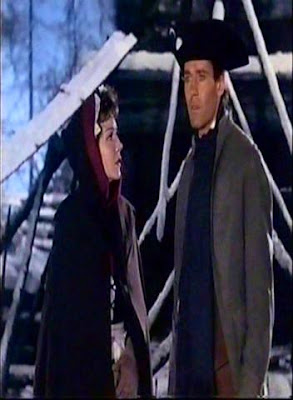
“Drums Along the Mohawk” (1939) leads us into our weekend celebrations of Independence Day, and is one of the few movies of Hollywood’s heyday to deal with the American Revolution. Surprisingly so, since one would expect that the intrigue and drama of the era, not to say the very patriotism of the theme, would lend itself to films of the day. Perhaps the studios perceived the subject was too remote, too far past to be appealing to modern audiences, the people and manners too colorless. Director John Ford’s vibrant movie does much to dispel the ideal that the forefathers were saintly heroes and the Revolution a foregone conclusion.

This early Technicolor film is beautifully shot, and the muted pastel tones are much more realistic and pleasing to look at than the garish “red shirt photography” of the 1940s musicals that would follow. The score is peppered with 18th century fife and drum music, and country fiddle tunes (and a liberal smattering of “In an English Country Garden” to designate the gentility of Claudette Colbert’s refined family heritage).

Henry Fonda and Claudette Colbert are frontier newlyweds when the frontier was still in New York. Fonda looks good in knee breeches and always looks authentic in period settings, no matter what the period. Claudette Colbert, even more like a porcelain doll in this rough setting of log cabin, appears as she always does; a loveliness of no certain age, but perhaps a bit too glamorous.

The movie is stolen outright by Edna May Oliver, who received an Oscar nomination for her role as the feisty widow who the young newlyweds come to work for as servants when the Indians burn their own homestead and crops to the ground.

The story is comprised of events, rather than a linear beginning, middle and conclusion. The frontier settlement, always battling the Indians, gets word of the colonists’ revolt against the English king. They think it’s a swell idea, and drill in ragtag formation, ready to fire upon any redcoats, but the British domination of North America in this movie is just John Carradine as a menacing Tory leading bands of Indians in waves against the township’s lonely fort.

Miss Colbert, the daughter of a fine family, must adjust to the roughhewn ways of her new neighbors and her new life. She and Fonda suffer privations and tragedies. Their bond, as actually occurred with many frontier couples, is strengthened from necessity of self reliance as much as from being in love.


There are humorous moments in the film, such as when the minister, Arthur Shields, half prays for and half reprimands a local girl for keeping company with a New Englander, “he’s a Massachusetts man, Lord, and Thou knowest no good can come of that.” He also prays for a man with the flux “real bad” and gives a commercial for a local merchant. And when he announces that the militia be formed, “Every man failing to report for duty will be promptly hanged. Amen.”

Ward Bond, another Ford regular, is the lusty, barrel-chested, booming-voiced bachelor who teases Edna May Oliver, and she gives it right back to him. John Ford always seemed to have given as much attention to the character actors as to the stars, which may be why they are so memorable in his films. At one point Bond, some 20 years her junior, playfully plants a kiss on a surprised Miss Oliver that, in its ferocity and very length is probably one of the most passionate kisses on the silver screen. I half expect that if the couple were Fonda and Colbert, the Code would not have allowed the kiss to last that long, but because the characters are supposed to be comic, Ford, and Bond and Oliver, get away with it.

But Edna May Oliver is more than just comic foil in this movie. She gets a chance to display her considerable dramatic talents, and the inherent drama in her each slight movement provides depth and texture to her role. Sometimes the ability to make a moment seem both comic and dramatic at the same time is like laying a perfect bunt down the third base line. It’s a thing of tantalizing beauty when it works.

Miss Oliver does this in such scenes as when Fonda is about to join a column of troops passing by her stone cottage, and she bids him goodbye first so that he can spend another few moments with his wife.

“I’m going to kiss you, so I better do it now so’s you won’t go off with the taste of a widow on your mouth.” Afterward, she comes indoors to keep from watching the men march away, reminded of her late husband, “Sometimes he’d wave…ten to one he didn’t even see me.” Her voice drops wearily, and the comic moment becomes tension-filled, and then simply philosophical.

Another moment finds both Colbert and Oliver on a porch at night, waiting for news of the battle. Colbert paces, finally is persuaded to sit on the step of the porch as Oliver, planted in a chair behind her, flaps a palmetto fan at mosquitoes. The contrast between the two actresses is interesting. Colbert is still, like a pristine statue, looking dreamily off. Miss Oliver hunches forward, her legs spread apart under her long skirts, resting her elbows on her knees, her chin on her hand in a brooding manner much less lady-like. She uses her whole body. Miss Oliver is living her role, while Miss Colbert is seems merely posed for the camera.

But the comedy is never too deeply buried, and bubbles up in Miss Oliver like a stream, as when the tobacco-chewing frontiersman comes to her door and tells her all families must flee to the fort. It’s a tense moment, but seeing he needs to spit his tobacco juice, Edna gets irritably practical,

“Go on and spit, man! Spit and get it over with!” She shoves him out the door so he can do so outside, and then mutters, trying to conceal her alarm about the approaching enemy, “Fool. He can’t even spit by himself.” In her crusty way, she is sensitive to life where Colbert is only hypersensitive to sounds and smells, and possible danger.

When Fonda and the troops march off in the distance, Colbert watches in the foreground, her back to us, from the rise of a sunny meadow. It’s a scene repeated in other Ford films like “She Wore a Yellow Ribbon” and “Fort Apache”, and “My Darling Clementine.”

The film turns from a study of frontier life to an action flick. Fonda, dragged from the rain and the mud, babbles to himself as he describes the gore of battle while Colbert tries to stop his bleeding and tries not to listen to him. It is her best scene where, distracted from posing, she appears most natural.

A man, sent to get help, is captured and tortured, and the horrified minister shoots him to keep him from suffering when the Indians burn him to death. Fonda is sent next to get help, and the women huddled in the fort don men’s uniforms to make the enemy think the fort is well defended by soldiers. This has precedence in many instances during the Revolution and in the French and Indian War when women took on a soldier’s role, sometimes donning soldier’s uniforms.

Even Daisy, Miss Oliver’s black house servant, dons a uniform and loads muskets. Edna May fires her gun, and takes an arrow in the chest, takes it like a man.

One wonders if the Indians were surprised that the “soldiers” were still wearing their frilly day caps underneath their tricorn hats.

The Indians depicted here are all “savages” except one; that is the character called Blue Back, played by Chief John Big Tree. He is a Christian convert, what were once called “praying Indians”, and so is friendly to the settlers. One could excuse Ford’s making the enemy Indians “savages” and the “good Indian” as the one who befriends the settlers, because that is how English-speaking settlers in the 18th century would have viewed the matter themselves. The year 1939, when this film was made, was too early for the revisionist history that attempts to make modern films on historical subjects less bigoted, if perhaps also sometimes less accurate in depicting the true (if sometimes repugnant) feelings of our ancestors.


However, Blue Back could have been a stronger, more well-rounded character, and Ford might have shown the immense conflict of what it must have been to have his feet planted in two different worlds. Unfortunately, Blue Back is little more than a clown who hollers “Hallelujah” at unexpected moments. Ironically, as a member of the Seneca nation, Chief John Big Tree is probably the most authentic link to the locale of the film.

The film ends with the fort being saved and the news that the British surrendered. That means the British lost the war. What they do not know, and the colonists all might have wondered for at least another generation, was who won the war? Who were the Americans?

John Ford brings the film to a rousing close with the strains of “My Country ‘Tis of Thee” (which since those lyrics had not been written yet, was still “God Save the King”, an odd choice), and the camera pans on the Americans of this frontier outpost admiring the raising of their new American flag atop the church steeple. Separation of church and state hadn’t been invented yet.

The camera lingers on, among others, the smiling face of Daisy, the African-American servant of Edna May Oliver, played by Beulah Hall Jones (in the last of only a few films she made). Daisy could have been a freewoman, but at this time it is more likely she was a slave. Her expression of breathless hope and satisfaction looking at the new flag is quite surprisingly moving. The camera lingers on Chief John Big Tree, also admiring the flag. Is it Ford’s way of showing we’re all happy Americans now, or Ford’s subtle irony that “freedom” and “equality” would have to wait for some people? Flawed, and diverse, if not equal, they all take in the moment to celebrate the new nation.

I hope you can take a moment this weekend to celebrate it, too. By the way, among the flags that finale color guard is holding appears to be the flag of New England (see this post from my New England Travels blog). Apparently, the reverend’s warning against consorting with New Englanders (or perhaps only Massachusetts men) was suspended for the moment.

Monday, June 25, 2007

Pride and Prejudice (1940)

If you can stomach the ladies’ costumes, it’s not a bad movie. “Pride and Prejudice” (1940) has all the elements of a delightful film including a well-known and beloved story by Jane Austen, two superb stars at the top of their game, and some of the best character actors of the day. Only a restoration of parts of the story line to Austen’s original intent, and the correct period costumes are all that is needed to make this an excellent adaptation.

Greer Garson and Sir Laurence Olivier are the iconic Elizabeth Bennett and Mr. Darcy, and their stagecraft and chemistry are evident. Ms. Garson’s twinkling eyes and slightly nose scrunching smile are charming, and her attentiveness to the other actors bears a history of ensemble work on stage. She is feisty, he is haughty, so far so good. Mary Boland and Edmund Gwenn are spot-on as Mr. and Mrs. Bennett, and Edna May Oliver as Lady Catherine is marvelous. Edna May Oliver as anything is generally a hoot. No actress could make pomposity as endearing as she.

In Marsha Hunt we have one of the funniest Mary Bennetts on screen, with her broad, almost campy playing of the unattractive and dull sister, particularly in her too-eager reaction when her mother admonishes her to smile at a party. The sour note she hits in her performance of “Flow Gently, Sweet Afton” is priceless.

In Mary, and in several aspects of the film we have a slapstick element being thrown in, and a tweaking of Austen’s verbiage to relate to a modern audience, as when Edmund Gwenn saves the Bennetts from looking more ridiculous by stopping Mary from performing another selection. Instead of insisting to his daughter that the other young ladies must have a chance to exhibit, he says, “Give the other young ladies a chance to make exhibitions of themselves.”

Frieda Inescort plays a suitably frosty Caroline Bingley, and she is perhaps the most recognizable element of the novel. Austen’s “Pride and Prejudice,” not surprisingly, undergoes some alteration in the interests of time, pacing, and translation to a modern audience in this film. Austen’s subtle wit is stretched to slapstick at points, and her wry observations on society are poured through a Hollywood sieve to make them commercial and relevant to what the executives felt audiences would understand and accept. The story becomes a kind of Cinderella story, with Lady Catherine playing matchmaker. Austen’s story was really more a parody of fairy tale romance, but evidently the studio felt this might not play in Peoria.

Interestingly, the aspect of five unmarried daughters desperately in search of husbands does not undergo any necessary explanation in this 1940 film, at least in the same way it does in the 2005 film starring Keira Knightley. This latest version of the story famously departed from the Regency period (more costume issues) and, according to some critics, “dumbed down” if you will, Austen’s narrative to explain a world which no longer exists to modern audiences, (younger audiences). The 1940 version was filmed in an era where the getting of a husband was still considered a career move for young ladies, and so required no explanation.

Inevitably both versions, any version of “Pride and Prejudice” is compared to the fine 1995 BBC film, which had the luxury of telling the story over several episodes, which is what such an intricate plot takes. In attempting to tell the story in under two hours, much is whittled out by necessity, and there are times when the 1940 version feels less like the novel and more like the Cliff Notes. It is odd that with so much removed, a few extra scenes including the opening segments are entirely made up and it takes a while for us to finally get to the famous line, “Netherfield Park is let at last!”

Back to the costumes. They are garish, distracting, anachronistic, and mostly left over designs by Walter Plunkett from “Gone with the Wind.” Evidently the Empire style wasn’t flashy enough, and we end up with everything from enormously cartoonish mid-19th century bonnets to Gilded Age leg-o’-mutton sleeves. The dancing sequences (you can’t have an Austen novel without a ball), are another hodgepodge of waltzing, mazurka and other dances not performed in England of Austen’s time, though “Drink to Me Only with Thine Eyes” is lovely enough to be performed wherever and whenever.

However, if one accepts this film only as a well-meaning version of “Pride and Prejudice” and not an attempt at the definitive, it remains a charming and enjoyable film, based on a novel that will undoubtedly continue to be remade, because it is just that good.

Sponsored Link:
Pride And Prejudice [DVD](1940) DVD

Related Products