IMPRISON TRAITOR, PEDOPHILE, AND CONVICTED FELON TRUMP.
Showing posts with label Ian Wolfe. Show all posts

Thursday, February 12, 2015

Abe Lincoln in Illinois - 1940


Abe Lincoln in Illinois (1940) carries both historical insight while at the same time being remarkably and most startlingly current in its message.  Surely writer Robert E. Sherwood made no attempt to be prescient, in the same way Abraham Lincoln seemed to foresee his own doomed future, but we may take as a sad state of fact that all life is a cycle and we must continually fight the same battles every couple generations. 

We celebrate Lincoln’s Birthday today with probably the best movie ever made depicting Abraham Lincoln, both in script, and in characterization by Raymond Massey, who played this role on Broadway before Sherwood adapted his own script for the screen.  John Cromwell directs, and we are treated to a nineteenth century fairy tale land of innocence and danger, but always familiar because it is part of our American consciousness—the log cabin, the reading by firelight, the lusty backwoodsmen who “wrassle” and drink, the hoop skirts, the stovepipe hat, but stringing everything along is the message of a gentle, reluctant man, sometimes self-admitted blunderer, who is idealistic enough to expect better from his country, and pragmatic enough to know “a more perfect union” wasn’t going to happen without an awful lot of trouble, and that some in the dysfunctional family of states would have to be dragged kicking and screaming to the table.  Behind all, shaping his journey and shouldering it, are his periods of depression that threaten his nimble mind, sap his courage, and crush his soul.

We covered another Lincoln biography here when Walter Huston took the role in 1930.

Raymond Massey’s Abe Lincoln is not a schoolroom saint.  He is flawed, human, and beset by troubles that include a nagging wife, certainly the most homespun and prosaic of incidents that ride the coattails of his more Herculean crisis—that of publically standing against slavery, and of trying to keep the union together when so many preferred it to be dissolved.  He makes compromises, he allows himself to be shepherded into the political process by backroom dealers.  Our American democracy is on display here for all that is good about it and all that is shady.

Election night, with vote tabulations cast by magic lantern onto a screen, and crowds cheering everything by torchlight, with relentless tinny tapping of Morse code relaying results from across the country—which is presented by a crude map of states and territories and pins—is no less accurate and no less exciting than were it covered ad nauseam between commercials on CNN.

That Raymond Massey, for whom Abe Lincoln was his signature role, was, and probably remains the best actor to have played him, was able to convey Lincoln’s self-deprecating humor, his cleverness, his anxiety, his good nature all at once is a splendid feat of acting.  His manner of speech is a marvel and mesmerizing.  However, he was helped along by the very legacy we have of Lincoln’s personality in context of the opinions of his countrymen.  There are fewer films in which George Washington is depicted, largely because we still, I think, don’t know how to approach the father of our country.  He remains a schoolroom saint in many respects, as least for the non-historian. 

We know more about Lincoln, and he has become a flesh and blood, more down-to-earth person to us in large part probably because so much was written about him in his own day that was extremely critical.  The Confederacy, of course, considered him an enemy, up to and including the nutcase who murdered him.  John Wilkes Booth’s act was borne of cold, deep-seated hatred, political resentment, and vengeance.  Such an action is not an anomaly; it is the end result of resentment carried to the extreme.  Then—and today.

But there were many in the North who felt just as much antagonism for Lincoln, even if they did not carry their anger to such extremes.  Lincoln was dogged by critics every step of his years as President, in his own party, in his own cabinet, by some of his own generals. 

All Presidents are met with criticism while in office, especially from the opposing political party; that is normal and the sign of a healthy democracy.  But few Presidents are reviled and mocked and vilified to the extent Lincoln was.  We may add Franklin Delano Roosevelt in this category, for his programs to lift the nation out of the Great Depression were all hated by those who considered them communistic.  FDR, just as Lincoln, was considered by those who felt they had a great deal personally to lose under his administration, as dangerous anti-American radicals.

And they were two of our greatest Presidents, who brought us through two of this nation's great periods of crisis, and we know them for their flaws as well as for their great deeds.  It’s a funny kind of paradox that those who hate to the extreme shine an accusatory light not only on their intended enemy, but on themselves.  Lincoln’s detractors, including those who mocked the Gettysburg Address, are regarded as fools today, standing on the wrong side of history.  So are the factions into the early twentieth century who felt that child labor was necessary and that without it, our economy would collapse; that if women were allowed the right to vote family values would collapse; etc. and we could go on about those who fear equality for others because it might mean they would lose their own enviable position in society, or their own imagined moral superiority.

Massey delivers, in a depiction of a Lincoln-Douglas debate on a wooden platform under torchlight:
“All men are created equal except Negroes.  If we are to accept this doctrine of race or class discrimination, what is to stop us in time of decreeing all men are created equal except Negroes, foreigners, Catholics, Jews, or just poor people?”

Stephen Douglas, played here by Gene Lockhart, upholds slavery as it is decreed lawful by the Supreme Court.  We could certainly draw similarities to a Supreme Court bought by special interests today, could we not?

Lincoln further warns that we are sliding into a morass where “there is no right principle of action but self-interest.”

It is a literate script that carries us from Abe’s adventures, and misadventures, as a young man, his doomed love for Ann Rutledge, his business failures, his start as a lawyer, his troubled courtship of Mary Todd.  John Cromwell’s direction is artistic and full of feeling. We look down over the shoulders of these historical figures, we look up at them, we stand in the doorway and watch their turmoil.

A few high points:  Mr. Massey’s singing of the old campaign song for William Henry Harrison and John Tyler: “Tippecanoe and Tyler Too” and the crowd later singing the campaign song for Lincoln, “Lincoln and Liberty Too.”

Stage actress Ruth Gordon gives a strong performance as Mary Todd Lincoln.  
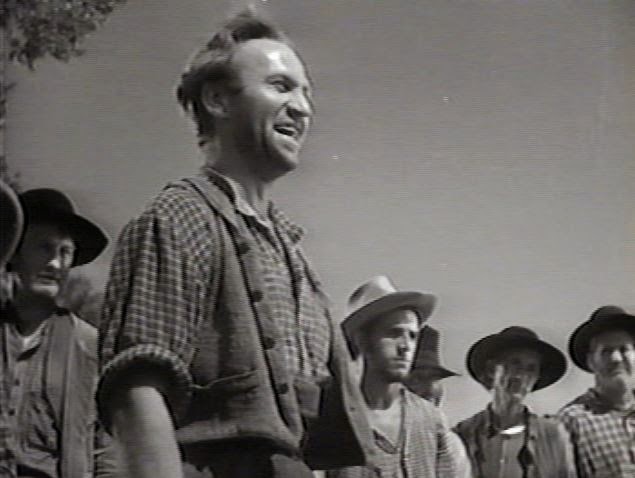
Howard Da Silva (who originated the role on Broadway) is the town bully and eventual loyal supporter of Lincoln. 

Louis Jean Heydt as Mentor Graham, who tutors Abe in the law.  Look for Ian Wolfe as newspaper editor Horace Greeley.

Alan Baxter is Billy, the young law clerk Abe takes under his wing, who, almost like Mary Todd, nags him to take up the torch of politics and defeat slavery.  An interesting minor character, he is not fawning and idealistic; he is tortured, angry, and a kind of Greek chorus.  All the minor characters who stay in Abe’s life through the film visibly age with him, and it is a poignant thing to see.

The scene where Lincoln has just won the election and Billy explains the new President’s grim attitude by reminding us that the South has threatened to secede if he won.  Now, war is inevitable, and Lincoln is walking straight into it.  Literally.  As Massey is about to leave to the room, suddenly the double doors open and a there is a uniformed guard detail: at once a sign that he is the President, that he will need security because there are already threats against his life, and also as a portent of Civil War and the soldiers over whom he will have authority as Commander in Chief.


The final scene is Cromwell’s dramatic touch, as Lincoln stands on the train platform offering a curiously ominous farewell to Illinois as he is about to leave for Washington.  He won the election, but seems somehow the loser.  The train slowly pulls away, he manages a weak half-wave, and he slips into the darkness of the night, as we finally imagine, as he has done already, his doom.  It is not a moment of triumph; it is an eerie moment of foreboding as the train chugs away into the blackness.

Abe Lincoln in Illinois is such a fine achievement both as drama and as history, and works so well partly because of the skill of the writer, the director, and the actors, but also because we have the unique legacy of knowing all about Abe Lincoln and all about those who hated him.  Neither can hide from us, even this far away from 1860.

©Jacqueline T. Lynch, 2007-2015. All rights reserved. If you're reading this on a site other than Another Old Movie Blog, please be aware that this post has been stolen and is used without permission. 


********************************

My book on Ann Blyth's career--Ann Blyth: Actress. Singer. Star. will be published on June 18th. To that end, I’ll be looking for some help in the pre-launch phase, so I’d like to invite any blogger—film blogger or book blogger—to participate in a blog tour. I’ll be looking for blogs to schedule publicity-oriented posts beginning Monday, June 1st. The last day will be June 17th. If anyone wants to pick a day, please let me know so I can coordinate with others. Think of it as a kind of blogathon. On your day, you can post a review of the book (I’ll have ARCs – advanced reading copies - available in PDF form which I’ll email to you that you can read on your computer), or you can do a Q&A with me, or I can just send you a 250-word excerpt of the book, or you can just post the cover and a link to the Amazon page, if you will. Just a little something to spread the word. I will be posting here every day from June 1st through the 18th and I’ll be linking to your blogs, pushing traffic to you.

Among those 17 bloggers who participate, I’ll throw your names in a hat and pick five winners who will receive a print book of Ann Blyth: Actress. Singer. Star. when it is published on the 18th. The rest will receive an eBook file in whichever format you choose: ePub, Mobi, or PDF (Note, the ARC copies will not have the index).


Thursday, August 28, 2014

The King's Thief - 1955


The King’s Thief (1955) is a colorful swashbuckler movie, entertaining and continuing in the vein of last week’s discussion of The Golden Horde (1951) as another Saturday matinee adventure story.  The King’sThief might be easier for us to relate to simply because it is less foreign and exotic.  We don’t really know how the Mongol tribes of Genghis Khan’s gang spoke or interacted with each other, and our uncomfortable ignorance is what makes us guess it’s all pretty phoney.  But The King’s Thief is set in the restored reign of England’s Charles II, which, being that much closer in time to our own, we stand on firmer ground when it comes to accepting Walter Plunkett’s elaborate costumes, the crisp speech, the elegant salons, and the grimy prison as coin of the realm, so to speak.


Both films are quite short, just over an hour, which lends a fast-paced adventure.  No over-burdened Cecile B. DeMille epics here, just grab your sword, tell the story, and get out.  It's filmed in CinemaScope, and looks well in this process.


Ann Blyth is reunited with Edmund Purdom, who starred with her in her previous film, The Student Prince (1954), which we discussed here.  He infamously lip-synched to tenor Mario Lanza in that film, but here Mr. Purdom happily climbs out from the shadow of that star and shines on his own.  He is quite capable, quite handsome in his Van Dyke beard, and seems to be a worthy successor to Errol Flynn.  His career never reached those heights, however.


His best buddy in this movie, Roger Moore, would climb to greater heights, and Mr. Moore is one of the pleasures of this film.  It’s a small role, but he demonstrates the dashing presence that will one day lead him to fame as James Bond.


Two Hollywood greats liven things up considerably, even if this little movie might not seem much in their careers: David Niven, who plays the villain, and George Sanders, so delightfully foppish as King Charles II (he had played this role as well in ForeverAmber (1947).


I love Mr. Sanders’ teasing, “Brr-r-rampton!” when he spies a small black notebook Niven has dropped, thinking it is a bachelor’s “little black book.”  “Some tasty names, I’ll wager?”

That little notebook is the real star of the show.  Niven is the king’s trusted advisor, a nobleman who has, unknown to the king, skimmed off quite a bit of spoils from the recent English Civil War.  I confess, my own interest in this historical time period is because the ultimate losers of the war – those stuffy, self-righteous, stubborn Puritans—came to settle my neck of the woods in the 1630s and 1640s.  Had they remained in power in England, the settlement, governance, and culture of New England might have been rather different.

We might not be so stuffy, self-righteous, and stubborn.  (Bah-ha-ha-ha.)  No, we probably would be.  It’s the climate. 


David Niven, in the aftermath of the restoration of Charles II, that hedonistic, “Merry Monarch,” has taken to discrediting noblemen who fought on the king’s behalf, accusing them of treason, putting them on trial and hanging them, and then skimming a good part of their fortunes for himself.  Boo!  Hiss!


Ann Blyth plays the daughter of one such discredited nobleman, who has lived in exile in France.  Now that the war is done, she’s eager to return to England, but is shocked and heartbroken when her father’s friend comes to tell her the news that David Niven has put her father to death.  Though told she must never return to England now, nevertheless, Ann is a feisty gentlewoman.  She’s heading back to find out what happened to her father, and confront this David Niven fellow.


The black book, mentioned above, has the names of other noblemen on Niven’s blacklist, as well as an accounting of all their fortunes and land he hopes to take.  Edmund Purdom, one of the soldiers of the king who, after the war, was not paid for his services, has become a highwayman.  He robs Niven, and takes the book, not really knowing what it is, but he soon learns that it is worth far more than the all the jewels he’s taken so far.


That book will change hands a lot in a lusty game of keep-away that involves elegant gambling salons, fast chases on horseback through the MGM backlot, assumed identities, subterfuge, sword fighting, and not a little flirting.


A few favorite scenes:  Ann makes another one of those walking down a grand staircase entrances, so effective for establishing credibility in society, making a statement, and building suspense.  And it's just pretty.  Ooh!  Ahhh!

Edmund Purdom escorting her home at night by walking beside her sedan chair, which is carried by stone-faced servants.


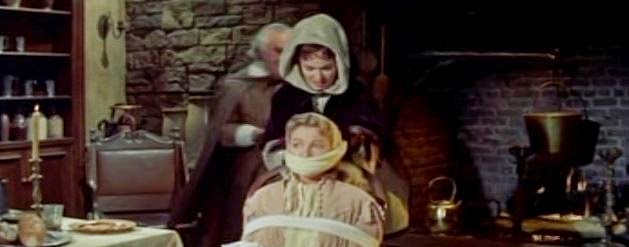
John Dehner as Niven’s captain of the guard.  He gets thrown out of a coach, and roundly tricked by Ann in a cute scene where she, being taken into custody, fakes heart trouble.  She has set up a plan where Dehner must take her to an apothecary shop, that happens to be run by the son-in-law and daughter of her faithful servant played by Tudor Owen.  His daughter, played by Queenie Leonard, refuses to let Dehner into the room where they are putting Ann to lie down during her "illness", “Please sir, I’ll have to remove her bodice,” she admonishes him.  Then, door closed, she allows Ann and her father to tie her up, and reminds them to gag her so it will look like Ann had no help in her escape.


By the way, favorite go-to man Ian Wolfe is among the familiar faces.

Ann and Purdom are a handsome pair, but there is little lovemaking when the plot is a constant chase for escape.  Ann wants to use the book as evidence against Niven, but Mr. Purdom wants to sell the information.


There are swordfights, and when Purdom and Moore are imprisoned, Ann is forced by Niven to visit them to get information on the whereabouts of their gang.  If she does not agree work for Niven as a double agent, he will ship her off in indentured servitude to the New World.  “A grim and so far unsuccessful effort to populate the colonies.”  America, ewww!  Who wants to go there?  She’d probably end up in Massachusetts, currently overrun with those stuffy, self-righteous, and stubborn sore loser Puritans, scrubbing floors for a humorless magistrate until, a few decades hence, she is hanged for a witch.

Instead, in a brave attempt to avoid all that, she slips Purdom a stiletto to pick the lock on his iron chains.  There is a painstaking and nail-biting escape from the prison.


The final hat trick is using Niven’s own coach, which Purdom had previously stolen, to gain entrance to the castle where the crown jewels are kept.  Purdom and Ann, pretending to be relatives of Niven’s, are allowed a private tour to see the crown jewels, which Purdom will attempt to steal and ransom back to the king, thereby demanding an audience with him so they can rat on David Niven.


But…ZOUNDS!  The king arrives unexpectedly just as Edmund Purdom is pummeling a Beefeater over the crown jewels!  Ann is desperately trying to stall Sir Isaac Newton in the next room by pretending to know more about astronomy than he does!  How will it end?!!

Our pal Bosley Crowther of The New York Times called it “…one of the most thorough banalities of the year.”


I think it deserves better, as a fun and rollicking adventure, a sumptuous costume drama with a lot to look at, not the least of which lovely Ann Blyth in her period clothes.  I would suggest the movie could have been made more memorable by a scene with her singing at a pianoforte.  No such luck.  The King's Thief has been shown on TCM, and is available on DVD.

Ann would sing in her next movie, her last movie musical, Kismet (1955), which we covered here.

By the end of 1955, Ann would be expecting her second child, a baby daughter born in December.  In October, Modern Screen, gushing over the news of her latest pregnancy, ran a rather long article recounting the major events of her life: her career start in radio as a child, her terrible spine injury as a teen, the loss of her mother, and a look back at her dating years that must have been with a certain degree of self-serving nostalgia for a magazine that must now satisfy itself with the less juicy news of her steady marriage and respectable motherhood.

Since her marriage, her babies, and her 30th birthday only a few years away, Ann’s place in the hearts of the movie-going public may not have changed, but the magazines, after having rabidly pursued her since her teen years, were beginning to turn their voracious attention to younger, single stars where there was a greater opportunity for them to write about scandal.  It was attention Ann apparently was happy to do without:

Speaking of the period when she was being tagged, her soft voice takes on an edge of firmness.  “This is a phase of your life—even if you’re in pictures—that’s quite private and special.  Not that you’re unwilling to share a certain amount, but only so much.”

Come back next Thursday when we discuss Ann’s teen years as a Hollywood actress during World War II, during years that were personally challenging, heartbreaking, anxious, and uplifting.  She made friends she kept for life, and films that would live forever.


 *************************
Modern Screen, October 1955, article by Ida Zeitlin.


The New York Times, August 13, 1955, review by Bosley Crowther, p. 7.
****************************
 THANK YOU....to the following folks whose aid in gathering material for this series has been invaluable:  EBH; Kevin Deany of Kevin's Movie Corner; Gerry Szymski of Westmont Movie Classics, Westmont, Illinois; and Ivan G. Shreve, Jr. of Thrilling Days of Yesteryear. 

***************************
TRIVIA QUESTION:  I've recently been contacted by someone who wants to know if the piano player in Dillinger (1945-see post here) is the boogie-woogie artist Albert Ammons. Please leave comment or drop me a line if you know.
****************************
UPDATE:  This series on Ann Blyth is now a book - ANN BLYTH: ACTRESS. SINGER. STAR. -

*********************
The audio book for Ann Blyth: Actress. Singer. Star. is now for sale on Audible.com, and on Amazon and iTunes.

Also in paperback and eBook from Amazon, and my Etsy shop: LynchTwinsPublishing.

Also available in eBook at:


 "Lynch’s book is organized and well-written – and has plenty of amusing observations – but when it comes to describing Blyth’s movies, Lynch’s writing sparkles." - Ruth Kerr, Silver Screenings

"Jacqueline T. Lynch creates a poignant and thoroughly-researched mosaic of memories of a fine, upstanding human being who also happens to be a legendary entertainer." - Deborah Thomas, Java's Journey

"One of the great strengths of Ann Blyth: Actress. Singer. Star. is that Lynch not only gives an excellent overview of Blyth's career -- she offers detailed analyses of each of Blyth's roles -- but she puts them in the context of the larger issues of the day."- Amanda Garrett, Old Hollywood Films

"Jacqueline's book will hopefully cause many more people to take a look at this multitalented woman whose career encompassed just about every possible aspect of 20th Century entertainment." - Laura Grieve, Laura's Miscellaneous Musings''

"Jacqueline T. Lynch’s Ann Blyth: Actress. Singer. Star. is an extremely well researched undertaking that is a must for all Blyth fans." - Annette Bochenek, Hometowns to Hollywood


Ann Blyth: Actress. Singer. Star. 
by Jacqueline T. Lynch

The first book on the career of actress Ann Blyth. Multitalented and remarkably versatile, Blyth began on radio as a child, appeared on Broadway at the age of twelve in Lillian Hellman's Watch on the Rhine, and enjoyed a long and diverse career in films, theatre, television, and concerts. A sensitive dramatic actress, the youngest at the time to be nominated for her role in Mildred Pierce (1945), she also displayed a gift for comedy, and was especially endeared to fans for her expressive and exquisite lyric soprano, which was showcased in many film and stage musicals. Still a popular guest at film festivals, lovely Ms. Blyth remains a treasure of the Hollywood's golden age.


***************************

A new collection of essays, some old, some new, from this blog titled Movies in Our Time: Hollywood Mimics and Mirrors the 20th Century is now out in eBook, and in paperback here.

Related Products