IMPRISON TRAITOR, PEDOPHILE, AND CONVICTED FELON TRUMP.
Showing posts with label A Town Like Alice. Show all posts

Thursday, August 27, 2020

Three Came Home - 1950


Three Came Home
(1950) is notable for its presentation of courageous women struggling to survive in a Japanese prison camp during World War II, and for its presentation of their captors in a way that is not a racist caricature.  Both are a big accomplishment for Hollywood at the time.


Claudette Colbert stars as Agnes Newton Keith, on whose memoir, Three Came Home, the movie is based. Miss Colbert had long since been a giant in Hollywood, whose ability to play drama or comedy was equal and impeccable. This movie benefitted especially from another quality she displayed which was more subtle: a kind of impression of being unassuming. Another actress might have played this role chewing the palm tree and barbed wire scenery, but Colbert moves from one incredible situation to the next like a person who at once has no idea how she got here, but is intellectually open to every experience. As such, she is our stand-in.

Today we celebrate TCM’s star of the day, Claudette Colbert, in the Summer Under the Stars Blogathon hosted by Kristen Lopez over at Journeys in Classic Film.

Agnes Newton Keith, an American, is the wife of a British official, the Conservator of Forests and Director of Agriculture, in Borneo. Agnes herself is a writer, having authored a book on her experiences as a Yank in Borneo. She is the only American among a colony of Dutch and English government workers and their families.  It is a world of wearing tropical whites and delegating labor to native servants. War breaks out, and the Japanese Army reaches them far sooner than they’d imagined.


Patric Knowles plays Colbert’s husband, and little Mark Keuning plays their son. He was about six when he did this role, and played in only one other movie, in the same year.  When it appears the Japanese are on their way, Mr. Knowles encourages his wife to take their son and leave for her home country, the U.S., but she wants to stay.  We listen to the bombing of Pearl Harbor on the radio, and a month later, everyone in their small community is taken prisoner.


Sessue Hayakawa, whose film career dates back to the ‘teens when he was a matinee idol in silent movies, appears as Colonel Suga, who will figure prominently as Colbert’s counterpart in the story. Hayakawa has read her book on Borneo, and he is very impressed with her, “You were very sympathetic with Orientals,” he remarks, “It’s not usual, you know.”  We have the suggestion that racism is a subplot to the story.

Mr. Hayakawa’s character studied in the United States as a young man, and he and Colbert reminisce about their college years.  It is one of those moments where Colbert’s quality of being unassuming makes the scene almost otherworldly for her being able to take in his surprising words and gentlemanly behavior (he lights her cigarette) while being scared to death at the soldiers with their bayonets about to herd them into a concentration camp.


The Japanese soldiers are present everywhere, some are stony-faced and stoic, some are cruel, some are bumbling, but all are human. That is one of the achievements of this movie, made only five years after the war ended.  Agnes Keith in her book was clear that she felt barbarism was to be found not in people, but in war, and the movie seems to have followed the spirit of her book.

The other aspect of Keith’s book well replicated in the film, as Colbert remarks, “Life was reduced to one simple, stubborn purpose – to keep alive.” 

They are brought on trucks down the jungle island to a camp where they spend nine months, the women and children separated from the men.  The men’s camp is nearby and they sometimes catch glimpses of them out in forced labor parties or are left notes.  There is a harrowing scene where Colbert sneaks out at night to meet her husband in the bush, while she is weak with fever, having not seen him for five months.
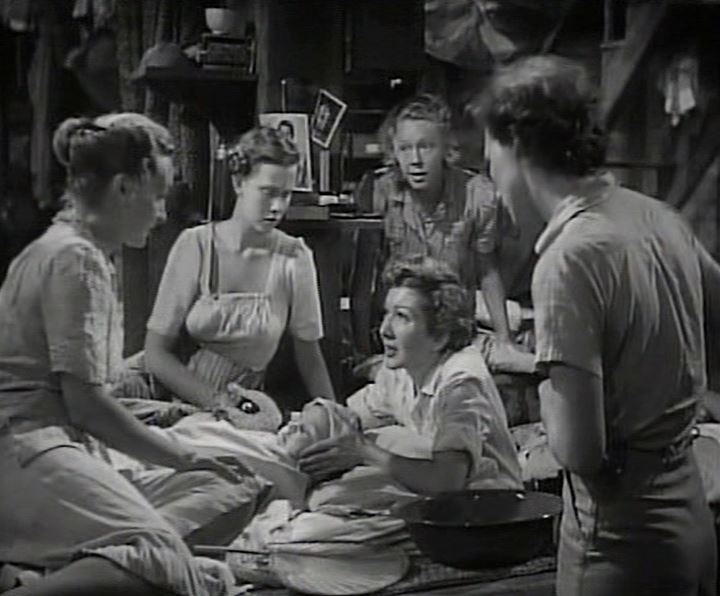

There are scant rations, working in rice paddies, beatings.  Colbert clings to her son and cuddles him.  Her friend Betty, played by Florence Desmond, sneaks her food from the garbage.  There is more in the book about the Dutch and English communities and the sometimes rancor between them, but the movie flows along quickly and with dramatic visuals of the muddy camps in the rain, of a group of British women singing “God Save the King” in their bunks at night while Colbert and her son, giggling, substitute the words for “My Country, ‘Tis of Thee,” of the threat of death always present.


They are moved to a new camp where they will spend the rest of the war, and will not be near the men anymore. They are allowed a distant goodbye with a ditch between them, barely allowed to touch their fingers if they can reach far enough.


The commander at the new camp, Lt. Nekata, is played by Howard Chuman. He is sadistic.  One night, Claudette Colbert is outside the hut retrieving laundry when a guard tries to rape her.  She reports the incident to Mr. Chuman, who wants her to sign a confession that nothing happened and that she lied.  She refuses, and Chuman has one of his men beat her.  The scene is about to be repeated the next day, when Sessue Hayakawa shows up unexpectedly, is delighted to see her, and he seems like a hero because we know she will be safe if he is near.


Though he is obviously strict and authoritarian, he behaves kindly to the children in the camp, and insists Colbert sign a copy of her book to him.  Toward the end of the war, in August 1945, they know that Allies will eventually arrive.  Hayakawa is stunned, almost somnambulant, but not because the Japanese have lost the war and he will likely face retribution; it is because, as he confesses to her, his family have all died at Hiroshima.  He says of his three kids, “Three of the dearest children you ever saw.”  Later, while watching Colbert’s son and some other kids playing in his garden and eating fruit he gives them, he will break down and sob.


A month later, in September, 1945, they are liberated, with a long scene of reuniting with the men prisoners that is more suspenseful than jubilant as we discover some of the women will not see their husbands again. Colbert at last spots her husband, stumbling down the dirt road on crutches.

The film was directed by Jean Negulesco with a smooth, rather quick pace and many dramatic visuals, but one aspect to the book was left out of the movie.  It is not dramatic, but it is important to the character Colbert plays.  Agnes Keith made secret notes and left them on bits of paper stuffed into cans, buried in the camp, sewed into her son’s teddy bear, hidden all over, and when she was liberated, she made stubbornly certain that she was not going to leave this part of her behind.  She was a writer.  She scrounged up all her notes and took them with her, and they eventually became her book.

The story of women in a Japanese concentration camp is reminiscent of our look here at A Town Like Alice (1956), which took place on the Malay peninsula.  Nevil Shute’s novel was based on stories of women’s real-life experiences as prisoners of war, but because he was a novelist, that story made more of a full arc in the telling.  Agnes Keith’s memoir was nonfiction, so it was detailed and precise, and less concerned with dramatic arcs, more concerned with chronicling a record. Nunnally Johnson’s script is necessarily episodic.  The movie does not tell us, as the book does, that Colonel Suga committed suicide in his Allied cell by cutting his throat on the day Agnes Keith, her husband, and son, left for the United States.


Claudette Colbert, despite her reputation for crisp, aristocratic elegance, had an everywoman quality that lent itself to her achieving a full spectrum of strong women’s roles during World War II: A nurse on Bataan here in So Proudly We Hail! (1943), a wife and mother keeping the homes fires burning—and eventually going to work as a Rosie the Riveter here in Since You Went Away (1944), and in this film, certainly an impressive trilogy. 

--------------

Jacqueline T. Lynch is the author of Ann Blyth: Actress. Singer. Star. and Memories in Our Time - Hollywood Mirrors and Mimics the Twentieth Century. Her newspaper column on classic films, Silver Screen, Golden Memories is syndicated nationally.

Thursday, February 26, 2009

A Town Like Alice (1956)


A Town like Alice (1956) is a fine, if incomplete, version of the novel by Nevil Shute. Many of us may be more familiar with the five-part miniseries that was shown on Public Television’s Masterpiece Theatre in 1981. It is the story of how lives can be changed by the intriguing combination of love…and economics.

The novel explores the aspect of economics in the story more fully than this film does. A young Englishwoman is the heir to a relative’s fortune, which he acquired in Australia, exploiting some that country’s mineral worth and taking it back to the UK (or Pommyland, as the case may be). Because of the prejudice this chap had for what he felt were the limited abilities of women, insisting that “a lassie is at the mercy of her sex”, this money was left to his female heir only at the discretion of a male solicitor, who was in charge of how she could spend it. When the solicitor informs Jean Paget of her legacy, she informs him she wants to go to Malaya and dig a well for some poor villagers. Then she tells him why, and here we have the unfolding of the story.

The Australian-produced TV version, as is typical with a mini-series, had the luxury of time to spread the novel out over several hours in several episodes. This 1956 British-made film is a more capsulated version, and ends before the story really carries us to Australia. Despite that, it is striking for showing the consequences of the 1941 Japanese invasion of the far-flung British Empire as it was in Malaya, and filmed only a little over a decade after the setting of the story. This is what gives this version a kind of authenticity. No matter how good or realistic a film is made today about a past event, it always carries a telescoping view of it.

Virginia McKenna is radiant as Jean Paget, a young Englishwoman working in an office in Malaya before the outbreak of war. Peter Finch plays the Australian soldier Joe Harman, whom she meets when they are both prisoners of the Japanese.

Much of the film is devoted to the scramble of the English in their self-made British colony to escape the advance of the invading Japanese, and then how they make do as prisoners once they are caught. We are shown how the women, separated from the men, are forced marched for several hundred miles, crisscrossing the Malay Peninsula because the Japanese Army has no camps for them and no one wants to take responsibility for them.


We are shown how these women, who in peacetime were separated into class divisions by wealth and pedigree, are now thrown together with no class distinction, how they must cooperate or die. We see how former relations with the Malays, whom they once regarded as their social inferiors, are now humbly appealed to for help. Jean is the most successful at this, as she appears to be a woman who, more than level-headed and resourceful, is also gracious and courteous. Her humility might have once made her a wallflower at a governor’s dance at Singapore’s old Raffles Hotel, but now it makes her a successful prisoner and admired among the native population who want to help her. This is truly a case of where the last shall be first.

This is also the story of the peculiar strength of women which springs from their empathy for one another. As some of the women die, the others assume responsibility for the orphaned children, just as Jean has taken on three of them. The women comfort each other, and even take care of their Japanese guard when he falls ill. A Malay woman bullies her merchant husband into giving Jean precious cans of condensed milk for the baby Jean lugs on her hip. We are shown the female bond is stronger than class distinction, nationality, or war. Their capacity for nurturing saves them.

I find amusing one scene this film which bears (or bares) I think an ironically Victorian outlook, and that is the representation of the women as they stumble upon an abandoned complex in which there is running water. So joyous are they to be able to bathe after weeks of marching through swamps and jungle that they strip and succumb to the comfort of showers, while carefully placed camera shots infer that they are naked. We are shown legs and underarms without body hair. As illogical as this is, evidently, the producers feel impelled to try and shock us with the brutality of a prison camp, but seem to think body hair would somehow offend us. It is not to be shown. We could chalk it up to being a 1956 film, except that I’ve seen this same thing in some other present-day made dramas about similar experiences of World War II female prisoners of war. There might be something here about a preference for idealizing women protagonists with flattering photography. There is more than one way to “sanitize” a story. Maybe you have some ideas on this.

Having lost all their belongings, including razors, the ladies remain sweaty, but hairless. Mrs. Frith, played here by Nora Nicholson, is a hypochondriac who proves to be more physically fit than anybody. Another lady, aghast at Jean’s wearing a sarong, scoffs at the notion of an English lady letting down her standards. She is aped by little Malay boys who laugh at her in her proper suit and hat, carrying her luggage. The musical score playfully launches into a bit of “Rule Britannia” to underscore the lady’s foolishness and the irrelevance of her self superiority.

Perhaps no other culture can top the English for their admirable ability to make fun of themselves, particularly at a period when the sun did not set on the British Empire. We Americans do not like to think of ourselves as empirical and are sometimes annoyed when others do consider us an empire. Invariably, we are better at laughing among ourselves at ourselves, than laughing when other nations laugh at us.

Another part of the British Empire comes to the rescue of these women, when a couple of Australian soldiers, also prisoners, pull tricks to get them some food and medicines. Joe Harman, played by handsome and charming Peter Finch, is immediately taken with Jean, and goes out on a limb to get her more supplies. The chemistry between Mr. Finch and Miss McKenna is something terrific, and when they sit quietly in the dark, after the standard erotic lighting of her cigarette scene, he tells her of his home deep in the Outback, in the middle of Australia, on a cattle station near a town called Alice Springs. Her eyes are riveted on him as he speaks. Her cupping of his hands as he lights her cigarette is the only physical contact, but the scene is intense.

Though they sit together and whisper in the dark, there are still walls between them. They are prisoners, their moments together are stolen. They are of different nationalities and likely would never have met but for their subjugation by the Japanese. He also believes she is married, because she always carries a baby. When he talks of Alice Springs, it sets them both free from all that for a moment. They are free among the red earth of the mythical Outback.

Ultimately, Mr. Finch pulls one hat trick too many for Miss McKenna’s behalf, gets caught, and is tortured by crucifixion. The women are whisked away on another march, and their guard, now in disgrace, an outcast among his fellow soldiers for innocently eating chicken stolen for the women, is left by himself to shepherd them to nowhere. Played by Kenji Takaki in this 1956 film, the guard is shown to have helped the women, to have watched over their children, and mourned with them. Had this film been made during the war, we would have seen a wicked caricature instead of a human being.

Even Jean, with her graciousness and humility, succumbs to hatred for the kind guard after the torture of Joe, panicking when he goes near her baby, and calls him a Jap.

But when he dies, the women find themselves in an even more precarious state. Jean appeals to the headman of a village, asking that the English women be allowed to work in their rice fields in exchange for a place to stay until the war is over. She approaches him respectfully, and asks permission to speak with him as woman on behalf of women, since their guard is dead and they have no man to speak for them. She squats in the dirt as they do, a little away from them to emphasize her unworthiness, and the village elder considers her outlandish request.

She adds, cleverly quoting from the Koran since he and most of the Malay people are Muslim, “Is it not also written that ‘if ye be kind to women, God is well acquainted with what you do’?”

“Are you of the faith?” he asks, amazed.

“No, but wise words are well in any faith.”

We see that Jean is a survivor, not the kind that clings and scratches, but one who makes a gift of her dignity and kindness, and thereby survives with her humanity intact. One day the village elder will refer to Jean fondly as “Daughter.” Again Nevil Shute examines the inconvenience of being a woman and turns it into strength, displaying his own remarkable empathy. This novel could not be more understanding of a woman’s place and prospects in that era if it had been written by a woman.

The war ends, and Jean must hand the baby, now a four-year old, back to a father he does not remember. And she discovers by accident that Joe Harman had survived his torture. She thought he had died. She asks for her lawyer’s permission for more money to go to Australia to find him. In the meantime, Joe has won a lottery, uses the money to travel to England and is in her lawyer’s office seeking her. Surely a twist on the interdependent relationship between love and money.


It makes a wonderfully ironic finale, and when they reunite in Alice Springs, this is where the film ends. There is a tentative, shy hesitation, and then a breathless hug as the old walls between them crumble. It’s a romantic ending, but leaves the novel truncated. In the novel, and in the 1981 miniseries, the story continues in Australia, as Jean aids the lonely dying outback town which is losing men because there are few women, by establishing a business, and then another, giving jobs to women. Again, women are the focus as they achieve financial independence and empowerment, and nurture the community into thriving.

Through her enterprise, she has revived the town, which brings the story full circle. Her relative who left her the legacy took wealth from Australia, and in her way, she returns it.


There is a shot in this 1956 film from what would appear to be the top of Anzac Hill in Alice Springs. It shows the distant


McDonnell Ranges, and below the grid of three or four streets which make up the town. What struck me upon seeing this film was how familiar the view was to me. Captivated by both the book and the 1981 miniseries, I went to Alice Springs some years ago. I had business in another part of the country and this was a side trip, an opportunity I couldn’t miss. It is a long way to go because of a book you’d read nearly a couple of decades ago. It’s that kind of book.

I’m not the only one to think so. Also pictured here is the plaque dedicated to British author Nevil Shute on the Australian Writers Walk in Sydney. Among other literary heroes commemorated here is Banjo Patterson, who wrote “The Man from Snowy River” and the lyrics for “Waltzing Matilda.” Shute, a non-Australian, is included in the Aussie pantheon, honored specifically for A Town Like Alice.

Alice Springs is a bit larger now, and the McDonald’s and Kentucky Fried Chicken are businesses that would not have been frequented by Jean and Joe Harman back in the day, but the view from Anzac Hill is strikingly similar.


On the top of Anzac Hill, which is only a small hill but because of the immense flatness of the landscape, it seems much larger and gives an incredible view, there is a monument, an obelisk dedicated in 1934 to the fallen of World War I. Since that war, plaques have been added to commemorate the service of Australian military personnel in other conflicts, World War II, the Korean War, the Malaya conflict of 1950 to 1963, in Borneo from 1962 to 1966, and the Vietnam War.

We don’t see the monument in the 1956 film, and neither would have Virginia McKenna or Peter Finch, for I believe a second film unit took the few establishing shots of Alice Springs. I don’t believe the actors even went there.

The film has, despite its limitations, an intriguing freshness that even the excellent 1981 miniseries lacks. Perhaps it is the lack of innocence in the 1981 film. Perhaps it is just the telescoping of so many more decades, a wall between our interpretation of the past and what the past really was, not unlike the tantalizing wall between Joe and Jean talking in the darkness about a town like Alice.


All color photos in this post by J.T. Lynch.  All rights reserved.

Related Products