IMPRISON TRAITOR, PEDOPHILE, AND CONVICTED FELON TRUMP.
Showing posts with label Cecil B. DeMille. Show all posts

Thursday, August 26, 2021

Hollywood Stars and the Search for a Polio Vaccine


Hollywood public service shorts on behalf of the March of Dimes and the search for a polio vaccine remind us of a world where a deadly and extremely communicable virus was everybody's fight and patriotic Americans did their part.  

The March of Dimes was founded in 1938, as the National Foundation for Infantile Paralysis was incorporated, launched by President Franklin Delano Roosevelt.  President Roosevelt, himself a victim of polio, was the nation's personification of the struggle against the mysterious virus.  After President Roosevelt's death, his image replaced the old Mercury Head Dime and became the Roosevelt Dime because of the March of Dimes and the fight against polio.  That fight still had almost another decade to find a solution. It found it in a vaccine.  The success of the field trials were announced on April 12, 1955 - the tenth anniversary of his death.  All of this, to a radical right fascist, might seem political.

Though there were plenty of detractors and outright enemies on the radical right against Roosevelt for his progressive programs, the fight against polio was not seen as political.  Polio was scary.

It also took more than one vaccine to vanquish.  The Salk vaccine was a two-injection process; the second shot was given three months after the first shot.  Then an additional booster shot some seven months later.

In 1961, the oral vaccine developed by Dr. Albert Sabin was available, and even those who had received the earlier Salk injection still took the Sabin oral vaccine.  Polio was that scary, people today who complain about the COVID vaccine and requiring boosters simply have no idea what they are talking about.

You were given a card on which to jot down the dates you received your shot:


Sound familiar?  The difference between then and now is now we have allowed the most ignorant and immature and irresponsible people in our society a louder voice and far more power than they deserve.

Polio still has no cure.  It is a virus that can be contained only by preventing it from spreading.  Since 1979 no polio cases have originated in the United States, a couple of decades from the discovery of the first vaccine, and four decades from the founding of the March of Dimes by the nation's most famous polio victim.

Hollywood pitched in and did its part.

Mickey Rooney and Judy Garland from 1938:


Robert Young and his family from 1951:


Cecil B. DeMille:


Lucille Ball and Desi Arnaz and their kids from 1954:


********************

Jacqueline T. Lynch is the author of Ann Blyth: Actress. Singer. Star. and Memories in Our Time - Hollywood Mirrors and Mimics the Twentieth Century. Her newspaper column on classic films, Silver Screen, Golden Memories is syndicated nationally.  Her new book, a collection of posts from this blog - Hollywood Fights Fascism - is available here on Amazon.


Thursday, March 6, 2014

The Buster Keaton Story - 1957


The Buster KeatonStory (1957), is a film made perhaps too soon, and which many fans of Buster Keaton would agree should never have been made at all.  It is an example of one of the most unrealistic biographies produced by Hollywood, bearing very little fact in the story.  But it is an interesting attempt at trying to portray the life of a giant of the early days of the film industry in an era where that giant, Buster Keaton, was only just beginning to be rediscovered by a new generation.

The bright spots of this story are Donald O’Connor, who plays Buster Keaton and Ann Blyth, who is a fictional character, a sort of composite of his wives.  She has a fictional name and a fictional back story.

The film began shooting in June 1956, a very busy year for Ann, who was 27 years old when this film was made, but, incongruously, her film career was actually winding down.  There would be only one more year after this.
In March 1956 she appeared as a guest on the Perry Como television show, and in May, she appeared on The Ed Sullivan Show, Mother’s Day, May 13, 1956 as a recipient of Sullivan’s Mother of the Year Awards (along with fellow recipients Betty Grable, Deborah Kerr, Betty Hutton, Rosemary Clooney and June Allyson).  A bevy of beautiful moms.


By August, it was reported that she had to cancel a singing engagement at the Sahara Hotel in Las Vegas, slated for September, because MGM, to which she was under contract at the time, ordered her back to start another film as soon as The Buster Keaton Story for Paramount was finished up. 

Her work in The BusterKeaton Story was understated and solid, but apart from the acrobatic final scene, which we’ll get to, seemed not much of a challenge.  From The Schenectady Gazette in an article by Louise Boyka from May 1957: “Attractive Ann Blyth does much to keep up the caliber of the film with her high quality acting and personal appeal." 

But Ann’s sincerity could not help the basic faults of this film, which suffered a loss of credibility through the clumsy handling of the film’s producers
With so much fictional in this movie about such a remarkable figure in film history, viewing it will quickly become an exercise in frustration.  This is not the place to go looking for the truth about Buster Keaton.  There are documentaries, such as the excellent Buster Keaton - A Hard Act to Follow (currently here on YouTube), but the best source on Buster Keaton’s genius are his own films.  Happily, many have been restored and make up some of the finest comedies made of the silent era.  That he was an exceptionally talented man, and brilliant, though down-to-earth storyteller cannot be denied, but The Buster Keaton Story ignores his genius and slides into lazy cliché.  We have the beginning of the down and out vaudevillians trudging through the snow to the theatrical boardinghouse where Buster is fighting for food as a child in a scene which we will later recognize from one of his movies. 

Though the film does lean heavily on Buster’s drinking to supply the drama and the tension, it does not really go into the reasons for his drinking.  In the movie, we are told that sound films have destroyed the silent era, and have left him without a job.  We even have a reference to John Gilbert’s professional demise because his voice was no friend to the microphone, a myth which has been proven false, but which is one of the clichés that the film perpetuates.

Written by Sidney Sheldon and Richard Smith, produced by them, and directed by Sheldon, the main fault of this movie is the script.  It is rife with clichés and so full of inaccuracies that the embarrassment Buster Keaton apparently felt at its premiere and the critical hammering the film received, giving both the careers of Ann Blyth and Donald O’Connor a black eye, is really the fault of the script and the production.  The direction was lackluster. 

And I can’t help but wonder what Peter Lorre was doing in this film as a belittling director.  It was a role that could have been played by anyone, so much so that it feels odd to have a man of such strong screen presence and a notable history of quirky roles play it.

Cecil B. DeMille has a cameo playing himself, and Jackie Coogan plays the silent star Elmer Case, but I think that’s it for the greats of the silent era.  Richard Anderson, an actor I’ve always liked, has the thankless role of the boring nice man who doesn’t get the girl.

Buster’s real-life parents also get bit roles.

Rhonda Fleming has a fun and flashy role as a snobby starlet, complete with liveried chauffer and hounds on a leash.  She turns Buster’s head for a while. 

Donald O’Connor’s work in the film, despite the material, is good.  He handles the drama with subtle intensity, and most especially the physicality of Buster Keaton, very well.  Mr. O’Connor is an old vaudevillian himself, and when he speaks of Buster’s childhood on the road, we can imagine he knows all about that.  He was a vaudevillian from his childhood.

He performs and re-creates a few of Buster’s famous stunts for indeed, most of Buster’s gags were actually stunts and I can think of no other dancer, no other actor who could have played Buster Keaton as well as Donald O’Connor.  He was the most acrobatic young dancer/actor in Hollywood at the time, able to do things neither Gene Kelly nor Fred Astaire could ever do.  It is this kind of athleticism needed to portray Buster Keaton, who was sublimely athletic.

Buster Keaton served as a technical advisor on the film and in her book on her husband, Buster KeatonRemembered, Eleanor Keaton writes, “For eight weeks Buster helped Donald with the comedy sequences, and he had wonderful time working with him.  However, the finished film  The Buster Keaton Story was awful.”  On the particularly difficult illusion of diving through the brick wall from Sherlock Jr, she writes, “Donald did an admirable job executing this risky stunt...  It was a very dangerous stunt.”

There are two elements of Buster Keaton’s real life that would’ve made a very interesting movie had that movie been made.  When it comes to his drinking, Buster Keaton was spurred on by two great heartbreaks.  One was the fact that his studio, The Buster Keaton Studio, set up for him by producer Joseph Schenck, whose sister-in-law, Natalie Talmadge, Buster Keaton married, was taken from Buster because he had a tendency to go over budget on his elaborate films.  Buster was put under the thumb of producers and writers writing gags for him, and when he came to work for MGM, his creativity was stifled and he became frustrated.  He was paired on screen with larger-than-life lovable motor-mouth Jimmy Durante.  Buster was now a second banana, and miserable.

The second great sadness of Buster’s life was his first marriage to Natalie Talmadge, with whom he had two sons.  Talmadge was a spendthrift who went through Buster’s money and quickly lost all affection for him.  When they divorced, she refused to allow her sons to see him, and even changed their surname to her maiden name.  She bore such a hatred for Buster the rest of her life that she refused to allow his name mentioned in her presence.

At the time The BusterKeaton Story was made, both Natalie Talmadge and MGM were still alive and had lawyers and would’ve come down hard on this film if it had come anywhere close to vilifying them.  So we have no mention of Buster’s first wife and unhappy marriage, and we have no mention of MGM.  The studio he works for is lamely called Famous Studio and the bad guys are sound pictures.

There is a scene in the movie where Ann Blyth’s character, a casting director for Famous Studio (kudos to the film for placing a woman in a position of responsibility and authority, which was common in the early days of film), falls in love with Buster, who barely knows she’s alive.  After one of his drunken benders, she bails him out of jail and marries him when he is too drunk to realize it.  The scene seems far-fetched, but it does have some basis to reality.  Buster’s second wife, a nurse at the sanitarium where he was being treated for alcoholism, actually did marry him under similar circumstances, and Buster would later remark that he could not remember the ceremony.

The greatest part of Ann Blyth’s fictional character resembles Buster Keaton’s third wife, a young Hollywood dancer named Eleanor Norris and with whom he was happily married for twenty-six years until his death in 1966.  Eleanor was a supportive and stable influence on the real Buster Keaton and Ann Blyth’s stoic endurance of Buster’s foibles, her understanding and kindness make her more Eleanor-like than any of his other relationships, but she is not really Eleanor. 
The real Buster and the real Eleanor Keaton on This is Your Life.

Donald O’Connor was able to match Buster’s quirky difficult social interaction with people that made him sometimes come off as rude, and mimicked his physical jerks quite well.  You can spot the little tricks of habit throughout the film.

There are two particularly fine scenes between Ann Blyth and Donald O’Connor.  One is when he has reverted to drinking after his latest failure, and she struggles to guide him to the couch, where he flops, mumbling about episodes from his past.  She kneels beside him, trying to soothe him, and they talk over each other, their words overlapping in a heartbreaking inability to reach each other.

The truest and most delightful part of the film comes at the very end when Buster decides to revive his vaudeville act where he is free to create.  He does not make much money, but he is overjoyed to be making people laugh.  Ann Blyth is standing in the wings, and he grabs her impulsively and pulls her on stage with him to re-create a famous skit that he has performed many times, and with which she is familiar.  His real-life third wife Eleanor also performed such skits with Buster in later years in Europe and on television.

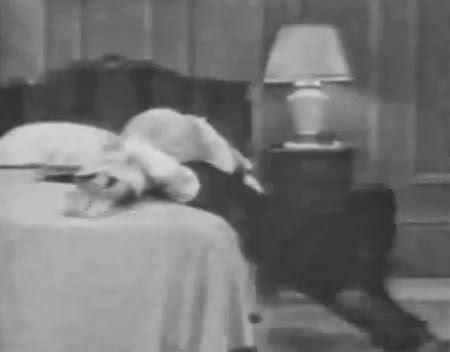
This skit performed in pantomime is Buster’s true medium.  They play a husband and wife who arrive home in the wee hours of the morning after celebrating too much on New Year’s Eve.  They are both a bit tipsy and exhausted.  They prepare to go to bed, but as Buster’s fumbles and hurts himself on a chest of drawers, Ann wearily stretches out on the floor and falls asleep. Donald as Buster discovers her there and through a series of acrobatics, physics and applied geometry has to get her into bed while she is completely unconscious.  He has to move her dead weight.

It is a funny skit and, for me, the only laugh out loud moments of the movie.  I can imagine Donald and Ann working through the scenario in rehearsals.  They must’ve been laughing their heads off.  Especially funny is one moment where he holds her in his arms and is trying to figure out a way to get her on the bed such that her head goes with the pillows and her feet go in the proper direction, but he can’t figure out how to do it.  So he sits down on the bed and attempts to throw her over his head, hoping she will land in the right position, but he doesn’t toss her high enough and she flops right on his neck, strangling him. 
When he extricates himself and stands, she lies limply over his shoulder like a towel.  It’s very well done and really requires a great deal of athleticism from both of them.

The film did make money and earned $50,000 for Buster Keaton as technical advisor, with which he and his wife were able to buy a comfortable home.  Moreover, it brought more notice to this great artist’s place in film history, and those are two things for which we as film fans can be happy.  Watching this to learn more about the real Buster Keaton’s life or work is fruitless. 

However, for those fans of Ann Blyth and Donald O’Connor, watch it simply for their last pairing on film.  They work well together.  They look like old friends who understand each other and it is a very pleasant thing to see them when you remember Ann got her start in film in a series of four musicals for Universal and Donald O’Connor was her first co-star.  We’ll talk about them down the road.
Here they are six years earlier at the premiere of Harvey in 1950, taken from a newsreel of the event.
And just because I like it, here's a clip from 12 years earlier of their duet from Chip Off the Old Block  (1944):


Our friend Robby Cress notes some location shooting from this film at his Dear Old Hollywood post.


On April 3, 1957, Buster was surprised by Ralph Edwards and the merciless This is Your Life show, in which Donald O’Connor appeared, dressed in his Buster outfit, to wish him well.  The program was part of the film’s publicity efforts.  Watch it here onYouTube, but jump to 24:00 minutes because it is the second half of the video.  The first half belongs to Laurel and Hardy. (We mentioned Ann Blyth’s turn as honoree/victim of This is Your Life two years later in 1959 in this previous post.)

Come back next Thursday when we travel back to 1949 and a trip to Ireland with Ann, Bing Crosby, and Barry Fitzgerald in Top o’ the Morning.

**************
Buster Keaton A Hard Act to Follow (Thames Television, 1987)

Keaton, Eleanor, and Jeffrey Vance. Buster Keaton Remembered (NY: Harry N. Abrams, Inc. Publishers) 2001, p. 38

Schenectady Gazette, May 17, 1957, article by Louise Boyka, p. 19.

This is Your Life, Ralph Edwards Productions, April 3, 1957

The Warsaw (Indiana) Times-Union, August 3, 1956, syndicated article by Harrison Carroll, p. 5.

*****************************

This week marks the seventh anniversary of Another Old Movie Blog.  Thank you so much for the pleasure of your company.

UPDATE:  This series on Ann Blyth is now a book - ANN BLYTH: ACTRESS. SINGER. STAR. -

*********************
The audio book for Ann Blyth: Actress. Singer. Star. is now for sale on Audible.com, and on Amazon and iTunes.

Also in paperback and eBook from Amazon, CreateSpace, and my Etsy shop: LynchTwinsPublishing.


 "Lynch’s book is organized and well-written – and has plenty of amusing observations – but when it comes to describing Blyth’s movies, Lynch’s writing sparkles." - Ruth Kerr, Silver Screenings

"Jacqueline T. Lynch creates a poignant and thoroughly-researched mosaic of memories of a fine, upstanding human being who also happens to be a legendary entertainer." - Deborah Thomas, Java's Journey

"One of the great strengths of Ann Blyth: Actress. Singer. Star. is that Lynch not only gives an excellent overview of Blyth's career -- she offers detailed analyses of each of Blyth's roles -- but she puts them in the context of the larger issues of the day."- Amanda Garrett, Old Hollywood Films

"Jacqueline's book will hopefully cause many more people to take a look at this multitalented woman whose career encompassed just about every possible aspect of 20th Century entertainment." - Laura Grieve, Laura's Miscellaneous Musings''

"Jacqueline T. Lynch’s Ann Blyth: Actress. Singer. Star. is an extremely well researched undertaking that is a must for all Blyth fans." - Annette Bochenek, Hometowns to Hollywood


Ann Blyth: Actress. Singer. Star. 
by Jacqueline T. Lynch

The first book on the career of actress Ann Blyth. Multitalented and remarkably versatile, Blyth began on radio as a child, appeared on Broadway at the age of twelve in Lillian Hellman's Watch on the Rhine, and enjoyed a long and diverse career in films, theatre, television, and concerts. A sensitive dramatic actress, the youngest at the time to be nominated for her role in Mildred Pierce (1945), she also displayed a gift for comedy, and was especially endeared to fans for her expressive and exquisite lyric soprano, which was showcased in many film and stage musicals. Still a popular guest at film festivals, lovely Ms. Blyth remains a treasure of the Hollywood's golden age.


The eBook and paperback are available from Amazon and CreateSpace, which is the printer.  You can also order it from my Etsy shop. 

If you wish a signed copy, then email me at JacquelineTLynch@gmail.com and I'll get back to you with the details.

Thursday, July 21, 2011

Calamity Jane Pt 2 - "The Plainsman" - 1937


“The Plainsman” (1937) never lets an absence of fact stand in the way of telling us a good story. Director Cecil B. DeMille is in his element here, treading on history and myth with great flourish. Here Calamity Jane is part of the tapestry of the American West and not just a freak show refugee. We can thank Mr. DeMille for this, for if he bends the truth a bit, he at least makes the attempt, and most certainly Jean Arthur makes the attempt, at showing Calamity Jane to have angst and tenderness, humor and compassion, which were most certainly part of her character as much as the men’s clothes and bullwhip.

Other parts of her character were eliminated, such as the drinking and raucous behavior that occasionally landed her in jail in real life, and this is a shame, because we might have learned more about Calamity Jane if she had been allowed to be more than just Wild Bill Hickok’s girlfriend.

Not that DeMille’s Calamity Jane was fooling audiences at the time. The review in the New York Times by Frank S. Nugent charges DeMille with “taking history by the tail and throwing it out the window." I particularly like the line “ you frontier authorities will probably be confounded, and will confound Paramount for telling you the sweetest story ever told about Wild Bill and Calamity Jane...the changes that time and Jean Arthur have wrought! She doesn't chaw tobacco anymore. She doesn't cuss. She doesn't run around with the boys. She just talks low and husky, is cute when she's being tomboyish, and she loves Wild Bill so much, she almost faints when the Indians start torturing him..."

In “The Plainsman” Calamity Jane is one of the trio of American West icons. Wild Bill Hickok, played by Gary Cooper, helps his pal Buffalo Bill Cody, played by James Ellison (who we’ll meet up farther down the trail in “The Texan and Calamity Jane” as her new prospective boyfriend), deal with a Cheyenne uprising and the scoundrels who sold them repeating rifles.

The movie starts in Washington, D.C. towards the end of the Civil War, where President Abraham Lincoln discusses the proposed transcontinental railroad. He wants the frontier to be made safe for the plow. Then he excuses himself from the meeting because he’s going to Ford's Theater. We covered what happened at the theater that night in this previous post on “Prince of Players” (1955).

Before we get too far, we might as well just forget picking out historical inaccuracies. There are too many of them. Suffice it to say in any movie about Calamity Jane, approach it as entertainment and not as a documentary on her life. Very little of what you see is probably true.

After Abe’s left the room some unscrupulous arms manufacturers conspire to sell rifles to the Indians because with the Civil War winding down, they are not going to make such huge profit anymore. The man they have dealing directly with the Indians is Charles Bickford. Though he's the head bad guy, we don't see that much of him in this movie. We get a bigger impression of his smarmy toady Jack McCall, played by reliable smarmy guy Porter Hall. He seems to bump into Gary Cooper a lot.

When we meet Wild Bill he is at the river landing in St. Louis, about to board a riverboat. He has just been discharged from the Army, and he runs into his old pal and fellow scout Buffalo Bill Cody and Cody’s new bride played by 19-year-old Helen Burgess (whose career was sadly cut short when she died of pneumonia the following year).

DeMille gives us one of his patented scenes of history that is a feast for the eyes. The camera leisurely moves over an enormous steamboat, and more extras than you can possibly count all moving busily in this bold young city on the Prairie. There are calls of “Mark Twain!" from the river navigators plumbing the depths, and most of you I'm sure know this is where the writer, Mark Twain, chose his pseudonym. We take it all in, and that's what Mr. DeMille meant us to do.

In a minute, we meet Herself, Calamity Jane. Not standing out in the crowd, only one of the Western menagerie. She is hitching a team of horses to her stagecoach. She wears loose buckskin trousers and shirt, and an army kepi. And, what appears to be quite red lipstick. Her short hair is brushed back off her face in a manner similar to the longish hair of Gary Cooper and Buffalo Bill Cody, making all three of them sort of resemble each other.

We might interject here that according to Calamity Jane, the Woman and the Legend by James D. McLaird (University of Oklahoma Press, 2005) which we referred to in our first post on this Calamity Jane series on Monday here -- the real Calamity Jane had dark hair and was tall, at about 5'9" and about 170 pounds, which one of her contemporaries recalled many decades later, was “all frontier muscle." (Page 112.) Whether this is a picture of her in her 40s or her 20s, we don’t know, but it’s of course drastically different from the blonde, delicate-looking Jean Arthur who stood about 5'3".

But there is something in Arthur's characterization that seems so natural. Particularly when you compare it to other actresses who've played Calamity Jane that appeared more affected and stagey.

We see Jean Arthur hitching up her team, climbing on the stagecoach, and throwing her whip. She does it with a natural athletic gracefulness quite different to many actresses in the role whose stomping around in hands-on-hips postures is done deliberately to look to mannish. She seemed perfectly at ease with what she's doing and this is the chief accomplishment in Jean Arthur's work.

Author James D. McLaird quotes from a play written by Thomas Newson in 1878, only a couple of years after the incident in 1876 when Wild Bill Hickok was shot by Jack McCall (I know this is a movie spoiler, but it's also history). Playwright Newson describes the character Calamity Jane in his stage directions: “Her movements are all free and unstudied, yet in no sense unbecoming. Her conversation is animated. She imitates no one; is an original in herself; despises hypocrisy; and is easily melted to tears. She is generous, forgiving, kind-hearted, sociable, and yet when aroused, has all the daring and courage of the lion or the devil himself..." (p. 103). This seems to be Jean Arthur’s take on her as well.

Calamity Jane was in her mid-20s, and she was already a celebrity, having dime novels and plays written about her. The darker side of Calamity Jane, her alcoholism, which caused her more than once to be thrown into jail for rowdy behavior is not mentioned in the novels or the play. That behavior, the other side of the coin, is left to the newspaper journalists of the day to illustrate in dry, ironic observations of the heroine of the plains, the so-called Queen of the Prairie. We are missing that description in this movie and in the rest of the movies in this series.

Jean Arthur carries no such baggage, and yet there is that angst about her which make us sense there is more to her than just buckskin leggings. There are certain aspects of the real Calamity Jane that are suggested in this movie. That they are only suggested and not portrayed is, of course, in part to do with the Production Code of the day. But, the Code was not entirely the obstacle of keeping the truth about Calamity Jane from the public. The truth is nobody really knew the truth, and the truth was made up of a lot of little slivers of fact, that never quite came together -- not in the media, and they never quite came together for Martha Jane Canary, and maybe that's what tortured her.

We get a few hints. While Jean is hitching up her stagecoach, a man walks by and flirts with her briefly and she returns his greeting in a friendly way. We see she has many men friends without needing to chase them. Gary Cooper is the one she wants. When she and Cooper first greet other, we see that she is crazy for him, plants a kiss on him which the disdainful Mr. Cooper wipes off and he insinuates that she is “a woman that has a fellow in every stage station and a beau in every cavalry troop west of the Missouri.” Through the Production Code gauze we are being told that she is promiscuous, which she was. She was also for periods of time, a prostitute, and in this movie a few times she uses the word “mopsy” to refer to a mistress or prostitute. Only a low woman would know such a western saloon word.

But this is the West and as Cooper tells Buffalo Bill Cody's frightened bride, “There's no Sunday west of Junction City. No law west of Hay City, and no God west of Carson City.”

Though Cooper shrugs off Miss Arthur's affection, he carries a pocket watch with a picture of the two of them. She wears around her neck a set of beads that he once gave her.

General George Armstrong Custer gets a cameo. He's going after a band of Cheyenne warriors, and Ellison and Cooper are recruited as scouts. Ellison must leave his wife and their very dusty cabin.  Jean shows up to take her in hand, and look out for her.

Holding up curtains against her waist, Jean replies that it's pretty enough to be worn as a dress. Mrs. Cody asks, “Why Calamity, do you ever wear dresses?"

“I might if I had one," Jean answers affably. As we mentioned in part one, Calamity Jane did wear dresses just as much she wore buckskin, and Arthur's delighted reaction to wearing one of Mrs. Cody dresses, getting a kick out of seeing the skirt twirl, shows us she is not presented as someone who needs to be taught to be a woman (as in later movies about her), but as a woman who was product of her environment and that is at least refreshing. Credit should be given to Cecil B. DeMille, despite the otherwise artificial aspects of her character in this movie, for presenting her as a person in a time and a place where Calamity Jane was after all, accepted.

It was rather the eastern newspapers, the eastern writers, who made much of her, who turned her into one-part heroine and three-parts curiosity or sideshow freak. The Western journalists took her for what she was, good and bad and made no great fuss over her in a world where there were plenty of other wild characters. She is no more outlandish in her buckskin than Cody or Custer or the Cheyenne.

Except for that part where the Cheyenne warriors try on the ladies hats that Jean gives them to distract them from capturing Mrs. Cody. They capture her instead.

Gary Cooper comes to her rescue, and when they are held captive together awaiting torture, we see how lovesick she is, and he finally admits begrudgingly that he loves her, now that he’s going to die anyway. Jean can't stand to watch Gary Cooper being hoisted over flames, so she tells the chief where the small band of soldiers is headed, which saves Gary Cooper's life, but dooms the men of an infantry squad.

Mr. Cooper sends her for help, and he heads out for the ambush, joining the troop under siege. His pal Buffalo Bill Cody is one of the members. It's another one of DeMille's dramatic scenes with the besieged men are fired upon from all angles by the Cheyenne who have the new repeating rifles, thanks to the unscrupulous arms manufacturers. And Charles Bickford. And Porter Hall.

She goes off, brings back Custer, the cavalry comes in saves the day. Gary Cooper still has a score to settle with Charles Bickford and when he finally catches him and his gang, he holds them up in the saloon for the military authorities to come and take them into custody. While they're waiting, they play poker.

Here is where we get the famous scene (or a CB’s version of it) where Wild Bill Hickok was murdered by Jack McCall. It seems something of a travesty to have Porter Hall gunning down Gary Cooper, doesn't it?

History buffs know that Gary Cooper is going to die when Mr. DeMille shows us a close-up of his last poker hand. A combination of aces and eights in five card draw. It is popularly called “the dead man's hand,” supposedly because this was the hand held by Wild Bill when he was murdered on August 2, 1876 at Saloon Number 10 in Deadwood, South Dakota.

However, there are different versions of what this hand of poker actually comprised. In this version and the many versions of the story, he's holding black suits -- ace of spades, ace of clubs, a pair of black eights and the king of spades. Nobody really knows if that's what he was holding and other versions of the story had him holding different cards.

While in Deadwood, Calamity Jane has left stagecoach driving to become a bartender, which she really did on occasion. She’s still using her bullwhip against bullies and people who don’t pay their bar tab. Check out the scene with a mechanical cocktail shaker. One imagines Mr. DeMille found that a tag sale somewhere, pining for the right movie to use it.

When Wild Bill is gunned down, Calamity Jane rushes to hold him in her arms and gives him one last kiss that he can't wipe off. In the play written about her so soon after this incident, Calamity does more than mourn for Wild Bill; she goes after his killers.

Calamity Jane was still in her early 20s at the time this event happened. How remarkable that she could become an icon of the Wild West when she was still a very young woman -- and over an event which she really had no great part.

Martha Jane Canary herself, though she made an unsuccessful attempt at selling stories of her life in pamphlet form in wild west shows in her later years, was one of the few people to fail to profit off Calamity Jane.

In 1902, the year before her death, according to author McLaird, she reportedly gave an interview to a newspaper where she said that she and Wild Bill Hickok were to be married in a few days, when Wild Bill was murdered. Maybe she started believing the stories.

Facts very quickly became irrelevant in the forming of Calamity Jane's fame. Rather, it seemed the case of detractors wanting to paint her as a ridiculous person, admirers wanting to make her far more angelic than she was, and the fascination of the public for the great adventure at the American West represented.

Women were part of that great adventure. They were wives and schoolteachers. They were captives and orphans, and sometimes they were what the eastern towns would consider to be the scourge of society. And Calamity Jane represented all of this, all rolled into one person. There is a temptation, particularly in the 20th century, to define Calamity Jane in feminist terms. But she confounds even that reasoning. She was just who she was, and the fact that she never fit in and defied explanation was perhaps the irresistible draw to this hapless misfit.

What would she have thought if she saw herself getting the star treatment in the movies? When Jean Arthur played this role she was at the top of her game or soon would be. Calamity Jane in this movie was an equal to the characters of Wild Bill Hickok and Buffalo Bill Cody. They were the dynamic trio, they were the Mod Squad of the 19th century. Although she may be quaint and odd in her buckskin and her bullwhip, she is not a sidekick or comedy relief. Indeed, as previously mentioned Jean Arthur plays her with a kind of sensitivity we don't get to see from later portrayals of Calamity Jane in the 1940s and 1950s.

“The Plainsman” was not the first occasion we see Calamity Jane in the movies. According to James D. McLaird, the first known film was in 1915, “In the Days of ’75 and ‘76”, locally produced in Nebraska. She and Wild Bill were married in that one.

He notes the first nationally distributed film that featured Calamity Jane starred William S. Hart and Ethel Gey Terry in 1923, but that no print of this movie exists. So “The Plainsman” is the earliest major motion picture to feature the character of Calamity Jane in existence, and this a starring role by one of Hollywood's major actresses of the day.

In his excellent biography, Jean Arthur, The Actress Nobody Knew (Limelight Editions, New York 1997), author John Oller notes that Mr. DeMille's first choice for Calamity Jane was Mae West (p.94).

Let’s all consider that a moment and choke on our coffee.

But, C.B. was pleased with Jean Arthur's dedication to the role. Apparently, she wanted to play the role without makeup, and with close cropped hair, but the studio apparently wouldn't let her get too scruffy.

In The Autobiography of Cecil B. DeMille, edited by Donald Payne (Prentice-Hall Engelwood Cliffs, New Jersey 1959), the director notes that he was pleased with Jean Arthur, particularly by how she learned to use the 10 foot bullwhip “as competently as Calamity Jane did when she was driving a stagecoach. I offered my wrist is a convenient target for the curling end of the whip during Jean’s practice sessions. The wrist for a lash marks for days; but Calamity herself would have applauded the skill of her portrayer.”

Mr. Oller in his book on Jean Arthur also notes the coincidence that Jean Arthur's mother was a child in Deadwood, South Dakota at the time Wild Bill Hickok and Calamity Jane were living there.

In what was certainly part of promotion for the film, and perhaps part defense of playing the notorious social outcast, Jean Arthur wrote an essay called “Who Wants to Be a Lady?” for Screen and Radio Weekly, (quoted by Oller, p.p. 96-97) which was published September 20, 1936. Noting that Calamity Jane lived her own life the way she chose in the environment and circumstances that presented themselves to her, “really emancipated women are always natural, because they do what they want to do. They are not dulled with ‘culture,’ either, because there's nothing false or ‘put on’ with them. They may be smart and well-informed, but they are not stuffy. Because of this there are thousands of emancipated women who don't wear slacks, smoke or drink cocktails, a type, clerk, keep house, raise children.

"Doing what they want to do, they are emancipated without knowing it.”

Emancipated, or deeply troubled, a victim of her time and circumstance or survivor of it, or just her own worst enemy, Calamity Jane means many things to her many interpreters. Come back next Monday when Calamity Jane slides from stardom and becomes queen of the B-movies in “The Texan Meets Calamity Jane” and “Calamity Jane and Sam Bass.”

Wednesday, May 4, 2011

Union Pacific - 1939


“Union Pacific” (1939) is a Cecil B. DeMille spectacle on the joining of the transcontinental railroad, making this great big country a little smaller, or as it is said, uniting the country “with a wedding ring of iron”.

No longer did passengers need to suffer the dangers of a prairie crossing in a Conestoga wagon, or round Cape Horn in a six-month sea journey around South America to get to the west coast of the U.S. It seems we have Barbara Stanwyck and Joel McCrea to thank.

Miss Stanwyck plays the daughter of a train engineer on the Union Pacific. She holds court in the caboose as the postmistress for the workers laying track. She reads their letters to Irish immigrants, like Regis Toomey, who are illiterate.

As it is said of her, “She belongs to the railroad, although you’d think the railroad belonged to her.”  She uses an Irish accent in this film, which is pretty credible when she holds onto it, but she seems a bit self-conscious in this movie, as if trying to hold onto that accent is taking all her concentration.  She seems much less natural and relaxed than in other performances.

One of the film’s stunning images comes at the very beginning when we see her standing precariously atop the car of firewood on the moving train, bringing her engineer father, played by J. M. Kerrigan, his dinner pail. They lovingly verbally abuse each other in the manner of Irish families.

Our first glimpse of McCrea is a dramatic ride on horseback to catch up to the moving train, leaping onto the platform.  His character doesn't go through a lot of change or development in this movie, but his low-key heroism is always a pleasure to watch.

Joel McCrea is the other “Captain Butler” of 1939, an ex-soldier from the Civil War now on security duty for the railroad, keeping crooks like Brian Donlevy in order. Robert Preston is McCrea’s old army buddy, who is now in league with the evil Mr. Donlevy.

Preston is years, maybe light-years we could say, away from his future movie stardom as a happy go lucky flim-flam man, but he has his roots here as the charming ne’er do well in a pencil-thin mustache. He competes with Mr. McCrea for Miss Stanwyck’s affections.

One of the fun things about this movie is spotting (or at least reading credits on the IMDb site) all the minor characters and extras who found a job, for only minutes, on this movie. They include Ward Bond, Lon Chaney, Jr., Monte Blue, Will Geer -- who most of us remember more as the grandfather in “The Waltons” television series, Anthony Quinn -- the director was his father-in-law, Evelyn Keyes, and Bert Stevens, who was Barbara Stanwyck’s real-life brother.

Better known character actors like Lynne Overman and Akim Tamiroff play Joel McCrea’s sidekicks. They supply a bit of comedy relief, but with an unusual courage and capability not often granted to sidekicks in the movies. They are shrewd, sensible, and protect McCrea’s back on repeated occasions. He would be dead several times over if it weren’t for them.

Henry Kolker plays the crooked banker whose plans to scuttle the Union Pacific provide much of the plot. He played a lot of bankers, and you might remember him as Katharine Hepburn’s stuffy banker father in “Holiday” (1938).

Nameless are the scores of real-life Navajos playing the Indians who contemplatively watch the smoke-belching iron horse tear across the wide open landscape, who in other scenes, attack the beast with ineffectual courage against the passengers who fire at them with rifles. In a one scene they wreck a train and pillage its contents, causing anxiety for McCrea, Stanwyck, and Preston, who are trapped inside trying to hide. The idea that these three could send a Morse code message by tapping an electrified wire on the barrel of a shotgun pre-dates any of “MacGyver’s” antics by decades.

I’ll not do a play-by-play on the plot. Cecil B. DeMille was a showman, and what is most powerful about this film are the showman’s images, not necessarily the story (which has so much action and so many arcs it seems like a several-part serial shown all at once). We pretty much know who the good guys are, who the bad guys are, and in the mire of stereotypes, there really aren’t too many surprises.

Oh, the train wrecks are startling, but not really surprising. I think we expected them.

The images tell stories all on their own, quite apart from the plot. Those Native Americans watching the train thunder by, the one warrior on his pinto pony that rears up at the precise moment. It reminds one of those 1940s or 1950s magazine advertisements for the Santa Fe “Chief”.


Though the movie was filmed in many western locations, much of the interior work in the cars was obviously shot in the studio, though the rear-screen projection of the desert with distant rocky spires and buttes that slides on by us out the train windows is done pretty well. The train cars rock and sway as Barbara Stanwyck walks through and tenderly replaces the bonnet on a sleeping woman, and the top hat on a snoozing gent, careful to tuck his train ticket in his hatband.

The scene with the heard of bison roaming around Stanwyck’s and McCrea’s solitary handcart looks a bit more artificial, technically. Unlike the Sioux that look so picturesque watching the train from their ponies, there is no sense of foreshadowing of doom for the bison, though we know most of them were decimated by white hunters shooting them for sport, often right from trains.

There is instead the distasteful scene when one of Donlevy’s henchmen, played by Harry Woods (not Robert Barrat, thank you Caftan Woman), takes up a bet with Anthony Quinn that he can shoot an Indian for sport out the window of the train.

The warrior who rides along the train waves, and we see him smile, as if he is playfully challenging the train to a race. The bad guy takes his rifle, and, shockingly, murders the happy rider instantaneously. There is much less destruction in this instant than the later train wreck(s), and yet it is more heartbreaking. We hear the sounds of shock and anger from other passengers, the disdain over their complaints from the bad guys, “What’s one more dead Indian, more or less.”

Joel McCrea slugs it out with the murderer, while his sidekicks keep boss Donlevy and the other henchman at bay. Mr. Tamiroff is pretty handy with a bullwhip.

The murderer falls off the train platform. We see him roll in the dirt, and the train pulls off into the sunset, becoming smaller and smaller while the land gets bigger and wider, with the lone figure standing in the foreground. He is made small and insignificant in the shot, now that the train has pulled away, and tension builds as he is also probably in danger from the warrior’s tribe when they catch up with him, alone and unprotected.

The train is a world unto itself, and when it leaves in the distance, it takes civilization, protection, and companionship with it. But, the is not a very comfortable world, the hard train seats, the soot and smoke, the days on end of riding a swaying, narrow wooden box across an enormous wilderness.

The train heads for “end of track” where still another world is set up. Donlevy’s gambling house and saloon is there to lead the track workers astray. The supplies for track building, and everything needed for a temporary town, are hauled in, and Stanwyck sets up her post office in the caboose. End of Track is like Oz, but a whole lot less pretty and dream-like.

Back to the train wreck that imprisoned McCrea, Stanwyck, and Preston -- another dramatic image is when Stanwyck turns her back to the gentleman to pray for their salvation, and McCrea points his pistol at the back of her head, ready to do a mercy killing to keep her from getting captured or tortured by the Indians. A very eerie shot.

At the final moment, they are saved -- by another train. Trains are the real heroes in this movie, Joel McCrea notwithstanding. Even the U.S. Cavalry that comes to their rescue arrives by train.

In this world where the train is everything, the most iconic image, of course, is the final Golden Spike scene, where a bit of humor is injected when conniver Henry Kolker, having been forced by Tamiroff and Overman to pay for his evil deeds by driving spikes with a sledgehammer until he’s surprisingly gotten very good at it, does the honors.

The two trains meeting nose to nose is as familiar as any image we have of 19th century America, of the West, and of the post-Civil War era when uniting North and South seemed more troublesome than uniting east and west. The throng of people climbing on the engines, the dignitaries in their top hats, the photographer and his bulky camera on a tripod to catch what everyone at the time knows is going to be the most historic event of their lives.

I first remember seeing this movie when I was quite young, perhaps as young as 8 or 9 years old, and as the movie played, tracing with my finger the route of the Union Pacific on a map of the U.S. Some place in Nebraska called Omaha to another place in Utah called Ogden, about four inches away. I sat on the floor with the coffee table as my desk. I think it was a Saturday afternoon, and I can still recall the play of afternoon sunlight, with one strong beam splashing on the map from the window behind me, so strong a light I could see the dust in the air.

I understood nothing of the history or the politics in the plot of the movie (even Ulysses S. Grant shows up at one point), but the images were easy enough for even a child to grasp. Maybe that’s what Mr. DeMille really excelled at, a simplified but still dramatic image. Most of his epics have more splash than depth, but they are eyecatching.

This post is part of our celebration of National Train Day, this Saturday May 7th. The train has an unusually iconic place not just in our history, but in classic films. This movie, throughout the jumble of carnival showmanship, imagines how important the train was to a 19th Century America with growing pains. It also shows Hollywood’s love of the train as a set, as a metaphor, and as a plot device.

It ends with a swell of patriotic music and a shot of a modern streamliner roaring past the camera.

Trains would continue to be important to America in the first half of the 20th Century, and to the movies for the first several decades of the film industry. Come back Thursday when we’ll have a look at “The Narrow Margin” (1952), which shows the other end of the romantic timeline of the train in American history and American film. It’s a sleek, modern train, faster and more elegant. There are no pioneers on this trip, even though it’s heading west to California, but there is plenty of danger, and almost all of it is on board.

And have a look here for National Train Day this coming Saturday.

Related Products