IMPRISON TRAITOR, PEDOPHILE, AND CONVICTED FELON TRUMP.
Showing posts with label Casablanca. Show all posts

Sunday, October 28, 2018

Long Live Democracy - Casablanca (1942)


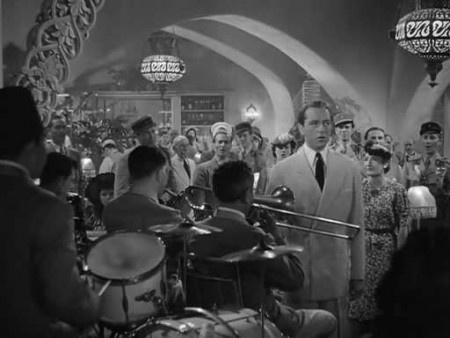
A pivotal moment in the film Casablanca (1942) occurs when Major Strasser and the other Nazis are drowned out in their singing of “Die Wacht am Rhein” by everybody else in the café singing “La Marseillaise.” It is a stirring scene, and one that never fails to bring some of us to tears. It has been reported that the much of cast in that scene were brought to tears as well. In one of those almost supernatural moments when art really does reflect life, the desperate European refugees in the café were played by actors who actually were European refugees. It is a spine-tingling moment of reality in an otherwise not very realistic film.

We revisit Rick’s Café Americain with the bulk of this essay having been previously posted on this blog in 2007, the first year of Another Old Movie Blog.  A great deal has changed in the world since then, though the most comforting aspect of our love of classic films is that the world we explore in them never changes.  We can visit a place and time and it is ever the same, and ever fresh.

Casablanca has become larger than life for us, a film whose reputation has grown with the decades. It will likely always be a favorite for its witty dialogue, its charismatic actors, and its fast-paced plot. It has the irresistible veneer of glamour in an otherwise dark and frightening time.

But, even those of us who love the film cannot overlook the fact that Victor Laszlo and Ilsa Lund would not have played a cat-and-mouse game of hidden threats over cocktails with Nazi officers in French-occupied Africa. The Nazis would have taken both of them into custody the moment they arrived in Casablanca, tortured them, and filmed their corpses with newsreel cameras. The movie would have been over in ten minutes. No cocktails, no white dinner jackets, no game of hide and seek with omnipotent “papers” that will set them free.

In this respect, Casablanca could be called an escapist film, because it gives us heroism and hope, redemption, a fairy tale of intrigue. The most fanciful scene in the movie, carrying this fairy tale along, is the scene with “La Marseillaise” trumping “Die Wacht am Rhein.”

And in that same scene, ironically, we see the real truth of the film, not always recognized, but there. S.Z. Sakall, who plays Carl, fled Hungary in 1939. His three sisters didn’t make it and died in a concentration camp, along with other relatives.

Madeleine LeBeau, pictured above, who played Yvonne, who pines for Rick and who is fought over by the Nazi soldier and the French soldier; and her then real-life husband Marcel Dalio, who played Emil, the gambling room croupier, both escaped from Nazi-occupied France through Lisbon, just as in the film. Reportedly, the visas they obtained for Chile were forgeries, but they managed to arrive in the U.S. through hastily arranged temporary Canadian passports.

Curt Bois, who played the pickpocket, fled Germany in the early 1930s. Helmut Dantine, who played the young Bulgarian man losing at the gambling tables, whose wife beseeches Rick to help them, fled Austria. Dantine was an Austrian who was put into a concentration camp after the Anschluss. He was arrested for leading an anti-Nazi youth movement. He was then nineteen years old.

Mr. Leuchtag, who practices his English by asking his wife the time, “What watch?” was played by Ludwig Stössel, another Austrian who fled after the Anschluss.

Ilka Grünig, who played Mrs. Leuchtag and replies “Ten watch,” escaped Germany in the early 1930s after the Nazis came to power.

Even the Nazis were played by actors who escaped real Nazis. Richard Ryen, who played Colonel Heinze, was a Hungarian-born actor who was actually expelled by the Nazis from Germany. Hans Twardowski, who played the Nazi officer who fights with the French soldier over Yvonne, fled Germany in the early 1930s.

Even Major Strasser, played by Conrad Veidt, escaped the SS, who pursued him for anti-Nazi activities, and he fled to England where he became a British citizen and supported Britain’s war effort with his salary.

There were actually very few American-born actors in the cast of Casablanca and not all of the rest were refugees, but a good many of them were. This gives the film a legitimacy that certain fanciful elements of the script did not.

When you watch the “La Marseillaise” scene, think of the refugee actors with genuine tears in their eyes, and remember that the Nazi regime had not yet been defeated at the time this film was made. It was not known then if they would be.

It was certainly never imagined that we’d be fighting them in our own country in the next century.  This is why we must vote on Tuesday.  At the very end of the “La Marseillaise” clip, Madeline LeBeau shouts, “Vive la démocratie,” and it is almost drowned out by the jubilant crowd triumphing over the smug, cruel Nazis in a nightclub songfest.  But it’s there, and it’s the whole point of the song.  

Vote for every Democrat on the ballot next Tuesday, in all local, county, and national categories.  Voting is no longer an expression of political opinion in this country; it's a chess game.  The politicians know that, and so do the pundits.  The voter has yet to realize how we are being played, and we must use our vote -- while we still have it -- to block the machinations of our impending doom.  Halting the progress of a corrupt and vile administration that now controls the executive branch, both legislative houses, and the Supreme Court can only be done now by making the Republican Party, which has ceased to be the Republican Party, fear more for their jobs than they fear the evidently powerful influence of a shameless grifter, the NRA, and the Russians from whom they have accepted bribes, and indeed, several corrupt members of their party, whom they’ve chosen to embrace and blindly support in the unholy name of holding power.  


When I think of the “La Marseillaise” scene in Casablanca, I also think of my father, who, still in his early twenties, left his wife and baby and fought in the South Pacific during World War II for over three long years.  No furloughs, no coming home until it was over.  When I was young, we watched Casablanca together, and he surprised me by belting out the French national anthem during this scene in his powerful, resonant bass voice.  He really had a very good voice, sounding a lot like Tennessee Ernie Ford only with a New England accent, but we used to tease him because he could not remember the words to anything. But like an automaton, he launched into “La Marseillaise” without any effort, and I think he even surprised himself that he remembered it.  

He explained, in that somewhat reluctant way all men of his generation did when talking about the war, that when he was stationed for a bit in that island-hopping campaign on the French colony of New Caledonia, they were required to stand at attention for the raising of the French flag and playing of their anthem in camp, as well as the American.  He also related the mournful tradition of answering roll call in their memory for pals who had just been killed.  The Vichy government was chased off the island and like the struggle in Casablanca, became Free French. Their symbol is on the paper money above, a souvenir my father brought home.

My father and his surviving comrades; and my mother, who was Rosie the Riveter in a war plant making parts for PT boats, thought their job was done on V-J Day.  

I mourn as much for the memory and the inspiration of that generation as I do for the future of this country if we do not remember the lesson that was so easily absorbed in Hollywood films of the 1940s:  The authoritarian fascists were the bad guys.  Frank Capra explained that to us, if we didn’t know already, in Prelude to War (1942).

How many Trump supporters and apologists would root for Bogart, Henreid, and Bergman today?  How many would look at those refugees with loathing that filled the Café Americain?  How many would turn Madeleine LeBeau away at the border today?


We already know from surveys done that many Millennials cannot even name who fought in that war and on which sides.  Right and wrong has become lost, and history, which should be a compass, has become a muddle.

Fans of classic films inevitably adore them for a world that is, among other things, rife with moral clarity.  We have lost that in our society, probably for many reasons, but one of the things I admire most about classic films is the courageous idealism.  It seemed to stream from the directors.  Frank Capra, a conservative Republican such as they used to come in this country, gave us Meet John Doe.  William Wyler, who gave us Mrs. Miniver; and the man who directed Casablanca, Michael Curtiz, were refugees, as was Billy Wilder.  John Ford, like Wyler and Capra, served in the military during World War II.  They had no patience for Nazis.  Ford would have punched them in the face.

Frank Capra & John Ford

The word Nazi is not bandied about carelessly when it is used correctly.  It is the word Republican that has lost its meaning.  The Grand Old Party surrendered and became complicit to survive in a more vicious environment, like the capitulating French Vichy government.  

When you vote on Tuesday, remember that Hitler was elected to office, and that was the last election.  He killed democracy in Germany.  Putin is angling for the same result here  by remote control and he has already lined the pockets of several Republicans to that end.  Unlike the troubled conquered countries in World War II, we will have no one to save us.  We have to do it ourselves.  There have never been higher stakes than this coming election.

Vote Democrat on Tuesday.  If the Republican Party regains its soul in having lost the election, that will be for the benefit of all of us, because nobody, including intelligent Liberals, want a one-party government, even one of Liberal Democrats. We need the vibrancy of differing opinions and perspectives.  

But first, we have to rid ourselves, democratically, of the traitors to our democracy who gerrymander precincts; who scrub voters off the registration lists; who cheat to deny the vote to African Americans, Mexicans, and Hispanics and other minorities; who attack the free press and shout that truth is not the truth, who praise Nazis and even become them. Vote Democrat.

Vive la démocratie.  Long live democracy.


Thursday, September 28, 2017

Sheet Music from the Movies


This week's post on my Ann Blyth: Actress. Singer. Star. blog features a contribution from an Ann Blyth fan -- scans of sheet music from her 1952 film The World in His Arms (which we had discussed in this earlier post) illustrating that the beautiful love theme I thought had no words actually was published with lyrics.  Today we have a look at a few other examples of sheet music from classic films.


Hollywood was extremely resourceful in its juggernaut promotion of films, and sheet music played a role in publicizing a film by exploiting the popularity of songs from a movie, or by trying to make those songs popular to increase interest in the movie.  The sheet music usually pictured stars on the cover, and that was an added feature desired by fans who collected photos of their favorites. 


While these earlier decades of the twentieth century could boast a larger percentage of the population who owned pianos or otherwise played musical instruments, I suspect many collectors of these items kept them mainly for their walls and their scrapbooks.  


Sheet music of movie themes continue to be published for modern films, but perhaps used today more in the form of a high school band playing the theme from Star Wars (1979).  I don't imagine sheet music from modern films is as popular today among fans who are not musicians.


Do you have any sheet music in your classic film memorabilia collection?


Thursday, November 3, 2016

Naive Idealism -- Part 11 of the State of the Classic Film Fan


It’s the idealism.  It’s the idealism (sometimes dismissed as propaganda, sometimes spurned as naiveté) that is most powerful about classic films and cannot be duplicated today.

We are in a more cynical age, where we mistrust idealism.  We also resent even the merest suggestion that a film might be preaching to us.  We don’t mind being preached to by hypocritical politicians, by hypocritical television advertisers who think they are telling us what we want to know or confirming our worse fears to induce us to buy their products, and by actual preachers whose personal wealth puts them in the camel-through-the-eye-of-a-needle category.

But if a movie tries to make us rally around a simple concept of decency, honor, and patriotism – by suggesting that we are all decent, honorable, and patriotic – the modern audience that does not like classic films hoots in derision (or worse).

“One might suspect their morality,” says the haughty Nazi officer of the compromised crowd of partygoers at the German embassy in Watch on the Rhine (1943).

I love that movie, loved it since I was a teenager, and marveled at its message of idealism in action.  “So the time has come,” Paul Lukas, the professional antifascist says, “This time it is of the utmost importance.”

So it is.  We finally vote this coming Tuesday.  This nation has not been in such crisis in decades, or in such danger since 9/11.  Some weeks ago, we discussed several movies in a series about fascism as represented in classic films: The Mortal Storm (1940),  Address Unknown (1944),  Storm Warning (1951),  Keeper of the Flame (1942), and Seven Days in May (1964).

Eight years ago, I wrote another pre-election day post, a two-part series on Gentleman’s Agreement (1949), part 1 here and part 2 here.  In this passage from that series, I remarked on the surprising nastiness of the 2008 campaign year:

How interesting that today much of the former open vehemence of prejudice has shifted from the now socially unacceptable derision against race or religion to the more socially acceptable ridicule of political affiliation.

“Conservative” and “liberal” are used today like dirty words, accusing labels, where the opposing political party, or politician, or even individual voter, is vilified with a degree of condescension, arrogance, and meanness that would appall most of us were it applied against a person’s race or religion.
 It is no longer enough to simply disagree.  We must condemn. 

How naïve those words sound today, like those old movies that espoused idealism.  Our level of political and social discourse has sunk far lower; open bigotry is accepted by society and unquestioned in the media.  I could not imagine then that the fascists who reviled, taunted, and condemned Barack Obama for his paternal African American heritage would continue to do so for his entire two-term presidency, unchallenged by a media that reveled in any controversy fired by lies.  I certainly did not imagine that an evil, idiotic piece of filth like Donald Trump would ever become his party’s nominee for the highest political office in this country and the leader of the (formerly known as) free world. 

This is the 11th part of our year-long monthly series on the state of the classic film fan.  In my first post in January, I specifically referred to Donald Trump, in affirming our American idealism as such that he could not possibly be elected president.  From that post in January:

Today, we address the juxtaposition of classic films on the turbulent world in which we live today.  Are they merely an escape from a louder, cruder world?  Or, do they provide us with mental and emotional sustenance to cope with our modern, angry society?  Probably both, but that depends on the classic film fan.

So we find ourselves, we classic film fans, at a crossroads.  Are our old movies a model, or an escape?  In my youth, they were a model; for I had nothing to escape from that I was aware.  Now, in middle age, I don’t know.  My earlier confidence that Trump was not a threat to the vigor of our democracy was clearly foolish.  I did not imagine that so large a number of people in this country could be so devoid of intelligence or integrity to support him; nor a media so lazy, greedy and corrupt that it failed its duties as the Fourth Estate; nor a Republican party so eager to roll over and play dead. 

Frank Capra’s Prelude to War, the first in his World War II Why We Fight series would, understandably, be labeled as propaganda today, but it was a powerful teaching tool that easily instructed a populace about to face the greatest evil of modern times on why it would have to risk death doing so.  The film quoted politicians, scripture, the words of Confucius, and from the Koran, and talked about Americans as a diverse society free and strong because of its diversity.  It just assumed its audience agreed.  Such “propaganda” dragged conservative isolationists to the table, and to the fascists among us – certain Jew-haters and industrialists – it made them shut up.

Their brand of wickedness was no longer fashionable. 

How did it get to be fashionable again, and make idealism passé?

I love the old movies that lead off with a paragraph scrolling before the first scene.  We don’t have that anymore; nobody likes wordiness, or the feeling that they are being preached to.  Watch on the Rhine begins with these words:

In the first week of April 1940 there were few men in the world who could have believed that in less than three months, Denmark, Norway, Belgium, Holland and France would fall to the German invaders.

But there were some men, ordinary men, not prophets, who knew this mighty tragedy was on the way.  They had fought it from the beginning and they understood it.

We are most deeply in their debt…

Such unabashed idealism, so unashamedly taking sides against fascism, without reserve.  Of course, the movie, unlike the play on which it was based, was produced during wartime, so it took little courage to point out our enemies for what they were, though Warner Bros. had a better track record on that that the other studios.

Another movie, Meet John Doe (1941), which we covered here, was even more courageous for picking out a fascist villain that was purely American: a businessman who wanted to take political control for personal gain.  Sound familiar?  James Gleason, in a wonderful scene of slightly drunken disgust, implores the very naïve Gary Cooper to open those beautiful eyes of his and see what is painfully apparent:

You’re mixed up with a skunk.  A no-good dangerous skunk…

I get mad for a lot of other guys besides myself.  I get mad for a guy named Washington, and a guy named Jefferson, and Lincoln.  Lighthouses, John, lighthouses in a foggy world…”

The fascist businessman is…

“…trying to worm his way into the White House, so he could put the screws in, so he could turn out the lights in those lighthouses…”

Leave it to Frank Capra to have the guts to risk calling the common folk a bunch of saps, and then raising them to herculean majesty when they see their error, and put the brakes on evil.  The little guys convince Gary Cooper to carry Barbara Stanwyck off the snowy rooftop and back to safety and a new fight, as James Gleason, cynical and yet idealistic, and thoroughly righteous member of the Fourth Estate taunts the businessman fascist,

“There ya are Norton, the people.  Try and lick that!”  And the movie ends with ringing of church bells and the triumphant swell of Beethoven’s Ninth Symphony.

No, that sort of thing wouldn’t happen today in a movie.  We’re too smug. 

I wonder what the demographic is among political affiliations among classic film fans?  From what I have observed on blogs and social media, old movie buffs are a wonderfully diverse group, where both liberal and conservative voters are equally drawn to classic films and can unite in our appreciation of their artistry and value to our culture. 

“But I do not believe for a moment that he will be elected president.”

That was my comment in January.  I did not think that by November I would be so ashamed of my country for laughing at a vulgar joke, for allowing a faction of stupid bigots to forsake common sense and common decency in order to vent their vileness.

In my complaint that modern critics found Gentleman’s Agreement too preachy:

Casablanca is also dated and preachy, but its bad guys were the Nazis, so we don’t mind speeches against them.  In Gentleman’s Agreement, we are the bad guys, or we could be if we’re not careful.  That’s the difference.

Now I wonder if there isn’t a very large segment of our population—Trump supporters—that would, if they were shown Casablanca for the first time, cheer for the Nazis?

We’ll see on Tuesday.  As Paul Lukas, the professional antifascist, says in Watch on the Rhine when he fears the greedy George Coulouris will sell him to the Nazis for a price,

“We will wait, and we will see.”

If the outcome is bleak, will classic films continue to inspire courage and decency, or just serve as an escape from a society decomposing?

I suppose I am waiting naively, idealistically, for the happy ending, the ringing of bells, and the soaring strain of Beethoven's Ninth in the background.  But it will never come again.
**************

Past posts in this series here:

Part 1 of the year-long series on the current state of the classic film buff is here: A Classic Film Manifesto. 

Part 2 is here: Cliff Aliperti’s new book on Helen Twelvetrees.

Part 3 is here: An interview with Kay Noske of Movie Star Makeover.

Part 4 is here: Evolution of the Classic Film Fan.

Part 5 is here: Gathering of the Clan at Classic Film Festivals.


*********************
The audio book for Ann Blyth: Actress. Singer. Star. is now for sale on Audible.com, and on Amazon and iTunes.


Also in paperback and eBook from Amazon.


Thursday, April 14, 2016

Letters in Old Movies


Humphrey Bogart stands on the train platform in the rain, reading the letter Ingrid Bergman has written to him.  The next few frames of the movie are focused on the letter, its handwriting melting to a blur as the ink bleeds down the page from the rain.

Some classic films, such as The Letter (1940) and Love Letters (1945) discussed here, and The Shop Around the Corner (1940) discussed here, have plots that are predicated on a letter.  A letter is the catalyst for conflict in the story.  There are a lot of movie plots we could add to this category, like A Letter to Three Wives (1949).  A letter is the incriminating evidence, or provokes a mystery, or a love letter may bring the wrong lovers together, or incite jealousy. 

But the use of letters, moreover, showing the handwriting on the letter is such a typical device used in old movies that we might regard it a cliché, though I don’t think I’ve ever seen it parodied.  It certainly could be, but perhaps the image of handwritten letters is so natural to this era that we accept it without thinking.  In this previous post, readers responded with what were their favorite images commonly seen in old movies: the passage of time with flipping calendar pages, or the candle stick desk phones, men’s broad-brimmed hats, etc.  We can also see all of these in modern movies set in the 1930s or 1940s, and we can see them in parody skits, but I don’t think the use of a handwritten letter has been used in decades since the era when handwritten letter were the major form of communication, in business and in personal use.

I especially love moments in old movies where a letter has nothing to do with the plot, but it’s there as a convenience.  Consider White Christmas (1954), where Anne Whitfield passes a letter written by Rosemary Clooney to her sister, Vera-Ellen.  The letter informs Vera-Ellen that Rosemary, not wanting to stand in the way of what she thinks is her sister’s impending marriage, breaks up their stage act and has taken a job in New York.  Vera-Ellen merely glances at the letter to know all the contents, and passes it to Danny Kaye, who, likewise, merely glances at the letter to know all its contents.  They may be speed readers, but the director gives us a few frames of the actual letter to read because we don’t read as fast.

We are included in the letter reading.  It is as if Vera-Ellen has passed the letter around to us too.  The audience shares the news “real-time.”  We are reading over her shoulder.

Who really wrote the letters in the movies?  Was it a staff of talented handwriting stand-ins?  A studio secretary with a high school prize for penmanship?  I’d love to know.  A reader commented once that the handwriting in two different letters in two different movies looked the same.

I suppose the most famous letter in literature is the very long and detailed letter Mr. Darcy wrote to Elizabeth Bennett in Pride and Prejudice, explaining the back story of his relationship with Mr. Wickham and the treachery done to his sister, and why Darcy interfered with Mr. Bingley’s relationship with Elizabeth’s sister Jane.  It’s a bomb dropped in the middle of the story, and turns the whole plot on its head. 

He may be a closemouthed fellow when it comes to talking, but in a letter, Darcy goes on forever, yadda, yadda, yadda.  We would not likely see such a long letter printed verbatim in a modern novel. Even modern film adaptations of Darcy’s famous letter tend to abbreviate his epistle, or illustrate its points instead in dramatic flashback scenes.  The directors must think modern audiences will not sit still for a little juicy letter reading.

In many schools today, cursive handwriting is no longer taught.  Many of us have youngsters in our families who cannot write or read cursive handwriting.  This is unfortunate on many levels, most especially that they will not be able to read historic documents, including the personal letters preserved in their own families.

But it also means they will not be able to read Rosemary Clooney’s letter to Vera Ellen, or Ingrid Berman’s letter to Bogie, or any of the notes and handwritten clues as to why the actors are behaving the way they do—remember, their actions are not always explained.  Reading the letter saves us from having to say what has happened off screen.

“Why is Bogie sad, Mommy?”  Now, doesn't that just tear your heart out? 

The letter writing and letter reading scenes are passive, yet still powerfully dramatic.  The letters convey intimate news.  Sometimes they are kissed or embraced because they represent the person that wrote them.  Sometimes they are stashed quickly in a hiding place.  Sometimes they are burned, or crumpled and thrown away. 

This is what Bogie does when the goodbye letter that kicks his guts out has become illegible from the rain, substituting for tears, as Ingrid’s words bleed down the page.  He stands on the steps of the now moving train, crushes the soggy paper in his fist, and tosses it to the tracks.

Deleting an email, or "un-friending" someone was never so dramatic, or so satisfying.

What are some other favorite “letter scenes” of yours?

Please have a look at the other great posts in the Words, Words, Words blogathon.


****************************


"Lynch’s book is organized and well-written – and has plenty of amusing observations – but when it comes to describing Blyth’s movies, Lynch’s writing sparkles." - Ruth Kerr, Silver Screenings


"Jacqueline T. Lynch creates a poignant and thoroughly-researched mosaic of memories of a fine, upstanding human being who also happens to be a legendary entertainer." - Deborah Thomas, Java's Journey

"One of the great strengths of Ann Blyth: Actress. Singer. Star. is that Lynch not only gives an excellent overview of Blyth's career -- she offers detailed analyses of each of Blyth's roles -- but she puts them in the context of the larger issues of the day."- Amanda Garrett, Old Hollywood Films

"Jacqueline's book will hopefully cause many more people to take a look at this multitalented woman whose career encompassed just about every possible aspect of 20th Century entertainment." - Laura Grieve, Laura's Miscellaneous Musings

"Jacqueline T. Lynch’s Ann Blyth: Actress. Singer. Star. is an extremely well researched undertaking that is a must for all Blyth fans." - Annette Bochenek, Hometowns to Hollywood


Ann Blyth: Actress. Singer. Star.
 
by Jacqueline T. Lynch

The first book on the career of actress Ann Blyth. Multitalented and remarkably versatile, Blyth began on radio as a child, appeared on Broadway at the age of twelve in Lillian Hellman's Watch on the Rhine, and enjoyed a long and diverse career in films, theatre, television, and concerts. A sensitive dramatic actress, the youngest at the time to be nominated for her role in Mildred Pierce (1945), she also displayed a gift for comedy, and was especially endeared to fans for her expressive and exquisite lyric soprano, which was showcased in many film and stage musicals. Still a popular guest at film festivals, lovely Ms. Blyth remains a treasure of the Hollywood's golden age.


The eBook and paperback are available from Amazon and CreateSpace, which is the printer.  You can also order it from my Etsy shop. It is also available at the Broadside Bookshop, 247 Main Street, Northampton, Massachusetts.

If you wish a signed copy, then email me at JacquelineTLynch@gmail.com and I'll get back to you with the details.

**************************
My new syndicated column SILVER SCREEN, GOLDEN YEARS, on classic film is up at Go60  or check with your local paper.


Related Products