IMPRISON TRAITOR, PEDOPHILE, AND CONVICTED FELON TRUMP.
Showing posts with label Gold Diggers of 1933. Show all posts

Thursday, October 24, 2019

90th Anniversary of the 1929 Stock Market Crash


James Stewart's dazed expression at the panicked customers demanding all their deposits in the aftermath of the 1929 stock market crash speaks volumes to the audience who remembered the crash and lived through its aftermath.  His quick decision and energetic parceling out of meager funds saves the bank with two dollars to spare at closing time.  Today we mark the 90th anniversary of the 1929 stock market crash.


Many movies of the 1930s reflected and illustrated the Great Depression with unblinking frankness despite, as Mary Astor noted in her memoir Mary Astor--A Life on Film:

“The national situation was tragic, but it wasn’t our tragedy.  It was something that was happening ‘out there’ and wasn’t it awful, but did you read Variety today?  People stood in line at the employment agencies but they also stood in line at the theaters.”  (p.81)

“These were the years called by the extravagant name of the Golden Years, maybe because nobody ever had it so good as the movie-makers.  In our fortress of films we were safe from dust bowls and grinding poverty, breadlines and alphabet agencies.”  (p. 109)

The buildup to the Crash was also extensively covered by Hollywood in its 1920s pre-Code party mode -- the vamps, the lascivious key-hole views of wild parties, and occasionally, a look at the even more wild spree on Wall Street.  The Marx Brothers capped the madness by adding more of their own in The Cocoanuts from 1929 a few months before the crash, which we covered in this post.


The Roaring Twenties (1939) attempts to cover it all -- the boom, the bust, the gangsters that appeared to usher the era in and out again, but takes the Crash with a clearly clichéd and nostalgic view.  It's easier to put a label on an event or an era when we are looking at it in the rearview mirror.  Here 90 years on from that event, from which we have only a few images of people swarming to the Stock Exchange when the panic began, we still dismiss it with a bemused and somewhat condescending eye.  We cannot imagine ourselves running to our local banks and screaming for our money, and not getting it (not all banks were so fortunate as to have George Bailey and his two dollars left).

We covered The Roaring Twenties here in this post -- ten years ago on the 80th anniversary of the Crash.  Have I really been writing this blog for twelve years?  We were coming down off a financial crisis then, ten years ago.  I have, I confess, feelings of more ominous foreboding for the one we're entering right now, but I can still take comfort in George Bailey's desperate and gusty response to a crisis. 


The timeline of the crisis that ultimately launched us into all those great Great Depression movies was this:

On Wednesday, October 23, 1929, the stock market fell about 4.6 percent, but rallied on Thursday the 24th in heavy trading.  Bankers stepped in and bought up shares, similarly to what the Fed is doing today, to prop up the market.  By Friday the 25th, the crisis seemed to have been averted.

But Monday, October 28th, when the market reopened, stocks dropped again.  Tuesday, October 29th, "Black Friday," the bottom fell out and the stock market collapsed.


That event is what we like to peg the beginning of a new era, but the market did not actually stop falling.  It slid down a bit more through several months and did not actually hit its bottom until July 1932, when 90 percent of its 1929 value had been lost.


Of course, as devoted investors like to point out, if one had bought stocks in August 1932 and held them, they would be rich because the stock market went up after that.  Well, yes, but it did not reach its 1929 level until 1954 -- 25 years later.  Fine if you're young and bought in (not a whole lot of people had the money, let alone confidence in Wall Street, to buy stocks in the depths of the Depression), but if one was middle-aged or a senior, the ball game was over.  What was lost was never to be recouped.


History, as is said, does not repeat itself, but it often rhymes, in a quote often attributed to Mark Twain.  I like to take a lesson from charts and graphs, from the testimony of people who experienced an event -- and from George Bailey, who always seemed to be behind the 8-ball but who thought fast and stayed on his feet.

May we all be here in ten years, marking the 100th anniversary of the start of the Sound Era with curious, bemused, and somewhat condescending commemorations of the Crash of 1929.

**************
Jacqueline T. Lynch is the author of Ann Blyth: Actress. Singer. Star. and Memories in Our Time - Hollywood Mirrors and Mimics the Twentieth Century. Her newspaper column on classic films, Silver Screen, Golden Memories is syndicated nationally.

Monday, February 4, 2008

Gold Diggers of 1933


Gold Diggers of 1933
(1933) is kind of a shock to the system. A quintessential “Depression” movie, it actually aspires to be a Depression movie with no claim to be anything else, an in-your-face comment on current events.

The film begins with a barrage of blonde chorus girls singing “We’re in the Money,” in a frenzy of fantasy that must have been fascinating to moviegoers in 1933, the depths of the Great Depression. When you consider that many of those moviegoers had to scrimp for the purchase price of the ticket, probably anywhere from 10 cents to 25 cents depending on where they saw it, whether it was an evening performance or matinee, the sight of women swathed in gold coins placed in strategic places on their bodies must have been nothing short of obscene. Not in a sexual manner (though there is plenty of naughtiness in the movie as well), but obscene in the way you don’t eat a three-course dinner in front of a starving man. It’s cruel.

Choreographer Busby Berkeley, with his customary surreal and eye-popping musical scenarios, gave the crowd more than 10 cents' worth of fantasy, but there is a strange dichotomy between fantasy and cold, hard reality in this film. Warner Bros., as always, had a bead on the grim reality of the 1930s and fixed its reputation on socially relevant films. Gold Diggers of 1933 is a cross between a socially relevant film and lemon meringue.

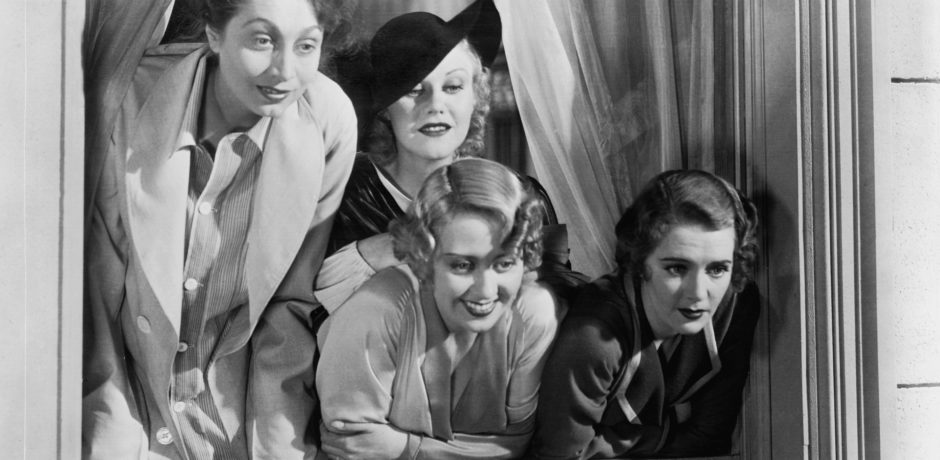
Joan Blondell stars as the tough-talking chorus girl. Aline MacMahon and Ruby Keeler are her pals, and Ginger Rogers has a featured role, opening the film in the “We’re in the Money” number. The bit where she sings a chorus in pig Latin was put in, as she notes in her autobiography, Ginger, My Story (Harper Collins, 1991), by producer Darryl F. Zanuck after he heard her clowning around with the song and doing a verse in pig Latin during a rehearsal.


The girls are thrown out of work when the Broadway show they are in is shut down by creditors because Ned Sparks, the producer/director, can’t pay the bills. We see the girls struggling in their run-down apartment, stealing milk from the neighbors, and when they hear a rumor that a new show is going to be cast, they pool their clothes for one good outfit for Joan Blondell to wear to go check it out. When she calls them to relay the good news that a new show is on and they might all get jobs, she is crying on the phone. It is one of those real moments that breaks through all the wisecracks and reminds us, more that it does the audience of the day, that this was the Depression. Nostalgia buffs need to remember that for many people it was a nasty time to be alive. Or, as when one of the chorines complains of their hard luck, Ginger Rogers comes back with the world-weary remark, “The Depression, dearie.”

Dick Powell plays a young composer who lives in the apartment across the way. He is sweet on Ruby Keeler. He is also a wealthy playboy in disguise, so he comes up with the money to fund the new show. The show, as Ned Sparks envisions it, is going to be about the Depression, and featuring a number about “the forgotten man,” a 1930s euphemism for unemployed World War veterans. Sparks crows about his inspiration, “Men marching, marching…jobs… JOBS! Gee, don’t it get ya?”

It must have got everybody.

The rehearsals for the new show carry the fun of the typical backstage world the movies occasionally give us a glimpse of, just to remind us that there is hard work behind the magic.

We have some character actors who have very brief time on screen but give the film its quirky personality. Clarence Nordstrom plays the middle-aged “male juvenile” of the show, (we see him as well in the “Shuffle Off to Buffalo” number in 42nd Street) whose sudden attack of lumbago forces Dick Powell into the starring role on stage. Nobody seems to have lumbago anymore. It went the way of “the ague” and “the vapors,” I think.

It is another hard slap reminder that the wolf is at the door when, as Dick Powell first refuses to go on stage, Aline MacMahon chastises him with the information that all the cast will be out of work again, and perhaps some of the starving actresses will “have to do things I wouldn’t want on my conscience.” It brings the wealthy playboy to hard reality, and us, too.

Billy Barty plays the naughty “baby” in the strange “Pettin’ in the Park” park number. Sterling Holloway, future “Winnie the Pooh” voice among other roles, plays a delivery man, and ever dependable, ever-present Charles Lane has a brief spot as a reporter. Mr. Lane played curmudgeonly types in just about every film ever made in Hollywood and most TV shows in the 1950s through the 1990s. When he died at 102 years old, he was still working.

Warren William plays Dick Powell’s older brother, who tries to get Powell away from the clutches of Ruby Keeler, whom he sees as a gold digger. He views all actresses as gold diggers, and in his scheme to separate them, he unwittingly falls for Joan Blondell. He is a stuffed shirt, who grows more likable if only for his helplessness among the streetwise gold diggers, with family retainer Guy Kibbee in tow.

Ruby Keeler undoubtedly appeared very cute and sweet on screen, but her questionable range of talent made her no match for Joan Blondell. Particularly in the striking “Forgotten Man” number, Miss Blondell displays such intensity and commanding screen presence that is it surprising she did not enjoy a longer career as a leading lady, always cast in second leads. Perhaps Hollywood already enjoyed an embarras de richesse when it came to tough-talking blondes and felt it didn’t need another one.

We see a few pre-Code influences in the “Pettin’ in the Park” number with its undressing chorines drenched by rain pouring down on the multi-level “park” set that goes through different seasons.


“The Shadow Waltz” number, where even Ruby Keeler sports blonde finger waves, is typical Busby Berkeley fare, with overhead kaleidoscope shots of the girls in dresses with corkscrew hoops that spring and bounce as they play violins that are eerily lit by neon tubing. One wonders about the expense and the possible safety issues.

The film concludes abruptly with “The Forgotten Man” number, a stark street set where Joan Blondell speaks the first verse of this song about downtrodden World War vets. Only the year before, a “bonus army” of vets were routed by the Army with General Douglas MacArthur at its head and burned out for camping in protest in Washington, D.C., over the issue of their service bonuses.

“Remember my forgotten man.
You put a rifle in his hand.
You sent him far away.
You shouted hip hooray.
But look at him today.”

Etta Moten takes a verse in her rich contralto as the camera pans across the poverty-beaten wives of the jobless forgotten men. Miss Moten made only three films in Hollywood, all in this same year of 1933, but went on to a long career on stage and as a radio journalist. She is reported to be the first African-American performer to be invited to the White House, when the Roosevelts hosted her.

Much of this song is pantomimed, with many extras dressed as World War soldiers marching off to the war jubilantly, crowds waving. The rain beats down on them as they continue to march, now wounded, with a defeated attitude, home from the war, then shuffling in civilian clothes in a breadline with hollow eyes and bleak faces.

When a cop tries to roust a homeless guy sleeping on the sidewalk, Joan Blondell wordlessly comes to his rescue by turning over his coat lapel showing his Medal of Honor, and gives the cop a glare that would kill.

To us today this is a reminder that the Great Depression was not all waltzing with neon-lit violins and romantic fantasies. In 1933, they already knew that. Perhaps Warner Bros. felt the public wanted affirmation of their problems, some legitimacy granted their desperation.

The movie ends, or just slams shut, on this dour note, the complete opposite of how it began with “In the Money.” Both musical numbers are stunning, especially in that they show opposite sides of the “coin.”

   ********************

Jacqueline T. Lynch is the author of Ann Blyth: Actress. Singer. Star. and Memories in Our Time - Hollywood Mirrors and Mimics the Twentieth Century. Her newspaper column on classic films, Silver Screen, Golden Memories is syndicated nationally.  Her new book, a collection of posts from this blog - Hollywood Fights Fascism - is available here on Amazon.

Related Products