IMPRISON TRAITOR, PEDOPHILE, AND CONVICTED FELON TRUMP.
Showing posts with label 42nd Street. Show all posts

Monday, April 18, 2011

Una Merkel's Roadside Tribute


This is a roadside marker from Covington, Kentucky.  Una Merkel, screen comedienne we might remember as the wisecracking best friend from "42nd Street" (1933), or the wisecracking housekeeper from "The Parent Trap" (1961), or a number of wiseacre roles in between in movies and on TV, was born here.

Nominated for an Oscar for "Summer and Smoke" (1961), she also had a handful of Broadway credits, and won a Tony Award in 1956 for "The Ponder Heart".   I have to wonder, though, if this simple sign, as earnestly detailed as possible in what space it allows, is a more glorious tribute than even the Tony.  That your hometown would care to remember you long after you'd left it, and hitched it's civic pride to your humble existence in an entertainment industry where you represent little more than a footnote, is something special indeed.

Who says historical markers are just for famous pioneers, generals, and presidents?  Get out of the car and take a picture of the family by Una Merkel's roadside marker, and take your hats off a good ol' sassy peroxide blonde.

Thursday, September 16, 2010

More Niagara Falls Movies

In keeping with our review of “Niagara” (1953) on Monday, let’s continue our visit at Niagara Falls with some other old movies.

That magnificent water works we share with our pals up the road in Canada has long been a tourist attraction, and most film depictions of Niagara Falls show characters on vacation, as in “Niagara”, or on honeymoons. By the way, Americans visiting the falls should most definitely go over to experience the view, and hospitality, on the Canadian side. You need your passport these days, but any inconvenience is worth the effort.

Any film about Niagara Falls is likely going to be filmed on location, since it is a bit unwieldy to fake on the back lot or slap in the background with rear screen projection. However, that’s not to say doubles can’t be used with a second unit film crew.

This shot from “Callaway Went Thataway” (1951 - see this previous post), shows Howard Keel and Dorothy McGuire on a cross-country publicity tour. This actor and actress were probably stand-ins.  It could be rear-screen, but in that case I don't think they'd be shooting them from the back.


Harry Houdini, however, had no problem showing up in person, and naturally, performing his own stunts, in “The Man From Beyond” (1922). Mr. Houdini co-wrote the scenario and also produced this silent film, about a man revived from a one-hundred year sleep. Supposedly, the dangerous action you see in this clip below was done without camera tricks.

(Don't forget to scroll to the bottom of the page to pause the music so you can hear the following video clips.)


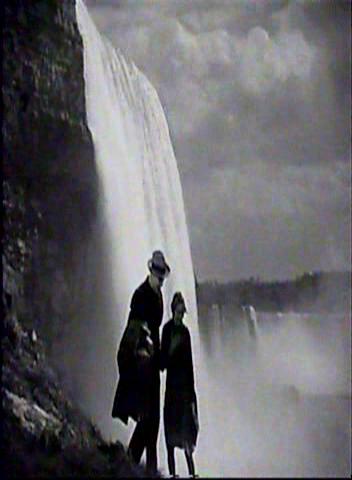
Here in “The Crowd” (1928 - see this previous post), the honeymooners James Murray and Eleanor Boardman are actually shot at the Falls, climbing a pretty steep hill to the side of it.

Rainbow Bridge is behind them in this view.

Here below is another movie, this time a 43-minute B-movie (sorry about the commercials) made in 1941 by Hal Roach, “Niagara Falls”. A couple of couples endure comic hijinks at the “Falls View Hotel”, a much swankier spot than the efficiency cabins pictured in “Niagara.” It stars Marjorie Woodworth, Tom Brown, Zasu Pitts, and Slim Summerville, who is featured at the beginning and the end as intending to end his life by jumping into the falls in his jammies. We shouldn’t be too worried about him, he hasn’t been successful at any other endeavor in this movie. A minor role of another honeymooner is played by Rand Brooks, who you may remember as Charles Hamilton in “Gone with the Wind” (1939). What two years can do to your career.


Then of course we have popular references to the Falls, most notably in “42nd Street” (1933), where we have the musical skit “Shuffle Off to Buffalo”. As we are told, “To Niagara in a sleeper, there’s no honeymoon that’s cheaper.”
Then there is the ever-popular, “Niagara Falls routine”, better known to some as “Slowly I Turn.” Here are two variations on this old vaudeville bit. First, with The Three Stooges from “Gents Without Cents” (1944).


Next up to bat, we have the Abbott & Costello version from their 1950s TV show:


You may remember Lucille Ball having a crack on this theme, too, in an episode of “I Love Lucy”, though the trigger word here is not “Niagara Falls”, but Martha. Niagara Falls is the blast of seltzer she gets in the pus. You can watch in on YouTube here.

For more on Niagara Falls, have a look at this blog.

THIS JUST IN!!!!!.......
Doaf!  Our roving reporter Moira Finnie (catch her here at Skeins of Thought), just reminded me about "Remember the Night" (1940) with Fred MacMurray and Barbara Stanwyck.  Am kicking myself as we speak.  Moria supplies us with these two great shots from the film:


Thanks for the help, Moira.

Thursday, August 16, 2007

All Aboard - Trains in the Movies

The movies began with “The Great Train Robbery,” (1903) a film that lasted all of ten minutes and gave birth to our fascination with the flickers. It also began a relationship that blossomed in Hollywood’s heyday of trains and the movies.

“It’s a taxi!” Audrey Hepburn incredulously remarks to Gregory Peck in “Roman Holiday” (1953), because she has never ridden in one before, to which he sarcastically replies, “It’s not the Super Chief.”

The Chief and the Super Chief brought many actors to Hollywood, and the Super Chief was featured in the film, “Three for Bedroom C” (1952), but many, many films contained a scene or two on the “magic carpet made of steel” about which Arlo Guthrie later sang.

Joel McCrea and Veronica Lake hop a boxcar as pretend hoboes in “Sullivan’s Travels” (1941). Later they get to leap off the moving train. The Three Stooges enjoy slightly better accommodations in “Movie Maniacs” (1935) where their boxcar carries furniture and props bound for Hollywood. They sleep in a large bed, and Curly cooks their breakfast on a working stove. Despite the usual nonsense of the Stooges, Moe gets to say the most sensible thing anybody probably said in the old movies. Curly asks, “How we gonna get in pictures? We know nothing about movies.” To which Moe replies, “There’s a couple thousand people in pictures don’t know nothing about it. Three more won’t make any difference.”

“White Christmas” (1954) includes a famous scene of the four principals, Bing Crosby, Rosemary Clooney, Danny Kaye, and Vera Ellen in a dinning car traveling from Florida to Vermont as they sing about “Snow.” Director Michael Curtiz transforms a static scene to one of seeming Busby Berkley-like movement as they turn a handkerchief, a napkin, and some parsley into a snow-covered hill, with quick shots on all their faces and we see their booth from several angles. It is the most movement in a musical number you could get with all the actors sitting down.

“Since You Went Away” (1944) (see blog entry April 19, 2007 ) of course has the famous scene of Jennifer Jones chasing after the train as she bids goodbye to her boyfriend, but there is a quieter, more meaningful scene in the film as the mother and daughters travel wearily in an overcrowded train at night. We see several servicemen on board, including an amputee. We see refugees, including a young European girl who describes their destitution living under Nazi occupation, and she shudders as the conductor walks by because he is wearing a uniform.

Here Claudette Colbert and Jennifer Jones talk with the elderly woman who tells them her granddaughter was a nurse at Corregidor. The train gives us a sense of being moved along, without our will, to some unknown destiny, and a claustrophobic sense of camaraderie.

A train provides the plot device of a woman pretending to be 12 so that she won’t be charged the price of an adult fare in “The Major and the Minor” (1942), a solution which Ginger Rogers then has difficulty extricating herself from for much of the film.

When “The Thin Man Goes Home” (1944), he goes home on a train, but their dog Asta is caught protruding from Myrna Loy’s coat and must be sent back to the baggage room.

A train provides the honeymoon to Niagara Falls and a musical number from the upper and lower berths of a sleeping car in “42nd Street” (1933) as we “Shuffle Off to Buffalo.”

Joseph Cotten attempts to kill Teresa Wright in “Shadow of Doubt” (1943) (see blog entry: July 2, 2007) by shoving her off a train, with unexpected results.

Trains had the unusual juxtaposition of both being the everyday workhorses of our society back then, and at the same time, representing glamour and freedom from the everyday.

They could also show us the modern technology of our world at the time, or they could open a window onto the nostalgic past, such as in the number, “On the Atchison, Topeka and the Santa Fe” sung by Judy Garland and cast on the train platform, from “The Harvey Girls” (1946).

Can you think of other train scenes?

That’s all for this week. See you Monday.

Related Products