Oh, GAD! It is with only a little tongue in cheek that I wish those who celebrate Easter a pleasant holiday by discussing a movie about a man who refuses to get baptized.
From the first glimpse in the stereopticon images to the opening theme swelling with a rhythm that suggests the clip-clop of trotting horses, “Life with Father” (1947) sweeps us back to a simpler time that is part history, and part parody.
One could categorize this film along with some of the others in the post-War era that seemed to soothe our raw nerves from the experiences of wartime with gentle nostalgia, a family of films that would include “I Remember Mama” (1948), “Good News” (1947), “Cheaper by the Dozen” (1950). But, “Life with Father” has its own pedigree.
The film is based on the famous stage play that, at the time, had been the longest running show on Broadway. On my New England Travels blog this week, we have a look at the Lakewood Theater in Skowhegan, Maine, where this premiered in 1939. A young Teresa Wright, before she came to Hollywood, played the role taken by Elizabeth Taylor in the film.
Like “Mama” and “Cheaper by the Dozen”, “Life with Father” began as a book. In each case, the authors wrote humorous and heartwarming reminisces about their parents. Opposite of the angst-filled, vitriolic, tell-all books popular today, it’s interesting to think that Mama, and Frank Gilbreth, and Clarence Day could be manufactured by their children into characters in American literature.
Perhaps they are not so well known characters these days, but there was a time when at least a couple of generations of readers claimed familiarity with them. Have a look at this post where we discussed popular novels turned into films.
The movie, with sets painted in those pleasing, soft colors we’ve noted in some other post-War color films, takes us back to 1883 New York City, where irascible Clarence Day, a Wall Street financier, domineers his family not so much with sternness as with overpowering confidence that his own judgment is unfailingly right. The first glimpse we get of the great man is of his shadow on an upstairs hall landing. It's a great entrance.
William Powell plays Mr. Day in a performance that deservedly earned him an Oscar nomination. His tolerant wife is played by Irene Dunne. These two, at the sunset of their film careers, are charming in their roles. She would earn her own Oscar nomination the following year for “I Remember Mama”.
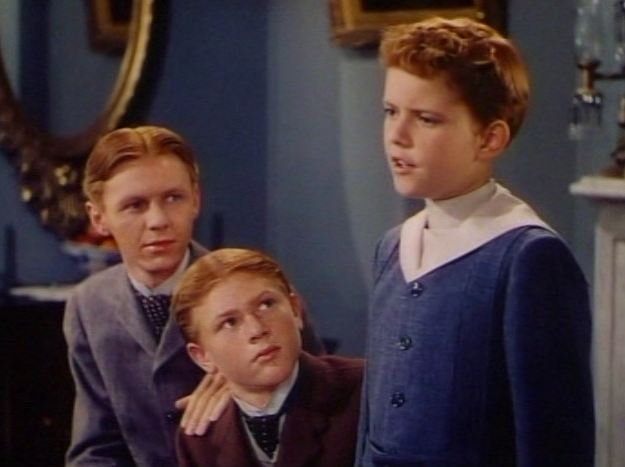
They have a family of four sons, played by Jimmy Lydon, best known for his portrayal of Henry Aldrich (“Coming, Mother!”) in a series of B-movies; a tall 15-year-old Martin Milner in his first film. We last saw Martin here in “I Want You” (1951). Johnny Calkins is next in line, and little Derek Scott plays the youngest. All the boys, like their father, are redheads. Martin Milner reportedly mused that of all the cast, he was the only natural redhead of the bunch.
Monte Blue, from silent film days, gets a brief role as the cop. Zasu Pitts, like Mr. Powell and Miss Dunne, a veteran of Hollywood’s heyday, plays a visiting cousin, but though her role is chipper and chatty, she does not get to display here her tremendous gift for slapstick comedy that we noted in this post on “Bargain of the Century” (1933). It is almost something of a shock to see her act like a regular person, and not that lovable but almost tragically obtuse comic character she created so many years before in Mack Sennett shorts. There’s something vaguely disappointing about Zasu Pitts being normal. I miss the Olive Oyl warble in her voice, and those hysterical expressions that despite their goofiness seemed to indicate a superior knowledge of the human condition.
Miss Pitts comes to town with a young Elizabeth Taylor. With a handful of films already under her belt, Elizabeth plays her ingenue role with confidence. Much has been written lately in the aftermath of Miss Taylor’s passing about her beauty, her iconic image, and her power as an actress. I can’t refute any of that, but I would note that one scene in this film has always stood out for me, and perhaps it’s because it shows the possibility of an alternate future for Elizabeth Taylor.
I mean the scene where she and oldest boy, the Yale-bound Jimmy Lydon attempt a violin-piano duet on “Ye Servants of God”. She does not recognize the tune, though she is familiar with the words of the hymn on the sheet music. The Day family are Episcopalian, and Elizabeth confesses that she was raised a Methodist. The tune is different in the Methodist church. They make several false starts and struggle badly through the piece.
“It was my fault,” Mr. Lydon gallantly states, but Elizabeth, like a 19th Century Juliet unable to socially bond with her Victorian Romeo:
“No, you’re the Episcopalian.” She then remembers that her father had been baptized in the Episcopal church, but joined the Methodist church when he married her mother.
“She was the Methodist,” Elizabeth says, as if she is calling her mother something vile, and it is a sparkling moment of deft comedy. It makes one wonder if Elizabeth Taylor could handle comedic timing so well, so young, what would her career have been like had she not also been so beautiful? Her chirpy voice is an affectation of the moment, but might she have blossomed into a less iconic leading lady, but with a larger range of roles had audiences been allowed to identify with her more and deify her less.
The question of religious affiliation drives a good part of the film, beginning with third son Johnny Calkins constantly seeking help to practice his catechism for his upcoming Confirmation. Still troubled by the “mixed marriage” of her parents, Elizabeth Taylor asks William Powell if he had been baptized Episcopalian, and Mr. Powell jovially confesses he was never baptized at all.
Irene Dunne nearly pops her corset in shock, deeply upset both by Powell’s cavalier insistence that it’s not important, and by the thought that he will not join her in heaven, that they are not really married in the eyes of the church, and that her children are quite possibly illegitimate.
Though she has taken great pains to accommodate the master of the house in all things from scaring away nervous Irish servants, to banishing her new rubber plant, to maintaining accurate household accounts (mostly), she is unrelenting about the horror of his not being baptized and insists he get the ceremony done immediately.
He insists, with what we might consider a quite modern outlook, that he will be a Christian in his own way.
“They can’t keep me out of heaven on a technicality!”
Of course, among Christians, the idea of being a Christian in one’s own way is nothing new. If this were not the case, there would never have been any Methodists or Episcopalians, Lutherans, Quakers, or Baptists, etc. Re-defining, honing perhaps, the essentials of religious practices seems to be part and parcel of what it is to be a Christian.
The movie has a lighthearted grip on this irony, as well as on the elements of Victorian society that also pit tradition versus change. In a scene where Jimmy Lydon asks his father about women, we have William Powell sitting down to tell his son the facts of life, only to sputter about wrong his mother is over her stubborn beliefs. When Lydon wants clarification on men’s relationships with women, Powell turns back into the Victorian father and sternly remarks, “Gentlemen don’t discuss such things.”
Edmund Gwenn plays the gentle minister who makes Powell squirm in his pew (which Powell informs his wife has lost property value in two years - “If the market ever goes up, I’m going to unload that pew.”), by sermonizing on the perils of not being baptized.
“I don’t go to church to be preached at as if I’m some lost sheep!” Powell blusters.
Eventually, Mr. Powell takes his troubles directly to God when Irene Dunne becomes ill. Powell, in a funny, but moving prayer, hollers at the Deity, “Have mercy, I say!” and promises to become baptized if she is spared.
She gets well. It’s time for Powell to pay up, but he still refuses, and it takes a bit more cajoling to get him to the font. It’s another humorous touch that one of the motivating factors that makes him decide to proceed with getting baptized is that the cab Irene Dunne has hired for that purpose is costing him $2 an hour just waiting outside.
One of the sweetest moments in the film is a scene of domestic bliss between Mr. Powell and Miss Dunne, when they sit together, their discussion fading off into a soft duet of “Sweet Marie”. We knew Dunne could sing, but Powell is charming. The camera pans back and we see the stillness, the orderliness of the drawing room with the only movement a slight billowing of the lacy curtains at the window, sifted by the summer breeze. It is a cameo image of the 19th Century.
Michael Curtiz directs this film with his customary economy, but moments like these make one think of Vincente Minnelli.
Another memorable moment is when Jimmy Lydon, wearing one of his father’s old cut-down suits, is unable to kneel in church, or sit with a girl on his lap, or do anything his father wouldn’t do in this suit. The suit seems to control him. When Elizabeth curls up to him, he growls helplessly, “Get up! Get up!” What bigger insult can a young lady have?
The boys try to raise money, and Jimmy Lydon offers his “piece of John Wilkes Booth’s finger” to Martin Milner.
When Irene Dunne laments the newspaper article about a wreck on the old New Haven railroad line because it would disturb Wall Street and therefore her husband: “I do wish the New Haven would stop having wrecks. If only they knew how it upset your father.”
There is, above all, the glorious, just short of scene chewing mastery of William Powell, with his pince-nez glasses on a ribbon, his colossal ranting, and his clear, helpless devotion to his wife. His flirty, “Shall I leave the room?” when Zasu Pitts wants to show Irene Dunne her purchases of intimate apparel.
The horse-drawn streetcar, the quiet country lane that once was Madison Avenue in New York City, and the stereopticon pictures. It’s a feast for the eyes.
And could be a better visual feast if only the film was restored, but it is now in public domain and has become an orphan. (Oh, GAD!) If you’d like to see it right now, here’s a link where you can watch the whole thing, interrupted by a few commercials. It’s not the best way to see this delightful movie, but even Clarence Day couldn’t argue about the price.
“A Stolen Life” (1946) is one of those movies that does not seem to equal the sum total of its parts, but its parts are interesting. Break up the separate themes of this film and I suppose you could have at least three separate movies, so adventurous is the life of the unadventurous character Katie Bosworth, played by Bette Davis. She also plays Katie’s identical twin sister, Pat. Herein lies the main plot device that links the episodes in this film.
While I believe I can be objective and unprejudiced about most issues, I have to state right off that I detest “evil twin” stories. They are mind numbingly trite. I also find them insulting, preferring, like most twins, not to regard myself as a freak of nature.
It’s common to compare twins, to search out something that makes them different from the other. At best, it becomes a benign parlor game of visiting relatives marveling at different interests of the twins.
At worst, it becomes an onslaught of labeling each twin as the one who has better grades in school, which twin is more gifted athletically, which twin is actually better looking or at least has fewer flaws than the other twin. God help the twins if one, or even both of them, is handicapped. What God has put together, the world insidiously tries to pick apart.
In movies, there is a cruel assumption that one twin must have all the positive attributes and the other all the negative. I doubt writers and producers have any idea of the angst this causes in many twins who, if they are lucky, can laugh at the ridiculousness of such a theme, or if unlucky enough to be hit with insensitive comparisons, and self doubt, in real life, must be reminded yet again of the burden of being the “different” one in a society where movies tell them they are freaks automatically.
“A Stolen Life”, however, gives us a slightly more acceptable situation in that Pat is not really evil. She’s self-centered and shallow, but she’s not maniacal. Katie, too, is not exactly perfect. She is quite capable of wheedling her way into what she wants; it’s just that her wants are more simple and wholesome than Pat’s. Their relationship is not completely adversarial, and they seem to mostly live their lives apart. It could have been a film with more depth if it explored this more, as well as issues of co-dependency, instead of just hinging everything that happens to Katie based on her being the “good” twin.
What this film does have going for it is a whole lot of atmosphere, which I suspect is a draw for a lot of its fans. Taking place on an unnamed island off the Massachusetts coast, we get lots of majestic seascape, crashing waves on the rocky New England coastline, a lighthouse that figures prominently in the story, sailboats, a ship in a bottle, and a cozy cottage. Lobstah traps on the wh-a-a-a-h-f, ayuh.
The changeable sea can be dark and threatening at one moment, or gloriously beautiful and serene the next. It’s a great place to set a movie with moods and undercurrents. The isolation of the island can be a haven, or it can be a trap.
The other draw for this film is the remarkable technical achievement of filming Bette Davis as two people in the same scene. It’s done pretty well, and not overdone to the point of milking it. Most scenes have the two women separately, so we get used to thinking of them as different people. In the scenes where they are together, it is like electricity, a tantalizing achievement by the technical crew as well as Miss Davis.
The film starts with a map of New England, zeroing in on New Bedford, on Buzzard’s Bay. The Bay State has a lot of bays. I like movies with maps as much as I like movies with trains. Does it seem like Warner Bros. films have map graphics in them more than the other studios?
Bette Davis as Katie enters rushing from a taxi to meet the last steamer of the day leaving for “the island,” swinging her suitcases with the stickers on them. Not only are there lots of bays, there are lots of islands, but I guess since even a fictional name is not applied, we might infer she’s heading for Martha’s Vineyard. She’s supposed to reach there in two hours, so I don’t think it’s supposed to be Nantucket, which would be a bit longer journey.
Martha’s Vineyard is usually referred to by New Englanders as “The Vineyard.” It’s not a vineyard, it’s an island, but with so many islands, nobody would know what you mean if you said you were going to “the island”. I suspect Hollywood neither knew nor cared about this. And although there is a shot of her sailboat against some bluffs that look like a reasonable facsimile of the western part of Martha’s Vineyard called Gay Head or Aquinnah, the lighthouse in the movie (which is off a point called Dragon’s Head), does not resemble the real Gay Head/Aquinnah lighthouse). See my post on this lighthouse in my New England Travels blog for the real one.
So, right off we’re heading into a mix of fantasy and reality the way Bette heads right into the mysterious fogbank. I would love to know where some scenes in this film were shot. Some of the quaint New England seaport village stuff is obviously back lot, but there’s enough real coastline that teases us.
By the way, the airport scene was filmed at the actual Long Beach, California airport. Other movies were, too, and we’ll have more on that next week.
The lighthouse is particularly intriguing. Close-ups of its front door may be a partial replica built anywhere. Distant shots against a backdrop of glistening ocean could be a miniature model on a scaled down set. However, there are mid-range shots of Bette actually hopping off a boat, trotting up the dock up to the lighthouse, which makes me think at least some of this is an actual location. I’ve read somewhere that Laguna Beach, California was one filming location, but I’d love to know more detail on that. One of the other interesting aspects of this movie is how well they splice visuals together.
Katie, missing the ferry steamer, hitches a ride to “the island” from Glenn Ford, who is the lighthouse keeper’s assistant just about to leave the wharf with a motor launch full of supplies. On the way she sketches him, and we learn she is an artist, a woman who is sensitive and playful, yet down to earth.
Mr. Ford is handsome as can be here, a rugged but gentle and introspective chap who has forsaken a promising career as an engineer to work as Walter Brennan’s assistant at the lighthouse because of the simple life and freedom it offers. Mr. Brennan in his usual role of the comically crusty old codger doesn’t really have too much to do in this film, but he adds as much atmosphere as the lighthouse and the fog. His natural born eastern Mass. accent fits nicely with his role, no phony Yankee here.
For that matter, our Miss Davis hails from Lowell, Mass., so she seems to fit naturally among the all the pseudo New Englanders populating this faux community. We see her striding about in her casual trousers and flats, the wind tussling her hair carelessly, or in jeans and sneakers, and sweater, doing away with Hollywood glamour in this role. She seems pleasantly authentic, a woman/actress on her own turf.
With the lighthouse scenes, we might also muse on the film’s efforts to recapture a romantic past, or at least to ignore the realities of the present. We see painted above the door of Walter Brennan’s lighthouse “U.S. Lighthouse Service”. When this film was made in 1946, there was no U.S. Lighthouse Service. This government bureau was ended in 1939, capping an era throughout the 1920s and 1930s when more and more lighthouses were being automated, discontinuing the need for lighthouse keepers. In 1939, the U.S. Coast Guard took over the management of lighthouses. This post-war movie continues the romantic fantasy of the lonely intrepid lighthouse keeper, ignoring the possibility that Walter Brennan would have been downsized.
We are not given much back story on Katie and Pat, except that Charlie Ruggles is their cousin and their guardian. They are visiting him in a cottage on “the island” which he has rented for the summer. Mr. Ruggles is ever the delight in his films, with that finely drawn mixture of kindly bumbler and sharp-as-a-tack gentleman of the old school.
Katie relates that this is her first time to “the island”. However, she’s learned to sail somewhere, and she wastes no time taking out her sailboat to visit Walter Brennan at the lighthouse. She wants to paint his portrait and bribes him with a ship’s model he covets to do so, but it is a ploy so she can spend more time with Glenn Ford, with whom she has fallen in love.
(Small point here, but I like the way she handles the paintbrush, deftly rolling it in her fingers, changing her grip on it as she concentrates on the detail of her portrait of Mr. Brennan. It looks like she knows what she’s doing.)
We see that, far from being the perfect “good” twin, Katie can be cunning, duplicitous, and secretive, but we can also see that she has a very understanding heart. She earns our sympathy from the beginning with her confessions of loneliness and her quiet charm.
The movie pulls a nice trick on us by not revealing Katie has a twin until she enters her bedroom at the cottage after a date with Glenn Ford, to find her sister Pat lazily lounging in a chair. Pat peeks her head around to notice Katie in the foreground of the shot, still in the half shadow. Her voice is familiar. They chat companionably, and in another moment, Bette Davis walks over to the chair where her sister sits, turns on the lamp. GASP! There are two of her! Then she hands her twin a match so the sister can smoke a cigarette. One senses this shot was most gleefully done by everybody involved.
Notice however, that Katie does not light Pat’s cigarette, but reaches down to put the match in Pat’s hand, which rests on the arm of the chair. They are cleverly covering the joined exposures here. In another moment, Katie is in bed, and Pat flops on the other side to chat a bit more, seeming to pick at Katie’s sleeve as she speaks. Another good matching of exposures here. There’s not too much of this in the film, it would detract from the story, but it’s a lot of fun to watch.
Pat, we discover, is more worldly than Katie, more sophisticated, bored with “the island” and her wealthy friends in Hyannis on Cape Cod. Perhaps it is her boredom which leads her to make a play for Glenn Ford, tricking him into thinking she is Katie.
Mr. Ford is a good sport at first when he realizes he’s been fooled. Then decides it is Pat he really loves. Considering we are set up to believe he and Katie are meant for each other, and we are also set up to accept Pat as a self-centered man trap, it seems a bit of a stretch that his swell guy would fall for what seems so obviously artificial to us. But, fall he does, preferring as he says “the frosting” rather than the cake, as he also says most men will.
“Must you always let that sister of yours get ahead of you?” Charlie Ruggles demands of Katie, wanting her to fight for what she wants. She avoids being competitive with her twin (more could be made of this), but she determinedly side steps the bridal bouquet Pat later merrily tosses to her. We see Katie has a recalcitrant side.
Pat’s conquest of Mr. Ford happens rather swiftly at the local barn dance. New Englanders, you see, love square dancing. You can tell by how many Hollywood movies have New England square (sq-way-uh) dances in barns or at the town hall. We see it in “Christmas in Connecticut” (1945) (where we also see our penchant for riding in sleighs, see this previous blog post) and “Summer Stock” (1950), and so we have to have one here. A good old b-a-a-h-n dance. The other thing we do with b-a-a-h-ns is turn them into playhouses for the local summer stock company. Like in “Summer Stock”. Summer stock in New England is sometimes referred to as The Barn Circuit (or The Straw Hat Circuit).
In fact, our Bette Davis in real life got her start in such a barn at the Cape Playhouse on Cape Cod, where she was an usher before graduating to bit parts. Have a look here in my Tragedy and Comedy in New England blog. (Come to think of her, her hometown of Lowell now has a first-rate professional regional theatre, the Merrimack Repertory Theatre. She’d be pleased. Except it’s not in a barn. Uh, that’s b-a-a-h-n.)
By the way, Mr. Lippincott, who owns the b-a-a-h-n, is played by silent screen actor Monte Blue, according to the IMDb website. Other silent screen stars have uncredited roles as well, including Snub Pollard, who also shows up at the b-a-a-h-n dance. He appeared in eight movies in 1946, all in bit parts that must have kept him eating. Creighton Hale is also listed as an extra.
Pat sweeps Glenn Ford off his feet at the b-a-a-h-n dance, and they get married. Katie heads back to the family mansion in New York to brood and paint. She is not alone. Dane Clark shows up to brood and paint, and bully her with insults, which Kate takes with astonishing serenity.
Here is where we have a branching off of plot that could make a separate movie. Dane Clark is a starving artist of, we are told by him, great talent. His role is similar to John Garfield, the dismissive pianist in “Four Daughters” (1938), see this previous post, who was also poor and talented, with a really lousy attitude.
Mr. Clark, however, does not seem to have the same knack John Garfield had for drawing our sympathy. Clark’s character is without any humor about others or himself. His arrogant proletariat rudeness toward Katie makes her seem far more a doormat than she ever was when Pat stole her boyfriend. A person living in the shadow of a more glamorous or accomplished sibling is a common story, in the movies and in real life, but here we wobble uncertainly as to what is the cause of Katie’s malaise.
Dane Clark’s explanation is simple and cruel, “You two disliked each other from the time you were born. It’s a perfectly natural antagonism.” This presumptuous and ignorant conclusion is what drives most “evil twin” stories and is perhaps one of the other reasons I dislike them so much.
Mr. Clark, who seems to thrive on antagonism himself, criticizes her painting, making a further accusation, “I bet you’re not even a woman.”
When she asks him for clarification, he sneers like a little boy who has thrown a rock at a bird and delights in having hit it. “That always gets ‘em,” he says.
From the time Pat is said to have “frosting” to the time Mr. Clark indicates Katie is not a “ball of fire”, we are seemingly meant to infer that Katie’s reticence is more than just a meek acceptance of stolen boyfriends and angry artists. She may not be sexually experienced, which may explain Clark’s ridicule. She is hardly shy; it is she who pursues Glenn Ford, but she is not sexually aggressive in the way Pat is, and perhaps we are being told this is one of her flaws.
According to the Hollywood on Twins Playbook, if being oversexed is Pat’s character trait, then Katie must be afraid of sex, for as we seem to be told, tiresomely and yet again, that twins, individually, are not whole people, that only together they have all the attributes of a human being. Individually, they are only fragments of a person. When the egg in the womb splits their chances at ever being a complete person evaporates.
There’s probably a lot more dime store Freud in here that I’m missing, but you get the idea.
But, Katie, passive or not, seems to impart a kind of courage, a stoic survivor’s attitude, bearing up under Pat’s callousness, under Walter Brennan’s blustering, under Dane Clark’s insults, and even under Glenn Ford’s hideously thoughtless request that she help him pick out intimate apparel for Pat’s present on their birthday.
The older men in this film are more interesting than the younger men. Ford and Clark act like pinheads hijacked by their own insensitivity, who are either manipulating or being manipulated.
Katie seems to get some of her moxie back when she efficiently rebuffs Dane Clark’s rough advances. He actually looks crushed and his scowl departs for about two seconds. Unfortunately, she also declares herself a third-rate artist in comparison to his talent, and we must wonder if she is giving up her art because she cannot be the best.
Katie heads back to “the island”, unexpectedly finds Pat there also seeking refuge, and the twins companionably head to the wharf to go sailing, striding through town in their jeans like a Doublemint commercial. This is a long shot with Bette and a double. The split-screen close-up was done in the studio with rear-screen projection.
Pat has become outdoorsy like her sister, perhaps feels more than she actually expresses of her regret in marrying Glenn Ford, and they get caught in a storm. I realize this entire post has been a spoiler, as all my posts are, but if you don’t want to know what happens next, you’d better go down to the corner for a newspaper. Bring me back a candy bar, any kind.
Did they leave? I thought I heard the screen door slam. Okay. For those of you who have remained, I’m going to assume you know I’m going to tell you that one of them drowns. It’s Pat. Here’s where the plot splits again and could be the story for another entirely separate movie.
The scenes of the twins sailing in the storm are skillfully done, with Bette and a double alternately blocked by the swinging boom. She, and the double, had to film this scene separately as Pat, and as Katie, being battered by wind and soaked by waves. It’s all stitched together quite well, even more impressive when you realize it was filmed on a set.
Katie, who though distressed at the loss of her sister does not express anywhere near enough the realistic anguish of the situation, impulsively decides to say nothing when she is mistaken for Pat. Her rescuers think it was Katie who drowned. Katie plays along, thinking this is her chance for happiness being the wife of Glenn Ford.
(The scene with the beleaguered sailboat smashing against the rocks of the lighthouse ledge reminds me of “Portrait of Jennie” (1949). You wonder for a moment if Joseph Cotten and Jennifer Jones are going to scramble over the rocks.)
Assuming the identify of a deceased person is also not a new plot idea to film, but using identical twins makes an interesting twist because Katie now moves about incognito, disguised in plain sight. As such, she is comforted by Walter Brennan and others who tell her that her sister Katie was such a wonderful person. It’s like being at her own wake. Very eerie and emotional, and more could have been done with this.
Even Dane Clark displays his own belligerent sense of grief when he shows her that he has painted a portrait of Katie from memory.
Now, Katie must run an obstacle course of fitting into Pat’s life. The easiest part is making Pat’s dog, Mike, accept her even though Katie doesn’t smell like Pat. Mike is not fooled. Mike is the smartest character in this movie.
But, she gets around him with treats. Even Mike, it seems, can be bought.
However, Katie’s game of pretend comes crashing down on her head when irony akin to an O. Henry story slams her in the chops. Glenn Ford wants to divorce her because Pat has had affairs with other men. Katie runs back to safety of “the island”, where Charlie Ruggles figures out her secret, because he’s almost as smart as Mike. We are given one of those slapped-on happy endings because somebody must have noticed they were running out of film and it was time to end the movie.
It’s still a fun movie, for all the tangled plot threads, but especially for the technical achievements, and the atmosphere. It makes an attempt to carve out an old stock melodrama using film technology and good old film theatrics. But there’s a story missing in all this contrivance. It’s the twinship that never gets told, that Hollywood never seems to get a handle on.
And I’m not even going to mention the Carol Burnett parody.
For a look at the striking scene where Bette Davis meets up with herself, have a look below. (Don’t forget to scroll down to the bottom of the page and pause the music.)
“The Undersea Kingdom” (1936) - Chapter 10, to be precise, is a sliver of a serial produced by Republic in the days when kids would have to come back the next week to see if the hero got free of the mine shaft explosion or the train wreck. He always did, and it was usually by showing how, in re-capping last week’s episode, that he had jumped clear of the train before it crashed, or was never even in the mine when it exploded. One feels glad, but just a little cheated.
Ray “Crash” Corrigan starred in “The Undersea Kingdom,” which also featured a rather down and out Monte Blue, former romantic lead in silent movies, now reduced to playing Unga Khan, the villain of the piece who wants to rule the world. Villains always seem to want to rule the world, despite what a bother it is.
Also featured are Lon Chaney, Jr., and Smiley Burnette, but B-movies were nothing new to them, and Crash Corrigan would never do better for himself than B-movies and serials, where he did have a following. Mr. Corrigan started as what was called a physical culturalist back in day, a physical trainer to the actors. He got his name Crash because once he got into small roles, he did his own stunts. Known for a great physique, he spends much of this serial bare-chested, in what looks like a bathing suit, boots, a cape, and a helmet on his head that resembles a hood ornament. Anyone else would probably have gotten a headache from wearing it after a while, but our man Crash was in good shape, as we are continually reminded.
Crash is assisted by Diana, girl reporter (there are always girl reporters in these things), and Billy, a young boy who wears a dark tie and shirt, and a sailor cap making him look a little like an American Hitler Youth, and young Billy’s father, the Professor, who has been hypnotized and is under the power of Monte Blue, the bad guy.
The acting could be called forgettable, except you can’t forget it, with lines like, “If they see you, it’ll be just too bad.” In this episode, a horse-drawn chariot race occurs on hillsides of California scrub. It doesn’t look very much like Atlantis, unless perhaps Atlantis had a terrible drought that year. There are enough horses to make this seem like a Western, except all the villain’s army are dressed like they’re performing in “Lysistrata.”
There is no blood in the clashing of soldiers, perhaps because we can see that they stab each other with swords under the arm, the way we did as kids with sticks.
What is fascinating about the series is the prescient references to things that were just on the horizon for us as a nation. An attack on a fortress brings retaliation in the form of cannon-like contraptions built into the walls called “flame-throwers.” Unga Khan keeps track of his enemies by viewing them on what looks like a television set. The whole taking over the world scheme is reliant upon Unga Khan’s being able to use the Professor’s experience in harnessing the atom, and a nuclear submarine. This was still 1936. It seems as if we’d heard of these modern marvels, and we couldn’t wait for them to happen to us.
At one point, when Crash is told, “My son, on your shoulders likes the safety of Atlantis,” and he responds by making what looks for all like a “Heil Hitler” salute.
The only aspect of “Undersea Kingdom” that truly is realistic is the bit about a villain wanting to take over the world. Perhaps because of a steady diet kid’s adventure serials and science fiction plots about mad scientists and their evil plans, we reacted too slowly when we saw the mad men wanting to take over the world in real life. It seemed too unreal to be real. It was laughable, until it wasn’t anymore.
And, besides, even though the hero gets crushed by a falling wall at the end of Chapter 10, we somehow think everything will be all right anyway. We’re told, are we not, to come back next week and catch the next exciting episode? Chapter 11 is called, “The Flaming Death.”
Since Bastille Day rolls around this Saturday the 14th, today and tomorrow we’ll have a look at Hollywood’s view of the French Revolution with “Orphans of the Storm” (1921). Hollywood’s view by way of Long Island, where the movie was shot, though the look is credibly 18th century France, and this was one of director D. W. Griffith’s best films.
Real life sisters and silent film icons Lillian and Dorothy Gish play adopted sisters who travel to Paris for a doctor to treat Dorothy’s blindness. On the road, they meet a lecherous Marquis with designs on Lillian, who paints his lips with lipstick before engaging her in flirtation, and who inappropriately touches both the flowers on her bodice and one of her sausage curls. We see he has nefarious designs on her. In Paris, he arranges his henchmen to kidnap Lillian for an evening of debauchery.
We are introduced to a number of characters and plot lines, and how Mr. Griffith (as Lillian used to call him) intersperses this is nothing short of masterful. We meet the handsome young Chevalier, played by Austrian actor Josef Schildkraut in his first American film. His uncle and aunt, the Count and Countess, played by Frank Losee and Katherine Emmet represent the aristocratic class soon to fall prey to the vengeful starving masses, represented by the glowering Jacques-Forget-Not, played by Leslie King.
There is a huge scope of political and social history being diced up for our easy digestion here. A huge swath of time is telescoped in the individual stories of these people whose lives become linked through misfortune, coincidence, and the swift march of historical events.
Mr. Griffith tells us in the prologue that all this French Revolution soured into murderous anarchy by “otherwise highly moral men except that they saw evil in all who did not THINK AS THEY DID.” He even uses the anachronistic term of bolshevism to describe their dissent, and Robespierre is deemed a “pussy-footer” for blowing with the wind politically. Another fun term of days gone by. His use of the term bolshevism, and perhaps the film itself, is a reaction to the “red scare” in the U.S. in the early 1920s.
The Court of King Louis XVI is lavishly presented, with enormous interiors of great halls and salons, and palace exteriors huge in scale. In one scene, courtiers are moving in procession in the great hall, and floor is so polished we can see the reflections of the actors.
The village streets are paved with cobblestones, and the filthy hovels of the poor peasants are shown in stark contrast to the grand environment of the aristocrats. The detail is exceptional.
Danton, played by Monte Blue, is introduced to us as “The Abraham Lincoln of France,” in a scene where he confers with the visiting Thomas Jefferson and Marquis de Lafayette. When Danton sees the young Chevalier distributing bread to a flock of starving peasants whose desperate looks he cannot escape, Danton remarks, “If more aristocrats were like you, things would be different.”
But they’re not, at least not in this film. Even the Chevalier’s family is known to have committed terrible atrocities in punishing its estate tenants, including the father of Jacques-Forget-Not, who had boiling lead poured into his veins. In this flashback scene, the Chevalier, still a boy, looks on. As boy he is played by Kenny Delmar, who you will remember as the voice of Senator Claghorn on Fred Allen’s radio show. The cartoon character Foghorn Leghorn was based on this Senator Claghorn character of Delmar’s. You can take a moment to play Six Degrees of Foghorn Leghorn. Tomorrow we’ll get back to the film.