Old Hollywood seems to have had a love affair with the automobile. Today when we see a car in the movies, it’s probably going to be destroyed in an elaborate crash sequence. Back in the day, the confines of the auto interior was the secret world where characters fought, hatched evil plans, whispered confidences, fell in love, took hostages, pursued their dreams, or escaped from a bad reality.
We’ve got some pretty good guesses to Monday’s screen cap trivia on motorists and their passengers. Here’s who they are:
A. The only right-control car in our collection tells us this is not in the U.S. Alexis Smith is behind the wheel in “The Sleeping Tiger” (1954) with Dirk Bogarde riding shotgun.
B. Barbara Stanwyck and Fred MacMurray snooze in “Remember the Night” (1940).
C. Celeste Holm, Bette Davis, and Hugh Marlowe run out of gas in “All About Eve” (1950).
D. In “Split Second” (1953), Robert Paige rides shotgun, and in the back seat are Frank DeKova, Paul Kelly, and Stephen McNally as the ultimate backseat driver. Alexis Smith takes the wheel again.
E. Patricia Owens and Jeffrey Hunter, with their moving van following behind them, drive to their new suburban home in “No Down Payment” (1957).
F. “Conflict” (1945) has Humphrey Bogart at the wheel, Rose Hobart his front seat passenger, and behind we have the eerie shot of Alexis Smith’s eyes in the rearview mirror.
G. June Allyson and William Holden take a ride in “Executive Suite” (1954).
H. Errol Flynn is in the back seat in “Footsteps in the Dark” (1941), chauffeured by Allen Jenkins.
I. Jane Russell and Victor Mature cruise the strip in “Las Vegas Story” (1952).
J. That’s perennial sidekick Ruth Donnelly with Jean Arthur at the wheel in “More Than a Secretary” (1936).
K. Kim Novak and Fredric March get cozy in “Middle of the Night” (1959).
L. Jean Peters and Max Showalter, also known as Casey Adams, drive to “Niagara” (1953).
M. Judy Garland and Eddie Bracken in “Summer Stock” (1950).
N. Walter Brennan and Teresa Wright in “Pride of the Yankees” (1942). I find this shot endearing, as in real life Teresa Wright was nearsighted and wore her glasses off set. Her acting is perhaps unconsciously realistic in this scene as she squints to be able to see the “road” ahead of her. Apparently nobody told Miss Wright that was all just rear screen projection passing by and they weren’t really moving.
Showing posts with label Executive Suite. Show all posts
Showing posts with label Executive Suite. Show all posts
Thursday, July 5, 2012


Monday, September 5, 2011
Middle of the Night - 1959

Middle of the Night (1959) begins with a camera shot out the back of a moving truck in New York City traffic. It is early morning. The soft strains of a single oboe lend a contemplative touch. We float through the traffic and the pedestrians (actual New Yorkers going to work and unaware they are being filmed from the back of a truck). We head into the Garment District, and we see workers pushing rolling racks of clothing on the street. Here is where Fredric March spends his days and a good many of his nights as a clothing manufacturer.
We celebrate Labor Day today with a look at this terrific film about a middle-aged widower, a self-made man and workaholic, who begins a romantic relationship with his 24-year-old receptionist, played by Kim Novak. Their performances are powerful, and the script by Paddy Chayefsky adapted from his Broadway play, is the kind of introspective, sensitive, and adult (in the real meaning) story we rarely see anymore. There are no “Storyline for Dummies” cliché images; we are meant to take our time, and expend a little effort, to understand.
Directed by Delbert Mann, the film, being film, takes us places that the stage play can’t - outside in the wintry streets, allowing us to examine the cold stone exteriors of the claustrophobic interiors were we spend so much time.

The scenes showing the love story between Kim Novak and March, and the emotional confrontations with their families, are always interspersed with scenes of the workplace. Unlike like many films showing career people in turmoil, here it is the job that represents the sane, safe place, and the home life is the source of tension and chaos.

Just beyond the office is the factory floor, where men are cutting out clothing patterns on long tables, and Fredric March takes a moment to have a coffee in a paper cup with some of his salesmen, who tell tales of the road. They are all middle aged men, feeling the angst of knowing their own mortality, and morbidly gossip about whom among their peers is sick and who is dead.

Dekker playfully leers at Kim Novak, and she is unnerved, ready to fall apart.

When March is heading out the door to his union meeting, he stops, in his hat and coat, to try one more phone call to this woman. Though we hear only his side of the conversation, we watch him become deflated as she brushes him off, and tells him she has married someone else. As pitiful as the scene is, Mr. March is not the kind of man to ask for pity. He is gracious and gentlemanly on the phone, though his voice shakes and his lips tremble.
It is an interesting sketch of a man who, as we are gradually told through the film, came to this country as a child, had no formal education, and though he lived through some hard and miserable times on the street, worked diligently to establish his own business and thrived. Not only did he work hard, but he learned -- from others, from the people around him whether they were his workers or others, perhaps bankers and business associates, and teachers from the design school he attended -- people who were his superiors in education and society -- how to speak and how to behave like the man he wanted to become. We sense that though he came from the streets, by the time he worked his way up to his own factory floor, he left streets outside.

Cut to later in the evening when she is telling a funny story about her teenage years, and we see he is laughing and enjoying her company. He breaks up the evening only long enough to make a quick call to the union meeting and tells them affably, with only mock gruffness, “All right, tell them we’ll make it six cents a seam.” He used to belong to a union himself. He knows that workers have value, not just because of what they can do for him, but because they are human beings and so is he.
And those of us who had been union factory workers or children of union factory workers know that each sick day, health benefit, or few cents an hour raise came not through the corporation’s benevolence, but by fighting tooth and nail for it.
In one scene, March is urged by his salesmen to take on a big new client and dump the little ones. He refuses, because they have been faithful customers, these smaller stores who buy his merchandize. He treats his customers with fairness and respect, because they have been with him through thick and thin, and he knows the bigger conglomerates will not extend him the same courtesy. “We don’t chisel our customers for anybody!”
Mr. March finds himself smitten with Miss Novak, astonished that it should be so, but with honesty and frankness, has already diagnosed himself as going through a midlife crisis. Because of his unflinching analysis about himself, he is able to apply the same direct focus on her problems. She feels confidence in him, and he helps her to untangle her emotional pain.
We see a shot of him later on in the movie pinning a cloth pattern on a dressmaker’s dummy, smoothing the fabric over the shoulders with a capable, almost loving touch. We sense his knowledge of human beings developed through years of making clothing for them, as if in creating this shell for the outside of the people, he has gained knowledge of what’s going on inside them.
Their relationship is tenuous, frightening for both of them. They pull away, and get back together with frustrating repetition. We are reminded by them, and by their unsympathetic families how impossible or inappropriate a romance between a 56-year-old man and a 24-year-old woman is supposed to be. We are shown no fairy tales of love conquers all or automatic happy endings, but we see the struggle of loving and being loved.

I love these films of the late 1950s and early 1960s when we get to see the greats of Hollywood’s Golden Age matched up with the rising young TV-trained stars. We saw some of this before here in The Dark at the Top of the Stairs (1960) -- another Delbert Mann-directed movie.
In some scenes, Mr. March tentatively talks about his youth, which is tied inextricably like everything else in his life, to his business. It is as if he tries to explain himself to her, for the sake of transparency let her see the goods before she buys. During one such scene, they are in the work room late at night alone, he in his shirt sleeves finishing up an order, tracing markers for a pattern.
He talks about being a kid of 14 when he started work. “I joined the union, they made me a goon…you don’t know what went on here 30, 40 years ago. Bosses hired gangsters, we hired gangsters. People were murdered right in the streets here.”


Novak defends her relationship with Mr. March, “I don’t have to beg him for kindness; he gives it with both hands.”
We know what they want and they know what they want, the question is, are labor and management able to get together? And would world end if they did?
As long as we’re talking about juxtaposition here, a good film to watch with this movie is the HBO documentary Schmatta: Rags to Riches to Rags (2009).

What do they know about making clothes? This is what one laid-off garment worker in the film wants to know. Maybe nothing, but they do know that slave labor, including that of children, in overseas sweatshops makes for a sweet profit.
There are many interviews with garment industry workers from all levels, from sewing to the designers. One recalls her immigrant mother quitting her sewing job one day -- I believe this was in the early 1960s. The woman, herself a laid off garment industry worker today, recounts with disbelief that her mother simply walked into another factory and got a new job that same afternoon. There was a sea of jobs in what had been the largest single employer in New York City. And over 90 percent of those jobs union.
Archival footage showing us fashion through the decades. We see the guys hauling rolling racks of clothes along Seventh Avenue, and the enormous work rooms full of sewing machines, the designers who in the 1970s and 1980s became rock star famous, the bridal shops, the sportswear and separates, the ranchero scarves, and the glitz of the sequined 1980s. It’s a fascinating ride through fashion and culture, and money, and politics.
A stunning montage shows that in 1965 about 95 percent of the clothes bought and worn in America were made in America.
In 1975, that dropped to 80 percent.
In 1985 - 70 percent.
In 1995 - 50 percent.
And in 2009, the year this television documentary was made -- only 5 percent of the clothing sold and worn in the USA was made here.
That’s a lot to think about, and I leave you to think about it. Happy Labor Day.
*********
Jacqueline T. Lynch is the author of Ann Blyth: Actress. Singer. Star. and Memories in Our Time - Hollywood Mirrors and Mimics the Twentieth Century.
Monday, September 6, 2010
Executive Suite - 1954

Robert Wise is the director, and we start from the first moments of the film with bold credits flying toward the audience while an ominous sounding bell tolls…for whom? For everybody, it seems. Maybe even us.
The bell sits in the tower above the executive suite of the title, in a downtown stone monument of a building that serves as the corporate office of a furniture company. We are not yet in the days of suburban industrial parks. We are downtown where the action is.
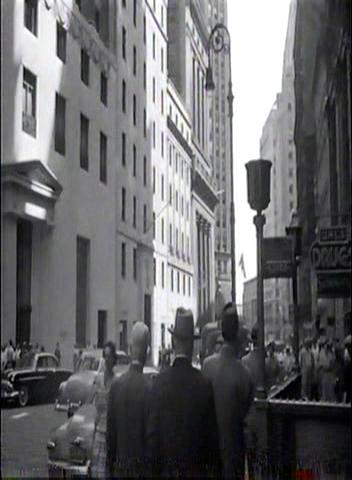
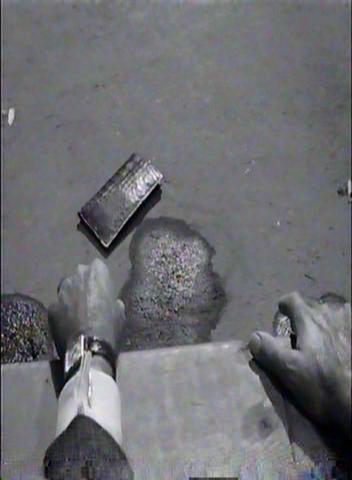
Then he hails a cab out on the sidewalk and crumples to the ground, dying instantly of a heart attack. We see, through the camera and his eyes, the swirling buildings, and the clear sky above

Once it does, he can buy it back for next to nothing. In the weeks to come, the stock will rise. He will make a tidy profit.
His cheap sell-out scheme lays out before us the message of the film. We get there, by and by.
It is fun to see Mr. Calhern’s meltdown when the Big Boss, whose wallet was stolen by a passer by when the ambulance arrives, is taken to the city morgue as a John Doe, and wrecks the timing on Calhern’s game.

Paul Douglas is the hail-fellow-well-met head of sales, who settles deals on the golf course and a bribe of a bottle of scotch. It is the charming façade of a spineless company man. His mistress, and secretary, played by feisty Shelly Winters provides the ego boost he needs, along with other comforts. Until he lets her down, and she shows more pride and mettle than he has.

There is William Holden, as the Bright Young Man, who works in product development and represents the idealism that the Big Boss and his partners once had, but have abandoned in the lure of making an even bigger profit.

I wonder if the furniture in his ultra modern house was made by his own company, and if it’s the good stuff or the cheap knock-off stuff, and if he got a discount?
Check out Walter Pidgeon’s home and we get an eyeful of traditional furniture, a nice contrast that tells us a lot about these two men, their perspectives and their eras. Furniture is not just set dressing in this movie. Look at the medieval design of the woodwork in the executive suite. The stained glass windows behind Holden during his big speech make him seem like an evangelist.


They all have their own agenda. Mr. Holden pouts because his latest product development test got messed up. The Big Boss, who once promised him free reign to improve their furniture, let the ball drop and fell under the spell of business ideology such as Fredric March’s character, Mr. Shaw, where profits are to be doled out to stockholders and not reinvested in the company.
Holden complains, “Improve the profits but never the product. That’s Shaw’s philosophy,” he says of Mr. March. “To him, the whole company’s just a curve on a chart.”
Dean Jagger, a hands-on man like William Holden, who helped start the company, resents Holden’s supposed “golden boy” (so to speak) position with the Big Boss. Mr. Jagger practically invented furniture, he seems to say, “And I didn’t need the boy wonders and the slide rule experts to show me how.” (See this previous post for our discussion on slide rules. My gosh, there’s a link for everything in the post.)
Mr. Jagger is so fed up, he is planning on retiring, and let the company crumble. I love Holden’s admiring smile across the boardroom table when Jagger says he is taking a weekend trip to sail on his boat and eat Maryland crab. It’s a small touch but says volumes about mutual appreciation and comradeship that can exist in companies as well as enmity.

Walter Pidgeon’s wife complains that he has been living in the Big Boss’s shadow, and urges him to make a play for the top job.

They argue details, but March has clearly assumed control. Walter Pidgeon, ever the gentleman from the old school, is aghast that Mr. March does not intend to close the factory out of respect for the deceased.
Time is money.
Suddenly the plot shifts from what will happen to these board members, to what will happen to the company.
To save it from the nefarious clutches of Fredric March and his ilk, Holden, the reluctant hero, must convince Walter Pidgeon to anoint him heir. Holden must dicker and pontificate in the boardroom in a tense scene to shake them up and win their confidence, rather like a politician. And he must shame Barbara Stanwyck, who holds a controlling vote, into dropping her self pity for two seconds to consider the lives of others and the legacy of this furniture company that bears her family name.

The workers are worried the plant will shut down now that the Big Boss is gone and things are so unsettled. Some complain about the junk furniture they manufacture, a far cry from the good old days when they were proud of their product.

Holden has no answers. But we know where they went. We’ve already arrived.
Have a look at this link to a New York Times story from July about the Harley-Davidson motorcycle manufacturer enjoying soaring profits, more than triple from a year ago. Reaping the profits, specifically, are the shareholders. The workers reap pink slips. Around 1,500 people will be let go by the end of this year. As the article notes, many other manufacturing firms reaping profits this year did so by trimming the fat, which in business terms always seems to mean people, and do not intend to use their profits to rehire anytime soon.
It’s endemic, this cutting the fat. Check out those self-service checkout lines in grocery stores, the ATM in the bank lobby while two tellers work in a bank that has eight empty teller windows, even the new self-service checkout stands in libraries. Cuts down on the need for librarians to check out your books. All for your convenience isn’t it? Yours or theirs?
So much convenience and so few jobs.
“Convenient!” Mr. Pidgeon blasts Mr. March, “That’s always been your attitude…to make everything as convenient as possible for yourself!”
It is interesting, and somewhat astonishing, to note that what we might lament as the failure of industry in this country and corporate greed today had roots as far back as 1954, specifically the notion that the product will become inferior and the jobs will be lost if the only object is profit for the shareholders.
We were enjoying one of the most energetic and profitable business booms of all time in the early 1950s. But here in this film, we see the veneer crack a little. In industry and in the cheap line of furniture this company has been making, shaving off quality to bolster the bottom line.

William Holden gets thrust to the top of the heap when he decides to take the responsibility to point out how lousy things have been run in the company. He assumes a leadership role by doing this, thereby anointing himself.
While we listen to his words, our minds may wander a little bit from the plot to what is going on in our own lives.
Fredric March spells it out succinctly, “I believe that a company is answerable first and last to its stockholders.”
Mr. Pidgeon protests, “I get it. Manufacturing and selling don’t count anymore.”
Mr. Holden agrees with Pidgeon, “Sometimes you have to use your profits for the good of the company, not paying them all out in dividends to impress the stockholders with your management record.”
Mr. March contends, with a nod to the brooding Miss Stanwyck at his elbow, that the Big Boss ran things that way. Holden comes back with a remark that seems to speak directly to us.
“He was wrong, the way a lot of people are wrong these days, grabbing for the quick and easy, the sure thing. That’s just a lack of faith in the future.”

He talks about workers on the line who prefer to take a pay cut to post to other jobs in the company, just to avoid working on the really cheap crap they’ve been making because it damages their pride.
He tells Barbara Stanwyck that they must put out product that she will be proud to bear her family name.
Do we still have that kind of pride? Willing to take a pay cut to avoid demeaning ourselves? As for pride in family names on companies, in a world where most of our big corporations are acronyms or just a meaningless jumble of vowels and consonants arising from many names over the course of many takeovers, do we really know what company we’re dealing with when we buy that item?
Though the movie ends on a hopeful note (except for Fredric March, whose sickened expression after losing the presidency of the company is priceless), we may not be able to help brooding on the old lady laborer, who walks out of the factory with the swarm of other workers after punching out, to ask William Holden about their future. They know the company is in trouble.
“Everything’s going to be all right, isn’t it?” She asks.
“Don’t you worry about it,” he tells her with a comforting smile.
“But you weren’t here in ’33, you don’t know how it was…”
I wonder, do we know now?
William Holden only guessed at catastrophe for the company and the nation in a booming 1954 when the net dividend for the stockholders was starting to become the benchmark for the health of the company, not the quality of its goods or services, not how many people it employed or if those employees were able to earn a sufficient living.
This is what makes this film fascinating. It can speak to us through a span of more than five decades and still be relevant, yet not relevant because of any timeless quality of human behavior…relevant because its subject is so ironically and unexpectedly topical.
Topical despite that they were in a boom, and we are…where we are, where we were headed back then with decades of deregulation in our future, and industrial flight to overseas plants to improve the net dividend for the stockholders.
By the way, happy Labor Day.

*********
Monday, July 19, 2010
Movie Locations - Long Beach Airport

The Long Beach Airport in Long Beach, California, specifically its Art Deco style terminal building, has been used in a number of movies over the decades. Among the films with scenes shot here are “The Bachelor and the Bobby-Soxer” (1947), “Executive Suite” (1954), which we’ll discuss in more depth down the road, and “Key to the City” (1950). I believe some modern TV shows have also used this location.


I don’t suppose that shot is discussed that often as a “message image” in this landmark film on the homecoming of three servicemen after World War II, but for me this view of Dana Andrews walking, encumbered with his bag, across the map of the earth in his weary journey home is iconic.

In “A Stolen Life” there is no such greater meaning to the airport terminal, except that Bette Davis is meeting her cousin here while she is pretending to be her twin sister. It is a place of meeting and greeting and new beginnings overshadowed with foreboding.


The Long Beach Airport was built in the late 20s, and commercial aviation began at least by the mid-1930s. The Art Deco style terminal building was constructed in 1941.

For more on the Long Beach Airport, have a look at this website. For more on the history of filming in Long Beach, have a look here.
Subscribe to:
Posts (Atom)