IMPRISON TRAITOR, PEDOPHILE, AND CONVICTED FELON TRUMP.
Showing posts with label Ann Sheridan. Show all posts

Thursday, March 11, 2021

Black Legion - 1937


Black Legion (1937) reveals how a factory worker from the Midwest is lured into a white supremacist gang, commits atrocities in fellowship with them, and what happens to his family, friends, and community. It should have made Humphrey Bogart a star, but that would have to wait a few years until the studio decided to promote him as such.  But Warner Bros. showed no hesitancy to rush to produce this film barely a year after the real-life incident on which it was based.


One is drawn to obvious social and political parallels today about the recurrence of violent fascism in our country, culminating most recently with the attempted coup and overthrow of the government with the Trumpist-militants’ terrorist attack on the Capitol Building in Washington, D.C.   The depressing thought that such lunatics have always existed in this country is certainly shameful, but Black Legion is a film that one should view not just with sober realization of an evil undercurrent in our country; the movie should be recognized with pride as an important film that Hollywood had the guts to make.  America is uniquely forthright in airing our dirty laundry, so to speak, and uniquely able to reboot, again and again.  Our ability to address social ills and repair injustice, as difficult and slow as that is, should be a source of pride and something to which each succeeding generation should aspire.  Movies like Black Legion informed a Depression-era audience by reflecting their own times, their own world.  It was current events. The uncomfortable topic wasn’t trivialized, hidden, or given the asinine “both-sides-ism” treatment in order not to offend people who might take revenge. (Of course, Warner Bros. execs didn’t have to fear MAGA goons walking around the streets in those days with military-grade automatic weapons.)  It was just a story about a guy.  That happened to be true.


Humphrey Bogart plays Frank Taylor, a factory worker who is seemingly happy in his life. He’s got a steady job – something to be grateful for in these Depression days – a good marriage, a good, healthy son played by Dickie Jones, and some good buddies like Dick Foran.  We learn early on that Bogie, though he likes his job, is not exactly a go-getter.  Like some of the other fellows, he teases a fellow machinist on the line who spends his lunch hour studying so that he might earn a promotion.  His name is Joe Dombrowski, played by Henry Brandon in one of eleven films he did that year.  Oh, the life of a bit player.  It’s a wonder he had time for lunch at all.


John Litel is the foreman (he did nine films released in 1937). He’s moving up the ladder to a better job and the company will choose from among the workers to take his place.  Bogie thinks he’s got seniority and is better at this job than anyone on the line, convinces himself the job’s in the bag.  He’s so sure, he’s walking on cloud nine and plans to buy a car to celebrate, plans on fixing up the house and buying his wife a vacuum cleaner.


But Joe Dombrowski gets the job. Bogie is humiliated, and angry.  The charming scenes with his wife at home, and listening to a children’s adventure show on the radio with his boy are wiped away in his growing resentment of being passed over.  Bogie is very skilled in showing the, at first, subtle change in his character.  The early lighthearted scenes are a far cry from the usual brooding gangster he played in his early film career, but he is entirely believable at creating a very likable persona. 


Then being passed over clouds his mood, and later, his judgment.  Suddenly, the home and the job are both dissatisfying.  His resentment grows, and it’s not directed at the company he works for but rather the fellow who got the job.  Joe Dombrowski lives with his widowed father on a small farm on the outskirts of town.  His father is an immigrant from Poland.  We don’t know if Joe was born in the U.S. or not, but he and his father get labeled as foreigners, one strike against them in this apparently fairly homogenous white Midwestern town.  Another strike is they are likely Roman Catholic, in what is apparently a largely Protestant community.  Put these two together in a fellow who got a job that a “real American” considered was his, and we have the typical trigger for a vigilante group looking for any excuse to start trouble.


Bogie, following a trail of hints and whispers of a brotherhood who will give him a sense of belonging, not to say superiority, stumbles upon the Black Legion in the basement of a drugstore in town.  The druggist, and other prominent businessmen, are members, “free, white and 100 percent American.”


They take him into the gang and in an initiation ceremony late at night in the woods, he kneels like a postulant before a group of men clothed in Ku Klux Klan-style robes and hoods, and takes an oath:


“In the name of God and the Devil, one to reward and the other to punish, and by the powers of light and darkness, good and evil, here under the black arch of Heaven's avenging symbol, I pledge and consecrate my heart, my brain, my body, and my limbs and swear by all the powers of Heaven and Hell to devote my life to the obedience of my superiors and that no danger or peril shall deter me from executing their orders. That I will exert every possible means in my power for the extermination of the anarchist, the Roman hierarchy and their abettors…”

Taking an oath in the name of Satan is peculiarly appropriate for a mob intent on such evil activities, and Bogie falters over some of the words, seems bewildered and nervous about what he is doing, wondering what it means and what might really be expected of him.  He seems surprised at what he is reading on the card, but he adjusts quickly to his new brethren when he is offered a robe and hood (for $6.50) and his very own revolver (for $14.95.)

The scene back at home when he poses with his new revolver in front of a mirror, admiring his tough image, swaggering a little – we have seen that many times since, not only on feature films (Robert De Niro in Taxi Driver – 1976), but in countless sickening cell phone videos posted to the Internet by self-described avengers.

He spends more time away from home in the evening, and tells his wife, played by Erin O’Brien-Moore, that he has joined a lodge.  She is concerned, and she suffers his road to hell on the sidelines.

Bogie goes out with them at night to terrorize the Dombrowski farm, meaning to teach the “undesirable alien” a lesson.  They beat up father and son, kidnap them, set fire to the home, and then dump the Dombrowskis on a freight train.  The thugs drink and celebrate at a bar later on.

Bogie comes home drunk for the first time, gets Dombrowski’s job as shop foreman (not only did Joe Dombrowski not show up for work the next day, he was never seen again), buys a new car, and tries to get his pal, Dick Foran to join the Black Legion.  Mr. Foran’s response, “That’s for half-wits.”


Bogie is understandably put off by this insult, but Dick Foran knows nothing about the group, not really.  He rooms at the home of their older fellow worker, Mike Grogan, played by Clifford Soubier.  Old Mike has a beautiful daughter, played by Ann Sheridan.  Dick Foran and Ann Sheridan are sweethearts.  Their bliss will soon be shaken by forces building around them.

The Black Legion goes on more raids, smashing the store windows of “cut rate” shops, i.e., immigrant-owned, Jewish-owned.

The militant group requires membership dues and each member is required to sign up two new recruits.  Now that Bogie is the shop foreman, he’s in a position of authority to pressure his workers on his line to join. 

He asks one worker what church the man goes to, and the man replies he goes to none.

“Are you willing to protect your job?” He takes another tack, plays the foreigner taking his job angle, and the guy agrees to join.


Bogie tends more to the Black Legion than he does his job, and there are problems on the production line.  He messes up and asks people to cover for him with management.  Bogie is demoted and his foreman’s position is given to someone else – Pa Grogan.  Uh-oh, Mr. Grogan has an Irish accent.  He wasn’t born in the U.S.  He’s an immigrant taking the job of a “real” American.

No surprise, the Black Legion goes after Grogan next.  He is brought out to the woods, stripped to the waist, tied to a tree, and whipped.  “That ought to give the Irish something to remember us by.”


Old Grogan is hospitalized, and Dick Foran gets suspicious and asks Bogie’s wife about his lodge meetings.  Bogie takes up with the town floozy, played by Helen Flint.  Foran confronts Bogie, laying down the law to him when Bogie comes home drunk and hits his wife.  Bogie, in a drunken panic, exclaims he can’t leave the group because they won’t let him.  He fears their power.  Fascists are always cannibalistic; they always destroy their own.

Dick Foran is now the target. He is kidnapped, taken to the woods, but in an attempt to run away, he is shot dead.  All the thugs run away except for a shocked Bogie, who tearfully, haunted, tells Foran’s lifeless body, “I didn’t mean it!”

There is a suspenseful manhunt sequence as he stumbles away in the darkness, goes to a truck stop to pull himself together, flinches at the sight of motorcycle cops and spooked by the radio report of a body being found. 


The cops nab Bogie, and through a series of scenes we see the mop-up of the terrorist gang.  Bogie is imprisoned, and when his wife is brought to him, he falls on his knees, throws his arms around her, and cries. 


But he has another visitor to his cell, a rep from the Black Legion, who wants him to keep quiet.  He threatens to kill Bogie’s wife and child if Bogie talks.  He is told to tell the judge that he killed Dick Foran in self-defense, and to not implicate anyone else who was there. There is a plot to defame Dick Foran, and a courtroom full of Black Legion thugs smirk at each other in anticipation of their victory.


But Bogie, overwhelmed at the faces in the courtroom, including his wife, his mind reeling at the events of the past months, cracks, confesses, and names names.

We are dashed into a conclusion of headlines and the judge reading from the Bill of Rights, but perhaps the most profound impact is the last shot of Humphrey Bogart as he is being led away to spend the rest of his life in prison.  He throws a look to his wife.  It is half-apology and half-plea for an explanation, as if to say, “How did this happen to me?”  It is perhaps the bewilderment even more than the remorse that cuts to the audience.

How many real-life members of the Black Legion were moved by this film we won’t hazard a guess; they were undoubtedly more directly hit by the investigations that came their way after their kidnapping and murder of Charles Poole, a French-Catholic organizer for President Roosevelt’s Works Progress Administration in Michigan in 1935, resulting in the imprisonment of nearly 50 of them.  The fascist organization was against Blacks, Catholics, Jews, union members and leaders, Communists where they could find them and tagging people with that label when they could not.  They counted businessmen, pillars of the community in their ranks, as well the disgruntled uneducated mobs who were their willing foot soldiers. 

Read this fascinating article in The Detroit News for more on the Black Legion and the incident that inspired the movie. 

Note that the article was published in 1997.  Note that Michigan is again plagued by fascist terrorists, some of their leaders charged after their plot to kidnap and murder Michigan Governor Gretchen Whitmer was foiled by the FBI. 

For more on classic films that explored and exposed fascism, have a look at my book Hollywood Fights Fascism, available in print and eBook:


Hollywood Fights Fascism
 (eBook):

Amazon

Apple

Kobo

Barnes & Noble

PRINT BOOK  - Amazon

My Etsy shop

----------------------------------

References:

The Detroit News, “The Murder that Brought Down the Black Legion,” August 4, 1997.

_____________________

Jacqueline T. Lynch is the author of Ann Blyth: Actress. Singer. Star. and Memories in Our Time - Hollywood Mirrors and Mimics the Twentieth Century. Her newspaper column on classic films, Silver Screen, Golden Memories is syndicated nationally.  Her new book, a collection of posts from this blog - Hollywood Fights Fascism - is available here on Amazon.

Thursday, February 21, 2019

The Secret Lives of Hollywood Stars in Children's Novels


Deanna Durbin had a secret life, at least as evidenced by her two adventures told in children's novels: Deanna Durbin and the Adventure of Blue Valley, and Deanna Durbin and the Feather of Flame.  These began a popular, if sometimes rather odd, series of girls' books by Whitman Publishing Company of Racine, Wisconsin.  We learned about the adventures of other stars as well in exploits never told in fan magazines.

These two books were published in 1941 and spearheaded the collection that would be known as the Whitman Authorized Editions, though whether any star actually authorized these stories is quite doubtful.  They do stand as creative examples of not only the studios' ownership of its stars, but its wide-reaching commercial exploitation of the stars as its products.


One of the more interesting of the series was Ginger Rogers and the Riddle of the Scarlet Cloak, which was actually written by her mother, Lela E. Rogers, so Ginger must have at least known about the novel even if she didn't authorize it.  The story has Ginger dealing with a rough relationship with her mother, meeting her father for the first time, and in her job as a night switchboard operator for a hotel, ferrets out enemy spies in the aftermath of Pearl Harbor.  A full day's work.

Most, but not all, of the books in the series were written by Katheryn Heisenfelt.

We see by the titles that many stars had a lot going on in their lives. There is:

Bonita Granville and the Mystery of Star Island
Jane Withers and the Hidden Room


Ann Rutherford and the Key to Nightmare Hall
Betty Grable and the House with Iron Shutters


Jane Withers and the Phantom Violin (Jane Withers was very busy.)
Betty Hutton and the Romance of Palmetto Island

Ann Sheridan and the Sign of the Sphinx (Look at her casting that wry eye at the whole idea.)
Jane Withers and the Swamp Wizard (Jane's back again in a weird swamp story.)

Judy Garland and the Hoodoo Costume
Shirley Temple and the Spirit of Dragonwood
Shirley Temple and the Screaming Specter (because why should Jane Withers have all the excitement?
Gene Tierney and the Invisible Wedding Gift (I find this title the most intriguing.)
Dorothy Lamour and the Haunted Lighthouse

And just so you don't think the ladies have all the fun, we have:


John Payne and the Menace at Hawk's Nest


Gregory Peck and the Red Box Enigma
Van Johnson, the Luckiest Guy in the World.

If any of you have read any of these books, I'd like to hear your book report. 

************* 

In this previous post from 2010, I discussed some children's novels that were centered around World War II and published in that era.  I'll be writing a book on this subject, something that's been on the back burner for, obviously, a very long time.  My to-do list is so long it sometimes strangles me, and I have to shoot it.  But I'd like hear your input as well on books like the Cherry Ames series, the Dave Dawson series, the Ann Bartlett series, etc., all the pre-teen novels about the war.  I'll post more on this down the road.
***


Thursday, November 26, 2015

Turkeys and Starlets - Happy Thanksgiving


Thanksgiving brought out some weird impulses from Hollywood studio publicity departments. We often see among classic film blogs examples of this "art" this time of year. Here is a gallery of examples below -- and I am inevitably reminded of the prescient wisdom of young Teresa Wright, who had stipulated in her contract that she should not be required to pose in a publicity photo, "... looking insinuatingly at a turkey for Thanksgiving." We discussed her unique contract in this previous post.


And now, for a Thanksgiving roll call:


Judy Garland as a male Pilgrim.  She looks like she is befriending this bird, rather than stalking it.


Bette Davis as a female Pilgrim, who appears to be employing this turkey as a draft animal to pull the kiddie wagon full of bounty from the fields.  Or the prop department.


Barbara Bates, as a sexy Pilgrim who appears to be dressing up the turkey because they are going out on a date to have Thanksgiving dinner at the Mocambo.


Marilyn Monroe as a cutie pie sexy Pilgrim who does not appear particularly threatening to that turkey.  


Doris Day, with no cutie pie Pilgrim nonsense, appears ready to get down to business.  I can't think of a more grim publicity photo for Thanksgiving, and I suppose for that reason it just makes me laugh more than the others.  It's as if Alfred Hitchcock directed the photo shoot.

Ann Blyth managed to get a more dignified and pleasant-looking Thanksgiving photo shoot here at my other bog.

Though there could have been an ax hidden somewhere among the props, I suppose.

Recently, I had to stop my car only about a mile from my home to let a flock of wild turkeys half-fly, half-stumble across the road.  Doris Day was not chasing them, so I'm pretty sure they got away.

To all our American readers: Happy Thanksgiving.

Thursday, July 11, 2013

The Unfaithful - 1947


The Unfaithful (1947) is a superior movie to The Letter (1940). 
I just wanted to get your attention.  I’ve been away from this blog for a long time.  I’m still here.
But seriously, I really do prefer The Unfaithful to the much more well-known and deservedly lauded The Letter.  Pour yourself a cuppa and I’ll tell you why.  You don’t mind spoilers, do you?  I didn’t think so.
Both films are based on the story and subsequent stage play by W. Somerset Maugham, (went through a handful of other film versions as well) but The Unfaithful is a re-working of the story to fit into a different locale: post-war Los Angeles.  The original story, you’ll remember, is set in a Malaya rubber plantation.  The Letter stars Bette Davis and Herbert Marshall in the tale of an unfaithful wife, who murders her married lover, and then must hide the truth from her husband and the police.  The device that seals her fate and proves her guilt is a letter written to her lover.  Gale Sondergaard, who strikes fear into the hearts of everybody, not just in this movie—she probably struck fear into the hearts of people just walking down Wilshire Boulevard—is the dead man’s wife who holds the whip hand over Bette Davis.

Directed by William Wyler, The Letter is lush and mysterious, steamy and provocative, beginning with Miss Davis unblinkingly gunning down her lover.  We are plunked down at the edge of the jungle, under a tropical moon, where civilization, i.e. white European society, is represented in a dance at the Raffles Hotel in Singapore.  It is about guilt and revenge and racial stereotypes.  The famous line uttered by Bette Davis: “With all my heart, I still love the man I killed!” is still a shocker, an electric moment. 
But for me, the film is a marshmallow: all air, sticky, and without nourishment.  Even the impressive Miss Sondergaard reminds me of The Dragon Lady in the old Terry and the Pirates comic strip, and so the “mysterious orient” clichés that abound in this movie strike me as somewhat cartoonish.  I prefer The Unfaithful for several reasons.  Here we go:
Ann Sheridan is in the Bette Davis role, but unlike Davis—who we know is guilty from the very first moment in the film—Ann Sheridan’s guilt, her sin of being unfaithful, is not apparent until far into the movie.  We start with a happy Miss Sheridan speaking on the phone with her husband who is away on a business trip.  We see she is in love, and eagerly awaiting his return the next day.  We do not suspect her of an adulterous affair.  What we do learn about her comes through twists and turns, and by the end of the film, we see we do not know her at all.  In comparison, Bette Davis comes off as transparent, and I find her brittle rigidity, though compelling psychologically, still two-dimensional, even if we are shocked by her declaration at the end of the film.
Miss Sheridan attends a party thrown by her husband’s cousin, Eve Arden.  Any movie with Eve Arden is always better than a movie without Eve Arden.  Our Eve has a good role here.  We first meet her as a new divorcee who throws herself a Happy Divorce Party.  All her friends are there, and one who is not her friend: her ex-husband shows up, drunk and angry, and vents his bitterness before he is dragged away.  Douglas Kennedy has this small role.  We saw him previously in South of St. Louis (1949).
Miss Arden is raucous, crude, loud, and tasteless in the early part of the film, but she keeps popping up from time to time, and each time we see her, a little more of her hard shell gets peeled away and we discover by the end of the film she’s really a sad and lonely person, and a mensch.  She turns out to be a real pal to Sheridan and her husband, played by Zachary Scott, when they really need her.

Zachary Scott has a more interesting role than the character played by Herbert Marshall in The Letter.  Though I love Herbert Marshall, and though we feel great sympathy for him as the cuckolded husband of Bette Davis, we also can’t help but regard him as a sap.  She’s playing him like a fiddle.  The story, and the director, allows us to see right through Davis, but he has no such advantage and we may wonder how he could be so dense.
Mr. Scott is nobody’s fool, an enterprising builder taking advantage of the post-war boom.  He’s devoted to Sheridan, but when the clues of her guilt wipe the scales from his eyes, he’s determined to dump her and see her rot.  How quickly, and stunningly, love turns to hate.  It’s all passion in one form or another.
Lew Ayres plays their friend and lawyer in a role similar to James Stephenson in The Letter; likewise he is devoted to his friends, plays knight errant to the accused until he discovers her guilt and then fights his own disgust to be able to save her.
Most especially, I love that The Unfaithful is frankly and most purposefully without that fantasyland setting of the tropics.  It is set in a mundane and more familiar time and place.  (Although, I confess, as a New Englander, I find palm trees, even lined up in front of a shopping mall, extremely exotic.) This is a setting we recognize; these are people with whom we are familiar.  It brings this tumultuous story down to earth, with consequences that are real.  We must take their troubles more seriously because they may be our own.
This being a blog about how classic films teach us much about the eras in which they were made, I find The Unfaithful a very useful tool in examining the post-war era.  It’s got all the details.  The narrator tells us as the camera pans from the home of Sheridan and Scott to the palm-tree lined roadway, “The problem with which it deals belongs not to any one town, city or country, but is of our times.”  In this respect, the movie is less like The Letter and more like The Best Years of Our Lives.
The “problem,” it seems, is that so many marriages begun in haste during the romantic and rushed war years are ending in divorce.  Lew Ayres’ clients are mostly women seeking divorces, and he has mixed feelings about that: a desire to be successful, and yet a sense of disgust for his clients.  Eve Arden is his latest client and his latest victory in the courtroom. 
Ann Sheridan is the opposite of Eve Arden: she is a loving wife who waited patiently for her husband to return from war, who still waits patiently for him to return from every business trip.  She waits around a lot.  She and Eve Arden are not close friends; they are too different.  One is a lady and one is…not.
Things turn very bad for Ann and progressively get worse.  She arrives home from Eve Arden’s divorce party, and parks her car in the back of the house.  As she pulls into the drive, we see a man is watching her.  Instantly, the tone of the movie changes.  She walks to the front of the house and we see her silhouetted in the mist.  We watch her walk towards us, knowing the man is hiding, also watching her.  At her door, the man attacks her, pulls her into the darkened house.  We watch through the windows, from the street, a scene of terror and the sounds of struggle, and screams.  We don’t know what’s happened, but we’ve imagined the worst.
It’s the next morning and Zachary Scott lands at the airport, wondering why his wife isn’t there to pick him up.  I like the way the director, Vincent Sherman, takes his time and lets this scene play out.  He’s very good at developing these very tense scenes from ordinary situations.  Your stomach tightens when you see Ann Sheridan walking at night in her own driveway.  Your stomach tightens when you see Zachary Scott get bad news.  We’ve been there.  This is a large part of why I prefer this movie to The Letter—it brings high drama to smallest, quietest elements of what we know as “real” life.
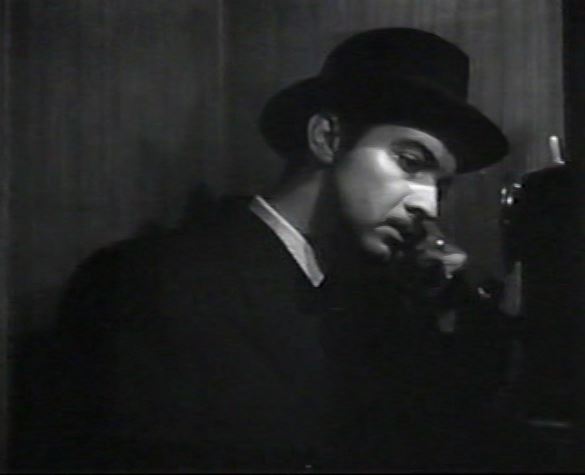
Mr. Scott looks and looks around, finally goes to a phone booth to call home.  Because he’s closed the door of the booth, and because there are constant announcements on the public address system about flights, we barely hear his voice.  We strain to hear him—a nice dramatic touch over not hearing him at all.  It makes us an active participant.  We don’t know what he’s saying—just like we couldn’t see the attack except from yards away and through curtains.  By his expression, we realize somebody on the other end told him shocking news, and he rushes to find his checked luggage and get a cab.
The phone, we learn, was answered the by the police, and we see when he arrives that his home is chaotic with reporters, and police all around.  For the first time, we learn that Ann Sheridan is well and survived the attack, but that her attacker lies dead on the living room floor with an ornamental knife in him that Mr. Scott had brought back from Japan during the war.  That’s about all of the mysterious orient you’ll find in this movie.
When Miss Sheridan is interviewed in her bedroom by the police, with her husband and Lew Ayres at her side, we see that she is traumatized and miserable.  We knew Bette Davis’ distress was just an act, but Sheridan’s horror is real.  The million-dollar question is asked of her “Had you ever seen him before?”  She answers no, and we have no reason to doubt her.  Neither does her husband or her lawyer pal.  The police detective, played by John Hoyt, remains cynical, but that is his job.

The widow of the dead man, played by Marta Mitrovich, accuses Ann of murder. “You killed him!” She is not as scary as Gale Sondergaard, but she’s pretty worked up about it.

By the way, does anyone know who plays the stenographer in this scene?  She has no lines, but she looks familiar.  I love stenographers.  
The detective tells us that the dead man has no criminal record, that he was a sculptor.  His mind, and ours, turns to the question, why did he go to her house?  If robbery wasn’t his motive, we are left with a question of attempted rape, though nobody uses the word.  Ann Sheridan’s expression is our first clue that she’s not being completely honest, she’s withholding some information, but we have to find out the hard way.
Steven Geray plays a smarmy art dealer who contacts Lew Ayres about a bust of a woman, asking him if he wants to buy it.  It was sculpted by the dead sculptor guy.  The face is Ann Sheridan’s.
Ann lied.   The dead scupltor obviously knew her and she knew him, because we are told that this kind of piece would have to be modeled from real life.  He didn’t sculpt it from a photo of her.  I find Ann's scatterbrained, guilt-driven, panic-induced deceit much more understandable and appealing than Bette Davis' psychotic, chilly posturing, but that is not to say that one actress is better than the other in the role; it's just a preference for characterization. 
The art dealer is attempting to blackmail Mr. Ayres’ client, but our noble Lew isn’t having any of it.  He brushes off the smarmy art dealer and goes straight to Ann, who, reluctantly, relents and confesses she did know the dead guy.  It was during the war, and she hired him to do the sculpture, but after a few sittings, he got too personal and creepy and made her feel uncomfortable, so she avoided him and never went back.  He stalked her a few times, but when her husband came home from oversees, it scared the guy off.
Ann tells Lew she didn’t tell him or the police that she knew the guy because, “I was afraid of what people would say.”
Now Lew has to hammer home to her that what people say is not the problem.  The problem is if she knew the guy, a jury might think she let him into the house and murdered him, that it was not self-defense.  She’s frustratingly slow on the uptake about this.
Unless there's more to it that she isn't saying.  

And there is.  

Then Ann goes to the smarmy art dealer herself to pay the blackmail, but the widow doesn’t want her money.  She wants her to go to jail. 
Ann goes back to Lew Ayres in a panic, getting herself in deeper and deeper, and finally Lew understands, as do we, that she had more than a professional relationship with the sculptor.  She had a fling with him.
Lew, lawyer and bachelor, is disgusted.  “You’re no different from all the other cheating, conniving women who parade through my office.”  Now he strips the final layer away:  Did she kill him on purpose to shut him up?
We pause here to watch the how her web of lies has taken on a life of its own.  Smarmy art dealer still wants a cut of the blackmail money he thinks he’ll get, so he contacts Zachary Scott and meets him, like a spy movie, in MacArthur Park (no cake out in the rain here, so just never mind that), one of the many neato Los Angeles scenes we have in this movie.  He takes him to the widow’s run-down apartment and meets Ann’s sculpted likeness as the art dealer hammers him with the old Othello scenario about the treachery of women.  Zachary is crushed.
He goes home to have a showdown with Ann.  She tries to explain her loneliness during the war.  He blasts her, “Millions of women waited, they waited decently, loyally.  They didn’t cheat.”
Mr. Scott wants a divorce, but just as he’s about to storm out, the cops show up at the door to arrest Ann on suspicion of murder.  See, the cops discovered Zachary going to the widow’s apartment with the smarmy art dealer.   They know about the sculpture now.  The jig is up.
Our Lew, despite his profound disappointment in Ann, agrees to represent her at the murder trial, where the prosecuting attorney is our old pal, Jerome Cowan.
The trial sequence builds to a crescendo of self- knowledge—of Zachary about Ann, and of about himself and his failings as a husband.  We learn they knew each other two short weeks before they were married, and he was so eager to pursue his career on his return home, she became an afterthought.  We also learn, somewhat surprisingly, that she was a fashion editor for a magazine before the war, yet we are given the impression she does not have a career now.  She gave up a job like that to stay home and volunteer for the Red Cross?  That is an interesting subplot that is not pursued, however. 
Neither is it fleshed out the possibility that Lew Ayres may feel more than friendship and respect for Ann and could present as a romantic rival, which would have been intriguing, but no triangle happens. 
What we do have is the crime of the century—not the murder, and not just cheating on her husband, but cheating on a vet in a post-war climate that revered them.
Jerome Cowan asks us, “Is this a woman you can believe?”
But Lew Ayres, and the producers remind us, “She is not on trial for infidelity.”  Mr. Ayres, from his own professional perspective as a divorce lawyer counters: “How many personal tragedies occurred far from the battlefield,” and “If there had been no war, she would not be in this court today.”  So it’s the war’s fault.  We see Zachary Scott mulling this over.
The best summation of the story is handled by Eve Arden.  When the jury is out a long time, Zachary Scott goes over his cousin Eve’s house to wait.  The merry divorcee is spending a quiet evening alone, with a book, the radio, and a box of chocolates, still wisecracking, but softer and sympathetic.  Zachary tears up, and cries, and she softly replies, “I’m glad to see you acting like a human being for a change.” 
Though she was never best pals with Ann Sheridan, whom she regarded as too good to be true, she defends her, and Zachary is upset.  “Is it my fault I was sent overseas?”
“You knew you were going when you met her.  Let’s face it, that’s why you married her…what you wanted was a whirl and a memory.  You wanted a beautiful woman waiting for you, and you didn’t want anyone making time with her when you were away, so you hung up a no trespassing sign, like you’d stake a gold claim.  You didn’t marry her; you just took an option on her.”
“She could have said no.”
Eve continues her sane, and somewhat shocking for the times, rebuttal: “When the band was playing?  Listen, I was there.  I saw you making with that uniform and that ‘today we live’ routine.  And then you were off.”
Production on this movie was begun in late 1946.  Just a year after the war, and we’re already negating all that movie patriotism and sacrifice that got us through the worst of it.
Then a phone call lets them know that Ann has been acquitted by the jury.  Mr. Scott quietly says, “Oh.”  So that we are still not sure how the ending will be played.
With Lew Ayres seemingly guiding the shell-shocked couple to a negotiation, it ends with a cigarette on the couch, and the leaden film noir score suddenly lighter, giving us hope, a suggestion of gentleness, and we even hear bells pealing.
We are left with an indictment not of Ann Sheridan, but of the era, and that gave the audience then, and gives the viewer now, something to think about. 
“With all my heart, I still love the man I killed” is just a cheap thrill in comparison. 
And the ending of The Letter where Bette Davis is murdered was not in the original story.  This was tacked on by the stalwart keepers of the Production Code to see that a murderess and adulteress was punished.
Ann Sheridan, in The Unfaithful remarkably gets away with both a killing and adultery, and still holds our sympathy.  She’s rebuked, but still noble.  Way to go, Ann.  It would have been a great scene for the movie if Ann had discussed her affair,  what attracted her to the man and why she needed to be with him.  Perhaps the intimacy of her face and body being so closely studied in creating the sculpture was what seduced her.  But I guess you can push the Hays Office just so far.
You may now rebut.

Related Products