IMPRISON TRAITOR, PEDOPHILE, AND CONVICTED FELON TRUMP.
Showing posts with label Peggy Ann Garner. Show all posts

Thursday, May 18, 2017

The Pied Piper - 1942


The Pied Piper (1942) strikes a unique balance between a whimsical adventure—and the ghastly horror of being caught in the middle of a war.  In the world of children, however, what can be terrible can also be an adventure, and what can be an adventure can also horrify.  It is sometimes a very fine line, and that is the nature of childhood: that children are both helpless and yet resilient.

This post is part of the Classic Movie Blog Association (CMBA) “Underseen and Underrated Blogathon.” Please wander over and check out the other great participating blogs.


This post is also the first entry in my new series on the depiction of children during World War II.  In the coming weeks, we’ll be discussing On the Sunny Side (1942) with Roddy McDowall, The Search (1948) with Montgomery Clift, Youth Runs Wild (1944) with Bonita Granville, the short subject You, John Jones (1943) with Margaret O’Brien and James Cagney, and two March of Time short documentaries, Youth in Crisis (1943), and Teen-Age Girls (1945). 

Many classic films from that era tend to show children on the periphery of the wartime crisis and not in the middle of it.  For example, Shirley Temple portrays an American home front childhood as only a reflection of the grownups’ world and not even enough to form a subplot in the movies of Since You Went Away (1944) and I’ll Be Seeing You (1944).  With a stable full of glamorous grownup stars like Jennifer Jones, Ginger Rogers, Claudette Colbert, and Joseph Cotten, the worries of Shirley Temple brooding over collecting scrap and experimenting with too much lipstick is not enough to carry a film, and most directors and producers of the day evidently felt there was not much of a market to make films for children about the war, let alone films about children.  Not that there weren’t any, but if the horrors of war were toned down in a censored Hollywood—censored not just by the War Department, but by the Production Code—then the horrors experienced by children during the war were obviously not going to be dramatized in great detail.  We didn’t have much of a stomach for that.

Paradoxically, there were quite a few series chapter books written for kids during the war that brought the tension, the anxiety, and to a degree, the horrors of wartime to an American middle-grade readership.  Such titles include Norma Kent of the WACS, Red Randall at Pearl Harbor, Dave Dawson with  the R.A.F., Nancy Dale Army Nurse, and a few of the early more famous Cherry Ames books.  As I wrote in this previous post on this topic:

There are several elements to these stories which are quite striking.  One is the, in some cases, unsparing description of death and cruelty, and the fatalistic manner in which the tone of these stories seems to indicate the young reader should accept these conditions.  Nancy Dale’s troop ship is torpedoed, and she spends several days in a lifeboat with a handful of other nurses and crew members.  One dies and they dump the body overboard. 

At one point in the story she receives word her brother is missing in action and presumed dead.  A family friend, comforting her, tells her not to hold out much hope of his survival.  “Don’t let wishful thinking keep you from facing reality, my dear.  There’re many things worse than death in this war.”  How would a kid, who had relatives in the war, take this message?

Due to several other projects, my intention to write a book about this subject has been on the back burner for some years, but I hope to resurrect it possibly next year.  If any of you have any suggestions to add to the list of children’s books, I’d be very interested to hear them.

The Pied Piper, unlike most World War II era movies dealing directly with the war, shows us what it is like to be a child during this hellish period in history, but does so in a light and skillfully handled way.  We are purposefully not made uncomfortable, but we are reminded that very young, very helpless victims are suffering beyond our reach to help them, and that should be horror enough for any compassionate person.
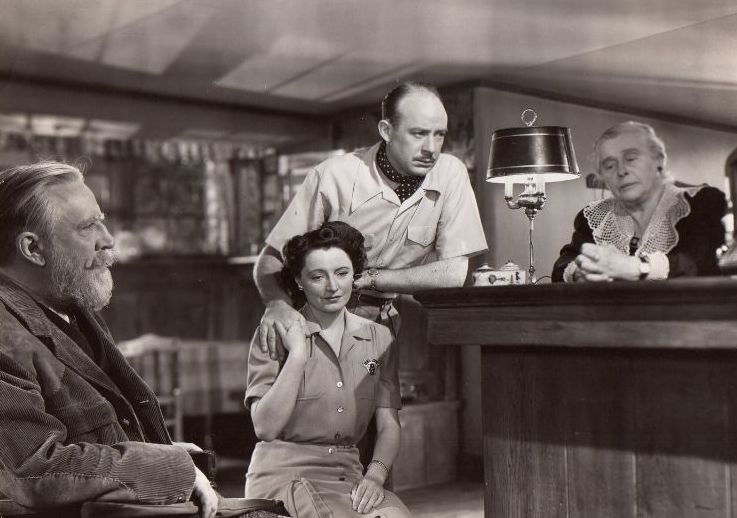

Monty Woolley stars as an irascible Englishman on holiday in Switzerland.  He is a widower, and his son, an RAF officer, has recently been killed in the war.  His only other child is a married daughter living in the United States, so he is alone.  He went to Switzerland, he admits, to sulk because having offered his services to British government authorities, hoping to do his bit for the war effort, he was continually turned down because of his age and told by his vicar he could perhaps instead knit for the soldiers.  Disgusted, spitting nails, he took his fishing rods and went to Switzerland.

There at the rustic inn, he is harassed by young Roddy McDowall, a bright boy who, though polite in the conventional English manner, is not shy of adults and speaks to them on an equal footing: he and Monty Woolley have an argument over whether Rochester is a city in the United States or a state.  Mr. Woolley insists it’s a state and takes such umbrage at Master McDowall’s disagreeing with him that he develops resentment near hatred for the boy.  It is very funny.  Nobody can sputter or sarcastically fly off the handle like Monty Woolley, and he does it a lot in this movie.

Peggy Ann Garner is Roddy’s younger sister.  She is better behaved.

However, it is June 1940, the war is heating up, Dunkirk has just happened, and they hear from the BBC that France is likely to fall to the Nazis soon, and England may be invaded.  Woolley decides his place is home in England, to knit if need be, and packs to leave.  The parents of Roddy and Peggy Ann, played by Lester Matthews and Jill Esmond, ask Mr. Woolley to take their children with him back to England, to live with her sister until the war is over.  Matthews is with the League of Nations in Switzerland and must remain at his post, and his wife wants to remain with him.  They fear that Switzerland will be invaded next.  (As it happens, it was not invaded and the kids would have been safer there, but this injected opinion demonstrates the chaos of the war and how little we knew what was happening, and absolutely no clue as to predict how the events would play out.  When we watch these sometimes sentimental war films, we need to remind ourselves that the Allies were losing for much of the war and we really did not know how it would end.)

Monty Woolley is hesitant to take the kids, but he agrees after delicate questions about their ability to tend to their personal needs, and they’re off on a train to the north of France.  However, the train is stopped before they reach the new and ever-changing front lines.  Woolley, still the domineering Englishman on vacation bellows at the French railroad official, “But I have two small children!”

The harried civil servant replies, “At your age, Monsieur, that is undoubtedly magnificent, but if this is a contest, I have nine.”

Roddy, still irritating, however manages to be useful because he has learned French and is able to converse with all and sundry, especially now that they are being treated like cattle on an overcrowded bus to Chartes.  Here on the bus they pick up a new follower: a small French girl, played by Fleurette Zima, whose aunt has thrust a paper with instructions into Rose’s hand which direct Woolley to take her to her father who works as a waiter in London.


Woolley at first balks at this, but since the child is alone; he takes responsibility and allows her to come with them.  Hence, the title of the movie, The Pied Piper, as he gathers child-followers through the war zone to take to safety in England.  The story is from the book by English author Nevil Shute, who later more famously gave us A Town Like Alice, (the film version we discussed here) and On the Beach.

The bus, crawling along a road choked with refugees straggling away from the front, breaks down, and the passengers alight.  As Woolley and the three kids cool their feet in a nearby stream and eat sandwiches which have been packed for them, Nazi planes swoop down and strafe the ragged column of refugees.  Woolley gathers their bags to continue the journey on foot, unable to shield the kids from the view of dead bodies in the road.  The camera shows the three heads of the kids popping up from an embankment off the side of the road, looking with disbelief at the corpses in front of them.

Just as our protectiveness and our embarrassment makes us try to gloss over terrible aspects of life to kids, so Monty Woolley’s continual funny indignation keeps the movie moving along, though the tone has become darker, as if to ignore the war as a troublesome inconvenience.  He’s trying to keep everybody’s head above water, and soon he finds himself with another child: Pierre, another boy on the bus whose parents were murdered in front of him.  The boy is almost catatonic with the horror of his experience, and Woolley’s shock at Pierre’s mental state, looking into his eyes, is a demonstration to us that we really have no idea what horror is as we tend our victory garden, and collect nickels and dimes for the Red Cross.

Pierre, played by Maurice Tauzin, apparently is speechless and unresponsive to sounds.  Roddy bonds with Monty Woolley as his second in command, and does much to take care of Pierre and the girls.  Soon they are joined by Willem, a Dutch boy who cannot speak either English or French, but with a wound on his head, is apparently orphaned and homeless as well.  By this time, Woolley does not question or balk, he accepts the boy into his protection. 

He searches out the house of a French family whom he and his son met in the previous year on holiday.  They became good friends, and he will learn that Anne Baxter, the daughter of the family, actually was the sweetheart of his son, and she mourns him as well.  In his son’s memory, Miss Baxter lends a hand and helps to usher Woolley and his kids to the Brittany coast, where she will enlist the help of her uncle to arrange a fishing boat to take them across the Channel to England.


But the uncle, played by J. Carroll Naish, is reluctant to help.  He has been living in Occupied France for months, and in despair, cries out that no one can trust anyone, lending a hand to anyone could get them killed.  His fears are real and valid, and we cannot treat them lightly.

But he helps to hook them up with Marcel Dalio, the fisherman with the boat, but soon they are caught by the Nazis and taken to the chateau headquarters of the local commander, played in his movie debut by Otto Preminger.

Why Preminger, with years of directing under his belt, and two years away from his masterpiece, Laura (1944) decided to play a Nazi in this movie I have no idea, except that it is very important for the American audience not to write off this enemy as a mere caricature, because what follows is the hook, and perhaps, the soul of the movie.

Helmut Dantine, incidentally, has a small role as Preminger’s aide.  He also appeared as the German flyer captured by Greer Garson in Mrs. Miniver in the same year.  Both he and Marcel Dalio also turned up in Casablanca (1943).

The Nazis threaten Woolley, Anne Baxter, and the kids, because a plot to kill Hitler, visiting in the general area, had been foiled.  The hunt for conspirators brought a dragnet of the village, and Preminger is especially skeptical of Woolley’s stated intention of taking these five children, none of whom actually belong to him, to England.  Preminger tries to wear down and intimidate Woolley, believing he is covering for something bigger.

At last, Preminger relents, and the prisoners, including the French boat captain, are given food and treated civilly, and Monty Woolley is called to the commander’s office for a private meeting.  The guards are dismissed.

Okay, spoiler coming.  If you don’t want to know the end, go away.  No?  You want to stay?  Fine, it’s no skin off my nose.

Otto Preminger questions Woolley once again on the ridiculous story of taking the children to England, which, he says, is pointless because the Germans are going to invade in a matter of weeks.  Woolley states that he intends to send the children to the United States to the care of his married daughter.  Preminger counters that this is unbelievable—why would she want to take care of strange children?  Why would her husband permit that?

Woolley, irritated with this man’s utter lack of imagination, let alone compassion, insists that it is so.  They are kids, they need to be safe.  Preminger says, “What about the Jewish child?”  He infers that Pierre, who has dark hair and dark eyes, is Jewish.  Woolley says he is unaware of what religion the child is and couldn’t care less and neither would his daughter or her husband care.  He says that in the U.S., many children war refugees have already been taken in without regard to color, race, or religion.

Monty Woolley apparently has never met Donald Trump.

Otto Preminger, never losing his steely glare, nevertheless seems finally to be convinced of Mr. Woolley’s sincerity.  He lowers his voice and becomes confidential.  He will make a deal with Woolley.  He will allow Woolley to leave with the children and go to England, but Woolley must do him a favor.  Woolley stiffens.  He will not be a spy for the Nazis.

Preminger does not want him to spy.  He wants something else.  He wants Woolley to take another child along:  His little niece.  She is the child of his younger brother, now dead, who married a woman they later discovered to be Jewish.  The mother has been murdered by the state.  The child is not safe in Germany now.

Preminger tells Woolley that he has an older brother in the United States, who became a U.S. citizen long ago.  The child should be sent to her uncle.  He lives in Rochester, New York.

Rochester!  A brilliantly comic moment in a dramatic scene.  Woolley’s longstanding argument with Roddy McDowall over whether Rochester is a city or a state comes back to haunt him.  He must admit defeat.

But there is success and triumph in this nightmare of war.  The little niece joins the other kids, and Woolley and the French captain leave for England.  The kids have been traumatized, and this is clear even though the story is focused more on the adult actors.  Woolley, who had felt sidelined in the war due to his age, has become a hero through his sense of responsibility and duty despite the fact that he dislikes children.  Anne Baxter has paid the highest tribute to her deceased love by saving his father.  Otto Preminger, representing evil in his Nazi uniform, can still make an exception to the rules of war and his foul regime, in his affection for his niece.  He cannot believe that Woolley and Baxter have risked their lives for these ragged children, and that strangers in the United States will care for them, even the Jewish girl, but he must believe, because it is his only hope.

As the fishing boat pulls away from the stone wharf, Anne Baxter and Otto Preminger wave goodbye to them.  It is an unlikely scene, but we must believe, because the millions of souls who will not have a happy ending are beyond our comprehension.  Like Pierre, we will become frozen in horror if we think of it. 

I suspect this movie, directed by Irving Pichel and adapted by Nunnally Johnson from Nevil Shute’s book, since I hear of it little mentioned, may well be underseen and underrated.  For other great blog posts, please check out the Classic Movie Blog Association (CMBA) “Underseen and Underrated Blogathon.”

Come back next Thursday for a look at On the Sunny Side (1942) and You, John Jones (1943).

*********************
The audio book for Ann Blyth: Actress. Singer. Star. is now for sale on Audible.com, and on Amazon and iTunes.

Also in paperback and eBook from Amazon, CreateSpace, and my Etsy shop: LynchTwinsPublishing.


Thursday, February 5, 2009

A Tree Grows in Brooklyn (1945)


A Tree Grows in Brooklyn (1945), though it starts with the strains of early 1900s hurdy-gurdy music and ends with a young brother and sister looking back on their childhood, is almost startlingly free of nostalgia.

Continuing with our look at two poetic but very different films that were made on the heels of each other, “Brooklyn” takes a more somber view, is more intimate where My Darling Clementine (post here) is painted with broader strokes. One is an innocent look at a rough place. One is a tough look at a rough place, though the eyes of innocents.

This is not a “how it was in the good old days” movie. This is an honest, unsentimental dramatization of a poverty-stricken family that ennobles this struggling family even while exposing it. This film is being shown on TCM this coming Sunday, so today seemed like a good opportunity to discuss it. If you’ve not seen it, here’s your chance.


The novel by Betty Smith, rich with memorable minor characters and anecdotal history of Francie Nolan’s world, is not replicated detail for detail in this film. It can’t be; there’s too much of it, and the book covers too much time. Elia Kazan, in his directorial debut, does a magnificent job lifting only bits of the book, and using the imagery of film like mortar between the bricks of Betty Smith’s story.

However, Mr. Kazan, in his autobiography A Life (Knopf, NY, 1988) expresses dissatisfaction with the film, complaining that it was not realistic enough. He remarks: “It was just another movie…it was mushy. I did think Peggy was fine and Jimmy the real thing and Lloyd Nolan marvelous and Dorothy McGuire valiant, but the whole thing was poverty all cleaned up (emphasis his).”

I can’t explain his disdain for his brilliantly and sensitively directed film, nor can I understand it. The realism that became the trend in films in the next decade and which remains today might have shown us an uglier film, but it would not have shown the Nolan family any more pitiful, their world any more harsh than what was achieved so beautifully in this film. Perhaps it is the film’s incongruous beauty which Kazan disparages decades later, the way an accomplished writer might look ruefully back on a high school essay as too immature and innocent.

Francie reads aloud an essay she wrote about her alcoholic father, and in her innocence, giving him the nobility of a king, and it nearly tears our hearts out.

James Dunn deservedly won a Best Supporting Academy Award for his role as Johnny Nolan, a singing waiter who destroys himself with alcohol. He is unable to support his family, but his dreamer’s passion for life makes him beloved among his neighbors and especially his adoring daughter, Francie. He fills her head with stories and songs, and promises he cannot keep.

Francie is played by Peggy Ann Garner, probably the best child actress of the day, with her expressive face, a natural delivery, and a seeming mature understanding that belies her woeful innocence. Her brother Neeley is played by Ted Donaldson, who is also natural and at times, genuinely funny in his role. My only criticism of him is that he looks too healthy and well fed. The Nolan children, according to the book, were starving a good part of the time. In the scene where Dunn brings home, in the wee hours of the morning, leftovers from a wedding for which he was hired as a waiter, the children rise from bed and dig in. The movie turns this into an impromptu party for the family. The books makes it appear more desperate, perhaps not unlike dogs eating out of the garbage.

Their mother is played by Dorothy McGuire in one of the most challenging roles of her career. The complex Katie Nolan, a woman beaten down by life and her husband’s alcoholism is the spine of her family if not always its heart. There is a keen precision to her performance, an intelligent use of individual moments to pinpoint who Katie is and what she is feeling. We learn Katie is multi-faceted, that her mind is always working, conniving to survive, calculating, and constantly evaluating herself, mostly to her own dissatisfaction.

The wonderful Joan Blondell plays her sister, the loving, effusive, devil-may-care Sissy with warmth and earthy charm. She is all heart and no prudence. James Gleason has a brief role as the awkward and apologetic bartender friend of Johnny’s. Lloyd Nolan, whose depth and strength as an actor is probably not as lauded as it should be, plays the cop on the beat who lives his lonely life on the fringes of the Nolan family, a stranger on the outside looking in, until at last he gratefully becomes part of it.

Despite the memorable character actors and a surprisingly huge cast of extras playing the neighbors in the claustrophobic alleys of this depressed Brooklyn neighborhood before World War I, the main story is the triangle between Katie and Johnny Nolan, and their daughter Francie.

Their struggle, separately and together, is one not just of survival, but of their chosen methods of survival, how their methods clash, and how they are, ultimately, inter-dependent on one another. Dignity is the theme. Balance is the goal.

Dorothy McGuire survives by taking control. For her, control is her peculiar comfort. She cannot depend on her husband to provide, so she works as a charwoman for their tenement building, and saves pennies in a tin can nailed to the closet floor. Every penny plunked into the can gives her a sense of preservation, of satisfaction, a few seconds of a sense of freedom.

James Dunn survives by escaping their poverty in pipedreams, and sentimental ballads, and looking for luck in all the wrong places. And copious amounts of alcohol to wash it down.

Peggy Ann Garner is the linchpin between them. She is closer to her fanciful father, whom she prefers. He is more fun, more gentle, and more understanding. Papa tells her to dream. Mama tells her to stop dreaming. Papa tells a dying child in the building that her expensive new dress makes her look beautiful. Mama says her parents are foolish to spend money on clothing that will last longer than the child, that they will suffer the ignominy of burying her in a potter’s field because they throw their money away on trifles.

Young Miss Garner is awash in a sea of pre-adolescent emotions, desires and terrors, thrives on the stability her mother represents, but needs her father’s buoyant hopefulness. It is Papa who comforts her that the scraggly favorite tree outside their window that is cut down will grow again, because it is tough. The tree becomes the metaphor for Francie. She is tough, as tough as the tree, as tough as her mother, but it will take a lot to make her discover this.

Dignity is as important to poverty stricken people as money is. McGuire hands precious dimes and nickels over to the insurance man to ensure that she, her husband, and her children will have a proper burial. She admonishes her sister for her carefree attitude to her multiple romantic relationships, because she will shame the family. McGuire is obsessed with avoiding shame as much as avoiding the wolf at the door. Garner unwittingly has inherited this trait, proudly showing her handful of pennies to a suspicious floorwalker at a 5 & 10 cent store, proving that she has a right to be there because she is a customer.

They are so proud, mother and children that they express concern only in their eyes when the visiting insurance man pours too much of their precious condensed milk in his coffee. McGuire stiffens when she sees him explore with the toe of his shoe a tear in their torn carpet. We see a room without curtains, a Christmas tree with paper ornaments that was salvaged from being literally thrown away, rough dirty bricks framing Francie’s sensitive face during her fire escape library book reading, the peeling paint on a metal bed frame. These speak eloquence.

The use of rain and snow in the movie to evoke atmosphere reminds me a lot of director Frank Capra. It has an emotional quality.

One of the strengths in the film is the long scenes, with not a lot of cutting between shots. Many scenes have the feel of a play. The scene when Francie ministers to her mother in labor shows us the child-woman Garner playing with equal strength to McGuire. This is not a scene between a veteran actress lending benign support showcasing a kiddie cutie pie, as in so many other films with children. They are equal scene partners, fellow actresses in an intimate world of their own, masterfully surfing each other’s waves. In this scene, they create tsunamis. And they hardly move.

Katie and Johnny Nolan love each other, but lament over each other’s faults, and brood over their own. McGuire will not let her children call Dunn drunk, telling them instead to refer to him as “sick.” But she tells Dunn bluntly that she cannot depend on him. She complains to her sister that she wishes she did not love Dunn so much, confesses how much she bitterly regrets the course her life has taken. But when Mr. Dunn tips his rakish derby to every neighbor and makes courtly bows to every old maid in the hall, McGuire follows him with her eyes, marveling over the magic he spreads.

She is anxious over criticisms by her mother and her sister that she has grown hard and heartless over the years in her struggle to survive. McGuire is hurt, and even frightened at becoming a harsh embodiment of the harsh life she has known.

(This reminds me a bit of Alexandra’s mournful defense at being called hard by her resentful and weaker brothers in Willa Cather’s novel, O Pioneers. She counters, “I never meant to be hard. Conditions were hard. Maybe I would never have been very soft, anyhow; but I certainly didn't choose to be the kind of girl I was. If you take even a vine and cut it back again and again, it grows hard, like a tree.")

Still, it is her protectiveness for her children as much as her bitterness over her husband’s failures that makes her exclaim, “My kids is gonna be something if I have to turn into granite rock to make them.”

They read a chapter from the Bible and from Shakespeare every night, and when her son balks, she insists that education will help them get a good job. Her immigrant mother exhorts them to continue reading, but not just for the opportunities that education will give them, but reminds McGuire sternly it is for “the thing inside of us. You don’t think well about this.” She remonstrates her daughter for being so neglectful of feeding the soul, and McGuire shoots the humbled glance of a chastised daughter, then drops her eyes back to her darning. McGuire is always scrubbing, cooking or occupied in some manner with her hands as she speaks. She rarely has a line where she is not doing something.

A pivotal scene, and one of the film’s best, is when Dunn returns home to find his family has moved upstairs to a smaller, cheaper apartment. The little dying girl has passed away, and when he wistfully offers the comment that at least the little girl had a pretty dress, McGuire rebuffs him with the disdainful criticism of the girl’s pauper’s grave as a trade for the dress.


There is a piano in their new apartment, left by the tenant (played by Adeline DeWalt Reynolds, discussed in this past blog post ) who could not afford to have it moved. Dunn sits down and plays and sings the old Scots love song “Annie Laurie,” trance-like, almost as a kind of funeral dirge for the neighbor girl. McGuire watches, charmed, and her expression softens. When she attempts to compliment him, he angrily ignores her and plays on, singing another chorus with heartfelt belligerence. Rebuffed by his unspoken criticism of her as she was by her mother’s remonstrance for her lack of soulfulness, McGuire resentfully seeks comfort in the tin can coin bank, which she hammers into the floor of their new apartment. She pounds over his song with a stroke of independence and bitterness.

In such a manner, the movie is lyrical, and perhaps this is what discomforts director Mr. Kazan, in his complaint that the film was not realistic enough. But there is sometimes a poetic aspect to even our most wretched experiences, probably having to do with those gossamer qualities we call being human. It does not mean there is an absence of realism. It means only that there is more to reality than cold hard facts.

Francie’s new teacher, played by Ruth Nelson, provides her with the key to balancing her father’s lovely pipedreams with her mother’s somber practicality, and that is to turn her fanciful exaggerations, or sometimes outright lies, into stories. She has a gift for writing, and in this way Francie will be able to express herself, take purposeful flight to her imagination, and possibly earn a living, too.

“Pipedreamers can be very lovable people, but they don’t help anyone, not even themselves,” the teacher tells her, and it begins to dawn on Garner that her father is such a person.


Another pivotal scene is Christmas night, when McGuire tells Dunn she is pregnant again, and that their daughter will have to quit school to go to work because they cannot continue they way they are with another mouth to feed. Dunn is shattered, horrified that they should deprive school to a child who loves it as much as Francie does. Dunn’s desperate, stuttering agony is heartbreaking, and McGuire’s steely resolve not to lament over the decision is like the way a person rips a band-aid off all at once. From that point Dunn morphs into the granite of his wife, and walks out of the apartment and out of their lives. In a few days, stone cold sober, he will have died of pneumonia looking for a job as a sandhog.

The scenes dealing with his funeral and their grief are finely detailed, and never melodramatic, but subtle and revealing. When Garner hears of her mother’s plan to remove her from school, she also morphs into the granite of Miss McGuire, shooting such looks of hatred at her that it does not seem to be the same child at all who shyly whispered, “My cup runneth over” to her father when he hatched a plan to send her to a better school. It isn’t the same girl. She’s grown up, even before her 8th grade graduation.

When James Gleason, in a lovely brief appearance as the diffident, stammering Irish bartender, hires the Nolan kids to work for him, the money will allow Garner to continue school. (In an age where few children went to secondary school, eighth grade graduation was a big deal. For many, it literally signaled the end of their childhoods.)

The flowers she receives from her now deceased father at graduation, who had arranged while he was still alive that they be sent to her on this day, leads to another memorable scene when Blondell takes the child to the school’s girls’ room to cry in private. All the unspent grief of the previous months erupts into an hysterical crying jag an adult actress would have difficulty conjuring. Young Miss Garner is amazing.

The scene where McGuire squirms uncomfortably on her bed in the throes of labor, having scrubbed the hall stairs literally until the last moment, brings an angry Garner, still struggling with hatred for a mother who seems to have no pity and no affection for her, to McGuire’s bedside to help because she is the only female around. There is no money even for a midwife, let alone a hospital. While her brother is sent to fetch their aunt and grandmother, McGuire’s anxiety over who she is and what she has done to her sensitive daughter battles with her latent grief over her husband’s death.

She still marvels over Dunn’s easy way with people. “Who’ll cry for me like that if I died? I never did a wrong thing in my life, but it ain’t enough!” (the common fate of dull, responsible people who are not appreciated) she wails piteously, and the two discover each other in a way they had not before. McGuire asks the painfully reluctant Garner to read her essay on her father, delighted at her daughter’s talent with words just as she marveled over her husband’s talent for happiness. Garner discovers there are chinks in her mother’s granite façade. She also takes on her mother’s sense of freedom through control when she becomes her mother’s caretaker. She is empowered by the ability to roll up her sleeves and do the unpleasant tasks. All this is accomplished without maudlin confessions or saccharine promises. It’s very raw simplicity hurts and heals at the same time.

For all Katie Nolan’s granite, it is she who notices in a calm moment between contractions that the candle by the bedside is pretty and looks like Christmas. It is she who decides to name the new baby daughter Annie Laurie after the song Dunn sang. It is she, for all her habit of facing hard facts, who insists that the word “alcoholism” be omitted from her husband’s death certificate.

In days of such economic turmoil as we now experience, we might take notice of the tin can coin bank, and how she saves her pennies, against amazing odds, with a soldier’s discipline. Theirs is a world without retirement plans or health insurance, just the hope of a can full of coins if they persevere, and the cushion it will provide if no money comes in for a week or so.

This is, in its lyrical quality, as hard-edged a film as has ever been made about such sad and desperate people. It is a black and white snapshot, nothing sepia-toned or gingerbread about this tale. The only nostalgia present in the film, curiously, is at the very end, when brother and sister talk on the roof of their building. With a gray and smoky Brooklyn at their feet, they discuss how their mother is to marry the kindly cop played by Lloyd Nolan, who will adopt the baby daughter. They acknowledge that Annie Laurie will have it much easier than they did…but that she probably will not have as much fun. They have learned the wild pleasure of living life to its fullest, a perspective which, ironically, security and a full belly do not always lend.

Though they have just graduated eighth grade, they talk of the olden days of their childhood as if they are middle-aged. They are very knowing children by now. There is nothing innocent in that.


*********

Jacqueline T. Lynch is the author of Ann Blyth: Actress. Singer. Star. and Memories in Our Time - Hollywood Mirrors and Mimics the Twentieth Century. Her newspaper column on classic films, Silver Screen, Golden Memories is syndicated nationally.

Related Products