Thunder on the Hill (1951) is a great stew of dark-and-stormy-night
whodunit, character actor fest, and higher questions on what is faith and what
is only fanatic assumption.
Some of
these aspects, not entirely married in the stew, fall to the bottom of the pot,
neglected, and some rise again and again to the surface with a little stirring.
Connie Gilchrist is the
cook in this film whose constant guardianship over soups and stews makes one
inevitably hungry for some, and is responsible for the above gastronomic
paragraph.
The movie stars
Claudette Colbert as a nun with tragedy in her past and a troubled drive for
excellence that creates conflict with those around her.
Ann Blyth is a
convicted murderess on her way to the gallows, when she and practically the
whole county of this rain-sodden chunk of England is forced to take refuge at the
hilltop convent and hospital.
The movie was still
tentatively titled
Bonaventure, after
the stage play by Charlotte Hastings from which the story is taken (Miss
Colbert’s character name is Sr. Mary Bonaventure)—when a reporter allowed to
observe a scene being filmed commented on Ann Blyth’s encounter with an on-camera breakfast.
“Spread before her is a dish of bacon and eggs, two slices of toast and
a cup of tea. As the camera rolls, Ann
methodically consumes her last meal.
‘Very good,’ says Director Douglas Sirk, ‘The action of the extras in
the background wasn’t all it could be, though.
I think we had better do it again.’
The prop man brings another helping of food from his portable steam
table, and the scene is filmed again.
This time, something goes wrong with the sound—and again Sirk calls for
another take.
As the shot is finally completed to everyone’s satisfaction, Ann slumps
back in her chair and pushes away the third empty dish of bacon and eggs.
‘Now I know what they mean when they say, ‘the condemned man ate a
hearty breakfast,’ she gasped.”
Unfortunately, Ann’s Herculean
task of eating three helpings of bacon, eggs and toast was for naught.
The scene apparently ended up on the cutting
room floor; you won’t see it in the movie.
It was filmed early in
the year 1951 (the article was published in February), and by December of that
year, columnist Louella Parsons noted, “Ann Blyth, bright-eyed and happy, told
me that 1951 had been the most exciting year of her entire life.”
It was certainly a busy
one.
Five of her films, the most in one year,
were released in 1951, including
I’ll Never Forget You (discussed here, and we’ll talk about it some more later
on in the series),
The Golden Horde, The Great Caruso, and
Katie Did It
(which I’m having a terrible time finding -
UPDATE - FOUND IT!).
They represent a variety of roles and genres, and this was perhaps the
greatest satisfaction for her.
There were also several
more radio performances, including two scenes from this movie played out on the
Lux Radio Theater by Ann and
Claudette Colbert.
The episode covers
eight films premiering in 1951.
Listen
here at the
Internet Archive website and scroll down to “Movietime USA”.
Their scene starts at 7:54 and afterwards is followed by a brief interview.
Ann Blyth was
twenty-two years old when
Thunder on the Hill was filmed, her name along with Miss Colbert’s above the title.
Her stature in Hollywood had been cemented at
this young age by her talent and popularity, but top movies would prove to be a
challenge to get as the changing film industry, and changing society, advanced
further into the 1950s.
Claudette Colbert, a
major star for a couple decades, was a great example of both career excellence
and longevity, but time and diminishing opportunities in a coming era when
her "type" of the elegant and sassy woman was replaced by a new wave of younger gamines and sexpots. Ann Blyth’s film
career, despite her being much younger, would end before the decade was over
for some of the same reasons. They both
represented an era of actresses who radiated class, intelligence, and dignity,
but in the years would not find much of a place on
film.
Author Lawrence T.
Quirk in
Claudette Colbert, AnIllustrated Biography, notes, “Ann Blyth recalled her work with Colbert as
a delightful experience, mentioning that unlike other great stars she had
appeared with…Colbert was a relaxed, down-to-earth, infinitely secure person,
disciplined about the projection of her talent, gracious to all those about her.”
Gladys Cooper, who
plays the Mother Superior in the film, he quoted, “Claudette is a professional,
and even when the material is thin and rather pedestrian, as I thought that
film unfortunately tended to be, she gives it her best efforts.”
That the plot of
Thunder on the Hill seemed a
“pedestrian” and standard English murder mystery, with all the suspects
gathered in one place at the climax, is the most common observation on this
film.
While that may be intended as a
complaint, I don’t see the plot, simply because it is standard, is a
downfall.
There are only so many stories
out there, and none of them are new.
I would suggest that
more could have been done to season the stew simply by paying more attention to
ingredients that were on hand: including the superstitious and judgmental townsfolk
who are uncomfortable with having a murderer take refuge with them from the
storm—versus the images of clemency, salvation and redemption present in the
Catholic icons of the convent and hospital.
I was quite surprised to read director Douglas Sirk, who specialized in
glossy melodramas, dismiss the idea that the film should contain any reference
to religion.
In an interview with author
Jon Halliday in
Sirk on Sirk, Mr.
Sirk comments:
“I wanted this picture to have nothing to do with religion. For me,
there is one interesting theme in it: this girl (Ann Blyth) being taken to the
gallows, the storm, the delay, and so on.
This should have been the only thing the picture was about. There was no story in the Claudette Colbert
part. But for various reasons, including
the fact that the producer blew most of the budget building that fantastic
convent in Hollywood, when we could have gone on location somewhere, they kept
pushing it towards religion the whole time.”
I think Mr. Sirk was
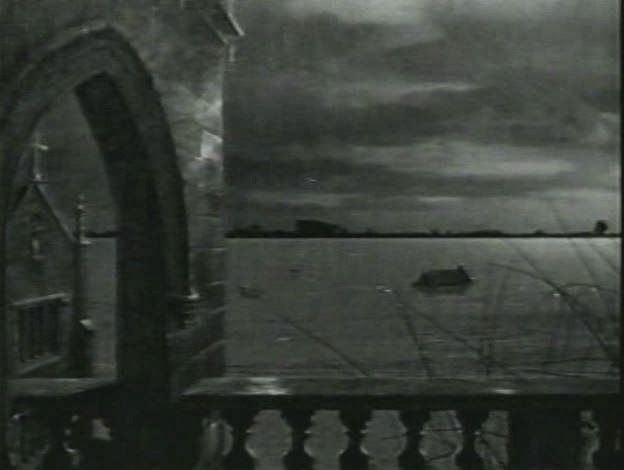
missing the elephant in the room this time around. The villagers are escaping a devastating
flood and flee to the highest ground near them, on which sits a convent and
hospital run by nuns. They’re not going
to the McDonald’s on the hill; they’re going to the convent on the hill. Just the image of being on higher ground sets a symbolic tone to a brooding story about
being right and being wrong, being guilty and being innocent, always with the
image of a young woman, guilty or not, about to hopelessly face execution—and thereby
face what most of the characters presume to be some kind of afterlife and
further judgment.
The director and
writers would have done better to face the religious tones of the original
script head-on, rather than shy away from them.
Religion is one of the most conflicting, controversial, and contentious
elements of man’s experience--great kindness and great evil have been done in the name of religion--which can make it a forum for intense drama. It becomes a forum for weak platitudes only when
we let it be.
As for Mr. Sirk’s
complaints about spending the budget on the set—for me, one of the best things
about this movie is the magnificent set.
Though I can understand that filming on location could be more cost
effective, and certainly realistic to the setting of films, I often prefer the
sets Hollywood created. I don’t regard
them as artificial, but as art.
Have a look at the
detail of this set, the gothic arches, the stonework. I love how the stone steps are worn, uneven, as
if they’d been trod upon for centuries.
That’s great detail.
We begin
Thunder on the Hill with thunder.
On the hill.
And in the marshy lowlands where, through torrents of cold rain, a whole
lot of extras got work that day sloshing through a winding muddy road, walking
like desperate war refugees with carts of their belongings, and even farm
animals.
It’s a dismal setting and
nicely played against the opening credits that sets the eerie mood and leads us into our receiving line
of characters.
Connie Gilchrist, so
beloved as earthy, excitable, crusty but with a heart-of-gold types, plays the
sister in charge of the kitchen. She
also becomes Claudette Colbert’s sidekick, and inevitably takes the lead in solving
the mystery. I’m not sure, but I think
she gets more screen time here in this film than others she’s played.
Gladys Cooper, who in
her long stage and screen career was rarely anything less than magnificent,
plays Mother Superior, dedicated administrator of this chaotic menagerie, whose
fairness is a source of strength to the troubled Miss Colbert, but who also
presents Miss Colbert’s greatest turmoil by challenging her conscience and
accusing her of always needing to be right.
It is a complaint
others in the hospital have of Colbert, including one particularly nasty nurse
played by Phyllis Stanley. Miss Colbert
runs the hospital, and everything’s always got to be her way.
Robert Douglas plays
the gentlemanly doctor on staff, who, like Claudette Colbert, doesn’t seem to
get any sleep over the suspenseful couple of days the story plays out. He's the kind of movie doctor who administers a lot of sedatives. He is also worried about his wife, ill and
anxiety-prone, for whom he has set up a bed his office at the hospital to keep
her safe from the flood...and away from others.
She is played by Anne
Crawford, and she has a tendency to wander around.
Gavin Muir is the
stalwart detective sergeant who escorts the doomed Ann Blyth to the gallows,
who clashes more than once with Colbert over her confounding attempts to be
nice to the prisoner.
Norma Varde is the
police matron who accompanies Ann Blyth everywhere, chain-smoking and generally
trying to mind her own business.
She had
a spectacularly long career, beginning in the early 1920s, but is most often
seen, I think, in reruns of
The Sound of Music (1965) as the housekeeper.
I especially like John
Abbott as the officious and stuffy pharmacist.
We last saw him in his great role as Frederick Fairlie in
The Woman in White (1948) here.
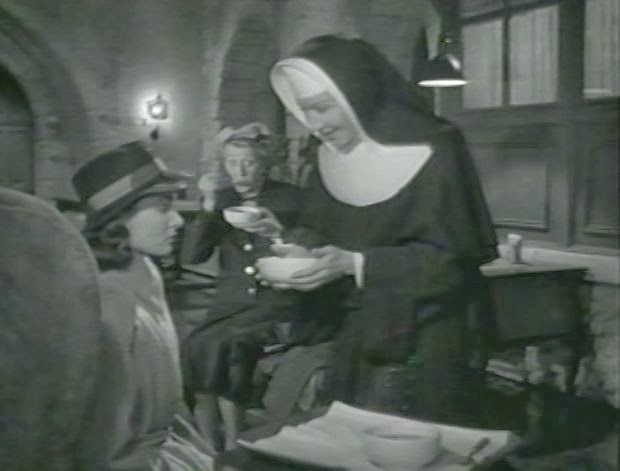
Miss Colbert, trying to
micro-manage everybody, finally makes her way with bowls of soup for the
condemned and her guards, and we meet Ann Blyth for the first time, rigid with
bitterness, sarcastic, and utterly without any feeling for anybody or
anything. She is impervious to gestures
of politeness as she is to feeling the cold damp of this sinister storm.
She is well known among
the villagers: some remember her pleasantly in former days before she turned
bad, some call her “the devil’s daughter.”
She was convicted of murdering her brother, a concert pianist and
unsuccessful composer. He had been
languishing from a stroke, and she, his caretaker, poisoned him by giving him
an overdose of his medicine. He is
described as mistreating her, bullying her and others, an alcoholic with a
fearful temper. Nobody’s sorry he’s
dead. Everybody writes Ann off as guilty,
because not only did she have perfect opportunity and means to kill him, but
nobody would blame her for doing it.

However, Ann comforts
herself in the office of the Mother Superior by playing one of her brother’s
compositions on a piano, and angrily tells Claudette Colbert how his talent was
unappreciated. This is one of the
ingredients of the stew that sank to the bottom. It would have been interesting for a little
more on why she could still find beauty in her brother’s artistry and defend
him though he was said to have treated her miserably.
Small point, but I like
Ann’s piano technique. Most likely, she
is dubbed by an off-set pianist, but she actually looks like she’s engrossed in
what she’s doing and is making all the proper movements. We don’t usually see natural and realistic
pantomime on faked playing in films of this era. She’s really “in the moment” in this scene.
Ann Blyth manages a
creditable English accent in this film, and Connie Gilchrist whips out her trusty
Irish brogue. All the others accents are
genuine, except for Claudette Colbert, who does not attempt to sound like
anything but the usual “mid-Atlantic” speech that worked for her in all her
films.
Colbert sees something
in Ann’s intense playing, in her defense of her brother, as clues to her innocence,
and the thought that she cannot help this woman so shortly to die haunts her,
bringing back an old and never-ending emotional torment: the suicide of her
sister, despondent over the lover who Claudette would not let her see.
Claudette interfered in her sister’s
relationship with a man we are led to believe was no good, but though her
intentions were, she thought, for the best, it ended in tragedy.
Feeling guilty, Claudette left the outside world,
joined the convent, and in a few years was running things.
She’s disciplined, and devoted to detail.
She has a need for control.
These qualities make
her a bit of a fanatic, something against Mother Superior warns her. They also make her a good person to have in
your corner if you’re going to the gallows.
This being a mystery, I
won’t do the play-by-play, but we soon discover that the principle people involved
in Ann’s murder case, witnesses at her trial, all happen to be here—taking
refuge from the storm. Including Willie
the handyman, played wonderfully by Michael Pate, who is the slow, so-called
“half-wit” who, though awkward in the company of people, knows his way around a
bog.
He wrangles a rowboat
and takes Claudette to the village to bring back Ann’s fiancé, played by Philip
Friend. Ann requested Colbert to fetch
him in a sarcastic taunt to perform a miracle for her, refusing any spiritual comfort
just as she refuses the steaming bowl of Connie Gilchrist’s soup.
There is a parallel
here with Claudette’s refusal to allow her sister’s romance and the guilt she
feels for it. Her nighttime adventure
through the flood with Willie is a way for her to take control of that guilt
and re-create the moment she most regrets, to play it over and change it. She once refused her sister to have contact
with her lover. So she braves the flood
and brings Ann hers. As they glide
through the dry ice fog of the soundstage, you’d think the Phantom of the Opera
was going to pop out any minute and start singing about the Music of the Night.
If you filmed that on
location, it wouldn’t be half so mystical or fun to watch.
I like Willie’s
description that the fog “be thick and ghost-like.”
The fiancé, played by
Philip Friend, is relegated to a sort of dishwater role, and I’m not sure if
the weakness is in his portrayal, the script, or the direction. On the one hand, I think it’s a great device
that he, though deeply in love with Ann, actually thinks that she’s guilty,
because like everybody else, he wouldn’t blame her for bumping off her creep of
a brother. But his turmoil only takes
the form of him drinking in a pub, drowning his sorrows, where Willie and
Claudette Colbert find him. To be sure,
at the end of the movie he admirably comes to Claudette’s aid (she is attacked
in the bell tower by the real murderer—shades of Vertigo), but I think we’re looking for someone less self-pitying so we can empathize with Ann’s loss of a future life with her beloved.
Ann Blyth is relegated to a passive role simply because she is a prisoner
and her reality is that she is unable to save herself, others must do it for
her.
She can only wait for either rescue
or hanging.
All she can do as an actress
is maintain the intensity of her seething resentment, broken occasionally by
waves of panic, and she does that very well.

The action is left to
Connie Gilchrist and Claudette Colbert.
Miss Gilchrist is a hoarder, who never throws away newspapers. She has papered every shelf in the convent
and hospital with them, and I like her line about loving the Sunday
Times because, “It has such a nice gray effect on my shift.” Sister Nancy Drew and Sister Miss Marple
spend the spooky evening hunting through all the closets, retrieving newspapers
to re-read the trial transcripts. Other
clues pop up, like a stolen letter, but Claudette Colbert’s sleuthing is halted
by Gladys Cooper, who forces her in accusatory terms to examine her own
conscience. Does she really believe this
girl is innocent because she wants her to be?
Is she just trying to manufacture a case so that, once again, she can be
right and everybody else wrong?
A compelling argument,
and it is late in the game when Connie Gilchrist, and the fuddy-duddy
pharmacist, supply the final clue to raise the most suspicion.
There is a
climactic violent scene in the bell tower. I like that the murderer is
apprehended and will face the same course of plodding justice that Ann Blyth
faced in her trial and failed appeal.
Too often movies, then and now, use a quick instant death to remove the
villain, and that is just lazy. It is
like a deus ex machina to take our
troubles away from us when we should be solving them ourselves.
It is regrettable,
however, that we have only a brief look of happiness shared between Ann and
Philip Friend at the movie’s conclusion.
It would have been more dramatic for the audience to witness the moment
Ann is told she has been vindicated.
It’s the miracle she had taunted Claudette Colbert about early in the
film. Despite the religious aspects to
the script and setting that made director Sirk uncomfortable, he missed a few
opportunities, as did the writers of the screenplay, to fan the drama that was
already there, inherent in the story.
It’s not that drama wasn’t there; it’s that they turned away from
it. They should have taken Sr. Connie
Gilchrist’s advice and not wasted anything.

Some favorite
scenes: When Ann appears jolted when she
is told the dike has collapsed and they will not be able to take her to the
gallows tomorrow. It’s going to have to
wait a few more days. Rather than
relief, she is horrified. It only
prolongs her misery. Nothing in life has
worked out. She took care of her creepy
brother, and this is the thanks she got.
The law failed her. The community
turned its back on her. Her boyfriend
thinks she’s guilty. All she wants now
is to leave this hilltop haven, head back out into the icy rain and end this
miserable life.
Then she melts into hysterics when she realizes with black humor that her execution is going to be
postponed because of rain—“Like a cricket match.”
The moment where
Claudette Colbert brings Ann’s fiancé to her, and Ann, humbled and grateful,
tells Colbert, “I want you to know you did this for an innocent woman. I make you a gift of it, my innocence.” (Not only does this make Colbert’s wanton act
of obstruction of justice raised to a spiritual level—it makes her right.
We may smile and debate which is the more important to this nun.)
I like Willie’s
devotion to those who are kind to him, and the gallantry he displays to ladies,
except Nurse Philips, whom he has threatened to smack more than once.
I like this shot here
where we see Connie Gilchrist from under the table telling Michael Pate as
Willie not to eat like a pig.
An interesting scene
where, after a difficult birth, a baby is being aspirated manually by the
doctor and by Claudette Colbert by sucking gunk out of his throat with a straw. I don’t know how effective, or accurate this is, but it’s
another look at the medicine of the day.
The scene where Ann
tells Philip Friend she knows he thinks she’s guilty, always knew it, and
forgives him, tells him to go on and live his life and not memorialize
her. Only a moment later, she panics and
recants, wanting desperately to live, jealous of anyone he may love in the
future.
When Claudette prays
for help, making the intimate confession to God, if to no one else, that she
doesn’t what to do and it scares her.
Enjoyably atmospheric
and moody, whether in the rain-soaked foggy bog, or under the glare of a naked
light bulb peering at the
Sunday Times
in the middle of the night in the dark recess of an ancient abbey,
Thunder on the Hill creates a little
world where all take refuge, but some aren’t safe.
It is available on DVD, fortunately, and I’d
love to hear your take on it.
Have some
soup or stew while you’re watching it.
Or three helpings of bacon, eggs, and toast.
Come back next Thursday
when we lighten things up considerably with what I think is one of the funniest
comedies of the era.
Ann Blyth woos a
nervous Robert Montgomery in
Once More, My
Darling (1949) directed by Robert Montgomery in one of his last screen
roles.
Did you notice if this
post was long?
I wasn’t paying
attention.
You shouldn’t talk on your
cell phone and blog at the same time.
That’s how accidents happen.
********************************
Dick, Bernard F. Claudette Colbert: She Walks in Beauty. (University Press of Mississippi, 2008), p.
198.
Lux Radio Theater – “Movietime USA” episode September 24, 1951.
Quirk, Lawrence T. Claudette Colbert: An Illustrated Biography
(NY: Crown Publishers, Inc., 1985) pp. 163-165.
Sirk, Douglas and Jon Halliday.
Sirk on Sirk (Viking Press, 1972).
St. Joseph (Missouri)
News-Press, syndicated article by Louella Parsons, December 16, 1951, p.
4D.
Toledo Blade, syndicated article, February 5, 1951, p. 35.
**********************************
UPDATE: This series on Ann Blyth is now a book - ANN BLYTH: ACTRESS. SINGER. STAR. -
"Lynch’s book is organized and well-written – and has plenty of amusing observations – but when it comes to describing Blyth’s movies, Lynch’s writing sparkles." - Ruth Kerr, Silver Screenings
"Jacqueline T. Lynch creates a poignant and thoroughly-researched mosaic of memories of a fine, upstanding human being who also happens to be a legendary entertainer." - Deborah Thomas, Java's Journey
"One of the great strengths of Ann Blyth: Actress. Singer. Star. is that Lynch not only gives an excellent overview of Blyth's career -- she offers detailed analyses of each of Blyth's roles -- but she puts them in the context of the larger issues of the day."- Amanda Garrett, Old Hollywood Films
"Jacqueline's book will hopefully cause many more people to take a look at this multitalented woman whose career encompassed just about every possible aspect of 20th Century entertainment." - Laura Grieve, Laura's Miscellaneous Musings''
"Jacqueline T. Lynch’s Ann Blyth: Actress. Singer. Star. is an extremely well researched undertaking that is a must for all Blyth fans." - Annette Bochenek, Hometowns to Hollywood
Ann Blyth: Actress. Singer. Star.
by Jacqueline T. Lynch
The first book on the career of actress Ann Blyth. Multitalented and remarkably versatile, Blyth began on radio as a child, appeared on Broadway at the age of twelve in Lillian Hellman's Watch on the Rhine, and enjoyed a long and diverse career in films, theatre, television, and concerts. A sensitive dramatic actress, the youngest at the time to be nominated for her role in Mildred Pierce (1945), she also displayed a gift for comedy, and was especially endeared to fans for her expressive and exquisite lyric soprano, which was showcased in many film and stage musicals. Still a popular guest at film festivals, lovely Ms. Blyth remains a treasure of the Hollywood's golden age.