IMPRISON TRAITOR, PEDOPHILE, AND CONVICTED FELON TRUMP.
Showing posts with label Robert Young. Show all posts

Thursday, February 6, 2025

Men Must Fight - 1933


Men Must Fight
(1933) straddles the convictions of pacifism versus a willingness to go to war on provocation; it straddles a cinematic proclivity to predicting the future and yet carries forward anachronistic images to illustrate that future.  Mostly, it straddles the past and present: the former grim and the latter an airy illusion of modernity we weren’t living up to in 1933.

This is another in the films I’d like to examine this year made during the 1930s that represent our mindset and our pop culture of that pivotal decade.


The film begins during World War I, with a gentle and yet provocative shot of lovely English actress Diana Wynyard and Robert Young chatting in a charming, homey room in England, preparing to take leave from one another.  The director Edgar Selwyn handles this opening in a sensitive and tantalizing manner.  As the seconds and the chatty dialogue click by, we gradually realize they are lovers, and they are dressing, both preparing to return to wartime duties.  In another moment, as they dress, we see she is a nurse, and he is an American flyer.  We must pause a moment to reflect how handsome and charming Robert Young was in his early career, and what a remarkably confident and appealing nature he projects.  He is quite natural in an era where screen acting could still be quite mannered and even stilted.

Robert says he wants to marry her and we have it on good authority now that they have enjoyed a romantic tryst and are unmarried.  There is no discussion of mores of the time, only that she has anxiety that he may be killed in the war, and he brushes that off with boyish gallantry.

But he does die.  (Longtime readers of this blog will be aware that I give no warning of spoilers, I just spit them out, so you newcomers to the blog had better adjust or go out and come in again.)

In an abrupt scene, we see a plane crash, and the body is transported to Miss Wynyard’s hospital, and it is Robert Young, and he doesn’t make it.

We are shunted to another scene where Miss Wynyard is talking with an old friend, played by Lewis Stone.  He is an American officer as well, but has never met Robert Young.  However, he knows Diana well enough to help her get a transfer, and make a gentlemanly offer to marry her.  “You don’t want your baby born in an atmosphere like this.”


The movie has barely begun and we get Pre-Code shock after shock.  Diana Wynyard at first rejects Lewis Stone because she does not love him and it would not be fair to him, and he gallantly accepts that, but offers security for her and the child.

The war ends, and Diana remarks, “Thank God it’s over and it will never happen again.”  That was the general idea during The World War, however unfortunate and inaccurate a prediction that turned out to be.  We know now the sequel to The World War began in 1939, but this movie, filmed in 1933, projects ahead at this point to 1940 and war clouds gather ominously again.  It is, however, a fictional war and is not really a remarkable prediction of World War II, but is rather a reflection of the dichotomy between the extremely strong anti-war fervor that began after World War I and continued into the early 1930s and the beginnings of militarism around the globe—first with Mussolini in Italy in the 1920s, Hitler’s rise in Germany and becoming chancellor in January 1933, and the Japanese invasion of Manchuria in 1931. These world events had us on tenterhooks—at least those who paid attention to world news—and pacifism, isolationism, nationalism all converged and began to make even the most unwilling take stances.  Eventually, they would take sides.

Lewis Stone, we may note, in the early scenes during the World War is given a very dark dye job to suggest he is a much younger man than we see him in the 1940 scenes, which is appropriate, but even with the dark hair, and even looking trim in his officer’s uniform, we might note he still looks too old for Diana Wynyard, but this is not mentioned and perhaps we are meant to take him for her contemporary.


By the 1940 scenes, he looks like our old friend Judge Hardy, and Diana is now made up to look middle-aged and matronly.  They are married, and her baby is now a grown man, who has never been told that Lewis Stone is not his father.

Played by Phillips Holmes, young Bob is a recent college graduate with a chemical engineering degree, who is returning to the U.S. from abroad with a new girlfriend on board, played by Ruth Selwyn (who in real life was the second wife of the director, Edgar Selwyn).  When she eventually goes to meet his folks, she brings her mother along—played by Hedda Hopper in her pre-gossip column days.


Lewis Stone is a bigwig in the American diplomatic service, Secretary of State, and Diana Wynyard is a peace advocate.  With them living in their Art Deco apartment in New York City is May Robson, the grandmother.  Miss Robson gets to make snappy remarks and get away with it.

Their butler, Albert, is played by Robert Greig, who played so many butlers in his career that he must have belonged to the union.  Perhaps my favorite is his turn as Joel McCrea’s butler in Sullivan’s Travels (1941), which we discussed here.

Diana Wynyard and Lewis Stone have a cozy, comfortable marriage, but trouble comes between them when a U.S. ambassador to a fictional nation called “Eurasia” is murdered and the United States finds itself on the brink of war.  The naval fleet is sent to confront Eurasia.  Diana wants Lewis Stone to resign his position, but he will not.  “I’m not obsessed with the fear that has haunted you all your life.   You’ve seen one war, you’ve seen the man you loved killed, and ever since you’ve been afraid of what might happen to his…”  He’s about to say “son,” but just then their boy Phillips Holmes enters and Diana shushes Lewis Stone.

She speaks at a pacifist rally, and he wants their boy, with his new degree, to enter the chemical engineering side of the war department because “Gas will win this war,” that it will kill not only soldiers but civilians as well.  While we know poison gas was one of the greatest horrors of World War I, it’s not being the weapon of choice in World War II makes the remark sound anachronistic, but not funny.

Lewis Stone is adamant, “Any talk of peace is not only cowardly, it’s treachery.”

Their cook, an immigrant, wants to go back to his homeland—Eurasia—to fight in its defense.  He sounds vaguely Italian, so we really don’t know where Eurasia is supposed to be.  Butler Greig gives him a boot.


One of the interesting attempts at imagining the future world of 1940 is the scenes where we see Diana Wynyard’s speech at the peace rally on television, and another scene where the characters talk on video phones.

Diana is heckled at the rally and fights break out.  Guards hustle her away to safety.  There is mob violence in the city, but Lewis Stone addresses it from their balcony, with their son’s girlfriend’s visiting brother, who is in uniform.  Mr. Stone uses the young soldier as a prop to show the crowd he is all for war.  The uniform calms the crowd and they cheer Lewis Stone for not being a pacifist.


Their boy, Phillips Holmes, however, is.  He has learned about the evils of warfare from his parents from an early age and he has no desire to join up or use his education to become a military chemical officer.  He is torn about what to do, and his girlfriend breaks up with him.  He wants to speak up about peace and his mother’s pacifist cause, but Lewis Stone intervenes in a surprisingly cruel way.

He will not let the son use his good name in the cause of promoting peace.  He tells him that he is not his real father and that he is not free to use in this way the surname that has been generously given to him.

“You have no moral right to use the name of Seward in the manner you propose or any other manner.”  Diana Wynyard cringes, she knows what’s coming.


Lewis Stone continues telling Phillips that he is illegitimate, “Your father was a brave man who died for his country.” He zealously pulls away the honor of his name and the security it represented to a much younger Diana Wynyard.

She tells the whole story to her son, who is now more torn than ever.


Men in uniform march in the streets, and the enemy from Eurasia bombs and burns New York City.  Diana Wynyard and her son’s girlfriend are caught in a cab that is blown up and overturned, but she’s not seriously injured.

Lewis Stone makes a prescient remark, “All those years we’ve sat around and waited. Talked about peace and disarmament.  It’s cost us lives of thousands of men. We weren’t prepared for a war like this.”

Phillips Holmes eventually decides to join up, not in the chemical corps with its ghastly poisons, but as a flyer, like his real father.

His mother is crushed, of course, and the hand of fate weighs heavy on her, to think of her son being a flyer like his father, Robert Young.

“Do you believe in this war?” she asks him.

“Of course not.  It’s a dirty rotten business,” he replies, but adds no less truthfully, “I’ve got to play the game.” 


His girlfriend takes him back, they are married, and in the final scene, the women are sitting on their New York City balcony watching warplanes, biplanes, flying overhead.  We have also gotten a glimpse of zeppelins. Nothing says future war like zeppelins.


May Robson remarks that the world should be run by women.  “Let the men crow and strut and fight and be ornamental.  Like roosters.  That’s the function of the male.”

The new young bride muses that if she ever has a child, he’ll never go through this, but May responds, “Fat lot you’ll have to say about it.  You’ll be just another mother.”

It is a wistful and sad ending, not terribly inspirational though one suspects a certain amount of inspiration was intended.

The movie is daring in so far as it can be; truthful in so far as it could presage the facts of another war, but it fails to give any guiding wisdom about what to do about extermination camps, atom bombs, and the total annihilation of total war.  It couldn’t, of course.  In 1933 we were still too innocent, despite the famed world-weary attitude of the Lost Generation, to imagine anything could be worse than what we had already experienced.

 *******************************


My new non-fiction book, CHILDREN'S WARTIME ADVENTURE NOVELS - The Silent Generation's Vicarious Experience of World War II -- is now available in eBook here at Barnes & Noble, Apple, Kobo, and a wide variety of other online shops.

Or here from my Shopify store if you want to buy direct from me and avoid the big companies.

And it is here in eBook, paperback print, and hardcover, from Amazon.

From Cherry Ames, to Meet the Malones, from Dave Dawson to Kitty Carter - Canteen Girl, the Silent Generation spent their childhood immersed in geopolitical events through the prism of their middle grade and young adult books.  From the home front to the battlefield, these books are a window on their world, and influenced their hard-working, conformity-loving generation.


Thursday, December 14, 2023

"That's What I Want for Christmas"


Stowaway
(1936), which is not a Christmas movie, ends the movie with a Christmas scene in which Shirley Temple sings about what she wants for Christmas.

It’s used to tie up the movie, to show the happily ever after of her new family. In this adventure, Shirley is the orphaned daughter of missionaries in China. Cute as a bug, she’s raised speaking Chinese and learning Confucius-type pearls of wisdom from Philip Ahn. She’s on her own after the person who is assigned to take her to safety away from country bandits does not do his job. She wanders into Robert Young, a rich American playboy, and accidently stows away on the very ship he is taking around the South Seas. Also on board is Alice Faye, who chides Mr. Young on both his wealth and his irresponsibility (she is traveling with her dour future mother-in-law played by Helen Westley to reunite with her drip of a fiancé on a colonial plantation), but Alice eventually warms to Robert as they both find themselves shipboard babysitters to Shirley. Young’s valet, the ever-proper Arthur Treacher, helps.

Young wants to adopt Shirley, and he and Alice Faye create a fake marriage so that he can do so, which then after a few twists and turns in the plot, and a few songs, the judge in Reno at their divorce decides they should stay together. 

In the final scene, everybody’s sitting around the Christmas tree in their jammies and bathrobes and Shirley, the little girl everybody wants for a daughter in the 1930s, sings “That’s What I Want for Christmas.”  The lyrics include shoes for poor children everywhere, and soldiers who never fight, and making her new mommy and daddy happy, safe, and strong. What a swell kid!

Christmas is a convenient sort of ready-made finale for this movie. It’s the shorthand for happily ever after.

But I keep worrying about Philip Ahn not knowing where she is. 


*******************

Get your copy of CHRISTMAS IN CLASSIC FILMS here at Amazon in print or eBook...

...and here at Barnes & Noble, Apple, Kobo, and a variety of other online stores.

  ************

Jacqueline T. Lynch is the author of Ann Blyth: Actress. Singer. Star. and Movies in Our Time - Hollywood Mirrors and Mimics the Twentieth Century and Hollywood Fights Fascism and Christmas in Classic Films. TO JOIN HER READERS' GROUP - follow this link for a free book as a thank-you for joining.


Thursday, May 18, 2023

Greer Garson on Father Knows Best - 1957


Greer Garson chews the scenery—all in fun, on a visit to the Anderson family in an episode of Father Knows Best.  Originally broadcast November 13, 1957, it's "Kathy's Big Chance."


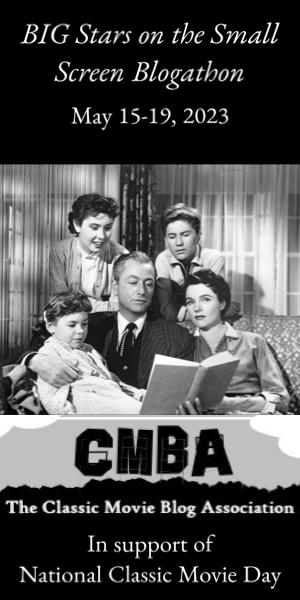
This is our entry for the Classic Movie Blog Association’s blogathon -- Big Stars on the Small Screen: In Support of National Classic Movie Day.  Have a look here for more great bloggers on the subject of classic film stars and television.

Though Miss Garson plays herself, touring in their Midwest town of Springfield to promote her latest film called “Rebel Lady,” the movie is fictional.  She never made such a film, but perhaps that gives her the freedom to act out such a comic and outlandish synopsis of the movie for the benefit of the Anderson’s youngest daughter.  A real movie she might be actually trying to promote would require more dignity.  Certainly, the studio heads would require it.  Greer throws dignity out the second-floor window of Kathy’s bedroom.


Kathy, or “Kitten” as her father calls her, played by Lauren Chapin, is the youngest of the three Anderson kids.  Billy Gray plays “Bud” the middle child, usually popping in and out of scenes with the funniest lines and the best comic timing.  


Elinor Donahue is the lovely eldest, Betty or “Princess” as Dad calls her.  Dad prefers nicknames (to the point where we may have forgotten that “Bud” is actually named for him—James Anderson, Jr.)  Miss Donahue, despite the trope of Big Sister Scorn she was forced to play in so many episodes, is probably one of the best “child” actresses in the enormous landscape of television families through the decades, who handled both dramatic and comedy scenes very well.


Mother is played by Jane Wyatt, who won three consecutive Emmy awards for her role as Margaret Anderson.  With her Eastern finishing school voice and manners, we may overlook that she is one of the most genuine of TV moms of the era in her relationship with husband and kids.  She gets mad and says so.  She is not always so understanding.  She even wears jeans and a sweatshirt once in a while.  She introduces herself to Greer Garson as “I’m the mother” but she’s a lot more than that on this show, if not this particular episode.

In an almost forerunner of what she would play on TV, Jane Wyatt starred as the mother of Ann Blyth in Our Very Own (1950) which we previously discussed here.


Robert Young plays Father, who actually began this role on radio in 1949, but the radio version of Jim Anderson was much more sarcastic and even mean, as radio tended to play in broader strokes for comedy.  When it moved to television, Mr. Young, who had a hand in production, wanted a warmer dad and a more loving family.  The show ran from 1954 to 1960, and became one of the iconic TV shows of an idealized suburban America in the 1950s.

Robert Young appeared with Greer Garson in That Forsyte Woman (1949), which we discussed in this previous post.  In that film, he is a prospective lover who ardently pursues Greer, but in this TV episode he only chases her for her autograph.  Young’s last film was made in 1954, and Greer Garson had also not made a film since 1954, though she had a few more in her, beginning with her turn as Eleanor Roosevelt in Sunrise at Campobello in 1960.  Until then, these two stars, like so many classic film stars and character actors, turned to the new medium of television for work.  They are middle-aged, but Young is the settled family man with the graying hair, and Greer is still glamorous, so much so that she mesmerizes the household, and is Kathy’s favorite actress.


Kathy must write an essay on the Civil War for school and has chosen to write on a new Civil War film starring Greer Garson called “Rebel Lady.”  She submits her essay to a contest, the prize for the several winners chosen is to visit Miss Garson in her hotel suite for cake and ice cream, and then accompany the famous actress to the theater to see the movie with her.


Kathy imagines what this will be like, and in her daydream, Greer Garson is dressed like a queen, complete with tiara, and their la-de-da dialogue Garson delivers with deadpan charm.   She tells Kathy, “You have such intellectual brains.”  Another actress gushing this would be cute, but spoken with Greer Garson’s regal intonation, it’s really funny.

Roused from her reverie, Kathy has a lot of work to put in on this essay, which is the most important essay anybody ever had to write.  She finishes it, sends it off, wins the prize, and then gets the measles.  Even in idyllic white middle-class suburbia, life dumps on you, apparently.

Measles, back in the day, could be a nuisance, or a sick-as-a-dog but you get over it illness, or serious complications, including death, usually from pneumonia.  Isolated populations with no immunity suffered cruelly, which an estimated 20 percent of people in the Hawaiian Islands in the 1850s and 40 percent in Fiji in 1875 killed by this sickness.  Millions of kids the world over died from measles every year, until vaccines were produced in the 1960s. 

We’re pretty sure Kathy will get over it, though.  She’ll probably be on the show next week.


Kathy, with nothing left to live for now that she can’t go to Greer Garson’s hotel room and eat ice cream and cake, sends dear old dad to her hotel to sign Kathy’s glamorous studio photo of Greer.  Dad, on the spot, reluctantly goes and stands in line with a bunch of clambering schoolgirls to get an autograph.  Supposedly, one of those kids is played by Kathy Garver, who later got to be older sister Cissy in Family Affair (1966-1971).  If you recognize her, let me know.

Just as he gets to the head of the line, Greer’s pen runs out of ink, and she is whisked away by her handlers.  Poor Jim Anderson has failed Kitten.  I love the line of the girl who, also denied an autograph, complains, “If that old man hadn’t hogged so much time.”  Robert Young has progressed from middle-age to old man.

Back in the sickroom, older sister Elinor Donahue aka Princess is trying to amuse the fretful Kathy with a game.  Kathy wants to know what’s taking Dad so long, and bitterly snaps, “Probably ran off with her.”  Another good line well delivered.  Yeah, there’s a few here and there even in a show with a rather too-sweet reputation.


Finally, Father returns, with Greer Garson herself in tow, and she compliments Kathy on her essay.  “It was so intellectual I could hardly understand part of it.”


Then, at Kathy’s request, she puts on a boffo performance of the entire movie in five minutes.  Flinging herself around the little girl’s bedroom, she mugs, she fires the opening salvo of the Civil War, she primps, she spies (her character is a spy for the Confederacy), she grabs the unsuspecting Bud, uses him for a prop as he unwittingly stands in for a Union sentry and later her husband, plants a lipstick smear on his forehead, to the gales of laughter from his parents, and finally, Greer delivers a message behind the lines to Stonewall Jackson, whom she also plays.


When it’s time for Greer to leave, Kathy says in sincere appreciation, “You’re such a good guy.”


Yeah, she is.

Remember to visit the other good guys blogging about Big Stars on the Small Screen here.


Notes:  "Migration and Disease" article Digital History site. 

            Fiji University National College of Medicine site.

 ************

Jacqueline T. Lynch is the author of Ann Blyth: Actress. Singer. Star. and Movies in Our Time - Hollywood Mirrors and Mimics the Twentieth Century and Hollywood Fights Fascism.  Her latest book is Christmas in Classic Films. TO JOIN HER READERS' GROUP - follow this link for a free book as a thank-you for joining.


Thursday, August 26, 2021

Hollywood Stars and the Search for a Polio Vaccine


Hollywood public service shorts on behalf of the March of Dimes and the search for a polio vaccine remind us of a world where a deadly and extremely communicable virus was everybody's fight and patriotic Americans did their part.  

The March of Dimes was founded in 1938, as the National Foundation for Infantile Paralysis was incorporated, launched by President Franklin Delano Roosevelt.  President Roosevelt, himself a victim of polio, was the nation's personification of the struggle against the mysterious virus.  After President Roosevelt's death, his image replaced the old Mercury Head Dime and became the Roosevelt Dime because of the March of Dimes and the fight against polio.  That fight still had almost another decade to find a solution. It found it in a vaccine.  The success of the field trials were announced on April 12, 1955 - the tenth anniversary of his death.  All of this, to a radical right fascist, might seem political.

Though there were plenty of detractors and outright enemies on the radical right against Roosevelt for his progressive programs, the fight against polio was not seen as political.  Polio was scary.

It also took more than one vaccine to vanquish.  The Salk vaccine was a two-injection process; the second shot was given three months after the first shot.  Then an additional booster shot some seven months later.

In 1961, the oral vaccine developed by Dr. Albert Sabin was available, and even those who had received the earlier Salk injection still took the Sabin oral vaccine.  Polio was that scary, people today who complain about the COVID vaccine and requiring boosters simply have no idea what they are talking about.

You were given a card on which to jot down the dates you received your shot:


Sound familiar?  The difference between then and now is now we have allowed the most ignorant and immature and irresponsible people in our society a louder voice and far more power than they deserve.

Polio still has no cure.  It is a virus that can be contained only by preventing it from spreading.  Since 1979 no polio cases have originated in the United States, a couple of decades from the discovery of the first vaccine, and four decades from the founding of the March of Dimes by the nation's most famous polio victim.

Hollywood pitched in and did its part.

Mickey Rooney and Judy Garland from 1938:


Robert Young and his family from 1951:


Cecil B. DeMille:


Lucille Ball and Desi Arnaz and their kids from 1954:


********************

Jacqueline T. Lynch is the author of Ann Blyth: Actress. Singer. Star. and Memories in Our Time - Hollywood Mirrors and Mimics the Twentieth Century. Her newspaper column on classic films, Silver Screen, Golden Memories is syndicated nationally.  Her new book, a collection of posts from this blog - Hollywood Fights Fascism - is available here on Amazon.


Thursday, July 14, 2016

The Mortal Storm - 1940


The Mortal Storm (1940) is about fascism.  It is about young love—and fascism.  It is about family values—and fascism.  It is about career dreams—and fascism.  We may consider these ideals to be separate from fascism, even opposing, but they are not.  So many people in the course of history have woven them together at their own peril.

For the next few weeks, we’re going to be talking about fascism, a particularly appropriate theme with the coming of the Republican Party convention and the rise in the media and in American politics of Donald Trump.  He is a fascist.  Too many people perhaps equate the word fascism with something old-fashioned, belonging to the twentieth century, and think it is a foreign aberration, since Adolf Hitler made it his slogan and source of power.  They might think that use of the word today is cliché and overused, but it is as powerful and meaningful a word and a strain of political thought today as it ever was from the 1920s through the 1940s.  It is with us still, and the most poisonous aspect of fascism is it becomes chameleon-like.  We do not see it for what it is, unless we force ourselves to concentrate and look.

Classic films forced us to look at fascism.  During World War II, of course, the films were patriotic, and even propagandist, and it was very easy to pick out the villains in the movies because they were wearing Nazi uniforms.  But in that strange, tense era just before our involvement in World War II, the studios utilized their art and their industry with courage not seen today, and with a social conscience not seen today, they examined fascism.

Because of so many screen Nazi bad guys, we may have come to believe that fascism is a product of Europe, and is as out of sync with the modern world as high waisted trousers, fedoras, and clip-on earrings. The movies we’re going to examine will take us out of that notion, and into an interesting exercise of where we must look to examine how fascism starts, how it spreads, and what do we do about it?

Along with The Mortal Storm, in future weeks we will be discussing Address Unknown (1944) here, Keeper of the Flame (1942) here, Storm Warning (1951) here, and Seven Days in May (1964) here.  This brings us up to the 1960s, when our world became far more interested in the Cold War against communism, and the space race, and the dizzying parade of social ills and revolutions.  But fascism remained, always there, like a smoldering ember at a campfire that has been carelessly left, and will start a forest fire if the prevailing winds allow it.

TheMortal Storm (1940), was produced by MGM, with great trepidation.  We were not at war with Germany yet (indeed we would not go to war with Germany until two days after they already declared war on us in December 1941), and the studio was wary about producing a movie that could be considered inflammatory.  The German market was especially important to Hollywood, and offending the German government could be disastrous when it came to distribution of the film in Europe.  Moreover, the studio heads were sensitive about pushing the subject of fascism when, as most of them were of Jewish heritage, were afraid to appear as if they were politicizing their product.  It had been their practice, as most of them were European immigrants to this country, to assimilate to their new country and to adapt to its culture, its language, and even, if necessary, to concede to its long-standing prejudices.

We may recall from these previous posts (part 1 and part 2), that Gentleman’s Agreement (1947) was avoided by many studios and was finally produced by Darryl F. Zanuck of 20th Century Fox—a major studio head who happened to be not Jewish, but who had guts, and took on the story.

We may applaud MGM for moving forward with The Mortal Storm, risks and all, but their fears were justified.  The German government under Adolf Hitler was incensed that this film was made, and banned that and any future MGM movie from being shown in Germany.  That MGM was blacklisted by the Nazis may have been worn as a badge of courage by the studio in future years when the war was going on, but at the time it was seen as a misfortune.

However, the film is quite mild by today’s standards, at least of depicting the savagery of Hitler’s regime.  It is still a powerful movie, and that is because it deals with people.  Ideals, and political jargon are bandied about, of course, and people take sides, but first and foremost it is a movie about a single family and what happens to them when forces beyond their control knock on their door and take over their lives.  It is gentle, and it is scary.

Frank Morgan plays a university professor in Germany.  The year is 1933.  Irene Rich is his wife.  Her two grown sons by a previous marriage are played by Robert Stack and William T. Orr. They are very close to their stepfather, Frank Morgan, and when the film opens with Morgan’s 60th birthday celebration, they take him aside to give him their present personally and to thank him for being such a wonderful father to them.

From Mr. Morgan’s marriage to Irene Rich there are two younger children, a daughter played by Margaret Sullavan, and a son barely in his teens played by Gene Reynolds.  At the university where Mr. Morgan teaches, a surprise celebration in his lecture hall greets him when his students and the other members of the faculty, who clearly respect him and love him very much, present him with a gift and sing “Gaudeamus Igitur” in his tribute (which is pretty impressive watching the cast sing it in Latin).  We’ve heard the song in zillions of old movies and cartoons whenever a scene is set at a college. It’s like playing “California, Here I come,” or “The Sidewalks of New York.”

Two of those students are played by Robert Young and James Stewart.  Mr. Young, Mr. Stewart, and Miss Sullavan have been friends since childhood.  When these two gentlemen come home with the family to have a birthday dinner for Mr. Morgan, we see that Robert Young is even closer to Margaret Sullavan, and impetuously asks her to marry him.  With his exuberance, and the whole family watching, he makes it difficult for her to say no and she accepts.  Everyone in the family is jubilant, except for James Stewart, whose expression ever so slightly falls to the floor and we see that he has harbored an unspoken affection for Margaret.

But the birthday party turns on its head when we hear from the radio that Adolf Hitler has just been elected Chancellor of Germany.

Fascism, in its most vile form, is brought to a nation in a democratic election.  There is nothing so virulent a germ as a political movement which serves to appeal to the most base, crude, and ignorant in a society, inflating them with a power they do not have, and then taking it away like a shell game. Alexis de Tocqueville, nineteenth century historian who made many keen and valuable observations on America in its formative years noted especially of our eagerness to follow the mob, despite our boasts of individual freedom:

In times of equality, no matter what political laws men devise for themselves, it is safe to foresee that trust in common opinion will become a sort of religion, with the majority as the prophet.

Robert Young, Robert Stack, and William T. Orr are overjoyed at the radio announcement and celebrate, saying that Hitler will bring the country back to greatness.  He will make Germany great again.

James Stewart has no political convictions; he still seems to be reeling by the idea that Margaret Sullavan is going to marry somebody else.  Frank Morgan and his wife are hesitant to be quite as jubilant as the boys. They hope for the best, but as a university professor, Morgan is unimpressed with Hitler’s designs on the country and his methods for achieving greatness.  Morgan is a man devoted to logic, and this is all too illogical for him.

But there is more to his concern.  We come to find out later in the film that Frank Morgan is Jewish.

In the movie his Jewish heritage is never mentioned by name, he is instead called “non-Aryan,” and at first we may think this is MGM pulling a punch, trying not to get too ethnic, too personal, too political.  It probably was. But time tends to leave a patina, on ideas as well as on objects, and I think perhaps that “non-Aryan” sounds here more inclusive of all the millions of people who suffered under Hitler’s regime.  

When people who deny the Holocaust, or just as perverse, people who do not deny it, but who simply prefer not to think about it, hear the figure of 6 million Jews being murdered, I wonder if they forget that also there were at least 9 million non-Jewish citizens of the Soviet Union murdered in death camps, and nearly 2 million non-Jewish Poles, and millions of other people whom the Hitler regime regarded as non-entities: Gypsies (properly referred to now as Roma), non-Jewish Czechs, Serbs and other peoples of occupied Europe, and people within Germany who protested including Catholic priests, Protestant ministers, Jehovah’s Witnesses, the infirm, the mentally challenged, convicts, and homosexuals—a variety of targets in addition to the millions of suffering Jews.

It is staggering.  And because it is staggering, the human mind recoils, unless the heart is brave and the mind has a bigger conscience than it has a fear of discomfort.  Only a moron and a coward would deny the Holocaust, and though we may equate the Holocaust with fascism, we must remember that fascism did not start there.

“Non-Aryan,” means everybody who was not considered to be “us.”  And fascism resulted in millions of “thems.”  Us and them.  That’s where it always starts.

The movie moves swiftly from this point, with Robert Young, Robert Stack and William T. Orr becoming more immersed in the Nazi culture, wearing uniforms, giving the Nazi salute, and their boyish jubilation has turned to stern, dogmatic, and slavish obedience to their new leader. (Look for a young Dan Dailey as an especially vicious Nazi youth leader.)  Hitler has given them an identity, and they draw apart from their family because of it.  They become distant with Frank Morgan, and Robert Young’s preoccupation with his new Nazi youth organization duties has left Margaret Sullavan alone and puzzled at the change in him.


James Stewart, who has come to the university to learn veterinary medicine, has grown up on a farm on the outskirts of town.  His mother is our favorite Maria Ouspenskaya, who seems to see no werewolves in the vicinity.  Young Bonita Granville is their hired girl, and Bonita has a crush on James Stewart.  Before the movie is over, she will be terrorized by Nazi thugs trying to get information out of her about where James Stewart is hiding.

Stewart has pulled away from his university pals; he wants none of this Nazi business.  When he sees them beating up an old teacher, James Stewart runs to his aid, and Margaret Sullavan helps. She refuses to stop seeing Stewart as friends, even though Robert Young warns her to stay away from him, not so much because of romantic jealousy, but because Stewart is getting a name for himself as an enemy of the state.  It does not take much to be an enemy of the state.  James Stewart has made no political speeches, he assiduously avoids talk of politics at every turn; he just wants to be left alone.  But he will not join the boys in their Nazi youth organization, and this makes the boys furious.  He will not play with them, so now James Stewart has stopped being “us,” and has started to be “them.”


Frank Morgan, formerly beloved by one and all, has become an even more serious “them.”  He is not political either, but he was born to be a “them,” because he is a non-Aryan.  He is sent to a concentration camp.

James Stewart and Margaret Sullavan show the most courage and the most moxie of anyone in the movie because of their stubborn refusal to be one of the gang, because they defend a victim of that gang, and because Miss Sullavan openly claims her heritage.  When she hears Robert Young disparage non-Aryans, she calls them “my people,” though her mother most certainly is Aryan and if she wanted to, Margaret Sullavan could be safe even in this Nazi regime, by denying her father and ignoring her Jewish heritage. She breaks off with Robert Young.

An exciting climax builds when, after Frank Morgan dies in the concentration camp (which must have been at least surprising, if not shocking, to audiences of the day), she, her mother, and her young brother try to escape from Germany as James Stewart has already done before them.  Mother and younger brother make it, but Margaret is held at the border.  Stewart comes back for her and leads her through a treacherous mountain pass, with Robert Young and the boys on the chase. Just Stewart and Sullavan are skiing down a wintry slope approaching the Austrian border, the patrol under the orders of Robert Young, shoots Margaret Sullavan down like a dog.

Mr. Stewart scoops her up in his arms and continues to ski for the border, but she dies before he can reach it.

That had to be equally strong stuff for the audiences of the day.  The Nazis here are not punished, they are not foiled.  World War II is barely six months old, and it would be another year and a half before we became involved.  This is a tragedy we cannot reach.  Is it any of our business?  Some Americans on the sidelines (and in the movie theaters) said yes, some said no, some were cheering for the Nazis and resented them being presented as the bad guys.

Robert Young has always impressed me with his sensitive acting ability, I think I like him better in dramas than in comedies, though he could certainly do both well.  Here he is not so much a brainwashed Nazi, as someone who is trying to convince himself that he hasn’t made a mistake, and his pride is too great to admit that he could be wrong. 

We see this so often today.  People so slavishly devoted to an idea, or political party, or a candidate, and refuse to entertain any niggling doubt that might indicate they are wrong in their choice, that there are holes in the story they want to believe.

Robert Young does still love Margaret Sullavan, and we can see he is choked up and appalled by her murder (he even helped her earlier by finding out what camp her father was taken to), but we do not know if this is going to change him and make him step back from being a Nazi.  It probably won’t.  He would have to admit he was wrong.

Robert Stack is also appalled by his half-sister’s murder, and he is the most sensitive to the horror of it.  It’s possible he would step back from being a Nazi if he could, but he is too weak.  It is not his pride that keeps him in the grip of fascism; it is his weakness.

The younger brother, William T. Orr, is the one most flagrantly dogmatic about fascism, to the point where he does not mourn his sister’s murder.  He slaps Robert Stack in the face for entertaining thoughts that they have made a mistake.  Orr has embraced fascism out of lack of maturity, a lack of intelligence, and because of the sensational high it gives him, and he is perfect fodder for the new regime.

Frank Morgan, before he is taken to the death camp, refuses to submit to Nazis, not because he is a non-Aryan, but because he is a teacher and a scientist and in both professions truthfulness is more important than fashion, or should be.  He takes umbrage about the concept of racial purity in his lecture hall when students protest when he insists that the blood of different races is the same.

“Scientific truth is scientific truth, unchangeable and eternal.  It cannot be altered to suit the politics of the hour or the clamor of immature hoodlums.”

Later he will say, “I’ve never prized safety for my children, I’ve prized courage.”

These are great lines.  They are just as apropos today.  We began this year with this post on the relevance of classic films today, particularly as we examine how our society is buffeted in turbulent times.  I mentioned Donald Trump as both an aberration of our time, and a consequence of it.  I admit, I did not think he would get this far, that the media would have raised him to the level of a celebrity; or that the party of Abraham Lincoln, of Teddy Roosevelt, of Dwight D. Eisenhower would have embraced this pig.  But fascism has its mysterious and confounding allure.  We cannot depend on modern films to tackle the subject.  They are too busy with juvenile stories.  Luckily, we have classic films.


Come back next week when we discuss Address Unknown here with Paul Lukas. This time, we see the allure of fascism not to impetuous youth, but to an educated and cultured man in middle age, and two immigrant American families that are touched by long-reaching ideology from a foreign source, caught in its web even from the supposed safety of American shores.

**********************


My audio book version of Ann Blyth: Actress. Singer. Star., narrated by Toni Lewis, is now for sale on Audible.com, and on Amazon and iTunes.


*********
Jacqueline T. Lynch is the author of Ann Blyth: Actress. Singer. Star. and Memories in Our Time - Hollywood Mirrors and Mimics the Twentieth Century. Her newspaper column on classic films, Silver Screen, Golden Memories is syndicated nationally.

Related Products