IMPRISON TRAITOR, PEDOPHILE, AND CONVICTED FELON TRUMP.
Showing posts with label My Dream Is Yours. Show all posts

Wednesday, April 4, 2007

My Dream Is Yours (1949)


In My Dream is Yours (1949), we have a film which spoofs radio advertising, the music business, agents, and really has no Easter message at all, except for the small Easter celebration toward the end of the film when single mom Doris Day’s uncle is seen dyeing colored Easter eggs for her son Freddie, and Freddie gets stuffed bunnies from all the grownups. Doris Day and Jack Carson sing a musical number with Bugs Bunny in an animated sequence, which is Freddie’s dream. Day and Carson are dressed as Easter bunnies. Even Tweety, who must have had a good agent, has a cameo. 


Even beyond the animated sequence, the film is awash in color, in the pastel gowns in the all-female orchestra on S. Z. Sakall’s radio program. Eve Arden, whose sassy sense and smart mouth foreshadow her success on radio with Our Miss Brooks is vivid with her red hair and yellow jacket. In another scene she wears green slacks, the color jumps off the screen. Among the ladies there are green hats, blue dresses, pink blouses. The message may not be fashion, but it certainly is color. The drab war years are over. 


The plot is typically simple. Arrogant radio singer Lee Bowman dumps agent Jack Carson to go on to bigger things. Carson replaces him with nobody Doris Day and spends much of the film trying to arrange her first big break. Doris falls for the lout Bowman, but in the last moments realizes good guy Jack Carson, who adores her son, is the one to be with. A fun aspect to this film are the many shots of post-war Los Angeles, some location shooting, and some rear-screen projection, of street scenes and landmarks including the Brown Derby and the Copacabana. 
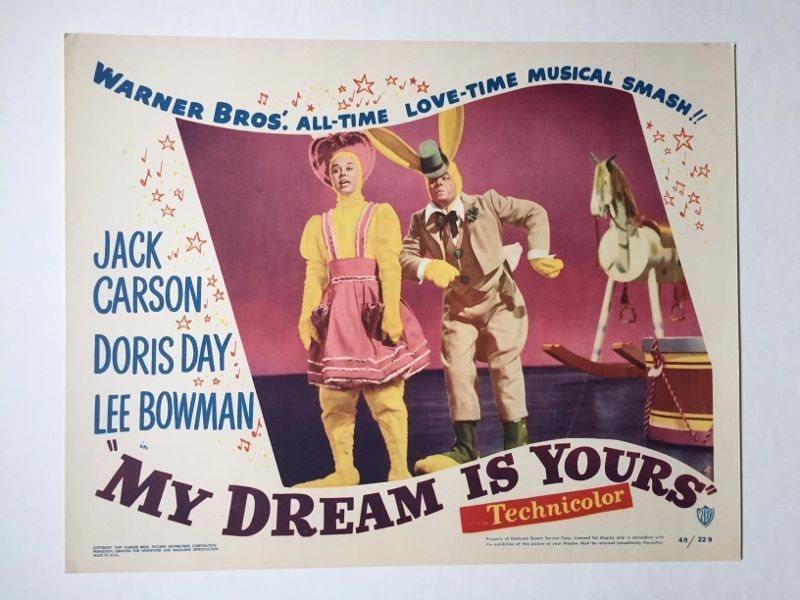

Another point to remember in these post-war Easters is that gas rationing of the war years was over. Sugar rationing is over. Clothing rationing is over. The urge to celebrate, not just victory, but the return to a normal life is what makes a huge difference in how the celebration of secular Easter has come down to us. During the war, we had a brief glimpse of Bing Crosby and Marjorie Reynolds singing “Easter Parade” as they left a small country church in Holiday Inn (1942). They are dressed simply and modestly for church, but there is no opulence. When Fred Astaire greets them on the porch of the inn, he is not wearing a top hat or carrying an Easter lily. It is a sweet, but not a splashy segment. By 1949, Easter, like the eggs in the color bath, got a bit splashy. 
_____________
Jacqueline T. Lynch is the author of Ann Blyth: Actress. Singer. Star. and Memories in Our Time - Hollywood Mirrors and Mimics the Twentieth Century. Her newspaper column on classic films, Silver Screen, Golden Memories is syndicated nationally.  Her new book, a collection of posts from this blog - Hollywood Fights Fascism - is available here on Amazon.

Tuesday, April 3, 2007

Easter In Hollywood - 1949

Easter in the old movies comes to us in fashion, flowers, and songs. The two films, “Easter Parade” and “My Dream is Yours” give us plenty of these, along with colors of the rainbow like so much Easter egg dye.

Though Cecil B. DeMille may have tackled both the story of Christ and the story of Moses, a holiday like Easter was usually presented its most secular clothing. But, Hollywood did not create this new Easter, it merely exploited it.

As far back as the mid-1900s, Easter began a new secular role when New York City’s Fifth Avenue became the site of the so-called “Easter Parade,” when the wealthy classes strolled home from church in the latest European fashions, watched with fascination by the working class people who hovered on the edges of society. This is the world Judy Garland gets a glimpse of as a young, awkward hoofer in “Easter Parade.”

As the 20th Century dawned, other cities picked up this craze, and after World War I, when the boom of the 1920s put more money in the working man’s pockets, the idea of springtime fashions became possible for everyone. Amid the frenzied commercial cult of the 1920s, new clothes were requisite for the entire family. Milliners were as important to life then as the milkman. One didn’t leave home without a hat, and if a holiday required new clothes, then it also required new hats. The Easter bonnet was born.

The holiday spending spread to candy, flowers, and small toys in the shape of rabbits and chicks. In some cities, the biggest shopping day of the year, right through the Depression, was not the day after Thanksgiving as it is now, but Holy Saturday.

By 1948-49, which gave us “Easter Parade” and “My Dream is Yours” there were more families, more kiddies, and more money. Freddie, the little boy of single mom Doris Day in “My Dream is Yours” gets showered with presents of toy rabbits by all the adults.

The song Fred Astaire sings while chapeau shopping in “Easter Parade” is called “Happy Easter,” and on his radio show on April 17, 1949, Easter Sunday, Jack Benny and Mary Livingstone sing this song while they take their listeners on an imaginary Easter parade up Wiltshire Boulevard in Los Angeles, touting the movie. One of the passers by they “meet,” incidentally, is played by Sheldon Leonard, who has a minor role in “My Dream is Yours,” and also a character played by Mel Blanc, who does the voice of Bugs Bunny in the animated sequence in “My Dream is Yours.” Before we get into playing Six Degrees of Sheldon Leonard, let’s note that by the following year, 1950, Gene Autry released his hit, “Here Comes Peter Cottontail,” and the American suburban Easter was firmly in place, planted by Hollywood. The “bunny trail” was the back yard.

The whole family may not get new Easter clothes anymore, but the candy makers still do a brisk business, and these two movies remain to tell us a lot about how things used to be.

More tomorrow on “Easter Parade” and “My Dream is Yours.”

Monday, April 2, 2007

Easter Films - Sacred vs Silly

With Easter approaching and this week, Holy Week, the most important in the Christian calendar, it’s interesting to take a look at Americans’ ability to walk that line between the sacred and the silly. Obviously jelly beans and chocolate bunnies have nothing to do with liturgy, yet they are now part and parcel of Easter.

Movies have not grasped the holiday and wrung it to bits the way they’ve commandeered Christmas, but two Easter films we’ll be dealing with this week are stamped with that genuine American attitude of compromise. The Passion of Christ cannot, for most of us, be reduced to a lighthearted musical review of songs and dances. But, the secular aspects of any religious holiday are more comfortably shared, celebrated, and kidded. Thus the sacred and the silly are separated, but not necessarily opposing.

By the way, we’re talking “old” movies (see Intro in archives), so “Godspell” and “Jesus Christ Superstar,” despite their merits as musicals, are not the issue here. Nor will either help us to understand that American invention of the secular persona for a sacred holiday.

The two films are “Easter Parade” and “My Dream is Yours,” from 1948 and 1949. These postwar years play a big a part in the character of these films. The post-war years had a strange duality to them. On the one hand, the GI Bill of Rights provided the resources for a generation of young men to pursue education, business, and a suburban tract home. On the other hand, despite this drive to a seek out a wonderful future, there was a kind of fatigue after the horrors of war and a yearning to turn back the mind, if not the clock, to a happier time and place. That’s generally called nostalgia, and it’s usually mostly made up.

There was the bewildered realization that after victory in the war and especially with the invention of the atom bomb, America was now the most powerful nation on earth, an aspect of our lives with which Americans still struggle. Yet, there was a naiveté about our power and our bomb, that led Doris Day, in “My Dream Is Yours” to sing a novelty tune called “The Geiger Counter Song” with a “tick-tick-tick” syncopation to “give me a radioactive kick.”

“Easter Parade” eschewed the modern times and sent us back to 1911-1912, where modernity was represented in large plumed hats and ragtime, a more comfortable spot for us to be, evidently. The film was intended to be a showcase for a variety of Tin Pan Alley Irving Berlin tunes. Ironically, the song “Easter Parade” was not from this era, but was written by Berlin for the musical review “As Thousands Cheer” in 1932. It’s always been hard to film a movie about the past and not get slapped in the head by unruly anachronisms. That is because we want the past to be what we want it to be, and not what it was.

More tomorrow on these Easter films.

Related Products