IMPRISON TRAITOR, PEDOPHILE, AND CONVICTED FELON TRUMP.
Showing posts with label Humphrey Bogart. Show all posts

Thursday, November 5, 2026

This is us right now...Casablanca (1943) "La Marseillaise" scene...


For more on this fascinating and important...and timely...film, have a look at this previous post.


Hollywood Fights Fascism is a collection of posts from this blog that showcase a braver era in Hollywood, when fascism was called out for what it was.  eBook and print from Amazon;

Available in eBook here from Barnes & Noble, Apple, and a varied of other online shops.


*******************************

CHILDREN'S WARTIME ADVENTURE NOVELS - The Silent Generation's Vicarious Experience of World War II -- is available in eBook here at Barnes & Noble, Apple, Kobo, and a wide variety of other online shops.

From Cherry Ames, to Meet the Malones, from Dave Dawson to Kitty Carter - Canteen Girl, the Silent Generation spent their childhood immersed in geopolitical events through the prism of their middle grade and young adult books.  From the home front to the battlefield, these books are a window on their world, and influenced their hard-working, conformity-loving generation. 

Buy this or any of my books online here at Bookshop.org.

Thursday, November 10, 2022

We're No Angels (1955)


We’re No Angels (1955) cheekily teases us about our own Christmas sentimentality with an unabashed romp of black humor and goofy good will toward men.  And a murder.


This is my entry into the Classic Movie Blog Association's "Movies are Murder" blogathon.  Have a look at the site here to see the other great blogs.


This post also serves as my intro to a countdown to Christmas coinciding with the launch of my newest book, Christmas in Classic Films.

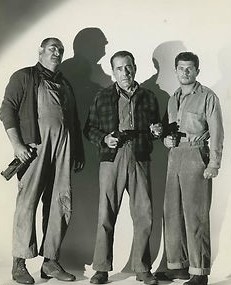
It is Christmas Eve, 1895 in French Guiana, where three convicts have escaped from the prison at Devil’s Island.  They are Humphrey Bogart, Peter Ustinov, and Aldo Ray.  They do not shoot it out to escape, but rather employ playful charm and Boy Scout-like helpfulness to hide with the family of a local storekeeper until they can board a ship that will take them away back to France and freedom.  The only real weapon they have is their wits and Adolphe, a poisonous snake.

The storekeeper is Leo G. Carroll, befuddled and incompetent, who allows the convicts to repair his roof, not knowing they have escaped.  Joan Bennett is his flighty wife, and Gloria Talbot is his teenage daughter, who spends much of the movie fainting and being carried around by lecherous Aldo Ray.

Basil Rathbone is the wealthy owner of the store, who arrives with his son to take over the business because it is so badly run and unprofitable.  Rathbone is a delightfully first-rate villain, an obnoxious, arrogant, sneering scene stealer who forbids his son to have anything to do with Gloria Talbot, and breaks up their budding romance, not that the son seems to mind that much.  He knows which side his bread is buttered on.

The convicts step in to help Mr. Carroll’s family—they work as sales clerks, they artfully fix up his ledger, they arrange a magnificent Christmas dinner for the family with little luxuries they have stolen.  It’s not certain if they like Carroll’s family so much or just hate Basil Rathbone with a passion, but they stay to defend the family, even to the point of killing Rathbone and his son.

Well, they don’t actually do it.  Adolphe, the snake, bites them, but the convicts let him.


Some charming moments are finding Bogie completely at home cooking in the kitchen wearing a pink frilly apron as if to dare us to laugh, and the trio singing the hymn, “Three Angels,” which they perform for the family.

The dialogue is fast and witty, and very dark.  They frankly and disarmingly discuss their crimes, display a taste for violence with odd joie de vivre, and the film generally defies not only our usual expectations of Christmas sentiment, but our pedestrian need for logic. Director Michael Curtiz’s last movie before this was the tippity-top of all Christmas movies, White Christmas (1954).  Perhaps his own sense of irony required a palate cleanser.

When the family is safe and the opportunity presents itself for the convicts to catch their boat to freedom, they instead decide to return to prison, because it wasn’t so bad and people on the outside are not very nice.  Except for their new little family, which they decide they can always visit when they break out of prison next Christmas.  They walk away from the camera, and three halos are superimposed above their heads.  And over the little cage Aldo Ray carries that holds Adolphe.

But we know, they’re no angels.  Unless, of course, angels can be temporary manifestations when we need them.


Don't forget to check out the other blogs in CMBA's "Movies are Murder" Blogathon!

   ********************

Jacqueline T. Lynch is the author of Ann Blyth: Actress. Singer. Star. and Memories in Our Time - Hollywood Mirrors and Mimics the Twentieth Century and Hollywood Fights Fascism. TO JOIN HER READERS' GROUP - follow this link for a free book as a thank-you for joining.

Thursday, March 11, 2021

Black Legion - 1937


Black Legion (1937) reveals how a factory worker from the Midwest is lured into a white supremacist gang, commits atrocities in fellowship with them, and what happens to his family, friends, and community. It should have made Humphrey Bogart a star, but that would have to wait a few years until the studio decided to promote him as such.  But Warner Bros. showed no hesitancy to rush to produce this film barely a year after the real-life incident on which it was based.


One is drawn to obvious social and political parallels today about the recurrence of violent fascism in our country, culminating most recently with the attempted coup and overthrow of the government with the Trumpist-militants’ terrorist attack on the Capitol Building in Washington, D.C.   The depressing thought that such lunatics have always existed in this country is certainly shameful, but Black Legion is a film that one should view not just with sober realization of an evil undercurrent in our country; the movie should be recognized with pride as an important film that Hollywood had the guts to make.  America is uniquely forthright in airing our dirty laundry, so to speak, and uniquely able to reboot, again and again.  Our ability to address social ills and repair injustice, as difficult and slow as that is, should be a source of pride and something to which each succeeding generation should aspire.  Movies like Black Legion informed a Depression-era audience by reflecting their own times, their own world.  It was current events. The uncomfortable topic wasn’t trivialized, hidden, or given the asinine “both-sides-ism” treatment in order not to offend people who might take revenge. (Of course, Warner Bros. execs didn’t have to fear MAGA goons walking around the streets in those days with military-grade automatic weapons.)  It was just a story about a guy.  That happened to be true.


Humphrey Bogart plays Frank Taylor, a factory worker who is seemingly happy in his life. He’s got a steady job – something to be grateful for in these Depression days – a good marriage, a good, healthy son played by Dickie Jones, and some good buddies like Dick Foran.  We learn early on that Bogie, though he likes his job, is not exactly a go-getter.  Like some of the other fellows, he teases a fellow machinist on the line who spends his lunch hour studying so that he might earn a promotion.  His name is Joe Dombrowski, played by Henry Brandon in one of eleven films he did that year.  Oh, the life of a bit player.  It’s a wonder he had time for lunch at all.


John Litel is the foreman (he did nine films released in 1937). He’s moving up the ladder to a better job and the company will choose from among the workers to take his place.  Bogie thinks he’s got seniority and is better at this job than anyone on the line, convinces himself the job’s in the bag.  He’s so sure, he’s walking on cloud nine and plans to buy a car to celebrate, plans on fixing up the house and buying his wife a vacuum cleaner.


But Joe Dombrowski gets the job. Bogie is humiliated, and angry.  The charming scenes with his wife at home, and listening to a children’s adventure show on the radio with his boy are wiped away in his growing resentment of being passed over.  Bogie is very skilled in showing the, at first, subtle change in his character.  The early lighthearted scenes are a far cry from the usual brooding gangster he played in his early film career, but he is entirely believable at creating a very likable persona. 


Then being passed over clouds his mood, and later, his judgment.  Suddenly, the home and the job are both dissatisfying.  His resentment grows, and it’s not directed at the company he works for but rather the fellow who got the job.  Joe Dombrowski lives with his widowed father on a small farm on the outskirts of town.  His father is an immigrant from Poland.  We don’t know if Joe was born in the U.S. or not, but he and his father get labeled as foreigners, one strike against them in this apparently fairly homogenous white Midwestern town.  Another strike is they are likely Roman Catholic, in what is apparently a largely Protestant community.  Put these two together in a fellow who got a job that a “real American” considered was his, and we have the typical trigger for a vigilante group looking for any excuse to start trouble.


Bogie, following a trail of hints and whispers of a brotherhood who will give him a sense of belonging, not to say superiority, stumbles upon the Black Legion in the basement of a drugstore in town.  The druggist, and other prominent businessmen, are members, “free, white and 100 percent American.”


They take him into the gang and in an initiation ceremony late at night in the woods, he kneels like a postulant before a group of men clothed in Ku Klux Klan-style robes and hoods, and takes an oath:


“In the name of God and the Devil, one to reward and the other to punish, and by the powers of light and darkness, good and evil, here under the black arch of Heaven's avenging symbol, I pledge and consecrate my heart, my brain, my body, and my limbs and swear by all the powers of Heaven and Hell to devote my life to the obedience of my superiors and that no danger or peril shall deter me from executing their orders. That I will exert every possible means in my power for the extermination of the anarchist, the Roman hierarchy and their abettors…”

Taking an oath in the name of Satan is peculiarly appropriate for a mob intent on such evil activities, and Bogie falters over some of the words, seems bewildered and nervous about what he is doing, wondering what it means and what might really be expected of him.  He seems surprised at what he is reading on the card, but he adjusts quickly to his new brethren when he is offered a robe and hood (for $6.50) and his very own revolver (for $14.95.)

The scene back at home when he poses with his new revolver in front of a mirror, admiring his tough image, swaggering a little – we have seen that many times since, not only on feature films (Robert De Niro in Taxi Driver – 1976), but in countless sickening cell phone videos posted to the Internet by self-described avengers.

He spends more time away from home in the evening, and tells his wife, played by Erin O’Brien-Moore, that he has joined a lodge.  She is concerned, and she suffers his road to hell on the sidelines.

Bogie goes out with them at night to terrorize the Dombrowski farm, meaning to teach the “undesirable alien” a lesson.  They beat up father and son, kidnap them, set fire to the home, and then dump the Dombrowskis on a freight train.  The thugs drink and celebrate at a bar later on.

Bogie comes home drunk for the first time, gets Dombrowski’s job as shop foreman (not only did Joe Dombrowski not show up for work the next day, he was never seen again), buys a new car, and tries to get his pal, Dick Foran to join the Black Legion.  Mr. Foran’s response, “That’s for half-wits.”


Bogie is understandably put off by this insult, but Dick Foran knows nothing about the group, not really.  He rooms at the home of their older fellow worker, Mike Grogan, played by Clifford Soubier.  Old Mike has a beautiful daughter, played by Ann Sheridan.  Dick Foran and Ann Sheridan are sweethearts.  Their bliss will soon be shaken by forces building around them.

The Black Legion goes on more raids, smashing the store windows of “cut rate” shops, i.e., immigrant-owned, Jewish-owned.

The militant group requires membership dues and each member is required to sign up two new recruits.  Now that Bogie is the shop foreman, he’s in a position of authority to pressure his workers on his line to join. 

He asks one worker what church the man goes to, and the man replies he goes to none.

“Are you willing to protect your job?” He takes another tack, plays the foreigner taking his job angle, and the guy agrees to join.


Bogie tends more to the Black Legion than he does his job, and there are problems on the production line.  He messes up and asks people to cover for him with management.  Bogie is demoted and his foreman’s position is given to someone else – Pa Grogan.  Uh-oh, Mr. Grogan has an Irish accent.  He wasn’t born in the U.S.  He’s an immigrant taking the job of a “real” American.

No surprise, the Black Legion goes after Grogan next.  He is brought out to the woods, stripped to the waist, tied to a tree, and whipped.  “That ought to give the Irish something to remember us by.”


Old Grogan is hospitalized, and Dick Foran gets suspicious and asks Bogie’s wife about his lodge meetings.  Bogie takes up with the town floozy, played by Helen Flint.  Foran confronts Bogie, laying down the law to him when Bogie comes home drunk and hits his wife.  Bogie, in a drunken panic, exclaims he can’t leave the group because they won’t let him.  He fears their power.  Fascists are always cannibalistic; they always destroy their own.

Dick Foran is now the target. He is kidnapped, taken to the woods, but in an attempt to run away, he is shot dead.  All the thugs run away except for a shocked Bogie, who tearfully, haunted, tells Foran’s lifeless body, “I didn’t mean it!”

There is a suspenseful manhunt sequence as he stumbles away in the darkness, goes to a truck stop to pull himself together, flinches at the sight of motorcycle cops and spooked by the radio report of a body being found. 


The cops nab Bogie, and through a series of scenes we see the mop-up of the terrorist gang.  Bogie is imprisoned, and when his wife is brought to him, he falls on his knees, throws his arms around her, and cries. 


But he has another visitor to his cell, a rep from the Black Legion, who wants him to keep quiet.  He threatens to kill Bogie’s wife and child if Bogie talks.  He is told to tell the judge that he killed Dick Foran in self-defense, and to not implicate anyone else who was there. There is a plot to defame Dick Foran, and a courtroom full of Black Legion thugs smirk at each other in anticipation of their victory.


But Bogie, overwhelmed at the faces in the courtroom, including his wife, his mind reeling at the events of the past months, cracks, confesses, and names names.

We are dashed into a conclusion of headlines and the judge reading from the Bill of Rights, but perhaps the most profound impact is the last shot of Humphrey Bogart as he is being led away to spend the rest of his life in prison.  He throws a look to his wife.  It is half-apology and half-plea for an explanation, as if to say, “How did this happen to me?”  It is perhaps the bewilderment even more than the remorse that cuts to the audience.

How many real-life members of the Black Legion were moved by this film we won’t hazard a guess; they were undoubtedly more directly hit by the investigations that came their way after their kidnapping and murder of Charles Poole, a French-Catholic organizer for President Roosevelt’s Works Progress Administration in Michigan in 1935, resulting in the imprisonment of nearly 50 of them.  The fascist organization was against Blacks, Catholics, Jews, union members and leaders, Communists where they could find them and tagging people with that label when they could not.  They counted businessmen, pillars of the community in their ranks, as well the disgruntled uneducated mobs who were their willing foot soldiers. 

Read this fascinating article in The Detroit News for more on the Black Legion and the incident that inspired the movie. 

Note that the article was published in 1997.  Note that Michigan is again plagued by fascist terrorists, some of their leaders charged after their plot to kidnap and murder Michigan Governor Gretchen Whitmer was foiled by the FBI. 

For more on classic films that explored and exposed fascism, have a look at my book Hollywood Fights Fascism, available in print and eBook:


Hollywood Fights Fascism
 (eBook):

Amazon

Apple

Kobo

Barnes & Noble

PRINT BOOK  - Amazon

My Etsy shop

----------------------------------

References:

The Detroit News, “The Murder that Brought Down the Black Legion,” August 4, 1997.

_____________________

Jacqueline T. Lynch is the author of Ann Blyth: Actress. Singer. Star. and Memories in Our Time - Hollywood Mirrors and Mimics the Twentieth Century. Her newspaper column on classic films, Silver Screen, Golden Memories is syndicated nationally.  Her new book, a collection of posts from this blog - Hollywood Fights Fascism - is available here on Amazon.

Saturday, December 5, 2020

Tom Tully - What a Character Blogathon


Tom Tully was an actor of great depth, who exuded grace even in his most snide, sinister, and crusty roles, and yet who could display such unassuming warmth that one could hardly imagine him ever being snide, sinister, or crusty.

Today we join several other blogs in the 9th “What a Character!” Blogathon celebrating favorite character actors of classic films, sponsored by the blogs Paula’s Cinema Club, Once Upon a Screen, and Outspoken & Freckled. 


We covered some of Tully’s work in previous posts, including his genial, kindly, and somewhat befuddled uncle of Ginger Rogers, who visits him at Christmas here in I’ll Be Seeing You (1944).  He had only been in Hollywood a couple years and it was something like his seventh movie.  Mr. Tully already had worked over a decade in radio and on stage, but seems to have made an effortless transfer to screen, where he exhibits a natural, if not actually a shrewd and canny ability to navigate the intimacy of playing to a movie camera.  Like a lot of character actors of his day, he seemed a lot older than he really was.  He was in his late 30s when he played Ginger Rogers’ middle-aged uncle in I’ll Be Seeing You.  He was only three years older than her.

A couple years later, he straddles the genial as well as the world-weary man of authority as the police detective in Lady in the Lake (1946), breaking off an interrogation in his office when his little daughter calls and he helps her to recite “T’was the Night Before Christmas.”


Here we covered his turn as a gangster in Killer McCoy (1947), where he displays humor, not exactly geniality, and vengeful cruelty.  It is truly an off-beat character that would probably be more cartoonish in a less-skilled, less-intuitive actor.


We recently covered The Turning Point (1952), where Tully, far at the other end of the spectrum from his part in I’ll Be Seeing You, plays a cop on the take, desperate to avoid being investigated by his prosecutor son.  He’s fallen between the cracks, not proud of abetting the corruption he’s supposed to be fighting, but not apologizing either, just a self-aware doomed man awaiting judgment one way or the other.

A movie I love, but have not covered yet, is The Caine Mutiny (1954), for which Tully earned a Best Supporting Actor nomination.  He plays the battle-scarred captain of a minesweeper, part of what he calls “the junkyard Navy” that is the new assignment of the movie’s protagonist, played by Robert Francis.  Tully commands his scenes, riding young Francis over the young officer’s bumbling mistakes.  We first see Tully shirtless, with a wrapping of bandage around his torso, but his wound is not explained, only that his ship has been through many battles.  He will be replaced by Humphrey Bogart, who as the infamous Queeg, will give the performance of his life as a mentally unstable commander.


The crew respects Tully, even if Robert Francis does not, and they give him a parting gift of a watch.  It is a rough crew, and a rough captain, and yet we see blustering tenderness.  At the very end of the film, Tully returns to command a new ship, and forges a new relationship with Robert Francis, who has grown in the Navy and which Tully acknowledges by allowing him to give the first commands to get underway.

Tully is in The Caine Mutiny for only a brief time, and yet he is as memorable in the film as Bogart, who like Tully, received an Oscar nomination for his role.

Tully himself served in the U.S. Navy as a young man.  In 1969, he went on a USO tour of South Vietnam, a so-called “handshake tour” to meet the troops, where he contracted an illness which affected his circulation, requiring that his left leg be amputated. 

He performed in one more film after that (having a couple decades of TV under his belt), Charley Varrick (1973), but his health curtailed his career from that point.  He died in 1982 at 73 years old.  Here is a link to an article about how his grandsons discovered Tully’s star on the Hollywood Walk of Fame and how Tully never knew he had one.

Tom Tully’s portrayals were skillfully genuine. 

Have a look at more wonderful character actors in the great blogs participating in the "What a Character!" Blogathon.

*****************

Jacqueline T. Lynch is the author of Ann Blyth: Actress. Singer. Star. and Memories in Our Time - Hollywood Mirrors and Mimics the Twentieth Century. Her newspaper column on classic films, Silver Screen, Golden Memories is syndicated nationally.  Her new book, a collection of posts from this blog - Hollywood Fights Fascism - is available here on Amazon.

Thursday, November 15, 2018

The Desperate Hours - 1955


The Desperate Hours (1955) brought the escaped convict genre to suburbia. That’s where everyone else was headed in the 1950s, and the house in the neighborhood is as much a character in this film as the three outlaws and the family they terrorize.

This is our entry into the Outlaws blogathon hosted by the Classic Movie Blog Association. Please check out this link to read some other great blogs on this sinister subject.

In The Desperate Hours, Humphrey Bogart plays the lead bad guy in his second-to-last film and the very last bad guy role he was to play in movies. He shows he’s still got it.

Dewey Martin plays his younger brother who has broken out of prison with him. The third member of their gang is played by Robert Middleton, who is arguably the most frightening member of the trio.

The movie begins with an audience perspective shot as we move down a suburban subdivision. There are lawns and trees, children, a dog or two, people walking on sidewalks. It is deceptively peaceful. The camera moves very quickly to one particular home on the block. If the house looks familiar to you from the outside that’s because two years later, Beaver Cleaver lived here. The television sitcom Leave It to Beaver (1957-1963) used this exterior for the Cleaver home.

Fredric March is the head of the clan, doting father and husband and executive, who works “downtown,” a place which with the settlement of suburbia has become more distant and vaguer to us.

Martha Scott is his wife; Mary Murphy is his grown daughter; and the wonderful Richard Eyer, who as we’ve seen was such a standout in films here like Friendly Persuasion (1956) and here in Slander (1957), plays his young son.

Though we see the family gathered together for a cheerful, if rushed, breakfast, it is not all idyllic on the home front. Fredric March does not approve of his daughter’s latest boyfriend, a hotshot young lawyer played by Gig Young. She is rebellious and they argue in the car when he drives her to work “downtown.”

Young Richard no longer wants to kiss his father goodbye when he leaves for school; he’s too man for that now and he does want to does not want to be known by a nickname anymore. He’s an All-American boy, pretty much goes his own way and his sudden streak of independence, while cute in this scene, is going to prove to be a greater problem later on when he tries to rebel against their captors.


The story was written by Joseph Hayes from his novel and his original script which was performed on Broadway at the Ethel Barrymore Theatre from February to August 1955, the film’s release year. For some years thereafter, it was a popular summer theatre play and the two-level set which was required to tell the story of showing the family in different rooms with the bad guys was always a challenge and always a hit on stage. We take things for granted like a two-story house in the movies, but on stage we appreciate more the architectural skill it takes to build and to work on a two-level open set.

The Broadway version was directed by actor and director Robert Montgomery. Karl Malden played Fredric March’s role as the suburban husband and father, and Paul Newman played the Humphrey Bogart role. We can imagine that the younger gangster in the mid-1950s might have carried a more sinister suspense story because the brothers would have been contemporaries and because they might have appeared more violent and impetuous.


Though Bogart is a generation older than his brother played by Dewey Martin, we can accept them as brothers and accept that Bogart, even though famed for playing dangerous criminals, serves a different function in the screen version. His is rather like a parallel to Fredric March, than to his partner younger brother.  Like March, he is the head of his family, or his gang, and he sometimes has trouble keeping them in line. Fredric March bristles at his daughter’s romance, believing her to still be a kid. Humphrey Bogart is stumped when later in the film his brother rebels not just against his authority but against the whole way of life in which his big brother has raised him.

Bogart and his gang have chosen this house at random, which is certainly an eerie aspect about the story, it could have been any home—maybe even yours. Bogart’s reason for choosing this house was that Richard Eyer has left his bicycle on the front lawn. Bogart knows he would be able to make the family more fearful and more easily cooperative if they have to protect children. This tells us that he has some experience and logic in his craft, and also that he would prefer not to have any trouble if he could avoid it. He intends to hole up here until he can arrange for a former girlfriend to bring them money to escape.  But he also wants to go after the deputy sheriff responsible for putting him in prison.

Arthur Kennedy plays the deputy sheriff, who is the only one among the police officials to take the news of the jailbreak seriously, feeling certain that Humphrey Bogart is coming straight for him. He is not so paranoid as he is analytical, just as logical as Bogart or Fredric March is in this scenario. There is an attempt to turn the story into more or less a triangle to include the efforts of the police to trace Bogart’s whereabouts. This is obviously not something that would have been easily done on stage where the whole story was pretty much set in the home.

Note Bogart’s disgust when he sees that March, whom he resents for his middle-class respectability, has only $800 in his bankbook.  In that era, it would have represented probably something like three or more months’ wages saved.  That may not be terrific in Bogart’s eyes—he’s after all the marbles—but today when it is estimated that only about 18 percent of Americans have three-to-five months’ savings in the bank, then this family is doing okay.

The movie also gives us a lot of familiar faces to pick out in the crowd, Ray Teal as the state police detective, Alan Reed (Fred Flintstone) is another officer, Ray Collins, Simon Oakland will also play police officials, Whit Bissell plays a pensive and intellectual FBI agent. Beverly Garland plays the teacher who drops by and in front of whom March must pretend to be bringing home drinking buddies to cover for her seeing the bad guys. Joe Flynn plays a panicky motorist taken hostage, and poor Walter Baldwin plays the junkman in the greatest danger of all of them.


Shortly after father and daughter leave for work, and Junior’s off to school, mom Martha Scott begins her housecleaning. She brings along a portable radio into every room to listen to music and, of course, to give us the opportunity to hear the news bulletins about the escaped convicts. Later on in the movie, Humphrey Bogart will smash the radio in a fit of anger.

It is interesting that even though this film was released in 1955, we see no television set in the home. It is more than likely that by the mid-1950s, a middle-class home such as this would have a television. I’m not sure why they don’t include one, either because it didn’t figure into the plot, or because the film industry was still chafing with resentment over its new competitor and didn’t want to acknowledge its existence?  Though Fredric March drives an older model car, the movie is not set in the late 1940s—Gig Young’s flashy sportscar alone tells us that.

We might think today that the TV would be a better place than the radio for news bulletins, but this was long before 24-hour news and also it was an era where news broadcasts were infrequent and brief. There were usually only one or two news programs lasting all of about 15 minutes from the 6 o’clock to the 7:30 time frame in the morning, and it was much the same in the early evening from 6 o’clock to about 7:30. We might have one or two news programs 15 minutes in duration. Television news did not really come of age until the 1960s, and much of that, sadly, was launched in the aftermath of the Kennedy assassination. Newspapers were still king of the news--even of bulletins, with the ability to produce "extras" several times a day.

Robert Middleton, the large hulking Neanderthal of the bad guys with one presumes the IQ of a child, plays with Richard Eyer’s toys in his room and break some of them in frustration when he smacks his head while looking out the window.  He fumbles with a toy bank that looks like a little safe, and he cannot open it. At one point he takes a toy gun and blasts it around the house until Humphrey Bogart tells him knock it off. In one scene—one of director William Wyler’s touches, while Bogart is terrorizing Martha Scott in the foreground, in the background we see Middleton drinking from a milk bottle and spilling it down his chest (just as the boy will do later).  These images of the buffoon are only half-comic.  They also point to Middleton’s mental instability, which is the most dangerous thing about him. These fellows had been in prison, we don’t know for how long, but it’s possible that television would have been a complete novelty to them. I imagine if Robert Middleton’s character was so enthralled by Richard Eyer’s toys, then he might have enjoyed CaptainVideo or Hopalong Cassidy.

Bogart snidely says of Middleton to Martha Scott, “Crude, ain’t he?”

Bogart is commanding in his sneering, angry role, indeed, it is a role he has played many times. There is stubble on his face and over the phone he calls his gun moll “Doll,” like a man from another era, and he is supposed to be. He has no place in modern society.


His younger brother, Dewey Martin, feels this more acutely than Bogey. He is more wide-eyed at the appearance of the house, and at the nubile young daughter. At first, when he enters the daughter’s bedroom while she is at work and sees her canopy bed, he touches the frills on the canopy and brushes his face seductively on them.  It is an image which causes us to think he will present a sexual threat to her, but when he meets the girl and examines the whole house more closely, there is an unexpected change in him.  He is strangely awed and respectful of this world and its people.

Interestingly, the scene with her canopy bed reminds me of the scene in Wyler’s other film The Best Years of Our Lives (1946) when Dana Andrews wakes after a drunken night in Teresa Wright’s canopy bed, and he amusedly blows on the canopy’s frills, surprised to find himself in such a feminine haven.

When father and daughter come home from work, and Junior comes home from school, the entire family is held hostage and they are moved from room to room at gunpoint. In some scenes, it even looks as if they are camping in their own home as they try to stay together.

Martin seems more than attracted to daughter Mary Murphy; there is a shy, almost boyish crush he exhibits for her. Bogart notices the attraction and jokes that when they leave, they will take the daughter with them as a hostage just as a present for his younger brother. It is a chilling moment.

But the brother protects the girl from Robert Middleton, who is a far greater danger not only to her but everyone in the house, even to Bogey, because he is so undisciplined and so mentally unstable.

The real terror in the film comes from the sudden destruction of the blessed normality of their everyday lives. They live in a world of 1950s conformity, and though it may get a little stale sometimes, they know they are safe there. Their safety has been shattered not necessarily by three escaped convicts, one of them with a gun, but that the normality is gone and the unknown has entered their lives.

One gun becomes two as Bogart discovers that the family keeps a pistol in the house. This evens up the score a little and makes Bogart happy because Middleton has the other one.

But there is an even greater danger to Bogart than Robert Middleton’s instability. It is his younger brother. Dewey Martin doesn’t want to take over his brother’s life of crime anymore. When Bogart tells him to stick with him, that he got them out of prison and he will take care of him, that he taught him everything he knows – a common manipulation used by the heads of families to keep the younger in line – Dewey Martin disgustedly replies, “You taught me everything, except how to live in a house like this.”

If Dewey Martin was not dissatisfied with his life in prison, he certainly is now because he sees a glaring comparison to how his life has gone. This is a nice home, with a nice family. If Mary Murphy’s beau, Gig Young, is not welcomed by her parents, then what chance would he have? Even though he respectfully calls her, “Miss,” and calls Fredric March, “Sir.”


The family has its own struggles, its own splinters and breakdowns, and coming together. Unfortunately for Fredric March, who tries to shepherd his family through this terrible experience and proves himself to be courageous and very intelligent in how he manages to outmaneuver the bad guys, his greatest handicap is also his greatest treasure – his family. Neither his daughter nor his son obey his explicit instructions and they mess things up, even his wife rebels and throws a monkey wrench into the works. At some point we have to wonder if March just wants to throw his hands up and yell, “All right then, go get yourself killed! I’m sick of talking to you people!”

But he doesn’t. At one point when he is allowed to leave the house on a mission for the bad guys, he stumbles onto the dragnet by the cops who have traced Bogart’s whereabouts, and he has to plead with them to allow him to go back in to mediate the situation because he doesn’t want them shooting up his house and killing his entire family. They reluctantly agree, but give him a gun. He empties it of all the bullets. He takes it with him. The cops think he’s nuts, but we see in the course of his last gambit that he is more clever than anybody.

It is an intricate and interesting movie and fast-paced but I won’t linger too much on the heroics of the family. This blogathon is about outlaws. In the tradition of classic films, none of these outlaws comes to a good end.

We may not mourn Robert Middleton, he’s just too scary and too bad, and has already committed one murder right before our eyes.

Dewey Martin has the greater share of our sympathy and how he meets his end is entirely accidental and tragic because he is escaping his brother and a life he does not want.

Bogart plays his cards all the way to the end, and it’s just March and Bogart at the end. March has outsmarted him because he has managed it so that Bogart holds the gun with no bullets in it.

When March has his own gun, Bogart sneers, “You ain’t got in you.”

March growls, “I’ve got it in me. You put it there.”

Then March does something so effective and perhaps even cruel, to get back at Bogart. Having heard the news about Bogart’s brother’s death – which Bogart doesn’t know – March tells him how his brother died and he sneers and shouts, “You did it! How do you like it?”

This is really the end of Humphrey Bogart. Yes, he has a few more minutes in the film, and yes, he rushes out into the police spotlights and drops down on their front lawn only a few feet from the boy’s bicycle that had brought him to the house in the first place, but it was really upon hearing of the death of his brother, the end of his family, and the collapse of his authority that kills him.


Some may say that Bogart was a little too old to play this role, especially if they had seen Paul Newman play it on Broadway, but this is a different interpretation. Movies are different from plays. We wouldn’t have had all the cops in the play, we wouldn’t have all the bicycles, the milk delivery trucks and the sound of crickets in the evening. We wouldn’t have had March’s bewildered office staff in front of whom he has to pretend, we wouldn’t have had the roadhouse where Dewey Martin tries to escape. We wouldn’t have had the town dump where Robert Middleton commits a cruel and vicious murder.

Bogart was in his element in this role because Bogart was in his own world. Hollywood at this time took its gangster movies from the faux city streets of its backlot and soundstages, to a wider and somehow more complex world on a backlot suburbia. The Cleavers would move into that house – on television of course – and the conformity of suburbia would cover over Bogart, Dewey Martin, and Robert Middleton, like a blanket of snow, masking the ugliness, but not obliterating it.

The 1950s introduced us to new bad guys – psychos, rebellious youth, juvenile delinquents. They would be more at home here in suburbia. They could not be gotten rid of so easily, like the crabgrass on the lawns of the middle-class homeowners; they were rooted and endemic.


Please visit the Outlaws blogathon hosted by the Classic Movie Blog Association for more great entries on bad guys in film.

Related Products