IMPRISON TRAITOR, PEDOPHILE, AND CONVICTED FELON TRUMP.
Showing posts with label Curt Bois. Show all posts

Thursday, January 31, 2013

The Woman in White - 1948


“The Woman in White” (1948) is an example of how Hollywood can “borrow” a classic novel, change things around, slap together “locations” on a soundstage and back lot, even alter the ending, and still, sometimes, get it right.  This movie is a winner because of its engaging cast, and a director who employs film noir techniques on a Victorian mystery.
 
How the movie succeeds is probably because this is one of the few times where that old bemused studio system arrogance that altered the plots of classic novels as often as it changed the names of its contract players actually came up with a plot that works for this movie.  This is not to say that the movie is the ultimate version of this story, written by Wilkie Collins in 1859—it does not strictly adhere to the plot—but I will say that no filmed version of this story I have seen, including two BBC miniseries (and nobody dramatizes their literature like the British), are better.  All take liberties with plot and characterization.  This movie, I think more closely follows the spirit, certainly energy, of the book.
Long post.  I hope you brought an overnight bag.
 
The film, directed by Peter Godfrey, employs an economy of script and cinematography to capture the essence of the story.   If there was one thing Old Hollywood did well, it was atmosphere. 
The novel was a smash in its day.  It was at the forefront of the rise of the sensation novel, and one of the first to use a character, or in this case, two characters, to follow logical detection to solve the mystery.  Or mysteries.  There are several.  According to Matthew Sweet, who wrote the introduction to the Penguin Classic version published in 2009,
“The progress of the plot became a dinner-table topic and bets were struck on the outcome of this or that situation.  Collins received letters from single men demanding to know the identity of the original for his heroine Marian Halcombe, and if she would accept their hand in marriage…The future Prime Minister William Gladstone cancelled a theatre engagement in order to continue reading it...Prince Albert was a great admirer, and sent a copy to the royal family’s most trusted adviser, Baron Stockmar.” (p. xv)
 
The book is very long and the subplots are intricately entwined.  A modern reader might be surprised to discover that a book written in 1859 could have such a “modern” feel in pacing, but it really is a quick read if only because you can’t put it down.  A charming approach the author uses to create intimacy with the reader is to break up the book into separate first-person narratives with many different characters each taking a turn at bat and giving their perspective on what is happening. 
We know that Marian Halcombe is intelligent, loyal, and forthright, speaks her mind, because of her impressions as she relates them.  We know others regard her with admiration because they say so.  We know Walter Hartright is the hero because he tells us he suspects the ladies are in danger and he wants to help them.  We don’t entirely know who the villains are at first, but slowly we begin to realize from the testimony of others that some people are not to be trusted.
The movie similarly sets us up right away on the characters of Marian, played by Alexis Smith; and Walter, played by Gig Young.  We know right off the bat they are to be trusted, because both director and novelist know we have to come to the table trusting somebody.  We experience the mystery through them.  I like Gig Young in the role.  He’s stalwart and transparent, and we need to see him as the Rock of Gibraltar.
In the book, Marian is described as tall and graceful, but with an unattractive face.  Some critics may fault the film or at least smile at it because Alexis Smith was not unattractive.  However, the previously mentioned BBC offerings featured actresses in the role who were also attractive, so it seems a moot point among directors to regard that bit of information on Marian as unimportant.  And so it is.
 
Miss Smith is warm and natural in her role, speaks her accent with a greater ease than the other Americans, enjoyed good reviews, but this was one of the last films she made for Warner Brothers, having finally worked her way to star billing.
Walter Hartright is called to the mansion of Frederick Fairlie to teach his nieces to draw.   In the book, the young women are half-sisters, who share a mother.  Their parents are all deceased and Laura, the younger, is Fairlie’s ward.  Laura, through her father, is the heiress of a great fortune.  Marian, who is a few years older, has only a small income.  They are inseparable and devoted to each other.  Marian tells Walter at the beginning that neither she nor Laura can do without the other, so he must please both of them.  In the end, he does.
In the movie, Marian and Laura are cousins.  I’m not sure what necessitated this particular change in script, but the novel deals with Laura’s father having an illegitimate child, and maybe this was too close a relationship to make the censors happy.  Beats me.  That child is Anne, who in this movie becomes yet another cousin.  She is a near lookalike to Laura.  So, in this movie both Anne and Laura are played by Eleanor Parker.
I won’t go play-by-play from here on in, but what the movie does change from the novel is a skillful paring down of a very long story to under two hours of film.  The movie should be taken separately from the novel as its own creation, and will be best appreciated as such.
 
For instance, and here is a big fat spoiler—in the movie, Walter falls in love with Laura, but later circumstances change and he falls in love with Marian.  In the novel, Walter falls in love with Laura and marries her.  In this case, I prefer the movie version.  Laura is a weaker character and by the end of the novel, quite emotionally and physically dependent on Marian and Walter to take care of her.  She draws our sympathy, but does not seem like she should be an object of passion.  Marian, however, has been at Walter’s side through thick and thin, helping him and facing danger.  He tells us how much he admires her, and other characters in the story do, too.  One villain in particular is infatuated with her. It seems more logical that Walter would be, too.  The author’s only reason for Walter’s romantic disinterest in Marian seems to be that she’s ugly.
 
Eleanor Parker, one of Hollywood's most gifted actresses, is quite good in the dual roles of Laura and Anne.  Laura is charming, lighthearted, and unaffected.  Anne, who has just escaped from an asylum, is tense, with a wandering mind and an overly emotional response to others.  There may be a bit of scenery chewing here, but Anne’s at the edge and sometimes all an actress can do is go to the edge with her.

 
John Abbott plays Frederick Fairlie, plays him so well you wonder why he didn’t star in films instead of just play bit parts or uncredited walk-ons.  Frederick is a self-absorbed fop, dramatically fussing about his nerves and comically displaying a disinterest in everything but himself.  Mr. Abbott is spot-on and terrific in this role.  He’s hysterical.  It’s like this guy knew he was given the role of his life.  He takes the baton and runs with it.
Poor Curt Bois, who I think gets one line in the film, is his bullied servant.  With a slackened stance and hangdog look, he seems to be channeling Buster Keaton in a couple scenes, and makes the most of his part.


John Emery is Sir Percival, who is engaged to marry Laura.  He’s charming one minute, and a villain the next.  He’s out for her money.
The best for last.  Sydney Greenstreet.  It’s as if Wilkie Collins had Sydney Greenstreet in mind when he wrote the complicated character Count Fosco.  A brilliant man of self indulgence, who plays human beings like chess pieces, and is so wicked that writes his own rules.  And usually gets away with it.
We know early on Mr. Greenstreet must be wicked, because the director gives us a hint at the very beginning of the movie.  Gig Young is walking in the twilight mist of the English countryside of the back lot.  He meets Anne, learns a bit of her story, learns she is running away, and then she bolts as a carriage approaches. A man asks if Young has seen an escapee from the asylum.  Inside the carriage where Gig Young can’t see him, is Sydney Greenstreet with a scowl on his face.  He looks mean.
 
We next see Greenstreet when he pops through the French windows from the terrace as Mr. Young is welcomed to the mansion by Alexis Smith.  She is delighted to see Mr. Greenstreet, and treats him like a fond and funny uncle.  It's as if he is a different person.  So, we see from the start his character is duplicitous. 
We are quickly fed the plot in bite-size chunks—about asylums (there will be more than one escape before the movie is through), about inheritance, and getting robbed of one’s inheritance, and how to foil the bad guys. 
 
Alexis, by virtue of her being the older girl and because John Abbott can’t be bothered, takes responsibility for the younger Laura.  When she senses Gig Young falling for Laura, she warns him that Laura’s already engaged and he has to knock it off.  We see, though he does not, that Alexis is falling in love with him.  A few nice very light touches by the director indicate her desire.  In one scene, he questions Mr. Greenstreet's motives, and she tells him not to overstep his bounds. 
 
The camera is on her as she turns her back to him and proceeds to leave the room, but she thinks the better of it, softens, and turns to address him again.


The camera shows us he has already turned his back to her and is walking out to the terrace to be with Laura.  Camera cuts back to Alexis, who looks like a despondent wallflower at a country dance.  We can imagine she has been in this situation before.
In another scene he plans to leave the estate because Laura is going to marry John Emery.  He kisses Alexis’ hand and she leans over him slightly as his head is bowed.  She lingers as if she will touch him or say something, but doesn’t.  These are great clues that will make their union logical at the end, except we get no clues from Gig Young.  The director doesn’t set up any scenes with his reactions to her.  His later declaration of love for her seems a surprise, to us as well as her.


The director gives us some other shots though, that are splendid, uniting the 1940s with the 1850s in a neat way.  Lots of ground-to-ceiling film noir shots that show menacing figures, a few shadows on the wall. 

There’s a spiffy scene shot from the ceiling to the floor through the crystal jungle of a chandelier.  It is morning, and a few characters leave the room through a door, closing it behind them. 


Then, instantly it is night, the chandelier is lit, the door opens, and another character walks through.  It is a seamless showing of the passage of time.
On another occasion, Gig Young and Eleanor Parker are spied on through a telescope, and the camera takes a view of them through the telescope that looks like an iris shot from a silent movie.  Then it opens up, and we are no longer watching them from a distance; we are right behind them.  We could touch them.
I also really like the score of this movie.  Max Steiner is credited, but some of the English country ballad flourishes sound authentic to me, and I wonder if he adapted some traditional music?
 
Laura, who has now married Sir Percival, may be in great danger.  We suspect this when Alexis, who has spent a few months with relatives in the country while Laura and Sir Percival are in Europe on their honeymoon, returns to silly John Abbott’s mansion to wait for them.  Hey, none of the servants are familiar!  They’re all new!  Including marvelous Anita Sharp-Bolster, who we discussed here in this previous post.  That woman, with her stupendous profile, could play scary/funny like nobody. 
Alexis is given a different room on the other side of the mansion!  Away from Laura!
 
Alexis confronts John Abbott about this.  He attempts a tantrum, but his blood sugar level is too low.
Alexis discovers that Sydney Greenstreet is living here now with his wife, played by Agnes Moorehead.  She is an enigma, and takes the character from the novel to a different, more intense, level.  We may puzzle at Greenstreet’s hold over her, that allows him to taunt and manipulate her, but still waters run deep.  There’s a lot more going on here.  We will soon see she’s not just a wax figure under her husband’s thumb.  Miss Moorehead does so much with a small role, it's like she conducting a master class in acting.
 
When the honeymooners return, Laura is a changed person—haughty, gaudily bejeweled and attempting to smoke at the dinner table.  (GAD!)  She has not replied to Alexis’ letters to her during their separation.
 

Back in her room that night, Alexis writes her fears in her diary that Laura is lost to her.  This is about the only scene, except for some beginning narration by Gig Young, that tries to imitate the novel in first-person perspective, but that’s hard to keep up in a movie.
Later Laura sneaks into Alexis’ room, tells her  she has to act out a part because she’s in danger.  Alexis gets to do some girl power stunts when she climbs out on a ledge in a storm to eavesdrop (quite literally under the eaves) on the plans of the bad guys.
 
She returns to her room and we see her figure in a shadow on the wall as she is changing from a rain-soaked nightgown to a dry one.  Then the curtains part, and it’s Sydney Greenstreet!  He thinks she knows too much.  He’s also attracted to her.
There’s a nifty exchange between them when she asks, “Was it necessary to hide there and shame me as well?”
He responds with that gravely-voiced huff, “I was only too happy to discover at last something as flawless in form as it is in spirit.”  It took me several viewings of this movie to realize that meant he’d been watching her undress.  Yes, I am that obtuse.
There’s nothing quite so charming as Victorian lechery.
 
And, funny enough, just before this a scene where we hear John Emery muttering his frustration and he appears, if I’ve heard right, to use the word “bugger”.  Obviously, to us in the US this is just a funny sounding oath, but in British English it’s a vulgarity.  It may have lost quite a bit of its punch through the decades and no longer so offensive, but at the time story is set, it was quite vulgar and author Wilkie Collins never used it.  I guess those minding the store didn’t know that.
Actor and screenwriter 1, Production Code 0.


Because Anne and Laura are played by the same actress, we do have one Patty Duke Show scene where they’re together, but it’s not overdone.  I don’t think we ever mistake one for the other because they behave differently, and Anne’s makeup, with her dark circles under her hollow eyes indicates she is sickly.  But others mistake them, and I won’t tell you what happens because of it.  So there.
Mr. Greenstreet gloats over Alexis when she refuses his offer to be his mistress, predicting she will return of her own accord.  She does, when she thinks Laura’s in too big a jam and Walter unable to help.  She offers herself to the big guy if he lets Laura go.
Alexis Smith appeared with Sydney Greenstreet in “Conflict”(1945) discussed here, and she enjoyed working with him.  On “The Woman in White”, her husband in real life, Craig Stevens, was quoted in The Women of Warner Brothers by David Bubbeo (McFarland and Co., Inc.: Jefferson, NC, 2002) “Alexis was mesmerized by Sydney Greenstreet…He memorized the entire script.  He knew everyone else’s role.  She just thought he was fascinating to be around.”
In the novel, Marian describes Fosco as a man, “who devours pastry as I have never yet seen it devoured by any human beings but girls at boarding-schools…”  In a nutshell we have Fosco’s love of food, and Marian’s witty sense of humor.
 
In another passage, she tries to get Laura to leave her cruel husband, “Are you to break your heart to set his mind at ease?  No man under heaven deserves these sacrifices from us women.  Men!  They are the enemies of our innocence and our peace—they drag us away from our parents’ love and our sisters’ friendship—they take us body and soul to themselves and fasten our helpless lives to theirs as they chain up a dog to his kennel.  And what does the best of them give us in return?  Let me go, Laura—I’m mad when I think of it!”
Doesn’t sound very Victorian, does it?  The book also has an astounding subplot of murder by a 19th century style Italian Mafia. 
Watch the movie and enjoy it for all it is, which is plenty.  But treat yourself to the book as well.  Hollywood exploited popular literature and classic literature, but also introduced  a fair number of its audience to these books for the first time.  A lovely co-dependence.  Like Marian and Laura.


Thursday, October 18, 2012

Caught - 1949


“Caught” (1949) is one of those movies that reminds us, deliciously so, that what the story is about is sometimes not as important as how it is told. After all, there are just so many different plots. Director Max Ophüls (or Opuls) achieves intimacy with his characters in small, very telling ways that in the hands of another director might be cliché, in a story that could have been very melodramatic.


The story is about false values and how we surrender to them. Illusions we create to trick ourselves. The movie is a morality play without getting preachy, because we can understand how lead actress Barbara Bel Geddes is lured into an unhappy situation. It could happen to anybody, and does, every day. For her, it is the goal of marrying a wealthy man. For others, it might be falling under the thumb of credit card debt or backstabbing fellow employees to get the corner office, any number of horrid scenarios in which basically good people lose themselves in the struggle for what we imagine is the good life.

Fans debate over whether it is true film noir. For my money, it is, and not just because of all those table-height shots (which are quite important to the telling of this story - more about that later). I would call it noir for more than the stark cinematography, but rather for the self-imposed sentence of doom the principle characters endure. Even the weak ending to the story, which seems some sort of compromise, does not negate that most of the film is a dark journey into wretchedness caused by the characters themselves.

The movie lulls us into the mindset of false values from very beginning. Over the opening credits, we see lush magazine ads from some high-tone publication. Ladies’ gowns, jewels. The camera pans back, and we see two young women, ogling the expensive merchandise, pretending what they would buy if they were rich. It’s a normal scene, people do this all the time. Nothing nefarious about two girls drooling over a picture of a mink coat, smoking their cigarettes on a chenille bedspread. The mink coat image is going to play a big part in this movie.

By the way, a mélange of spoilers ahead. Discreetly look away if this troubles you.

And this one is going to be long. Go long. I’ll hit you in the end zone.

Barbara Bel Geddes (what a great name) is a young carhop who wants to marry well. She is encouraged to do so by her roommate, played by Ruth Brady, who insists that Barbara must better herself and go to school. We might agree, but then we understand she means go to charm school. “Without a social education, you’re never going to meet a real man.”

Before we think charm school too frivolous, which in these days most people probably do, we need to recall that there once was a real emphasis on the social graces to getting ahead in society and in business. Not undeservedly so, (I wish a few more people today would go to charm school. I’m not talking about you. They know who they are. Maybe.), though this movie shows us the dark side of putting importance only on the appearance and not the substance of a human being.

Have a look here at one of my favorite blogs, Shopping Days in Retro Boston for a post on the charm and etiquette classes department stores offered for young ladies that were popular right up until the early 1970s. As blogger “Charles Boston” relates:

“Charm schools, etiquette classes or fashion guidance seminars were offered by most of the once great Boston stores. Beginning gently in the 1930’s R.H. White’s offered a short course from a visiting expert in the “field of charm” and then by the 1940’s Jordan Marsh began the Marsha Jordan Fashion Board (also called “fashion council” in some years) and Chandler’s began the Junior Charm School for young ladies.

The Jordan Marsh Marsha Jordan Contest phenomenon was a huge success for pre-teen and teenage girls and carried on well into the 1970’s.”

So Barbara Bel Geddes’ foray into the charm school run by Natalie Schafer (Mrs. Thurston Howell, III, to you), is nothing at which to snicker. Lessons in the social graces were considered to be ammunition for making your way in the world. Today...not so much.

Director Ophüls makes some interesting decisions. We see Miss Bel Geddes first in rolled up jeans, a girl dreaming of pretty things money can buy. Ruth Brady sits at their card table and figures out the finances. The folding card table that could be bought from any discount store is an image of their poverty and social level.

Tables seem to be of great importance in this movie. When we see the girls at charm school sitting at a table, enacting a practice scene of social introduction between ladies, we may not notice at first that the table, a sturdy wooden prop, is actually quite scratched and worn. It is an unmentioned, scruffy reality behind a sham presentation.  This rented office Natalie Schafer uses is a stark contrast to her elegant clothing and white gloved practice handshakes. Like Kathleen Freeman, the comic vocal coach in “Singin’ in the Rain” (1952), Miss Schafer exhorts the girls to “speak out, full tones.”

With her new education, Bel Geddes gets a job as a store model, wearing what else? A mink coat. Well-heeled ladies finger her garment, including Beaver’s mom, Barbara Billingsley.

Another customer eyes her goods. He’s Curt Bois, whom you may remember from “Casablanca” (1943) as the pickpocket, “Vultures, vultures everywhere.”

Here, he’s Robert Ryan’s slimy toady, who picks up girls for Ryan. Nice scene where Bel Geddes, who is onto Mr. Bois, opens her coat one side at a time at his request to see the lining. She reveals her figure, which was what he really wanted to see, and then he invites her to a party on Ryan’s yacht.

Her roommate, of course, urges her to go because Mr. Ryan is richer than rich, and that is their object. Miss Bel Geddes is reticent and replies, “I resent the whole setup.”

It’s the last bit of integrity we see from her for the rest of the film. She goes to the party, and though Ryan sweeps her away from it to do business in town, leaving her to fall asleep alone in his convertible, she links herself to this fellow and her own downfall quite willingly.

Robert Ryan is masterful in this movie. It could be such a mustache-twirling role, but instead of playing at villainy or going over the top as another actor might, Ryan attacks the character just as the character attacks life. He makes us believe that he is genuine. That is what is so frightening about his character. He believes in himself.

He’s handsome, rugged, educated, lives in a mansion, owns everything, and is supremely wealthy. We cannot really blame Bel Geddes for marrying this man when everybody from her roommate, and all of society is telling her she’s nuts if she doesn’t. The newspapers call her the carhop and emphasize how lucky she is. One headline quotes her proud mother saying she always knew her daughter would be a success. She’s the Cinderella girl.

When Ruth Brady visits her at her husband's mansion, she thrills at the fairyland wonder of being rich, and bellies up to the lifestyle like a pig at a trough.

Our Cro-Magnon ancestors would have understood. The female early human, just like a female animal, received only the strongest male, and became his prize. Despite the Renaissance notion of romantic love giving us a lot of lovely poetry, we see that for Barbara Bel Geddes, the 20th century harkens back, in its confounding commercialism, to those ancient days when “a real man” as Ruth Brady puts it, was the alpha male.


Robert Ryan is a terrific alpha male, with something skewed that the director lets us in on right away. Shortly after he and Barbara meet, we see him visiting his psychiatrist. They have a sparring relationship. Ryan is impatient, irritated, annoyed with the doctor’s assessment of Ryan as a man who likes to have his own way, to the childish extent of developing psychosomatic illness if he does not. Ryan believes his angina attacks are because of a bad heart. The psychiatrist, played with wonderful world-weary frankness by Art Smith, tells him he only gets these attacks if he doesn’t get his way. Like a spoiled child’s tantrum. Ryan is paranoid about his money to the extent, as the doc says, of never wanting to marry because he believes a woman would only be after his money.

Ryan, in a child’s you’re-not-the-boss-of-me mode, picks up the phone and calls his toady to get that girl -- he cannot recall her last name -- and make arrangements for quickie wedding in Yuma. There, he showed that doctor a thing or two.

The idea might seem ridiculous, but the scene is quite chilling. We see at once what lengths Ryan will go to not to be topped. He has no feelings for Barbara Bel Geddes, except to use her.

As his wife, her life becomes a series of insults, humiliation, and psychological abuse. He tests her loyalty by making her stay up until the wee hours of the morning to act as hostess for his impromptu business meetings. She is bejeweled and coiffed, and wearing gowns, and that coveted mink, but she is a prisoner in a cage. Her only companion is Bois, who is his master’s stooge. Bois, irritating and concerned only with his own self-preservation, expresses no sympathy for her, only wheedles her into doing what the boss wants. But the boss is never pleased.

Ryan works his mind games on her and makes her feel unworthy. In another interesting table scene, the camera is level with the pool table in one of cavernous rooms in his mansion. She sits bewildered, overtired, on a low stool while he conducts a miserable tirade of insults and accusations in a cool, firm voice. He is as authoritative as he would be in a business meeting. The only thing that betrays his sociopathic obsession is the way he continuously rolls billiard balls on the table, grasping them one by one, tightly, and then firmly shoving them across to carom off the sides. In other scenes, he will clench his fists as he talks, as if trying to suppress an obsessive tic. (Though the story is based on a novel by Libbie Block, screenwriter Arthur Laurents and the director flavored the character with personality traits of Howard Hughes.)

We might well wonder why on earth she doesn’t leave Ryan, clearly a bully and master of manipulation. That answer is supplied later on in the film by James Mason. He plays a doctor in a struggling practice on the lower east side of New York. He will eventually tell her that she married Ryan for the security, the goods, the money and not because she loved him. She tells herself, and others, that she loves him, but she is fooling herself. She does not want to feel guilty or admit that she is wrong.

This is another noir element to the film. Bel Geddes may be a victim, but she’s hardly honest. She is a golddigger.  James Mason is the hero who will rescue her, but he’s no knight in shining armor for all his ministering to poor patients as a pediatrician. In one scene, a child nearly dies because he has ignored important symptoms. But he accepts his mistake and learns from it.

Miss Bel Geddes walks away from Robert Ryan and takes a job as the receptionist in the office shared by Mason and the terrific Frank Ferguson, who is an obstetrician. Ferguson is one of those fellows who we may recognize in bit parts in a zillion TV shows and movies. I wonder if this was his largest role? He is my favorite character in the movie. He stumbles in and out of his office, vest unbuttoned, kindly and patient, but always exhausted. Because he delivers babies at all hours, he takes odd moments in the office to shine his shoes, or shave himself. There’s something really quite endearing about his character.

Bel Geddes, who never pursued anything of worth, or put any effort into it, is a lousy receptionist and Mason bawls her out. But his criticism is not like Ryan’s. He does not diminish or humiliate her. Rather, he calls her out on flaws that she’s smart enough to fix if she weren’t so lazy. Mason is exasperated with her mink coat and foolish sense of values. Even the nurse, when Bel Geddes applies for the job asks her, “I hope you’re looking for work and not a husband.”

In the mindset of the times, one can hardly blame her suspicions.

Or blame Bel Geddes if she was just looking for a doctor husband.

Bel Geddes is lost, and vulnerable. Robert Ryan shows up at her shabby one-room apartment, contrite. The only thing more humiliating than him berating her is him feeling sorry for her living conditions, with the noisy L track outside her window. We see, too, that she has reverted to using a card table for her meals and to practice her typing. The most gallant thing Ryan ever does in this movie is help her to fold it up.

When he asks her out, she slips her hand into the closet covered only by a drab curtain, and pulls out her mink coat.

Next is the morning after scene. She’s in their bed in the mansion, one strap of her negligee artfully slipped down off her shoulders as the toady Bois wakes her. Ryan wants her up and at ‘em in an hour. He and his business colleagues are touring his plants across the country. She has to come along for appearances.

She’s had it. She goes back to her reception work for the doctors, and really applies herself this time, taking shorthand lessons, studying medical terminology and office procedures. She’s finally making good.

But we are not entirely surprised when she comes into the office early to greet Frank Ferguson just back from a late-night call. It occurs to us when she timidly taps on his door…he’s an obstetrician.

The last night of passion with Ryan has resulted in pregnancy. We know she’s pregnant by the way she steps out from behind the screen and buttons her blouse; we know it before the test results have come back.

Her dilemma now is more than just carrying the child of a man she loathes. She also makes a friend in Mason. He sees her without a warm coat on a cold day (she has put aside her mink) and buys her a cloth coat. A touching moment of ironic gratitude when she accepts, as if he has given her diamonds.

They struggle through a crowded dance floor on their first date, and we see her laugh for the first time. On their first date, he proposes.

Habit and the force of what a commercial society has told her from puberty is too strong for Bel Geddes, and she goes back to Ryan, the alpha male, so that her baby can grow up with all the good things.


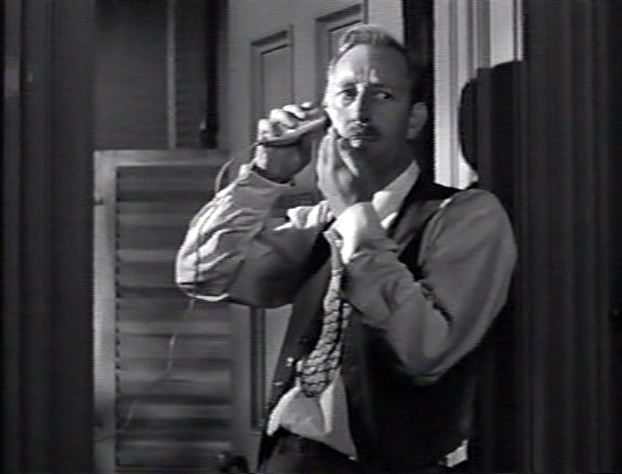
Possibly my favorite scene in the movie is when Mason and Ferguson are alone in their office late at night discussing Bel Geddes’ disappearance. Here is where the director steps in again and tells the story in an intimate, artful way. The camera settles on Ferguson, standing in his office doorway, laconically shaving himself with an electric razor, enjoying a quiet moment before the next medical call.

The camera slowly swings across the empty desk where Bel Geddes usually sits, over to the office doorway of James Mason. He leans against the doorframe, puzzling aloud why Barbara has left them. The camera goes quietly back and forth between them. On the corner of her desk are empty in-boxes for each doctor with his name on it.

Bel Geddes isn’t in this scene, yet she’s all over this scene in the image of the unoccupied desk. She fills the room.

Neither doctor knows Bel Geddes, who used her maiden name with them, is the wife of the rich guy. Ferguson knows she’s pregnant, and assumes she's run off to conceal her pregnancy because she is an unmarried woman. His taciturn behavior is touching. He keeps her confidence and does not tell Mason what he knows. Today we might call it observing the HIPAA rules, but he’s just being ethical and gallant because that’s his nature.

When Mason tells him of their first date, Ferguson asks, carefully, if that was their only date. He wonders if Mason is the father.

Mason eventually finds his way to the mansion and confronts both Ryan and Bel Geddes. Torn, she plops on the running board of one of their many cars to think about the crisis. As we discussed in this previous post, there’s nothing quite so romantic as a running board.

Bel Geddes elects to stay with Ryan, and he continues to treat her badly, to the point of finally upsetting toady Curt Bois. We can imagine Bois has been with him for years, lured to a life of bitter, demeaning servitude to this rich horse’s ass because he’s just as guilty of greed. But when he sees this pregnant girl growing sicker and exhausted, he’s had enough. He quietly tells Ryan he wants to go back to being a head waiter. Ryan calls him a dirty parasite, and tells him to bring down his wife.

Bois quits, with the calm, soft utterance, “You know you’re a big man, but not big enough to destroy that girl.”

Today, he is a man.

And launches Ryan into one of his most serious faux angina attacks.

We may have forgotten that these attacks are not real, and when Bel Geddes, in a trance of indecision, looks right at the camera when she discovers Ryan lying under his pinball machine (boys and their toys), moaning for water, we might almost cheer when she leaves him there. Sort of like Bette Davis and the dying Herbert Marshall in “The Little Foxes” (1941).

Okay. Here’s the ending. Don’t get excited, it’s not that great.

Miss Bel Geddes, who does not look at all several months pregnant, goes into premature labor. The baby is stillborn. Mr. Mason rallies her with the exuberant message that now she is free from Ryan.

It’s a very strange way to the end the movie for several reasons. First, it gives that unsatisfying deus ex machina feel to it, that fate intervened and took away all their problems. Stories are more meaningful if the characters solve their own problems, even if imperfectly.

Second, it feels unsettling to have a baby being born dead as a cause for relief and even celebration. True, the pregnancy was unwanted and the father was most certainly intending to destroy both mother and child (which he did not believe was his anyway). Though regretting a pregnancy is human, to be glad the baby has died, as both Mason and Bel Geddes demonstrably are, may just make this another reason to call it noir. It’s a twist.

Third, if the child had lived it would have added to the conflict to the story and might have led to a more exciting and interesting ending. Her severance from Ryan would have taken more work, especially since he could have used his immense wealth to accuse Mason of being the father and ruined both him and Bel Geddes.

But, the movie has to end sometime, doesn’t it? I’d like to know how the novel ended. Novels have a lot more time to sort these things out.

There is a strong melodramatic element to the movie, or could be, but the smooth underplaying of Barbara Bel Geddes makes her a believable character. She may not exactly be a heroine or a victim, but she could be somebody you know. While it is uncomfortable watching Robert Ryan’s cruelty to her, the sureness of his acting is strong point to this movie. He’s a monster, but he’s also believable in a way many movie villains are not. He conveys that arrogant and even bitter disdain some holders of extreme wealth display to those whose incomes are inferior. Ironically, the only person who can dislodge him from his psychological king of the mountain game is himself and his paranoia.

Sly, quick moment to catch: when Bel Geddes steps out of Ferguson’s office after her gynecology examination, the nurse, just entering the office quips, “You don’t look it.”

Meaning she doesn’t look tired even after working late last night. It gives Bel Geddes a start. Paranoia has different levels.


Related Products