IMPRISON TRAITOR, PEDOPHILE, AND CONVICTED FELON TRUMP.
Showing posts with label Zachary Scott. Show all posts

Thursday, April 28, 2016

Film Stars on Stage - The Storrowton Music Fair


They also did theatre.

The stars and the character actors and the bit players, all the gang we know from the old movies we treasure, a lot of them did theatre as well—either before, or concurrently with their film careers—but these samples are, for the most part, what they did after their film careers were over.  The 1950s and 1960s was reckoned to be a kind of golden age for summer theatre in this country, and it hit just when many of the Golden Age of Hollywood stars were finding it difficult to get good movie roles.


Maybe it wasn’t a coincidence that they reaped the benefit of having somewhere else to go. Maybe they fueled the fire with their tremendous talent. 


 We discussed stars on stage at the La Jolla Playhouse in La Jolla, California, in this previous post.  We also discussed Ann Blyth’s work in theatre after her film career.  One of her gigs was at the Storrowton Music Fair in West Springfield, Massachusetts, where she starred in Show Boat in 1976.   Today we turn our attention to the old Storrowton Music Fair, erected on the grounds of the Eastern States Exposition every summer from 1958 to 1978.  


Tent theaters are special.  They have a particular ambiance and magic, but sadly, when we lose them, we don’t even have a building left to remember it by. 


 But here, at least, are a few program covers.


****************
Come back next Thursday for part 5 in our monthly series on the classic film fan for a look at the TCM Classic Film Festival.

Thursday, March 26, 2015

Answers, Updates, and Famous Photos...

A bit of this and that today:

First, a big huzzah and best wishes to all our fellow film bloggers enjoying the festivities at the Turner Classic Movies Film Festival in Hollywood, which begins today and runs through Sunday.  I really enjoy reading their posts and updates on the fun, and their coverage only gets better each year.

**********************
Now, the answers to last week’s Leggy Ladies on Ladders photos:

A is Cyd Charisse.  Though it’s a candid sort of backstage shot, the film she was doing in this costume is Meet Me in Las Vegas, which we discussed previously here.

B is Paul Newman and…Alexis Smith.  This is from The Young Philadelphians, which we briefly mentioned in this previous post on Alexis.

C is Zachary Scott entering the room to find…Joan Crawford in Mildred Pierce, which we discussed here. And here.


*************************
I have a book signing coming up this Saturday, the 28th of March at the Indian Orchard branch of the Springfield City Library, 44 Oak Street, Indian Orchard (Springfield), Massachusetts, from noon to 2:00 p.m.  I’ll have a variety of my books available for purchase, both non-fiction and novels, and if you have time to stop by, I’d love to chat with you.

*************************

And now, a word about my soon-to-be-published book on the career of Ann Blyth.  June 18th is less than three months away, and will be here before we know it.  I’m working like mad on it, and I hope you’ll approve of the final product.

Part of the challenge of finding photographs for the book is investigating the copyright or ownership of the images.  It can be a daunting task, but also a pleasure when one discovers really fine photos by a master photographer.  In this case, I’m speaking of two greats: Florence Vandamm and Eileen Darby.  They were giants in the field of theatre photography, and Ann Blyth was photographed by both when she appeared in Watch on the Rhine as a young girl.

Florence Vandamm was a pioneer in this field, and from 1925 to about 1950, she was the foremost photographer capturing the greats of the Broadway stage.  The Vandamm Studio specialized in very glamorous portraits of the Broadway stars, images not too dissimilar from what the Hollywood studios would adopt for their style of light-sculpted, touched-up and stunning glamour photos in the 1940s.

Eileen Darby came a long a little later, beginning her career as a theatre photographer in 1940, Vandamm’s chief competitor and ultimate heir to this highly specialized field; however, Darby’s work had a different style.  She would most often perch herself in the front row seats and shoot with low light the dramatic action on stage, catching stars in the moment of their greatest work.

Ann Blyth, just by the serendipitous circumstances of being cast in Watch on the Rhine, was photographed by both these greats for that play, and I am so pleased and privileged to be including photos from both these famous photographers in my book.  I admire their work tremendously.

Today, the Vandamm body of work is the property of the Billy Rose Theatre Division, The New York Public Library for the Performing Arts.  Because my budget was limited, I could only purchase the rights for one Vandamm photo.  Though I was tempted to go with the images that grouped Ann with Paul Lukas, who played her father, and other actors in the play, I ultimately chose, instead, a portrait of her.  The group photos were excellent, but I had seen them, or photos like them in other books and magazines.  The reasons I chose the portrait are twofold:

First, it is such a sweet expression that seems to show this young girl on the verge of leaving her “play-acting” years and becoming a serious actress – half school photo and half actor’s professional headshot.

Second, because something in that portrait kept calling to me, and finally I realized what it was.  I think I might have been the first person in seventy years to look upon that sweet face outside of the archives, and if I didn’t publish it, I might be the last.  So, since those other photos were more easily available to the public in other books, I took this rarely (or never) seen photo for mine.

The Eileen Darby photo of Ann in Watch on the Rhine is one of her “action shots” that shows Ann on stage with Lucile Watson, who played the family matriarch; George Coulouris, the villain of the piece; and Peter Fernandez, who played one of Ann’s brothers.  This particular photo had also found its way into the New York Public Library for the Performing Arts collection, but for rights to publish I had to turn to the Eileen Darby Estate, which is currently managed by her grandchildren.  I am very grateful to Mr. Alex Teslik for allowing me to publish that photo.

There will be quite a number of other photos in the book, and other photographers or publishers to whom I needed to apply for permission, but I wanted to tell the story of these two particular photographers because of the important place they have in the history of American theatre.

Last year, a retrospective of Vandamm's work was held at the New York Public Library for the Performing Arts called: Pioneering Poet of Light: Photographer Florence Vandamm & the Vandamm Studio, which you can read about here and see some of her stunning work.

Eileen Darby's life and work has been presented in the excellent book, Stars on Stage- Eileen Darby & Broadway's Golden Age by Mary C. Henderson.


See you next Thursday for a little Easter noir.  You can probably guess the movie.


Thursday, February 13, 2014

What's a Nice Girl Like Ann Blyth Doing in a Place Like This?


One of the most fascinating aspects to Ann Blyth’s film career is how her reputation flipped from powerful actress doing moody parts to nice girl playing nice girl roles in which she was invariably taken less seriously.  A lot of that transformation in the eyes of the press and the public had to do with the fact they found out that in real life—she was a nice girl.  In terms of press copy, her natural and intuitive versatility as an actress seemed to be outshone by her real-life pleasant, even spotless, reputation. 

The utterly silly phenomenon began as How Could a Nasty Screen Character be Played by Such a Nice Person in Real Life...and morphed to Such a Nice Person in Real Life Cannot Play a Nasty Screen Character.

Mildred Pierce, in which she ferociously played a budding young conniving sociopath (see last post here), established her at the age of 16 as a serious actress—so much so, that some in the press, including Los Angeles Times drama editor Edwin Schallert, were excitedly calling her a young Bette Davis.

For the first few films after Mildred Pierce, she played other troubled young women with chips on their shoulders, axes to grind, or evil plots to hatch.  But she didn’t want to be typecast, and worried at first that “mean” roles were the only kind she would be offered.  Mr. Schallert interviewed her when she was making Swell Guy (1946), her first movie after the long recovery from her back injury, discussed in this intro post.  We’ll talk about Swell Guy later in the year.  “Miss Blyth is reputed to give her most sensational performance in this.”

Ann described her character in the film: “I’m not a mean girl…but I don’t change completely for the good…She is wild at the beginning, but her wildness results in unhappiness for her.  So I naturally am not against that part.  However, I do want to do a nice role now, and I want to sing in a picture.  You see, I am hoping, as perhaps many people do in Hollywood, for a variety of opportunities.”

Mr. Schallert notes in his November 1946 article that Ann “is essentially shy,” but he kindly does not call her naïve for wanting or expecting not to be typecast in Hollywood.  It was the bane of many, if not most actors, that the studio’s bottom line and the public’s perception would roll over like a steamroller an actor’s usual hope of playing something different than his last movie.  Mr. Schallert also kindly notes the catastrophes suffered in the past two years with her spinal injury, and the death of her mother, and that “The emotion associated with that bereavement is too close as yet for Ann to discuss.

“Ann’s fortitude is nothing light in the film world.  Her experiences have undoubtedly given her an unusual maturity in her work.  She has no formula for playing the roles that are so much at variance with herself.  She indicated that she does them intuitively as much as anything else.”

A simple answer to a question that trailed Ann through her early career.  How could a nice girl play such less-than-virtuous people so convincingly?  She’s an actress, that’s why.

The very question seems to lead us to the astounding conclusion that actors who play murderers, thieves, and pickpockets must actually be murderers, thieves, and pickpockets.

Another article that November of 1946 notes her latest role in Swell Guy: “Her part…is that of an ornery little brat grown up, and Ann is quite aware of the danger she will be typecast as a ‘meanie.’  Result: she is studying vocal music, with every intention of snagging a part in the next big musical show filmed at her studio.”

That next big musical at Universal never happened, but after a few more ‘meanies’, her roles began to change towards nice girls in less demanding parts.  How much of this was due to her seeking new material, and how much was due to a personal life that the press was touting more and more as laudatory is an interesting question.

The notice of her as a young woman living an exemplary life may have gained more steam in April 1949, when she was slated to play the lead in a film called Abandoned, which she refused and was put on unpaid suspension.  The movie, (judging by this swell lurid poster, was a crime noir with a great cast) deals with unwed mothers and a black market baby adoption racket. 

Many actors risked studio wrath by rejecting scripts because the scripts were lousy.  However, though I don’t know the reason she rejected the movie and have never read an interview with her opinion on the subject, some columnists seemed to infer that taking the suspension was an exercising of her moral conscience.  One would assume that none of the greedy, conniving, promiscuous characters she had heretofore played, performing unsavory deeds including shooting Zachary Scott dead, would fall in line with how a proper young lady should behave, but the columnists took the shortcut and wrote her up—and wrote her off—as a nice girl.

It was also regarded as somewhat quaint, if admirable, that she preferred not to do any cheesecake photos.

Sheilah Graham noted in August 1949, that Ann didn’t smoke, or drink, and went to church regularly and attended church socials, but also gave Ann credit for spunk.  “She seems happy and easy going, but she has a mind of her own.  Not too long ago she took a suspension from her studio for refusing to play a role she didn’t like.  In spite of her lack of experience in real life, on the screen Ann is able to portray hardened, willful, sinful characters.”
By 1954, syndicated columnist Sue Chambers echoed the, by now, cemented public view of Ann, that she was deeply religious, and there has  “…never been a whispered breath of scandal about her….she has never been temperamental; she has never kept anyone waiting for an appointment…She leaves a good impression with everyone.  Her working associates have never known Ann to raise her voice in anger or turn down a request for a benefit appearance, no matter how ‘small’ the group.” 

Not keeping anyone waiting for an appointment may be really fishing for nice things to say, but the press was also apparently intrigued that she could be a homebody who was equally interested in a career, the antithesis of the 1950s nice girl.  Ms. Chambers noted that Ann, married the previous year and expecting her first child at the time the article was published, wanted a family “but she has no intention of giving up her career; she’s intensely ambitious, too.”

Her reputation more than preceded her; it wrapped around her like a cocoon.  From a syndicated article in 1952:  “Can a nice girl make the grade in the movies?"


Nice girls get paper dolls made in their image.


“Ann Blyth, a girl any fellow could proudly take home to meet mother, is proof that virtue is its own reward—even in Hollywood.  The young and beautiful actress is one of the most talented and successful in the business.  Yet, paradoxically, her name is seldom, if ever, mentioned in the gossip columns…Ann, it seems, spends most of her leisure time at church bazaars, a most unlikely hangout for gossip columnists.

“She has three major motion pictures either just released or about to be.  All of them accent her versatility…somehow, in between, she manages to make countless benefit appearances at church suppers or hospital wing dedications.”

One of Hollywood’s most famous gossip columnists, Louella Parsons, early on noted the amazing paradox of the young girl who was career-ambitious and yet still seemed like a nice person.  By 1951, Louella, who had this backyard fence familiarity/condescension in her prose, was still ruminating on the problem child who was so frustratingly not a problem:  “Ann’s aunt and uncle are her family, and she lives with them.  She has been brought up as if she had never been in Hollywood or motion pictures.

“Her aunt waits up for her until she gets home at night…likewise, Ann’s escorts are always carefully scrutinized by both her aunt and uncle.  She might have been brought up in some small town and then not had the protection she had with these two loving people.  And, withal, she is a fine girl and a versatile actress.

“Her first success was ‘Mildred Pierce’ when she played the horrid daughter…and was everything a young girl should not be.

“How could you happen to play that girl so well when she is just the antithesis of you?’ I asked her.”

Did Ann’s reply shock her? 

“I like to vary my roles, and it would be very tiresome if I played only sweet young things…I’d really rather have a part I can get my teeth into—one with character rather than a milk and water girl.”

Louella wasn’t listening.  She had decided, as did other members of the press, that the nice girl should only play nice girls.  A movie to be tentatively titled White Sheep was proposed for Ann in April 1951 (though never made with Ann), and Louella Parsons announced, “This is the story of a small town minister who helps regenerate a rather wayward family.  Ann, of course, is the white sheep of the family.  You could not believe her in any other role.”

You could not believe her in any other role?  What happened to Another Part of the Forest, or A Woman’s Vengeance, or Mildred Pierce and the scheming, sultry, promiscuous, greedy, backstabbing, murderess roles for which she had earlier been called a young Bette Davis?


On her film, The Golden Horde – columnist Harold V. Cohen also scoffed at the notion of the nice girl playing anything but:  “Nobody in his right mind could possibly visualize sweet, wholesome Miss Ann Blyth in the role of a seductive Persian princess, dressed in scanties and flimsies, who uses the wiles of her sex to stop the ruthless march of the terrible Genghis Kahn…Now Miss Blyth can take off those veils and go back to her cashmeres and dirndls, where she belongs.  In ‘The Golden Horde’ they’ve sent an innocent child to do a woman’s work.”

You can seduce Zachary Scott and then blast him to smithereens, but how quickly they forget.

Another aspect of Ann’s personal life which may have influenced press opinion may have been her resplendent Roman Catholic wedding ceremony in June 1953 celebrated by several clergy including a cardinal—James Francis Cardinal McIntyre, who also delivered a blessing from Pope Pius XII. 

In the company of several priests and monsignori was an old friend from back east, the Rt. Rev. Charles E. Hagearty, a monsignor at that time located in Hartford, Connecticut.  Msgr. Hagearty had been a curate at St. John's Church in Stamford, Connecticut when Ann visited her uncle and aunt there in the summers as a child.  It was this same uncle and aunt, Mr. and Mrs. Patrick Tobin, who gave up their Stamford home and moved out to Los Angeles to care for Ann after the death of her mother, which we discussed in the intro post here.   According to an article in the Hartford Courant at the time, she was ten years old when she and Fr. Hagearty first met.  He played the organ.  She liked to sing. 

The church was packed with some 500 people, but according to a newspaper description of the event, "set workers and crewmembers...far outnumbered the celebrities."  The press lumped the nameless techies together as "friends of the bride."  To most of them she was Annie.

More about her bridesmaids in a future post.

In a town that loved spectacle, it was a spectacular beginning to a long and happy marriage.  Dr. James McNulty, a Los Angeles area obstetrician, was invariably referred to in articles as Dennis Day’s brother (who acted as best man at the wedding) more than I think he ever was referred to as Ann Blyth’s husband.  Dr. and Mrs. McNulty had five children over the next ten years, further cementing Ann’s confounding respectability.

Her respectability, itself, became a problem for television producers of the 1953 Oscars, when she had been asked to perform the song “Secret Love” from Calamity Jane (a movie we discussed in this previous post).  Doris Day had been slated to reprise the song she made famous, but according to the authors of Inside Oscar – The Unofficial History of the Academy Awards, Miss Day turned down the opportunity due to being afraid to sing before the live audience (made bigger still by television).  The program was telecast March 25, 1954.  Ann was pregnant with her first child (her baby son was born in June).  Having a pregnant woman on television at all was still considered a dicey subject in this buttoned-up era, but one who stood there and sang the lyric “and my secret love’s no secret anymore” seemed to fill the NBC network powers that be with considerable trepidation.


It was the second time that the Oscars were broadcast on TV, called by columnist Bob Thomas, “The biggest star splurge in television history,” to an expected 60 million viewers.  The ceremony was held at the RKO Pantages Theater with Donald O’Connor as host in Hollywood, and Fredric March handling the live TV-hook-up from New York.

Ann, who the newspapers were a little more brave about acknowledging her pregnancy, still referred to it delicately as her “soon-to-be-mother-condition” wore an emerald green chiffon gown (“naturally,” commented columnist Buck Herzog with a nod to her Irish ancestry) with a big skirt and off-shouldered neckline.  She also wore emeralds.  Too bad TV was still black and white then.

Ann, who evidently felt no reason to wear a scarlet letter on her green gown, and seemed to see no reason why the sight of a pregnant woman should engender sophomoric double entendres about love not being a secret, performed without incident or apparent damage to her career.  Unfortunately, her old pal and former co-star Donald O’Connor, did suffer the wrath of pundits, including the disgust of Ed Sullivan, when he made the unpardonable faux pas of publicly acknowledging that Ann was with child.  He playfully introduced her before her number as “Ann Blyth and family.”

He was berated for his poor taste.  Ann thought his remark was cute.

Over two years later, the press was starting to crow with its typically short memory how mature the public was in accepting pregnant women in society.  “Women entertainers used to retire temporarily when they became expectant mothers, but in this day of the working wife, females everywhere go on working as usual.” The columnist, Aline Mosby, cites for her examples as Lucille Ball, Rosemary Clooney, and “Ann Blyth sang at the Academy Awards show shortly before she had a baby.”

And the world didn’t end.

Not too long after the birth of her son, she took her nice girl act on the road and really showed them. 

That September, Ann performed a night club act at the Sahara Hotel in Las Vegas, and brought the house down.  Los Angeles Times writer Edwin Schallert, who we quoted at the beginning of this piece when he interviewed her some eight years earlier, marveled at how well the nice girl blossomed.

Nice girls also do Lux Soap ads with Peter Gunn.
“Miss Blyth won completely and without sensationalism the cosmopolitan public that had previously been intrigued by Dietrichs, Mae Wests, Gabors…it was a simple, sincere victory gained by a fragile-looking young girl in a modest shell-pink lace gown who confessed her knees were shaking.”

She sang such hits as “April in Paris,” “September Song,” excerpts from The Student Prince and Rose Marie (movies which we’ll discuss in future posts this year), an Irish song, and in a series of songs labeled as a “Calendar Hit Parade”, she belted out “Yankee Doodle Dandy”, and “Silent Night.”  She closed the segment with “Auld Lang Syne.”

“With her eyes misty with tears as she held a huge armful of flowers, she thanked the audience again and again for their tribute…There were also many misty eyes among the people present.”

Louella Parsons crowed that Ann, “…brings down the house, she’s so good.”

Syndicated columnist Bob Thomas wrote, “The gamblers and dealers in this hard-boiled town never saw anything like it.  Everyone in the night club was standing and cheering a demure beauty whose act was pure enough for a Sunday school picnic.”
Good girl makes good.

He reported on her closing performance after a three-week stint in Vegas, “With tears streaming down her cheeks, she sang, ‘Auld Lang Syne’ and bowed off with a thundering ovation.  Most of those in the Congo Room were misty-eyed too.”

He compared her to other more ribald acts such as the striptease by Marlene Dietrich and Mae West’s racy humor.  “But along came little Miss Ann Blyth to prove that purity pays.” 

She had tried out the act first in San Diego, and then sang to the crowds at the California state fair in Sacramento.  Ann acknowledged, “It is the first time I played night clubs or any singing dates, and it has opened up a whole new world to me.”

However, the old world of Hollywood was increasingly reticent to accept Ann’s versatility as easily as she had.  A big role was coming up that would, unknown to anyone at the time, be her last film, The Helen Morgan Story.  The down-and-out, troubled, hard-living alcoholic 1920s saloon singer was considered by everyone who voiced an opinion about it to be beyond Ann’s abilities.

Some still recalled her earlier career of sultry gals.  According to Armand Archerd, “She is truly a paradox, having been described as ‘sweet Victorian’ to ‘sexy and sultry’…by nature, of course, Ann is probably the sweetest person in the film colony.”

She was required to test for the role in competition with something like 300 other actresses.

 “Ann, by virtue of her own reputation, was the least likely candidate of all.”

By virtue of her own reputation.

“Of course, no one in Hollywood believed she would get the role of the sexy Miss Morgan.”

So how did she get the part?

According to Mr. Archerd, “…her test out-sizzled any of the so-called sexy stars of Hollywood.”

The headline in the Daytona Beach Sunday News Journal reflected a shocked public.

Good Girl
In Movie
Gutter

Hollywood reassured a nervous public, “Ann Blyth is still a good girl, despite what some of her fans think…who fear that Hollywood’s ‘little lady’ compromised her own moral principles in taking the part.”

Ann responded, “There are always people who can’t disassociate an actress’ personal life from her screen life…An actress, to keep going, must portray life, and life is not all sweetness and light…there was great conflict between good and evil in Helen’s life.  Unfortunately, she had weaknesses and the evil in her life often won over the good.  I personally think that such movies, when done in taste, do more good than ones that gloss over the brutal facts.”


We come full circle then to a description of Ann by Ida Jean Kain earlier in her career from 1949: “I thought you might be interested in knowing what she is like is real life, this girl who plays the hateful, spoiled darling roles so realistically.

She is poised and genuinely unaffected—completely unspoiled.  And in a quiet, confident way, she knows where she is going, and she is neither deviating nor taking short cuts.”

The quiet, confident woman replied to Mr. Archerd at the time of The Helen Moran Story as to how she could possibly make the transformation to such a wayward woman?

“Well,” she blushed, “I guess I just try to be the person I’m playing.”

Because she’s an actress, that's why.
Come back next Thursday when we jump several decades ahead to 1985, a time when even the wholesomeness of Hostess Cupcake television commercials could not keep her from turning wayward again as a woman haunted by the death of her first husband, who stabs her second husband with scissors in a fit of hysteria, and who may be a murderer.  That's up for her friend, the intrepid Jessica Fletcher, to decide in Murder She Wrote.


****************

Beaver Valley Times, syndicated article by Aline Mosby, December 28, 1956, p.11.

The Deseret (Utah) News, November 8, 1946; also syndicated column by Louella Parsons, April 5, 1951, articled by Ben Cook, April 21, 1952.

The Florida Flambeau (Florida State University, Tallahassee, Florida), article by David Dreis, January 18, 1955, p. 2.

The Free Lance Star (Fredericksburg, Virginia), syndicated article by Bob Thomas, October 21, 1954, p. 14.

The Hartford Courant Magazine, July 19, 1953, p.7.

The Kentucky New Era, syndicated column by Armand Archerd, June 22, 1957, p. 9.

The Lewiston Evening Journal, July 17, 1952,  p. 22.

Los Angeles Times, article by drama editor Edwin Schallert, November 17, 1946, p. A1; also by Schallert, September 22, 1954, p. B6.

The Milwaukee Sentinel, syndicated column by Sheilah Graham, August 22, 1949; syndicated article by Sue Chambers, May 1, 1954, p. 3; also syndicated article by Buck Herzog, March 28, 1954, p. 19; also syndicated article by Louella Parsons, September 27, 1954, p. 6.

Pittsburgh Post-Gazette article by Harold V. Cohen, November 12, 1951. 

Portsmouth Times, (Ohio), article by Ida Jean Kain, July 15, 1949 p. 15

Sarasota Herald-Tribune, June 28, 1953, p. 6; also syndicated article by Bob Thomas, March 24, 1954, p. 16.

The St. Joseph (Missouri) News-Press, syndicated column by Louella Parsons, December 16, 1951.

The Sunday News Journal (Daytona Beach, Florida), September 15, 1957, p. 12A.

Wiley, Mason and Damien Bona.  Inside Oscar – The Unofficial History of the Academy Awards (NY: Ballantine Books, 1986), p. 238.

UPDATE:  This series on Ann Blyth is now a book - ANN BLYTH: ACTRESS. SINGER. STAR. -

*********************
The audio book for Ann Blyth: Actress. Singer. Star. is now for sale on Audible.com, and on Amazon and iTunes.

Also in paperback and eBook from Amazon, CreateSpace, and my Etsy shop: LynchTwinsPublishing.


 "Lynch’s book is organized and well-written – and has plenty of amusing observations – but when it comes to describing Blyth’s movies, Lynch’s writing sparkles." - Ruth Kerr, Silver Screenings

"Jacqueline T. Lynch creates a poignant and thoroughly-researched mosaic of memories of a fine, upstanding human being who also happens to be a legendary entertainer." - Deborah Thomas, Java's Journey

"One of the great strengths of Ann Blyth: Actress. Singer. Star. is that Lynch not only gives an excellent overview of Blyth's career -- she offers detailed analyses of each of Blyth's roles -- but she puts them in the context of the larger issues of the day."- Amanda Garrett, Old Hollywood Films

"Jacqueline's book will hopefully cause many more people to take a look at this multitalented woman whose career encompassed just about every possible aspect of 20th Century entertainment." - Laura Grieve, Laura's Miscellaneous Musings''

"Jacqueline T. Lynch’s Ann Blyth: Actress. Singer. Star. is an extremely well researched undertaking that is a must for all Blyth fans." - Annette Bochenek, Hometowns to Hollywood


Ann Blyth: Actress. Singer. Star. 
by Jacqueline T. Lynch

The first book on the career of actress Ann Blyth. Multitalented and remarkably versatile, Blyth began on radio as a child, appeared on Broadway at the age of twelve in Lillian Hellman's Watch on the Rhine, and enjoyed a long and diverse career in films, theatre, television, and concerts. A sensitive dramatic actress, the youngest at the time to be nominated for her role in Mildred Pierce (1945), she also displayed a gift for comedy, and was especially endeared to fans for her expressive and exquisite lyric soprano, which was showcased in many film and stage musicals. Still a popular guest at film festivals, lovely Ms. Blyth remains a treasure of the Hollywood's golden age.


The eBook and paperback are available from Amazon and CreateSpace, which is the printer.  You can also order it from my Etsy shop. It is also available at the Broadside Bookshop, 247 Main Street, Northampton, Massachusetts.

If you wish a signed copy, then email me at JacquelineTLynch@gmail.com and I'll get back to you with the details.

Thursday, July 11, 2013

The Unfaithful - 1947


The Unfaithful (1947) is a superior movie to The Letter (1940). 
I just wanted to get your attention.  I’ve been away from this blog for a long time.  I’m still here.
But seriously, I really do prefer The Unfaithful to the much more well-known and deservedly lauded The Letter.  Pour yourself a cuppa and I’ll tell you why.  You don’t mind spoilers, do you?  I didn’t think so.
Both films are based on the story and subsequent stage play by W. Somerset Maugham, (went through a handful of other film versions as well) but The Unfaithful is a re-working of the story to fit into a different locale: post-war Los Angeles.  The original story, you’ll remember, is set in a Malaya rubber plantation.  The Letter stars Bette Davis and Herbert Marshall in the tale of an unfaithful wife, who murders her married lover, and then must hide the truth from her husband and the police.  The device that seals her fate and proves her guilt is a letter written to her lover.  Gale Sondergaard, who strikes fear into the hearts of everybody, not just in this movie—she probably struck fear into the hearts of people just walking down Wilshire Boulevard—is the dead man’s wife who holds the whip hand over Bette Davis.

Directed by William Wyler, The Letter is lush and mysterious, steamy and provocative, beginning with Miss Davis unblinkingly gunning down her lover.  We are plunked down at the edge of the jungle, under a tropical moon, where civilization, i.e. white European society, is represented in a dance at the Raffles Hotel in Singapore.  It is about guilt and revenge and racial stereotypes.  The famous line uttered by Bette Davis: “With all my heart, I still love the man I killed!” is still a shocker, an electric moment. 
But for me, the film is a marshmallow: all air, sticky, and without nourishment.  Even the impressive Miss Sondergaard reminds me of The Dragon Lady in the old Terry and the Pirates comic strip, and so the “mysterious orient” clichés that abound in this movie strike me as somewhat cartoonish.  I prefer The Unfaithful for several reasons.  Here we go:
Ann Sheridan is in the Bette Davis role, but unlike Davis—who we know is guilty from the very first moment in the film—Ann Sheridan’s guilt, her sin of being unfaithful, is not apparent until far into the movie.  We start with a happy Miss Sheridan speaking on the phone with her husband who is away on a business trip.  We see she is in love, and eagerly awaiting his return the next day.  We do not suspect her of an adulterous affair.  What we do learn about her comes through twists and turns, and by the end of the film, we see we do not know her at all.  In comparison, Bette Davis comes off as transparent, and I find her brittle rigidity, though compelling psychologically, still two-dimensional, even if we are shocked by her declaration at the end of the film.
Miss Sheridan attends a party thrown by her husband’s cousin, Eve Arden.  Any movie with Eve Arden is always better than a movie without Eve Arden.  Our Eve has a good role here.  We first meet her as a new divorcee who throws herself a Happy Divorce Party.  All her friends are there, and one who is not her friend: her ex-husband shows up, drunk and angry, and vents his bitterness before he is dragged away.  Douglas Kennedy has this small role.  We saw him previously in South of St. Louis (1949).
Miss Arden is raucous, crude, loud, and tasteless in the early part of the film, but she keeps popping up from time to time, and each time we see her, a little more of her hard shell gets peeled away and we discover by the end of the film she’s really a sad and lonely person, and a mensch.  She turns out to be a real pal to Sheridan and her husband, played by Zachary Scott, when they really need her.

Zachary Scott has a more interesting role than the character played by Herbert Marshall in The Letter.  Though I love Herbert Marshall, and though we feel great sympathy for him as the cuckolded husband of Bette Davis, we also can’t help but regard him as a sap.  She’s playing him like a fiddle.  The story, and the director, allows us to see right through Davis, but he has no such advantage and we may wonder how he could be so dense.
Mr. Scott is nobody’s fool, an enterprising builder taking advantage of the post-war boom.  He’s devoted to Sheridan, but when the clues of her guilt wipe the scales from his eyes, he’s determined to dump her and see her rot.  How quickly, and stunningly, love turns to hate.  It’s all passion in one form or another.
Lew Ayres plays their friend and lawyer in a role similar to James Stephenson in The Letter; likewise he is devoted to his friends, plays knight errant to the accused until he discovers her guilt and then fights his own disgust to be able to save her.
Most especially, I love that The Unfaithful is frankly and most purposefully without that fantasyland setting of the tropics.  It is set in a mundane and more familiar time and place.  (Although, I confess, as a New Englander, I find palm trees, even lined up in front of a shopping mall, extremely exotic.) This is a setting we recognize; these are people with whom we are familiar.  It brings this tumultuous story down to earth, with consequences that are real.  We must take their troubles more seriously because they may be our own.
This being a blog about how classic films teach us much about the eras in which they were made, I find The Unfaithful a very useful tool in examining the post-war era.  It’s got all the details.  The narrator tells us as the camera pans from the home of Sheridan and Scott to the palm-tree lined roadway, “The problem with which it deals belongs not to any one town, city or country, but is of our times.”  In this respect, the movie is less like The Letter and more like The Best Years of Our Lives.
The “problem,” it seems, is that so many marriages begun in haste during the romantic and rushed war years are ending in divorce.  Lew Ayres’ clients are mostly women seeking divorces, and he has mixed feelings about that: a desire to be successful, and yet a sense of disgust for his clients.  Eve Arden is his latest client and his latest victory in the courtroom. 
Ann Sheridan is the opposite of Eve Arden: she is a loving wife who waited patiently for her husband to return from war, who still waits patiently for him to return from every business trip.  She waits around a lot.  She and Eve Arden are not close friends; they are too different.  One is a lady and one is…not.
Things turn very bad for Ann and progressively get worse.  She arrives home from Eve Arden’s divorce party, and parks her car in the back of the house.  As she pulls into the drive, we see a man is watching her.  Instantly, the tone of the movie changes.  She walks to the front of the house and we see her silhouetted in the mist.  We watch her walk towards us, knowing the man is hiding, also watching her.  At her door, the man attacks her, pulls her into the darkened house.  We watch through the windows, from the street, a scene of terror and the sounds of struggle, and screams.  We don’t know what’s happened, but we’ve imagined the worst.
It’s the next morning and Zachary Scott lands at the airport, wondering why his wife isn’t there to pick him up.  I like the way the director, Vincent Sherman, takes his time and lets this scene play out.  He’s very good at developing these very tense scenes from ordinary situations.  Your stomach tightens when you see Ann Sheridan walking at night in her own driveway.  Your stomach tightens when you see Zachary Scott get bad news.  We’ve been there.  This is a large part of why I prefer this movie to The Letter—it brings high drama to smallest, quietest elements of what we know as “real” life.
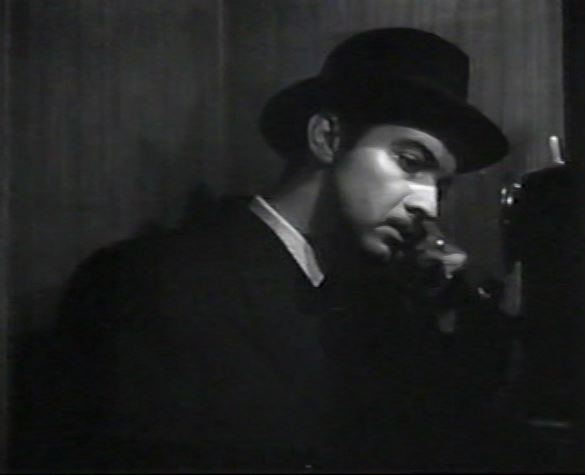
Mr. Scott looks and looks around, finally goes to a phone booth to call home.  Because he’s closed the door of the booth, and because there are constant announcements on the public address system about flights, we barely hear his voice.  We strain to hear him—a nice dramatic touch over not hearing him at all.  It makes us an active participant.  We don’t know what he’s saying—just like we couldn’t see the attack except from yards away and through curtains.  By his expression, we realize somebody on the other end told him shocking news, and he rushes to find his checked luggage and get a cab.
The phone, we learn, was answered the by the police, and we see when he arrives that his home is chaotic with reporters, and police all around.  For the first time, we learn that Ann Sheridan is well and survived the attack, but that her attacker lies dead on the living room floor with an ornamental knife in him that Mr. Scott had brought back from Japan during the war.  That’s about all of the mysterious orient you’ll find in this movie.
When Miss Sheridan is interviewed in her bedroom by the police, with her husband and Lew Ayres at her side, we see that she is traumatized and miserable.  We knew Bette Davis’ distress was just an act, but Sheridan’s horror is real.  The million-dollar question is asked of her “Had you ever seen him before?”  She answers no, and we have no reason to doubt her.  Neither does her husband or her lawyer pal.  The police detective, played by John Hoyt, remains cynical, but that is his job.

The widow of the dead man, played by Marta Mitrovich, accuses Ann of murder. “You killed him!” She is not as scary as Gale Sondergaard, but she’s pretty worked up about it.

By the way, does anyone know who plays the stenographer in this scene?  She has no lines, but she looks familiar.  I love stenographers.  
The detective tells us that the dead man has no criminal record, that he was a sculptor.  His mind, and ours, turns to the question, why did he go to her house?  If robbery wasn’t his motive, we are left with a question of attempted rape, though nobody uses the word.  Ann Sheridan’s expression is our first clue that she’s not being completely honest, she’s withholding some information, but we have to find out the hard way.
Steven Geray plays a smarmy art dealer who contacts Lew Ayres about a bust of a woman, asking him if he wants to buy it.  It was sculpted by the dead sculptor guy.  The face is Ann Sheridan’s.
Ann lied.   The dead scupltor obviously knew her and she knew him, because we are told that this kind of piece would have to be modeled from real life.  He didn’t sculpt it from a photo of her.  I find Ann's scatterbrained, guilt-driven, panic-induced deceit much more understandable and appealing than Bette Davis' psychotic, chilly posturing, but that is not to say that one actress is better than the other in the role; it's just a preference for characterization. 
The art dealer is attempting to blackmail Mr. Ayres’ client, but our noble Lew isn’t having any of it.  He brushes off the smarmy art dealer and goes straight to Ann, who, reluctantly, relents and confesses she did know the dead guy.  It was during the war, and she hired him to do the sculpture, but after a few sittings, he got too personal and creepy and made her feel uncomfortable, so she avoided him and never went back.  He stalked her a few times, but when her husband came home from oversees, it scared the guy off.
Ann tells Lew she didn’t tell him or the police that she knew the guy because, “I was afraid of what people would say.”
Now Lew has to hammer home to her that what people say is not the problem.  The problem is if she knew the guy, a jury might think she let him into the house and murdered him, that it was not self-defense.  She’s frustratingly slow on the uptake about this.
Unless there's more to it that she isn't saying.  

And there is.  

Then Ann goes to the smarmy art dealer herself to pay the blackmail, but the widow doesn’t want her money.  She wants her to go to jail. 
Ann goes back to Lew Ayres in a panic, getting herself in deeper and deeper, and finally Lew understands, as do we, that she had more than a professional relationship with the sculptor.  She had a fling with him.
Lew, lawyer and bachelor, is disgusted.  “You’re no different from all the other cheating, conniving women who parade through my office.”  Now he strips the final layer away:  Did she kill him on purpose to shut him up?
We pause here to watch the how her web of lies has taken on a life of its own.  Smarmy art dealer still wants a cut of the blackmail money he thinks he’ll get, so he contacts Zachary Scott and meets him, like a spy movie, in MacArthur Park (no cake out in the rain here, so just never mind that), one of the many neato Los Angeles scenes we have in this movie.  He takes him to the widow’s run-down apartment and meets Ann’s sculpted likeness as the art dealer hammers him with the old Othello scenario about the treachery of women.  Zachary is crushed.
He goes home to have a showdown with Ann.  She tries to explain her loneliness during the war.  He blasts her, “Millions of women waited, they waited decently, loyally.  They didn’t cheat.”
Mr. Scott wants a divorce, but just as he’s about to storm out, the cops show up at the door to arrest Ann on suspicion of murder.  See, the cops discovered Zachary going to the widow’s apartment with the smarmy art dealer.   They know about the sculpture now.  The jig is up.
Our Lew, despite his profound disappointment in Ann, agrees to represent her at the murder trial, where the prosecuting attorney is our old pal, Jerome Cowan.
The trial sequence builds to a crescendo of self- knowledge—of Zachary about Ann, and of about himself and his failings as a husband.  We learn they knew each other two short weeks before they were married, and he was so eager to pursue his career on his return home, she became an afterthought.  We also learn, somewhat surprisingly, that she was a fashion editor for a magazine before the war, yet we are given the impression she does not have a career now.  She gave up a job like that to stay home and volunteer for the Red Cross?  That is an interesting subplot that is not pursued, however. 
Neither is it fleshed out the possibility that Lew Ayres may feel more than friendship and respect for Ann and could present as a romantic rival, which would have been intriguing, but no triangle happens. 
What we do have is the crime of the century—not the murder, and not just cheating on her husband, but cheating on a vet in a post-war climate that revered them.
Jerome Cowan asks us, “Is this a woman you can believe?”
But Lew Ayres, and the producers remind us, “She is not on trial for infidelity.”  Mr. Ayres, from his own professional perspective as a divorce lawyer counters: “How many personal tragedies occurred far from the battlefield,” and “If there had been no war, she would not be in this court today.”  So it’s the war’s fault.  We see Zachary Scott mulling this over.
The best summation of the story is handled by Eve Arden.  When the jury is out a long time, Zachary Scott goes over his cousin Eve’s house to wait.  The merry divorcee is spending a quiet evening alone, with a book, the radio, and a box of chocolates, still wisecracking, but softer and sympathetic.  Zachary tears up, and cries, and she softly replies, “I’m glad to see you acting like a human being for a change.” 
Though she was never best pals with Ann Sheridan, whom she regarded as too good to be true, she defends her, and Zachary is upset.  “Is it my fault I was sent overseas?”
“You knew you were going when you met her.  Let’s face it, that’s why you married her…what you wanted was a whirl and a memory.  You wanted a beautiful woman waiting for you, and you didn’t want anyone making time with her when you were away, so you hung up a no trespassing sign, like you’d stake a gold claim.  You didn’t marry her; you just took an option on her.”
“She could have said no.”
Eve continues her sane, and somewhat shocking for the times, rebuttal: “When the band was playing?  Listen, I was there.  I saw you making with that uniform and that ‘today we live’ routine.  And then you were off.”
Production on this movie was begun in late 1946.  Just a year after the war, and we’re already negating all that movie patriotism and sacrifice that got us through the worst of it.
Then a phone call lets them know that Ann has been acquitted by the jury.  Mr. Scott quietly says, “Oh.”  So that we are still not sure how the ending will be played.
With Lew Ayres seemingly guiding the shell-shocked couple to a negotiation, it ends with a cigarette on the couch, and the leaden film noir score suddenly lighter, giving us hope, a suggestion of gentleness, and we even hear bells pealing.
We are left with an indictment not of Ann Sheridan, but of the era, and that gave the audience then, and gives the viewer now, something to think about. 
“With all my heart, I still love the man I killed” is just a cheap thrill in comparison. 
And the ending of The Letter where Bette Davis is murdered was not in the original story.  This was tacked on by the stalwart keepers of the Production Code to see that a murderess and adulteress was punished.
Ann Sheridan, in The Unfaithful remarkably gets away with both a killing and adultery, and still holds our sympathy.  She’s rebuked, but still noble.  Way to go, Ann.  It would have been a great scene for the movie if Ann had discussed her affair,  what attracted her to the man and why she needed to be with him.  Perhaps the intimacy of her face and body being so closely studied in creating the sculpture was what seduced her.  But I guess you can push the Hays Office just so far.
You may now rebut.

Related Products