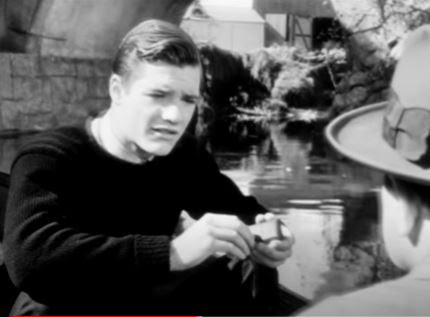
The Stranger (1946) is a film
not so much about the battle of good versus evil as much as it is the inner
battle the conscience wages to justify evil.
It was a movie of its time, but in this respect has just as much
relevance today.
As we end this
bizarre and improbable year, I’ve chosen a couple of off-beat seasonal movies instead
of the usual holiday fare, to surrender to the curious and unsettling
atmosphere this year, and throw even a few more shadows for good measure. Next week, we’ll discuss The Curse of the
Cat People (1944). We get a
Christmas carol, at least, in that one.
Long post
ahead. Have someone read it to you while
you string popcorn for the tree.
The Stranger is not exactly a
holiday film, though it does take place in what appears to be late autumn/early
winter in a New England town. I’ve
always thought of it as taking place between Thanksgiving and Christmas,
perhaps that torpid state just after the tryptophan wears off and before the
hectic shopping begins. In this quiet netherworld
between giving thanks and being relentlessly reminded through songs, holiday
cards, and popular programs with contrived Christmas themes that there should
be peace on earth but there isn’t, a Nazi hunter travels to a small town to
settle some unfinished business.That, in itself,
is a remarkable plot device for a nation weary of war, as we were in 1946, wanting
to move on, many not wanting to be reminded of ghastly and unfathomable
atrocities – and still others, not choosing to believe them. This was the first feature film to show clips
of official government footage of what became known as The Holocaust. Film critics and fans have argued for decades
whether this is Orson Welles’ worst film or one of his best, but that inclusion
of this horrific documentation alone, I think, merits this film as a crowning
achievement. Welles’ celebrated creativity
could be freewheeling, but he was also a man whose brashness sometimes took the
form of frank courage when it came to the larger themes of life, such as: when
is an atrocity not merely an inconvenience?
We discussed his radio commentary on race discrimination and a particular savage event in this previous post.
If his direction,
not to say his acting, seems harnessed in this production famed for his being
forced by the studio to bring it in on time and under budget, with an editor
who slashed out several scenes that apparently would have revealed some
character development, the movie nevertheless is appealing for what it does
show in its very leanness. There are a
few scenes I would have liked to have been more developed, a back story
explored here and there, but for the most part, I just enjoy watching the
plodding search of the Nazi hunter for the war criminal in hiding.
Edward G. Robinson
plays the Nazi hunter, good-humored, pleasant, pensive, methodical -- a less
crusty character than his insurance investigator in Double Indemnity
(1944), but just as persistent. From the
opening moments of the film, we see Mr. Robinson is about to tail a Nazi
official who is being allowed to leave his post-war incarceration by American
authorities in Europe on the chance he may unwittingly lead them to bigger
fish, a more important Nazi official who has escaped capture. No one knows what the big shot Nazi looks like
because he never allowed photographs to be taken of himself, they don’t know
his new assumed name, or where he is.
All that is known about him is that he has a passion for clocks.
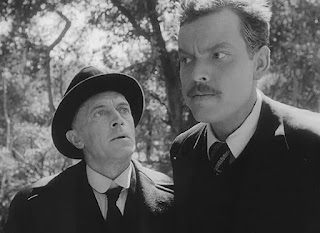
Konstantin Shayne
plays the underling, the dupe Mr. Robinson will follow to get to his real
quarry. Shayne is nervous, pushy, and a self-proclaimed
religious convert whose blind fanaticism causes him to search devotedly for the
whereabouts of his superior all the way to America, where he finds him and
instructs him to pray with him and find salvation. There is no repentance, however, in this
man’s religious fervor; only an obsessive-compulsive switch from one fanatical
loyalty to Hitler’s regime to a new zeal for a heavenly Master who will
presumably reward him with the blessings of superiority that the Third Reich
reneged on.
Close on Mr.
Shayne’s heels is Edward G. Robinson, who lost him when Shayne, realizing he
was being followed, lured Robinson into a school gymnasium and conked him on
the head with gym equipment. A sign,
with black humor, warns us, “Anyone using apparatus in this gym does so at
their own risk.”
The gym is part of
a private boys’ school, and the town where Robinson has followed Shayne is the
fictional Harper, Connecticut. It is
really an ingenious, deceptively simple movie set, and through inventive camera
angles looking out at the common through shop windows, it feels very much like
a real New England town. It has a soul,
like a character in the movie, a setting that is not a backdrop but a metaphor
for American ideals and innocence.
Most of the action
takes place around the common, which is bordered by shops, including a small
general store, administration buildings and dorms that are part of the school,
and a church with a tall clock tower that is the town’s most impressive
feature. Though the clock tells accurate
time, the works include automatons that are supposed to mechanically emerge
from the tower when the clock strikes on the hour, medieval figures with
swords, but that feature has been broken for many years and so the figures are
still and the clock is silent.
The use of
automatons in the clock works seems incongruous for a New England town,
particularly in what appears to be a Congregational-style church. It seems too European, and I don’t personally
know of any such clocks in New England, but I’d love to know if there are any.
European architectural influences are more commonly to be found in New
England’s Gothic Catholic churches, but the steeples are generally not turned
into cuckoo clocks.
Still, if its
incongruous, it’s another in a string of oddball aspects to wonder about in
this place of scattered and decaying fall leaves, a cold breeze shaking bare
branches, and wisps of snow flurries as a harbinger of a storm that seems
always on its way but hasn’t quite arrived.
Since Edward G.
Robinson has lain unconscious on the gym floor, he has missed some of the plot
exposition we’ve observed. By the time
he wakes up and makes his way over to the general store for a bottle of aspirin,
he’s lost the guy he was tailing. He
doesn’t know that man has just been murdered – strangled to death by the big
shot Nazi official for whom Robinson was really searching, the man he hoped
Konstantin Shayne would lead him to. His
trail has gone cold.
But we know that
the big shot Nazi is here in this little town, employed as a professor in the
boys’ academy, and is about to marry the daughter of the town’s most
prestigious person – a Supreme Court justice – to give him further cover. The daughter is played by Loretta Young. The big shot Nazi hiding in the plain sight
under an assumed name is played by Orson Welles.
The three stars
are a triangle in this movie; not a romantic triangle but one of friction, a
battle of ideals and loyalties, with a curious co-dependence.
The minor
characters form, as often happens in an Orson Welles film, an ensemble company
and this may reflect on Welles’ years in theatre and on radio, notably his
Mercury Theater players, which as a unit came to Hollywood before they shot off
like an Air Force squadron whose planes, with astounding precision, leave the
formation and go off on trajectories apart from each other. One member of that troupe was Agnes
Moorehead, whom Welles had considered casting in the Edward G. Robinson role in
The Stranger, but apparently the studio did not want a woman for the
part. Unfortunate, particularly as it
would have been interesting to see a dedicated, cerebral woman driven to doing
her job as a guardian of democracy trying to make the starry-eyed Loretta Young
face some hard facts about her new husband.
Someone who might have treated Loretta Young less delicately than the
gentlemanly Robinson.

The supporting
cast here are not quite the deep bench that Welles’ had behind him in the
Mercury Players, but it’s to his credit that he trusts them enough to give them
a lot of freedom. Billy House plays the
owner of the general store, as well as the town clerk, Mr. Potter. He’s a jovial checkers shark who engages
anybody in a game for money, and never appears to leave his chair if he can help
it. He steals scenes while both Robinson
and Welles, amused or startled perhaps, seem to be unable to do anything about
it.

The young doctor
in town is played by Byron Keith in his very first movie. Richard Long plays Loretta Young’s brother,
who attends the boys’ academy, and it is only his second film. He is quite good and very likeable as a quiet
young man who enjoys fishing and the outdoors, and seems to make it a code of
honor to mind his own business with a refreshing refusal to be judgmental. But there is a wariness, and sense of being
ill at ease with his family situation.
His professor at school is now his brother-in-law. It takes Edward G. Robinson to point out to
Richard Long that Richard does not really like his brother-in-law. Though Long uncomfortably denies this, he will
later help Robinson to trap Welles.

Martha Wentworth
plays the housekeeper, and though she did uncredited bit roles, or cartoon
voices, and later would appear in television, she did not have a strong career
in movies – yet she takes a pivotal scene and really goes to town with it. Miss Wentworth pops in and out in the early
parts of the movie barely noticeable, one might say like a good servant. But near the end of the film, Edward G.
Robinson enlists her help. Loretta Young is in danger of being murdered
by Orson Welles to keep her quiet when she begins to crack in the face of too
many of her husband’s dirty secrets and suspicious behavior. Martha Wentworth must stall Loretta and keep
her from meeting Welles at the church clock tower. Miss Young is impatient to leave, but
Wentworth keeps up relentless prattle to distract her. Loretta gets as far as the door, and Martha
bursts into tears (the housekeeper must have had a past life on the stage) and
picks a fight with Loretta, accusing her of not wanting her around anymore and
which forces Loretta to stay and comfort her.

Then when Loretta,
with dogged persistence, heads for the door again, Martha, a middle-aged woman
of no apparent athletic prowess, throws herself on the floor and fakes a heart
attack. It’s a tour de force performance. These are the kinds of actors Welles
populates his films with, and that he gives them free reign to shine is pretty
great.
Playing Loretta’s
father, the Supreme Court justice, is Philip Merivale, the only one of the
supporting cast who really had a long and distinguished acting career, mostly
in theatre. Unlike the newbies, this
would be is second to last movie, as he died the year this film was released,
1946, at 60 years old of a heart ailment.
His other theatrical claim to fame is he was married to the magnificent
Gladys Cooper.
Though Director
Welles may have been canny in shining the spotlight on the supporting players,
there are gaps in the motivations for this offbeat lot which really affects
what is, after all, a very psychological film.
There are questions that are not answered and they probably should be,
because why introduce a thought that the audience will cling to, and not show
them the answers? With his experience in
theatre, Welles surely knew the old maxim that if you have a telephone on your
set, it had better ring or someone had better talk on it during the course of
the play. If it is left untouched, there
only for set dressing, the audience is going to be riveted on that silent phone
and pay little attention to the rest of your play.
Doors must be
walked in and out of. Furniture must be
sat upon. The telephone must be used.
Some questions I
had: Why does Loretta Young always call
her father by his first name, Adam, and not Father or Dad, or Papa? Her brother, Richard Long, doesn’t do
that. Why does her father always call
Loretta “Sister,” instead of her name, or “Daughter”? Maybe there was an explanatory scene that got
cut.
We have no back
story on Loretta, how she met Orson Welles and how he wooed her. We might assume that she might have been
given an excellent university education, or at least a finishing school, yet
she appears to have no profession. She is
arranging curtains in the house she will share with Orson Welles on the very
day of her wedding. Was it her husband’s
home? Was the house a wedding gift from
her father?


Another question
left unanswered is why Orson Welles chose this very small town to settle in. We know he has a mania for clocks and the
clock tower in this town is very unusual, so perhaps he’d heard of it and that
was the attraction. He does make the
interesting comment to Konstantin Shayne, a brag really, that he is about to
marry the daughter of “a famous Liberal.”
The glee of “owning” Liberals by resentful fascists is nothing new.
Robinson’s only
clue that Welles could be the Nazi he’s searching for is when Welles, during a
dinner party where political discussion strays to questions of German philosophy,
Richard Long quotes Karl Marx as an example, but Welles, nonchalantly and
unthinkingly dismisses that example by replying that Karl Marx wasn’t a German;
he was a Jew, so he doesn’t count.
Later that night,
Robinson wakes from a sound sleep with the startling realization: only an
anti-semitic person would think a German Jew was not a real German. He puts this germ of an idea together with
the fact Orson Welles is repairing the old clock in his spare time, and decides
that this could be his man. A few more
incidents solidify the suspicion. Then
it becomes a matter of getting enough evidence.
He now enlists Orson Welles’ new in-laws.

When Edward G.
Robinson, quietly sitting in a rowboat with Richard Long, trying to broach the
subject of Orson Welles being a famous hunted Nazi, finally alludes to his
sister being in danger and announces, “I know you’re man enough for what I’m
going to ask you to do for me,” it’s almost as if Robinson is transforming into
a father figure to Long. He will spend
the rest of the movie sharing his Nazi hunter’s work with young Richard,
guiding him on what to do, and making expectations of him. Richard seems a self-sufficient young man,
and perhaps that is because his father, a man who though sometimes goes fishing
with him, is nevertheless an emotionally remote intellectual, undoubtedly
consumed by his lifetime appointment to the Supreme Court.
Orson Welles,
joining the family as his new brother-in-law, might give him comradery with an
older, wiser male, but he, too, is an emotionally remote intellectual. He’s also a Nazi.
But the scene
where Robinson talks to Richard Long in the rowboat is awkwardly cut off. He is about to tell him all about Orson
Welles’ nefarious past, but then the scene fades and resumes again when they
are getting out of the boat, Robinson already having told Long the news. This is wasting what could be a terrific
dramatic moment, dropping the bomb on Richard, but we never get to see it.
Likewise, we do
not get to see Robinson explain the vile news about his son-in-law to Philip
Merivale. We are only given a scene
where Merivale has already been told, and together, they show Loretta Young the
film of the Nazi atrocities. Perhaps
there was a decision by Welles and the producer to save the dramatic moment for
Loretta Young to be the one to have the bomb dropped on her and register her
shock.
Her reaction,
though certainly sickened by what she is seeing, is to remain frozen in denial
that her husband could be such a villain.
For the rest of the film, Loretta will either be psychologically
devastated by that thought, which for self-preservation she keeps suppressing—or
her husband is going to kill her to save himself.
Orson Welles’ role
in the movie is not an easy one. Most
actors love to play villains, but perhaps because of Hollywood’s stereotypical
treatment of Nazis during the war years, the audience may be inclined to see
these characters as one dimensional.
Welles must win his audience over to the idea that unlike the character
played by Konstantin Shayne, prone to cartoonish fanaticism, evil can be
calculating and charming, and a villain’s greatest need can be to simply
justify his evil.
Loretta Young, feeling
defensive, must justify her love for her husband by denying his is a Nazi. As the movie runs to its climax, it becomes a
chase not only for clues to build a case against Welles, but to save Loretta’s
life. Welles grows rattled when he
realizes he is under suspicion.
Everybody but Robinson is a nervous wreck.
A final showdown
in the clock tower – where Welles has triumphantly fixed the mechanism and the
automata now move and rotate on the hour – Loretta finally accepts the awful
truth and faces down her husband. The
three of them, Welles, Young, and Robinson, the triangle, fight over a
pistol. Welles’ fearfully gives the
customary defense of a Nazi, “I followed orders…I only did my duty.”
While there is
some satisfaction in seeing Loretta Young not only stand up to her husband but
take some responsibility for stopping his ability to spread more evil – she grabs
the pistol and shoots him – there is the inevitable Hollywood solution to have
him die in a dramatic fall after he is impaled on the sword of one of the medieval
mechanical figures.
Though it is not as
dramatic, it would be a more civic-minded move for Hollywood to show such
monsters brought to justice through the courts. Our laws are our sword and our shield in this
country. Fascism was destroyed in
post-war Germany not just because the Allied armies were victorious, but
because they forced the conquered citizenry to walk through the concentration
camps, to accept the horror that they abetted, and to accept responsibility, to
acknowledge that neighboring countries reviled them for allowing themselves to
be duped and to be complicit. Democratic
law was instituted and they were expected to conform. Germany crawled out from the shadow of those
terrible years through education and courageous soul-searching.

We don’t know if
the citizens of Harper, gazing at the lurid picture of the professor lying in a
heap on the steps of their church, will feel shock or disgust to have made this
creature welcome in their town. We look
down from the clock tower’s height to see the townspeople below clustered like
the Whos down in Whoville on a cold and snowy winter’s night. The movie ends
with a quip from Edward G. Robinson, waiting to be rescued from the tower,
calmly lighting his pipe, his signature prop through the movie.
It may not be a
Christmas movie, really, but there is a smattering of redemption that we don’t
usually see in film noir.
*****************
Jacqueline T. Lynch is the author of Ann Blyth: Actress. Singer. Star. and Memories in Our Time - Hollywood Mirrors and Mimics the Twentieth Century. Her newspaper column on classic films, Silver Screen, Golden Memories is syndicated nationally. Her new book, a collection of posts from this blog - Hollywood Fights Fascism - is available here on Amazon.