
Showing posts with label Fred MacMurray. Show all posts
Showing posts with label Fred MacMurray. Show all posts
Thursday, August 29, 2019
Fred MacMurray sings "I'm in the Market for You"


Thursday, December 7, 2017
The Aviatrix - Part 2 - Wings and the Woman, and Flight for Freedom

We
continue our series on the aviatrix with two films from the 1940s: Wings and the Woman (1942), and Flight for Freedom (1943). They both
illustrate a more self-conscious female pilot than in the first two films we
discussed in last week’s post: Tail Spin,and Women in the Wind, both from1939. The wartime aviatrix was back to fighting the battle of the sexes.


The
film lauds her independence and her drive. As a young woman she
attains college degrees, applies herself in different office jobs, but it is
not until she begins her hobby of learning to fly where she feels the most
satisfaction and the greatest sense of purpose for her intelligence and her
energy. In the 1930s her exploits captivated the British public and she became
famous. In close-ups of her perched in the cockpit the film becomes an intimate
examination of not only her motives but of the great sense of freedom she feels
while she is flying. One particular scene, where after several hours of
exhaustion and despair, she finally sights her goal of reaching northern
Australia, the relief and ecstasy on her face are more eloquent than any
explanations of why would a young woman want to put herself through such a
dangerous test.
The film explores in a more introspective way a woman’s need to excel and to feel the freedom of pursuing her own dreams, as well as the unusual freedom of just being alone. (Indeed, in the two films we discussed last week from 1939, there was a camaraderie in a community of female flyers; but in the two wartime films in this post, the ladies are truly solo, without the support of other women.) In the first two films that we discussed last week, which were more lighthearted and less introspective, we do not examine the women’s motives for being pilots. This may result in a less satisfying story; however there is, ironically, a greater sense of freedom and self command displayed in those earlier two movies by the women who never needed to be examined for their motives, never needed to explain why they were doing what they were doing, and never needed validation. They were just pilots, and that was jake with the men around them. In a sense, it was not a story about men and women; there were only pilots and non-pilots.
The film explores in a more introspective way a woman’s need to excel and to feel the freedom of pursuing her own dreams, as well as the unusual freedom of just being alone. (Indeed, in the two films we discussed last week from 1939, there was a camaraderie in a community of female flyers; but in the two wartime films in this post, the ladies are truly solo, without the support of other women.) In the first two films that we discussed last week, which were more lighthearted and less introspective, we do not examine the women’s motives for being pilots. This may result in a less satisfying story; however there is, ironically, a greater sense of freedom and self command displayed in those earlier two movies by the women who never needed to be examined for their motives, never needed to explain why they were doing what they were doing, and never needed validation. They were just pilots, and that was jake with the men around them. In a sense, it was not a story about men and women; there were only pilots and non-pilots.


Over
the Channel, Amy’s plane goes down, and we see her parachute into the dark, cold
waters below. The real-life event happened January 5, 1941. Amy’s body was
never recovered. She was 37 years old. The movie ends, poignantly, with a shot
of the interior of the plane with its open door from which Amy has jumped. On
the floor of the plane lies her military cap. This is a nod to her war of the
straw boater at the beginning of the film. It is a new hat, a uniform hat,
signifying honor, purpose, and dignity, and service to King and Country. But like
her balking at wearing the straw boater—there is no individuality allowed in a
military uniform.

Rosalind
Russell plays the fictional Tonie Carter, who learns to fly under the tutelage
of Herbert Marshall. He is a designer of aircraft in the early 1930s with
dreams of establishing his own company. Fred MacMurray is a hotshot pilot, a
brash playboy with no use for women flyers. He remarks, “Women ought to stick
to what they were made for.” He is especially disdainful of women pilots
because they steal headlines and he thinks the only reason they fly is to get
their names in the paper. “I just don’t like women who try to be men.”
Eventually, they do begin a romance, on-again/off-again, because they are hardly ever in
the same spot at once, but it is an unsatisfying if typical movie scenario: We
don’t really know why Rosalind Russell is attracted to Fred MacMurray; he’s
really quite rude and obnoxious. I suppose the writers have thrown in her slavish
attraction to a “man’s man” merely to prove that, despite the grease and dirt
on her mechanic’s coveralls, she still a “real” woman.

But
Roz is human and makes mistakes – not just about Fred MacMurray. In a flight
from New York to Los Angeles she tries to fly very high above stormy weather to
pick up some speed but in this era of unpressurized cabins, the high altitude
makes her drowsy and she nearly crashes. Eventually, she makes the trip from L.A.
to New York in 12 hours of straight flying and breaks a record. A lady reporter
yells, “You got a boyfriend? What’s his name?” Of all the films we’ve discussed
on the aviatrix, this one unfortunately is rife with sexism and it’s a shame to
see Rosalind Russell play the poor sap, when we have seen her as the
magnificent Hildy Johnson only a few years earlier. But it’s wartime now and
the men are heroes, and the women are not supposed to compete.

Just
before this, Herbert Marshall, her longtime mentor and plane designer, has
proposed marriage. His proposal is so sweet and awkward and we (or me, at
least) rejoice at his being the better partner and a far more interesting man
with whom to spend her life than the self-involved, if handsome, Fred MacMurray. Because she
is on the outs with Fred, she accepts Herbert, but she tells him she must do her
flight around the world first, and when she comes home, she will marry him.
The
opening credits of the movie are placed over a vast map of the Pacific. When
Roz meets the Navy officer who gives her instructions on her mission, they
stand in a briefing room on which on one wall there is likewise a huge map of
the Pacific. It is a good illustration because it dwarfs the people in the
scene and it shows not merely how large a body of water that is, but how little
we know about it. Most of our armed forces, once we got into the war, were
island hopping all across the Pacific somewhat blindly: many of those islands
were really uncharted.

She flies to the Pacific and meets her contact in a Polynesian wayside inn. The palm trees sway and the moon shines over the exotic island.
It’s
Fred MacMurray.
They
renew their passion for each other, and she forgets all about Herbert. Their
postwar plans have Fred continuing to fly all over the world, but Roz will stay
home with the kids. But going back to
the hotel desk to get her key from the sinister Japanese desk clerk, he tells
her with snide confidence that he knows who she is, who Fred MacMurray is, what
their mission is, and they will never succeed. They know all about the plans.
Roz
goes back to Fred, but instead of telling him straight out that the jig is up,
she asks him what he would do if he was flying alone and he knew the mission
had been compromised, if there was no hope for his survival. He says
cavalierly, and quite hypothetically, he thinks, that he would just keep flying
until the plane ran out of gas.
She
decides to do that. She takes off in the plane alone, sparing Fred’s
life, and flies off into the vast sky over the Pacific Ocean. In a reprise of
the early scene where she had tried to break a record and flew too high, making
herself drowsy and nearly crashing, she decides that she will take this
comfortable way out and she aims the plane straight for the heavens. The higher
she goes, the less oxygen she has and she begins to fall asleep.
In
these two movies, in which both our heroines meet their ends crashing their planes into the ocean, we know that their self-sacrifice is a common self-flagellation
element to the wartime propaganda films. The women become symbols more than
people, although we get to know Amy Johnson’s motives a little bit better than
we do the fictional Tonie Carter. In the first two movies, Tail Spin and Women of the Wind,
those women flyers faced sudden death in crashes pursuing records and shrugged
it off with a kind of pragmatism that was almost heartless; the wartime films seek
to demonstrate that their deaths are not without meaning, and that sacrifice is
noble, and required—including, for Roz, the sacrifice of a career when the war
is over.
These
two women seem to have a yoke on their shoulders that the early 1930s aviatrix
did not. Life has become very complicated, and not just because the planes have
become more complicated.
***
Have
a look at the career of real-life aviatrix Maude Tait, a record-breaking flyer
who beat Amelia Earhart’s record, a lady from my hometown – over at my New England Travels blog.
Monday, April 9, 2012
Dive Bomber - 1941

Dive Bomber (1941) is a pretty, pretty movie.
The dainty mix of its color schemes and the rather feminine sensibility of its Technicolor palette is a strange but pleasing contrast to the macho world of naval pilots putting themselves in great danger.
So, too, is the interesting, although I’m sure coincidental use, of cigarette smoking as a male bonding ritual. Usually in classic films we’ve come to view the sharing of cigarettes, the dramatic pause in the middle of dialogue to light up, the smoke that curls from one’s lips and over the shoulders of one’s partner as a kind of foreplay between a romantic couple. Here, it’s all part of being one of the guys. It shows comradeship, good will, a "safe" way to demonstrate (or mask) deeper emotions. Ultimately, a cigarette case, as trophy and mark of identity becomes heartfelt tribute.
And this is such a pretty, pretty movie.
It's also going to be a long post. Please keep your arms and legs inside the ride at all times.

According to the AFI website the movie was filmed between March and May of 1941. The United States would not enter World War II until the end of that year, but the war was already a year and a half old. There are only a couple of small references to the war raging in the rest of the world, but there is still that underlying tension to the shenanigans of the peacetime pilots with their devil-may-care attitude towards war and women and the dangers of flying.
Of course, all this is more deeply sensed today than it was by audiences in 1941. Many Americans back then felt it was likely we would go to war, but did not know when. We know now what, when, where, and how awful it was, and that it began for us only three months after this movie premiered in August 1941.
Much like our look here in this previous post at Navy Blues (1941), which shows an even more lighthearted frolicking among gunnery trainees, yet there is still a sense of foreboding for us.


Airplanes with yellow wings, floating in an azure sky, the rich chocolate brown bomber jackets, and the myriad of Easter egg pastels that will parade later on in civilian dress…one pretty movie.

Flynn muses to his assistant, and everybody’s habitual sidekick, Allen Jenkins, “We represent the uncertainty of life for those pilots. No wonder they don’t love us.”

They are all transferred to the naval air base in San Diego, where Toomey and MacMurray are assigned the job of teaching Flynn to fly. More harassment. Add to this Ralph Bellamy, who plays a curmudgeonly research physician. Flynn becomes his assistant and receives his sarcasm, which he returns in kind.


Some of the other pilot trainees and grounds crewmen you may spot in this movie, although I admit I didn’t, are DeWolf Hopper, and Alan Hale, Jr. - the future skipper on Gilligan’s Island, and Creighton Hale. Herbert Anderson has a few lines, he later went on to a featured role opposite the wonderful Ann Sheridan in the above-mentioned Navy Blues.


When he first arrives as a civilian, he and Errol Flynn have a minor fender-bender car accident that evolves into a fistfight. Later on in the film Stevens becomes one of the handful of guinea pigs for the experiments conducted by Ralph Bellamy and Mr. Flynn. Apparently, according to IMDb, so did Gig Young, but I missed him.


It was also her first romantic pairing of four with Errol Flynn, some twelve years her senior. She caused a minor stir in the press for refusing to kiss Errol in this movie. The story made the rounds, but here it is from The Spokesman-Review (Spokane, Washington) , April 25, 1942:

"'That won't do at all.' she told the director, 'It's not in character.' And she argued so convincingly, the scene was cut." This from a girl who refused to start her contract at Warners until she completed her last college course. And would not allow the studio to change her unusual first name and all-too-common last name. This girl was trouble in an upsweep hairdo.
Here’s that previous post on the tall girl. Again.

I have to mention when all the pilots graduate in a ceremony at San Diego, I wondered why the band played “Semper Paratus,” which is the Coast Guard march, not the Navy’s?


He is. He is very pretty. But, he’s still got pilot fatigue even though he’s trying to hide it, and when he leaves to fly his British plane to Canada, he crashes. MacMurray, in a moving scene - he looks as though he has been crying - volunteers as a guinea pig for Bellamy’s tests. We get to watch what seem to be very primitive experiments, but no less frightening because of their apparent technological crudeness.


They still haven’t found the problem of how to fly very high and not suffer illness. The men and the doctors are severely stressed.


Look at the outfits of the ladies, muted peach and blues, the turquoise, lime green, cream-colored shirts. You could show this as an Easter movie if there weren't so many gol-darned plane crashes. Pretty.

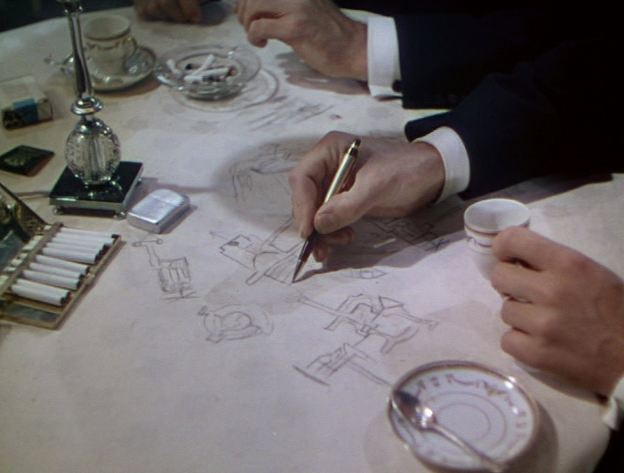
And by drawing on the tablecloth. And playing with Alexis’ lipstick.

The lipstick is a very pretty shade of red.
Both Flynn and MacMurray take to the air in some very scary dive sequences. Fred MacMurray eventually succumbs to pilot fatigue and he is grounded. He is consoled in what is one of the few foreshadowing moments of our involvement in the war, “Kind of tough to be yanked out of a ring when the main event may be about to start.”
But, one more test must be performed before their invention can be approved. MacMurray takes it on himself to fly the test.
MacMurray performs his test successfully, but crash lands and is killed. (Yeah, spoiler-schmoiler.) In the final scene we see Errol Flynn flying off to join a squadron with the Pacific Fleet. We know he is going to Pearl Harbor, and we know what will happen there. It is with poignancy and sadness that we realize he does not.
In tribute to his pal, he drops MacMurray’s gold cigarette case, which he retrieved from the crash, into the ocean, tossing it out of the cockpit of his airplane.
The last shot of the squadron flying towards the rays of the sun is brilliant enough to make you want to shield your own eyes.

Who says macho can’t be pretty?
*********
Jacqueline T. Lynch
is the author of Ann Blyth: Actress.
Singer. Star. and Memories
in Our Time - Hollywood Mirrors and Mimics the Twentieth Century. Her newspaper
column on classic films, Silver Screen, Golden Memories is syndicated
nationally.
Thursday, December 22, 2011
Remember the Night - 1940

Remember the Night (1940) is a polar opposite to My Reputation (1946), covered here in Monday’s post. The latter film feels darker in tone and in cinematography. It featured flashes of noir. The characters were well-to-do upper crust. It was wartime. Conversely, Remember the Night brings us out of the Depression, among simpler, homespun people. It is screwball comedy when it’s not frankly sentimental, and is a much lighter film in tone as well as on the set. The linchpin between the two movies is Barbara Stanwyck, who with ease can be either a shy upper class widow, or a petty thief from the streets.

Because Miss Bondi played mothers so often, and was so recognizable a character actress, and had that trademark quiver to her voice, it might be easy to dismiss her, unless you watch her carefully. Especially those large, expressive eyes. Her years of stage work (she came to the movies in her early 40s) shows in her ability to play off her scene partner rather than the camera -- which is what a lot of movie stars did who did not have theater experience. Spring Byington, who also had a career of playing mothers, had a lighter, more comic touch, and she could be accused of sometimes playing a stereotype. That’s because comedy is often born of parody.

You have the sense that she has lived a very hard life, but managed to keep a good outlook in spite of it.
Preston Sturges reportedly was not entirely happy with the film. He felt that his screwball comedy was turned into sentimental schmaltz, and at times it was. But Remember the Night has become for us, in a more cynical era, a wonderful holiday tradition. It could not be so without the sentiment. That it is equal parts screwball only makes it better.
We are coming out of the Depression in 1940. The war is going on in Europe and Asia, but you’d never know it from this movie. When Stanwyck and MacMurray travel cross-country by car, they encounter a WPA sign announcing yet another road construction project -- that never seems to be completed. But it was such projects that helped to drag us out of the depths of the Depression some seven years earlier.
Barbara Stanwyck has her own way of dealing with hard times. She’s a thief, and has walked out of a jewelry store with a diamond bracelet on her arm. She’s caught, and Fred MacMurray is the prosecutor in court.

The case, which is tried on Christmas Eve, is postponed until early January. Since she has no money and can’t raise bail, she’s doomed to spend Christmas in the hoosegow. Good guy Fred feels bad, and pays Fat Mike the bail bondsmen to get her out for the holiday.


Snowflake’s packing up Fred’s stuff and trying to hustle him out of the apartment because Fred’s supposed to drive to Indiana to visit his mother for Christmas. Stumped with what to do with Stanwyck, who is more amused than relieved that he has no designs on her, Fred takes her to a supper club for a bite to eat while they figure out where she can go.

It has been years since she’s seen her mother -- she ran away when a teen -- and Fred suggests he drop her off at her mother’s house for the holiday and pick her up on the drive back. She’s flustered by the idea, and there is a wondrous expression, anxiety mixed with longing, in her dark eyes.
I guess songs about our home states do that to us. Look how Jean Arthur completely lost it during her tipsy rendition of “The Iowa Corn Song” in A Foreign Affair, discussed here.
Doah! You can just sense a future trivia post about state songs in the movies, can’t you? This stream of consciousness writing is going to be the end of me one of these days.
I’m pretty sure “All Hail to Massachusetts” has never been in a movie.

I was on a train once, traveling through a dark upper New York State night, when, half asleep in my berth, I felt the train stop. I looked out the window to read the name off the train depot to see where we were, but we had not stopped at a depot. All was dark. All except a distant enormous red KODAK in block letters. Ah, I thought to myself. Rochester.
GPS? I spit on your GPS.
However, much as I admire the freewheeling adventure of our two travelers, I am invariably made freezing when I watch this movie because they travel for hundreds of miles in the winter with their car windows rolled down. Now, I know this was filmed on a nice toasty Hollywood soundstage, but jeez-louise. I have driven short distances with no heat and it’s a challenge to the soul. Several hundred miles would be a feat, I fear, beyond my endurance. You see, we here in the northern climes do not go to the trouble and expense of heating our homes for the ambience. We do it to keep from dying. Hypothermia also occurs in cars driving 700-plus miles in freezing temperatures with the windows open.
Especially when they get lost, tired, and decide to sleep in the car. With the windows open.

The farmer hauls them before the local judge for trespassing and destruction of property, and when they flee justice and become fugitives, MacMurray gets a taste of what life has been like for Stanwyck -- always ducking, living by her wits, and even enjoying the taste of rebellion


This still, silent, powerful acting is reprised when she is taken to her room. After Miss Bondi has left her alone, Stanwyck leans over her suitcase on the bed and sinks her chin into her shoulder, looking all around the room pensively, curiously, with almost a note of humor we think, until we see there are tears in her eyes.
Fred, being a square shooter, tells his mother what kind of person Stanwyck really is, and Beulah Bondi, the forgiving type, makes being extra nice to Barbara her new project. This includes gift giving the next morning around the tree. Stanwyck is part of the family by the end of the week.


I love how Sterling Holloway leaps into the arms of a very tall girl to get his kiss.
Mother Bondi sees the attraction between her boy and the petty thief houseguest, whose romance is egged on by her Cupid-playing sister. She tries to gently put a stop to what might be the end of her good boy’s career if he gets tangled up with a bad girl.

One the ride home they drive through Canada.
I know they joked about not wanting to drive through Pennsylvania again because that’s where they took it on the lam from the farmer with the shotgun and the judge, but really? That’s a heck of a detour to make. Through a much colder country. Lake-effect snow. With the car windows rolled down.
Nice shot of them by icy Niagara Falls though. We talked about Niagara Falls in the movies in this previous post. And a lovely ambiguous remark by Stanwyck when MacMurray, who wants to marry her says he’ll take her to Niagara Falls on their honeymoon.
“But we’re there now, Darling.”
Fade to black. Quick, before the censors find out what she means.
Of course, another reason for Canada is that Fred suggests since they are out of the U.S., she could jump bail and he practically invites her to become a fugitive. She wants to go back and face the music. Then when the trial resumes, he tries to throw it, but she won’t let him to that, either. She pleads guilty.
We don’t know what her sentence is going to be, but they’re both pretty sure they won’t be seeing each other for a while. We’re also pretty sure Fred will wait for her.

Christmas is a lovely illusion, and is probably best appreciated when we let it be. Reality is for January.
Barbara Stanwyck, Fred MacMurray, Beulah Bondi, and Sterling Holloway reprised their roles in the Lux Radio Theater presentation of this movie March 25, 1940. Have a listen here at the Internet Archive, now in public domain, or download it free to your computer. Scroll down to “Remember the Night.”

Merry Christmas, Happy Chanukah, and may the peace of the season be yours.
Subscribe to:
Posts (Atom)