IMPRISON TRAITOR, PEDOPHILE, AND CONVICTED FELON TRUMP.
Showing posts with label Ann Rutherford. Show all posts

Thursday, December 15, 2022

Love Finds Andy Hardy (1938)


Love Finds Andy Hardy
(1938) represents Christmas only as a deadline and an event on the social calendar.  As with many classic films, the holiday is a backdrop, not the focus of the plot.  As with all the movies in the Andy Hardy series, sixteen of them, Andy’s focus is on Andy.  We may not learn any lessons at the end of the tale, but Andy always claims he does.

Then we have another movie where he has forgotten them.


This post is part of the countdown to Christmas coinciding with the launch of my newest book, 
Christmas in Classic Films.

The story begins in early December, and the Hardy family are occupied with their usual challenges:  father Judge Hardy played by Lewis Stone censures a young juvenile delinquent in his courtroom for driving under the legal age and getting in a crash.  Sis Marian, played by Cecilia Parker has broken up with her boyfriend and melodramatically swears off men.

Andy, played by the energetic powerhouse Mickey Rooney, wants to buy his first car, a fixer-upper which will cost him the astronomical price of $20.  He pays down $12, and owes $8 and must find some way to pay it so he can have the car by Christmas Eve.  (His pop does not want him to have a car, so he has to do this on the sly.) There is to be a big formal dance at the country club on Christmas Eve and he wants to take his girlfriend, Polly played by Ann Rutherford. 

Normally, Ann Rutherford is a pretty high-maintenance girlfriend with expensive tastes and a somewhat controlling attitude, but young Mr. Rooney’s dead gone on her so he does his best to keep up to keep getting those kisses.  However, in what will be a rash of people going away for the Christmas holiday, Miss Rutherford is leaving with her family to go to her grandma’s and will miss the big dance.  Andy swears to her he will take nobody else and will just go stag.

However, his pal Beezy, played by George P. Breakston, is also going away for the Christmas holiday with his family, and he asks Rooney to date his girlfriend to keep the other wolves in the class away from her.  She is a hottie and he’s afraid of losing her.  He promises to pay Rooney the $8 he needs to buy the car.  The girlfriend is played by Lana Turner in her fourth film, in what was actually her first featured role.


Another new girl is entering Andy Hardy’s life: Betsy Booth, played by Judy Garland in her first of three Andy Hardy outings, and her second of some ten films she played opposite Rooney.  Young Miss Garland plays a 13-year-old visiting her grandma for a few weeks running up to Christmas.  Her grandma lives next door to the Hardys, and she becomes instantly smitten with Andy.


Not to be outdone, the Hardy family has its own grandmother issues when Mrs. Hardy’s mother, who lives on a farm in Canada, has suffered a stroke.  They receive the telegram with the bad news and the house is all a-flutter with what to do.  Mrs. Hardy, played by Fay Holden, and her sister who lives with them, Aunt Milly, played by Betsy Ross Clarke, will take the next train and leave the family rudderless.  The Judge hires a cook, played by goofy Marie Blake, and sister Marian takes charge of the house like General Patton, driving Andy nuts.

The movie could have been called “Christmas with Grandma” or “Grandma Messes Up Everybody’s Christmas Plans.”

In the days leading up the Christmas, Judge and sister Marian decorate an enormous tree in the living room.  There is the familiar scene of Pop feeling victorious that the lights actually work, and the stepladder is out to reach the high branches.  It’s a homey scene, but the son of the house is too busy moping on the running board of the family car in the driveway, worrying about his troubles.  He does not appear to have any joy or anxiety about Christmas wishes or shopping for others.  It’s all about the upcoming dance.

Amid Rooney’s hijinks and stress juggling dates (Beezy found a new girlfriend and no longer wants Lana Turner, so the deal’s off), problems at home, and yearning for his car, with the deadline of Christmas Eve looming before him—he marks off the days on the calendar—is a charming relationship with Judy Garland.  She has a crush on him and tries to interest him, but he thinks of her as a child.  Judy sings the plaintive-comic “In-Between” regretting she has no glamor—and briefly glances down at her chest.  “No glamor at all.”

Judy is the one who helps Mickey the most, serving as a shoulder to cry on, a sounding board for his schemes, and with much less heavy-handedness than either Ann Rutherford or Lana Turner, manipulates our young hero into taking her to the dance, eventually ditching Turner, and she herself patches up his romance with Miss Rutherford.  Judy and Mickey are pals through this film, and he couldn’t find a better one.

We have some interesting pop culture references in this movie, including the sending and receiving messages from Mother in Canada via ham radio, Andy’s ruminating on how there were no cars or planes when his father was a boy, and the Judge’s eerily prescient remark, made when admiring the 12-year-old boy ham radio operator and former delinquent in his court, played by future television producer Gene Reynolds, “Heaven only knows what this generation has coming.”

It would have a world war the following year.

Perhaps for these and much more, including the delightful performance of Judy Garland—who commands every scene she’s in—the movie was named for preservation in the U.S. National Film Registry by the Library of Congress in 2000 for being “culturally, historically, or aesthetically significant.”

To be sure, the Andy Hardy series is a window on an era. 


Christmas Eve arrives, and Mickey takes Judy to the country club dance.  He is in a tux with a top hat.  He is astounded by how grown-up she looks with her new long gown.  He takes possession of his car (she has bought a flashy hood ornament for him for Christmas) and incongruously, as in many classic films, they drive in an open jalopy through the cold.  It might have looked good on a Hollywood soundstage, but nobody seems to have considered the very real consequence of frostbite or hypothermia.  Just looking at people driving in an open car in the winter makes me cold.

Ann Rutherford is back from grandma’s early, so she attends the dance in a huff with another escort, once she finds out that Mickey has been dating Lana Turner.  Her date is a young orchestra leader from New York, played by Don Castle.  He is familiar with Judy Garland, having met her and heard her sing at a house party back home.  He asks her to sing, and though Mickey is nervous his 13-year-old date will make a fool of herself in front of his friends, he needn’t be.  She’s Judy Garland, for heaven’s sake.  Judy sings a couple songs, leads the grand march with Mickey, and the evening is a great success.

He brings her back to his house afterwards to give her his Christmas present to her, which we never see, and the Judge and Marian sneak out to join them in the living room.  It is just past midnight, so it is Christmas Day.  They wish each other a forlorn “Merry Christmas,” but then the doorbell rings and it’s Mother, who bravely flew in an airplane to return home to them.  (Maybe Aunt Milly decided to play it safe and take the train.  She ought to be along in a day or two.) Grandma’s out of the woods and it’s a happy ending.

The next morning, with a wreath on the grille of new car, which the Judge has given in and gave him the balance of what he owed, Mickey’s troubles vanish.  Polly arrives with the bandleader, who was her cousin after all, and makes up with Rooney because Garland had visited her earlier and explained things.  We can’t help but wonder if Andy Hardy wouldn’t be better off with a selfless girl like Betsy Booth, but he’s still attracted to the flashier types.

Garland’s humble response to his gratitude: “On account of you I was grown-up for one night, just like Cinderella.  Now I know how wonderful life’s going to be when I’m eighteen.”

It’s a sweet and innocent remark, and if Christmas is a time for wishes, for family, for nostalgia, for angst, and for sadness, there’s also plenty of room for old-fashioned innocence.  That might be what we mean when we say “Christmas is for children.”  But when we carry appreciation and respect for innocence into adulthood, even if we do not quite rate the label ourselves, it’s a form of benevolence that makes for a kinder world.

**************

Come back next week in the home stretch to Christmas for a department store hijinks with Ginger Rogers, David Niven, and a baby in Bachelor Mother (1939)

************

Jacqueline T. Lynch is the author of Ann Blyth: Actress. Singer. Star. and Movies in Our Time - Hollywood Mirrors and Mimics the Twentieth Century and Hollywood Fights Fascism.  Her latest book is Christmas in Classic Films. TO JOIN HER READERS' GROUP - follow this link for a free book as a thank-you for joining.


Thursday, June 27, 2019

Andy Hardy's Private Secretary (1941) and Spring Reunion (1956)


Andy Hardy’s Private Secretary (1941) celebrates the high school graduation of Mikey Rooney as Andy Hardy, a member of the class of 1941.  Spring Reunion (1956), starring Betty Hutton and Dana Andrews, is a look at another class of ’41 at their 15th reunion.  The first movie idealistically launches teenagers into their newly proclaimed adulthood at the first major accomplishment of their lives—commencement, and the latter film looks back with a wistful sadness and even frustration, questioning just what have they accomplished since.  


We’ve mentioned before the deeper meaning of being a member of a high school graduating class in the spring of 1941 in this previous post on Peyton Place (1957).  Though World War II had already begun and most young people were likely expectant that the U.S. would join the Allies sooner rather than later, it must have been a strangely unsettling feeling graduating from high school that spring of 1941.  Plans for further education, or job options, would have been made probably only tentatively, with an uneasy suspicion of the lack of permanence in a world catching fire.


Andy Hardy plans to go to college, but with his typically jubilant frenzy, he never gives the impression he suspects his plans might be knocked out by the war.  (We discussed his next venture in this post on Life Begins for Andy Hardy - 1941) Mikey Rooney, a workhorse actor whose well over 300 films began when he was barely old enough to tie his shoes, had traded a long run as “Mickey Maguire” for a long run as Andy Hardy by 1937 and Andy Hardy’s Private Secretary was tenth in the series.  He could play the part with his eyes closed, and the mugging all-American fella in the sweater vest was Louis B. Mayer’s schmaltzy paean to American boyhood, a mantle not always worn comfortably by Rooney.

Lewis Stone is his long-suffering pop, Judge Hardy; Fay Holden is his adoring and somewhat ditzy mom; Sara Haden is back as doting maiden Aunt Milly who lives with them, and who teaches English at the local high school.  Older sister Marian is absent from this entry in the series and it is explained that she’s away in New York City.

Ann Rutherford’s back as Mikey’s best girl Polly, and spends most of the movie in a jealous snit.  The main diversion for the Hardy clan, besides Andy’s struggle to graduate, is the Land family.  Widower Ian Hunter lives in a small cottage on the other side of the tracks with his son Harry, played by Todd Karns; and his daughter Kathryn, played by Kathryn Grayson in her first movie.  She is the reason Ann Rutherford’s in a jealous snit. The secondary characters are always more interesting in the Hardy series because we already know Andy’s going to be okay no matter what. His family will always bail him out, and he’s Uncle Louis B. Mayer’s pride and joy.


Young Miss Grayson is fresh-faced and natural, and I think her appearance here is actually less affected than some of her later performances when her career had hit its peak in the following decade.  Her voice, of course, is lovely and she gets to display her talent more than once in this film, most notably in selections from Lucia di Lammermoor.  Louis B. Mayer convinced her to turn down her dream of an operatic career in favor of the movies.  A purely unselfish act on his part, you understand.


Todd Karns, son of our favorite smarmy bus passenger, Roscoe Karns (“Shapely’s the name, and that’s the way I like ‘em”), also made his film debut in this movie.  It is never said that the Land siblings are twins, but they are both graduating, and because they are poor, Karns does not have the requisite white flannel pants, and Grayson does not have the requisite silk stockings (still available even with the war on?) to take part in the ceremony.  Mickey Rooney, their fairy godfather, will take care of that.

They had lived with their dad in Europe for several years, but the war has put a damper on his travel business (nobody wants to vacation in war zones, go figure), and working in a garage is the only job he’s been able to find.  His ability to speak nine languages will be just the angle for Judge Hardy to give him a hand up at the end of the movie.  Anybody who enters the Hardys’ magical sphere is always the better for it.  

There is something amusingly snobbish about Louis B. Mayer’s version of a perfect America where Andy Hardy, the son of a judge, and Polly Benedict, the daughter of the local banker, are regarded as typically middle class—both will be presented with brand-new cars by their dads—while Mr. Land, who must work in a garage as a mere “working man,” the expression used to be, is regarded as somehow pitiable.  Judge Hardy must remind his son to be nice to the Land kids and include them in their own graduation ceremony.

Kathryn Grayson is the private secretary in the title, assigned to help Mickey in his duties as class president in the final hectic weeks of senior year.  He has the ceremony to arrange, the yearbook, is writing the class play, and as a result of his over-extending himself, he flunks his English final.  Even Auntie Milly could do nothing to save him.

Todd Karns, who is understandably fed up with Mickey’s antics with the resentment a poor kid has for an upper-middle class kid who’s getting a brand-new car for graduation, nevertheless finds the loophole to get him a makeup test and together with Kathryn and Ann Rutherford, stays up all night and force-feeds English grammar rules into Mickey’s thick head.

Kids today might regard the importance of English grammar on the same level of unbelievability as the apparent social shame of not owning white flannel pants.

Todd is given the chance to pay off his graduation fee and contribute to the festivities by being allowed to decorate the high school auditorium for graduation.  Not only does he win the prestigious $25 prize for academics and citizenship, but his artistry is rewarded by being offered a job creating window displays for a local department store.  This is more than just a convenient happy ending or a deus ex machina, at least for our purposes in examining the cultural background of movies.  It tells us a little more.  These are kids who want to work, have seen their father struggle, and they want to help him and pay their own way.  The Great Depression is receding, but it’s all these teens remember and it will mark them for life, and a job, any job, made one a winner, at least in one’s own mind. We might wonder how Kathryn can have such a polished coloratura soprano voice with no mention of voice teachers, but we can accept that Todd might not have plans for college and be thrilled at starting a career in a department store.  

If you can find a department store in your town that is not a chain, they still likely may have an outside advertising agency handling that for them.  Once upon a time, retail was local, every facet of running the store, nothing outsourced, and the boss was the owner.

At one point, Mickey announces, “I don’t live in the present.  I belong to the future.”

The future, at least fifteen years down road, is where Spring Reunion takes us. The town of Carson might not be so very different from the Hardys’ town of Carvel, but the seaside burg has undergone a lot of real estate development in the backwash of the war. Jean Hagen, who plays Betty Hutton’s girlhood chum, returns to her old hometown for the reunion with the bemused, incredulous, “What happened to this town anyway?  Supermarkets, ranch houses….”  

The movie sinks us into sleepy springtime nostalgia with the opening credits taking the form of yearbook pages.  Betty Hutton had been “most popular girl.”  Dana Andrews had been “most likely to succeed.”  Jack Frazer plays the football hero.  Jean Hagen had a less stellar high school identity; she is comically noted as a chess club captain and assistant proofreader of the yearbook.  When she arrives to attend the reunion, she is on a much-needed vacation from her husband and four kids. She is perhaps back not so much to relive the glory of her high school days—they were not so glorious—as she is on much-delayed, last-chance at being the person she wanted to be then.

Betty Hutton is one of the organizers of the reunion, and it’s easy to see why she was voted most popular.  No “clique” is inferred here, her popularity comes from her genuine likeability and her friendliness with everyone.  Betty Hutton is really quite appealing in this quiet role.  Some of her other movie performances tend to jump into your face and choke off your air.  This role, her last film, perhaps because of the nuance of wistfulness, of sadness below the surface, is more intimate and draws our interest and our sympathy.

Betty’s problem, opposite from Jean Hagen’s, is that she is not married and has no children.  She helps her father run a successful real estate business, but the refreshing sight of seeing a woman in this period capably handle a business with authority is tempered by the sight of the woman questioning her self-worth because of not being in a romantic relationship.  Her bigger problem is one she does not see:  Her father, who calls her “Kitten,” is entirely too clingy.  Played by Robert F. Simon, Papa seems to enjoy his daughter’s company more than his wife’s.  She is played by Laura La Plante, and her eyes are wide open to the situation, and she tries to tactfully pull him away.  A subtle point made with the set decoration is seen late in the movie when we see two photos on either side of her father’s desk at the office.  One is a portrait of his wife.  The other, perched across the desk on the other corner as if in a world of its own, is a photo of he and his daughter together.

We see some old friends at the reunion, character players who would find more prominent places in pop culture in television: Irene Ryan as the innocent class advisor growing tipsy on spiked punch would later play Granny on The Beverly Hillbillies.  Herbert Anderson was the dad of Dennis the Menace, Ken Curtis was Festus on Gunsmoke, Richard Deacon came back as Lumpy Rutherford’s dad in Leave it to Beaver.  Betty Hutton would also make a break for the world of TV in her The Betty Hutton Show as her next gig.  It was a time of new beginnings.


Though she is mocked as a no-talent leftover from an old school show, voice actress Sara Berner is splendid as Paula Kratz, who does impersonations of movie stars being interviewed by Louella Parsons.

There are the usual jokes at the reunion about weight gain, hair loss, and the anxiety of not measuring up to who they thought they’d be fifteen years down the road, still dwelling in the identities they had in high school. The football hero is the only one who seems to be a case of arrested development, enjoying game reels of himself and reliving past glory on the gridiron.  The others are more uncomfortable with themselves.


Dana Andrews has no interest in the reunion.  He’s only in town to sell his family’s beach house, which Betty, as a real estate agent, is happy to handle.  It is only a desire to see her again that evening that he shows up reluctantly at the reunion.  The event fills him more with disgust than nostalgia.  He had been class president, but squandered opportunities through the years with an inability to be happy at anything.  Perhaps he could have used a secretary like Kathryn Grayson.

They leave for a long walk and what ends up being a long night of talking about themselves, escape on a sailboat, and renewing something of what could have been a romance in high school if either had been ready for it.  They may not be ready for it now, but their mutual attitude is they have nothing left to lose, and maybe nothing left to expect from life.

They end up on the rocks—literally, as the sailboat takes refuge below the lighthouse where the local lighthouse keeper, played by our old friend James Gleason, longs for company and card players. He and Dana are old friends.

Meanwhile the football hero, his wife out of town, cozies up to Jean Hagen, who is half excited and half scared to be finally paid the attention she never was in high school.  She comes daringly close to an affair, but will think the better of it by morning when she decides she wants to return to her family.

Betty and Dana have not come to their senses in the light of day.  They decide to run off to be married, but her dad makes one last ditch effort to keep her by dangling a job, a partnership for Dana. Dana walks out, because he always walks out on opportunities and doesn’t want to feel trapped, and it is supposed to be a moment of triumph for our Betty when she runs out into traffic with her suitcase to go with him.  Perhaps her first impulsive move will be his first effort at commitment and both will be happy at last.

Where were Kathryn and Harry Land fifteen years after graduation?  Did he make it through the war?  Did she ever sing in public again?  Did they go to their 15th reunion at Carvel High?

*********

Jacqueline T. Lynch is the author of Ann Blyth: Actress. Singer. Star. and Memories in Our Time - Hollywood Mirrors and Mimics the Twentieth Century. Her newspaper column on classic films, Silver Screen, Golden Memories is syndicated nationally.

Thursday, February 21, 2019

The Secret Lives of Hollywood Stars in Children's Novels


Deanna Durbin had a secret life, at least as evidenced by her two adventures told in children's novels: Deanna Durbin and the Adventure of Blue Valley, and Deanna Durbin and the Feather of Flame.  These began a popular, if sometimes rather odd, series of girls' books by Whitman Publishing Company of Racine, Wisconsin.  We learned about the adventures of other stars as well in exploits never told in fan magazines.

These two books were published in 1941 and spearheaded the collection that would be known as the Whitman Authorized Editions, though whether any star actually authorized these stories is quite doubtful.  They do stand as creative examples of not only the studios' ownership of its stars, but its wide-reaching commercial exploitation of the stars as its products.


One of the more interesting of the series was Ginger Rogers and the Riddle of the Scarlet Cloak, which was actually written by her mother, Lela E. Rogers, so Ginger must have at least known about the novel even if she didn't authorize it.  The story has Ginger dealing with a rough relationship with her mother, meeting her father for the first time, and in her job as a night switchboard operator for a hotel, ferrets out enemy spies in the aftermath of Pearl Harbor.  A full day's work.

Most, but not all, of the books in the series were written by Katheryn Heisenfelt.

We see by the titles that many stars had a lot going on in their lives. There is:

Bonita Granville and the Mystery of Star Island
Jane Withers and the Hidden Room


Ann Rutherford and the Key to Nightmare Hall
Betty Grable and the House with Iron Shutters


Jane Withers and the Phantom Violin (Jane Withers was very busy.)
Betty Hutton and the Romance of Palmetto Island

Ann Sheridan and the Sign of the Sphinx (Look at her casting that wry eye at the whole idea.)
Jane Withers and the Swamp Wizard (Jane's back again in a weird swamp story.)

Judy Garland and the Hoodoo Costume
Shirley Temple and the Spirit of Dragonwood
Shirley Temple and the Screaming Specter (because why should Jane Withers have all the excitement?
Gene Tierney and the Invisible Wedding Gift (I find this title the most intriguing.)
Dorothy Lamour and the Haunted Lighthouse

And just so you don't think the ladies have all the fun, we have:


John Payne and the Menace at Hawk's Nest


Gregory Peck and the Red Box Enigma
Van Johnson, the Luckiest Guy in the World.

If any of you have read any of these books, I'd like to hear your book report. 

************* 

In this previous post from 2010, I discussed some children's novels that were centered around World War II and published in that era.  I'll be writing a book on this subject, something that's been on the back burner for, obviously, a very long time.  My to-do list is so long it sometimes strangles me, and I have to shoot it.  But I'd like hear your input as well on books like the Cherry Ames series, the Dave Dawson series, the Ann Bartlett series, etc., all the pre-teen novels about the war.  I'll post more on this down the road.
***


Thursday, February 23, 2017

Happy Land - 1943

Happy Land (1943) is a gentle, yet powerful film of common decency, and the discipline and quiet courage that common decency sometimes requires.  We used to attribute these as American values.  The movie is sentimental about this, and yet bravely forward-thinking for all its nostalgia: there is an underlying current of foreboding almost as if they knew how delicate decency is, and that is must be nurtured.


The title of the movie, as related by the strains of the theme song, comes from the lines in “Hail Columbia,” composed for George Washington’s inauguration, that was often used as a national anthem up until the time “The Star Spangled Banner” was officially made the National Anthem in 1931.  With all due respect to our anthem, I have a preference for “Hail Columbia”.  It is stirring, and sweet, and nobly idealistic, and perhaps a little naïve. “Hail Columbia, happy land!”  Listen to song here on YouTube. 

Don Ameche stars as a man from a Middle West small town at the height of World War II.  He is a pharmacist and owns the town’s drugstore on Main Street, and much of what we see will remind us of a Norman Rockwell painting.  He is married to Frances Dee, lives in a cozy white wood frame house, and his only son is away in the Navy.  He knows all his customers personally.  It is a good life.

At the very beginning of the movie, we see a telegram delivery girl ride her bicycle up to the front steps of Don Ameche’s house.  Perhaps no image ever instilled more fear in the United States during World War II than the telegram delivery person.  Here it is a mere girl.  Her name is Hilda, and Don Ameche, of course, knows her.

Pleasantries are quickly dispensed with.  She hands him the telegram without looking at him.  He stands silently, and the close-up lingers on his expressionless face, on which we see only a flicker of realization that his son has been killed.

The movie is filled with moments like this, strong, gutsy, brave moments that are no less courageous from the actors and the director, Irving Pichel, because they are placed in a comfortable and nostalgic setting.  Sometimes the movie may well remind us of what The Best Years of Our Lives (1946) would have been had it been filmed three years earlier; and it is perhaps no coincidence that the material is from a novel by MacKinlay Kantor, just as Best Years was.

We shift quickly to the town’s newspaper office where the editor composes a hasty eulogy for Ameche’s son in his daily editorial.  There is slight leap forward in time—Ameche takes a leave of absence from his drugstore and his employees are left to run the shop: good old Mary Wickes among them.  The minister calls on Mr. Ameche to lend comfort with the true words, “Suffering and pain are part of life too.  We must accept them.”

But Ameche’s loss of his son Rusty is compounded by his sense of injustice that Rusty “never had a chance at life.  He never went anywhere.  Just a youngster living at home, going to school, working for his dad…It isn’t right.  It isn’t fair.”

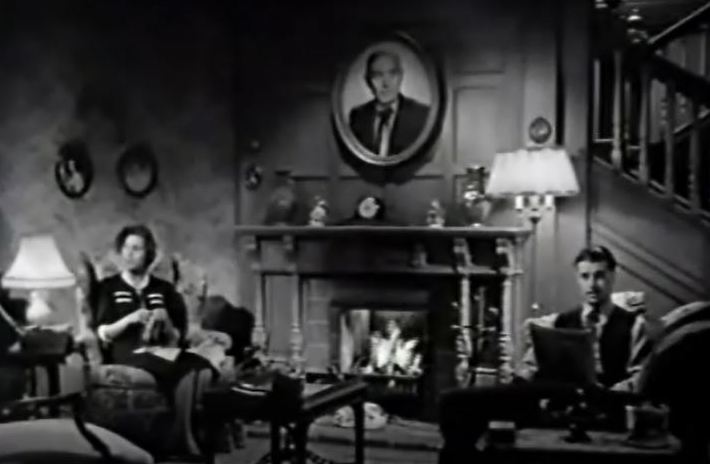
Ameche’s next visitor will have a stronger impact: Harry Carey, who plays his deceased grandfather.  We may compare this scenario with It’s a Wonderful Life (1946), but Harry Carey is no bumbling angel.  He speaks frankly with a kind of homespun horse sense we might expect from Will Rogers or Mark Twain, and though he has been dead twenty-one years, he is still very much alive to Don Ameche.  We know this because of Carey’s prominent portrait in Ameche’s home and at the drugstore.  Grandfather Carey’s influence is strong.  So it is with certain people in our lives, who seem to walk with us now and again even though they’re gone.

Ameche goes for walk into town, and Mr. Carey goes with him, and soon they travel not just through town, but through time.  We are brought to the end of World War I, when Harry Carey and the rest of the town welcomed home a parade of doughboys, including a younger Don Ameche.  (It is really something to consider that Ameche was still playing romantic leads at this point in his career, but in this movie he plays a character who ages, whose main purpose in the film is to be a father.  This would, as it does for aging actresses, signal a turning point, perhaps even a demise of his film career, but this movie is a gem and I hope he didn’t regret it.)  Grandpa Carey ran the drugstore then, and Don becomes a pharmacist as well.  We are then given a tour through Ameche’s adult life, of which his marriage to Frances Dee, and his son Rusty, is the biggest part.

Grandpa Carey died shortly after Rusty was born, and we jump to a Memorial Day of placing flags on Civil War vet Grandpa’s grave when Rusty is about six.  He is impressed, and knows that soldiers get flags.  He says that someday he wants one.  It is a moment of foreshadowing of doom, but Frances Dee confidently notes, “There aren’t going to be anymore wars.”  That, after all, was the slogan of World War I, when it was just still called The World War.

Grandpa Carey’s ghost remarks to Don Ameche, “She was right.  That’s the way to bring up American kids, not to be thinking always of conquests and battles, but to learn to enjoy the homely, simple things that are here all around them.”  It is a mighty thought, that to be peace-loving and grateful should be patriotic, for if we do not appreciate what patriots have won for us in war, we do not deserve the peace.  Then the strain of “Hail Columbia” repeats in chorus during this exchange.  The tune becomes our conscience.

We see Rusty playing with his friends at being Indians in a cornfield, and being dragged home by Mom to take his nap.  He balks at being called and answers, “Me no Rusty, Woman!”

Rusty gets spanked by Pop for refusing to go to kindergarten, but goes and makes pals there of two brothers who live on the other side of the tracks.  He brings them to the drugstore to meet Pop, and Ameche gives them free ice cream and orders some groceries for their family.  Their dad is out of work.  Ameche tells Rusty, “When you come across a fellow that hasn’t got anything and you’ve got things, why, you just give him some of your things.  Some folks call that charity.  I don’t like that word.  All it is, is being friendly.”

Rusty grows older, joins the Boy Scouts, and saves for a hatchet to take on a camping trip with the Scouts.  He’s almost got enough, but when he’s left in charge of the store and an old man comes in for medicine and can’t pay for it, Rusty buys it for him with his own money. Ameche witnesses the scene.  The expression of pride on his handsome face is exquisite.

He buys the hatchet for his son, and we see Rusty with other Scouts singing “MyDarling Clementine” to a harmonica accompaniment.  We are back to homespun pleasures, and a montage of scenes as Rusty plays football and runs track in high school.  He was not always the star, but tried his best, and his father notes with equal pride, “He was a good loser.” This is a virtue as important as being a good winner.

Rusty dates, and his eventual best girl, Ann Rutherford, shares with him an unusual but pleasingly respectful relationship, an old-fashioned courtliness borne of modern wariness.  She does not gush over him, and withholds her kisses from him because she has seen him lose his head over flashier girls and she will not lower herself to compete.  He must win her, and with gallant gentlemanliness, he acquiesces to kisses only on the forehead until the moment when the time for passion is right.

Rusty, played by Richard Crane as an adult, is touchingly mature.  He and his friends have fun at a late summer backyard party, but listen to Hitler’s invasion of Poland on the radio and soberly understand, wise beyond their years, that their future has just been altered.  As President Franklin D. Roosevelt had said only three years earlier in 1936: “There is a mysterious cycle in human events.  To some generations much is given.  Of other generations much is expected.  This generation of Americans has a rendezvous with destiny.”

Back at the drugstore, Old Ben, who works in town as a night watchman, played with eloquent, natural grace by Leigh Whipper, veteran of Broadway and the first African American to receive membership in the Actors Equity Association, remarks of the latest news on the radio about the threat of fascism, “It’s the same old thing, weasel talk.  The same old bunch of gangsters and killers out to make slave of the rest of Europe.”  Mr. Whipper’s too disgusted to be scared.  He sets a fine example in righteousness for the Rusty and his pals planning on joining the service, some fighting in these pre-Pearl Harbor days for Canada.

Along with Leigh Whipper, we must note how well chosen the cast is, from Richard Crane, who despite the enthusiasm of a boy coming of age really plays his role in a careful, understated manner which makes his character very likeable that makes us, like his father, seem to take pride in him.

His best friend is played by Dickie Moore, and Ann Rutherford’s character is played as a child by Darla Hood.  Also for the trivia buffs, this was five-year-old Natalie Wood’s first movie.  She has a brief walk-on as a child who drops an ice cream cone.  It also warms the heart see Adeline De Walt Reynolds in a brief role as a patron of the drugstore who trades homemade loganberry wine for a “snake oil” tonic. (We discussed her career in this previous post.)  The wine is reprised in several scenes as Rusty shares his first drink with Dad, and other momentous occasions.

Rusty decides, rather than enlist in a knee-jerk reaction to the world news, that he will go to pharmacy school.  After the war, he wants to join his father in business, and he feels that if he has his pharmacist’s license, he will be of more use to the service with this skill.  Don Ameche is once again beaming with pride, and invites his son for a toast of loganberry wine.

Rusty’s a strapping sailor in his Navy uniform.  But the world comes crashing down on us when we see his smiling face in the bus window pulling out of town and Ameche says in his soft, low voice, “That was the last time I saw him.”

Grandpa Carey is at his side again; we’re back in the present.  Carey says, “It was all worthwhile, the whole thing.”

We know what he means, that just because Rusty’s life was short doesn’t mean it didn’t have value, and that he didn’t pack a lot into it.  Ameche understand, too, but responds, “Rusty led a good life.  You’re right about that.  I know all the other things you’re hoping I’ll say, but I can’t.  He was my boy.  And now he’s dead.  I miss him.  I can’t help it.  I’ll always miss him.  I’ll always wish he was back, as long as I live.”

This exchange, during the height of World War II, was a very frank thing to say, and brave in its open-faced acknowledgement of grief.  We are most respectful to the grieving not when we try to cheer them up, but when we acknowledge their grief.  There is no cheerleading here, but the end of the movie gives us and Ameche a startling task.  It dares us to continue our lives and force ourselves to find a purpose.

The gentle but no less firm admonition for Ameche comes in the form of Henry Morgan.  He’s a young sailor, a shipmate of Rusty’s.  He shows up to the drugstore on furlough, and in an exchange of very few words, almost as if they are reading each other’s minds, Ameche invites Henry, who has no family of his own, to stay at his house.  Frances Dee, also awed by an unspoken epiphany, kisses Henry upon meeting him as if he was her son, and they, without talking about it, suggest he take Rusty’s room.  We know their bond is sealed when Ameche takes out the loganberry wine.

The strains of “Hail Columbia” rise again with lyrics, “peace and safety we shall find.”

But we shall only find it together.


Special thanks to fellow blogger Moira Finnie (see her blog The Skeins) for introducing me to this movie.  You can watch it here on YouTube.

*********************
The audio book for Ann Blyth: Actress. Singer. Star. is now for sale on Audible.com, and on Amazon and iTunes.


Also in paperback and eBook from Amazon.

Related Products