IMPRISON TRAITOR, PEDOPHILE, AND CONVICTED FELON TRUMP.
Showing posts with label Dorothy Malone. Show all posts

Friday, May 20, 2022

Young at Heart at the beach


Young at Heart
(1954) gives us a glimpse of an idyllic beach scene on the Connecticut shore in the 1950s.  To be sure, it is mostly of Hollywood origin, or at least, California, but if the beach is not in the right location, the warm and lovely nostalgia of the beach is genuine.


This is my entry to the Fun in the Sun Blogathon, hosted by the Classic Movie Blog Association.  Have a look at some great posts on this topic here.


The movie Young at Heart is a remake of Four Daughters (1938), which we covered previously in this post.  In that original story, widowed Claude Rains heads a family of four girls, played by the Lane sisters plus Gail Page, and all are musicians.  May Robson plays the auntie matriarch who lives with them.  The girls’ suitors have picked out their choices among the daughters, but all the young beaus have competition with the newcomer: handsome and happy-go-lucky Jeffrey Lynn.  But an even newer newcomer, a dour, sarcastic and self-pitying John Garfield swoops in to really disrupt things and his love for Priscilla Lane nearly tears the family apart.

We see the beginnings of the rift and a change from a lighthearted first part of the movie to a more serious and even tragic second part at a family picnic in a secluded country glen.  Here we see the sisters are really all interested in the same man. 
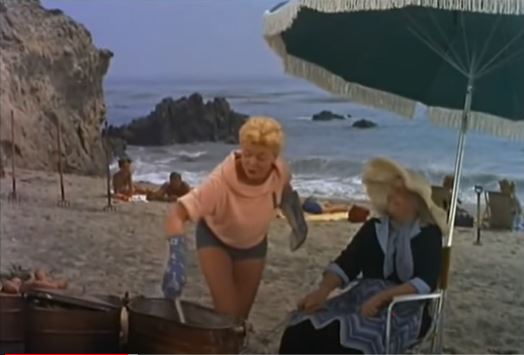

In Young at Heart, this scene is transported to the beach.  Robert Keith plays the Claude Rains role of the dad, Ethel Barrymore in a charming mixture of regal and down to earth plays the May Robson role.  Here the sisters number only three instead of four: Elisabeth Fraser, Dorothy Malone, and Doris Day.  Doris plays the lead Priscilla Lane role.  The boyfriends are with the family at the beach, and the heartthrob who will cause unspoken jealousy among the sisters is played by Gig Young in the Jeffrey Lynn role.

Frank Sinatra plays the John Garfield role in this movie, but this scene is just before he makes his first entrance in the film, so we don’t know yet how he’s going to upend the family.  Even without him, the seeds of discontent are already sown, making the day at the beach bittersweet.


With an almost nuclear-powered sunny disposition, Doris Day is the most lighthearted of the group and fails to see her sisters’ yearning for the man she playfully cavorts with in the surf.  Doris gets to sing two songs during this nearly 10-minute beach sequence. 

For those of us who live close enough to a coast to have spent pleasant days on the beach, the movie image of sand and sea, of wave-kissed rocks and sunshine reflecting off the constantly moving ocean is familiar and almost personal, like someone with a movie camera somehow entering our brains and capturing a memory.  Some sensations experienced going to the beach are really timeless and there is a distinct and powerful comfort about that.


But we may sense that some aspects of this scene are not timeless, and that perhaps going to the beach in the 1950s was a little more do-it-yourself, simple, and perhaps with a slower pace of life.   Yes and no.  We don’t see any arcades or water parks or concessions, or even bathhouses with facilities on this beach, but there were beaches back then and even before – though not all – with plenty of tourist amenities. 

That this beach is not crowded and there is plenty of space between the actors and the extras in the background should not be taken that beaches were not crowded in the 1950s.  Of course, they were.  But not all were, and even in these modern times, I have been to New England beaches that were just as unspoiled and unpopulated as this one in the movie seems to be.

So that is not quite it, either.  There must be something else that evokes the strong feeling of nostalgia for a 1950s beach in this film.  Is it because there are no loud radios playing?  Maybe, but we see Doris singing along to a portable record player.  We don’t see too many record players at the beach these days.  

Is it because nobody’s in a bathing suit and they come lounging on the sand in their clothes?  Maybe.  No sunscreen?  Maybe.  


It could just be that the clam digging and the large pots with New England clambake accoutrements – corn on the cob, potatoes, etc., are not seen quite as much now as in the old days, or campfires on the beach, or gathering driftwood to fuel the fires.

There is a noticeable lack of people taking selfies or scarfing packaged junk food snacks.  No one is being divebombed by seagulls for a few Cheetos. 


I get a kick out of Alan Hale, Jr., who plays the suitor of Dorothy Malone, talking about his sudden idea of what a great thing it would be “buying this strip of beach, tearing down all the bungalows on the highway and putting up some hotels, a whole string of them.” 

She responds, “Whoever heard of a string of hotels along the beach in Connecticut?”

There are some hotels here and there on the Connecticut coast, and were, too, in the 1950s, but not enough perhaps to make Alan Hale, Jr.’s dream come true.  Instead of hotels today there are more likely to be a few condominiums, but the geography doesn’t always allow for development.  Working harbors, saltwater marshes here there, and far more protected areas than there used to be.  Thank heaven.


I think what I really like about this beach sequence is the work of the sound technicians.  Behind all the dialogue, behind Doris’s songs and the “orchestration” that seems to bloom from her portable record player, is the omnipresent, lazy, rhythmic sound of the waves rushing to the shore.  The seacoast is not a quiet place.  The sound of the surf is eternal.
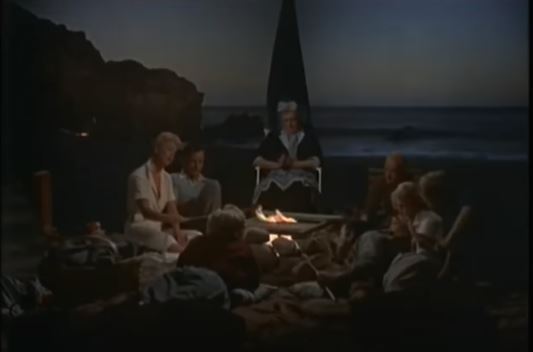

The bright, almost blinding daylight of the first part of the sequence becomes a peaceful twilight with the family around the campfire, and Doris still singing, toasting marshmallows.  The large beach umbrella that sheltered Ethel Barrymore earlier in the day has been folded up.  You can almost feel the refreshing cooler breeze off the ocean, almost feel chilled by it.  It is an idyllic ending to the sequence, a calm before the storm.  A day at the beach is a respite, time to enjoy, to reflect, and to make a memory that will last through days to come.  A beach memory may mark epochs in our lives, just as it does in the movie.

Visit the CMBA website here for more Fun in the Sun Blogathon.

    ********************

Jacqueline T. Lynch is the author of Ann Blyth: Actress. Singer. Star. and Memories in Our Time - Hollywood Mirrors and Mimics the Twentieth Century. Her newspaper column on classic films, Silver Screen, Golden Memories is syndicated nationally.  Her new book, a collection of posts from this blog - Hollywood Fights Fascism - is available here on Amazon.

Monday, May 28, 2012

South of St. Louis - 1949


“South of St. Louis” (1949) displays an almost startling lack of moral righteousness. Set in the comfortable Western venue, the good guys, instead of seeking justice, are looking for a profit. Against the backdrop of the American Civil War, what sides are taken are easily abandoned. Its moral ambiguity could make it film noir, except it’s shot in Technicolor and a burst of final sentiment makes over ninety minutes of vendetta crumble away. Still, there are no lessons, no morals, except to let go of one’s hatred because it kills everything around you.

On this Memorial Day, we once again turn our attention to Hollywood’s treatment of the Civil War, the war that gave us Memorial Day.

The prologue narration describes a “wall of hate between North and South,” but if we are expecting a story of torn loyalties, we get fooled. There is precious little loyalty to either North or South going on in this movie.

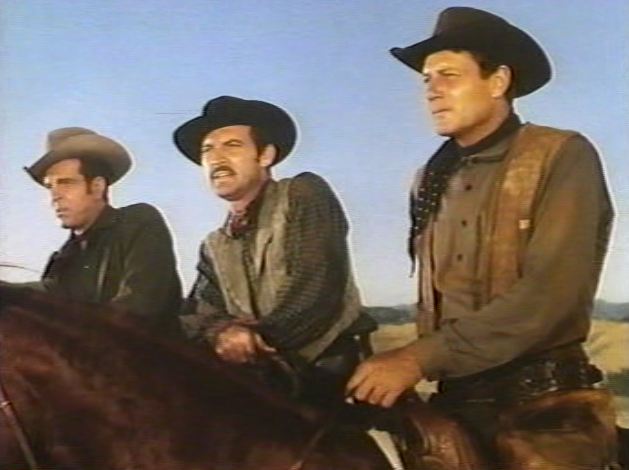
Joel McCrea, Zachary Scott, and Douglas Kennedy are pals who run a ranch together in Texas. The ranch is called Three Bell, and they each wear a tiny bell on one spur that jingles when they walk. When they are off rounding up cattle, Victor Jory and his band of raiders burn out the ranch, abscond with some cattle and chase off the rest. The three pals are left with nothing.

Victor Jory, in his patented nasty heavy role is currently working for the Union Army, which has just taken the border town Brownsville, Texas from the Confederates. Jory scatters and terrorizes the settlers.

One of which is Dorothy Malone, who here is a couple years after her intriguing book shop proprietress from “The Big Sleep” (1946), and several years away from her Oscar-winning mambo in “Written on the Wind” (1956). You might not recognize her in her long brown curls and gingham. She’s as pretty -- and as static -- as a daisy. Not her fault, though. She clearly got the leftovers on this gig.

The flashy part goes to Alexis Smith as dance hall singer Rouge. She was quoted in an article by Bob Thomas syndicated in the Regina, Saskatchewan Ledger-Post (July 28, 1948): “It’s a pleasure to be playing someone named ‘Rouge’ after seven years of ‘Ceciles’”.  It amuses me that Canadian newspapers back in the day never missed a chance to publish anything on Alexis Smith, usually heading the article "Penticton, B.C. girl...."

She elaborated her delight on shifting from icy clotheshorse to lusty babe for the Dayton Beach Morning Journal (June 15, 1948): “For seven years I’ve played society dame parts and begged for a role with guts. Now I’ve got my wish and I’ll probably spend the next seven years wishing to get back into clothes.”

Not likely.  The seven-year contract days were ending for the Hollywood studios, and she would soon be, along with hundreds of others, cast into the freelance lagoon to sink or swim.

Joel McCrea and the boys head for Brownsville to beat up Victor Jory for torching their ranch. McCrea, his matinee idol face now craggy and softer -- he would turn to cowboy movies pretty much for good now -- tells Jory to get out of Texas. Jory flees to Matamoros, Mexico, just over the Rio Grande.

The movie is kind of "a tale of two cities" -- Brownsville and Matamoros.

Zachary Scott and McCrea have to scrounge up some money to replace their herd and fix their ranch. This is where Alexis Smith comes in.  She sets them up in the gunrunning business. They will take weapons from Matamoros into Texas and sell them to the Confederate Army.

Douglas Kennedy bows out, decides he wants to join the Confederate Army. His pals tease him. There is no question of fighting for “the cause” for McCrea or Scott. Neither of them are pacifists or Unionists -- they hate the Yankee soldiers in Brownsville -- but they wander around in a most curiously self-involved cloud, as if the monumental events of the day, the battles ranging all around them are far away and none of their business.

Their self-preservation is not unique. Everybody in Brownsville is afflicted with it. When Joel makes his first gunrunning attempt and gets caught by the Union Army, he is sent to the stockade, possibly to be shot -- Alexis bribes the marshals to get him out.

She explains, “They’re southerners -- for $100 gold.”

There is much back and forth between Brownsville and Matamoros. McCrea and Scott get themselves a band of cutthroats to help them smuggle the guns into Texas. One of these men, played by Bob Steele, wears a long knife in his belt and has an almost psychotic silent-movie stare. No wonder, for Mr. Steele, who made about a zillion westerns, began his film career in 1920.

The gunrunning trade shows us a complex economy. They pick up the guns in Matamoros, and sell them to the Confederates in Texas, but are paid in Texas cotton. Then they must take the cotton back to Matamoros where they sell it to a British agent for pounds. Remember, the Union blockade of southern ports hit the British textile industry. The cotton mills of Manchester were waiting for Joel McCrea to get them some more raw material.

All this has been set up by Alexis, a shrewd businesswoman with no seeming loyalty to North or South. When we meet her, she is singing in Alan Hale’s saloon (Hale too little used, by the way), “Yankee Doodle.” The Union men are cheering her and buying another round, making Mr. Hale very rich and very happy. Later on, after the Confederates have taken Brownsville again (though actually the Union Army abandoned Brownsville), she sings to Confederate men, noting to Zachary Scott, “I’ve got a couple of fences that need mending.”

Hale is happy, too, for after all, he stresses he was born in Missouri. Alexis is from Baton Rouge (her nickname Rouge is from her birthplace and not her fancy gal cosmetics). Both southerners, each blows with the wind. (All the main characters in this movie are southern, and none have appropriate accents.)

Alexis’ singing in this movie is done by herself, according to the syndicated article in The Deseret News (Salt Lake City, December 29, 1949), but the IMDb lists her as being dubbed by Bonnie Lou Williams. I believe the first number, “Yankee Doodle” is definitely Alexis, but I’m not sure about the other two numbers. In the quiet, sultry, “Too Much Love”, which she croons, bitterly tipsy, to Joel McCrea could be dubbed, but it’s just such a good vocal match it’s hard to tell. I’m even less certain about the third song, “It Must Be Fun to Have a Soldier”.


Somewhere between gunrunning and vendettas with Victor Jory, Miss Smith has fallen hard for Joel, who is planning to marry Dorothy Malone. Smith’s “How pretty is she? Very pretty? Kip, is she very pretty?” shows the showy saloon girl with a heart full of pain, asking for what can only hurt her.

Her song and dance number, “It Must Be Fun to Have a Soldier” comes with other consequences. You can see as she sings that the dark beauty spot located just to the right side of her mouth has slipped off her face and landed conspicuously on her right breast.  Blooper?  Joke?


For those of you who sing in public, please be sure your beauty spot is fastened firmly to your face, or you may lose it on the next chorus. This has been a public service announcement from Another Old Movie Blog - Serving Your Old Movie and Saloon Girl Cosmetic Needs Since 2007.

Dorothy Malone, no beauty spot needed, works as a nurse in a makeshift hospital for Confederate soldiers. Douglas Kennedy has become an officer and is posted to Brownsville. In one of the most ironic scenes in the movie, McCrea’s gunrunning band dresses as Union men to steal weapons from Victory Jory and sneak across the border, but runs into a Confederate patrol. A skirmish occurs and men are killed on both sides. McCrea’s band, who are running guns in support of the Confederate Army, have just wiped out a Confederate patrol.

So many true-life senseless killings happened in that war, but rarely has old Hollywood acknowledged it, let alone treated it with such a blasé shrug of the shoulders. Douglas Kennedy finds out and is of course outraged, but no pangs of conscience hit his buddies.

“We couldn’t help it,” McCrea says, “They started shooting. We had to defend ourselves.”

“Defend the wagons, you mean,” Kennedy answers, “You were willing to fight us, kill our men, anything just to make sure you got your money.”

Vendettas continue between Jory, who is no longer working for the Union Army, but is selling guns to the Confederates in competition with McCrea and Scott. Scott takes it up a notch by looking the other way when Bob Steele attempts to assassinate McCrea so they could have a greater share of the wealth.

The only two people with a sense of commitment are Dorothy Malone and Douglas Kennedy, who finally commit to each other and intend to marry, and McCrea is disgusted at one buddy who tries to kill him and one who steals his girl. It is from disgust, more than any moral epiphany, that he resigns from the gunrunning business and tells Scott he can have all the money.

Alexis follows him, even though he doesn’t want her, and Zachary Scott, who fancies her himself, wants to know why she’d give up a lucrative business for a saddle tramp who doesn’t even know she’s alive.

“He ain’t got nothing but the clothes on his back.”

“It’s how you wear them, Charlie,” she responds, “It’s all in how you wear ‘em.”

Eventually he does notice Alexis in a scene more sweet than passionate, and has a final showdown, helping Douglas Kennedy, now a Texas Ranger that the “hostilities have ended” -- you’d think the end of the war was nothing more than a passing thunderstorm -- fight off the bad guys.

We hear the tiny jingle of silver bells on their spurs, and cut to a shot of Zachary Scott’s face. Will he remember past friendships? Will he have a change of heart before the trigger is pulled?

There is no sense of redemption for anyone, but a lesson nevertheless as Alexis slams Joel, who is caught it a morass of anger, self-pity and vengeance, “What are you going to do, spend the rest of your life getting even?”

With malice toward none, with charity to all.

A peaceful day of solemn remembrance to everyone this Memorial Day.

Related Products