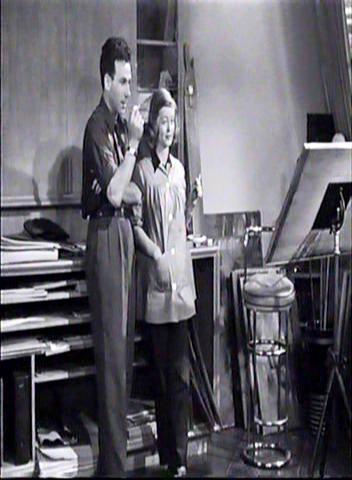
There is a scene in Since You Went Away (1944) of such gossamer poignance that we might miss the impact just because it is a fleeting, throwaway line. But these days, I think our own experience engenders empathy and we understand a little better.
Claudette Colbert plays the mother of Jennifer Jones and Shirley Temple. They sit together as Colbert reads aloud a letter to them from her husband, who is away in the war. She reads the special message he sends to his daughter, Jennifer Jones: "...she must hold the thought that next year, or the summer after that, we'll be boating again on the lake..."
Jennifer lifts her head slightly and says, almost to herself, with a leaden epiphany, "The summer after that."
She suddenly realizes that the war may last a very long time. She is seeing in her mind's eye a picture of the normal life she knew growing smaller in the rearview mirror. She has no idea how to look ahead.
This movie, like many produced during World War II, was produced not only for entertainment value, or for the box office draw the big names would elicit. It was produced to serve the country during a terrible time. It was produced to remind us of homespun, democratic, decent values for which we told ourselves we were fighting; and also to give us hope, not only the hope of future victory, but the hope that we would remain unchanged and our regular lives of comforting normality would resume one day.
Neither theme was entirely accurate, but both were necessary. We needed to aspire to more than just a return to normal, but to make normal better. We do now, too. In the meantime, we have to slog through some unpleasantness. And we have to just buck up and do it.
In the United States, we have the Thanksgiving holiday approaching next month, which, for those from other countries who may not be so familiar with it, is a huge holiday in this country because it so deeply reaffirms our cultural heritage. Also, most of us really like pumpkin pie.
Christmas, which is celebrated around the world, will come after that in a world now consumed by the COVID-19 virus. We in our respective countries are being told to tone down our holiday family gatherings this year to keep each other safe. So many of us are balking at that, but I would have to ask them, if a doctor gives them a diagnosis of cancer and tells them they must begin treatment with chemotherapy or radiation, or surgery, or a combination of all three, what will be their answer? Will they say, "No, I won't!" And run out of the office and on to their certain deaths? Or will they master their fear and face down their dislike of unpleasantness and inconvenience for the good of themselves and their loved ones and begin treatment?
If you are given a diagnosis of cancer, only you have the disease. If you are infected with COVID-19, everybody near you gets it, too. Unless you have been tested, you may not know that you have it.
Back to Claudette, and Jennifer, and Shirley sitting together for comfort in the icy cold realization that their lives are not going to return to normal anytime soon...I'd like to add a personal note. My father, who served overseas during World War II in the United States Army fighting the fascist enemies of democracy (that's what you do when you're Antifa), missed three Thanksgivings and four Christmases. He had to; it was for the good of the nation and all civilization. Some of his pals never got home to celebrate another Thanksgiving or Christmas ever again. So he didn't complain.
Neither should you. Do your part. Do your bit. Wear the mask. Stay home. Keep calm and watch classic movies.
Since You Went Away (1944) is a tribute to the American home front during World War II, its cozy, meandering plot glowing with quiet moments of breathtaking truth. Sentimental, certainly, but no less truthful for its sentiment, and never more so than the important scene toward the end of the film when we see Claudette Colbert learning a lesson on what it is to be an American.
She takes a coffee break in the canteen at the shipyard where she is doing war work. Her co-worker, an immigrant from Europe, recounts of the terror of the old country, of clutching her child, hearing, "the sound of heavy boots marching down the street."
We do not know the country, or her religion, or how she came to arrive in America, only that her little boy did not come with her. We cannot imagine the circumstances of what we presume was his death, or what happened to his father.
"We'd pray together that God would let us go to the fairyland across the sea."
Nazimova plays Zofia Koslowska. Her name, Claudette Colbert writes to her husband, "is nothing like we ever heard at the country club." Nazimova describes her visit to the Statue of Liberty upon arrival in the country, and recites from memory over the lunch counter, over their coffee, as Claudette listens, watching her face with awe, the Emma Lazarus poem inscribed on the bronze plaque on the pedestal of Lady Liberty:
Give me your tired, your poor, Your huddled masses yearning to breathe free, The wretched refuse of your teeming shore, Send these, the homeless, tempest-tost to me, I lift my lamp beside the golden door!"
"I know it so well here," she points to her head, "because I feel it so much here," she points to her heart. It was Nazimova's last film; she died the following year at 66 years old. Another veteran of the European stage, Albert Basserman, plays another immigrant in the film, and producer/screenwriter David O. Selznick prefaces his appearance with the tender, and pointed, quote on a plaque by another American poet, Carl Sandburg,
"America, thy seeds of fate have borne a fruit of many breeds..."
Then we see a university degree awarded to Sigmund Gottlieb Golden, M.D., a kindly psychiatrist treating a young serviceman in a veteran's hospital, played by Craig Stevens, who is suffering from what we today call post-traumatic stress. The doctor's name, like Zofia Koslowska's, would never be heard at the country club.
But middle class WASP Claudette Colbert, and her daughter played by Jennifer Jones, embrace these "wretched refuse" as role models and as friends. We next see Nazimova as a guest at a party at Claudette's home.
Selznick uses these inferences and examples of the strength, nobility, and virtue of a culturally diverse America -- and the white Christians openly accepting the newcomers who are different -- not as a shaft of conscience, but as a source of pride during a desperate war against fascism. Our cultural diversity and our pride in that was one of our greatest weapons against evil.
“Love Letters” (1945) is our third and last in the series of “war stories”. It’s a love story, and a mystery that doesn’t really need The War as a backdrop, but this was a time when so many letters were written, and relationships begun on the strength of a chance meeting.
In many families, the wife said goodbye to the husband (or sweetheart) at the train station. She said welcome home to him (if she was lucky), three or four years later. The only way to communicate in the years between were by letters. They might meet again -- to resume their lives and their relationship -- as near strangers, unless the letters were particularly heartfelt, and the communication between them was open and honest.
I doubt in our age of instant, but often weak and meaningless, communication does the power of language ever come close to matching the importance it had during World War II.
Note: Ayn Rand co-wrote the script with the writer of the novel on this story is based, Christopher Massie.
Joseph Cotten, again here in his trademark role of the troubled, romantic loner, is an officer with the British Army in Italy. He pens the letters that his fellow officer, Roger Moreland, sends to his girlfriend. Roger, played by Robert Sully, is a boorish, self-centered cad, who, though unfaithful to this woman, is amused by the idea of winning her through Mr. Cotten’s tender prose.
Cotten is sick of the idea, and disgusted with himself for doing the chore, partly because he knows Roger is an ass, and partly because he fears he is falling in love with the woman who writes sensitive replies to his letters. He has a fiancée of his own, and he is growing apart from her. He seldom writes her, saving his deepest thoughts for Roger’s friend, Victoria.
“I was able to write to her all the things I was never able to say to any woman I know.” He says, and felt the ruse was innocent as long as the girl didn’t care. “But Victoria cared, understood.” He realizes Victoria has fallen in love, not with Roger as she believes, but with his letters.
“She’s in love with a man who doesn’t exist.”
Mr. Cotten demands the charade stop. He won’t write anymore, wants to know nothing more about her. When Cotten is seriously wounded and placed in a military hospital in Italy, he gets a letter from Roger, who has returned to England for training. Roger has married Victoria.
When Cotten is sent back to England to convalesce he learns from another pal that Roger is dead, not in the war but from an accident at home. This news nags at Mr. Cotten, because it means this Victoria is now a widow, and free, and a temptation in spite of himself. He also feels guilt for making possible what he suspects must have been a bad marriage. In a way, though it is never couched in these terms, it's as if he prostituted this earnest, romantic woman to a callous stranger.
He still wants no part of the charade he committed, and wants to distance himself from what he has done. But when his brother takes him to a party at a friend’s flat, Cotten meets Victoria even though he is not aware of it, mainly because she is not aware she is Victoria.
Victoria is played by Jennifer Jones in their second pairing after last year’s “Since You Went Away.” She goes by another name, because she has lost her memory. There is more intrigue to come, and we get bits and pieces a little at a time. I won’t give a play-by-play on the plot, that would ruin it, but we do learn that Roger was murdered, and Mr. Cotten discovers his letters played a part in a tragedy and the great mystery of Miss Jones’ amnesia.
Jennifer Jones is by turns ethereal, and also teasing and free spirited. This is also something of a trademark role for her, the fey innocent, but she appears more at ease in this film and less fragile than in some of her other work.
Ann Richards plays her friend, a woman who took Jones into her flat and cared for her when she was unable to take care of herself. Ann Richards also had minor roles in “Random Harvest” (see this post) and in “Sorry Wrong Number” (see this post here and here), but her film career ended in the early 1950s.
It’s difficult to believe she could not have been given better promotion by a studio in Hollywood and enjoyed a longer film career, as she has an engaging presence in this film. Her role is minor, but she shows a range of emotion and great chemistry with Joseph Cotten. Until Cotten falls in love with Jennifer Jones, one might suspect, and even wish, that she would get together with Cotten.
Notice the scene where, when Ann Richards wants to discuss the tragedy/mystery privately with Cotten, she sends Jennifer Jones to the store to get some porridge. She hands her their ration book. Since the UK imported most of their cereals (and a lot of other products), rationing was more severe there and lasted well beyond the war. Though the US had its own rationing program, I don’t think we rationed oatmeal (porridge). Maybe somebody can set me straight on that. Being the so-called “bread basket of the world” had its compensations.
We don’t see too many ration books of the day in the movies, and I’m not sure why. Possibly the government requested the cooperation of the film industry not to make too big a joke of them so that people would follow the rules and take their use seriously. Possibly they did not want to harp on (though an English setting in this movie, this was still an American-made movie for an American audience), shortages to an audience weary of them and doing its utmost to sacrifice.
Mr. Cotten takes up residence in a country cottage left to him by his deceased aunt, where he is looked after by rustic family retainer Cecil Kellaway (whom we saw in “Portrait of Jennie”, see here). Ian Wolfe plays a vicar, and Harry Allen a local farmer, both character actors who you might remember from “Mrs. Miniver”, which we reviewed in the second post on this series.
Gladys Cooper, who also teamed up with Jennifer Jones in “Song of Bernadette” (1943), see this previous post, plays Miss Jones’ guardian. She plays prominently in the tragedy/mystery, and she’s a shadowy figure for most of the film. It’s not until the very end we get her story and the truth about Victoria. It’s a good scene between Jones and Cooper, where they both reach back into their memories and describe a particular pivotal event, each finishing the other’s sentences.
The war in this movie, unlike in “Mrs. Miniver” and “The More the Merrier” is less on the surface of everyday life for these country dwellers and more in the fog-shrouded background, though there is one scene where Cotten, driving with Jones on winding lanes, does mention the gas rationing, “Since you love motoring so much, we’ll travel to the end of our coupons.”
Also, there is a scene with a wedding in what appear to be the bombed-out ruins of a church, evocative of the end of “Mrs. Miniver.” The war is still present in this movie, but it seems to be sliding into the background.
And I think that portrait of the little boy which figures in a couple of scenes that Joseph Cotten says is him as a child really was him. There is a similar photo in his autobiography, “Vanity Will Get You Somewhere” (Mercury House, Inc., San Francisco, 1987). In that book, he states that the photo was also used in “Shadow of a Doubt”.
The war is mostly represented in the letters he has written to her, and in his depression on coming home. He tells her, “Ever since I came back from the war, I’ve wanted to be alone. I’ve been miserable with other people. You’re the first one with whom I feel at peace.”
She replies, “That’s because you’re broken up inside almost the same as I am. You’ve been through the war and you can’t bear to look back.”
In this movie, and as World War II drifted into the past (the film was released in August 1945, after the Japanese surrender but before the formal surrender ceremonies in September), the generation that fought the war seemed to decide in large measure not to talk about it anymore. Many servicemen, like Joseph Cotten in the film, preferred not to look back.
Much of that war is documented in letters, and the intriguing notion that two people can fall in love without ever meeting each other…I would not hazard a guess as to how many times that actually happened. I don’t doubt that it did.
This is the end of our series on “war stories”. The all-clear has been sounded. Now get out of my cellar. I'd better not be missing any cans of SPAM.
“A Stolen Life” (1946) is one of those movies that does not seem to equal the sum total of its parts, but its parts are interesting. Break up the separate themes of this film and I suppose you could have at least three separate movies, so adventurous is the life of the unadventurous character Katie Bosworth, played by Bette Davis. She also plays Katie’s identical twin sister, Pat. Herein lies the main plot device that links the episodes in this film.
While I believe I can be objective and unprejudiced about most issues, I have to state right off that I detest “evil twin” stories. They are mind numbingly trite. I also find them insulting, preferring, like most twins, not to regard myself as a freak of nature.
It’s common to compare twins, to search out something that makes them different from the other. At best, it becomes a benign parlor game of visiting relatives marveling at different interests of the twins.
At worst, it becomes an onslaught of labeling each twin as the one who has better grades in school, which twin is more gifted athletically, which twin is actually better looking or at least has fewer flaws than the other twin. God help the twins if one, or even both of them, is handicapped. What God has put together, the world insidiously tries to pick apart.
In movies, there is a cruel assumption that one twin must have all the positive attributes and the other all the negative. I doubt writers and producers have any idea of the angst this causes in many twins who, if they are lucky, can laugh at the ridiculousness of such a theme, or if unlucky enough to be hit with insensitive comparisons, and self doubt, in real life, must be reminded yet again of the burden of being the “different” one in a society where movies tell them they are freaks automatically.
“A Stolen Life”, however, gives us a slightly more acceptable situation in that Pat is not really evil. She’s self-centered and shallow, but she’s not maniacal. Katie, too, is not exactly perfect. She is quite capable of wheedling her way into what she wants; it’s just that her wants are more simple and wholesome than Pat’s. Their relationship is not completely adversarial, and they seem to mostly live their lives apart. It could have been a film with more depth if it explored this more, as well as issues of co-dependency, instead of just hinging everything that happens to Katie based on her being the “good” twin.
What this film does have going for it is a whole lot of atmosphere, which I suspect is a draw for a lot of its fans. Taking place on an unnamed island off the Massachusetts coast, we get lots of majestic seascape, crashing waves on the rocky New England coastline, a lighthouse that figures prominently in the story, sailboats, a ship in a bottle, and a cozy cottage. Lobstah traps on the wh-a-a-a-h-f, ayuh.
The changeable sea can be dark and threatening at one moment, or gloriously beautiful and serene the next. It’s a great place to set a movie with moods and undercurrents. The isolation of the island can be a haven, or it can be a trap.
The other draw for this film is the remarkable technical achievement of filming Bette Davis as two people in the same scene. It’s done pretty well, and not overdone to the point of milking it. Most scenes have the two women separately, so we get used to thinking of them as different people. In the scenes where they are together, it is like electricity, a tantalizing achievement by the technical crew as well as Miss Davis.
The film starts with a map of New England, zeroing in on New Bedford, on Buzzard’s Bay. The Bay State has a lot of bays. I like movies with maps as much as I like movies with trains. Does it seem like Warner Bros. films have map graphics in them more than the other studios?
Bette Davis as Katie enters rushing from a taxi to meet the last steamer of the day leaving for “the island,” swinging her suitcases with the stickers on them. Not only are there lots of bays, there are lots of islands, but I guess since even a fictional name is not applied, we might infer she’s heading for Martha’s Vineyard. She’s supposed to reach there in two hours, so I don’t think it’s supposed to be Nantucket, which would be a bit longer journey.
Martha’s Vineyard is usually referred to by New Englanders as “The Vineyard.” It’s not a vineyard, it’s an island, but with so many islands, nobody would know what you mean if you said you were going to “the island”. I suspect Hollywood neither knew nor cared about this. And although there is a shot of her sailboat against some bluffs that look like a reasonable facsimile of the western part of Martha’s Vineyard called Gay Head or Aquinnah, the lighthouse in the movie (which is off a point called Dragon’s Head), does not resemble the real Gay Head/Aquinnah lighthouse). See my post on this lighthouse in my New England Travels blog for the real one.
So, right off we’re heading into a mix of fantasy and reality the way Bette heads right into the mysterious fogbank. I would love to know where some scenes in this film were shot. Some of the quaint New England seaport village stuff is obviously back lot, but there’s enough real coastline that teases us.
By the way, the airport scene was filmed at the actual Long Beach, California airport. Other movies were, too, and we’ll have more on that next week.
The lighthouse is particularly intriguing. Close-ups of its front door may be a partial replica built anywhere. Distant shots against a backdrop of glistening ocean could be a miniature model on a scaled down set. However, there are mid-range shots of Bette actually hopping off a boat, trotting up the dock up to the lighthouse, which makes me think at least some of this is an actual location. I’ve read somewhere that Laguna Beach, California was one filming location, but I’d love to know more detail on that. One of the other interesting aspects of this movie is how well they splice visuals together.
Katie, missing the ferry steamer, hitches a ride to “the island” from Glenn Ford, who is the lighthouse keeper’s assistant just about to leave the wharf with a motor launch full of supplies. On the way she sketches him, and we learn she is an artist, a woman who is sensitive and playful, yet down to earth.
Mr. Ford is handsome as can be here, a rugged but gentle and introspective chap who has forsaken a promising career as an engineer to work as Walter Brennan’s assistant at the lighthouse because of the simple life and freedom it offers. Mr. Brennan in his usual role of the comically crusty old codger doesn’t really have too much to do in this film, but he adds as much atmosphere as the lighthouse and the fog. His natural born eastern Mass. accent fits nicely with his role, no phony Yankee here.
For that matter, our Miss Davis hails from Lowell, Mass., so she seems to fit naturally among the all the pseudo New Englanders populating this faux community. We see her striding about in her casual trousers and flats, the wind tussling her hair carelessly, or in jeans and sneakers, and sweater, doing away with Hollywood glamour in this role. She seems pleasantly authentic, a woman/actress on her own turf.
With the lighthouse scenes, we might also muse on the film’s efforts to recapture a romantic past, or at least to ignore the realities of the present. We see painted above the door of Walter Brennan’s lighthouse “U.S. Lighthouse Service”. When this film was made in 1946, there was no U.S. Lighthouse Service. This government bureau was ended in 1939, capping an era throughout the 1920s and 1930s when more and more lighthouses were being automated, discontinuing the need for lighthouse keepers. In 1939, the U.S. Coast Guard took over the management of lighthouses. This post-war movie continues the romantic fantasy of the lonely intrepid lighthouse keeper, ignoring the possibility that Walter Brennan would have been downsized.
We are not given much back story on Katie and Pat, except that Charlie Ruggles is their cousin and their guardian. They are visiting him in a cottage on “the island” which he has rented for the summer. Mr. Ruggles is ever the delight in his films, with that finely drawn mixture of kindly bumbler and sharp-as-a-tack gentleman of the old school.
Katie relates that this is her first time to “the island”. However, she’s learned to sail somewhere, and she wastes no time taking out her sailboat to visit Walter Brennan at the lighthouse. She wants to paint his portrait and bribes him with a ship’s model he covets to do so, but it is a ploy so she can spend more time with Glenn Ford, with whom she has fallen in love.
(Small point here, but I like the way she handles the paintbrush, deftly rolling it in her fingers, changing her grip on it as she concentrates on the detail of her portrait of Mr. Brennan. It looks like she knows what she’s doing.)
We see that, far from being the perfect “good” twin, Katie can be cunning, duplicitous, and secretive, but we can also see that she has a very understanding heart. She earns our sympathy from the beginning with her confessions of loneliness and her quiet charm.
The movie pulls a nice trick on us by not revealing Katie has a twin until she enters her bedroom at the cottage after a date with Glenn Ford, to find her sister Pat lazily lounging in a chair. Pat peeks her head around to notice Katie in the foreground of the shot, still in the half shadow. Her voice is familiar. They chat companionably, and in another moment, Bette Davis walks over to the chair where her sister sits, turns on the lamp. GASP! There are two of her! Then she hands her twin a match so the sister can smoke a cigarette. One senses this shot was most gleefully done by everybody involved.
Notice however, that Katie does not light Pat’s cigarette, but reaches down to put the match in Pat’s hand, which rests on the arm of the chair. They are cleverly covering the joined exposures here. In another moment, Katie is in bed, and Pat flops on the other side to chat a bit more, seeming to pick at Katie’s sleeve as she speaks. Another good matching of exposures here. There’s not too much of this in the film, it would detract from the story, but it’s a lot of fun to watch.
Pat, we discover, is more worldly than Katie, more sophisticated, bored with “the island” and her wealthy friends in Hyannis on Cape Cod. Perhaps it is her boredom which leads her to make a play for Glenn Ford, tricking him into thinking she is Katie.
Mr. Ford is a good sport at first when he realizes he’s been fooled. Then decides it is Pat he really loves. Considering we are set up to believe he and Katie are meant for each other, and we are also set up to accept Pat as a self-centered man trap, it seems a bit of a stretch that his swell guy would fall for what seems so obviously artificial to us. But, fall he does, preferring as he says “the frosting” rather than the cake, as he also says most men will.
“Must you always let that sister of yours get ahead of you?” Charlie Ruggles demands of Katie, wanting her to fight for what she wants. She avoids being competitive with her twin (more could be made of this), but she determinedly side steps the bridal bouquet Pat later merrily tosses to her. We see Katie has a recalcitrant side.
Pat’s conquest of Mr. Ford happens rather swiftly at the local barn dance. New Englanders, you see, love square dancing. You can tell by how many Hollywood movies have New England square (sq-way-uh) dances in barns or at the town hall. We see it in “Christmas in Connecticut” (1945) (where we also see our penchant for riding in sleighs, see this previous blog post) and “Summer Stock” (1950), and so we have to have one here. A good old b-a-a-h-n dance. The other thing we do with b-a-a-h-ns is turn them into playhouses for the local summer stock company. Like in “Summer Stock”. Summer stock in New England is sometimes referred to as The Barn Circuit (or The Straw Hat Circuit).
In fact, our Bette Davis in real life got her start in such a barn at the Cape Playhouse on Cape Cod, where she was an usher before graduating to bit parts. Have a look here in my Tragedy and Comedy in New England blog. (Come to think of her, her hometown of Lowell now has a first-rate professional regional theatre, the Merrimack Repertory Theatre. She’d be pleased. Except it’s not in a barn. Uh, that’s b-a-a-h-n.)
By the way, Mr. Lippincott, who owns the b-a-a-h-n, is played by silent screen actor Monte Blue, according to the IMDb website. Other silent screen stars have uncredited roles as well, including Snub Pollard, who also shows up at the b-a-a-h-n dance. He appeared in eight movies in 1946, all in bit parts that must have kept him eating. Creighton Hale is also listed as an extra.
Pat sweeps Glenn Ford off his feet at the b-a-a-h-n dance, and they get married. Katie heads back to the family mansion in New York to brood and paint. She is not alone. Dane Clark shows up to brood and paint, and bully her with insults, which Kate takes with astonishing serenity.
Here is where we have a branching off of plot that could make a separate movie. Dane Clark is a starving artist of, we are told by him, great talent. His role is similar to John Garfield, the dismissive pianist in “Four Daughters” (1938), see this previous post, who was also poor and talented, with a really lousy attitude.
Mr. Clark, however, does not seem to have the same knack John Garfield had for drawing our sympathy. Clark’s character is without any humor about others or himself. His arrogant proletariat rudeness toward Katie makes her seem far more a doormat than she ever was when Pat stole her boyfriend. A person living in the shadow of a more glamorous or accomplished sibling is a common story, in the movies and in real life, but here we wobble uncertainly as to what is the cause of Katie’s malaise.
Dane Clark’s explanation is simple and cruel, “You two disliked each other from the time you were born. It’s a perfectly natural antagonism.” This presumptuous and ignorant conclusion is what drives most “evil twin” stories and is perhaps one of the other reasons I dislike them so much.
Mr. Clark, who seems to thrive on antagonism himself, criticizes her painting, making a further accusation, “I bet you’re not even a woman.”
When she asks him for clarification, he sneers like a little boy who has thrown a rock at a bird and delights in having hit it. “That always gets ‘em,” he says.
From the time Pat is said to have “frosting” to the time Mr. Clark indicates Katie is not a “ball of fire”, we are seemingly meant to infer that Katie’s reticence is more than just a meek acceptance of stolen boyfriends and angry artists. She may not be sexually experienced, which may explain Clark’s ridicule. She is hardly shy; it is she who pursues Glenn Ford, but she is not sexually aggressive in the way Pat is, and perhaps we are being told this is one of her flaws.
According to the Hollywood on Twins Playbook, if being oversexed is Pat’s character trait, then Katie must be afraid of sex, for as we seem to be told, tiresomely and yet again, that twins, individually, are not whole people, that only together they have all the attributes of a human being. Individually, they are only fragments of a person. When the egg in the womb splits their chances at ever being a complete person evaporates.
There’s probably a lot more dime store Freud in here that I’m missing, but you get the idea.
But, Katie, passive or not, seems to impart a kind of courage, a stoic survivor’s attitude, bearing up under Pat’s callousness, under Walter Brennan’s blustering, under Dane Clark’s insults, and even under Glenn Ford’s hideously thoughtless request that she help him pick out intimate apparel for Pat’s present on their birthday.
The older men in this film are more interesting than the younger men. Ford and Clark act like pinheads hijacked by their own insensitivity, who are either manipulating or being manipulated.
Katie seems to get some of her moxie back when she efficiently rebuffs Dane Clark’s rough advances. He actually looks crushed and his scowl departs for about two seconds. Unfortunately, she also declares herself a third-rate artist in comparison to his talent, and we must wonder if she is giving up her art because she cannot be the best.
Katie heads back to “the island”, unexpectedly finds Pat there also seeking refuge, and the twins companionably head to the wharf to go sailing, striding through town in their jeans like a Doublemint commercial. This is a long shot with Bette and a double. The split-screen close-up was done in the studio with rear-screen projection.
Pat has become outdoorsy like her sister, perhaps feels more than she actually expresses of her regret in marrying Glenn Ford, and they get caught in a storm. I realize this entire post has been a spoiler, as all my posts are, but if you don’t want to know what happens next, you’d better go down to the corner for a newspaper. Bring me back a candy bar, any kind.
Did they leave? I thought I heard the screen door slam. Okay. For those of you who have remained, I’m going to assume you know I’m going to tell you that one of them drowns. It’s Pat. Here’s where the plot splits again and could be the story for another entirely separate movie.
The scenes of the twins sailing in the storm are skillfully done, with Bette and a double alternately blocked by the swinging boom. She, and the double, had to film this scene separately as Pat, and as Katie, being battered by wind and soaked by waves. It’s all stitched together quite well, even more impressive when you realize it was filmed on a set.
Katie, who though distressed at the loss of her sister does not express anywhere near enough the realistic anguish of the situation, impulsively decides to say nothing when she is mistaken for Pat. Her rescuers think it was Katie who drowned. Katie plays along, thinking this is her chance for happiness being the wife of Glenn Ford.
(The scene with the beleaguered sailboat smashing against the rocks of the lighthouse ledge reminds me of “Portrait of Jennie” (1949). You wonder for a moment if Joseph Cotten and Jennifer Jones are going to scramble over the rocks.)
Assuming the identify of a deceased person is also not a new plot idea to film, but using identical twins makes an interesting twist because Katie now moves about incognito, disguised in plain sight. As such, she is comforted by Walter Brennan and others who tell her that her sister Katie was such a wonderful person. It’s like being at her own wake. Very eerie and emotional, and more could have been done with this.
Even Dane Clark displays his own belligerent sense of grief when he shows her that he has painted a portrait of Katie from memory.
Now, Katie must run an obstacle course of fitting into Pat’s life. The easiest part is making Pat’s dog, Mike, accept her even though Katie doesn’t smell like Pat. Mike is not fooled. Mike is the smartest character in this movie.
But, she gets around him with treats. Even Mike, it seems, can be bought.
However, Katie’s game of pretend comes crashing down on her head when irony akin to an O. Henry story slams her in the chops. Glenn Ford wants to divorce her because Pat has had affairs with other men. Katie runs back to safety of “the island”, where Charlie Ruggles figures out her secret, because he’s almost as smart as Mike. We are given one of those slapped-on happy endings because somebody must have noticed they were running out of film and it was time to end the movie.
It’s still a fun movie, for all the tangled plot threads, but especially for the technical achievements, and the atmosphere. It makes an attempt to carve out an old stock melodrama using film technology and good old film theatrics. But there’s a story missing in all this contrivance. It’s the twinship that never gets told, that Hollywood never seems to get a handle on.
And I’m not even going to mention the Carol Burnett parody.
For a look at the striking scene where Bette Davis meets up with herself, have a look below. (Don’t forget to scroll down to the bottom of the page and pause the music.)
We make icons of film stars, particularly those who suffer the tragedy of dying young. It is as if we mourn these stars more for losing them while they are at the peak of their beauty or talent, and their brilliance is frozen in time forever.
As irresistible as that is, there is a finer and more meaningful, if less glamorous, alternative.
Jennifer Jones was beautiful, and most certainly talented. She conveyed in her acting, even in the stronger and funnier roles, a vulnerability that sprang from her own quiet personality. There were also tragic incidents in her life where she might have died young. Had that happened, perhaps she would have been fast tracked to that transcendent icon status, and remained there. There would be no need to revive reasons many decades later since she stopped working, why she was so special. As it is, at 90 years old she has few contemporaries in the industry left to mourn and remember her. Whether she intentionally retired from films in middle age or was simply not in demand, or a combination of both, is a question less easily answered. She just seemed to have quietly slipped away.
Growing old is seldom forgiven by the movie industry, particularly where ladies are concerned. But with luck, and courage, and grace, she survived both the tragic incidents of her personal life and the awesome pressures of her film career, and applied herself in other directions in another kind of wonderful transcendence.
And that is the triumph of her life. Notoriously shy, (she was one of those actresses who took her work seriously, but hated stardom) Jennifer Jones devoted her later life to supporting art, and contributing both funds and her personal time to the treatment of cancer and mental illness.
The immeasurable significance that she died an old lady, in her own bed, with those she loved to say goodbye (what we should call a lifetime achievement award) may, understandably, be lost on young movie buffs just discovering a love for classic films based on a crush for beautiful young icons. We’ve just lost a great actress and a special lady whose greatest gift was neither her beauty nor her talent, but probably her resiliency.
Those who are unfamiliar with her work will likely have opportunity now, as always happens after the death of a star, to watch a number of her films. They may find themselves adding the incomparable, transcendent, Jennifer Jones to their list of favorites. She deserves this, and more.
“The Song of Bernadette” (1943) pits man against miracle in a many-layered universe. The first layer of this complicated universe is the historical 19th century event on which the story is based. Then, there is the book by Franz Werfel and the World War II climate under which that book was written and published. Finally, there is Hollywood, that tries diplomatically to be both pious and frank, spiritual and temporal, to present a money-making story, and yet present it under the auspices of a religious experience.
By filming a story about a miracle, Hollywood created something of a miracle in its own craftsmanship just by what it accomplished and how.
On this Easter Monday, we take a look at Hollywood’s presentation of a miracle and the ironically realistic way it chose to present it. Man is by nature a creature which believes. We have religions and sometimes complicated protocols of faith. We have superstitions, and we have good luck and bad luck, and we have worries and fears and paranoia, and that is all part of what we willingly believe without proof. On the opposite side of man’s nature is an innate skepticism.
Someone who believes in the efficacy of the prayers of his own faith, may disbelieve the efficacy of prayers of another faith. An atheist may disbelieve the efficacy of any prayer at all, and yet wholeheartedly believe in luck, or horoscopes, or that a co-worker who gives him a dirty look is out to get him. It may be the co-worker is just in a bad mood, but that does not shake the belief of the paranoid. A lot of logical, sensible people knock on wood. Even people who believe in nothing believe in something, even if it is only the superiority of their own opinions.
So, we believe, regularly, commonly, without proof. It may be part of our DNA. But at the same time we are skeptical over someone else’s experiences. “The Song of Bernadette” shows these disparate sides of human nature and the clinging onto of human dignity more than it puts forward of one belief over another, or promotes miracles. The film begins with the narrative,
“For those who believe in God, no explanation is necessary. For those who do not believe in God, no explanation is possible.”
But this is not merely a disclaimer to placate a general movie-going audience of mostly Christians, albeit demographically mostly non-Roman Catholics. It is a simple analysis of human nature. Belief and skepticism may be at opposite poles, in life and in this movie, but they do not represent good and bad. There is nothing bad in skepticism. Skepticism is healthy and beneficial, except when it becomes distorted as a tool for manipulation. The same may be said for belief. It is healthy and beneficial, except when it becomes distorted as a tool for manipulation. This film is remarkably and consciously clear in demonstrating that.
It is the telling of the story, and not the miracle, that is the subject of this post. Such care was taken in the historical accuracy of the southern French village (a realistic set of stone which was also used, I believe, for “How Green Was My Valley”?), in the soaring and evocative music by Alfred Newman, in the clothes, the everyday life of the poor-as-dirt peasantry, in the meaty, articulate script, in the camera work which plays on light and dark with such soul-baring intimacy. This film is an example of craftsmanship at its best. Stark, unflinching, and yet remarkably empathetic craftsmanship. The studio, and all those involved evidently wanted to make not just a money-making film, but a great film. So often we have seen so-called blockbuster movies made at this period, and especially today, where a truckload of money is thrown into a project, but what results is only lumbering over-produced garbage. This film shines with the obviously meticulous care put into it.
The cast is a collection of some of the best character actors of the day, along with a flock of extras as villagers, and a young Jennifer Jones in the title role that made her a star, and won her an Academy Award. About the only weak links are the child actors playing her younger siblings, who seem by the way they speak and carry themselves to resemble 20th century American kids rather than 19th Century European children, but the rest of the cast are true and believable.
Anne Revere and Roman Bohnen play the parents of Jennifer Jones’ Bernadette. Miss Revere was commonly cast in hardscrabble mother roles. How much was due to her scrubbed complexion mottled with freckles and her strong jaw and the flint in her eyes that suddenly turned soft and sympathetic can be guessed at. Most actors are chosen for their roles because of their looks, and sometimes their height. Other actresses habitually played mothers on screen, but did not have Miss Revere’s quality of appearing genuine. Other screen mothers were often only superficially mothers, the kind who came out of the kitchen with milk and cookies. Revere gives us the impression she actually changed diapers, wiped noses, was the hand that rocked the cradle, and sometimes the backhand to the cheek or slap on the bottom.
Roman Bohnen played Jones’ father, an out-of-work peasant at his wits end, beyond hope and failing strength. He is downtrodden and resentful, petty and frustrated, but we see the depth of his love for his daughter when he desperately promises to let her return to the grotto, after having already forbid it, and when he scrambles fearfully into the Royal Prosecutor’s office, where Jones has been taken for questioning, to claim her and take her home. From the time we see him rise up early to beg for a job dumping hospital waste, to the point where he must say a final goodbye to his daughter, in every action, this man’s heart is breaking. Charles Bickford is the Dean of Lourdes, the village priest who, in his dashing Cavalier-like hat and cape looks something like a superhero before the ragged villagers. The sash on his cassock is cinched firmly about his waist, making the line of his body look lean and rugged, with broad shoulders and he takes his long strides with a lordly bearing. Mr. Bickford, last seen here as Jane Wyman’s father in “Johnny Belinda” (1948), played tough, commanding men who kept their own counsel, and whose role here as the scornful priest who doubts Bernadette and later becomes her staunchest ally, demonstrates his formidable screen presence. Vincent Price heads the local magistrates who connive to discredit Bernadette. He is the self-important and dangerously ambitious Royal Prosecutor. It is a role perfect for Mr. Price, whose elegant disdain so completely captures this highly intelligent, highly skeptical man. There is a particular facet about his character that is especially memorable, and that is his constant flourishing of a voluminous handkerchief, dabbing at his nose as he makes a gesture or a point about the foolish Jennifer Jones and the idiot townspeople.
“What do you expect from a peasantry fed on dogmas and superstitious nonsense?”
At times he looks foppish waving the hanky, and at other times, it is as if he is using it to steal scenes, and it becomes an almost funny prop, along with his ever-present allergy symptoms. It is only late in the film we notice with an ominous sense of foreboding that his voice has grown hoarse, and that his raw throat and troublesome sinuses, which he writes off as influenza, is actually a serious illness. Contrasting the lighter earlier scenes of the scene-stealing foppish hanky, it is a shock to learn now he has throat cancer. Charles Dingle, so delightfully wicked as the rascal older brother in “The Little Foxes” (1941) plays another devious role here as the chief of police, and Lee J. Cobb as the kindly and scrupulously objective village doctor rounds out a very strong supportive cast of town officials.
Gladys Cooper, so impressive here as the envious, bitter nun who first presents as Bernadette’s stern school teacher, and then her mistress of novices in the convent, conducts a master class on acting just in the convent scenes alone when she confronts Jennifer Jones about her supposed sightings of the Lady. Miss Cooper’s dark eyes burn in her wan face, emitting her particular venom for Jones through those eyes. Then a convulsion of emotion rips out of those remarkable eyes as we see Cooper has an epiphany of her own when Jones reveals proof of her agonizing illness that she has borne with quiet patience. Miss Cooper’s character takes a complete turn, and she melts almost like the Wicked Witch of the West, but not from water, from the sickening knowledge of her own deformed reflection in the mirror of her soul.
Jennifer Jones is Bernadette, from every nuance cast in stillness, even from her screen test. It is a famous Hollywood anecdote that among all the actresses trying out for this much-sought-after role and who were told to gaze at a stick held above the camera, Jennifer Jones, according to the director, was the only one who saw the Lady.
We can easily believe it. Her quiet sense of wonder is exquisite in this film. In the scene where she sees the Lady for the first time, there is a really very long moment of her fixated, unblinking stare into a kind of paranormal light cast during the Lady’s presence. In subsequent encounters, Jones’ child-like characterization is so complete that her fascinated gaze reminds one of the way a child will turn, eyes wide and unblinking, to the TV, absolutely absorbed by a toy commercial. If you’ve ever tried to talk to a child when a toy commercial is on, you know how exasperated Bernadette’s parents are when they cannot make her disregard her rapture for the Lady.
But her stillness, her economy of gesture and movement does not keep her from growing as a character, and this is another remarkable aspect to her work in this movie. She begins as a somewhat diffident, frail girl, a poor student who everyone, including herself, refers to as stupid. Her personality enlivens under the presence of the Lady, and we begin to see in her a sense of joy, a sense of wonder, and an occasionally comical common sense.
When questioned by the authorities on her lunatic behavior of pretending to wash herself with dirt, and falling to her knees, eating wild scrub plants like “an animal”, Bernadette replies, “Do you act like an animal when you eat salad?”
It is another Hollywood anecdote that when it came time to film the scene where the Lady asks Bernadette to wash her hands and face in a stream which does not exist, and eat some nearby plants, director Henry King wanted Jones to only pretend. Miss Jones insisted on digging into the ground with her hands, smearing dirt on her face and shoving the weeds into her mouth and eating them.
There was some debate at the time as to whether the film should show an image of the Virgin Mary to whom Bernadette is speaking, or, since nobody but Bernadette saw the vision, to leave it out. There is probably equal logic and merit on both sides, but having the movie-going audience see the vision as Bernadette sees it at least steers the story away from having us, along with the villagers, believe Bernadette is a lunatic. We are then free to focus on the villagers’ and the Church’s skepticism, and not our own.
Nobody believes her, and she is harassed not only by civil authorities, but most especially by the Roman Catholic Church. Even Charles Bickford, the priest who begins by threatening her with a broom and later becomes her protector, never really swallows the story completely. He is at last convinced of her sincerity and her innocence, but to believe that the Virgin would deign to make an appearance in such a lowly, filthy place to such a miserably nobody of a girl, is ridiculous. He is skeptical.
“Christ was born in a stable,” counters Bernadette’s formidable aunt, who chastises her parents for their lack of support and demands that the girl be allowed to visit the makeshift grotto in the town dump. When the spring water that wasn’t there suddenly appears, and a couple of people are healed by washing in it, a horde of people needing to believe in something show up, and keep showing up, and so do the concessionaires. The town prospers in the parasitic cycle of public relations and commerce. Miss Jones is at last made to understand that through the tumult she has caused, her life can never be the same again. She is offered both sanctuary and grinding servitude in a convent, and we see another aspect of her growing maturity as she says goodbye to the village boy who appears to have a crush on her. There is no fully developed romance between them, but the film intimates that there would be if only Bernadette could be left alone. A sweet, and deeply sad moment, when he stops her carriage with an armload of flowers as she is leaving for the convent, (that appear to be cherry blossoms?) and vows that he, too, will never marry. She snaps off a sprig of pure white blossoms and hands it back to him, and it is almost as if they are blessing each other in a kind of wedding ceremony for a chaste marriage.
When Bernadette arrives at the convent, she meets up with her old nemesis Gladys Cooper, and when that mean little nun walks through the door, we are perhaps even more shocked and depressed about it than Bernadette is. There is another wonderfully still, yet evocative moment, when left in her room alone, her “cell”, Jones glances around with a frozen expression and limpid eyes that gaze with a different, more foreboding sort of wonder. The cell is actually far more clean and comfortable than the home she grew up in, but here we see she is terrifyingly alone. We see a crucifix mounted on the bare whitewashed wall over her shoulder, and we wonder if the Lady has left her all alone forever, too.
We might comment with amusement that the vision of the Lady was actually played by a pregnant Linda Darnell, but that’s been noted so often that I think all of the really clever jokes and remarks have already been made, certainly nothing I can top.
Even here in the convent, Bernadette is still brought before Church commissions, made to testify over and over to what she saw. Even Peter denied Christ three times before the cock crowed, but Bernadette is more steadfast. She insists she saw what she saw. It is not a martyr’s courage that makes her declare this, only her simplicity and a lack of street smarts in knowing how to lie.
At the very end of the film, as Bernadette lay dying, she finally sees her Lady again, who beckons as if coming to her for a hug. Miss Jones once again makes us believe everything in her heart when she calls out to the vision that nobody else sees, “I love you…I love you!”
The musical score, a beautiful piece of art in itself, is suddenly covered by a male voice over at the end with a recitation from the “Song of Solomon”, which I always thought was a rather odd way to the end the movie. It’s one of the more beautiful passages from the Bible, but it never seemed appropriate to me to use here, at least until listening to the bonus track of commentary from the 2003 restoration DVD of this film. It is explained that the composer of the score, Alfred Newman, saw in his mind that the movie was really a love story between Bernadette and her Lady. A sweet way to look at it, and makes the words from the Song of Solomon as Bernadette is being encouraged by the Lady at the end of the film,
“Arise my love, my fair one, and come away….”
seem well used.
A note on this commentary track: we’ve commented before on this blog about how disappointing some DVD commentary tracks are, but this is not one of them. Delivered by historian Donald Spoto, Newman biographer Jon Burlingame, and Jones biographer Edward Z. Epstein, the commentary to this film is truly excellent. Mr. Burlingame covers the towering score by Alfred Newman, Spoto covers the historical setting, and their remarks are scholarly, spoken with clarity and articulate passion, as well as in voices, particularly in Mr. Spoto’s case, that are resonant and pleasing. It’s always enjoyable to hear someone speak well. Mr. Epstein’s comments are more superficial, but if one is unfamiliar with the life and career of Jennifer Jones, he provides a useful background. All three gentlemen’s remarks dovetail neatly.
Bonus tracks aside, the restoration of the film on this DVD (available from Amazon here) is worth the price alone, so vivid and sharp is the visual quality compared to any old television screenings you may have seen in the past.
The commentary underscores the idea that this film represents a many-layered universe, in this case, history and Hollywood. They ruminate on Franz Werfel, a Jew escaping the Nazis who on his escape route discovered the story of Lourdes and wrote a book on Bernadette, who had been canonized as a saint only fairly recently, in 1933. The notice at the very end of the film reminding us to buy war bonds is actually jarring; so deeply have we been sent into the19th century that a reminder of the present is a shock.
The film shows realities of poverty, of religious leaders who dismiss the idea that a sign of heavenly grace can be bestowed on anyone other than themselves, and of civil authorities who are threatened by the raising up of a peasant class until they find their own way to exploit it. These are realities as ancient as mankind, and as current as today’s headlines.
“She’s a religious fanatic, and every time religious fanaticism steps forward, mankind steps backward,” Vincent Price declares in this marvelously literate script. We may agree.
“You should be thankful, Bernadette, you did not live in former times” a spiteful Gladys Cooper tells her with delicious malice, because she would have surely been burned at the stake. Very true.
And Miss Cooper asks the most meaningful, the most fatal question of all, the same question all the clergy and all the authorities, and all the villagers ask quietly to themselves in their most private thoughts,
“Why then should God choose you, not me?”
Bernadette doesn’t have an answer to that one, and 20th Century Fox wisely refrains from providing one, but we don’t really need an answer. The question itself is thought-provoking enough.