Dive Bomber (1941) is a pretty, pretty movie.
The dainty mix of its color schemes and the rather feminine sensibility of its Technicolor palette is a strange but pleasing contrast to the macho world of naval pilots putting themselves in great danger.
So, too, is the interesting, although I’m sure coincidental use, of cigarette smoking as a male bonding ritual. Usually in classic films we’ve come to view the sharing of cigarettes, the dramatic pause in the middle of dialogue to light up, the smoke that curls from one’s lips and over the shoulders of one’s partner as a kind of foreplay between a romantic couple. Here, it’s all part of being one of the guys. It shows comradeship, good will, a "safe" way to demonstrate (or mask) deeper emotions. Ultimately, a cigarette case, as trophy and mark of identity becomes heartfelt tribute.
And this is such a pretty, pretty movie.
It's also going to be a long post. Please keep your arms and legs inside the ride at all times.
This is a buddy picture, but the pairing of buddies changes like partners in a square dance throughout the film. First we have Fred MacMurray, Louis Jean Heydt, and Regis Toomey as three veteran naval fliers who are so skilled that the Navy sometimes sends them on promotional tours such as at the famous Akron air speed races. They are known as the three top hats. At the very beginning of the movie we start our male bonding with cigarettes as the three of them take out their smokes from identical gold cigarette cases with a graphic of a black top hat on them. They are stationed in Honolulu, Hawaii and their training squadron has black top hats painted on the fuselage of their airplanes.
According to the
AFI website the movie was filmed between March and May of 1941. The United States would not enter World War II until the end of that year, but the war was already a year and a half old. There are only a couple of small references to the war raging in the rest of the world, but there is still that underlying tension to the shenanigans of the peacetime pilots with their devil-may-care attitude towards war and women and the dangers of flying.
Of course, all this is more deeply sensed today than it was by audiences in 1941. Many Americans back then felt it was likely we would go to war, but did not know when. We know now what, when, where, and how awful it was, and that it began for us only three months after this movie premiered in August 1941.
Much like our look here in
this previous post at Navy Blues (1941), which shows an even more lighthearted frolicking among gunnery trainees, yet there is still a sense of foreboding for us.
Part of what gives
Dive Bomber an edge over other films of this sort, is the very realistic and at times quite magnificent aerial photography shot in cooperation with the U.S. Navy. The actual ships we see are the
USS Enterprise and the
USS Saratoga. These were two of only three aircraft carriers that survived the war. The
Enterprise would be the highest decorated U.S. ship in WWII, earning 20 battle stars. It was steaming from Midway to Pearl Harbor when the Japanese attacked.
We see shots of Honolulu and of the naval air base at San Diego. There is official footage, all in color, of planes landing on the aircraft carrier deck and the deck crew guiding them in. Some of this provides background in later rear-screen projection shots.
The film begins with a military review, planes flying in formation with Busby Berkeley-like precision. This film was directed by Michael Curtiz. It is shot beautifully. The flying sequences are leisurely and long, nothing is rushed. Perhaps the omnipresent drone of the plane engines might irritate you after awhile, but it’s a visually pleasing film. Planes with bright yellow wings and shiny fuselages, and many of them actually biplanes. They look like those model airplanes you might remember from childhood from
Revell kits. They look so much like shiny toys. (Do kids still make plastic model kits, or was that a Boomer thing?)
Airplanes with yellow wings, floating in an azure sky, the rich chocolate brown bomber jackets, and the myriad of Easter egg pastels that will parade later on in civilian dress…one pretty movie.
In this opening flyover, Louis Jean Heydt’s plane crashes. First on the ground to come to his aid is Navy doctor Errol Flynn, who may be the prettiest thing in this movie. Unlike some of his other swashbuckling roles, where not only is Flynn’s physical prowess displayed but he gets to exhibit a dashing and extroverted personality, here he is an earnest and humble man, passionate only about research into the problem of high altitude sickness and pilots’ blackouts. He takes the brunt of criticism from the men in the ranks, and his superiors in the lab, and we might feel sorry for him for most of the movie.
Flynn muses to his assistant, and everybody’s habitual sidekick, Allen Jenkins, “We represent the uncertainty of life for those pilots. No wonder they don’t love us.”
When he reaches Mr. Heydt, he gets him into an ambulance and, like a good doctor, offers him a cigarette. When Heydt dies on the operating table Mr. MacMurray and Mr. Toomey blame Errol, and they spend the rest of the movie insulting him.
They are all transferred to the naval air base in San Diego, where Toomey and MacMurray are assigned the job of teaching Flynn to fly. More harassment. Add to this Ralph Bellamy, who plays a curmudgeonly research physician. Flynn becomes his assistant and receives his sarcasm, which he returns in kind.
They train in pretty yellow biplanes, the engines of which have to be hand cranked. Hard to believe we’re going to go up against Messerschmitts and Japanese “zeros” pretty soon isn’t it?
Ralph Bellamy is especially good in his role. A commanding presence, he seems genuine and mature where some of the other men in their roles merely seem cocksure. Eventually Flynn and Bellamy become allies and we know this because they share a cigarette together. One offers a match, the other cups his hands around the other’s hand to receive the flame.
Some of the other pilot trainees and grounds crewmen you may spot in this movie, although I admit I didn’t, are DeWolf Hopper, and Alan Hale, Jr. - the future skipper on
Gilligan’s Island, and Creighton Hale. Herbert Anderson has a few lines, he later went on to a featured role opposite the wonderful Ann Sheridan in the above-mentioned
Navy Blues.
Charles B. Smith who we might remember from
The Shop Around the Corner (1940) in this previous post here plays a bellboy.
Another young man who had made a handful of B movies would be enjoying a small role in this film, his first major movie, was Craig Stevens. Look at this shot of him. Isn’t he pretty?
When he first arrives as a civilian, he and Errol Flynn have a minor fender-bender car accident that evolves into a fistfight. Later on in the film Stevens becomes one of the handful of guinea pigs for the experiments conducted by Ralph Bellamy and Mr. Flynn. Apparently, according to IMDb, so did Gig Young, but I missed him.
Likewise another newcomer to the Warner Brothers studio, who had made a handful of walk-ons in B movies, would be enjoying her first featured role in a major movie was Alexis Smith. Miss Smith and Mr. Stevens had no scenes together in this movie -- the movie was actually completely filmed when the producers decided they needed a girl. Her scenes were added afterwards. They also each appeared in bit parts in
Affectionately Yours early that year.
Dive Bomber was huge leap up to the big leagues for Smith and Stevens. After this movie was shot, they were paired in another B movie (back to the minors) called
Steel Against the Sky (1941) with Lloyd Nolan, but this time in starring roles and playing characters who fell in love. Third time's the charm, so to speak. They became engaged a year later, and were married from 1944 until her death in 1993.
One might add that Alexis Smith is also, like the yellow airplanes, and the bomber jackets, and Errol Flynn, and Craig Stevens, very pretty. I was struck by these Technicolor shots of her in her suit and hat at a house party, because they look very much like some old Kodachrome slides a shutterbug uncle of mine took during the war. We sometimes muse on the outrageous outfits of actresses in classic films, but here she looks very much like several of my female relatives of that era. She could be my mother. (I really like the house party scene. It's quite brief, not necessary to the plot, but there's something so in-the-moment about it, so 1941. There is a sense of well, here we all are, but where are we going now?)
In this shot, her first close-up in the big leagues, she is immediately thrust into the role of the sophisticate, a part she would play for the rest of her life. In reality, she is just a girl of 19. That jug-eared bellboy is older than she is.
It was also her first romantic pairing of four with Errol Flynn, some twelve years her senior. She caused a minor stir in the press for refusing to kiss Errol in this movie. The story made the rounds, but here it is from
The Spokesman-Review (Spokane, Washington) , April 25, 1942:
"...she was supposed to jump up from a table, rush forward joyously and buss Mr. Flynn's astonished mouth.
"'That won't do at all.' she told the director, 'It's not in character.' And she argued so convincingly, the scene was cut." This from a girl who refused to start her contract at Warners until she completed her last college course. And would not allow the studio to change her unusual first name and all-too-common last name. This girl was trouble in an upsweep hairdo.
Here’s
that previous post on the tall girl. Again.
Another character actor fun to see is
Robert Armstrong. You will remember him from these previous posts of
The Most Dangerous Game (1932), and
King Kong (1933). The rascal of the 1930s here is the more knowing and somewhat more tired middle-aged man. He plays an engineer whose job is to help redesign and refit aircraft to match the specifications that are the result of Ralph Bellamy’s research. Robert Armstrong and Ralph Bellamy may not be terribly pretty like just about everybody else, but it’s great to see him.
I have to mention when all the pilots graduate in a ceremony at San Diego, I wondered why the band played
“Semper Paratus,” which is the Coast Guard march, not the Navy’s?
Eventually Fred MacMurray and Regis Toomey help out in the experiments to solve the problem of blackouts, partly as a tribute to their deceased friend. A crisis arises when Regis Toomey is found to have pilot fatigue. Ralph Bellamy and Errol Flynn ground him. Toomey is not happy about this, and quits the Navy. He joins the Royal Air Force, and while there are small references to the big job going on in Europe, the main reason for his joining the RAF is for the money. He cannot afford to be grounded, and there’s a great deal to be made in ferrying planes across the Atlantic from Canada to Great Britain.
Toomey visits the men, landing in San Diego in a British fighter plane. (I wonder how likely this is?) The other men tease and congratulate him over his new blue uniform, with his rakish overseas cap (I believe the Brits and Canadians called it a "wedge cap"), and silk scarf tied in a dashing Ascot. Someone calls to him “Aren’t you pretty?”
He is. He is very pretty. But, he’s still got pilot fatigue even though he’s trying to hide it, and when he leaves to fly his British plane to Canada, he crashes. MacMurray, in a moving scene - he looks as though he has been crying - volunteers as a guinea pig for Bellamy’s tests. We get to watch what seem to be very primitive experiments, but no less frightening because of their apparent technological crudeness.
The men are put in a chamber that will replicate the low pressure of high altitude and the lack of oxygen. Errol Flynn listens to their heartbeats. Craig Stevens, suffering oxygen deprivation, actually looks as if his skin turns slightly bluish. It is an amazing color in this Technicolor film, though I must say it is not pretty.
Some electronic gadget with a neon blinking sign that looks like it belongs in Frankenstein’s lab illustrates their irregular heartbeats. There is no EKG. They all receive X-rays of their knees and elbows to look for gas bubbles in the joints, open X-rays with no protection against radiation to anyone around them.
They still haven’t found the problem of how to fly very high and not suffer illness. The men and the doctors are severely stressed.
To break up the leaden atmosphere -- and the conflict in the script which by nature does not involve a lot of physical action, even if it does involve physical daring do -- we have a few comedy relief moments to lighten up the plot. Allen Jenkins’ wife, played by Dennie Moore, keeps showing up for her allotment checks and he keeps trying to avoid her, aided by double-talking Cliff Nazarro. MacMurray and Flynn take some time to socialize, and we see that in these pre-war days servicemen are allowed to wear civilian clothing off base.
Though many civilians at this time might have privately felt or wondered if time was running out for them, peacetime that is, still this scene seems to illustrate that the spring of 1941 was a leisurely respite, a calm before the storm. Yellow flowers, a pink dress. A nightclub with mauve walls, and the girl singer Jane Randolph singing the new hit,
“What’s New,” a lazy, romantic song of wistful parting that somehow does not foreshadow all the partings that would come in the months ahead.
Look at the outfits of the ladies, muted peach and blues, the turquoise, lime green, cream-colored shirts. You could show this as an Easter movie if there weren't so many gol-darned plane crashes. Pretty.
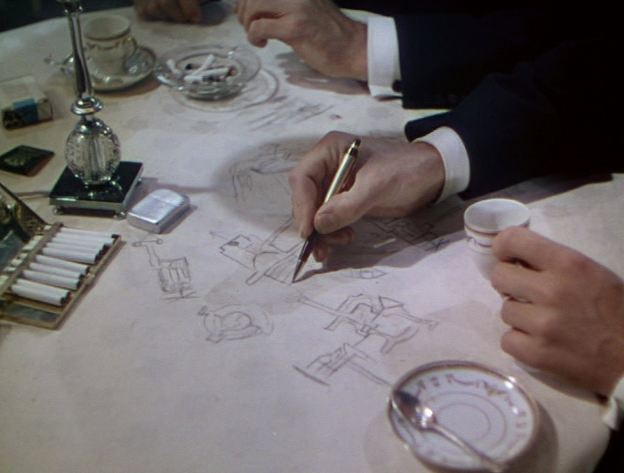
MacMurray and Flynn ignore their dates Alexis Smith and Ann Doran. They are instead preoccupied with a new idea for a pressurized suit to wear in an airplane, something like what a deep-sea diver would wear. They draw plans on the tablecloth. They smoke.
In a way it reminds me of the movie
Apollo 13 (1995) where the crisis of the space capsule being unable to return to earth must be solved by the men on the ground with very rudimentary methods. All solutions begin in the human mind.
And by drawing on the tablecloth. And playing with Alexis’ lipstick.
Errol and Fred are really excited about the lipstick screw function. More male bonding. Not usually done over lipstick, but I like to think I’m open-minded.
The lipstick is a very pretty shade of red.
Both Flynn and MacMurray take to the air in some very scary dive sequences. Fred MacMurray eventually succumbs to pilot fatigue and he is grounded. He is consoled in what is one of the few foreshadowing moments of our involvement in the war, “Kind of tough to be yanked out of a ring when the main event may be about to start.”
But, one more test must be performed before their invention can be approved. MacMurray takes it on himself to fly the test.
MacMurray performs his test successfully, but crash lands and is killed. (Yeah, spoiler-schmoiler.) In the final scene we see Errol Flynn flying off to join a squadron with the Pacific Fleet. We know he is going to Pearl Harbor, and we know what will happen there. It is with poignancy and sadness that we realize he does not.
In tribute to his pal, he drops MacMurray’s gold cigarette case, which he retrieved from the crash, into the ocean, tossing it out of the cockpit of his airplane.
The last shot of the squadron flying towards the rays of the sun is brilliant enough to make you want to shield your own eyes.
Who says macho can’t be pretty?
*********