IMPRISON TRAITOR, PEDOPHILE, AND CONVICTED FELON TRUMP.
Showing posts with label Herbert Marshall. Show all posts

Thursday, November 6, 2025

If You Could Only Cook - 1935


If You Could Only Cook (1935) is another Depression-era screwball comedy that uses the Great Depression as a springboard to humor. It also serves as a backdrop to contrast the silliness with the bleak realities of everyday life that presented challenges and provided plots.


Like Mr. Deeds Goes to Town (1935), a movie of the same year that we discussed recently here, this movie also features star Jean Arthur and brings along favorite gravely-voiced tough guy Lionel Stander in a supporting role.  He is one of the few clear-eyed and sensible people in this movie who wears his cynicism like a shield.  Everybody puts up defenses in the Great Depression, and some have more survival skills than others.

On the other end of the spectrum of cynicism is Frieda Inescort in a brief role as the bluenose fiancée of Herbert Marshall, who slyly seems to drive him to the altar in the manner of closing a business deal.  She has social standing in a respected old family that has, through generations, lost its fortune.  Marshall is new money, an automotive engineer who owns his own car manufacturing company.  She and her former debutante friends see it as the perfect match.


The movie opens on their wedding rehearsal in the family mansion, their friends and attendants, like Miss Inescort, just going through the motions of what a real, meaningful wedding celebration should be.  When Herbert Marshall leaves after the rehearsal to return back to work and a board meeting at his company, we see that he is not exactly happy.  Though he looks forward to his wedding, a sadness, a sense of dissatisfaction nags at him.  Frieda Inescort neither requires nor wants wooing.  Herbert is a romantic, and would like to have the experience of sentimental romance with a partner who could share life as an adventure. 


He faces disappointment at work, too.  His executive board does not approve of his new, futuristic, and somewhat cartoony designs for a line of autos.   He is told, “This company is in no condition to spend money on wild ideas” for his car designs, because the public has no money to spend on the cars.

Herbert’s response is a bit of fiscal cheerleading: “This country’s on its feet again, and soon it’ll be spending as it never did before.”

By 1935, the year of this film’s release, the policies of President Franklin D. Roosevelt did reduce unemployment since he took office in 1933 (and would continue to drift downward as the decade ended) but we were a long way from spending as we never did before.  When it comes to survival tactics, Mr. Marshall's character survives the gloom by being naively optimistic.


But fed up with his frustrations at his company, as well as in his personal life, he goes to a park as a brief respite, an afternoon’s escape to brood.  It turns into the kind of adventure he would have liked to have with his fiancée, Frieda Inescort.  Instead, he is a far luckier man; he discovers Jean Arthur.

She is on the bench he has chosen to sit upon and brood, reading the want ads in a newspaper, her suitcase by her side.  She’s down to her last nickel and has lost her digs.  But her survival skill is grit, determination, and belief in herself.  By his presence in the park in the middle of the day and perhaps by his dejected demeanor, she assumes he is also out of a job.

“Jobs are hard to find, aren’t they?” she remarks sympathetically and offers him the “help wanted-male” section.  “It’s tough these days.  About 200 people for every position.”  Not unlike today.

We are given to understand she is used to office work, but she comments, perusing the servant positions, that “the only good ones are for couples,” a cook and butler, fetching $175 per month.  “That’s real money.”

Mr. Marshall, amused, responds, echoing the title, “Now if you could only cook.”

She admits to being a good cook, having kept house for her widowed father since she was a girl.  Then a light dawns and she suggests they apply for the job together as a cook and butler.


Here we have a switch in the usual screwball scenario: she is the practical schemer, and he is the “madcap heiress,” persuaded to go along on a ridiculous romp.  It’s a fun premise, and since one never takes fairy tales or screwball comedies seriously, we do not wonder why, since he’s rich, he just doesn’t find her a job in his corporation.  He clearly takes an interest in her and wants to help her, but with very human self-interest, he sees this as a final escapade before resigning himself to the seemingly inevitable world of a dull marriage and an unfulfilling career.


Their prospective new employer is a gangster and former bootlegger played by Leo Carrillo, who fancies himself a gourmand and is especially pleased with Jean Arthur’s demonstration of merely holding a clove of garlic over a pan of sauce to infuse its flavor (I want to think she was putting him on, but again, one should never look for sense in a screwball comedy). 

Lionel Stander is Carrillo’s right-hand man, who vets all employees and anyone ever trying to get close to his boss.  He is shrewd and will soon suspect the new butler and cook are not what they seem.  Carrillo, for all his dangerous authority, is as grandiose as a character in an opera, flighty, passionate, and with the kind of zest for life we sense Herbert Marshall would like to have.

The “couple” is shown to their new digs—a room over the garage.  It has one double bed.


Mr. Marshall will take a daybed couch out on the porch, assuring her with good humor that she does not need to worry about being unable to lock the door.  When Jean retires that night to the double bed, he climbs down the trellis and heads back to his apartment to get clothes and to get a few lessons in how to be a butler from his own butler, played by Romaine Callendar.  Callendar, from an old English acting family, did a lot of stage work, and this was his first film since a couple of silents in 1918.  He frequently played butlers.

Bess Flowers, our favorite uncredited extra, can be spotted at the wedding rehearsal.

Romaine Callendar teaches Herbert Marshall to greet people at the door.  The wedding is a week away.  Herbert has one week of fun left.


Soon, the lark turns complicated, as both begin to experience possessive feelings for one another, if not love.  She is annoyed and complaining when she discovers he has been out all night, and dismisses his excuse of returning for his clothes, as if he is a wayward husband caught carousing.  When Leo Carrillo, who begins to fancy Jean, puts his amorous moves on her, Herbert gets angry, warning Carrillo off, defending his “wife.”

And bloodhound Lionel Stander, discovering their separate sleeping arrangements, does not believe they are married.  But they fight as if they are married.


The experience has woken Herbert Marshall up—he wants more from life than this playful situation, and decides to return to his company at night, take his experimental designs for cars, and start over.  He shows the designs to Jean, and she likes them, taking far more interest in his work than Frieda does.  They are lounging on the double bed with the designs, and he kisses her.  It’s okay, though, both of them still have their feet on the floor.

But Lionel has followed him, and he thinks Marshall has broken into the company to steal the designs.


It’s their day off and they plan to meet for lunch, but Jean says first she has an errand.  She takes his designs to sell to another company, hoping to give Marshall the confidence he needs in his work.  But the company notifies the board of Marshall’s company that Jean has stolen these designs that belong to them.  Poor Jean is nabbed by the cops, but Lionel Stander, who follows pretty much everybody, tells the boss that Jean is being interrogated, whereupon Leo Carrillo sends his boys to get her out.

Neither Lionel nor Jean thinks, at this point, that the designs are really Herbert’s, because he has used a fake name, and they think he has stolen the designs.

Leo Carrillo criticizes Jean for being so naïve.  “How did you happen to fall for it?”

She replies helplessly, “The Depression.”

Stander adds, incredulously, “I’ve heard of a lot of things blamed on the Depression.”  The Depression, like Bess Flowers, always gets a bit part in 1930s screwball comedies.

When they discover that Herbert is the famous car manufacturer, Jean is angry and humiliated, thinking he was just “slumming” at her expense, and Leo Carrillo helpfully says he has arranged a hit on him.

Jean is aghast and asks him to call it off, because…ready?  She loves him.


Herbert, without much enthusiasm, has shown up in a morning suit (or should that be "mourning"?) for his nuptials, and Leo, who has become protective of Jean, sends his boys into the middle of the ceremony to kidnap Herbert.  He’s not unwilling to go, but holding the wedding party and guests at gunpoint is pretty funny.


The mob brings Herbert back to Jean, who is still mad at him, but the gangsters trick Jean into revealing her true feelings by pretending to shoot Herbert. 

“Darling!” she sobs in his arms.

If it’s an odd way to find romance, well, blame it on the Depression.

 *******************************


My new non-fiction book, CHILDREN'S WARTIME ADVENTURE NOVELS - The Silent Generation's Vicarious Experience of World War II -- is now available in eBook here at Barnes & Noble, Apple, Kobo, and a wide variety of other online shops.

Or here from my Shopify store if you want to buy direct from me and avoid the big companies.

And it is here in eBook, paperback print, and hardcover, from Amazon.

It is also here in paperback from Ingram.

And here in hardcover from Ingram.

From Cherry Ames, to Meet the Malones, from Dave Dawson to Kitty Carter - Canteen Girl, the Silent Generation spent their childhood immersed in geopolitical events through the prism of their middle grade and young adult books.  From the home front to the battlefield, these books are a window on their world, and influenced their hard-working, conformity-loving generation. 


Thursday, December 7, 2017

The Aviatrix - Part 2 - Wings and the Woman, and Flight for Freedom


The devil-may-care aviatrix of the 1920s and 1930s became a serious and somehow less fancy free figure in the 1940s. Wartime was not the arena for setting records, but in another sense the aviatrix seemed to have had her wings clipped in this new era where the great flyers were aces, and were in uniform, and were men. Though women pilots did help in terms of ferrying planes and pulling targets, they were not allowed in the combat air forces of the Army or Navy. The line was drawn between the genders in aviation that did not exist in the earlier decades of flight.

We continue our series on the aviatrix with two films from the 1940s: Wings and the Woman (1942), and Flight for Freedom (1943). They both illustrate a more self-conscious female pilot than in the first two films we discussed in last week’s post: Tail Spin,and Women in the Wind, both from1939. The wartime aviatrix was back to fighting the battle of the sexes.


Wings of the Woman was a British film (released in the U.K. as They Flew Alone) about the real-life Amy Johnson, who was a heroine in a British Empire that marveled over her skill and daring, and followed her exploits over their empire on which the sun, at least at that time, never set. She was the first woman to fly solo to Australia from London, and also the first to fly to Cape Town, South Africa.


Anna Neagle plays Amy Johnson in a really luminous performance. The film begins when Amy rebels as a teenager at her school uniform, particularly over the nineteenth century straw boater which she and the other girls must wear. She stomps on hers and manages to switch the rest of the class to the more modern straw Panama hat. It is from this incident that the introductory narration remarks: “And to all the Amy Johnsons of today, who have fought and won the battle of the straw hat - who have driven through centuries of convention - who have abandoned the slogan 'safety first' in their fight for freedom from fear - from want - from persecution - we dedicate this film.”

The film lauds her independence and her drive. As a young woman she attains college degrees, applies herself in different office jobs, but it is not until she begins her hobby of learning to fly where she feels the most satisfaction and the greatest sense of purpose for her intelligence and her energy. In the 1930s her exploits captivated the British public and she became famous. In close-ups of her perched in the cockpit the film becomes an intimate examination of not only her motives but of the great sense of freedom she feels while she is flying. One particular scene, where after several hours of exhaustion and despair, she finally sights her goal of reaching northern Australia, the relief and ecstasy on her face are more eloquent than any explanations of why would a young woman want to put herself through such a dangerous test.

The film explores in a more introspective way a woman’s need to excel and to feel the freedom of pursuing her own dreams, as well as the unusual freedom of just being alone. (Indeed, in the two films we discussed last week from 1939, there was a camaraderie in a community of female flyers; but in the two wartime films in this post, the ladies are truly solo, without the support of other women.) In the first two films that we discussed last week, which were more lighthearted and less introspective, we do not examine the women’s motives for being pilots. This may result in a less satisfying story; however there is, ironically, a greater sense of freedom and self command displayed in those earlier two movies by the women who never needed to be examined for their motives, never needed to explain why they were doing what they were doing, and never needed validation. They were just pilots, and that was jake with the men around them. In a sense, it was not a story about men and women; there were only pilots and non-pilots.


But the two movies we discuss today drag us back into the dismal realm of the battle of the sexes. Wings of the Woman handles it a bit more deftly. Anna Neagle meets Robert Newton, who plays the real-life husband of Amy Johnson, Jim Mollison. Like her, he is a headline-grabbing pioneer aviator who likewise has great success in long-distance flying records. They seem to be made for each other, equally understanding of each other’s work and each other’s need to fly. However, Mollison is a bit of a playboy, charming, unreliable, and Amy is not so much jealous as she is independent to the degree of being able to jettison Mollison from her life like so much overweight cargo. In an interesting scene, when she catches him in a dalliance, instead of bawling him out like a fishwife, she determines to set a new world record beating his old one, just because she can. Because Mollison is a flyer, he is far more chastised than if she had hit them with a frying pan. Eventually, however, they both realize it is not working, and they divorce. Amy Johnson never takes her married name, at least not in this movie, and in real life Amy Johnson did revert back to her maiden name after her divorce legally.


At one point, they decide to pursue a record together and they fly a plane from London to New York, where the headwinds are much more difficult to fly against going from east to west, but just before they reach their destination, the plane runs out of gas. It’s an eerie scene when we no longer hear the motor running and Mollison, whose turn it is at the controls, must fly the plane like a glider as they search the ground below for some place to land. They do crash, and though both are injured, they both survive the incident, which happened in Stratford, Connecticut. They are eventually brought to New York and receive a tickertape parade.


The years go by, and when war comes, Amy decides to volunteer for the Air Transport Auxiliary. The women are not allowed to fly planes in combat, but they are allowed to ferry planes across the Channel to Europe and to other spots on the globe where they are needed. Jim Mollison has volunteered as well for this duty, and in the movie Amy and Jim meet one last time, both in uniform, and shake hands, ruefully musing at their paths in life and how they have come to this same mission. As she goes to her plane, he watches her enter and she takes one last look back. It is a foreshadowing, and even if we did not know the true story of Amy Johnson, we kind of know what’s going to happen next.

Over the Channel, Amy’s plane goes down, and we see her parachute into the dark, cold waters below. The real-life event happened January 5, 1941. Amy’s body was never recovered. She was 37 years old. The movie ends, poignantly, with a shot of the interior of the plane with its open door from which Amy has jumped. On the floor of the plane lies her military cap. This is a nod to her war of the straw boater at the beginning of the film. It is a new hat, a uniform hat, signifying honor, purpose, and dignity, and service to King and Country. But like her balking at wearing the straw boater—there is no individuality allowed in a military uniform.


Our final movie, Flight for Freedom, was released the year after, in 1943. There are some similarities to Wings of the Woman: this film, though the character is fictional, is purportedly based loosely on the final flight of America’s most famous aviatrix, Amelia Earhart; this film also features a romance with a male pilot; and this film also ends with the mysterious loss of the flyer over the ocean in a wartime world where her skills are useful, but she is still fighting the battle of the sexes.

Rosalind Russell plays the fictional Tonie Carter, who learns to fly under the tutelage of Herbert Marshall. He is a designer of aircraft in the early 1930s with dreams of establishing his own company. Fred MacMurray is a hotshot pilot, a brash playboy with no use for women flyers. He remarks, “Women ought to stick to what they were made for.” He is especially disdainful of women pilots because they steal headlines and he thinks the only reason they fly is to get their names in the paper. “I just don’t like women who try to be men.”

Eventually, they do begin a romance, on-again/off-again, because they are hardly ever in the same spot at once, but it is an unsatisfying if typical movie scenario:  We don’t really know why Rosalind Russell is attracted to Fred MacMurray; he’s really quite rude and obnoxious. I suppose the writers have thrown in her slavish attraction to a “man’s man” merely to prove that, despite the grease and dirt on her mechanic’s coveralls, she still a “real” woman.


Another person who at first disparages her is the restaurant owner of the private club where all the pilots hang out.  He is played by Eduardo Cianelli, though eventually he comes around when she becomes famous and he deeply admires her, welcoming her into the boys’ only club and giving her a small brass hook on his wall with a plaque with her name on it to hang her hat just like all the guys have.

But Roz is human and makes mistakes – not just about Fred MacMurray. In a flight from New York to Los Angeles she tries to fly very high above stormy weather to pick up some speed but in this era of unpressurized cabins, the high altitude makes her drowsy and she nearly crashes. Eventually, she makes the trip from L.A. to New York in 12 hours of straight flying and breaks a record. A lady reporter yells, “You got a boyfriend? What’s his name?” Of all the films we’ve discussed on the aviatrix, this one unfortunately is rife with sexism and it’s a shame to see Rosalind Russell play the poor sap, when we have seen her as the magnificent Hildy Johnson only a few years earlier. But it’s wartime now and the men are heroes, and the women are not supposed to compete.


The climax of the movie comes as Roz attempts to break a new flying record of circumnavigating the globe at the equator. On her first attempt when she lands in Honolulu for refueling, she receives a telegram from the Navy Department asking her to return as quickly as possible to Washington, D.C., because – well, it’s a secret. In the same way she never questions her undeserved devotion for Fred MacMurray, she never questions the order of the Navy Department.  She crashes her plane on purpose so that she doesn’t have to continue her record-breaking flight, and heads for D.C. Here she is told that the government wants her to try her flight around the world again, but to fly in the other direction toward the east so that the Pacific islands are the last leg of her journey. When she reaches a particular area of Japanese mandate islands, they want her to ditch her plane. She will land on an island where they have already stored food and provisions for her and, in time, a Navy ship will pick her up and bring her home. The reason for this is they want to attach cameras to her plane and film the Japanese mandate islands because they want to know where they are building airstrips. We have not yet entered the war at this point, but war is coming and the United States wants military intelligence without breaking any rules, tipping their hand, or ruffling any feathers. Roz agrees.

Just before this, Herbert Marshall, her longtime mentor and plane designer, has proposed marriage. His proposal is so sweet and awkward and we (or me, at least) rejoice at his being the better partner and a far more interesting man with whom to spend her life than the self-involved, if handsome, Fred MacMurray. Because she is on the outs with Fred, she accepts Herbert, but she tells him she must do her flight around the world first, and when she comes home, she will marry him.

The opening credits of the movie are placed over a vast map of the Pacific. When Roz meets the Navy officer who gives her instructions on her mission, they stand in a briefing room on which on one wall there is likewise a huge map of the Pacific. It is a good illustration because it dwarfs the people in the scene and it shows not merely how large a  body of water that is, but how little we know about it. Most of our armed forces, once we got into the war, were island hopping all across the Pacific somewhat blindly: many of those islands were really uncharted.


At this point, the movie intersects, or at least flirts with, the real-life ending of Amelia Earhart, possibly the most famous aviatrix of the 1930s. Her final flight in 1937 was an intention to circumnavigate the globe. She was lost and the mystery surrounding that event continues today, reviving the story in theories, controversies, and suspicions of conspiracies. One theory holds that she was captured by the Japanese army. Only this year that idea was floated again, and again dismissed. Possibly that theory was put forth first by this movie, Flight for Freedom, in which Rosalind Russell lands in New Guinea preparing for her final leg of her trip. She is to meet a navigator who will help her with the crucial filming and gathering intelligence over the Japanese mandate islands before they are to ditch the plane and hide out on that pinpoint in the Pacific until the Navy can retrieve them and the film. In a striking scene, again, a foreshadowing like in the last flight of Wings and Woman, Roz takes off from D.C., and Herbert Marshall bids her goodbye at the hangar.  We do not see her take off; instead, we have a view of Marshall standing alone, intently watching us as we pull away from him, leaving him smaller and smaller.  We hear the plane engine, but it is our view of his aloneness that foreshadows he is losing her forever.

She flies to the Pacific and meets her contact in a Polynesian wayside inn. The palm trees sway and the moon shines over the exotic island.

It’s Fred MacMurray.

They renew their passion for each other, and she forgets all about Herbert. Their postwar plans have Fred continuing to fly all over the world, but Roz will stay home with the kids.  But going back to the hotel desk to get her key from the sinister Japanese desk clerk, he tells her with snide confidence that he knows who she is, who Fred MacMurray is, what their mission is, and they will never succeed. They know all about the plans.

Roz goes back to Fred, but instead of telling him straight out that the jig is up, she asks him what he would do if he was flying alone and he knew the mission had been compromised, if there was no hope for his survival. He says cavalierly, and quite hypothetically, he thinks, that he would just keep flying until the plane ran out of gas.

She decides to do that. She takes off in the plane alone, sparing Fred’s life, and flies off into the vast sky over the Pacific Ocean. In a reprise of the early scene where she had tried to break a record and flew too high, making herself drowsy and nearly crashing, she decides that she will take this comfortable way out and she aims the plane straight for the heavens. The higher she goes, the less oxygen she has and she begins to fall asleep.

In these two movies, in which both our heroines meet their ends crashing their planes into the ocean, we know that their self-sacrifice is a common self-flagellation element to the wartime propaganda films. The women become symbols more than people, although we get to know Amy Johnson’s motives a little bit better than we do the fictional Tonie Carter. In the first two movies, Tail Spin and Women of the Wind, those women flyers faced sudden death in crashes pursuing records and shrugged it off with a kind of pragmatism that was almost heartless; the wartime films seek to demonstrate that their deaths are not without meaning, and that sacrifice is noble, and required—including, for Roz, the sacrifice of a career when the war is over.

These two women seem to have a yoke on their shoulders that the early 1930s aviatrix did not. Life has become very complicated, and not just because the planes have become more complicated.


***

Have a look at the career of real-life aviatrix Maude Tait, a record-breaking flyer who beat Amelia Earhart’s record, a lady from my hometown – over at my New England Travels blog.

Thursday, January 21, 2016

Let Them Eat Cake

Hollywood in the studio era has left us a few thousand bushels of images of its stars, both on and off the set.  One of the most recurring images, which always amuses me, is of stars eating cake.  Usually on set.  Often on somebody's birthday.  Above, Charles Boyer, Ann Blyth, and Jessica Tandy take a break from A Woman's Vengeance (1948 - discussed in this previous post) and in my book, Ann Blyth: Actress. Singer. Star.  The occasion is Ann's nineteenth birthday.

 
Both Debbie Reynolds and Jane Powell shared an April 1st birthday.  I wouldn't guess they always spent it together, but on this day it saved MGM from having to buy two cakes.

 
Clark Gable, Greer Garson, Joan Blondell, Lina Romay and director Victor Fleming on the set of Adventure (1946 -"Gable's Back and Garson's Got Him!" - you knew that was coming, didn't you?)  It appears to be Joan's birthday on this one, and she's actually got two cakes there, unlike the unfortunate Debbie and Jane, who had to share one.
Joan Crawford wields a sense of humor and an ax on a cake wishing her luck on her latest film Strait-Jacket (1964).  Back in the day, they had cake to celebrate the start of filming, the end of filming, and probably the middle of filming.   
 

Katharine Hepburn, as skinny as she was, clearly made cake a staple of her diet. Here she is riveted on director Vincente Minnelli's birthday cake, wishing he would hurry up and cut it. Robert Taylor lines up for his piece.  This is the set of Undercurrent (1946).  Something about birthday cake sort of unravels the mystique of Film Noir, doesn't it?
Myrna Loy with an enormous cake.  Beats the heck out of me what the occasion was, but it's clear all these people ever did was eat cake.  They did not work very much at all.  They just showed up to the studio every day for cake.

"I'm ready for my close-up"? -- No-o-o.  It was, "I want the piece with the flower on it."

 
Barbara Stanwyck, Eric Blore, Herbert Marshall, probably on the set of Breakfast for Two (1937).  Another hard day at the salt mine.  Pass the dessert plates.
 
"Quiet on the set!" they'd yell, "We're trying to eat our cake!"

Thursday, August 15, 2013

Crack-up - 1946


Crack-up (1946) takes us to the art world, not usually the sphere of film noir, but this brooding little mystery is unabashed in its take on salons of high culture and waterfront thugs.  Especially appealing is abating this quirkiness by casting veteran priest-coach-boring nice guy Pat O’Brien as the hero.  Pat was 47 when this picture was made, seems a bit long in the tooth for some of the stunts he (or rather his stunt double) is required to do, but his brand of sly, knowing maturity is particularly suitable for this protagonist who must solve the mystery with his brains and his expansive knowledge of art.
I also like that the plot hinges on a phone call he gets regarding his ailing mother, and how he rushes to see her in the hospital.  Real men worry about Mom.
Since this is a mystery, I’ll try to side step the spoilers, but there are some interesting scenes that push the plot along for their atmosphere.  First, we have the pulsating theme music over the opening credits and sounds like the rhythmic pounding of train wheels. A train figures prominently in the mystery.  Look at the lettering on the title.  Just that tells you we’re in for real noir.  Them’s real noir fonts.

We begin with Pat O’Brien in a crazed fit, smashing his fist through the glass doors of a New York City museum, tangling with a cop—in a hall of marble statues where a broken figure of a nude male topples to the floor and smashes—there’s a little artistic symbolism for you.  Pat passes out, psychotic or drunk, we don’t know.  Pat works at the museum.  The museum administrators, in a late meeting, are shocked and try to hush the matter up when detective Wallace Ford wants to haul him in.
Good old Wallace Ford.  He deserves a post of his own someday, for many reasons.
Ray Collins is a doctor on the board of the museum, the voice reason in this mess.
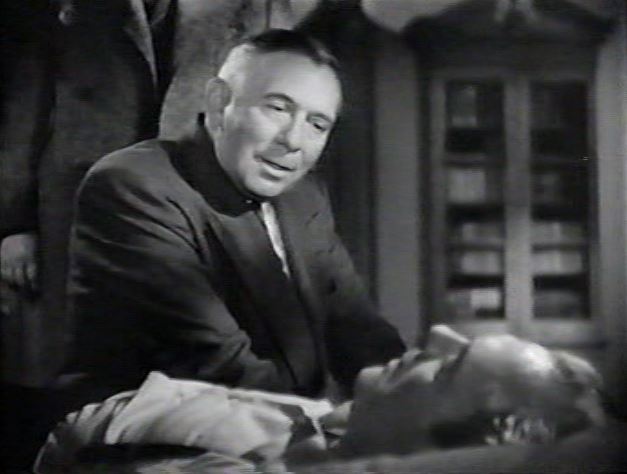
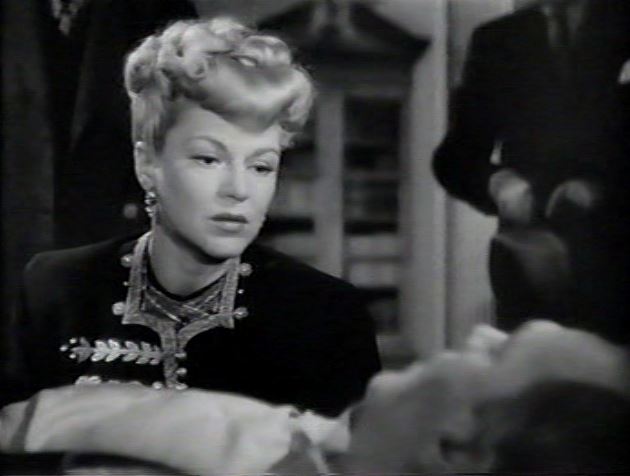
Claire Trevor is a society dame and magazine writer who appears in a different outfit and a different hairdo every time we see her.  She sparkles, but she’s a regular dame.  We gather she and Pat were an item once, and he’s still interested enough in her to be jealous and sarcastic of any man who takes her to dinner, like Herbert Marshall. 
Our old favorite Mr. Marshall is typically elegant and eloquent here as an international man of mystery.  We don’t really find out who he is or what his game is until nearly the end of the movie.  Mr. O’Brien does not disguise his distrust and disdain for him.
Pat is a docent at the museum and gives lectures on art.  (How many cool film noir guys do that?)  We are told that the museum curators regard Mr. O’Brien as revolutionary—in their eyes not a good thing—and that if it weren’t for his service record, they might have sacked him long ago.
This being film noir, nine times out of ten, the protagonist is a war vet trying to adjust to this weird new world he’s come home to but doesn’t recognize.  Especially interesting is that later we get some background on O’Brien’s war record—he worked for the Allied Reparations Committee investigating the Nazi theft of precious works of art. 
We trace Pat O’Brien’s psychotic disturbance to a train wreck he claims he was just in, though there are no reports coming to Wallace Ford that a train wreck has occurred.
Now we go to the requisite flashback as Ray Collins asks Pat to tell them what he remembers happened to him today.
We pick up from Pat’s docent job and his lecture, and the call about his mother.  When Pat rushes to the train station to start his frantic journey to see his mother in the hospital, we follow him pretty much step-by-step—the ticket line, the empty commuter car filling with nighttime stragglers getting off work late, a sarcastic butcher boy selling fruit, magazines and cigarettes.  There’s a guy half-dragging his buddy who appears to have had a little too much to drink.
The train car is already a place of tension because of Pat’s anxiety about his mother and trying to reach her as soon as possible.  He glances with impatience at the people around him, not studying them with interest, but as if they are adding to his annoyance and tension.  We hear the omnipresent sound of the train wheels, which seem to grow louder.  Pat seems to grow acutely aware of all the sounds and images around him, and so we, too, focus on these sensations.
He looks out the moisture-tinged train window, and sees in the distance, around a kind a bend in the track, a beam of light.  To his horror and ours, it appears to be another train on the same track.  Look at Pat’s frozen expression as he’s mesmerized by the sight, a sense of unavoidable doom.  Suddenly, the train whips around the bend and heads right toward us.  The flash of light splashes across his train window, and we hear screams.


Then the flashback ends and we are back in the present.  He is physically and mentally exhausted.
He is told by Wallace Ford that his mother is fine.  She was never in the hospital.  There was no train wreck.  They all think Pat is cracking up, and his clothing reeks of alcohol.
Poor Pat, baffled and shaken, and doubting his own sanity, is released by Ford for the time being, but the museum fires him.  You can’t have a loony giving lectures on Salvador Dali in the gallery.  Pat fears he really is cracking up, like other ex-GIs he’s known.  He confesses, “It’s the one fear everybody had.
Claire Trevor and her apparent new beau, Herbert Marshall, take Pat back to his apartment.  It’s all messed up, as if somebody has overturned everything looking for something.  We also see Pat is being tailed.
Pat, scared, but wanting to get to the bottom of this, even if it means he proves he’s a nut, tries to retrace his steps according to what scraps he can remember.
He goes to the train station, rides the same train, tries to track down the same butcher boy or others who might remember seeing him.  Nobody saw him, nobody remembers him.  We are filled with the same sense of tension as before, afraid another “wreck” will happen.  Just at the pivotal moment, that train that looks as if it’s on the same tracks comes barreling at us again, and Pat is panicked.  Then-whoosh!  It passes by.  It was a double track.  The conductor calls out the name of the next stop.
Aha.  Pat realizes this was the moment something must have happened to him.  He gets off at that stop, and the station master in this tiny, empty depot remembers him from the night before, as a drunk guy being dragged off the train and into a car.
Now he knows he’s not crazy, but he’s in somebody’s way.  Mr. O’Brien is mad and on the hunt.
A murder occurs meanwhile, and he’s implicated, and Wallace Ford is after him, so Pat takes it on the lam.  We are taken to a penny arcade where he meets up with Claire Trevor trying to help him hide.  It’s a neat setting, showing what typical urban penny arcades were like in the day, a place for grownups and not kids—see the “No Minors” sign—because there’s nickelodeon peep shows and stuff.
 
Pat slugs people.  He x-rays masterpieces.  He appeals to the mousy secretary of his museum boss to help him investigate a forgery connection to the museum.  Even Mary Ware, played by Mary Ware, is not what she seems.
We go to a cocktail party, end up at a rusty freighter at the wharf, where Pat saves a valuable canvas from a fire.  Ultimately, we have a showdown between Pat and the mastermind of the mysterious gang, and we discover the reason for his psychotic episode at the beginning of the film.  It might seem like a slightly goofball ending after all that noir atmosphere, but it’s a fun movie, especially for being offbeat.  Keep an eye out for Ellen Corby as a maid.
But, especially keep your eye on the graying middle-aged action hero with the knowledge of art history, a devotion to his mom, and a growing paunch at his belly.  Pat O’Brien was lucky to get the part with so many younger pretty boys in Hollywood, but none of them would probably be as interesting.  He earned it, because he gives it not so much an “edge” as a burnished shine. 
 
Besides, film noir protagonists are supposed to be world-weary and haunted—and who is more tired and cynical, and has as deep a back story as a middle-aged man?
As we discussed in last week’s Adventure in Manhattan, also about art theft, the surprise mystery or what we do not expect from a film doesn’t have to be a shocking plot device.  It can just be a little quirk that sticks out and fools us—and intrigues us.
 
***
 
Here's a preview of the cover of Dismount and Murder - number three in my cozy mystery series.  The book will likely come out in November, and I'll post more about that in weeks to come.  The artwork here is by the amazing Casey Koester, the Noir Girl.


Related Products