IMPRISON TRAITOR, PEDOPHILE, AND CONVICTED FELON TRUMP.
Showing posts with label Helmut Dantine. Show all posts

Sunday, October 28, 2018

Long Live Democracy - Casablanca (1942)


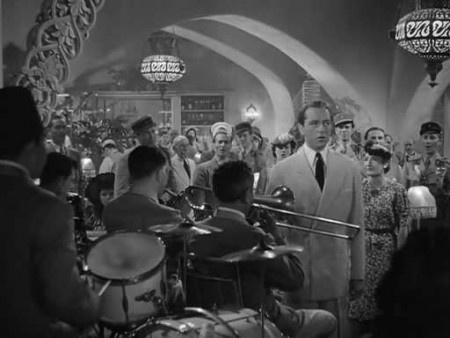
A pivotal moment in the film Casablanca (1942) occurs when Major Strasser and the other Nazis are drowned out in their singing of “Die Wacht am Rhein” by everybody else in the café singing “La Marseillaise.” It is a stirring scene, and one that never fails to bring some of us to tears. It has been reported that the much of cast in that scene were brought to tears as well. In one of those almost supernatural moments when art really does reflect life, the desperate European refugees in the café were played by actors who actually were European refugees. It is a spine-tingling moment of reality in an otherwise not very realistic film.

We revisit Rick’s Café Americain with the bulk of this essay having been previously posted on this blog in 2007, the first year of Another Old Movie Blog.  A great deal has changed in the world since then, though the most comforting aspect of our love of classic films is that the world we explore in them never changes.  We can visit a place and time and it is ever the same, and ever fresh.

Casablanca has become larger than life for us, a film whose reputation has grown with the decades. It will likely always be a favorite for its witty dialogue, its charismatic actors, and its fast-paced plot. It has the irresistible veneer of glamour in an otherwise dark and frightening time.

But, even those of us who love the film cannot overlook the fact that Victor Laszlo and Ilsa Lund would not have played a cat-and-mouse game of hidden threats over cocktails with Nazi officers in French-occupied Africa. The Nazis would have taken both of them into custody the moment they arrived in Casablanca, tortured them, and filmed their corpses with newsreel cameras. The movie would have been over in ten minutes. No cocktails, no white dinner jackets, no game of hide and seek with omnipotent “papers” that will set them free.

In this respect, Casablanca could be called an escapist film, because it gives us heroism and hope, redemption, a fairy tale of intrigue. The most fanciful scene in the movie, carrying this fairy tale along, is the scene with “La Marseillaise” trumping “Die Wacht am Rhein.”

And in that same scene, ironically, we see the real truth of the film, not always recognized, but there. S.Z. Sakall, who plays Carl, fled Hungary in 1939. His three sisters didn’t make it and died in a concentration camp, along with other relatives.

Madeleine LeBeau, pictured above, who played Yvonne, who pines for Rick and who is fought over by the Nazi soldier and the French soldier; and her then real-life husband Marcel Dalio, who played Emil, the gambling room croupier, both escaped from Nazi-occupied France through Lisbon, just as in the film. Reportedly, the visas they obtained for Chile were forgeries, but they managed to arrive in the U.S. through hastily arranged temporary Canadian passports.

Curt Bois, who played the pickpocket, fled Germany in the early 1930s. Helmut Dantine, who played the young Bulgarian man losing at the gambling tables, whose wife beseeches Rick to help them, fled Austria. Dantine was an Austrian who was put into a concentration camp after the Anschluss. He was arrested for leading an anti-Nazi youth movement. He was then nineteen years old.

Mr. Leuchtag, who practices his English by asking his wife the time, “What watch?” was played by Ludwig Stössel, another Austrian who fled after the Anschluss.

Ilka Grünig, who played Mrs. Leuchtag and replies “Ten watch,” escaped Germany in the early 1930s after the Nazis came to power.

Even the Nazis were played by actors who escaped real Nazis. Richard Ryen, who played Colonel Heinze, was a Hungarian-born actor who was actually expelled by the Nazis from Germany. Hans Twardowski, who played the Nazi officer who fights with the French soldier over Yvonne, fled Germany in the early 1930s.

Even Major Strasser, played by Conrad Veidt, escaped the SS, who pursued him for anti-Nazi activities, and he fled to England where he became a British citizen and supported Britain’s war effort with his salary.

There were actually very few American-born actors in the cast of Casablanca and not all of the rest were refugees, but a good many of them were. This gives the film a legitimacy that certain fanciful elements of the script did not.

When you watch the “La Marseillaise” scene, think of the refugee actors with genuine tears in their eyes, and remember that the Nazi regime had not yet been defeated at the time this film was made. It was not known then if they would be.

It was certainly never imagined that we’d be fighting them in our own country in the next century.  This is why we must vote on Tuesday.  At the very end of the “La Marseillaise” clip, Madeline LeBeau shouts, “Vive la démocratie,” and it is almost drowned out by the jubilant crowd triumphing over the smug, cruel Nazis in a nightclub songfest.  But it’s there, and it’s the whole point of the song.  

Vote for every Democrat on the ballot next Tuesday, in all local, county, and national categories.  Voting is no longer an expression of political opinion in this country; it's a chess game.  The politicians know that, and so do the pundits.  The voter has yet to realize how we are being played, and we must use our vote -- while we still have it -- to block the machinations of our impending doom.  Halting the progress of a corrupt and vile administration that now controls the executive branch, both legislative houses, and the Supreme Court can only be done now by making the Republican Party, which has ceased to be the Republican Party, fear more for their jobs than they fear the evidently powerful influence of a shameless grifter, the NRA, and the Russians from whom they have accepted bribes, and indeed, several corrupt members of their party, whom they’ve chosen to embrace and blindly support in the unholy name of holding power.  


When I think of the “La Marseillaise” scene in Casablanca, I also think of my father, who, still in his early twenties, left his wife and baby and fought in the South Pacific during World War II for over three long years.  No furloughs, no coming home until it was over.  When I was young, we watched Casablanca together, and he surprised me by belting out the French national anthem during this scene in his powerful, resonant bass voice.  He really had a very good voice, sounding a lot like Tennessee Ernie Ford only with a New England accent, but we used to tease him because he could not remember the words to anything. But like an automaton, he launched into “La Marseillaise” without any effort, and I think he even surprised himself that he remembered it.  

He explained, in that somewhat reluctant way all men of his generation did when talking about the war, that when he was stationed for a bit in that island-hopping campaign on the French colony of New Caledonia, they were required to stand at attention for the raising of the French flag and playing of their anthem in camp, as well as the American.  He also related the mournful tradition of answering roll call in their memory for pals who had just been killed.  The Vichy government was chased off the island and like the struggle in Casablanca, became Free French. Their symbol is on the paper money above, a souvenir my father brought home.

My father and his surviving comrades; and my mother, who was Rosie the Riveter in a war plant making parts for PT boats, thought their job was done on V-J Day.  

I mourn as much for the memory and the inspiration of that generation as I do for the future of this country if we do not remember the lesson that was so easily absorbed in Hollywood films of the 1940s:  The authoritarian fascists were the bad guys.  Frank Capra explained that to us, if we didn’t know already, in Prelude to War (1942).

How many Trump supporters and apologists would root for Bogart, Henreid, and Bergman today?  How many would look at those refugees with loathing that filled the Café Americain?  How many would turn Madeleine LeBeau away at the border today?


We already know from surveys done that many Millennials cannot even name who fought in that war and on which sides.  Right and wrong has become lost, and history, which should be a compass, has become a muddle.

Fans of classic films inevitably adore them for a world that is, among other things, rife with moral clarity.  We have lost that in our society, probably for many reasons, but one of the things I admire most about classic films is the courageous idealism.  It seemed to stream from the directors.  Frank Capra, a conservative Republican such as they used to come in this country, gave us Meet John Doe.  William Wyler, who gave us Mrs. Miniver; and the man who directed Casablanca, Michael Curtiz, were refugees, as was Billy Wilder.  John Ford, like Wyler and Capra, served in the military during World War II.  They had no patience for Nazis.  Ford would have punched them in the face.

Frank Capra & John Ford

The word Nazi is not bandied about carelessly when it is used correctly.  It is the word Republican that has lost its meaning.  The Grand Old Party surrendered and became complicit to survive in a more vicious environment, like the capitulating French Vichy government.  

When you vote on Tuesday, remember that Hitler was elected to office, and that was the last election.  He killed democracy in Germany.  Putin is angling for the same result here  by remote control and he has already lined the pockets of several Republicans to that end.  Unlike the troubled conquered countries in World War II, we will have no one to save us.  We have to do it ourselves.  There have never been higher stakes than this coming election.

Vote Democrat on Tuesday.  If the Republican Party regains its soul in having lost the election, that will be for the benefit of all of us, because nobody, including intelligent Liberals, want a one-party government, even one of Liberal Democrats. We need the vibrancy of differing opinions and perspectives.  

But first, we have to rid ourselves, democratically, of the traitors to our democracy who gerrymander precincts; who scrub voters off the registration lists; who cheat to deny the vote to African Americans, Mexicans, and Hispanics and other minorities; who attack the free press and shout that truth is not the truth, who praise Nazis and even become them. Vote Democrat.

Vive la démocratie.  Long live democracy.


Thursday, September 21, 2017

Screen Magazine February 1943


Olivia de Havilland graces the cover of Screen Guide magazine for February 1943.  Along with the usual star gossip and fan magazine articles, there are interesting insights on how we coped with the war.  Though packed with fluff, these kinds of publications are windows on popular culture and we see that the war is all pervasive.


The letters to the editor includes the complaint, "Why must so many of the new pictures be based on the war?" Working six or seven days a week (we tend to forget the enormous sacrifice of war plant workers), some preferred the lighter fare.  Though this writer mentions wanting more films like Holiday Inn or Yankee Doodle Dandy, which still had their patriotic cheerleading scenes, we need to remember these sentiments when we see something like those frothy Betty Grable or Carmen Miranda Technicolor fantasies.  Escape is very important sometimes.


James Stewart, here a Lieutenant, is given a special tribute.  He was one of Hollywood's first enlistees in the war, and we mentioned his contribution to a patriotic radio broadcast in this post a few weeks ago, also covered by Screen Guide.


The magazine would continually note the growing list of Hollywood's new members of the armed services.  These were the latest batch of recruits.


I like this mention of Helmut Dantine, a minor player then, recognizable in several films.  Though he had a long career in acting, then trying his hand at directing and producing, Dantine never became a major star, or even "one of the biggest male raves the screen has ever seen."   Too bad, but he evidently caught the eye of the public at the time.


It wouldn't be a real World War II-era publication without a plea for buying war bonds. How much do you miss your solider?  Give up the luxuries and buy the war bonds.  At 2.9%, they paid better interest than we get today.

Another blurb shows Linda Darnell with a device that one installs in one's car to keep the highest speed at 35mph.  That saves gas.  Sacrifice can be glamorous.  

Thursday, May 18, 2017

The Pied Piper - 1942


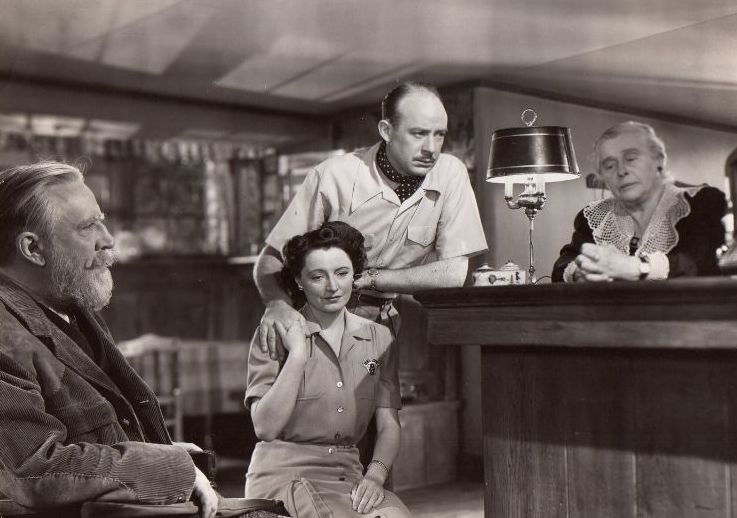
The Pied Piper (1942) strikes a unique balance between a whimsical adventure—and the ghastly horror of being caught in the middle of a war.  In the world of children, however, what can be terrible can also be an adventure, and what can be an adventure can also horrify.  It is sometimes a very fine line, and that is the nature of childhood: that children are both helpless and yet resilient.

This post is part of the Classic Movie Blog Association (CMBA) “Underseen and Underrated Blogathon.” Please wander over and check out the other great participating blogs.


This post is also the first entry in my new series on the depiction of children during World War II.  In the coming weeks, we’ll be discussing On the Sunny Side (1942) with Roddy McDowall, The Search (1948) with Montgomery Clift, Youth Runs Wild (1944) with Bonita Granville, the short subject You, John Jones (1943) with Margaret O’Brien and James Cagney, and two March of Time short documentaries, Youth in Crisis (1943), and Teen-Age Girls (1945). 

Many classic films from that era tend to show children on the periphery of the wartime crisis and not in the middle of it.  For example, Shirley Temple portrays an American home front childhood as only a reflection of the grownups’ world and not even enough to form a subplot in the movies of Since You Went Away (1944) and I’ll Be Seeing You (1944).  With a stable full of glamorous grownup stars like Jennifer Jones, Ginger Rogers, Claudette Colbert, and Joseph Cotten, the worries of Shirley Temple brooding over collecting scrap and experimenting with too much lipstick is not enough to carry a film, and most directors and producers of the day evidently felt there was not much of a market to make films for children about the war, let alone films about children.  Not that there weren’t any, but if the horrors of war were toned down in a censored Hollywood—censored not just by the War Department, but by the Production Code—then the horrors experienced by children during the war were obviously not going to be dramatized in great detail.  We didn’t have much of a stomach for that.

Paradoxically, there were quite a few series chapter books written for kids during the war that brought the tension, the anxiety, and to a degree, the horrors of wartime to an American middle-grade readership.  Such titles include Norma Kent of the WACS, Red Randall at Pearl Harbor, Dave Dawson with  the R.A.F., Nancy Dale Army Nurse, and a few of the early more famous Cherry Ames books.  As I wrote in this previous post on this topic:

There are several elements to these stories which are quite striking.  One is the, in some cases, unsparing description of death and cruelty, and the fatalistic manner in which the tone of these stories seems to indicate the young reader should accept these conditions.  Nancy Dale’s troop ship is torpedoed, and she spends several days in a lifeboat with a handful of other nurses and crew members.  One dies and they dump the body overboard. 

At one point in the story she receives word her brother is missing in action and presumed dead.  A family friend, comforting her, tells her not to hold out much hope of his survival.  “Don’t let wishful thinking keep you from facing reality, my dear.  There’re many things worse than death in this war.”  How would a kid, who had relatives in the war, take this message?

Due to several other projects, my intention to write a book about this subject has been on the back burner for some years, but I hope to resurrect it possibly next year.  If any of you have any suggestions to add to the list of children’s books, I’d be very interested to hear them.

The Pied Piper, unlike most World War II era movies dealing directly with the war, shows us what it is like to be a child during this hellish period in history, but does so in a light and skillfully handled way.  We are purposefully not made uncomfortable, but we are reminded that very young, very helpless victims are suffering beyond our reach to help them, and that should be horror enough for any compassionate person.


Monty Woolley stars as an irascible Englishman on holiday in Switzerland.  He is a widower, and his son, an RAF officer, has recently been killed in the war.  His only other child is a married daughter living in the United States, so he is alone.  He went to Switzerland, he admits, to sulk because having offered his services to British government authorities, hoping to do his bit for the war effort, he was continually turned down because of his age and told by his vicar he could perhaps instead knit for the soldiers.  Disgusted, spitting nails, he took his fishing rods and went to Switzerland.

There at the rustic inn, he is harassed by young Roddy McDowall, a bright boy who, though polite in the conventional English manner, is not shy of adults and speaks to them on an equal footing: he and Monty Woolley have an argument over whether Rochester is a city in the United States or a state.  Mr. Woolley insists it’s a state and takes such umbrage at Master McDowall’s disagreeing with him that he develops resentment near hatred for the boy.  It is very funny.  Nobody can sputter or sarcastically fly off the handle like Monty Woolley, and he does it a lot in this movie.

Peggy Ann Garner is Roddy’s younger sister.  She is better behaved.

However, it is June 1940, the war is heating up, Dunkirk has just happened, and they hear from the BBC that France is likely to fall to the Nazis soon, and England may be invaded.  Woolley decides his place is home in England, to knit if need be, and packs to leave.  The parents of Roddy and Peggy Ann, played by Lester Matthews and Jill Esmond, ask Mr. Woolley to take their children with him back to England, to live with her sister until the war is over.  Matthews is with the League of Nations in Switzerland and must remain at his post, and his wife wants to remain with him.  They fear that Switzerland will be invaded next.  (As it happens, it was not invaded and the kids would have been safer there, but this injected opinion demonstrates the chaos of the war and how little we knew what was happening, and absolutely no clue as to predict how the events would play out.  When we watch these sometimes sentimental war films, we need to remind ourselves that the Allies were losing for much of the war and we really did not know how it would end.)

Monty Woolley is hesitant to take the kids, but he agrees after delicate questions about their ability to tend to their personal needs, and they’re off on a train to the north of France.  However, the train is stopped before they reach the new and ever-changing front lines.  Woolley, still the domineering Englishman on vacation bellows at the French railroad official, “But I have two small children!”

The harried civil servant replies, “At your age, Monsieur, that is undoubtedly magnificent, but if this is a contest, I have nine.”

Roddy, still irritating, however manages to be useful because he has learned French and is able to converse with all and sundry, especially now that they are being treated like cattle on an overcrowded bus to Chartes.  Here on the bus they pick up a new follower: a small French girl, played by Fleurette Zima, whose aunt has thrust a paper with instructions into Rose’s hand which direct Woolley to take her to her father who works as a waiter in London.


Woolley at first balks at this, but since the child is alone; he takes responsibility and allows her to come with them.  Hence, the title of the movie, The Pied Piper, as he gathers child-followers through the war zone to take to safety in England.  The story is from the book by English author Nevil Shute, who later more famously gave us A Town Like Alice, (the film version we discussed here) and On the Beach.

The bus, crawling along a road choked with refugees straggling away from the front, breaks down, and the passengers alight.  As Woolley and the three kids cool their feet in a nearby stream and eat sandwiches which have been packed for them, Nazi planes swoop down and strafe the ragged column of refugees.  Woolley gathers their bags to continue the journey on foot, unable to shield the kids from the view of dead bodies in the road.  The camera shows the three heads of the kids popping up from an embankment off the side of the road, looking with disbelief at the corpses in front of them.

Just as our protectiveness and our embarrassment makes us try to gloss over terrible aspects of life to kids, so Monty Woolley’s continual funny indignation keeps the movie moving along, though the tone has become darker, as if to ignore the war as a troublesome inconvenience.  He’s trying to keep everybody’s head above water, and soon he finds himself with another child: Pierre, another boy on the bus whose parents were murdered in front of him.  The boy is almost catatonic with the horror of his experience, and Woolley’s shock at Pierre’s mental state, looking into his eyes, is a demonstration to us that we really have no idea what horror is as we tend our victory garden, and collect nickels and dimes for the Red Cross.

Pierre, played by Maurice Tauzin, apparently is speechless and unresponsive to sounds.  Roddy bonds with Monty Woolley as his second in command, and does much to take care of Pierre and the girls.  Soon they are joined by Willem, a Dutch boy who cannot speak either English or French, but with a wound on his head, is apparently orphaned and homeless as well.  By this time, Woolley does not question or balk, he accepts the boy into his protection. 

He searches out the house of a French family whom he and his son met in the previous year on holiday.  They became good friends, and he will learn that Anne Baxter, the daughter of the family, actually was the sweetheart of his son, and she mourns him as well.  In his son’s memory, Miss Baxter lends a hand and helps to usher Woolley and his kids to the Brittany coast, where she will enlist the help of her uncle to arrange a fishing boat to take them across the Channel to England.


But the uncle, played by J. Carroll Naish, is reluctant to help.  He has been living in Occupied France for months, and in despair, cries out that no one can trust anyone, lending a hand to anyone could get them killed.  His fears are real and valid, and we cannot treat them lightly.

But he helps to hook them up with Marcel Dalio, the fisherman with the boat, but soon they are caught by the Nazis and taken to the chateau headquarters of the local commander, played in his movie debut by Otto Preminger.

Why Preminger, with years of directing under his belt, and two years away from his masterpiece, Laura (1944) decided to play a Nazi in this movie I have no idea, except that it is very important for the American audience not to write off this enemy as a mere caricature, because what follows is the hook, and perhaps, the soul of the movie.

Helmut Dantine, incidentally, has a small role as Preminger’s aide.  He also appeared as the German flyer captured by Greer Garson in Mrs. Miniver in the same year.  Both he and Marcel Dalio also turned up in Casablanca (1943).

The Nazis threaten Woolley, Anne Baxter, and the kids, because a plot to kill Hitler, visiting in the general area, had been foiled.  The hunt for conspirators brought a dragnet of the village, and Preminger is especially skeptical of Woolley’s stated intention of taking these five children, none of whom actually belong to him, to England.  Preminger tries to wear down and intimidate Woolley, believing he is covering for something bigger.

At last, Preminger relents, and the prisoners, including the French boat captain, are given food and treated civilly, and Monty Woolley is called to the commander’s office for a private meeting.  The guards are dismissed.

Okay, spoiler coming.  If you don’t want to know the end, go away.  No?  You want to stay?  Fine, it’s no skin off my nose.

Otto Preminger questions Woolley once again on the ridiculous story of taking the children to England, which, he says, is pointless because the Germans are going to invade in a matter of weeks.  Woolley states that he intends to send the children to the United States to the care of his married daughter.  Preminger counters that this is unbelievable—why would she want to take care of strange children?  Why would her husband permit that?

Woolley, irritated with this man’s utter lack of imagination, let alone compassion, insists that it is so.  They are kids, they need to be safe.  Preminger says, “What about the Jewish child?”  He infers that Pierre, who has dark hair and dark eyes, is Jewish.  Woolley says he is unaware of what religion the child is and couldn’t care less and neither would his daughter or her husband care.  He says that in the U.S., many children war refugees have already been taken in without regard to color, race, or religion.

Monty Woolley apparently has never met Donald Trump.

Otto Preminger, never losing his steely glare, nevertheless seems finally to be convinced of Mr. Woolley’s sincerity.  He lowers his voice and becomes confidential.  He will make a deal with Woolley.  He will allow Woolley to leave with the children and go to England, but Woolley must do him a favor.  Woolley stiffens.  He will not be a spy for the Nazis.

Preminger does not want him to spy.  He wants something else.  He wants Woolley to take another child along:  His little niece.  She is the child of his younger brother, now dead, who married a woman they later discovered to be Jewish.  The mother has been murdered by the state.  The child is not safe in Germany now.

Preminger tells Woolley that he has an older brother in the United States, who became a U.S. citizen long ago.  The child should be sent to her uncle.  He lives in Rochester, New York.

Rochester!  A brilliantly comic moment in a dramatic scene.  Woolley’s longstanding argument with Roddy McDowall over whether Rochester is a city or a state comes back to haunt him.  He must admit defeat.

But there is success and triumph in this nightmare of war.  The little niece joins the other kids, and Woolley and the French captain leave for England.  The kids have been traumatized, and this is clear even though the story is focused more on the adult actors.  Woolley, who had felt sidelined in the war due to his age, has become a hero through his sense of responsibility and duty despite the fact that he dislikes children.  Anne Baxter has paid the highest tribute to her deceased love by saving his father.  Otto Preminger, representing evil in his Nazi uniform, can still make an exception to the rules of war and his foul regime, in his affection for his niece.  He cannot believe that Woolley and Baxter have risked their lives for these ragged children, and that strangers in the United States will care for them, even the Jewish girl, but he must believe, because it is his only hope.

As the fishing boat pulls away from the stone wharf, Anne Baxter and Otto Preminger wave goodbye to them.  It is an unlikely scene, but we must believe, because the millions of souls who will not have a happy ending are beyond our comprehension.  Like Pierre, we will become frozen in horror if we think of it. 

I suspect this movie, directed by Irving Pichel and adapted by Nunnally Johnson from Nevil Shute’s book, since I hear of it little mentioned, may well be underseen and underrated.  For other great blog posts, please check out the Classic Movie Blog Association (CMBA) “Underseen and Underrated Blogathon.”

Come back next Thursday for a look at On the Sunny Side (1942) and You, John Jones (1943).

*********************
The audio book for Ann Blyth: Actress. Singer. Star. is now for sale on Audible.com, and on Amazon and iTunes.

Also in paperback and eBook from Amazon, CreateSpace, and my Etsy shop: LynchTwinsPublishing.


Wednesday, August 15, 2007

Everybody Comes to Rick's

A pivotal moment in the film “Casablanca” (1942) occurs when Major Strasser and the other Nazis are drowned out in their singing of “Die Wacht am Rhein” by everybody else in the café singing “La Marseillaise.” It is a stirring scene, and one that never fails to bring some of us to tears. It has been reported that the much of cast in that scene were brought to tears as well. In one of those almost supernatural moments when art really does reflect life, the desperate European refugees in the café were actually played by European refugees. It is a spine-tingling moment of reality in an otherwise not very realistic film.

“Casablanca” has become larger than life for us, a film whose reputation has grown with the decades. It will likely always be a favorite for its witty dialogue, its charismatic actors, and its fast-paced plot. It has the irresistible veneer of glamour in an otherwise dark and frightening time.

But, even those of us who love the film cannot overlook the fact that Victor Laszlo and Ilsa Lund would not have played a cat and mouse game of hidden threats over cocktails with Nazi officers in French-occupied Africa. The Nazis would have taken both of them into custody the moment they arrived in Casablanca, tortured them, and filmed their corpses with newsreel cameras. The movie would have been over in ten minutes. No cocktails, no white dinner jackets, no game of hide and seek with omnipotent “papers” that will set them free.

In this respect, “Casablanca” could be called an escapist film, because it gives us heroism and hope, redemption, a fairy tale of intrigue. The most fanciful scene in the movie, carrying this fairy tale along, is the scene with “La Marseillaise” trumping “Die Wacht am Rhein.”

And in that same scene, ironically, we see the real truth of the film, not always recognized, but there. S.Z. Sakall, who plays Carl, fled Hungary in 1939. His three sisters didn’t make it, and died in a concentration camp, along with other relatives.

Madeleine LeBeau, who played Yvonne, who pines for Rick and who is fought over by the Nazi soldier and the French soldier, and her then real-life husband Marcel Dalio, who played Emil, the gambling room croupier, both escaped from Nazi-occupied France through Lisbon, as in the film. Reportedly, the visas they obtained for Chile were forgeries, but they managed to arrive in the US through hastily arranged temporary Canadian passports.

Curt Bois, who played the pickpocket, fled Germany in the early 1930s. Helmut Dantine, who played the young Bulgarian man losing at the gambling tables, whose wife beseeches Rick to help them, fled Austria. Dantine was an Austrian who was put into a concentration camp after the Anschluss. He was arrested for leading an anti-Nazi youth movement. He was then 19 years old.

Mr. Leuchtag, who practices his English by asking his wife the time, “What watch?” was played by Ludwig Stössel, was another Austrian who fled after the Anschluss.

Ilka Grünig, who played Mrs. Leuchtag and replies “Ten watch”, escaped Germany in the early 1930s after the Nazis came to power.

Even the Nazis, ironically, were played by actors who escaped real Nazis. Richard Ryen, who played Colonel Heinze, was a Hungarian-born actor who was actually expelled by the Nazis from Germany. Hans Twardowski, who played the Nazi officer who fights with the French soldier over Yvonne, fled Germany in the early 1930s.

Even Major Strasser, played by Conrad Veidt (see blog entry March 5, 2007) escaped the SS, who pursued him for anti-Nazi activities, and he fled to England where he became a British citizen and supported Britain’s war effort with his salary.

There were actually very few American-born actors in the cast of “Casablanca” and not all of the rest were refugees, but a good many of them were. This gives the film a legitimacy that certain fanciful elements of the script did not.

Here is a link to the “La Marseillaise” scene. When you watch it, think of the refugee actors with tears in their eyes, and remember that the Nazi regime had not yet been defeated at the time this film was made. It was not known then if they would be.


Sponsored Link:
Casablanca (Special Edition) [DVD](1942) DVD

Related Products