Animator and director Chuck Jones said of June Foray, "June Foray is not the female Mel Blanc; Mel Blanc was the male June Foray." For a cartoon voice artist, there can be no greater tribute. There were other tributes as well during her long career, many awards, among them she holds the honor of being the oldest person--at age 94--to be nominated for, and win, an Emmy. June Foray died last week just shy of her 100th birthday. I take particular pride in noting that she came from my neck of the woods, western Massachusetts. She was born and raised in Springfield, graduated from Classical High School in that city, and her first work as a voice artist came on the local Springfield radio station WBZA.
Fortunately for us, her work was recorded on video, audio, children's records, a wide array of media--and the sound media that gave her a career will continue to give us enjoyment of her talent. She lived a century, and her work reflects the media explosion of that remarkable century. Here is a clip on YouTube of only some of her voice characters. Have a listen, and look at her cartoon characters. You can't help but smile.
“Hollywood Commandos” (1997) is a made-for-television
documentary that classic film buffs, as well as students of World War II
history, should see.It tells the story
of one Army Air Corps unit that profoundly altered the training of troops, how
the war was to be fought, and documented the entire military experience of
World War II from recruitment, to technology, to combat action, to the grisly
discovery of Hitler’s concentration camps and the apocalyptic scenes after
Hiroshima and Nagasaki.Its home base of
operations—Hollywood.
This Army Air Corp unit was called the First Motion Picture
Unit, or FMPU.Though the motion picture
industry made many contributions to the war effort—in battle and home front
pictures to boost morale, in welcoming servicemen at the Hollywood Canteen, and
in the promotion of bond selling—FMPU was the motion picture industry’s
greatest and most valuable participation.We know that many film actors put their careers on hold to join the
military during those years, but the FMPU was as if the industry itself put on
a uniform.
FMPU had its start when the Warner Bros. studio, a step
ahead of the other studios to openly denounce the fascist powers of Europe and
acknowledge the coming storm, produced a series of shorts about the different
armed services.Army Air Corps General “Hap”
Arnold contacted studio head Jack Warner and asked for a recruitment film.As we mentioned in last week’s post, when the
US entered the war we were far behind our enemies in combat strength and had a
lot of catching up to do.
Jack Warner was made a Lieutenant Colonel (the unit would
later be commanded by famed movie stunt pilot Col. Paul Mantz), and he, along
with writer/producer (later Colonel) Owen Crump, launched production on “Winning Your Wings”.James Stewart, who was already in the Army
Air Corps as a pilot, was pulled off duty to star and narrate this film.It was made in 18 days and rushed out to
theaters and college campuses.
It is reported that over 150,000 enlistees into the Army Air
Corps can be traced directly to seeing this movie.
So the race began to catch up to the enemy, both in recruitment
and in training, and FMPU was established in June 1942.The unit soon moved to the old Hal Roach
studio.Where Laurel and Hardy bungled
their way through odd jobs, and the Our Gang kids messily marched through childhood,
the new 18th Air Force Base Unit churned out training films,
recruitment and morale films, and trained combat photographers.
Many Hollywood technicians were called into this unit: writers,
directors, cameramen, carpenters, makeup men.Most of the actors were starting their careers and were for the most
part, unknown.This was useful in
depicting the trainees as average guys with whom their Army Air Corps audience
could identify.Stars tended to take
away attention from the lesson.Captain
Ronald Reagan was the personnel officer for this unit, and appeared in a
few films, including “Recognition of the Japanese Zero Fighter”.In this, he plays a trainee who mistakenly
fires at an American plane piloted by Craig Stevens, who is understandably
grumpy about it.This film was
made because several friendly fire incidents needed to be addressed early in
the war.
For the most part, Captain Reagan’s participation in these
films was as a narrator.Craig Stevens also
appears as a pilot trainee in “How to Fly the B-26 Airplane” (1944).Don Porter is his instructor.It’s not as good a story as “Resisting Enemy
Interrogation”, but if you can stick out watching it, you will most certainly know how to fly
a B-26 airplane.
“Hollywood Commandos” is a terrific documentary that gives a
glimpse into the making of these films.
Loaded with archival footage, there are also several interviews, with Owen Crump, with writers, directors, technicians,
actors including Ronald Reagan, DeForest Kelly (whom we may most remember as Dr. "Bones" McCoy on the "Star Trek" TV series), and also Craig Stevens in what must have been
his last appearance on film before his death a few years after this documentary
was made.Many anecdotes are told, some
quite funny.
Stevens comically relates his dread
of appearing in “Three Cadets” which dramatized the dangers of venereal disease
and the protocol for treatment.Lt.
(later Capt.) William Orr, the father of the writer/director/producer of this
documentary, had a famous role “Three Cadets”, and he tells a funny story about
it.
Other actors in this unit who later became more well-known include
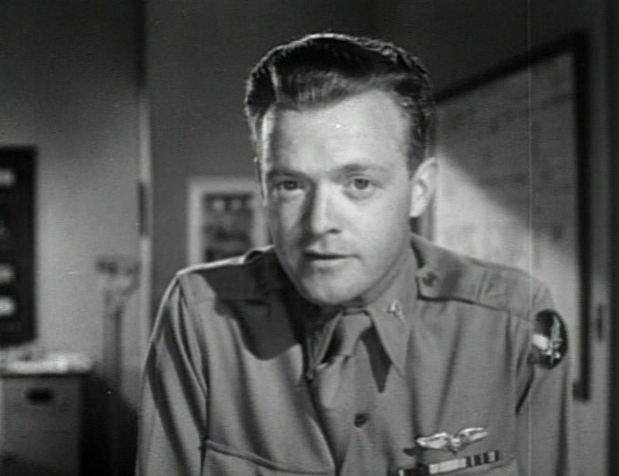
Arthur Kennedy, Van Heflin, George Reeves, and George Montgomery.
Some of the actors in this unit who were
already started or well along in their careers include Alan Ladd, William
Holden, Ronald Reagan, of course, and Clark Gable was attached to the unit
briefly and flew on combat missions to film documentary footage.
“Hollywood Commandos” has a fascinating segment on a top-secret
project to create a huge scale model of Japan, all detail done by hand, and
film a virtual “fly over” to educate flight crews who would be sent on missions
over Japan.
There are dramatic segments on the “Learn and Live” and “Ditch
and Live” films that instruct flights crews on how to survive a crash.These lessons were the forerunners of the US
military’s later survival schools.
Some of the training was done through animation, and much
voiceover work was volunteered by the great Mel Blanc.
“Hollywood Commandos” points out in a chilling sequence
that, as it was said at the time, the first shots of the war came not from a
cannon or gun, but from a camera—and we see German director Leni Riefenstahl’s
jaw-dropping Hitler spectacle of the Nuremberg rallies, “Triumph of the Will”
(1935).Film was now a weapon of war,
and who mastered the art of filmmaking in terms of gathering and disseminating information
would win the war.
FMPU, and other film units of the various branches of the
military, played a huge role in our victory.
It is poignant that Gregory Orr, the son of a member of this
unit, created this documentary as a tribute to this mostly forgotten aspect of
Hollywood history.Likewise, it is
poignant that Ron Reagan, the son of another member, Ronald Reagan, narrates.
I was able to see this film by special arrangement with Mr.
Orr, but the rights to this documentary are owned by AMC, and unfortunately,
they have not released it either on VHS or DVD.It should be available to younger generations to see and learn about the immense value the film industry had to the generation that fought World War II.
Maybe you can help. I would ask readers of this blog to contact the
AMC network here:amccustomerservice@amcnetworks.comand request that they either broadcast “Hollywood Commandos” again, or
make it available for sale as a DVD.
I leave you with one more film, and I urge you to watch
it.It’s not long, only about nine
minutes, but here Ronald Reagan narrates “Wings for This Man” (1945).It is about the Tuskegee Airmen, first unit
of African-American pilots and flight crews in the Army Air Corps.We may sometimes dismiss wartime films under
the umbrella label of “propaganda”, but that label does a disservice to this film and
any film that enlightens us on what we are, and more importantly, what we
should be.
For more information on the First Motion Picture Unit, have
a look here, and here.
(Remember to scroll down to the bottom of the page to pause the music first so you hear the video.)
As you can see by the trailer above, “Niagara” (1953) was a showcase built more around Marilyn Monroe than even Niagara Falls, though the Falls gets prominent play in this movie, as so too does Jean Peters. She’s the non-bombshell in this movie as we are repeatedly reminded.
The IMDb website notes a bit of trivia that a scene with Marilyn Monroe walking is the longest walk filmed in movie history at 116 feet of film. Apparently, the camera couldn’t let go of her.
Hollywood either saw her as box office or future box office, because although she had made quite a few movies before this one, “Niagara” was her most important role to date, and after this movie, it was stardom all the way.
There is an offbeat quality to this movie, a certain unevenness, a disarming goofiness that makes it intriguing. An average couple played by Jean Peters and Max Showalter, billed as Casey Adams, take a delayed honeymoon at Niagara Falls. They encounter their complete opposites in another couple played by Joseph Cotten and Marilyn Monroe. Directed by Henry Hathaway, the film almost feels like Alfred Hitchcock material in the way pleasant, even comic, normality is suddenly accosted by the weird and threatening.
The film has the Kodachrome look of old family vacation slides. We get a travelogue of Niagara Falls throughout the course of the movie.
Peters and Showalter have been married a couple of years, and take this trip ostensibly as a honeymoon, but also because he works for the Midwestern branch of Shredded Wheat, which has its corporate office in Buffalo, New York. He won a contest for most imaginative sales campaign, and his prize is to be hosted by a company mucky-muck. When they arrive at their lodgings after a leisurely drive in their convertible (and need no documentation to get over to the Canadian side, nor probably back again), Mr. Showalter exclaims with excitement, “You can see it from here!”
We think he means the Falls, but he means the Shredded Wheat plant. We have in Showalter’s character one of the most delicious cornball yokels in movie history, someone Hitchcock would have probably featured as the guy who is comically oblivious to the murder and gore around him. Mr. Showalter may not be totally oblivious, but his ever-present grin and enthusiasm might be tiring it if weren’t so funny.
His wife, Jean Peters, is the steady, sensible one of the pair. She is more in tune to what is going on around them, and by nature, is more eager to be involved. She turns into Nancy Drew and gets her life threatened before the movie is over.
The tension is provided by Joseph Cotten, a recently released psychiatric patient from a veterans’ hospital (shades of his character from “I’ll Be Seeing You” - 1945 - see this previous post), and his nubile, duplicitous wife, Marilyn Monroe. Miss Monroe, is actually quite good in this movie, despite the caricature the studio is already making of her as a sex object, playing a woman hatching a plot to murder her husband all the while playacting she loves him and is so worried about his mental condition.
But, being Marilyn Monroe with her star on the ascendant, we get a lot of eye candy which has nothing to do with the plot. Shots of her showering, of provocative poses, and costumes, and constant stares by all the males around her.
We start the cheesecake from the very beginning of the film, when Joseph Cotten, after a solitary ramble around the Falls in the early morning while his voiceover tells us how miserable he is, returns to their room to find her nekkid in bed. He calls her name, picking up one of her stockings that she had dropped on the floor, but she pretends to sleep. When he gives up and goes to his own twin bed, we see her contemptuous sneer.
Their digs are a motel of efficiency cabins right by the Falls. Peters and Showalter have booked the same cabin, but Miss Monroe and Mr. Cotten have not vacated yet, and so the new couple agreeably takes another cabin.
It’s a whole world unto itself, this land of efficiency cabins, where the resident owner plods around watering flowers and knowing everything about everybody, where the companionable vacationers dance in the pavilion to swing records on a phonograph and sip from Coke bottles on the steps under the stars. They are in no rush to see and do.
If you don’t count the murder plot, it seems like a very relaxing holiday. These days I think we’re programmed to be constantly on the go, even on vacation.
But, it’s not all ho-hum reading magazines in the rooms that have no cable TV, phones, or Internet service. The travelogue continues as Miss Peters and her goofy husband do all the requisite tourist stuff at Niagara Falls: the Rainbow Bridge, the Maid of the Mist boat ride, the Cave of the Winds. They spend a fair amount of time in raincoats and boots.
On one such excursion, Peters notices faithful worried wife Marilyn Monroe kissing a strange man. This is also a movie of darkened stairwells, trysting places, and secret haunts.
Miss Peters observes, as do we, that there’s something not quite right about that couple in the other cabin. Miss Monroe is not the faithful wife she pretends to be. But what about Mr. Cotten? Is he really a sick man the way his wife contends?
Jean Peters, smart, open-faced and unassumingly friendly gets to decide that for herself. When the cabin neighbors are all dancing under the stars, Monroe comes out to enjoy the music alone, puts on a record she has brought with her, and joins the normal couple on the steps.
In a moment, Cotten barges out of their room and smashes the record in his hands like The Incredible Hulk. We begin to see that the tune has a deeper meaning, and her actions are calculated for effect. She is not embarrassed or worried about her husband; she is pleased that so many people have witnessed his over-the-top behavior.
She is planning for her boyfriend to murder him, and wants to make it look like suicide. It won’t be hard. It apparently doesn’t take much for Mr. Cotten to become unglued.
It is Jean Peters, not his wife, who rushes to his room with a first aid kit and mercurochrome to patch up the cuts on his hand. If you’re going to smash a 78 rpm record, wear gloves.
It is an interesting scene, her caring for him, but even when he turns off the lights so she can better see Niagara Falls lit up at night, there is no intended eroticism. She is businesslike in her kindness, and he is too overwrought over his oversexed wife to contemplate sex or romance with anyone else.
When Peters’ goofy husband enters, he is so comfortable in his marriage and in her that he is not even jealous or suspicious. Maybe he’s too stupid. I can see where an audience might find his obtuse cheerfulness irritating, but I think he’s a hoot.
Cotten smashes the wooden model car he has been making in his room (more fun things to do when there is no cable TV) as he tells his back story about always messing up his life and how his wife is a tramp. He imagines she is unfaithful with every man she meets.
We don’t know that for a fact, but we do know that Miss Monroe is playing him like a violin, and uses his jealousy to lure him into a hidden spot where Boyfriend can knock him off.
Cotten’s paranoia serves him well, because he kills the boyfriend in self defense. He sneaks back to his cabin, knowing his wife thinks him dead, and finding Jean Peters there instead taking a nap. Again, more confidentiality in the half-light, but she screams and he runs away. Later, her tails her (more raincoats and boots) on another walk to the Falls, and he pleads with her to not tell anyone he is alive so that he can leave his wife and just get on with his miserable life by himself.
She’s willing to do this at first, even keeping his secret when the boyfriend’s body is found and the cops get involved. But, then she realizes that he might now be after his wife, who has fainted at identifying the body of her boyfriend in the morgue. This time she isn’t faking; she’s really shocked. Miss Peters, by default, becomes her caretaker.
Miss Peters’ goofy husband finally loses his remarkable serenity and is fed up with her continued involvement with the neighbors.
“We wait three years for a honeymoon and spend it with a couple of spooks!”
Then we get another burst of comedy when Mr. Showalter’s Shreaded Wheat boss welcomes him. Played by the booming barrel of chuckles, Don Wilson, who was the announcer for many years on the Jack Benny radio show, the boss and his wife, played by Lurene Tuttle, escort them on a social whirl of Niagara Falls. More raincoats, more hiking up wet wooden stairways along wet cliffs, and finally, a fishing excursion on the Niagara River that has tragic consequences.
By the way, Don Wilson is not the only connection to Jack Benny we have in this movie, if you think about it. The model car Joseph Cotten builds is a Maxwell. Remember the Maxwell chauffeured by Rochester, and the sputtering sounds made by Mel Blanc?
There’s a lot more danger and intrigue from this point, but if I go on, I’ll ruin it for anybody who hasn’t seen it. Just a couple of items about this movie that are fun to note:
Will Wright, perennial movie night watchman and grumpy crooked suspicious fellow (remember his small but pivotal role in “The Blue Dahlia”? We’ll have to cover that movie one sometime or other.) Here he has a small role as a grumpy boat rental owner.
The Carillon featured in this movie was part of the Rainbow Tower on the Canadian border side, and was completed in 1947. “O, Promise Me” is played on it early in the movie, I suppose to refer to the honeymoon connotations of the Falls, but popular tunes are also heard on it, and in one scene, a secret message is sent to Marilyn Monroe in a song. At the time this movie was made, the Carillon was played manually by a carilloneur. Today, it’s all automated.
Come back Thursday for more fun at Niagara Falls through the perspective of other Hollywood films.
Columbus Day, a product of late 19th century America and promoted with statues and celebrations by Italian-American organizations since that time, has experienced a curious evolution through the years.
First an ethnic festival, then a holiday intended to promote American cohesiveness, later on the man Columbus and the holiday both derided and protested against for the more ghastly aspects of colonization that Columbus has come to represent.
Today in New England it’s the prime foliage weekend, so it’s become synonymous with apple picking, leaf-peeping and pumpkin buying. And perhaps tags sales. Neither ethnic pride nor celebrating circumnavigation are so much a part of the picture.
But back when American history was taught as part fact and part myth (Washington and that cherry tree incident being only one of the colorful and utterly false tales we learned), the myth was enhanced by mirth. Here are two cartoons which use Christopher Columbus’ voyage to the New World not as a history lesson, but as fodder for sight gags.
Here is “Kristopher Kolumbus, Jr.” (1939), a black and white cartoon with Porky Pig in the Columbus role. Directed by Robert Clampett, the action is zany. His famous gag of throwing the baseball around the earth to prove the earth is round, and it’s returning to him with luggage stickers from all over the world, was so simple and nutty, that it was used again in another parody of the Columbus tale with Bugs Bunny.
“Hare We Go” (1951), directed by Robert McKimson, features Bugs as the mascot on board Columbus’ ship. Queen Isabella is depicted as something like Mae West, and Mel Blanc must have had a ball voicing the emotional, irascible Christopher Columbus. Annoyed that he must prove to the Queen that the world is round to get money for his voyage, he angrily shouts, “Ravioli! Alla time prove! Prove, schmoov! She’s a round!”
Bugs’ problem is avoiding being killed by the crew, who all think he is bad luck. One of the more clever gags is when Bugs holds up a postcard of the New York City skyline in front of a spyglass to show they are close to land. We see that Bugs Bunny has actually discovered America and Columbus only took the credit. Now, that’s a myth I can somehow believe.
Valentine’s Day is for lovers, and Hollywood has given us the ultimate romantic hero back in the days when love was the usual four-letter word we heard on screen. That screen idol is, of course, the dashing Pepé le Pew.
His Oscar-winning cartoon, “For Scent-imental Reasons (1949) establishes his romantic character and the glory of the chase with the time-honored movie device of mistaken identity. This amorous male skunk mistakes a cat splashed by white hair dye for a female skunk. She desperately tries to avoid him as he seduces her with a mangled combination of French and English, proving again, as Peter Sellers would someday learn, there are few things funnier than a really bad French accent.
Mel Blanc, who did most of the voices for the Warner Bros. cartoon division, is in rare form as the posturing gendarme, the distressed owner of the despoiled perfumery, and the libido-driven Pepé.
With Charles Boyer as inspiration, director Chuck Jones, writer Michael Maltese, and Mel Blanc came up with a skunk, who despite the arrogance of his assumption of his irresistibility, is anything but offensive. He is the hero of his own little world, perhaps because no one else will have him, and that is as sad a thought as it is funny.
“Un smelle voux finay,” has got to be one of the funniest and best-delivered lines ever to come out of a Hollywood studio.
The tables are turned when the lady cat falls into a water barrel, loses her faux skunk stripe, and gets a cold. When Pepé is accidentally covered in blue paint, disguising perhaps both his skunk-appearance and his odor, the kitty becomes attracted to his Gallic charm, and he repulsed by her disheveled looks.
“Pardon me, Grandmamma,” he desperately tries to stall her advances, not recognizing the former object of his affection, “Control yourself, Madame!”
But how can she control herself? How could any woman? Pepé, as he knew all along, is every woman’s romantic fantasy. They just don’t draw them like that anymore.
“What’s Opera Doc?” (1957) achieved what few parodies can do, and that is to create something original on its own, a genius apart from the parody. Cartoons, especially classic Warner Bros. cartoons, featured a lot of classical music, and I don’t know how old I was before I realized this Wagner fellow, and his cohorts Franz von Suppé, Rossini, and the like did not write special music for the cartoons. I cannot hear “Morning, Noon and Night in Vienna” without thinking of “Baton Bunny,” (1959) nor hear Gioachino Rossini’s “Il Barbiere di Siviglia” without thinking of the immortal lines, “Yell and scream and rant and rave/it’s no use, you need a shave.”
Still, in “What’s Opera, Doc?” we go beyond popular culture to the heights of a Valhalla where Elmer Fudd as Siegfried, voiced by Arthur Q. Bryan, conjures supernatural forces in his spear and magic hewmet, “Be vewy quIET…I’m hunting WAbbits.” We know this is to be a special performance just by they way we hear the orchestra tuning up over the opening credits. Excitement builds.
Is there nothing so majestic, so savage, so telling of human passions as, “Kiwuh da wabbit, kiwuh da WABBIT, WIWUH DA WABbit?” My only regret is that there seems to be no film footage of Mr. Bryan, and Mel Blanc, who voiced Bugs Bunny, singing operatic duets in a sound recording studio. Did they not know they were creating magic that should have been documented? Or, was schlepping to the studio to lay down a few voice tracks about a hunter and a rabbit so ordinary that it was considered routine? Impossible.
The other dynamic duo, director Chuck Jones and writer Michael Maltese, could have been filmed as well as they story boarded this cartoon. That, too, might have been magic.
Bugs makes his entrance in drag on an obese horse. Why Bugs Bunny in drag is always so funny, I have no idea, but it is. After Elmer falls in love with the ravishing Brunhilde, and after an impromptu ballet, the strains of “Retoin my wuv” are heard in Mr. Blanc’s Brooklyn tenor and Mr. Bryan’s front parlor baritone in perhaps the most romantic duet ever performed. Seriously. No, really.
Of course, this being an opera, the fates intervene and Elmer discovers his wovwey Brunhilde is only that rabbit, and his rage bears the fires of hell. He calls upon the very lightning to smite the rabbit, whom he carries, with remorse, in his arms to a peaceful eternal rest. As Bugs says, “What’d you expect in an opera? A happy ending?”
It is more than perfect parody, it is a perfect 6-minute opera.
I wish Wagner could have seen it. His rage would have been almost as spectacular as Elmer’s. He had no sense of humor.
Since part of the movie going experience, back in the day before these enlightened times of the $7 bag of popcorn, included cartoons and newsreels, today and tomorrow (and from time to time) we’ll take a look a few famous examples of these other movie house attractions.
Two cartoons when examined together tell us a lot about the World War II era, and from two different viewpoints. These two cartoons are “Peace on Earth” (1939) and “The Ducktators” (1942).
Just by the titles and the dates of release, we can tell these films are drastically different. “Peace on Earth” is rather like “All Quiet on the Western Front” for kids. A Grandpa Squirrel puts his grandkids to sleep with a story of long ago, how strange creatures called “men” fought a terrible war against each other. The flashback is stark, colored in grays and browns and blacks, looking realistically like an old film of World War I soldiers. There is chaos in the trenches, and a horrific man-like figure in a gas mask with a gleaming bayonet. It is a nightmare vision. Finally, only two men are left, and they kill each other from opposing foxholes. This is why, as Grandpa, voiced by Mel Blanc, explains, there ain’t no men no more.
The little squirrels go to bed, and we see that the whole squirrel village is made from old army helmets. All is peaceful under a blanket of snow. All trouble is gone because man is gone. “Peace on Earth” was nominated for an Academy Award.
This cartoon was released in December 1939, when World War II was a few months old. The strong pacifist message it carries was rooted in the horror of World War I, which created for most nations and people who participated in the war an aversion to future war that directed public policy, at least in Britain, France and the US, for the next generation. The cartoon also reflects American nervousness at the outbreak of the Second World War in Europe and how deeply reticent most Americans were at having to commit to the struggle. As it is, it took the Japanese bombing of Pearl Harbor to drag us in, over two years later.
Which brings us to “The Ducktators.” This is a sillier cartoon, a more humorous cartoon, with lines like, “My mama done told me - Sieg Heil!”, but despite the silliness it is a more savage cartoon. Here is a link to “The Ducktators”: http://video.google.com/videoplay?docid=1390519574176708696 .
There are no polite manners here, where barnyard animals are taken over by three bullies intended to represent Adolf Hitler, Benito Mussolini, and Emperor Hirohito. Ethic and racial characteristics are obviously exaggerated to ridicule these bullies. There is a brief comic signboard from the invisible theater management to announce, “We wish to apologize to all the NICE DUCKS and GEESE in the audience - The Management.” How funny this seemed to Americans of German, Italian, and Japanese ancestry who by the time of this film’s release must have endured a bellyful of caricature, we can only guess. Still, it is interesting that the producers would even tuck in that notice, as if to say they knew they were crossing a line, with sensitivity that was quite uncharacteristic for that time. Even a black duck sounds like the Rochester character on the Jack Benny radio show, played by Eddie “Rochester” Anderson.
But, in this cartoon, even the Dove of Peace is caricatured as an effete fellow speaking in couplets. We know that right is on his side, but we can’t help but be a bit disgusted by him as he sits waving around olive branches (note that he is perched near an actual jar of olives), and letting the bullies run the barnyard. We only begin to like the Dove of Peace when he has had enough of being trampled upon, and beats up the bad ducks in a Popeye-like fistfight.
The end of the cartoon, usually cut off in later releases, concluded with a plea to buy war bonds.
It is fascinating that terrorists of today are as evil as any enemy we encountered in World War II, yet we tread a fine line making fun of them, especially in the use of caricature. If we do not, we would run the risk of insulting millions of people these terrorists claim to represent, but do not represent and are innocent.
We are not even encouraged to buy bonds. It is as if even today we are caught between the messages of these two cartoons: one, that all war is bad. Two, that only the enemy is bad. Public policy may have taken a quick and drastic change after Pearl Harbor, but in the psychological span evidenced between these two cartoons, it is negligible how prompt most Americans were to respond to it.