
Parrish (1961) proves that Hollywood can fabricate a lush
soap opera story anywhere, under any conditions. All you need is beautiful leads, nasty
villains, and a Big Idea that the characters can exploit and then be destroyed
by, or overcome.
This movie has an incongruous edge to it because probably most
people not familiar with the Connecticut River Valley of western New England
know that tobacco growing was a huge part of our agriculture here at one time,
going back to the 1600s. It was a very
important crop, and a big engine in our economy. Less so today. For those of us living in the Connecticut
River Valley, it is incongruous that Hollywood would turn it into a place of
greedy land barons, nubile female field hands of questionable virtue, and Troy
Donahue.
Long post. Get a sandwich.
Long post. Get a sandwich.
The Connecticut River Valley is my home, and so this movie
has special significance for me just because so much of it was filmed on
location, and the sites are familiar to me.
I had family and friends who worked on tobacco farms, and one friend in
particular, now sadly no longer with us, claimed he made his film debut in Parrish. He was just a teenage kid working on the
farm where the final scenes of the movie were shot. He recalled that he and a bunch of other kids
were pulled from work and told to race across the fields. Lots of locals were in the movie. I’m afraid I don’t recognize
him in the long shots of running kids, and I doubt he could have recognized
himself, but it gives me a warm feeling to know he was there.


In my neck of the woods, this is what barns look like. Tobacco barns and curing sheds stand sentinel
on the valley floor, fewer than there once were, but ghosts of former times.

Sunderland, Mass., photo by JT Lynch
Troy Donahue, who always looked good in red, travels with
his mother, Claudette Colbert, from Boston to the tobacco farm of Dean Jagger
just north of Hartford, Connecticut. Mr.
Jagger is a gentleman farmer, whose family farm, and its lovely Georgian house,
has been here for ages. His daughter,
however, is no lady, played by Diane McBain with an industrial strength pout.

Miss Colbert is hired to help with Miss McBain’s coming out,
in debutante-speak, and be a steadying influence for the rebellious young
motherless woman.


Donahue and Miss Colbert are seen first crossing a river on
a ferry. They are supposed to be in the
Boston area, but this is clearly the ferry across the Connecticut River down by
East Haddam. You can even see the
Gillette Castle across the river in the distance on the bluff in the photo below. Have a look here for photos of the ferry
crossing site on my essay about the Gillette Castle here on my New England Travels blog. And here is another post on the other ferry on the Connecticut River joining Rocky Hill and Glastonbury. It is the oldest river ferry in the US.


They fly from Boston to Hartford, which cracks me up. (Look at it on a map. They’re an inch and a half away from each
other.) I imagine the director thought
that this would give him an opportunity to show the massive white tents of the
Shade tobacco fields to their best advantage, and give the plane’s pilot a
chance to narrate the view, thereby giving the audience a brief intro on the
location and story background.


This movie is based on the novel, Parrish, by Mildred Savage.
It was her first of three novels and became a best seller. I know she is a Connecticut native (and died
only a couple years ago), but I don’t know what her connection was to the
tobacco growers of the Connecticut River Valley. Her book is rich in detail about the process
of growing tobacco, about the economic realities, and labor problems, and
history of this unique agriculture. This
area is one of the few places in the world able to produce quality Shade
tobacco, which is used for the outer wrapper of cigars. How a Wellesley-educated girl knew about the
nuts and bolts of this world is something I have yet to learn, but I’d love to
know more about her experience.


The book, like the novel, is largely a coming of age story
about a young man named Parrish who must strike out on his own and deal with
what he sees are the challenges and hypocrisies of life. In a New
York Times article by Eugene Archer (June 5, 1960), Mildred Savage, who
visited the filming location stated, “I wanted to show an affirmative hero who may
be confused because of his youth and sex troubles but is still masculine,
unaffected, and optimistic—able to get ahead on his own two feet. The idea of setting the story in this tobacco
industry came last. It seemed sensible
to put a vigorous healthy young man to work in the soil.”

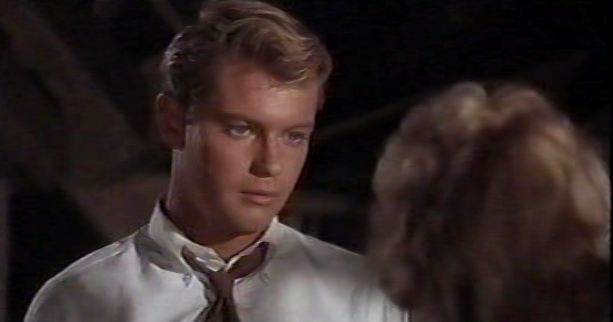
Her description pretty much defines Troy Donahue for
us. Never a great actor, but here he’s
awkward, sincere, bewildered—just what he should be. I find him very touching in the scene where
he defends his decision to escort Connie Stevens, pregnant by the loutish son
of the tobacco baron Karl Malden, to a harvest fair.
“If some person needs a little bit of kindness, that’s no
good. That’s immoral. That’s a disgrace to the great world we live
in.” The baritone ripple of indignation
is boyishly brave, and if he seems naïve, it’s because he’s supposed to
be.

In the book, he is a mouthpiece for progressive ideals. His family has been raising tobacco for
generations here. He tells Judd Raike,
the character played by Karl Malden, who is a newcomer to the Valley and new money, “It never bothers me to pay a
good foreman a good wage...He’s worth it.”
But Raike, who is Snidley Whiplash, responds, “A man…is
worth exactly as much as his nearest replacement.”
His son, wanting to impress him, echoes his father, “It’s a
crime what labor’s getting an hour these days.
Common labor.”


We don’t get these issues in the movie, and it only flirts
with other issues about conformity and the hypocrisy of society. We also don’t get as close a look at Mr. Fancher’s
browbeaten wife, who figures more prominently in the novel. We get more about the Jamaican workers in the novel. In the movie they are seen from a distance.


Parrish likes the Connie Stevens character and her family
(her brother-in-law in the movie is played by our old pal, Dub Taylor with
delightful aplomb) because they are unfettered by social rules and
self-consciousness. They are easy and
hail-fellow-well-met. Connie is a
tramp. It is possible this is what Troy
likes best about her.


In a scene that squeezes out every drop of eroticism you can
get in a bottle of calamine lotion, Connie dabs Troy’s back gently with the
lotion to soothe his tobacco poisoning rash.
(When she shows him his room in her family’s ramshackle
house, we hear the musical intro to A Summer Place, but director Delmer Daves
coyly saves us from the rest of the song.)
Later, after the birth of her child out of wedlock, a fact
that infuriates and shocks the locals, Parrish is compassionate and
understanding. However, what finally disappoints
him is when Connie and her family accept a bribe from the absent father, for
letting him remain anonymous. He will
not help raise the child nor contribute to its support, and not acknowledge his
relationship to the child. That’s okay
with Connie and the gang, because they’ve got a new refrigerator and a TV
set. It’s like they’ve won the lottery.
Parrish sees that even these independent common folk have a
price and can be bought, and that’s when he takes a step back from them. It’s in the book, but not the movie.
Another thing that comes out more clearly in the book is the
similar duplicity and opportunism of Parrish’s mother. Claudette Colbert plays her like a ladylike
member of the garden club, smooth talking and demure, and so she is in the book
as well, but she’s also gently manipulative, of Parrish, of her employer played
by Dean Jagger in the movie, and eventually of her husband.


She marries Judd Raike, played by Mr. Malden in the movie, because
he’s filthy stinking rich. She wants
more than anything for Parrish to get ahead in life, and she sees he’s too
cussed stubborn and independent to care about getting ahead, at least on her
terms. She has perceived that Judd’s
sons are no-account fools, and that Judd will need an heir to take over his
tobacco kingdom one day. She sets her
sights on the job for her boy. Claudette
has a brief scene where she stands up to her husband’s nasty remarks about her
son, but that never happens in the book.
She’s just as phony as Connie Stevens and her family. Just on a larger scale.


As far as I know,
there were never any tobacco barons in the Connecticut River Valley. Most farms were small, family owned, and
other farms were larger commercial farms owned by faceless corporations. One guy gobbling up other farms like taking
pieces on a chess board is as good a catalyst to tell the story of Parrish’s
coming of age as any. A story needs
conflict, and especially conflict of a personal nature, conflict with a
face. That is the purpose in the novel for
the character of Judd Raike, and he is as fiendish a guy as you will ever
encounter between the covers of a book.
The author deftly depicts him as a man so clever, so moody,
so tricky in his passive-aggressive challenges to his family and employees that
he is actually one of the most vivid, most real people in the story. He’s a bit frightening.


In the movie, however, Malden is given a script that shows
only Raike’s anger, and none of his subtle machinations. Malden has the thankless task of being
nothing but an enraged cartoon of a man.
The character, and the actor, deserve better. I suspect this was the director’s shorthand,
like the plane flight over the valley.
Critic Bosley Crowther in the New York Times (May 5, 1961), is unusually accurate and eloquent in
his wry review.
“Who would have ever imagined that growing tobacco in
Connecticut would be as socially involved and emotionally exhausting as it is
made to appear…”
Who, indeed?


He calls it a “status-conscious story,” where the locations
and people are “over-dressed and artificial…They are all more or less absurd
extensions of some kind of slicked-up social image or cliché.”
Well played, Bosley.
I suppose the biggest acting challenge, and most
successfully done, was by Sharon Hugueny, who plays Karl Malden’s
daughter. She ages from her early teens
to her early 20s in this movie, and proves to be the most sensible person in
it.


I have a soft spot for Dean Jagger in his quiet, stubborn
role as mentor to Troy Donahue.


Other faces to pick out are Hope Summers, who played Hattie
for a while on The Rifleman, and Madeleine Sherwood, a lusty young field
hand, who did lots and lots of TV and played Mother Superior on The Flying Nun. I still think of her as Mother Superior and
the field hand with the bare midriff shocked my delicate sensibilities.

Carroll O’Connor is the fire chief, and wouldn’t you know it? Bess Flowers is a party guest. You can’t put out a plate of hors d'oeuvres without her showing up.


Carroll O’Connor is the fire chief, and wouldn’t you know it? Bess Flowers is a party guest. You can’t put out a plate of hors d'oeuvres without her showing up.

We get a shot of Mystic Seaport, and Troy and Claudette
strolling on the whaler Charles W. Morgan. More on Mystic here at my New England Travels blog, with the
whaler in the background of these photos. I, too, have strolled the deck of the Charles W. Morgan and took the wheel, pretending to be Captain Ahab. Well, pretending to be Gregory Peck pretending to be Captain Ahab.


I’m not sure where the hotel on the shore is supposed to
be. Old Saybrook, I think, or
Madison? Maybe somebody can clear that
up for me. I wonder if it could be someplace they shot in California. Also the church where two weddings take place, somewhere in the Valley. What church is that?


We also get a brief glimpse of the submarine base at New
London, which family and friends of mine have passed through as well. About the only place I haven’t a connection
with in this movie is the scene where Parrish, aboard the nuclear sub USS Nautilus (Correction: I have since been informed that this is actually the USS Skate), spears the ice at the
North Pole.


(The Nautilus is
still down in New London, on display for visitors, and I may feature that on New England Travels sometime or other.)
In the novel, to get away from his troubles, Parrish joins
the Navy, but since the book is set in the late 1940s and early 1950s, he is
sent to the waters around Korea and he and his mates fear what might happen if
the Korean War involves them.
The movie strips us of that conflict and instead makes
Parrish’s naval service a footnote, but still a fun peek at popular culture of
the early 1960s.


There are grand parties, and grand tantrums, but most
appealing are the scenes that focus on smaller images that become intimate: the
young shoots of tobacco growing; we watch them climb and reach their full
height. The fields in all seasons, the
muddy spring, the fallow autumn, the snow, the lush summer. Dean Jaggers’ colonial furniture in his
farmhouse, against the rich colors of the walls compared to the modern furniture,
the pastels in Karl Malden’s showy Hartford mansion.


Those red sweaters of Troy’s.


And the final shot where Troy and Sharon Hugueny sew up a
gap in the tent over his tobacco field.
We see an aerial shot, with just their two heads poking out of a massive
field of white cloth. They look like the submarine surfacing at the North
Pole.


Parrish is not a great movie, but it is valuable if
only for the scenes it preserves of my backyard. The histrionic soap stuff I can live without. But give me shots of my ain countrie, and I’m
happy.


Have a look here at Moira Finnie’s post at The Skeins on Parrish, which I love, especially for remarks like
this:
“As filmmakers sought to push the envelope on what was
acceptable fare for general cinematic consumption, movie audiences were
shifting dramatically from a substantially adult market to one that had the
maturity of the average prurient thirteen-year-old. This movie reflects that
trend.”
This is perhaps the greatest flaw in this film and other
Troy Donahue flicks of the period (I’m looking at you A Summer Place and Susan
Slade). It shucks the social relevance of the novel for the frothy, the shallow, and the gloss. That's what sells...if you're selling to a thirteen-year-old. Or someone with the mind of one.
For more on tobacco growing in the Connecticut River Valley,
including the remarks of Martin Luther King, Jr., who worked on a tobacco farm
here when he was 15 years old, have a look here at my New England Travels blog this week.
*************************************
Come back next Thursday for The Woman in White (1948) with Sydney Greenstreet, Alexis Smith, Eleanor Parker, and Gig Young. A Victorian mystery based on the classic novel by Wilkie Collins. Rich in atmosphere, unlike Parrish, the evocative locations in this movie are all backlot and soundstage. But you'd swear you were there. See you next week.
************
Jacqueline T. Lynch is the author of Ann Blyth: Actress. Singer. Star. and Movies in Our Time - Hollywood Mirrors and Mimics the Twentieth Century and Hollywood Fights Fascism. Her latest book is Christmas in Classic Films. TO JOIN HER READERS' GROUP - follow this link for a free book as a thank-you for joining.


