Massacre (1934) is a bold standoff against treatment and societal views of the modern Native American, as well as the industry that brought us westerns with little appetite for treating Indians as nothing more than stereotypes…and targets.
It manages, however, to be more than just a message film,
for the story involves a lot of action, a fast-moving story line, and cool
deliberation on the part of Joe Thunderhorse, a man whose two-fisted approach
to life brings him away from the reservation so long that Sioux culture and its
modern problems mean little to him. He’s
out for himself and very successful at it.
What brings him back to his tribe is a shock, and he brings the audience
with him.

Richard Barthelmess, one of my favorites, is very good in this strong role. He manages, as does his character, to straddle the world of hardscrabble make-a-buck early 1930s and the ancient culture into which he was born but left at a young age to make his way in the world. For him, it is not just the “white man’s world,” it is his world. He walks with authority, like the son of a chief, like a guy who wears his self-confidence as if it were a bullet-proof vest. He generally has a great time, but he is not afraid to challenge anyone.

We first meet him in Indian garb riding a horse in a procession at a wild west show at the Chicago World’s Fair of 1933, and the theme of the fair, “Century of Progress” is only part of the irony facing the audience when, sinking into the story, we immediately begin to consider the plight of the Native American in twentieth-century America. Where is their progress?

Barthelmess is the star of the show, and his pictures on programs bring in a lot of money to the stock company, run by Robert Barratt, a kind of Wild Bill Hickok knockoff. Barthelmess does trick riding, fancy shooting at targets, and makes the girls swoon, particularly Claire Dodd, a wealthy sophisticate who has designs on him.

Barthelmess earns the princely sum of $300 per week, and demands for $400 and will get it. He has a valet played by Clarence Muse. No jovial Indian sidekick, his manservant is Black, but seems more a pal than a lackey. He calls Barthelmess “Chief” like everyone else does, not “Boss.” Our first surprise is when the monosyllabic “Chief” rides out of the stadium, goes to the manager’s tent where his valet removes the wig with the long braids, and reveals a modern Joe, who changes into a suit and speaks English fluently. We see he has only been playing a part. He is suddenly almost like a cross between Clark Gable’s masculine polish and James Cagney’s Bowery toughness. He smokes, he chews gum (sometimes at the same time), and strides out to his own sporty automobile with his name and picture emblazoned on the doors. The ten-gallon hat he wears is so large and ostentatious, it probably really does hold ten gallons.

I like the shot of Mr. Muse's face in the obverse side of the hand mirror he holds for Barthelmess.


Mr. Barthelmess amuses himself with the adoration of the females in the crowd, and has a shallow romantic relationship with Claire Dodd. It is interesting that while Hollywood would not stoop to his having a white manservant, he is allowed to have a white lady friend. Their kiss, a long and seductive encounter between two races in America at that time we might consider to be a daring image. Was it allowed because the audience was already familiar with the long career of Richard Barthelmess and knew he was not really Sioux, or is it because Claire Dodd is playing a coolly unsympathetic woman who collects men and marries on a whim? We have to question her emotional and mental stability when, as Barthelmess arrives for a cocktail party at her mansion, she brings him to a room that is filled with Indian regalia and artifacts. He looks at the objects, interested, as if he is on a museum tour, and will later confess that he realized at that moment he has gotten so far afield from his native roots that the significance of the pieces were lost on him and needed to be explained to him.

But it is her fascination with the objects and collecting them, the way she has collected men, that says a great deal about her. She is not a historian, an anthropologist, or a scholar; she has created a fantasy revolving around Joe Thunderhorse that is more sexual desire than cultural interest. She clings to him and murmurs her image of him as a wild, “red man” and she would like to be his “squaw.”
This movie seems to straddle, perhaps knowingly, the
conflicting images, tropes, of the Indian as a savage and as a noble and
beautiful child of nature. Joe
Thunderhorse is neither, he’s a just guy.

Massacre, like some of the previous movies covered (Heat Lightning, Employees’ Entrance), is a First National film, and we may reliably count on a frank, sometimes stark, socially conscious message. The Vitaphone Orchestra and the opening credits with the cameo portraits of the principal players might momentarily distract us at the old moviehouse like a doily on a scratched tabletop, but we know what we’re getting underneath. It’s wonderful, gritty honesty.
Spoilers at this point, naturally.

Barthelmess gets word that his father, still back on the reservation, is dying and is asking for him. So he takes Clarence Muse with him and drives his outlandish auto out to the reservation, which he left when he was still a boy. The government agent at the time he was there, played by Henry O’Neill, who is now working in Washington, D.C., sent him to the Haskell Institute, where he learned skills to make his way in the world. But Barthelmess returns to a desolate landscape he had almost forgotten, and which seems to have gotten worse in the years since he’d left. Even Clarence Muse notices and remarks, “White folks don’t give the Indian much of a break.”

The reservation is now run by unscrupulous managers. There is Dudley Digges, the agent in charge, whose side hustle is graft and more graft.

Frank McGlynn, Sr., is the arrogant, posturing, bloviating missionary. His funeral service for Joe’s father is all phony hype and brings no comfort to the family. Joe will afterward insist on a Sioux ritual that is far more spiritual and sincere. As Barthelmess looks to the night sky, he seems to truly mourn for his father, and perhaps for his people.

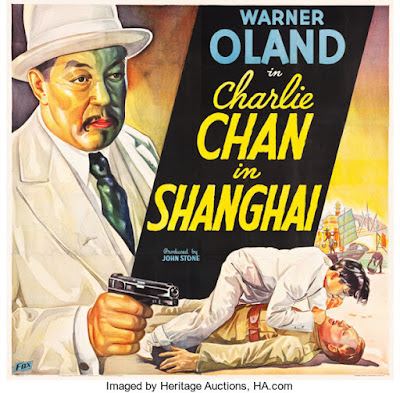
Sidney Toler, several years before his longtime gig as the kindly inspector Charlie Chan, plays the smarmy undertaker, whose crimes against the Sioux involve not only fraud and graft, but rape.

When Barthelmess arrives at the agent’s office on the reservation, he is all curiosity and impatience, and has no idea what corruption he has before him. A poised, beautiful young officer worker, played by Ann Dvorak, catches his immediate attention. She is Sioux also, and when she answers him in perfect English, he smiles in recognition and asks if she, too, had been sent to the Haskell Institute. She was, but she came home to make a life on the reservation, and in her small way, to make a difference. We don’t learn much about her character or her family, but she will prove invaluable to Barthelmess in helping him navigate this complicated world on the reservation.
The Haskell Institute, a real-life Indian school, was
founded in 1884, and like many such boarding institutions, created an often
harsh and even cruel environment for the Indian children who attended. It grew into a land-grant college now known
as Haskell Indian Native University, where some 140 Indian and native Alaskan
nations are represented in its student body.
In February of this year, 2025, budget cuts as a result of the whims of the traitor felon currently residing in the White House have forced the lay-off of one-quarter of the staff.
Barthelmess renews acquaintance with his younger brother and
sister, and cousins, but bristles at what he has observed in their miserable lives
under the authority of the local agent.
He is not shy about complaining or throwing a punch or two, and Ann
Dvorak warns him that he could be arrested and confined to the reservation and
never be allowed to leave again.

He is enraged to discover that the unscrupulous undertaker, Sidney Toler, has raped his 15-year-old sister, Jennie, played by Agnes Narcha. Lovely Miss Narcha plays the tragic role well, but has few lines and this was apparently one of only two movies she made.
Barthelmess hops in his car to go hunt down Toler, and we
know he means business because he has bought the lariat off a cowboy on a horse
in town. Barthelmess speeds away,
catches up to Toler’s car in one of a few car chases in this film, and lassos
him from behind, yanking him out of the car and then dragging him along the dusty
road, finally unleashing his inert, battered body. He is unconscious and rolls to the side of
the road, where Barthelmess leaves him.

Barthelmess is put on trial on the reservation in a kangaroo court, with three illiterate and docile Indians as judges to convict him. Ann Dvorak sneaks him the key to the jail cell, and he and Clarence Muse drive off, away from the reservation. Cleverly, when the cop cars begin to chase his unmistakable auto down the highway, it is Mr. Muse they catch, wearing the ten-gallon hat as a disguise. Barthelmess has taken Muse’s flat cap and hops a freight.

Finally, he makes it to Washington, D.C., where he hopes to bring his plight to his old mentor, the former agent on the reservation, played by Henry O’Neill. As he leaves the freight yard, we see the Capitol Dome in the distance over the top of an old wooden fence, and the familiar Blue Eagle of the NRA poster plastered on it. President Franklin D. Roosevelt’s National Recovery Administration was established the year before, in 1933, and was a popular start to the New Deal among distressed workers. Participation in the NRA among businessowners was voluntary, and in part involved agreeing to establish a minimum wage between 20 and 45 cents per hour, to limit the work week from between 35 to 40 hours, and to abolish child labor. In 1935, the U.S. Supreme Court declared it unconstitutional. However, some of its features remained and were carried forward in other progressive legislation in those years.

Barthelmess makes contact with Henry O’Neill, who sympathizes and takes his side when he is accused of the murder of Sidney Toler. O’Neill acknowledges his fight for the Sioux has always been an uphill battle. “Every move I make is blocked by the same organized group that have been bleeding the Indians for years…water power, oil rights, cattle ranges…whatever the Indian happens to own, they manage to get away from them through control of public opinion and legislation….”
O’Neill invites him to state his case in a congressional
committee meeting. Barthelmess explains life
on the reservation in strong language when one of the committee members notes
that Indians were granted American citizenship in the 1920s during the Calvin
Coolidge administration in return for their services during World War I.
Yes, they weren’t citizens until…the 1920s.
Barthelmess responds, “The Indian a citizen? That’s funny.
He hasn’t any constitutional rights.
He can’t even hire a lawyer without the agent’s consent. Oh, he’s given the right to live…on a
wasteland. He’s allowed the right to
worship, but if he remembers that the Indian once had a religion of his own, he
gets a beating for it. He’s given the
right to love, but a white man can violate an Indian girl and get away with it…You
used to shoot the Indian down. Now you
cheat him and starve him and kill him off by dirt and disease. It’s a massacre any way you tell it.”

These are strong words that probably a lot in the movie audience had never heard before or considered. He is rewarded with applause, but taken back to the reservation to stand trial for murder. Wallis Clark plays his lawyer, and they garner massive attention with headlines and crowds when the train pulls into the nearest town to the reservation.

But Jennie, his sister, is missing. She has been kidnapped to keep her from testifying about her rape. With his usual fearless and no-nonsense manner, Barthelmess tracks her down, not afraid to use his fists or tell off anybody. There is a buildup of suspenseful twists and turns right through to the end of the movie, with mob violence, where Barthelmess must keep his own people in check before they burn down the courthouse.

The quiet ending of him standing on a cliff, surveying the wide reservation lands is another surprise, for he was shot down in an earlier scene. Ann Dvorak joins him with a telegram giving him the appointment, should he choose to accept, of being the reservation’s new agent. He remarks, “Just think of all the time I wasted shooting glass balls and signing autographs. This is a real job.”

He and Ann will have, we assume, a happier future together, but not an easy one. It is a satisfying ending, seeing how they are satisfied.
There appear to have been at least a few actual Native
Americans in the cast in very small roles.
It would be interesting to find out what people from the native tribal
nations thought of this movie, if any of them had been able to see it at the time
in 1934.
You can see it now on YouTube.
Jacqueline T. Lynch is the author of Ann Blyth: Actress. Singer. Star. and Movies in Our Time - Hollywood Mirrors and Mimics the Twentieth Century and Hollywood Fights Fascism and Christmas in Classic Films. TO JOIN HER READERS' GROUP - follow this link for a free book as a thank-you for joining.

My new non-fiction book, CHILDREN'S WARTIME ADVENTURE NOVELS - The Silent Generation's Vicarious Experience of World War II -- is now available in eBook here at Barnes & Noble, Apple, Kobo, and a wide variety of other online shops.
And it is here in eBook, paperback print, and hardcover, from Amazon.
It is also here in paperback from Ingram.
From Cherry Ames, to Meet the Malones, from Dave Dawson to Kitty Carter - Canteen Girl, the Silent Generation spent their childhood immersed in geopolitical events through the prism of their middle grade and young adult books. From the home front to the battlefield, these books are a window on their world, and influenced their hard-working, conformity-loving generation.