IMPRISON TRAITOR, PEDOPHILE, AND CONVICTED FELON TRUMP.
Showing posts with label Verree Teasdale. Show all posts

Thursday, November 13, 2025

Terror Aboard - 1933


T
error Aboard
(1933) is an eerie mystery that, though from the Pre-Code era, feels more like a noir film of a later period with its flashbacks and cynicism.  However, we have Charles Ruggles in a comedy relief role to break the omnipresent gloom, and that certainly anchors us to the Pre-Code days.


This is my entry into the Classic Movie Blog Association’s “Early Shadows and Pre-Code Horror Blogathon,” and you can find many more terrific blogs participating here.


A ship, perhaps a fishing boat, travels through murky fog, blasting its horn to warn any unseen vessel.  As the fog clears, they see a yacht a short distance away, and they sound the warning again and try to make contact, but there is no reply, and the boat seems adrift.  


Curiously, from this distance, they can see no one on board.  The captain takes a small detail of men, including the ship’s doctor, and takes a launch over to the yacht to investigate.  The camera cuts to the other side of the yacht, where a man leaps into the water, unseen.  We will get back to him later.  This post, as usual, is awash with spoilers.


As the captain and his men cautiously roam about an empty ship, one of them is clubbed from behind.  They find passengers on the boat at last—dead ones.  A woman is found lying in a hallway—frozen to death.  A man is found hanging in a cabin. The captain mutters morosely, “This is some kind of devil ship.”


Suddenly, a fire breaks out in the engine room, and they quickly retrieve the bodies they’ve found and prepare to leave the yacht.  They also find a telegram addressed to a man named Krieg that had been sent two days earlier, which reads, “grand jury indicted you for forgery and grand larceny…”  This Krieg is bankrupt, and the police are after him.


Now we drop into our first flashback.  We meet Krieg himself, a dapper middle-aged man with a trim mustache, played by John Halliday.  He owns this yacht.  


As he reads the telegram he has just received, he ponders his situation—and we are launched into a second flashback, to October 1929, when the stock market crashes and mobs run on banks, and men swarm in panic on the stock exchange floor. 


The crash of 1929 made for a dismal and sickening backdrop for movies of the Great Depression.  Just its mention, or even the image of falling stocks on a ticker tape was easily recognizable shorthand for catastrophe.  Cinematically, it need not be explained. Certainly, through the decade of the 1930s, repercussions still stung from this event. 


Mr. Halliday, natty in his yachting cap and uniform jacket, visits the ship’s radiographer, played by William Janney, who sends and receives the telegrams.  He knows Janney has seen the message, for he deciphered the Morse code.  He has a companionable chat with him, talking of wanting to live on a nearby deserted island, lays out his plans to change course for it, but Janney seems obtuse either to what might be both a bribe and a threat. He only catches on when Halliday takes out a gun.  Because the camera is cut away from the instant the gun is fired, and we see only Janney’s expression of horror, we are teased into thinking that Halliday has shot himself, committing suicide. 


Then, after a long, rather agonizing pause, Janney falls, slumping to the floor, his white uniform covered in blood.  Halliday sets the scene to make it look as if Janney committed suicide.  Then he takes the guest list of passengers.


We get to meet them one by one, and their relationship to Halliday is briefly etched.  Verree Teasdale is an older woman, the wife of his business partner, encouraging ingenue Shirley Grey in Miss Grey’s forthcoming nuptials to Mr. Halliday.  Yet Grey seems troubled, and perhaps not entirely at the age difference between them. They will marry when the yacht reaches Australia.  We soon learn that she really loves Neil Hamilton, but they had quarreled.


Miss Teasdale will have her own marital problems come to the fore, as she is pursued in an adulterous relationship with Jack LaRue.  Morgan Wallace, Teasdale’s husband, will fight with LaRue and LaRue will knife him to death with a letter opener.  This violence is, however, subtly orchestrated by Halliday.  We come to understand he wants to eliminate his passengers.  We will see his hand scratch their names off the passenger list as they die.


Complicating his plans is the late addition to the guests on board when his fiancĂ©e’s former love, played by Neil Hamilton, arrives unexpectedly by plane, which he ditches in the ocean near the yacht.  He has been tracking down Shirley Grey to reunite with her.  We see a hand add his name on the passenger list, like an additional chore on a things-to-do list. Hamilton is handsome, rugged, flies a plane, and we assume he may be better equipped to cheat death on this cruise than the other passengers, perhaps even saving Miss Grey, to boot, but they end up getting locked in the engine room.  Where a fire breaks out. “It’s all right, darling.  We’ll get out of this somehow.”

Hamilton, you may recognize as the future Commissioner Gordon on the Batman TV series in the 1960s.

There is a poisoning, a hanging, and Verree Teasdale gets locked into the ship’s meat locker, where she freezes to death, and more names are scratched out.


Charles Ruggles has a prominent role as a ship’s steward, and he is comic relief, bumbling around, playing the amiable coward, terrified by all the murder around him, clutching at lucky charms.  We might assume that he will survive because God protects bumbling clowns, at least in old movies.

The captain of the yacht, played by Stanley Fields, begins to suspect Halliday of the horrific deeds.  Meanwhile, the crew grumble among themselves, worried and wanting to escape, and finally they rush a lifeboat, but Halliday shoots them.


Then a blast from a ship’s horn in the fog, and we are immediately taken back to the present when the yacht is seen drifting at sea.  The ship pulls up alongside the yacht, and captain and crew investigate.  Halliday, we discover, lurking about, is the one who smacked the sailor on the head.  He starts the engine room fire, and he is the man whom we earlier saw leaping from the yacht into the sea to swim for it.

Against all odds, Neil Hamilton and Shirley Grey are rescued from the fire, and all are speedily removed from the burning yacht to escape to the other ship.


John Halliday, whether driven mad by his indictment over the stock collapse or whether he was just a diabolical manipulator who was determined to win at all costs, is seen at the end of the film being pursued by a shark.  Horror begets horror, but it seems as if, as with many Pre-Codes, the just desserts are not a moral indictment, but a cheap thrill to round out the final reel. 

For more fun with spooky Pre-Code ne’er do wells, have a look at these great posts at the Classic Movie Blog Association’s “Early Shadows and Pre-Code Horror Blogathon,” and you can find many more terrific blogs participating here.

Terror Aboard can currently be seen on YouTube.


  *******************************


My new non-fiction book, CHILDREN'S WARTIME ADVENTURE NOVELS - The Silent Generation's Vicarious Experience of World War II -- is now available in eBook here at Barnes & Noble, Apple, Kobo, and a wide variety of other online shops.

Or here from my Shopify store if you want to buy direct from me and avoid the big companies.

And it is here in eBook, paperback print, and hardcover, from Amazon.

It is also here in paperback from Ingram.

And here in hardcover from Ingram.

From Cherry Ames, to Meet the Malones, from Dave Dawson to Kitty Carter - Canteen Girl, the Silent Generation spent their childhood immersed in geopolitical events through the prism of their middle grade and young adult books.  From the home front to the battlefield, these books are a window on their world, and influenced their hard-working, conformity-loving generation. 


Thursday, April 10, 2025

Skyscraper Souls (1932)


Skyscraper Souls
(1932) is an example of the ironic sense of fun teased out of terrible times—a hallmark of enduring the Great Depression—and the audacious bemusement over immorality that contributed to the adoption of The Code. 


A rift in the timeline of cinematic history was torn, and movies like Skyscraper Souls were afterward deemed Pre-Code, not merely to suggest they were of a lesser standard but that they were emblematic of an era of don’t-give-a-damn long before Clark Gable was ever given official, one-time-only, permission to utter the phrase.

We were on our way down in 1932, a few years after the 1929 Wall Street Crash, and not yet hit rock bottom, but we could see which way we were headed.  It made many people fearful and others, especially filmmakers, fearless.  The setting is a New York City skyscraper, notably a bit taller than the only other building rivaling its height—the real-life Empire State Building, which was finished the previous year.  


The fictional building is owned by Seacoast Bank, which is owned by Warren William, whose financial buccaneering life is centered on this massive monument to his investment prowess.  His sexual prowess is another thread to the tale.

In this huge building are many businesses, and the several minor roles comprised of fellow financiers and the massive support system to their lives including clerks, secretaries, waiters, and elevator operators, make up the cast of characters.  We don’t get to know all of them well, most are given only a thumbnail sketch, but we know them because for the most part, they are us, the little guys.  Some ride the coattails of the big shots, others are gullible enough to think that emulating them will make themselves big shots, too.  There is comedy in the mix, and tragedy.


The story centers on Maureen O’Sullivan, only two years into her Hollywood career and already this was her 12th movie (she had even made one Tarzan film by this time—and will be forever remembered as Jane).  She plays the secretary to the assistant of Warren William.  The assistant is Verree Teasdale, herself only a few years in Hollywood and her 7th film.  She is intelligent, polished, runs her department with efficient and no-nonsense authority, clearly Mr. William’s trusted right-hand man.  She has a somewhat motherly relationship with Maureen O’Sullivan, whose family she knew, and so she has taken a protective interest in the young woman, alone in the wicked city.  Heaven may protect the working girl, but not if she doesn’t want to be protected, and this is the case with Miss O’Sullivan.


Her boss, Warren William, has designs on her.  First, he must dispense with her self-appointed chaperone, Miss Teasdale.  Verree Teasdale is his current mistress.

By the way, if you’re new to this blog, there are going to be so many spoilers it will make your head spin, so discreetly look away if you don’t want the sordid details and your innocence shattered.


Warren William, tall, so handsome, with sudden surprising dimples and a twinkle in his eyes, reminds one of John Barrymore, but there is even something more suave and impressive.  A charming seducer, unrelenting in the chase, but not so lustful as rather being amused by life, as if it is one big joke.  Eventually, we will see that his charm disguises a deep and arrogant lack of empathy for others, and that winning is everything no matter what it takes.

This is one of the surprises in the movie and of the Pre-Code era, in that a character who is essentially a villain can be so likable.  He is not the only one who shows more than one flaw, and yet we can forgive the flaws because everyone here is human.  We may not, by the end of the movie, wish to associate with any of these people, but cannot be angered or repulsed by them, because they are just people in the rat race.  If the big building is a monument, it is also a trap.


We get our first lesson in flawed character when we see that Warren William, who also has an apartment in the building, shares breakfast with his right-hand…mistress.  Verree Teasdale sits across from him in a negligee, chuckling that she will be late for work and need to make excuses, while Mr. William, in his robe, shares companionable conversation in front of a sheer curtain which does not hide the bed in the background.  The scene is deftly accomplished with a wink and a nod to the audience. 


Warren William is, however, married to Hedda Hopper, who breezes into his office later on for a fill-up on her allowance.  They also have a happy relationship, but it is much more open and honest than the one he has with Verree Teasdale.  Hedda Hopper knows he has relationships with other women and laughs at him, and takes his money, and they part as good friends.  She knows, as she will explain much later in the movie to Miss Teasdale, that Mr. William is not the sort of man who can be tied down, and he will not divorce her because she is his convenient excuse to never get caught in a real marriage.  He can always say his wife will never give him a divorce.

This is what he tells Teasdale, and she accepts the arrangement, until a chance meeting with Hedda Hopper compels her to ask why she will not give Warren a divorce so that she can marry him.  Hedda schools her on the reality of their marriage arrangement, and Teasdale is shocked. 


But there is more gnawing at her.  Warren William has, in the meantime, taken a liking to Maureen O’Sullivan, luring her to his apartment during a party where he (and his silly drunken pal played by George Barbier) plies her with champagne to get her drunk.  A few scenes later, we see she has accepted the post as his new mistress.  This is not a case of an honest girl led astray by love.  She doesn’t particularly love him, but he is charming, fun, and…rich.

It's the Great Depression, Charlie Brown, and everybody in the building is in survival mode.


It’s why she is reticent to marry her new beau, played by Norman Foster, who is a teller in Warren William’s bank on a lower floor.  He is a fast-talking wiseacre with a habit of bumping into people, store displays, and generally bumbling his way through the magnificent Art Deco lobby of the building.  He is pushy in the manner of early 1930s film boyfriends, to the point where we can understand Maureen O’Sullivan’s annoyance with him.  Especially when he does the particularly creepy ploy of calling the security guard to bring her to him so he can find out her name and address under the guise of investigating a theft.  Why she suddenly thinks he’s cute and wants to date him is a mystery to any sensible person, but it is necessary for the plot, so we accept it.  Why she holds out marrying him is largely due to his $50 per week salary (which was actually pretty good), and his $1,800 in the bank.  It’s not enough to live on. Millions of others were living on far less, but they are not Maureen O'Sullivan.

Warren William offers furs, jewels, money, and a trip on his yacht.  She’s raring to go.


We meet one of my favorites, Wallace Ford, as another working stiff in the building, who, in vying for the attention of Helen Coburn, will join a frantic mob at the stockbroker’s office, also conveniently in the building, to attempt to make a killing.  Money is everything, and for these folks, the sure path to love.


But not to Jean Hersholt, a mild-mannered jeweler who is trying to woo Anita Page, a street-wise woman of easy virtue, also desperate for cash.  In the movie’s most touching scene, she confesses to him her sordid past, and he says he knows but does not care, and she is moved and shamefacedly asks for a dollar so she can buy something to eat.  Later, we are told they are on their honeymoon.  There seems to be such need and open honesty between them, that we cannot help but believe they are the only ones in the movie who will succeed in finding contentment.

But even they are touched by scandal when Wallace Ford, who has lost a bundle on the market, sneaks into Jean Hersholt’s open jeweler’s vault but gets caught there when Hersholt, who does not know he’s there, shuts and locks the door.  Helen Coburn knows he’s stuck in there, she was helping to create a diversion so he could sneak in.  She was going to share the loot with him.  In a story of scamps and miscreants, she, a minor character, pulls off the most venial act by walking away and knowingly letting Wallace Ford suffocate in the vault overnight because she does not want to be implicated.  We see her afterward parasitically attaching herself to a new prospective suitor.

It is not the only death.  But we’ll get to that in a minute.

Warren William, pressed by his associates as well as his business rivals, is in danger of losing his bank and his building.  He smoothly cuts out his associates and makes a backdoor deal with George Barbier.  It’s a fun series of shots where they talk business first thing in the morning—to recover from a night of drinking—in the fitness center in the bowels of the building.  They talk furtively in the gymnasium, in the steam room, get massages by rough masseurs, and swim together in a large pool, floating on their backs and finalizing their verbal pact to create a merger.  To really capitalize on their new arrangement, they will launch a stock market scheme that was once called “painting the tape.”  They will send the bank stock soaring, and then dump it, shorting the market.  Warren William’s character actually reminds one of Jesse Livermore, in his piratical market maneuverings and his sexual appetite, but I don’t know if he was patterned on Livermore or only a type.


Later that day, Verree Teasdale, still working on the problem of keeping Warren William away from Maureen O’Sullivan, takes Norman Foster to lunch in the grand restaurant on an upper floor and urges him to continue his relationship with Maureen.  When he complains that she will not marry him because of his lack of wealth, Miss Teasdale gives him the tip about putting his cash into the Seacoast stock.  Thrilled, he rushes down to the broker’s and buys shares.  Wallace Ford observes him, and copies him, doing the same.  Jean Hersholt, normally reticent about stock speculation, also joins in, and a crowd of people clamor at the broker’s to get their Seacoast shares as the stock rises and rises throughout the afternoon.  It is a fury of greed and high hopes for a high life and dreams coming true.

Then the nightmare.  Warren William skillfully pulls out, the stock tumbles, and so do the life savings of many a little guy. "More margin!" is the old familiar cry.  We see Norman Foster sobbing into a handful of tickertape.

The next day, Wallace Ford, left with nothing, dies in Jean Hersholt’s jeweler’s vault he has attempted to rob.

Anita Page confesses her sins to Jean Hersholt, who cares nothing about his stock losses and everything about her.

Maureen O’Sullivan, blithely jumping over to Warren William’s caresses and enormous wealth, increased by the merger and the stock swindle, plans her new life as a pampered mistress.

In Mr. William’s case, it is also out with the old and in with the new.  We see him tell his manager to arrange for a house in New England for Teasdale and to pension her off.  She’s retiring, he says.

When Miss Teasdale becomes aware of her forced “retirement,” especially with Mr. William’s cold explanation, “A man needs youth.  Without it, life is stale, meaningless.”

She tells him to give up Maureen O’Sullivan or she will kill him.  He laughs at her, and she takes the pistol from his desk and shoots him.  Is it out of hurt and jealousy or is she really just protecting Maureen?  Both, I expect.

But he seems not seriously hurt; he is shocked, chuckles, takes the gun from her when she apologizes, and sits in a chair.  When his manager enters, he does perhaps the only unselfish act in his life when he says it was all an accident, that he shot himself when he dropped the gun.  The manager runs to get help, and Mr. William takes his handkerchief and wipes her fingerprints off.

Then he slumps over, collapses to the floor, and dies.


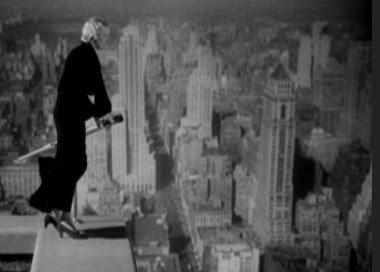
Verree Teasdale, in shock, goes to the roof of his magnificent building, stands precariously on the ledge, and allows herself to fall into oblivion.

In a previous scene, Warren William boasts of the grand accomplishment in life this skyscraper means to him.  “A million men sweated to build it.  I hate to tell you how many men dropped off these girders when it was being built, but it was worth it.”

We have barely enough time to catch our breath when the next scene is many months later, snow is falling softly in the city, and Hedda Hopper breezes by again, happily concluding a deal to sell the building and carry on with her immensely privileged life.


Maureen O’Sullivan chases Norman Foster for a second chance, and after some pouting, he agrees.  His fifty bucks a week salary is good enough now.  They are so shallow, we have a hard time caring about them.  Sometimes the very rich and the very poor have a lot in common if all they value is money.

  *******************************


My new non-fiction book, CHILDREN'S WARTIME ADVENTURE NOVELS - The Silent Generation's Vicarious Experience of World War II -- is now available in eBook here at Barnes & Noble, Apple, Kobo, and a wide variety of other online shops.

Or here from my Shopify store if you want to buy direct from me and avoid the big companies.

And it is here in eBook, paperback print, and hardcover, from Amazon.

From Cherry Ames, to Meet the Malones, from Dave Dawson to Kitty Carter - Canteen Girl, the Silent Generation spent their childhood immersed in geopolitical events through the prism of their middle grade and young adult books.  From the home front to the battlefield, these books are a window on their world, and influenced their hard-working, conformity-loving generation.

Related Products