IMPRISON TRAITOR, PEDOPHILE, AND CONVICTED FELON TRUMP.
Showing posts with label Raymond Huntley. Show all posts

Thursday, August 7, 2014

I'll Never Forget You - 1951 (Again)


I’ll Never Forget You (1951) is an exquisite time-travel romance, ill-fated, of course, for time is always our worst enemy, as well as being perhaps the greatest mystery in our lives.  This wistful film conveys those feelings, and illuminates the courage, longing, and heartbreak of the romantic couple faced with bridging a time gap of more than a century with their haunting relationship.

Tyrone Power is the time traveler, a nuclear physicist in post-World War II London, who travels back in time to escape a bleak modern world.  Ann Blyth is the 18th century woman he unexpectedly encounters, and with whom he falls in love.  We’ve discussed this film in a post from last year here, and compared it to Berkeley Square (1933).

I’m not going to re-hash the whole plot for this post, but I am going to discuss the final scene, which I left out in my original post, so beware of the spoiler.

This post will focus more on Ann Blyth’s performance, and I’ll lead off by quoting myself from last year’s essay:

Miss Blyth is fascinating to watch—all the cast are excellent—but she has a lot to convey and make us believe and she has to do this under acting restrictions that the other more emotional and physically expressive characters don’t have.  Her character is sheltered, demure, gentle, all qualities which can only be indicated by her posture, her voice, and disciplined economy of movement.  She walks softly, sits and stands with a ramrod-straight back, lowers her eyes at moments of mature discretion, a minimalist way of telling us who she is and what her world is like.

We've mentioned often in this year-long series on Ann Blyth’s career her versatility, her range, and her ability to create a character from the inside-out.  This quality is especially effective, and necessary, in this film. Her ability to inhabit a character helps her 20th century audience bridge the time gap as well.


I’ll Never Forget You, now a favorite of many who have discovered or re-discovered this film since its 2008 DVD release as part of a Tyrone Power collection, had a troubled past and a rocky start.

Tyrone Power, fresh from the stage in a six-month West End run of Mister Roberts was cast as Peter Standish, the time-traveling physicist. The film was shot at the Denham Studios in England.  The role of Helen Pettigrew, his beloved, proved a more difficult role to cast.  Several different actresses were considered, but Irish-born Constance Smith was finally chosen.  After about six weeks of filming, Miss Smith was replaced when Ann Blyth was quite suddenly loaned out by Universal to 20th Century-Fox and sent quickly to England in the spring of 1951.

The news reports of the day alternately reported that Constance Smith requested to bow out of the movie, and other reports that she was replaced due to pneumonia, or that she and Tyrone Power did not get along.  According to a biography of the director, Roy Ward Baker by Geoff Mayer, the author states that the real reason was Miss Smith’s “unsatisfactory performance.”

Having to replace one of the leads after six weeks, especially where color filming was involved, proved to be an expensive setback.  The studio, for whatever reasons, released the film without much build-up in December 1951.

The film languished, and disappeared, though an inferior black-and-white print was shown on television back in the day.  Until the 2008 DVD release presented a pristine print with the color scenes (the opening and closing scenes of this film are in black-and-white), audiences had not seen this truly beautiful film in decades.

The story is filmed carefully, meticulously, from the hazmat-style outfits of the modern-day scientists performing experiments with radioactive material in the beginning scene, to the 18th century costuming.  The radiation suits are meant to protect the scientists from contamination, but Tyrone Power encounters filth, disease, ignorance, and cruelty in the 18th century that is no less lethal.

Mr. Power idolizes the 18th century as the Age of Reason, yet he will face superstition and a disdain for science and logic that foil his attempts to help mankind in this era.  He will be persecuted for his knowledge.

The cast is excellent, as all described in my first post on this movie, and it is remarkable to think that Irene Browne, who plays Lady Pettigrew, the fluttering mother trying to marry off her two daughters to save the family from the disgrace of poverty, also played the same role in the 1933 version, Berkeley Square.

But this is more than a costume drama, it is a time-travel adventure, and three facets of this film, beyond the delightfully literate script, are I think what makes this movie successful in taking our imagination along on the trip – the tender, somewhat foreboding, musical score by William Alwyn, and second, Baker’s direction, with some wonderfully evocative moments – such as the image of Ann and Tyrone Power enjoying a peaceful day in the country, with two separate shots of passing carriages on the hill beyond them, both representing, literally, “trouble on the horizon.”  Also the use of the townhouse on the square, both the interior, that does not change through the centuries, and the exterior grounds of the square, which does, as another character in the movie. 

Most especially, of course, is the use of black and white to show the modern era, and the color stock for the 18th century scenes.  The color scenes are pretty, dream-like, and bring alive to us this distant past.  

However, we may note, incongruously, that the black-and-white film, beyond whatever statement it makes about the dreariness of post-War London, is actually a sharper, clearer image.  We can see contrast better.  We are wiser.  We know where we stand.  It is not romantic, but it is more real.

The third facet which contributes to making this movie work is Ann Blyth.

She may have been down on the list of candidates for this role, and a last-minute sub off the bench, but, serendipitously, could not have been a better choice.  As noted in my previous post on this movie, what she does with her body and voice is a very deft and intelligent interpretation of this 18th century woman.  Her light English accent is natural, and her carriage, lithe and graceful, yet rigid with that corseted waist and straight back, is used, along with her lowered glance, as a key for us to understand her world.  She is in a kind of bondage due to her gender, her class, her dwindling family fortunes.  

She is pursued romantically by the pompous Raymond Huntley, who jealously works to discredit and foil Tyrone Power.  Her reaction to Huntley's resentful, self-pitying wooing is one of acute embarrassment, pain and discomfort; she is too kind, and too poor, to tell him to get lost.  But still, she makes us feel she will not marry him, no matter what her mother wants.  This quiet young woman has a will of her own.  Tyrone Power is a godsend to her narrow world, who brings her excitement, passion, and her greatest heartbreak.

Ann Blyth brings depth to her character, and she enables Tyrone Power to break out of his awkward loner’s shell.  She gives him personality. 

Ann, the actress, moves as though conscious of being observed, as does her character under the watchful eye of society at the garden party.  Director Roy Baker uses her well, in two particular shots that I love: when she steps out of the coach, queenly straight as Tyrone Power takes her hand, and the hem of her dress ripples down the coach steps like a waterfall.  Also, when she walks away from Power at the end of the garden party, and she pauses, at the far end of the steps of the tented pavilion, to turn slightly and look back at us.  It is a glance of indecision, a reach across the room and the mysteries of time, to Tyrone Power.

Those shots belong to the director.  To Ann belongs the real tears that spring from her eyes when she and Mr. Power realize they haven’t much time left together, and her wondrous gaze into the future when she and Tyrone share a mind-meld vision of his world.  

It is so powerful, and so exhausting, they both break off with simply closing their eyes to illustrate the emotional release.  It is a kind of psychological consummation.

The time travel bit of the story is bookended by the opening and closing scenes which take place in the present.  Ann has a foothold here, as well.  Spoiler time.

Michael Rennie, who plays Tyrone’s colleague in the lab, tries to pull the loner out of his shell and reminds him that his sister wants to meet him.  At the end of the story, when Tyrone stumbles back through his own front door in a black and white world, Mr. Rennie reappears, and relates that Tyrone has been acting weird for several weeks, and that he and his sister have tried to look after him.  We know Tyrone's ancestor, the fellow Tyrone replaced in the past, is the weirdo.  But he’s gone back to his own world now, having switched places temporarily with Tyrone, and will marry Ann Blyth’s sister.

Mr. Power, barely able to deal with the loss of his beloved in the past, is stunned, as are we, when she walks through the door.  She’s not Helen, though; she’s Martha, Michael Rennie’s sister. 

It’s obviously a bone thrown to Tyrone, and us, to help heal the wound of his lost love, but it actually raises more questions.  When he bolts for the local graveyard to find proof that his 18th century love existed, and reads her headstone, Martha follows quietly and with gentle understanding.  He is shocked to discover Helen died only three months after he returned to his own time.  He surmises she died of a broken heart. 

Since this is one of those movies that make you think about the story long afterward, we wonder how awful it must have been for Helen to see the real 18th century Peter Standish marry her sister.  He would have known nothing about her, felt no love for her, been a complete stranger to her, except for his voice and his face, which is the image of her beloved, whom she will never see again.

Does Tyrone Power face a similar fate?  Here is Martha, so concerned about him, the image and voice of his beloved, but she is a total stranger.  Can we really expect he will replicate his love with her?  Does he expect that, or even hope for it?  When she and Tyrone, and Michael Rennie, walk, dreamlike, through the ground fog of the graveyard to leave us, is this the end of the story?  Never was an ambiguous ending so powerful.

For more on I’ll Never Forget You, have a look at this review posted on the Toronto Film Society website.

Come back next Thursday for another historical drama when Ann takes to the high seas with Robert Taylor in All the Brothers Were Valiant (1953).


********************
Mayer, Geoff.  Roy Ward Baker (Manchester University Press, 2004), p. 24.

The Southeast Missourian, May 22, 1951, p. 8, syndicated column by Erskine Johnson; June 4, 1951, syndicated column by Erskine Johnson.


*************************************************
I've started a Kickstarter campaign - looking for backers to raise funds for upcoming Ann Blyth biography - principally to offset costs of fees to obtain never or rarely seen photos in libraries, museums, and newspaper files. Please click on the notice box at the top right of this page.  It will run until August 24, 2014. Thanks to all who can help. 

****************************
 THANK YOU....to the following folks whose aid in gathering material for this series has been invaluable:  EBH; Kevin Deany of Kevin's Movie Corner; Gerry Szymski of Westmont Movie Classics, Westmont, Illinois; and Ivan G. Shreve, Jr. of Thrilling Days of Yesteryear.

***************************
TRIVIA QUESTION:  I've recently been contacted by someone who wants to know if the piano player in Dillinger (1945-see post here) is the boogie-woogie artist Albert Ammons. Please leave comment or drop me a line if you know.
****************************
UPDATE:  This series on Ann Blyth is now a book - ANN BLYTH: ACTRESS. SINGER. STAR. -
*********************
The audio book for Ann Blyth: Actress. Singer. Star. is now for sale on Audible.com, and on Amazon and iTunes.

Also in paperback and eBook from Amazon, CreateSpace, and my Etsy shop: LynchTwinsPublishing.


 "Lynch’s book is organized and well-written – and has plenty of amusing observations – but when it comes to describing Blyth’s movies, Lynch’s writing sparkles." - Ruth Kerr, Silver Screenings

"Jacqueline T. Lynch creates a poignant and thoroughly-researched mosaic of memories of a fine, upstanding human being who also happens to be a legendary entertainer." - Deborah Thomas, Java's Journey

"One of the great strengths of Ann Blyth: Actress. Singer. Star. is that Lynch not only gives an excellent overview of Blyth's career -- she offers detailed analyses of each of Blyth's roles -- but she puts them in the context of the larger issues of the day."- Amanda Garrett, Old Hollywood Films

"Jacqueline's book will hopefully cause many more people to take a look at this multitalented woman whose career encompassed just about every possible aspect of 20th Century entertainment." - Laura Grieve, Laura's Miscellaneous Musings''

"Jacqueline T. Lynch’s Ann Blyth: Actress. Singer. Star. is an extremely well researched undertaking that is a must for all Blyth fans." - Annette Bochenek, Hometowns to Hollywood


Ann Blyth: Actress. Singer. Star. 
by Jacqueline T. Lynch

The first book on the career of actress Ann Blyth. Multitalented and remarkably versatile, Blyth began on radio as a child, appeared on Broadway at the age of twelve in Lillian Hellman's Watch on the Rhine, and enjoyed a long and diverse career in films, theatre, television, and concerts. A sensitive dramatic actress, the youngest at the time to be nominated for her role in Mildred Pierce (1945), she also displayed a gift for comedy, and was especially endeared to fans for her expressive and exquisite lyric soprano, which was showcased in many film and stage musicals. Still a popular guest at film festivals, lovely Ms. Blyth remains a treasure of the Hollywood's golden age.


***************************

A new collection of essays, some old, some new, from this blog titled Movies in Our Time: Hollywood Mimics and Mirrors the 20th Century is now out in eBook, and in paperback here.


Thursday, September 5, 2013

I'll Never Forget You (1951) and Berkeley Square (1933)


I’ll Never Forget You (1951) is one of those quiet movies that if you catch it on a rainy day, the gentle memory of it will stay with you for a long, long time.  It’s a time-travel romance, and like all time-travel stories, from Edward Bellamy’s Looking Backward: 2000-1887, which was published in 1887 and has never been made into a movie, to Portrait of Jennie, to Somewhere in Time, the “present” depicted as the point from which the story is launched is as integral to the adventure as the final destination.  The “present” is the locale—or state of mind—from which the protagonist is trying to escape, and interestingly, because the past is fixed for us, the “present” is the part of the story that inevitably becomes dated. 
Long post.   Best to make some toast and let the dog out now.  Also a few well-meaning spoilers, for which I beg your pardon.
The “present” for I’ll Never Forget You is post-World War II, and the protagonist is a nuclear physicist.  The movie is a remake of Berkeley Square (1933), the “present” for which was 1933.  It was based on a play of the same name that was produced in London in 1926, and on Broadway in 1928, so the “present” from which to escape was one of Jazz Age frenzy, of motor cars and shallow society, and the memory of the Great War. 
The Broadway version of John L. Balderston’s play was co-directed by Leslie Howard who also starred.  It was a hit, and Mr. Howard reprised his role in the 1933 movie, for which he was nominated for an Academy Award.  I’ll Never Forget You is one of those times where the remake is better than the original, partly because of technological advances in filmmaking, and partly because I think the story benefitted, was really fleshed out, when launched from a more somber and mature “present”.  The 1933 version shows a fitful, restless dissatisfaction with the “modern age,” but the 1951 version has nuclear annihilation as its “present,” with the prospect of no future at all.  Curiously, I’ll Never Forget You is a brighter, more hopeful movie despite this.
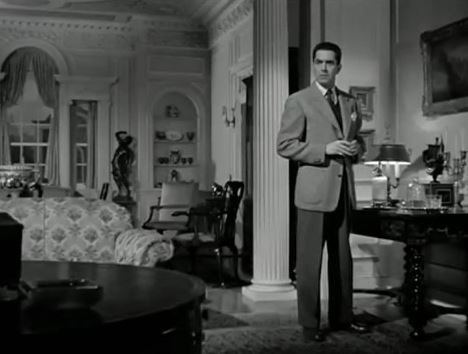
Tyrone Power plays Peter Standish, the atomic scientist burdened with guilt and despair over the enormous ethical and moral consequences of his work.  The story is set in London.  He is an American helping with the British nuclear program, and he lives in an 18th century townhouse in Berkeley Square, a home he inherited from a distant cousin.  The furnishings of the house are original, and with the exception of modern plumbing and electricity, the rooms look pretty much as they did in the late 1700s.
On the wall above the fireplace is a large painting of his distant relative, painted in 1784, a man also called Peter Standish.  He looks exactly like Tyrone Power.
One of the intriguing aspects to the movie is that we never really slip off into a ghost story, though it feels like this could happen any moment.  However, Tyrone Power finds reality far more haunting than any supernatural elements of the story.  Tyrone orchestrates his trip to the past as carefully as he would conduct an experiment in the lab—or nearly so; he does make mistakes, and they cost him. 

Along with the furnishings, he has discovered this 18th century Peter Standish’s diary, which tells of his life in this house.  He was an American, too, a veteran of the Revolutionary War.  In 1784, the war over, he traveled to Britain to meet his cousin, Kate Pettigrew to complete an arranged marriage with her.  It was through his marriage to her that he came to live in this, her family home.
The last few entries of the diary are strange, as this Peter Standish fancies he has seen into the future, experienced life in the 20th century. 
Tyrone Power, so absorbed by the past of this house, and armed with the diary of Peter Standish, concludes that he and Standish will switch places, that it is inevitable that they do so, for a limited time.  Then, as noted in Standish’s diary, Standish will return to his own time and marry Kate, have children, and live his life here.  Tyrone Power therefore believes that he, too, will return to his own time, but not before he enjoys one heck of an adventure.
He needs some time off, anyway.  He’s been working too hard.
We begin at the lab, with concrete walls and eerie glowing dials, an experiment in some reaction of two substances that cast off a white glare, gauges that measure in Röntgens, and serious men doing unfathomable science.  It’s a slow start to the movie, but curiously intense.  At one point, Tyrone pushes an experiment to the danger zone, and his boss has to remind him not to take chances.  He thinks Tyrone needs some downtime.
Handsome Michael Rennie is his co-worker and the closest thing Tyrone has to a friend.  Mr. Power is a loner, and his socially awkward manner with Rennie, who has also been trying to introduce him to his sister, is a really good fit for the character.  (In Berkeley Square, Leslie Howard just seems like a boyish eccentric with too much nervous energy.  Tyrone Power’s brooding introspection is more appealing.)

But having said that, I love the comic moment when Leslie Howard delightedly discovers his pony tail.
“What about going away for a while?”  Rennie asks companionably.  Power replies, “I am.”  It’s a long shot with the room, cavernous, foreshadowing his portal to the past.  He confesses his theory about his upcoming time travel to 1784.  He explains, much as other writers have sought to explain, that time is not a straight line, the way we might draw a chronology of events.  It co-exists in another dimension.
“I believe the 18th century still exists.  It’s all around us if only we could find it.”  What particularly appeals to him is the break from nuclear annihilation, although, despite the scary lab at the beginning, this is never spoken, only implied, as are the horrors of World War II, and the Holocaust.  The director knows the audience doesn't need reminding.  Indeed, they've come to the movie theater to forget the front page.  Similarly, Tyrone Power looks forward to returning to “The age of reason, of dignity and grace, of quietness and peace.”

A thunderstorm is brewing outside, and the lights go out.  Tyrone lights a candelabra and takes Mr. Rennie upstairs to see the diary.  Creepy music as they climb the stairs—shades of a ghost story, but not quite.
Michael Rennie thinks he’s nuts, but he’s a tactful guy and worried.  He implores Tyrone to leave the house, as it seems to have cast a spell on him.  Tyrone sees him to the door, and stands outside a moment on the steps as a thunderstorm moves in.  Time travel in this story is done by thunderstorm. 
A clap of thunder, a bolt of lightning, and Tyrone falls, collapsing on the landing.
The camera draws our attention to the door of the house, as the metal mail slot begins to disappear.  Then an arm reaches up from the landing—Tyrone’s arm, grasping for the knob to pull himself up.
 
 
A tuft of lace protrudes from the sleeve of his coat, a striped pattern—and it's--in color!  Upon opening the door of his own home, he sees Kate, his intended, here played by Beatrice Campbell, lowering herself to a deep curtsey in a hall of soft colors and the muted gentle sound of a harp playing a light air (or ayre, we are in London).  Tyrone’s in 1784.  (Oooh!  Pretty!)
This Wizard of Oz-style use of a dreary black-and-white existence and escape into a Technicolor world is only one of the technological improvements on the original Berkeley Square of 1933, though to be sure, it is the most spectacular. 
Counting the original stage play, these three incarnations of the story are interesting for what their medium allows them to convey.  The original stage script is tight and very witty, with one character, Kate’s brother Tom, who is a rogue, getting a crack at some risqué dialogue.  One can sense the inventive use of present/past on a fixed set.  I don’t know if this old chestnut is staged anymore, but I’d love to see it.  I enjoyed reading the lively script very much.  (By the way, I understand there was a TV version in March 1949 with Richard Greene and Grace Kelly in the lead roles.  Wish I could see this.)
Berkeley Square the movie is toned down both in language (less saucy) and action, and has a somewhat confusing beginning showing Leslie Howard as the original Peter Standish enjoying the fellowship of his new friends in a pub.  Then we must work to accept him as the 20th century version.  The movie attempts to follow the play, with only a few scenes out of the house, but what might be called stagey I think is really just downright static.  There is very little movement, and we could attribute probably a lot of that to early sound camera issues which kept the actors practically bolted to where the mic was.  As it is, the sound is scratchy and the film quality is somewhat poor.
I’ll Never Forget You takes up the script from the previous movie and the stage play and to a much farther place, a poignant, dreamlike scenario that is continually punctuated, as all time-travelers find out, with the ultimate knowledge that the past wasn’t such a great place.
Tyrone Power meets the family he’s pretending, as the 1784 Peter Standish, to marry into, and we can see his interest, his sense of adventure, even his latent sense of humor warming to the occasion.  He has trouble relating to people in his own time, but here he is allowed to be a different man, and he bravely attempts sociability like a shy boy eager for friends at a party.
Irene Browne plays Lady Anne, Kate’s mother, who, like any good mother in a Jane Austen novel of the period is desperately trying to marry off her daughters.  Her husband is deceased and left them with debts.  Her rascal son, the indolent gambler, drinker, and chaser of servant girls, Tom, is played with irresistible panache by Colin-Keith Johnson. 
“What do you call the colonies now?” he asks Tyrone.
“The United States of America.”
“Trifle pompous, don’t you think?  But after all, it’s only temporary.”  He refers to constantly putting his boot-in-mouth, but we sense that saying the wrong thing at the wrong time is Tom’s favorite hobby.  He is particularly pleased to have Tyrone marry his sister, because Peter Standish is said to have 10,000 pounds a year income.  Tom wants to mooch off him.
Then Tyrone is introduced to the younger sister, Helen, about whom he knew nothing, as the original Peter Standish did not write of her in his diary.  She is played here by Ann Blyth, who becomes an ally of Tyrone’s when she generously covers for him as he blunders about knowing something he really can’t have known.  Before long their curiosity for each other turns to love.  At first she resists, because he is to marry her sister, but when she learns from him—and more importantly, believes—that he is a different Peter Standish from the future—she allows herself to enjoy a sweet, passionate, and ultimately hopeless love for him.
Miss Blyth is fascinating to watch—all the cast are excellent—but she has a lot to convey and make us believe and she has to do this under acting restrictions that the other more emotional and physically expressive characters don’t have.  Her character is sheltered, demure, gentle, all qualities which can only be indicated by her posture, her voice, and disciplined economy of movement.  She walks softly, sits and stands with a ramrod-straight back, lowers her eyes at moments of mature discretion, a minimalist way of telling us who she is and what her world is like.  Her lovely face melts into a smirk at one of Tyrone’s naïve attempts to “catch on” to this old way of life.  She also has intelligence, and a sense of humor, making her the most reasonable and capable member of her family.  In trusting Tyrone and his tales of a future world, she is also the most courageous.  Like Tyrone, she silently carries burdens, the chief of which is the pressure by her mother to marry a much older man who is also a self-important jerk.
He is played by Raymond Huntley.  Something about the voice was tantalizingly familiar, and then I remembered him from the BBC series Upstairs/Downstairs.  You’ll recall he was the family solicitor, Sir Geoffrey.  Here he is a man always clinging to this family, trying to work his way in, and becomes jealous of Tyrone’s easy friendship with the beautiful young woman he had culled out of herd for himself.  His resentment will lead to revenge.
By the way, the role of Helen was played on Broadway with Leslie Howard in 1928 by Margalo Gillmore, who we met here as the superior officer in Skirts Ahoy from 1952, the year after I’ll Never Forget You was released.
Tyrone navigates through parties where he meets the greats of the age, including James Boswell and Samuel Johnson, and sees enough of the wretched filthy streets of London, including a glimpse of children being abused in a workhouse, to understand that life in the 18th century was not without its misery.  He becomes disillusioned. 
 
He also makes more and more blunders, and people begin to pull away from him in fear of his seeming ability to predict events.  He becomes just as isolated as he was in his lab (feeling comfortable in the lab environment, he even attempts to recreate it by performing simple experiments in a rented basement).
The date in Peter Standish’s diary that marks the end of the adventure is drawing near, but Tyrone does not want to leave Ann.  The authorities, when he has been accused of sorcery, will have the ultimate power over him.
Director Roy Ward Baker tells the story with exquisite cinematography and actors that are beautifully choreographed, not just the requisite Austen-like ball scene, but in ordinary circumstances.  When Tyrone Power hands Ann Blyth out of a coach, her long dress ripples to the ground, dripping down the metal fold-out coach steps. 
Shots of the rooms in the house, the stairway, the halls, convey mood and the house becomes like another character in the story.  The muted colors are lovely.  A bowl of colorful flowers catches our eye in the foreground as the actors stand behind, held together by the pastoral scenes on the wallpapered panels in the background.  The outdoor shots of London streets, of the quiet square, of the peaceful countryside, of Tyrone Power gazing out the window at night with satisfaction on his first day in the Age of Reason.
 
 
I like how Tyrone and the other men have a slight five-o’clock shadow in the color sequences that looks very much like men in the 18th century oil paintings.  This is a really nice piece of detail.  I don’t think this would have shown up well in black and white.
There are some major scenes that are handled differently in I’ll Never Forget You than they were in Berkeley Square, with very good effect, and turn the ending from a flat tragedy to a more hopeful, romantic, if equally gut-wrenching ending.
First, the crux ansata (more commonly known as an ankh) is a symbol of eternal life and was a trinket brought back from Egypt by Helen’s deceased father.  In Berkeley Square, Leslie Howard has this item from the beginning of the story as something he found in the house and wonders what it is.  Later on in the story, when he is in 1784, the Helen character shows it to him, and says she will leave it in the house as a symbol of their eternal love and connection.  At the end of the story, when he has returned to 1933, he holds it mournfully as a symbol of his lost love.
I’ll Never Forget You uses the crux ansata in a more romantic and suspenseful way, when at the point Ann Blyth realizes Tyrone Power must return to his own time, she shows him the object, tells him of its significance, and demonstrates that she will hide it in a secret compartment in a desk for him to find one day as a reminder of her.  At the end of the story, when Tyrone is back in 1951, he has a fleeting few time-travel hangover moments where he thinks his adventure was all a hallucination. 
Then—aha!  He remembers the object, and runs to the hiding place.  He fumbles a few moments, not able to locate the hidden drawer.  Will he find it?  Is it there?  Please let this not be a dream!  (If we just wasted 90 minutes of our life on a dream sequence we are not going to be happy.)  And then—bingo!  His recovery of the crux ansata is joyful.
Another scene played very differently is when the Helen character, who hints that she has envisioned Peter coming to her before they met—she had a vision of him walking down the staircase holding a lighted candelabra as we saw him in modern times—and she wants to see into the future.  She looks into his eyes and through what is, I guess, meant to be a telepathic communication between them, she sees fleeting images of his world as he thinks of them.  In Berkeley Square, Helen is played by Heather Angel (We last saw her here in Cry Havoc), who though a lovely young woman, has a bit of a deer-in-the-headlights look in this movie which I think is meant to be shorthand for her soulfulness.  Her visions are splashed on the screen as stock footage of skyscrapers, locomotives, racing cars (racing cars?) biplanes, warships, gangsters, and finally World War soldiers in gas masks, bayonets drawn, flamethrowers—and she is horrified.
“Devils!  Devils!  God, would not put us here to suffer for a race of fiends like that to come after us!”
Powerful sentiment, and the image of gas masks, that iconic, ultimate horror of World War I, lingers even today as we lately hear about the threat of chemical warfare.
I’ll Never Forget You has a drastically different take on this scene.  Instead of the horrors of World War II and the nuclear age, Ann Blyth sees only beautiful cities lit by electric lights in Tyrone Power’s dark, sad eyes.  There is no stock footage superimposed over her beatific expression, we have only the trust we have invested in her, and the trust she has invested in him, to know that her wondrous visions are real. The message here is not to pound us with our recent horrors, but to count our blessings. 
“What a beautiful dream of heaven.  Who would want to leave a world such as that?”
Tyrone returns to his own world, by force, when magistrates drag him down the staircase, off to the lunatic asylum, and we see a magnificent shot from Ann Blyth’s vantage point on the upper landing to the hall below.  The great double doors close behind Tyrone Power and his captors. 
 
 
Then more flashes of lightning, and the warm colors fade into crisp black and white.  The door slowly opens again, and Tyrone is in modern dress, his hair cropped, his arm tentatively reaching for the light switch.  As he enters the house, looking all around at these rooms that have not changed with the centuries, we hear a soft, plaintive reprise of an 18th century flute piece.  Truly, the past is alive around us if we are perceptive to it.
How we perceive our own times is the spectrum through which we judge the past.  How fascinating that the modern Peter Standish’s perspective of his own era (or rather, the filmmaker's perspective) could change so much in the eighteen years from 1933 to 1951. 
There is more to the ending that I won’t spoil for you, but it is open to our imagination, and imagination is the very essence of time travel. You can watch both Berkeley Square and I’ll Never Forget You on YouTube.  I’d love to know what you think.

Our friend Laura at Laura's Miscellaneous Musings discusses I'll Never Forget You here.


Related Products