IMPRISON TRAITOR, PEDOPHILE, AND CONVICTED FELON TRUMP.
Showing posts with label Montgomery Clift. Show all posts

Thursday, June 8, 2017

The Search - 1948


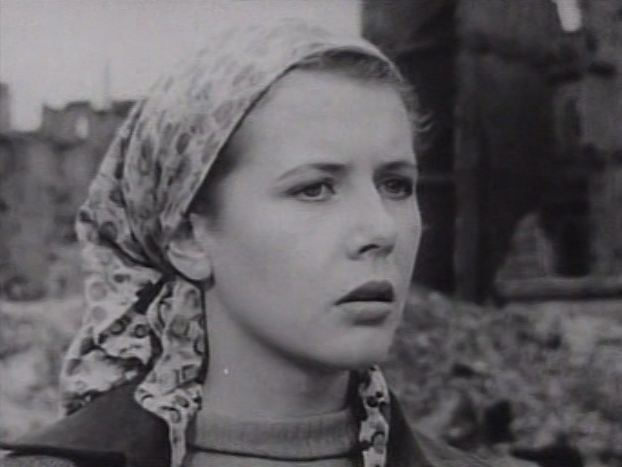
The Search (1948) is tenderly filmed.  The plot of the story carries the weight of the world and the eternal suffering of children during war, but lifts our hearts, though they may be breaking, as if on wings of angels.  Those angels are UNRRA (United Nations Relief and Rehabilitation) workers, and a young GI, and even us, if we have taken this movie to heart and take something away from it.

This is the fourth post in our series on how Hollywood depicted children during World War II.  This time, we leave the well-fed American kids behind, and step back to Europe in the aftermath of war.  It is said that the first casualty of war is truth.  The final byproduct is refugees. 

We encounter a small boy, one of the millions of refugees after World War II who have been released from concentration camps.  He is brought with nameless others to an UNRRA central tracing bureau to be processed and, if possible, reunited with relatives searching for them.  The movie takes on documentary-like qualities as we follow the children upon their arrival, sleeping in a boxcar on top of each other, ragged, sallow, starving, and sick—and terrified of the UNRRA personnel in uniform.  It is how they began their journey to the concentration camps; it is how the war ends for them.

Aline MacMahon, one of Hollywood’s finest and most valuable players, is in charge and interviews the kids in many languages.  Ivan Jandl plays Karel, a boy who was separated from his mother at Auschwitz.  His father and sister are dead.  He does not speak, only automatically repeats, “Ich weiss nicht,” (I don’t know) to answers put to him.  He is like a zombie, wooden, haunted, and barely able to function.  He also suffers from amnesia from the trauma of the concentration camp.  His number is tattooed on his arm.

In a moment of panic, he and another boy escape and wander the ruins of this German city.  Attempting to cross a river, the other boy drowns.  Though director Fred Zinnemann crafts a gentle telling of the story, it is nevertheless unblinking in its frank observations of the tragedies we witness.  Karel loses only his knitted cap in the water, and when that is recovered by UNRAA staff, they believe him to have drowned as well.

Alone now, Karel wanders aimlessly, until he meets Montgomery Clift, an Army engineer, part of the army of occupation.  Clift feeds him, takes him back to the building he shares billeting with Wendell Corey.  In days to come, the boy is cleaned, dressed in new clothes, and Clift teaches him English by naming objects in pictures torn from magazines.  Karel seems contented, but he still cannot emotionally or by memory connect with his past.  Clift wants to take him back to America.

That involves tremendous red tape. 
Eventually, he will take him to the UNRAA camp to help facilitate his adoption of Karel, whom he calls Jim.  This was Montgomery Clift’s first film, and he is a marvel of natural and riveting screen presence.  Many of his joking remarks and responses to the boy seem ad libbed and he has a wonderful off-the-cuff and in the moment delivery.  He is a lighthearted young man, quick with a funny quip, but the deeper he becomes involved with the boy the more sober he becomes.  (And his character may remind us of his role in The Big Lift-1950, which we covered here.) When he tries to form a plan to get the boy to the U.S., Wendell Corey counters that it is impractical and the rules impeding this are necessary: “We’d have all of Europe in America if we didn’t have those rules.”

Clift responds, “So what?”

“You’re the one who used to make cracks about those filthy DP’s, remember?”

“I did?"

“Yes, you did.  Not so very long ago, either.”

Clift answers, “Well, now I’ve learned something.”

Indeed he has, and we still struggle with that argument today.

Mr. Clift has a nice, easy rapport with the Ivan Jandl, who was from Czechoslovakia and only made a handful of films.  He is a splendid interpreter of this role: unaffected, natural, and perhaps wise beyond his years in his intuitive relationship with the camera.  It is also a wise choice on the part of director Zinnemann to follow the boy with long scenes of no dialogue.  We see deeper into the child’s world if we are allowed to adopt his mindset and we can do this more easily if we take on his silent observation of the world around him.

One of the most affecting scenes in the movie is when Wendell Corey’s wife and young son arrive to share their housing.  Clift will be rotated back to the U.S. very soon, but Corey will be part of the army of occupation for a while yet.  Karel observes Corey’s son interacting with his mother.  At one point, the son cries and the mother comforts him.  This triggers a long dormant memory in Karel.  He asks Clift, “What is a mother?”  Charmingly inventive, Clift points to one of the magazine photos thumbtacked on the wall of their room that he has used to teach the boy English.  It is a photo of a long-eared funny-looking bloodhound sitting next to a smaller pup.  Presumably, he has used this photo to teach the boy the word “dog.”  Now Clift points to the bigger dog and says, “This is the mother.”  Then to the puppy, “This is the child.”

Karel chews on this a while, and grows distressed. Looking at the photo, his expression becomes pained, and he struggles with a scene that remains in his mind of a woman who had been with him in the camp.  As he sits and almost like an automaton, draws lines on a paper, he suddenly remembers the pattern of the chain link fence in the camp.  Earlier in the film, we are given a flashback scene of when his mother was taken from him, separated into a different camp.  She calls to him, and kisses him through the small opening in the chain link fence.

It all comes back to Karel now, and he sobs, and he demands that Clift help him find his mother.  “Where is my mother?  I have a mother.  I know I have a mother.  Where is she?”  Clift believes Karel’s mother is dead, and tries to distract him with talk of going to America.  Karel is angry, and sneaks out in the night.

We follow him again across the ruins of war-torn Germany, until eventually; Clift finds him and takes him to the UNRRA camp where he hopes to begin the paperwork of adopting Karel.

Earlier in the film, we are shown that Karel’s mother, played by celebrated opera singer Jarmila Novotna, whom we also saw here in The Great Caruso (1951), has survived and is searching for him.  In a nail-biting series of circumstances, they continually miss each other.  Aline MacMahon helps to put together clues, and we are given the gift of finally seeing mother and son reunited.  I don’t know if we could take this movie if that didn’t happen.

The Search is really a very simple story, simply filmed, about very complicated geopolitical issues, and that is the wonder of it.  It allows us to see a large picture on a very small scale and connect with it in a personal way.  The movie was filmed, at least in part, in Europe so the location shooting is stark and genuine.  We do not have the optimistic and jingoistic approach of helping children in wartime as we saw in The Piped Piper.  We were still fighting the war then.  We are in the aftermath now, where at least as far as the mind of a child refugee is concerned, the world is borderless, without nationalities or allegiances—but it is not free.  It is a nightmarish maze of confusing obstacles.  Every grownup who displays compassion is a monumental hero.  

Come back next Thursday when we finish our series with a look at another March of Time short subject, a world away and back to America with the dawn of a new age—not the nuclear age, but the Teen Age.

Our previous posts in this series are:


*********************
The audio book for Ann Blyth: Actress. Singer. Star. is now for sale on Audible.com, and on Amazon and iTunes.

Also in paperback and eBook from Amazon, CreateSpace, and my Etsy shop: LynchTwinsPublishing.


Monday, December 5, 2011

Uneasy Victors - Pt 3 - "The Big Lift" -1950


“The Big Lift” (1950) straddles the period of our role as occupiers in Berlin, and as “combatants” in a new kind of war, a Cold War. Geopolitical past and future fused together in the awkward present of 1948 Berlin.

This is our third entry in the series on Uneasy Victors. Have a look at the intro here, and at last week’s post on “A Foreign Affair” (1948) here.

The movie has a documentary feel to it, yet there are elements of humor, adventure, and intrigue. Though the backdrop is highly political, the conflicts faced by the characters are not really political in nature. They are personal.

Montgomery Clift, in his fourth film, (he’d just finished “The Heiress” which we discussed here) is the opened-hearted, open-minded youth, an enlisted man in the Air Force who works as part of the ground crew. We don’t know about his past or if he has plans for the future; he’s very much a here and now kind of guy, living for the moment. His thin, handsome face is a strange cross between rugged and fragile, and we could take that as a metaphor for much in this troubled actor’s life.

Paul Douglas, also in his fourth feature film, but who always seemed to move and sound like a veteran, plays another man in Clift’s outfit, a radar operator. He is older, and wiser in the sense he is more cynical. He has been in the service many years, and we can see he will spend his career here. Both are stationed at Hickham Field in Hawaii.

These opening moments of the film are evocative of World War II and the place where disaster struck, the bombing of this base and Pearl Harbor, that brought the US into the war. We see a newsreel at the very start that tells us the Russians are blockading Berlin, which was divided among the victorious Allies into the French, British, American, and Russian sectors, from getting supplies overland. All roads, railroads, and canals are blocked, leaving the British, French, and American sectors of the city isolated. The Russians want to force those nations out.

Then the camera pans back and we see we are in a small auditorium where American servicemen are watching the movies. Suddenly a loudspeaker announcement calls a particular unit to report for duty, and Clift and Douglas rise from their seats with a groan.

The map is a little off - Chicopee is not in central Mass.; it's on the Connecticut River in the west.

It’s a fast way to set the story. In a few moments, their unit will be on a cargo plane bound for the mainland. The map takes us across the Pacific, and then across the continent to Chicopee Falls, Massachusetts and Westover Air Force Base. We see a glimpse of the base, the huge runway, the hangars, and a sign in the foreground telling us where we are.


Where we are is the largest air force base on the east coast, which in the new Cold War, became an important point of embarkation, supply line, (and eventual line of first defense in the nuclear age), and the jump-off point to the boys’ final destination -- Berlin. They are going to help ferry food and fuel to the stranded Berliners in a remarkable mission called Operation Vittles, and would be known as the Berlin Air Lift.

Stop by my New England Travels blog tomorrow for a post on a unique side operation of this mission, “Operation Little Vittles” in which Chicopee, Massachusetts packs tons of candy, ties them to handkerchiefs to be used for parachutes, and turns them over to Westover Field so that the men flying these missions can drop candy to the kids in the ruins of Berlin.

The documentary style of the movie is evident in how patient director George Seaton is, letting us experience the mission as it unfolds. The men’s ignorance on what the mission is to be. The long flights. The arrival at Rein-Main field in Germany, and then the final, nerve-wracking hop into Templehof and Berlin. The large transport planes, because of the restriction on fly space the Russians have put on them, have to navigate a very narrow strip, and because the landing field is set in very close proximity to the five-story brick buildings of the neighborhood, the planes must literally skirt the rooftops. In one shot we see a plane land from a side view, and as it dips below the line of roofs, the tail of the plane looks like a shark’s dorsal fin slicing the ocean waves.

“Just like landing in the Rose Bowl.”

The planes land with their cargo, unload, and then take off again every few minutes. It is an exhausting, round-the-clock mission that will last for months. It was our first response to a belligerent Soviet Union testing its influence. It kept the Berliners alive. It was one of the proudest achievements of the United States Air Force.

Just as we saw the American congressmen marvel at the ruins in Berlin as their plane arrives in “A Foreign Affair”, so are Paul Douglas and Montgomery Clift amazed at the devastation.

“Boy, this place sure caught it, didn’t it?” one of the men exclaims.

“Not enough. This is where they should have used the A-bomb,” Paul Douglas says.

This movie takes up where “A Foreign Affair” left off. We are a little farther along in our jobs as occupiers, and there is still the conflict between offering mercy and wanting revenge, between punishing the enemy and building friendships. Paul Douglas acts like the Ugly American, being as rude as he can to the German laborers employed at the landing field. He is dismissive and bullying to the Berliners he meets in town.

“Don’t start feeling sorry for them. They hate our guts. If the situation was reversed, they’d kick your teeth in twice a day.”

Paul Douglas is more than just the voice of vengeance and disgust with the vanquished enemy. He has a deeply personal reason for hating the Germans.

He was once abused as a POW in a German prison camp. While in Berlin, he will discover the prison guard who beat him. In a brutal scene, both men catch up with their destiny.

The movie has a nice mix of comedy that is kind of like blowing off steam at intervals between these dramatic moments. Some of the humor is macabre, like when the men have “fingers crossed” as part of their landing checklist. When Douglas, whose “schatzi”, played by Bruni Löbel (who had a long career in German film and television), wants him to define “democracy” because she is curious, he becomes an irate, frustrated, inarticulate teacher. He has no idea how to explain it, and tells her repeatedly to just shut up.

The best he can come up with is, “It’s a kind of feeling, a way of looking at things.” He explains that America is run by the people, and a light bulb goes on and she thinks it must be like the Soviet Union, which is also said to be run by “the people”. Douglas nearly has a stroke.

Another funny moment is when the men first land and find themselves dragged into a welcoming ceremony. The flight crew is paraded down a long aisle of Berlin guardsmen, under an arch of rifles, to the sound of a band. Montgomery Clift, voice shaking, nervously remarks,

“I feel just as if you and I were getting married, Lieutenant.”

At the welcoming ceremony, an old man, a young boy, and pretty woman who represent grateful citizens of Berlin, present speeches and gifts to the servicemen. They are dignified, proper, speak carefully-intoned English and display the requisite amount of humility for the newsreel cameras. The picture of the defeated enemy as possible friends.

Clift hooks up with the pretty woman, played very naturally by Cornell Borchers (who made only a handful of films in the 1950s, most of them German), and his Berlin romance begins. Her husband was killed in the war by the Russians. Her father stood up against the Nazis. Both tragedies make her a sympathetic heroine and worthy object for Monty’s affections.

He gets a pass and sees her in Berlin. When he gets paint on his uniform and must walk the streets in ragged clothes she has borrowed for him, Clift’s whirlwind escapade among the ruins in Berlin is where Jean Arthur’s ended. In parts it is just as wild and funny, and in parts more insightful and morose. This is a Berlin Americans don’t get to see on the newsreels cameras, the jostling for food, the enforced labor at shoveling rubble, the checkpoints and identity papers, the cold days and colder nights.

Because Clift is without his uniform and his identity card, he is a man without a country, and in danger from all sides, from straying into the Russian Sector, and from his own American MPs. At one point, they duck into a tavern, not too unlike the cabaret we went to in “A Foreign Affair”, where in an effort to escape the MPs, Monty hops on stage and stumbles through “The Chattanooga Choo-Choo” with a German quartet. When they start a verse in German, his panic, and his solution, are very funny.

Clift’s romance with his Berlin girlfriend is progressing. She is very pretty, and quite brave in facing the hardships of the post-war world. She accepts German defeat even though she bears no responsibility for the Nazi regime. When Clift, still without his uniform which is locked up in a tailor’s shop, spends the night, they embrace in a darkened apartment in front of a window. Behind them are the lights of the runway, and a huge transport plane flies right towards them.

The script and direction seem to take turns between using brief but stunning images like this to tell the story through metaphor, and alternatively trying to back it up with a wordy primer on German-American relations. It feels like propaganda at times, but it is probably useful for the American audiences watching the film at the time. For us today, it is a window on an era.

Both men and both girlfriends get together for a gemutlich little party with the neighbors, one of whom once traveled the US as an actor.  Today, he is a spy for the Russians, who pay him to count the American planes.  He gives them false numbers because they won't believe anything he reports anyway.

Gerde asks him, “What did you like best about America?”

He replies, “The way the Americans didn’t like it.”

Paul Douglas smiles. He directs Gerde with a glance to pay attention. He understands what the actor is trying to say.

“I mean, what they used to say about the government!”

They all laugh, and Gerde tries to understand a puzzling country where criticizing the government is okay.

Gerde works in one of the food service wagons on base. On another day, still brooding over this thing called democracy, she asks Paul Douglas about injustice in America. She points out that she has been reading a book, and by the description of the story, we know she is making a reference to “Gentleman’s Agreement”, which was also made into a movie by the same company, 20th Century Fox, a couple years earlier.

Gerde says that since the Americans were against Hitler for his actions against the Jews, how could it be that “in America Jews are kept out of certain hotels and schools?”

Douglas admits, “It shouldn’t be. It stinks.” And then he asks her where the book came from, and she says the PX. Ah, he says, finding a saving point. Would the Russians put out a book criticizing Russia in their stores? Being open about our prejudice is at least a point of honor, he wants to impress upon her. She is dubious.

Douglas is dubious about Clift’s romance with the Berlin beauty, and investigates her. Her husband was not killed by the Russians. Her father was not anti-Nazi. She seems tarnished now. She is less a heroine and more of Berlin enigma. Clift confronts her and she admits lying.

“When you have to live by the generosity of others, you have to make yourself pitiful and brave.” There is a nice shot of a wall behind her in the distance collapsing and crumbling to rubble, more rubble she will have to shovel.

This film is conscientious about showing us all sides. The United States, with rampant prejudice, is not as free a place as we claim. German gratitude may be false and self-serving. The only thing we can be sure about is the Russians are bad guys, when they are discussed at all. The foolish clowns from “A Foreign Affair” are absent here. The film’s main flaw is that we lose them and the question of who they are now. They have not even been replaced with a stereotype yet; they are shown only as rumor and headlines. In the early 1950s, we will come to choke on our paranoia and let it poison us.

Montgomery Clift struggles with his girlfriend’s duplicity, but decides after all, she was only a girl during the war. She cannot be held responsible for her family's involvement.  She is only trying to survive.  He wants to marry her.  Part of his desire, we may suspect, is the wish to save her.

He goes through the chain of command paperwork to get permission. One of the most interesting things about “The Big Lift” is that in various scenes we see a lot of military personnel. A lot of them. In this entire movie, only Paul Douglas and Montgomery Clift are actors playing Air Force men. Everybody else in uniform is an actual serviceman. This gives the movie that realistic documentary style. You also have to admire the acting ability of some of them. The commanding officer, Major Hetzel, who pushes through Monty’s marriage paperwork is quite funny in his scene after shouting over the phone and losing his voice.

While marriage plans are progressing, Gerde finally gets the lowdown on democracy, but not from Paul Douglas. With his bullying ways, he is a poor teacher. She got herself a government-issued pamphlet and has memorized the Constitution and Bill of Rights. Filled with enough righteous indignation to blow the roof off a New England town meeting, she hollers at Douglas and demands he stop bullying her. She calls him a stormtrooper.

Douglas is impressed, and like all bullies, backs off when she stands up to him. “Don’t let anybody push you around, not even me. That’s democracy!”

Another World War II-era metaphor is complete when she chucks a can of SPAM at him.

I won’t reveal how the relationship develops between Clift and Fraulein Borchers. It’s an 11th hour surprise, and lessons are learned by everyone.

Though the tours of duty are ending and men are being rotated home, Paul Douglas decides to stay in Berlin. He is kinder to the German laborers on the base, and even helps them out by speaking fluent German to them, which he was forced to learn in the POW camp.

“I suppose if we’re going to sell these stoops on a new way of living, you got to be a pretty good salesman.”

Then they hear over the radio that the Russian blockade of Berlin is over. The good guys have won. It is a World War II kind of patriotic moment, but the really impressive ending of the movie is the “curtain call” style end credits where we see the real-life military men who had speaking parts in this movie lined up as if for roll call.

Incidentally, the journalist who interviews Montgomery Clift and Paul Douglas when they first arrive in Berlin is Richard O’Malley, an actual journalist for the Associated Press.

Come back Thursday when we finish our series on “Uneasy Victors” with “Judgment at Nuremberg”, which takes us back full circle.  The first point of order for the occupier is to establish order and rule of law.  The second is to hold the bad guys accountable.  But it is a quickly changing world.  The political map of Europe is being altered day by day.  How do we settle accounts, so to speak, when nobody wants to live in the past anymore?  Montgomery Clift and Marlene Dietrich both return for impressive encore performances in very different roles.

Thursday, March 18, 2010

Rich Girls - Part 1 - The Trouble with Father

In The Heiress (1949) and Invitation (1951), we have two motherless young women whose wealthy fathers betray them emotionally. Each is romantically pursued for her fortune. Each must come of age under extreme duress and pass through a kind of trial by fire to reach a sense of empowerment. For one, even that final achievement is sad because she does not find what the other has been serendipitously gifted: a husband who loves her.

Before we entwine these two films together, we need to yank them apart. The Heiress (and I must make mention, once again, of the wicked Carol Burnett parody which always comes to mind when I watch this film, alluded to in this post) was originally a stage play, which was originally from the Henry James novel Washington Square. Our view of the setting of this Gilded Age story is fairly authentic, in sets, costumes, and hairstyles because of this, and since this is a post-World War II film, we may marvel at the similarities from one century to another in depiction of an otherwise undesirable woman’s chances for marriage (her highest hope for success as a woman) being based on her wealth.

Olivia de Havilland is superb as the intelligent and sensible, but shy and awkward daughter of a sarcastic and self-superior father, played by Sir Ralph Richardson. (Though Wendy Hiller played Olivia’s part on stage, and I would have loved to have seen her, too.) Richardson dominates her in a subtle swordplay of mind games couched in deferential Victorian manners so much that, like his daughter, we may not catch on until well into the film the depth of his dislike of her.

Montgomery Clift plays her suitor, just as coyly manipulative and so earnest and charming in his manner to her, we likewise may not realize his insincerity until well into his plot to marry her for her money. Father has suspected from the beginning, though, but rather than run the blackguard off straight away, he plays cat and mouse with Clift, with his daughter, and in a skillful interrogation scene with Clift’s sister, to demonstrate that anyone in his right mind would not want his loser daughter for a wife. Any man wanting to marry his daughter must be marrying her for her money, because in her father’s mind she is totally worthless in all other respects.

This arrogant father cannot simply forbid his daughter to marry a man of whom he does not approve; he must humiliate her as well, for her own good.

Like most films adapted from stage plays, the setting, mainly confined to rooms in their Washington Square townhouse in New York City, is intimate. There is nowhere to run, so conflict must be faced within a confined space. Characters are crisply drawn, with a precise orderliness to the plot. I love that about film scripts from stage plays.

Miriam Hopkins plays Miss de Havilland’s fluttery, superficial aunt with her trademark irresistibly self-serving coyness. Montgomery Clift could charm the birds from the trees in his humorous, affable romantic approach to the painfully socially backward de Havilland. He does not strike us first as a scoundrel, but rather as the answer to her needs, and we may take Mr. Richardson for an ogre in his disapproval, until the seismic shift in plot occurs and we see that he is proved right about Clift.

Some fun scenes include the athletic polka Miss de Havilland suffers through with an energetic older gentleman, and another when Montgomery Clift deposits himself at her spinet and sings “Plasir d’amour.” It’s a bit rocky, but we have to give him high marks for performing it himself.

When Mr. Clift leaves his gloves behind, de Havilland places her hand atop his glove, in what must be a more socially safe expression of her desire for him.

William Wyler is the director, and here as in many of his films where he is often called a director without a particular trademark style, lets the story tell itself in its own milieu, which is stagecraft. Only rarely do we see the camera butting in to tell its version of the story, such as a great shot of de Havilland climbing the steep, seemingly endless staircase towards us, stunned and utterly miserable, after she realizes Clift has abandoned her. The scene is repeated at the end of the film when she trudges up the stairs after having refused him, older, wiser, wealthier after the death of her father, in a white Paris gown, looking resolute if not exactly triumphant.

There indeed is no triumph for Miss de Havilland, who spends much of film being treated with so little sensitivity that it could not be more cruel if she had been beaten with a stick. Her neediness and its being rebuffed is heartbreaking. When she anxiously asks her father to be nice to her suitor and pleads, “It will not be immodest in you to praise me a little,” his harsh pragmatism responds to Hopkins, “How is it possible to protect such a willing victim?”

She is a willing victim, and grows more willing and more desperate when she at last realizes her father’s disgust with her. It takes more than his usual finesse at sarcasm to make it clear to her that Clift is the wrong boy for her. Losing patience with her devotion to Clift, he impresses bluntly upon de Havilland her unworthiness, and that her only attraction is her inheritance.

Humiliated, she at last learns a hard lesson in her father’s disdain for her, but does not yet understand he was right about Clift. Agreeing to elope with him, she ecstatically murmurs the wondrous phrase, “My husband!” and seems to melt into his neck in a stolen moment in the rain-splashed mews, never sensing Clift’s newfound hesitation to be married now that she has told him Father is disinheriting her.

It is left to Aunt Miriam Hopkins to splash a little more ice cold water in her face with the remonstrance, mourning the news that de Havilland told Mr. Clift about the disinheritance.

“Why were you not more clever?” Humiliated, once again, by the knowledge that everyone holds the same opinion of her unworthiness to be married, including her favorite aunt.

Spending a long night by the door with her luggage, waiting for him to elope with her, Miss de Havilland miserably realizes Clift has abandoned her, now that Father’s money does not come with her.

But, Father dies suddenly, and she inherits after all. In their final face-off, she throws his contempt back in his face, “Since you couldn’t love me, you should have let someone else try.”

She is immune to flattery or persuasion for the rest of her life, and when Clift finally returns, she coldly dismisses him with a trick played on his vanity.

“Can you be so cruel?” Aunt Miriam Hopkins, who always had a soft spot for the ne’er do well, asks her now uber-empowered niece.

In one of the best lines, de Havilland explains the meaning of life to us, “Yes, I can be very cruel. I have been taught by masters.”

It is interesting that the film Invitation (1952), reflecting American society one hundred years after the period depicted in The Heiress has so similar an attitude towards the failure of a woman to be marriageable and the ability of her father’s fortune to make up for that.

Two hundred years previously, the always money-conscious Jane Austen in her novel Emma, gives us a wealthy heroine with no intention to wed, because she does not need to in order to keep her elevated place in society. As she merrily philosophizes to her friend, “I have none of the usual inducements of women to marry. Were I to fall in love, indeed, it would be a different thing!”

“But still, you will be an old maid! and that’s so dreadful!”

Emma counters, “…it is only poverty that makes celibacy contemptible to a generous public! A single woman, with a very narrow income, must be a ridiculous, disagreeable old maid! The proper sport of boys and girls, but a single woman, of good fortune, is always respectable.”

A comic and sardonic stance, but one that would have struck horror in the hearts of Victorians, and perhaps in the post-World War II era when certain affectations of Victorianism remained, like the ignominy of being unmarriageable.

The rich girl in Invitation is Dorothy McGuire, who shares de Havilland’s mild demeanor, and her social reticence if not her actual awkwardness. Her father, the much more loving and doting Louis Calhern, also, however betrays his daughter in an unusual twist in this lush movie soap opera.

Miss McGuire, though not without friends among her breezy social set, is somewhat distanced from them by a mysterious heart condition she has suffered since childhood. They run around her father’s lawn party in tennis shorts, while she reads with a blankie over her lap. Mr. Calhern’s anguish over her loneliness is a sharp contrast to Ralph Richardson’s callous attitude in The Heiress, yet Calhern manages to be just as devious, and just as hurtful, when he uses his wealth to attract a suitor for her.

Another aspect the two films share is the presence of the ever-reliable Ray Collins, who plays de Havilland’s uncle, and the family friend and doctor of Calhern and McGuire. Like most old movie doctors, he diagnoses an incurable disease for McGuire and will not tell her what it is, but does a lot of hand holding and smiling.

Miss McGuire, it has been determined, has one year to live. Among her friends is Van Johnson, on whom she has an unspoken crush. Van is a pleasant, kindly, but unsuccessful young man, perhaps not too dissimilar from Montgomery Clift in his charm, his lack of prospects for wealth, but Van is far less clever and far more lazy to do anything about it. In steps Mr. Calhern, who buys Van Johnson for his daughter. One wonders what kind of story would play out if Ralph Richardson had bought the ambitious Montgomery Clift for Olivia de Havilland.

Interestingly, Calhern is just as disapproving of Johnson as Richardson is of Clift. He tells Van bluntly that he is not the person he would pick for a son-in-law. But instead of withholding his wealth, like Richardson does, to make Van go away, he dangles it in front of him as bait to marry his dying daughter.

The story is told through overlapping flashbacks common to the film noir of the era, and probably would make a good murder mystery, except nobody is murdered. Ruth Roman, however, who plays McGuire’s former friend and now rival for Van, is deliciously vindictive, with such glossy venom one expects a murder any minute, but that’s not Ruth’s style. She’s like a spider spinning her web, and her long-range plans are predicated with the knowledge that McGuire will die anyway. We referred to Miss Roman’s scene fingering Van’s slide rule in this previous post.

McGuire, acknowledging to her father her unmarriageability, like Jane Austen’s Emma, seems to come to comfortable terms with it.

“I don’t mind the fact that I’m going to be a spinster at all…I’m going to be a spinster, Father, all my life, but there’s an awful lot to be said for it.” Her outlook is admirable; it is her father who is bothered by it because above all, he perceives her loneliness.

But when Van Johnson proposes, she is humbly dumbfounded at what he could possibly see in her. She gushes with near hysterical emotion to her rattled father, “That means I’m not so -- that means I can be a woman and have a home! Father, somebody loves me!”

Putting aside whatever feminist cringeworthiness we may have for this outburst, it’s a genuinely affecting moment, made real by her humility and her until now unspoken desire to be loved. After the marriage, in a quiet conversation with her father, she acknowledges “the excitement of knowing from a lifetime of having been sort of pitied and left out of things, this morning I poured a second cup of coffee for a husband of my own.”

But her unknown enemy now is time, and how little she has left. Will somebody, like the evil Ruth Roman spill the beans and ruin her happiness by telling her that not only is she going to drop dead one of these days, but her husband does not really love her; he was only purchased, leased if you will, for her remaining year of life?

Yes, as a matter of fact, that is what happens. McGuire finds out over the span of one awful afternoon which sends her rushing to the encyclopedia to read about her condition, and putting two-and-two together to finally realize than Van Johnson, who is the love of her life, came with the fur coats, the house, and the other presents her father gave her.

Dorothy McGuire goes off the wall for a little while in some good scenes where she blasts both her father and her husband, and then, almost catatonic, retreats into herself while she watches Van Johnson with something colder than hatred in her expressive eyes as he tries to explain himself. It’s a great range of emotion, and she plays it well, reaching into the depths of this deceived woman’s psyche without chewing the scenery of their faux-New England renovated farmhouse. At times her words are thick with tears, at other times, steel enters her trademark well-modulated voice and it goes flat and hard.

“Is Dan on a weekly salary, or did you get him for a fat fee?” she asks Pop, skewering poor Louis Calhern over the phone.

Speaking of film noir techniques, there’s an interesting shot where she goes to the picture window, and looks out at an image of herself kissing her husband goodbye as he drives off to work. Not sure if it’s rear-screen projection, but it’s a nice touch, and she makes it go away by drawing the curtains.

Barbara Billingsley Alert: The Beaver’s mom plays Louis Calhern’s secretary.

One weakness of the film seems to be Van Johnson’s weakness. We are told, and are prepared to believe, that he is a nice guy, but flighty and without much backbone. The trouble is, when it comes time for us to believe he loves her, as the film wants us to do, we can only accept it as a fact because he’s Van Johnson, and Van Johnson is such a swell guy. But neither the script, nor Mr. Johnson, ever gives us the reason to believe he has inadvertently fallen in love with his wife; we must accept it on faith.

So must she, at this point, with little proof otherwise. It would have been a stronger film if we could see him grow to love her, need her, desire her, not just be on solicitous tenterhooks over her health because he knows she is going to die.

A happy ending gets tacked onto the film when we are treated with a brief scene reprising her kissing him off to work in the springtime which infers that the mystery movie operation she had to cure her heart ailment worked, and she will live for many years with a husband who loves her, in this faux-New England junior executive house with the odd wooden bridge over the pond that must be a real pain to clear snow off of in the winter. Nobody in Hollywood thinks of things like that.

Although, I must say, I do like the way their gardener asks McGuire if he can mulch their autumn leaves and not burn them. Good for the garden, he says. Very eco-friendly, this movie.

The second part of this series continues here when we see that sometimes the girls who are married for their money are also murdered for their money.

Monday, September 15, 2008

Theater Guild on the Air

Hollywood is full of stories about young hopefuls being discovered through talent scouts, beauty contests, chance meetings at drugstore counters, etc. Despite these get-famous-quick stories, many of Hollywood’s best actors from its earliest days through to the 1950s came from the theater.

Regional stock companies as well as Broadway provided a legion of terrific actors well grounded in art of acting before any screen tests brought their faces to the scrutiny of the studio heads. Some of these, like Fredric March, regularly returned to the theater in between film roles. Some, like John Garfield, found refuge in the theater in the late 1940s and 1950s when Hollywood blacklisted them. One regional theatre, the La Jolla Playhouse in California was founded by three movie stars: Dorothy McGuire, Gregory Peck, and Mel Ferrer. Nothing, probably then or now, could match the income and fame of a successful film career, but even so for some stars, theater remained their first love.

Unfortunately for us, theater’s impermanence leaves us without a record. Once the set is struck, the play is over and the experience remains only in a few still photos and a playbill saved in a scrapbook. However, we do have a wonderful glimpse into the excitement and immediacy of a live theater performance in the recordings of the Theater Guild on the Air. Sponsored by US Steel, this radio show went on the air in September 1945, then moved to television in 1953 for another decade. Some of the finest stars of film and theater joined together to perform plays live on the air.

This blog has previously referred to movie stars’ appearances on such radio shows as Lux Radio Theatre, (see here). But Theater Guild on the Air was something apart from an adaptation of current films that Lux did so well. Listen to John Gielgud performing “Hamlet” in March of 1951, with Dorothy McGuire as Ophelia. It is something masterful and magnificent. Miss McGuire also appears in a striking performance as Nora in Henrik Ibsen’s “A Doll’s House” in January 1947.

Listen to Canada Lee in “The Emperor Jones” in November 1945, or the theater greats Alfred Lunt and Lynn Fontanne in “Elizabeth the Queen” the following month. Another theater couple, Fredric March and his wife Florence Eldridge play in “Cyrano de Bergerac” in October 1947. Gertrude Lawrence reprises her Broadway role in “Lady in the Dark” in 1950. Helen Hayes appears with Montgomery Clift in “The Glass Menagerie” in September, 1951.

Here is a link to Theater Guild on the Air, now in public domain, where you can listen to these broadcasts for free. There’s a list of shows to choose. Listen to the intensity of the performances, to actors using their trained voices like instruments, to actors performing before a live audience, to actors who clearly loved what they were doing.

Related Products