In
That Forsyte Woman (1949), Errol Flynn gives a riveting performance as a jerk. He is a man of substantial self-importance, without humor or any self-effacing quality which might be termed human. And yet, he turns this characterization on its axis, and we find ourselves fascinated, and ultimately sympathetic with his very human flaws.
He plays Soames Forsyte in this dramatization of the John Galsworthy classic stories. Greer Garson is a lady of no particular age, whose loveliness in this role is tempered by her wretchedness, and a sordid realization that she has compromised on many levels the integrity we are meant to believe in her, hurting herself and others.
She is a piano teacher, poor and alone in the world, with only her beauty and her finer qualities of character to recommend her, who marries the snobbish Errol Flynn mainly because she is exhausted from refusing him, which she had done a number of times.
But we are told time and again in this movie that what Errol wants, Errol gets, through shear willpower and determination.
It probably does not need to be said, but one is compelled to note again how mind-blowingly handsome this man was.
Right, then. Continuing…
Though he beams with the triumph of ownership when she becomes his bride, Errol soon realizes with bitterness that a woman is not a piece of furniture or an object of art, or any pretty bauble that one buys and owns, because he cannot own all of her. He does not have her heart.
Walter Pidgeon is on board as Errol’s cousin and Greer’s sympathetic friend, and eventual soulmate. This is only right and proper; he is, after all, Walter Pidgeon.
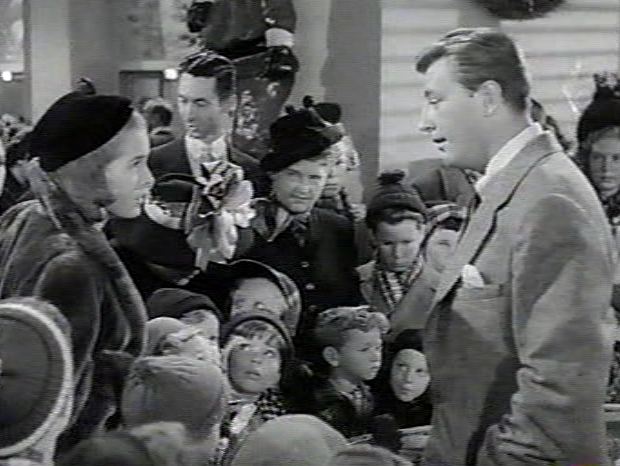
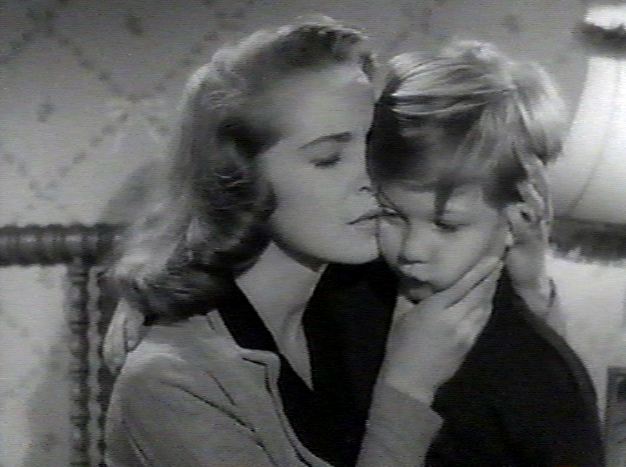
Robert Young is a cheeky young architect engaged to Janet Leigh, who is Walter’s daughter. However (insert ominous chords of music here), Robert and Greer are scandalously attracted to each other, and fall in love. All told, there are three suitors in this film after Greer Garson. Not a bad gig.
Set in London in the 1880s, the film is rich with Victorian set dressing, lush costuming, gaslight, and impenetrable fog. We find ourselves in elegant drawing rooms, art galleries, and cold, stark artists’ studios.
The Forsytes are only a couple generations removed from working class people, but now they are the newly wealthy, and as stuck-up as possible, regarding every privilege as a birthright and every non-family member as an underling.
Harry Davenport plays Walter Pidgeon’s father, the patriarch of this stuffy clan. Walter, however, is banished from their company because he is the black sheep. For one, he is an artist, not a man of business. For another, he eloped with his baby daughter’s nursery governess after the death of his wife and ran off to Paris to paint. He left his daughter, Janet Leigh, in the care of his powerful family, who forbid him to see her.
There is so much to look at in this film, but one is always distracted by the elegant Errol Flynn, who wears his impatient pomposity like a monarch’s robe; something he has been born to, deserves, and never fails to parade. What finally induces Greer to marry him is possibly his enormous self-confidence. For many women, this is as much a lure of security as a healthy bank book.
This quality may be what Mr. Flynn understands most about the character and why he plays it so well. He was himself a man of prodigious self-confidence, a person for whom perhaps everything came easy. Boredom and restlessness result from this trait as much as does success. It can be a double-edged sword. It probably was in Flynn’s case.
What strikes the viewer is the playfulness, even more than the understanding, that he brings to this character. He seems to enjoy wearing a pince-nez. In one scene, he enters the dim hall of Greer’s boarding house, and his top hat smacks against the chandelier. He gives it a glance of longsuffering loathing, refusing to surrender his dignity. It is moment of comedy, and a glimpse into Flynn’s ability to be self-effacing even if Soames Forsyte is not.

His characterization is not parody, however. Mr. Flynn has another good scene over the dinner table with Greer on their wedding anniversary. He is chafing under her polite formality with him, knowing that despite her acquiescence to his every whim, including letting him choose her dresses for her, she cannot love him with the passion he seems to feel he has bought and paid for. We are meant to take it as a slight to his vanity throughout the film, for he never indicates his passion for her. It is only at the end of the movie we see his wounded heart and feel sorry for him.
Until then, he only displays irritability as a mask for his hurt feelings. At one point during the course of his brittle dinner conversation, a scene that shows marvelous restraint, he accuses her of forgetting their anniversary. When at last he discovers under a napkin the gift she has left on his plate, he is contrite and vulnerable. Flynn does excellent work in this tense scene.
Obviously, for purposes of the film, the Galsworthy stories are condensed and somewhat altered, but the movie is a good introduction to the troubled and tragic Forsyte family.
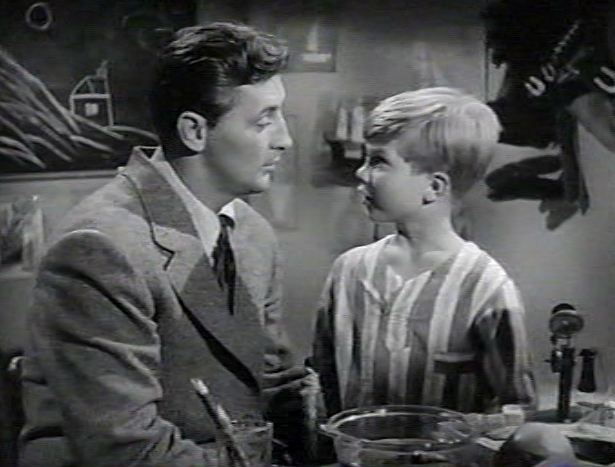
Greer becomes almost instantly attracted to Robert Young, who, open and fun-loving, a man who talks to children as an equal, is by nature the exact opposite of Mr. Flynn. He pursues her, and she refuses him because, more than the threat of scandal, she does not want to betray her beloved “niece,” Janet Leigh, who is like a companion to her. However, they are all tragedy bound.
Greer starts this film visiting a morgue, a haunted expression on her face, her eyes puffy. It is an unglamorous beginning. Though in some scenes she still produces gaiety with that trademark slip of laughter in her voice, she is for the most part an unhappy woman in this film. She is a victim of circumstances, of her own bad choices, and fate.
Walter Pidgeon is also tragic, but he appears as a more romantic figure for all his melancholy perhaps because, unlike Greer and Errol, he is true to his heart and honest about his feelings. He is a gentle, kindly man, humble about his artistic talent, who wants to reunite with his daughter. It is funny to think that in five years this dark-haired 40-ish dashing artist will become the gray-haired worn-out businessman in
Executive Suite (1954) - see previous post here.
That is perhaps another fun thing about this movie, the great romantic intrigue, the jealously and passion are all played out by middle-aged characters. By contrast, the young Janet Leigh, groomed by MGM and kept busy in a number of films at this point in her career, seems callow and less interesting.
Here, Mr. Pidgeon is ultimately still Greer’s hero. Perhaps we would be disappointed if he were not. Clem and Kay Miniver are ghosts in every movie in which Greer Garson and Walter Pidgeon appeared together after
Mrs. Miniver. This was, I think, the sixth of eight total movies. No matter how compelling the magnificent Errol was, even he couldn’t break up the team.