IMPRISON TRAITOR, PEDOPHILE, AND CONVICTED FELON TRUMP.
Showing posts with label Doris Day. Show all posts

Friday, May 20, 2022

Young at Heart at the beach


Young at Heart
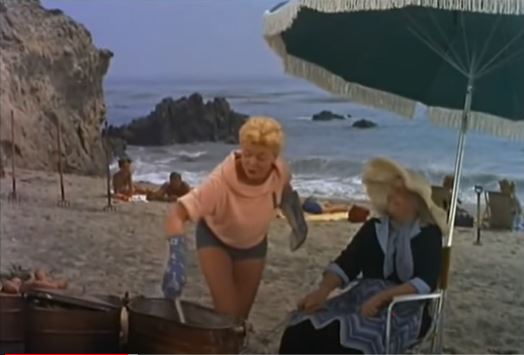
(1954) gives us a glimpse of an idyllic beach scene on the Connecticut shore in the 1950s.  To be sure, it is mostly of Hollywood origin, or at least, California, but if the beach is not in the right location, the warm and lovely nostalgia of the beach is genuine.


This is my entry to the Fun in the Sun Blogathon, hosted by the Classic Movie Blog Association.  Have a look at some great posts on this topic here.


The movie Young at Heart is a remake of Four Daughters (1938), which we covered previously in this post.  In that original story, widowed Claude Rains heads a family of four girls, played by the Lane sisters plus Gail Page, and all are musicians.  May Robson plays the auntie matriarch who lives with them.  The girls’ suitors have picked out their choices among the daughters, but all the young beaus have competition with the newcomer: handsome and happy-go-lucky Jeffrey Lynn.  But an even newer newcomer, a dour, sarcastic and self-pitying John Garfield swoops in to really disrupt things and his love for Priscilla Lane nearly tears the family apart.

We see the beginnings of the rift and a change from a lighthearted first part of the movie to a more serious and even tragic second part at a family picnic in a secluded country glen.  Here we see the sisters are really all interested in the same man. 


In Young at Heart, this scene is transported to the beach.  Robert Keith plays the Claude Rains role of the dad, Ethel Barrymore in a charming mixture of regal and down to earth plays the May Robson role.  Here the sisters number only three instead of four: Elisabeth Fraser, Dorothy Malone, and Doris Day.  Doris plays the lead Priscilla Lane role.  The boyfriends are with the family at the beach, and the heartthrob who will cause unspoken jealousy among the sisters is played by Gig Young in the Jeffrey Lynn role.

Frank Sinatra plays the John Garfield role in this movie, but this scene is just before he makes his first entrance in the film, so we don’t know yet how he’s going to upend the family.  Even without him, the seeds of discontent are already sown, making the day at the beach bittersweet.


With an almost nuclear-powered sunny disposition, Doris Day is the most lighthearted of the group and fails to see her sisters’ yearning for the man she playfully cavorts with in the surf.  Doris gets to sing two songs during this nearly 10-minute beach sequence. 

For those of us who live close enough to a coast to have spent pleasant days on the beach, the movie image of sand and sea, of wave-kissed rocks and sunshine reflecting off the constantly moving ocean is familiar and almost personal, like someone with a movie camera somehow entering our brains and capturing a memory.  Some sensations experienced going to the beach are really timeless and there is a distinct and powerful comfort about that.


But we may sense that some aspects of this scene are not timeless, and that perhaps going to the beach in the 1950s was a little more do-it-yourself, simple, and perhaps with a slower pace of life.   Yes and no.  We don’t see any arcades or water parks or concessions, or even bathhouses with facilities on this beach, but there were beaches back then and even before – though not all – with plenty of tourist amenities. 

That this beach is not crowded and there is plenty of space between the actors and the extras in the background should not be taken that beaches were not crowded in the 1950s.  Of course, they were.  But not all were, and even in these modern times, I have been to New England beaches that were just as unspoiled and unpopulated as this one in the movie seems to be.

So that is not quite it, either.  There must be something else that evokes the strong feeling of nostalgia for a 1950s beach in this film.  Is it because there are no loud radios playing?  Maybe, but we see Doris singing along to a portable record player.  We don’t see too many record players at the beach these days.  

Is it because nobody’s in a bathing suit and they come lounging on the sand in their clothes?  Maybe.  No sunscreen?  Maybe.  


It could just be that the clam digging and the large pots with New England clambake accoutrements – corn on the cob, potatoes, etc., are not seen quite as much now as in the old days, or campfires on the beach, or gathering driftwood to fuel the fires.

There is a noticeable lack of people taking selfies or scarfing packaged junk food snacks.  No one is being divebombed by seagulls for a few Cheetos. 


I get a kick out of Alan Hale, Jr., who plays the suitor of Dorothy Malone, talking about his sudden idea of what a great thing it would be “buying this strip of beach, tearing down all the bungalows on the highway and putting up some hotels, a whole string of them.” 

She responds, “Whoever heard of a string of hotels along the beach in Connecticut?”

There are some hotels here and there on the Connecticut coast, and were, too, in the 1950s, but not enough perhaps to make Alan Hale, Jr.’s dream come true.  Instead of hotels today there are more likely to be a few condominiums, but the geography doesn’t always allow for development.  Working harbors, saltwater marshes here there, and far more protected areas than there used to be.  Thank heaven.


I think what I really like about this beach sequence is the work of the sound technicians.  Behind all the dialogue, behind Doris’s songs and the “orchestration” that seems to bloom from her portable record player, is the omnipresent, lazy, rhythmic sound of the waves rushing to the shore.  The seacoast is not a quiet place.  The sound of the surf is eternal.


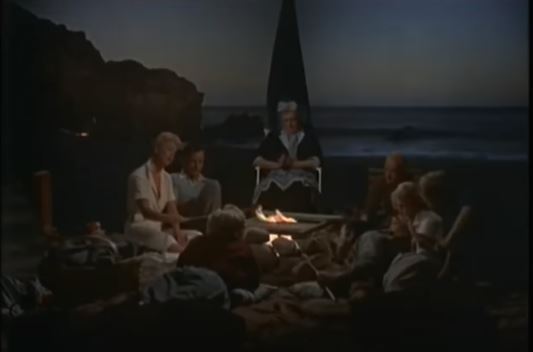
The bright, almost blinding daylight of the first part of the sequence becomes a peaceful twilight with the family around the campfire, and Doris still singing, toasting marshmallows.  The large beach umbrella that sheltered Ethel Barrymore earlier in the day has been folded up.  You can almost feel the refreshing cooler breeze off the ocean, almost feel chilled by it.  It is an idyllic ending to the sequence, a calm before the storm.  A day at the beach is a respite, time to enjoy, to reflect, and to make a memory that will last through days to come.  A beach memory may mark epochs in our lives, just as it does in the movie.

Visit the CMBA website here for more Fun in the Sun Blogathon.

    ********************

Jacqueline T. Lynch is the author of Ann Blyth: Actress. Singer. Star. and Memories in Our Time - Hollywood Mirrors and Mimics the Twentieth Century. Her newspaper column on classic films, Silver Screen, Golden Memories is syndicated nationally.  Her new book, a collection of posts from this blog - Hollywood Fights Fascism - is available here on Amazon.

Thursday, July 28, 2016

Storm Warning - 1951


Storm Warning (1951) is a bold slice of moody noir that is unabashedly a “message film” and is successful, however, by neither lecturing opponents, nor preaching to the choir, but by holding up a mirror and whispering, “Is this you?”

Ginger Rogers stars as a model who interrupts a sales trip for her company to detour to the sleepy southern town where her younger sister lives, for a long-delayed visit.  Her kid sister is played by Doris Day in her first dramatic role.  Steve Cochran plays Doris Day’s husband.  He is a truck driver; she works at the town’s entertainment center, which is really a glorified bowling alley that substitutes for nightlife in this town (Its owner, Ned Glass, is probably the nicest guy in the movie. A tougher job than you might think, considering his clientele.) She is expecting a baby.

Miss Rogers witnesses a murder. A group of Ku Klux Klan thugs drag a guy out of jail, beat him up, and then shoot him. Ronald Reagan plays the county prosecutor who investigates the murder. The movie is quite good, solid acting and moody cinematography, a fast-paced plot, that makes the film stylish and intriguing, and a bit creepy. That this movie has such entertainment value is important, because it is so obviously a message film. We have commented before on this blog that message films do not always appeal to the public, even when it is a message they need to hear. Nobody likes being preached to. The particular success of this movie is that though the audience is being lectured, they may be unaware of it, because it really is a good crime story – because the criminals are average Joe’s. Sometimes having an easily identifiable, sneering, Snidely Whiplash villain can be a bit tedious. We know where the plot is going. The bad guy is going to get his in the end.

But when the villain is pretty much everybody in town, and finding a bad guy to prosecute is like herding a bunch of cats, the story becomes more interesting because we don’t know who all the bad guys are, which ones of them are going to be brought to justice, and is there any justice at all?


One of the most common comments about this film is the complaint that the victim of the Ku Klux Klan murder is not a black man. He’s a white reporter.  There are very few African Americans in this movie. Many viewers feel that because of the prejudices of the day that the studio, Warner Bros., pulled a punch. That’s a valid complaint. Maybe they did.  It was certainly a big risk to offend the southern distribution market.  However, there is another way to look at this. I think in putting across the message, Warner Bros. did a sly, subtle, and intelligent maneuver by not making this film solely about racism.

Put a white robe and a white hood on a guy and we automatically identify the Ku Klux Klan with its brutality against blacks. We know that message. But some people, even those disgusted by this prejudice, may forget that blacks were not the only victims of the Ku Klux Klan. They also lynched, brutalized, and terrorized Roman Catholics, Jews, foreign-born individuals, and not a few journalists who were poking their noses in Klan business. The Ku Klux Klan are racist, but they are also fascists. Racism and fascism go hand-in-hand; you cannot have one without the other.

If Storm Warning does not particularly address racism against blacks, it does tackle the broader view of fascism, because the Klan in this town is made up of average nice people whose membership in this heinous organization they defend with a sense of self-righteousness. They feel they are above the law. When they are not terrorizing others, they threaten fellow members to stay in line. There must always be a constant threat, or there is no reason for having a Klan.  As we mentioned in last week’s post on Address Unknown, fascism is always cannibalistic.

This is our third entry in our series discussing how old Hollywood tackled the subject of fascism. We discussed The Mortal Storm (1941) here, and Address Unknown (1944) here.  Those two movies dealt with fascism and the rise of Hitler in Germany. Today we discuss native-born fascists. The Ku Klux Klan, not the only fascist hate group, but certainly the most well known, was born from the ashes of the Civil War, but the height of the clan really occurred during the 1920s, an era of great prosperity, and rose mainly in the Midwest, chiefly Indiana, the home state, coincidentally, of Republican vice presidential nominee Michael Pence.

Recently, a group of historians made their opposition to Donald Trump’s candidacy on social media.  One of them was 93-year-old William E. Leuchtenburg, whose The Perils of Prosperity 1914-1932 is a book I’ve long admired. He addresses the rise of the Klan in the 1920s among fundamentalist conservatives, the atrocities committed, and their astounding political power—until sexual and financial scandals drove them underground again.

At the recent Republican Party convention, congressman Steve King (R-Iowa) made headlines with his white supremacist remarks, and upon closer examination by the press, the so-called “Confederate” flag and the Tea Party’s (erroneously claimed) Gadsden flag on his desk.  

We know the old adage that politics makes strange bedfellows, and that even those who believe themselves to be virtuous will march in lockstep with people who are not, turning a blind eye to corruption, even evil, if it suits their purpose.

Donald Trump’s bullying rhetoric is asinine, his grandstanding is immature, unintelligent and without integrity, and so naturally appeals to those who are immature, unintelligent and without integrity, both in those politics and with the general public. There will always be some to whom his antics will appeal (including the television media, whose lust for ratings these days makes them the most shallow segment of the Fourth Estate).

Today’s film, Storm Warning, deals with fascism on its most lowest level, the small town, where the big men in town are not hidden, even if they wear a hood. Indeed, the funniest line of the movie is when Ronald Reagan approaches a Klan rally and sees a man completely covered by robe and hood and addresses him, “Hi, Ed. How are things at the dairy?”

None of these men are very powerful, and none of these men are very bright, and so we might not feel terribly threatened by them. But when they are all in a mob, they become a frightening spectacle indeed. It’s the particular sleight-of-hand of fascism. Whip people up into a frenzy, make them feel they are above the law, and then turn them loose. And then if they do wrong, whose fault is it? Who can we pinpoint to blame? It’s a wonder this country hasn’t suffered several slipped disks with all the shrugging we do.

Ginger Rogers suffers an obstacle course of horrors in this movie. She witnesses the murder while hiding in the shadows. It is a powerful scene as she stumbles away in the dark night, shaken, leans behind a lamppost and vomits. She finds her sister at work at the bowling alley and they go home together, and she tells her sister about the murder. Then her sister’s husband comes home.

Steve Cochran is an affable workingman, weak minded and easily influenced, and somewhat immature, who drinks a little too much and when he gets a little rowdy, is always astonished to find there are consequences to his behavior. He meets Ginger Rogers for the first time and welcomes his sister-in-law in a warm and friendly manner.

Ginger is frozen in horror at the sight of him. Steve Cochran was one of the mob who attacked the dead guy. We will find out later in the movie that it was Cochran, having had too much to drink, and getting excited at the mob frenzy, was the one who actually shot the guy.

Miss Rogers’ acting in this movie is quite good, understated, and believable.  She suffers the humiliation and the guilt of going on the stand at the inquest and lies about what she saw in order to protect Steve Cochran. She doesn’t like the guy, but Doris Day has begged her to keep his name out of it, and Ginger would do anything for her sister. Later, when she gets him off, Steve will get very brave, and very drunk, and spy on Ginger when she is changing her clothes and packing to leave. He catches her in her slip and makes overtures. Instead of shrinking away from him, Ginger stands right up to him, does not even pretend to cover herself, and lets him have a good long look while she tells him to his face that he is a “stupid, vicious ape.”


Then he attempts to rape her, but Doris comes home in time, pulling him off Ginger. Doris finally comes to the realization that her husband is really not such a nice guy, and she is ready to leave him. Now Ginger is free to go to the authorities and tell them what she saw. Cochran, panicked, punches Ginger and drags her to a Klan meeting to suffer their punishment.

I like Cochran's work in this movie, he is charming and exasperating, and scary at the same time.  We last saw him play a very different villain here in Slander (1957), where is character was more cool and intellectual.  He was a handsome actor, with a good solid range.


I also like Ronald Reagan’s acting in this movie. It is low key and understated. With his Fedora pushed back off his head and his low, quiet voice, he represents a decent man of authority in town. He is not an outsider, he grew up here. He is not so much a shocked crusader of human rights, just a guy who knows this town inside out and is sick of its imperfections. He’s tired and disgusted. But he plods along trying to do his best, persevering, and hoping one day to catch enough evidence on the Klan to put somebody in jail.  So far, he has been unsuccessful.  He is not an idealist, but a pragmatist, knowing nobody’s going to have a very good life in this burg if everybody’s a slave to a bunch of rowdies.

As regards another complaint about this movie and it’s skirting of the racial injustices in the South at this time period of the early 1950s, no one in this movie speaks with any regional southern accent. This time around, I don’t feel that that is typical Hollywood sloppiness. I really sense that this was a subtle and quite intentional move to bring the subject to a level where it applies to everybody. Though the Klan was a product of, and continues to be, a blot on the South, it is also possible to discuss racism as it applies to everyone in this country without pinpointing a particular group of people. Sometimes when we pinpoint one segment of our society of being guilty it is very easy for us to wash our hands of the guilt. We say, oh, that’s those people. We would never behave that way ourselves.

But fascism is a template that fits anywhere. In today’s political climate there is a great resentment, and perhaps always has been, of “Washington.” Ronald Reagan complains to the boys at the police station, “Every time someone from New York or Washington pokes his nose into our affairs, we holler, ‘Foul!’ Well, if we don’t want them meddling, one of these days we’re going to have to start cleaning up our own nests.”  He is calm, world-weary, and his quiet voice tells us he is sick of the lynchings and sick of trying to tell his best friends and neighbors what is so obvious: stop dividing the world into us and them. That is where fascism has its roots.  There is an inherent thuggishness in an "us" and "them" attitude.

The minor characters show the warts and make his point for us. The bus station baggage claim guy played by Paul E Burns, is afraid to stand up to the Klan.  It sickens him, and sobbing, he begs Ronald Reagan not to question him because he’s afraid they will burn him out.  He regrets being a coward. Later some of the boys will rough him up teasingly, and Ginger Rogers will come to his rescue.

Even the Klan’s leader shows his contempt for his own men. “You know these boys. Without those hoods, they are no heroes. That’s why they need the hoods in the first place.”

The scene with the reporter arriving to do man-on-the-street interviews at the enormous crowd in front of the courthouse is quite good. It looks real, not stagy, as the reporter struggles to pull his microphone cable through the crowd, and he makes comments and ask questions and the people either pipe up or else tell him to get lost. This is the only scene where we see a few African Americans in the crowd. I think it is used intelligently. They show us quite visibly that this is a topic that includes them. Almost as if to say, yes, the murdered guy was white, and we haven’t mentioned racial prejudice here, but you know we really are talking about that, don’t you? You know what this is really about, don’t you?

In case we missed it, the local Klan boss played by Hugh Sanders puts it bluntly in his defense of the Klan to Ginger Rogers, “You have to think of all the good the Klan does. Without us, a girl like you wouldn’t be safe in the streets at night.”

Safe from whom?  We know to whom he’s referring. If he had bluntly said or referred to in the most vulgar vernacular, that she was in danger of being raped by black men, it would have been a different movie. Yes, it would have been bolder, but it also would have switched the focus for people who automatically turn that message often their minds because it offends them, because they do not wish to face their own prejudice, or else because they feel their own prejudice is justified. By talking about racism as fascism and applying it to everybody as a principle that is evil and a danger to everybody, we reach more people because the audience cannot say, oh, you’re talking about them, you are not talking about me. Because I am not like that.

Yes, we’re talking about you.

By the way, I love the reporter’s Ted Baxter voice. Why do not radio and television reporters speak like that anymore?

We are also talking about Ginger Rogers. She is a girl of integrity, street smart, and even though she is a high-tone fashion model, we know she is not upper crust, not removed from the realities of the day. When the ad man accompanying her on the trip makes passes at her at the beginning of the movie, she sends him off like an expert fencer and shoves him on his way. This gal is a tough dame. She is no pushover.


But she rolls over and plays dead for the Klan and lies to Ronald Reagan in front of everybody, because she thinks that protecting her sister’s husband will get her sister out of a jam. It is like putting a Band-Aid on a severed artery. She just wants to smooth things over and leave town as quickly as possible. In such innocent ways do we become complicit with corruption.

A nice touch when, trying to squeeze out of the close crowd at the end of the trial, she and the dead man's widow are pushed together, face-to-face, and Ginger squirms under the woman's accusing stare.

When she leaves the courthouse, Ronald Reagan, frustrated in defeat, tells her off and actually shoves her out the door, “Now, beat it.” He tells her over the sound of the jubilant men outside whooping and hollering because they have won and nobody’s going to go to jail, “They just found out the law cannot touch them. You did that.”

It’s a powerful ending with two scathing realities: first, Reagan tells the Klansman at the rally, a huge burning cross above them lighting up the black sky, “It’ll take more than these sheets you’re wearing to hide the fact that you’re mean, frightened little people, or you wouldn’t be here desecrating the Cross.”

They are mean, and they are frightened and they’re letting their fears make them mean.

They kidnap Ginger Rogers, but things are too hot for them right now to just kill her outright. Instead, they will punish her with whipping.  The scene could easily be gratuitous—most movie whipping scenes tend to go for eroticism, to varying degrees, certainly when the victim is female. Instead, they slash her in the face with the bullwhip, repeatedly, to scar her.  We don’t see any marks on her – the magic of Hollywood—but the image of her being hurt in this manner does not stray into eroticism and therefore seems more profoundly cruel.

But the Klan in the 1920s, as Dr. Leuchtenburg points out, had a particular fondness for stripping naked “fallen” women – according to their standards (which included divorcees) – and whipping them.  Filming such a scene would have been truthful, but impossible to film without it being also gratuitous.

I have to applaud Warner Bros. for the courage of the second reality: to just let the movie end in tragedy with no happy ending, no, “Maybe we were wrong and things will be better now,” and no romantic clinch between Reagan and Ginger Rogers.  There is no flirtation between them; indeed, as mentioned above, he gives her a shove in disgust.  He’s arrived in the nick of time like the cavalry to save her, but he’s not her boyfriend.  The only clinch at the end is when Ginger Rogers cradles the dying Doris Day in her arms.  Day has been shot, accidentally, by her husband who was aiming for Rogers.  The end.  Go home and chew on that for a while.

Fascism is always racist, opportunist, and corrupt, and it poisons every level of society. 

But it doesn’t start there.  “Populist” movements have a big hand in keeping fascists in power, but they don’t have the clout to put them there. That takes money.  All the dictators of the world had their backers, wealthy men holding the purse strings, powerful men in the military, some to drive the vote to their best interests, and some to grab public office for themselves.  This will be the case in our last two movies: Keeper of the Flame (1942), and Seven Days in May (1964), which we’ll discuss in August.

Next Thursday, however, a break with a return to our monthly state of the classic film fan series. See you then.

*****************


My audio book version of Ann Blyth: Actress. Singer. Star., narrated by Toni Lewis, is now for sale on Audible.com, and on Amazon and iTunes.


Thursday, May 26, 2016

The Automat in the Movies


It's 1934, the worst year of the Great Depression, and Joan Crawford goes to the Automat in Sadie McKee because she can't afford better.  She can't even afford the Automat, scraping just enough nickels for a cup of coffee.


But The Little King, who is rich, and a king, also goes to the Automat in 1934 in Sultan Pepper, just for a lark, for the fun of it.

The Horn and Hardart Automat of New York City seems to bear the dual reputation of being a place of stark frugality and also a place of playful ingenuity.  It was nothing if not egalitarian.


It's fun to see it pop up in classic films from time to time.  Jean Arthur, down on her luck as Joan Crawford was, visits the Automat in 1937 for Easy Living, but finds rich boy Ray Milland slumming there, not unlike The Little King.  She determinedly tries to eat in the middle of riotous food fight.


By 1950, in Mister 880, which we discussed in this previous post, Burt Lancaster and the feds are trying to track Edmund Gwenn down for counterfeiting, and the Automat here seems less stylish, and more utilitarian.  A place where counterfeiters might hang out.


By 1956 and The Catered Affair, a serious young couple played by Debbie Reynolds and Rod Taylor discuss marriage.  Again, the Automat seems even more dour in this setting than it did for poor Joan Crawford in the depths of the Depression.  Perhaps it was no longer novelty and just another cheap cafeteria?


In 1962 in That Touch of Mink, Doris Day has a conversation with Audrey Meadows through the open food service slot, and because Doris is unemployed, pal Audrey, who works there, slips her food.  Here the Automat is fun again, and we don't take the hunger pangs seriously. 


For more on the Automat have a look at this brief documentary on YouTube.  Someone also put up a series of movie automat scenes, starting here.  Apparently one of the first, if not the first, was The Early Bird (1925).  The Automat had been around since 1912.  It closed in 1991.

Come back next Thursday for part six of our year-long monthly series on the classic film fan, and we'll have a look at John Greco's new book, Lessons in the Dark, a collection of essays from his blog Twenty-Four Frames.

Thursday, November 26, 2015

Turkeys and Starlets - Happy Thanksgiving


Thanksgiving brought out some weird impulses from Hollywood studio publicity departments. We often see among classic film blogs examples of this "art" this time of year. Here is a gallery of examples below -- and I am inevitably reminded of the prescient wisdom of young Teresa Wright, who had stipulated in her contract that she should not be required to pose in a publicity photo, "... looking insinuatingly at a turkey for Thanksgiving." We discussed her unique contract in this previous post.


And now, for a Thanksgiving roll call:


Judy Garland as a male Pilgrim.  She looks like she is befriending this bird, rather than stalking it.


Bette Davis as a female Pilgrim, who appears to be employing this turkey as a draft animal to pull the kiddie wagon full of bounty from the fields.  Or the prop department.


Barbara Bates, as a sexy Pilgrim who appears to be dressing up the turkey because they are going out on a date to have Thanksgiving dinner at the Mocambo.


Marilyn Monroe as a cutie pie sexy Pilgrim who does not appear particularly threatening to that turkey.  


Doris Day, with no cutie pie Pilgrim nonsense, appears ready to get down to business.  I can't think of a more grim publicity photo for Thanksgiving, and I suppose for that reason it just makes me laugh more than the others.  It's as if Alfred Hitchcock directed the photo shoot.

Ann Blyth managed to get a more dignified and pleasant-looking Thanksgiving photo shoot here at my other bog.

Though there could have been an ax hidden somewhere among the props, I suppose.

Recently, I had to stop my car only about a mile from my home to let a flock of wild turkeys half-fly, half-stumble across the road.  Doris Day was not chasing them, so I'm pretty sure they got away.

To all our American readers: Happy Thanksgiving.

Thursday, February 13, 2014

What's a Nice Girl Like Ann Blyth Doing in a Place Like This?


One of the most fascinating aspects to Ann Blyth’s film career is how her reputation flipped from powerful actress doing moody parts to nice girl playing nice girl roles in which she was invariably taken less seriously.  A lot of that transformation in the eyes of the press and the public had to do with the fact they found out that in real life—she was a nice girl.  In terms of press copy, her natural and intuitive versatility as an actress seemed to be outshone by her real-life pleasant, even spotless, reputation. 

The utterly silly phenomenon began as How Could a Nasty Screen Character be Played by Such a Nice Person in Real Life...and morphed to Such a Nice Person in Real Life Cannot Play a Nasty Screen Character.

Mildred Pierce, in which she ferociously played a budding young conniving sociopath (see last post here), established her at the age of 16 as a serious actress—so much so, that some in the press, including Los Angeles Times drama editor Edwin Schallert, were excitedly calling her a young Bette Davis.

For the first few films after Mildred Pierce, she played other troubled young women with chips on their shoulders, axes to grind, or evil plots to hatch.  But she didn’t want to be typecast, and worried at first that “mean” roles were the only kind she would be offered.  Mr. Schallert interviewed her when she was making Swell Guy (1946), her first movie after the long recovery from her back injury, discussed in this intro post.  We’ll talk about Swell Guy later in the year.  “Miss Blyth is reputed to give her most sensational performance in this.”

Ann described her character in the film: “I’m not a mean girl…but I don’t change completely for the good…She is wild at the beginning, but her wildness results in unhappiness for her.  So I naturally am not against that part.  However, I do want to do a nice role now, and I want to sing in a picture.  You see, I am hoping, as perhaps many people do in Hollywood, for a variety of opportunities.”

Mr. Schallert notes in his November 1946 article that Ann “is essentially shy,” but he kindly does not call her naïve for wanting or expecting not to be typecast in Hollywood.  It was the bane of many, if not most actors, that the studio’s bottom line and the public’s perception would roll over like a steamroller an actor’s usual hope of playing something different than his last movie.  Mr. Schallert also kindly notes the catastrophes suffered in the past two years with her spinal injury, and the death of her mother, and that “The emotion associated with that bereavement is too close as yet for Ann to discuss.

“Ann’s fortitude is nothing light in the film world.  Her experiences have undoubtedly given her an unusual maturity in her work.  She has no formula for playing the roles that are so much at variance with herself.  She indicated that she does them intuitively as much as anything else.”

A simple answer to a question that trailed Ann through her early career.  How could a nice girl play such less-than-virtuous people so convincingly?  She’s an actress, that’s why.

The very question seems to lead us to the astounding conclusion that actors who play murderers, thieves, and pickpockets must actually be murderers, thieves, and pickpockets.

Another article that November of 1946 notes her latest role in Swell Guy: “Her part…is that of an ornery little brat grown up, and Ann is quite aware of the danger she will be typecast as a ‘meanie.’  Result: she is studying vocal music, with every intention of snagging a part in the next big musical show filmed at her studio.”

That next big musical at Universal never happened, but after a few more ‘meanies’, her roles began to change towards nice girls in less demanding parts.  How much of this was due to her seeking new material, and how much was due to a personal life that the press was touting more and more as laudatory is an interesting question.

The notice of her as a young woman living an exemplary life may have gained more steam in April 1949, when she was slated to play the lead in a film called Abandoned, which she refused and was put on unpaid suspension.  The movie, (judging by this swell lurid poster, was a crime noir with a great cast) deals with unwed mothers and a black market baby adoption racket. 

Many actors risked studio wrath by rejecting scripts because the scripts were lousy.  However, though I don’t know the reason she rejected the movie and have never read an interview with her opinion on the subject, some columnists seemed to infer that taking the suspension was an exercising of her moral conscience.  One would assume that none of the greedy, conniving, promiscuous characters she had heretofore played, performing unsavory deeds including shooting Zachary Scott dead, would fall in line with how a proper young lady should behave, but the columnists took the shortcut and wrote her up—and wrote her off—as a nice girl.

It was also regarded as somewhat quaint, if admirable, that she preferred not to do any cheesecake photos.

Sheilah Graham noted in August 1949, that Ann didn’t smoke, or drink, and went to church regularly and attended church socials, but also gave Ann credit for spunk.  “She seems happy and easy going, but she has a mind of her own.  Not too long ago she took a suspension from her studio for refusing to play a role she didn’t like.  In spite of her lack of experience in real life, on the screen Ann is able to portray hardened, willful, sinful characters.”
By 1954, syndicated columnist Sue Chambers echoed the, by now, cemented public view of Ann, that she was deeply religious, and there has  “…never been a whispered breath of scandal about her….she has never been temperamental; she has never kept anyone waiting for an appointment…She leaves a good impression with everyone.  Her working associates have never known Ann to raise her voice in anger or turn down a request for a benefit appearance, no matter how ‘small’ the group.” 

Not keeping anyone waiting for an appointment may be really fishing for nice things to say, but the press was also apparently intrigued that she could be a homebody who was equally interested in a career, the antithesis of the 1950s nice girl.  Ms. Chambers noted that Ann, married the previous year and expecting her first child at the time the article was published, wanted a family “but she has no intention of giving up her career; she’s intensely ambitious, too.”

Her reputation more than preceded her; it wrapped around her like a cocoon.  From a syndicated article in 1952:  “Can a nice girl make the grade in the movies?"


Nice girls get paper dolls made in their image.


“Ann Blyth, a girl any fellow could proudly take home to meet mother, is proof that virtue is its own reward—even in Hollywood.  The young and beautiful actress is one of the most talented and successful in the business.  Yet, paradoxically, her name is seldom, if ever, mentioned in the gossip columns…Ann, it seems, spends most of her leisure time at church bazaars, a most unlikely hangout for gossip columnists.

“She has three major motion pictures either just released or about to be.  All of them accent her versatility…somehow, in between, she manages to make countless benefit appearances at church suppers or hospital wing dedications.”

One of Hollywood’s most famous gossip columnists, Louella Parsons, early on noted the amazing paradox of the young girl who was career-ambitious and yet still seemed like a nice person.  By 1951, Louella, who had this backyard fence familiarity/condescension in her prose, was still ruminating on the problem child who was so frustratingly not a problem:  “Ann’s aunt and uncle are her family, and she lives with them.  She has been brought up as if she had never been in Hollywood or motion pictures.

“Her aunt waits up for her until she gets home at night…likewise, Ann’s escorts are always carefully scrutinized by both her aunt and uncle.  She might have been brought up in some small town and then not had the protection she had with these two loving people.  And, withal, she is a fine girl and a versatile actress.

“Her first success was ‘Mildred Pierce’ when she played the horrid daughter…and was everything a young girl should not be.

“How could you happen to play that girl so well when she is just the antithesis of you?’ I asked her.”

Did Ann’s reply shock her? 

“I like to vary my roles, and it would be very tiresome if I played only sweet young things…I’d really rather have a part I can get my teeth into—one with character rather than a milk and water girl.”

Louella wasn’t listening.  She had decided, as did other members of the press, that the nice girl should only play nice girls.  A movie to be tentatively titled White Sheep was proposed for Ann in April 1951 (though never made with Ann), and Louella Parsons announced, “This is the story of a small town minister who helps regenerate a rather wayward family.  Ann, of course, is the white sheep of the family.  You could not believe her in any other role.”

You could not believe her in any other role?  What happened to Another Part of the Forest, or A Woman’s Vengeance, or Mildred Pierce and the scheming, sultry, promiscuous, greedy, backstabbing, murderess roles for which she had earlier been called a young Bette Davis?


On her film, The Golden Horde – columnist Harold V. Cohen also scoffed at the notion of the nice girl playing anything but:  “Nobody in his right mind could possibly visualize sweet, wholesome Miss Ann Blyth in the role of a seductive Persian princess, dressed in scanties and flimsies, who uses the wiles of her sex to stop the ruthless march of the terrible Genghis Kahn…Now Miss Blyth can take off those veils and go back to her cashmeres and dirndls, where she belongs.  In ‘The Golden Horde’ they’ve sent an innocent child to do a woman’s work.”

You can seduce Zachary Scott and then blast him to smithereens, but how quickly they forget.

Another aspect of Ann’s personal life which may have influenced press opinion may have been her resplendent Roman Catholic wedding ceremony in June 1953 celebrated by several clergy including a cardinal—James Francis Cardinal McIntyre, who also delivered a blessing from Pope Pius XII. 

In the company of several priests and monsignori was an old friend from back east, the Rt. Rev. Charles E. Hagearty, a monsignor at that time located in Hartford, Connecticut.  Msgr. Hagearty had been a curate at St. John's Church in Stamford, Connecticut when Ann visited her uncle and aunt there in the summers as a child.  It was this same uncle and aunt, Mr. and Mrs. Patrick Tobin, who gave up their Stamford home and moved out to Los Angeles to care for Ann after the death of her mother, which we discussed in the intro post here.   According to an article in the Hartford Courant at the time, she was ten years old when she and Fr. Hagearty first met.  He played the organ.  She liked to sing. 

The church was packed with some 500 people, but according to a newspaper description of the event, "set workers and crewmembers...far outnumbered the celebrities."  The press lumped the nameless techies together as "friends of the bride."  To most of them she was Annie.

More about her bridesmaids in a future post.

In a town that loved spectacle, it was a spectacular beginning to a long and happy marriage.  Dr. James McNulty, a Los Angeles area obstetrician, was invariably referred to in articles as Dennis Day’s brother (who acted as best man at the wedding) more than I think he ever was referred to as Ann Blyth’s husband.  Dr. and Mrs. McNulty had five children over the next ten years, further cementing Ann’s confounding respectability.

Her respectability, itself, became a problem for television producers of the 1953 Oscars, when she had been asked to perform the song “Secret Love” from Calamity Jane (a movie we discussed in this previous post).  Doris Day had been slated to reprise the song she made famous, but according to the authors of Inside Oscar – The Unofficial History of the Academy Awards, Miss Day turned down the opportunity due to being afraid to sing before the live audience (made bigger still by television).  The program was telecast March 25, 1954.  Ann was pregnant with her first child (her baby son was born in June).  Having a pregnant woman on television at all was still considered a dicey subject in this buttoned-up era, but one who stood there and sang the lyric “and my secret love’s no secret anymore” seemed to fill the NBC network powers that be with considerable trepidation.


It was the second time that the Oscars were broadcast on TV, called by columnist Bob Thomas, “The biggest star splurge in television history,” to an expected 60 million viewers.  The ceremony was held at the RKO Pantages Theater with Donald O’Connor as host in Hollywood, and Fredric March handling the live TV-hook-up from New York.

Ann, who the newspapers were a little more brave about acknowledging her pregnancy, still referred to it delicately as her “soon-to-be-mother-condition” wore an emerald green chiffon gown (“naturally,” commented columnist Buck Herzog with a nod to her Irish ancestry) with a big skirt and off-shouldered neckline.  She also wore emeralds.  Too bad TV was still black and white then.

Ann, who evidently felt no reason to wear a scarlet letter on her green gown, and seemed to see no reason why the sight of a pregnant woman should engender sophomoric double entendres about love not being a secret, performed without incident or apparent damage to her career.  Unfortunately, her old pal and former co-star Donald O’Connor, did suffer the wrath of pundits, including the disgust of Ed Sullivan, when he made the unpardonable faux pas of publicly acknowledging that Ann was with child.  He playfully introduced her before her number as “Ann Blyth and family.”

He was berated for his poor taste.  Ann thought his remark was cute.

Over two years later, the press was starting to crow with its typically short memory how mature the public was in accepting pregnant women in society.  “Women entertainers used to retire temporarily when they became expectant mothers, but in this day of the working wife, females everywhere go on working as usual.” The columnist, Aline Mosby, cites for her examples as Lucille Ball, Rosemary Clooney, and “Ann Blyth sang at the Academy Awards show shortly before she had a baby.”

And the world didn’t end.

Not too long after the birth of her son, she took her nice girl act on the road and really showed them. 

That September, Ann performed a night club act at the Sahara Hotel in Las Vegas, and brought the house down.  Los Angeles Times writer Edwin Schallert, who we quoted at the beginning of this piece when he interviewed her some eight years earlier, marveled at how well the nice girl blossomed.

Nice girls also do Lux Soap ads with Peter Gunn.
“Miss Blyth won completely and without sensationalism the cosmopolitan public that had previously been intrigued by Dietrichs, Mae Wests, Gabors…it was a simple, sincere victory gained by a fragile-looking young girl in a modest shell-pink lace gown who confessed her knees were shaking.”

She sang such hits as “April in Paris,” “September Song,” excerpts from The Student Prince and Rose Marie (movies which we’ll discuss in future posts this year), an Irish song, and in a series of songs labeled as a “Calendar Hit Parade”, she belted out “Yankee Doodle Dandy”, and “Silent Night.”  She closed the segment with “Auld Lang Syne.”

“With her eyes misty with tears as she held a huge armful of flowers, she thanked the audience again and again for their tribute…There were also many misty eyes among the people present.”

Louella Parsons crowed that Ann, “…brings down the house, she’s so good.”

Syndicated columnist Bob Thomas wrote, “The gamblers and dealers in this hard-boiled town never saw anything like it.  Everyone in the night club was standing and cheering a demure beauty whose act was pure enough for a Sunday school picnic.”
Good girl makes good.

He reported on her closing performance after a three-week stint in Vegas, “With tears streaming down her cheeks, she sang, ‘Auld Lang Syne’ and bowed off with a thundering ovation.  Most of those in the Congo Room were misty-eyed too.”

He compared her to other more ribald acts such as the striptease by Marlene Dietrich and Mae West’s racy humor.  “But along came little Miss Ann Blyth to prove that purity pays.” 

She had tried out the act first in San Diego, and then sang to the crowds at the California state fair in Sacramento.  Ann acknowledged, “It is the first time I played night clubs or any singing dates, and it has opened up a whole new world to me.”

However, the old world of Hollywood was increasingly reticent to accept Ann’s versatility as easily as she had.  A big role was coming up that would, unknown to anyone at the time, be her last film, The Helen Morgan Story.  The down-and-out, troubled, hard-living alcoholic 1920s saloon singer was considered by everyone who voiced an opinion about it to be beyond Ann’s abilities.

Some still recalled her earlier career of sultry gals.  According to Armand Archerd, “She is truly a paradox, having been described as ‘sweet Victorian’ to ‘sexy and sultry’…by nature, of course, Ann is probably the sweetest person in the film colony.”

She was required to test for the role in competition with something like 300 other actresses.

 “Ann, by virtue of her own reputation, was the least likely candidate of all.”

By virtue of her own reputation.

“Of course, no one in Hollywood believed she would get the role of the sexy Miss Morgan.”

So how did she get the part?

According to Mr. Archerd, “…her test out-sizzled any of the so-called sexy stars of Hollywood.”

The headline in the Daytona Beach Sunday News Journal reflected a shocked public.

Good Girl
In Movie
Gutter

Hollywood reassured a nervous public, “Ann Blyth is still a good girl, despite what some of her fans think…who fear that Hollywood’s ‘little lady’ compromised her own moral principles in taking the part.”

Ann responded, “There are always people who can’t disassociate an actress’ personal life from her screen life…An actress, to keep going, must portray life, and life is not all sweetness and light…there was great conflict between good and evil in Helen’s life.  Unfortunately, she had weaknesses and the evil in her life often won over the good.  I personally think that such movies, when done in taste, do more good than ones that gloss over the brutal facts.”


We come full circle then to a description of Ann by Ida Jean Kain earlier in her career from 1949: “I thought you might be interested in knowing what she is like is real life, this girl who plays the hateful, spoiled darling roles so realistically.

She is poised and genuinely unaffected—completely unspoiled.  And in a quiet, confident way, she knows where she is going, and she is neither deviating nor taking short cuts.”

The quiet, confident woman replied to Mr. Archerd at the time of The Helen Moran Story as to how she could possibly make the transformation to such a wayward woman?

“Well,” she blushed, “I guess I just try to be the person I’m playing.”

Because she’s an actress, that's why.
Come back next Thursday when we jump several decades ahead to 1985, a time when even the wholesomeness of Hostess Cupcake television commercials could not keep her from turning wayward again as a woman haunted by the death of her first husband, who stabs her second husband with scissors in a fit of hysteria, and who may be a murderer.  That's up for her friend, the intrepid Jessica Fletcher, to decide in Murder She Wrote.


****************

Beaver Valley Times, syndicated article by Aline Mosby, December 28, 1956, p.11.

The Deseret (Utah) News, November 8, 1946; also syndicated column by Louella Parsons, April 5, 1951, articled by Ben Cook, April 21, 1952.

The Florida Flambeau (Florida State University, Tallahassee, Florida), article by David Dreis, January 18, 1955, p. 2.

The Free Lance Star (Fredericksburg, Virginia), syndicated article by Bob Thomas, October 21, 1954, p. 14.

The Hartford Courant Magazine, July 19, 1953, p.7.

The Kentucky New Era, syndicated column by Armand Archerd, June 22, 1957, p. 9.

The Lewiston Evening Journal, July 17, 1952,  p. 22.

Los Angeles Times, article by drama editor Edwin Schallert, November 17, 1946, p. A1; also by Schallert, September 22, 1954, p. B6.

The Milwaukee Sentinel, syndicated column by Sheilah Graham, August 22, 1949; syndicated article by Sue Chambers, May 1, 1954, p. 3; also syndicated article by Buck Herzog, March 28, 1954, p. 19; also syndicated article by Louella Parsons, September 27, 1954, p. 6.

Pittsburgh Post-Gazette article by Harold V. Cohen, November 12, 1951. 

Portsmouth Times, (Ohio), article by Ida Jean Kain, July 15, 1949 p. 15

Sarasota Herald-Tribune, June 28, 1953, p. 6; also syndicated article by Bob Thomas, March 24, 1954, p. 16.

The St. Joseph (Missouri) News-Press, syndicated column by Louella Parsons, December 16, 1951.

The Sunday News Journal (Daytona Beach, Florida), September 15, 1957, p. 12A.

Wiley, Mason and Damien Bona.  Inside Oscar – The Unofficial History of the Academy Awards (NY: Ballantine Books, 1986), p. 238.

UPDATE:  This series on Ann Blyth is now a book - ANN BLYTH: ACTRESS. SINGER. STAR. -

*********************
The audio book for Ann Blyth: Actress. Singer. Star. is now for sale on Audible.com, and on Amazon and iTunes.

Also in paperback and eBook from Amazon, CreateSpace, and my Etsy shop: LynchTwinsPublishing.


 "Lynch’s book is organized and well-written – and has plenty of amusing observations – but when it comes to describing Blyth’s movies, Lynch’s writing sparkles." - Ruth Kerr, Silver Screenings

"Jacqueline T. Lynch creates a poignant and thoroughly-researched mosaic of memories of a fine, upstanding human being who also happens to be a legendary entertainer." - Deborah Thomas, Java's Journey

"One of the great strengths of Ann Blyth: Actress. Singer. Star. is that Lynch not only gives an excellent overview of Blyth's career -- she offers detailed analyses of each of Blyth's roles -- but she puts them in the context of the larger issues of the day."- Amanda Garrett, Old Hollywood Films

"Jacqueline's book will hopefully cause many more people to take a look at this multitalented woman whose career encompassed just about every possible aspect of 20th Century entertainment." - Laura Grieve, Laura's Miscellaneous Musings''

"Jacqueline T. Lynch’s Ann Blyth: Actress. Singer. Star. is an extremely well researched undertaking that is a must for all Blyth fans." - Annette Bochenek, Hometowns to Hollywood


Ann Blyth: Actress. Singer. Star. 
by Jacqueline T. Lynch

The first book on the career of actress Ann Blyth. Multitalented and remarkably versatile, Blyth began on radio as a child, appeared on Broadway at the age of twelve in Lillian Hellman's Watch on the Rhine, and enjoyed a long and diverse career in films, theatre, television, and concerts. A sensitive dramatic actress, the youngest at the time to be nominated for her role in Mildred Pierce (1945), she also displayed a gift for comedy, and was especially endeared to fans for her expressive and exquisite lyric soprano, which was showcased in many film and stage musicals. Still a popular guest at film festivals, lovely Ms. Blyth remains a treasure of the Hollywood's golden age.


The eBook and paperback are available from Amazon and CreateSpace, which is the printer.  You can also order it from my Etsy shop. It is also available at the Broadside Bookshop, 247 Main Street, Northampton, Massachusetts.

If you wish a signed copy, then email me at JacquelineTLynch@gmail.com and I'll get back to you with the details.

Related Products