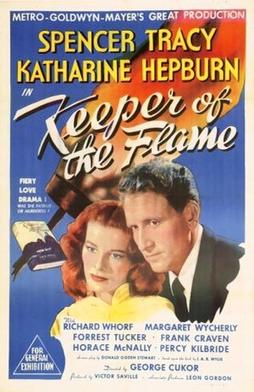
Keeper
of the Flame
(1942) is a daring examination of the existence of fascism in this country. We
had come late to the fight against fascism in Europe, and in wartime it was
easy to identify those monsters. But
this movie takes a hard look at American fascism. We were not safe from it
then; we are not safe from it now.
However, Hollywood, that fantasy factory that brought us so many upbeat,
escapist movies prettied up by the Production Code, could still be remarkably
vigilant when it came to the depiction of American ideals on screen—when they
were being maintained and when they were not.
This is the fourth film in our series on
the treatment of fascism in classic films.
We’ve already discussed the foreign-born variety in The
Mortal Storm (1940), Address
Unknown (1944), and then our
home-grown variety among racist thugs in Storm
Warning (1951). Today we take up a film that tackles the
notion that the bad guys aren’t always the ones in the propaganda posters, and
that fascism often comes to us from the minds, and wallets, of rich and
powerful people. Evil in our midst is
always a tricky subject. The audience does not like being preached to; the
studio does not like being accused of taking a partisan political position, in
order to protect its bottom line. It was
reported that studio head Louis B. Mayer was not happy with this film, feeling
it equated fascism with wealth.
But Keeper
of the Flame, directed by George Cuckor, brilliantly transcends that with
an eerie mystery story, a moody and atmospheric setting, and stellar acting. It is an
early example of film noir.

Spencer Tracy stars as a reporter, a
foreign correspondent just back from Europe where things have become too hot
for him to remain. Though we had many terrific political correspondents back in
that era, for me he brings to mind William L. Shirer, whose Berlin Diary was published soon after
Mr. Shirer left his political beat in Germany when things got too hot for him.
His voice was one of the earliest to warn a complacent America on the danger
of Adolf Hitler’s powers of seduction.
This post also serves as our entry into
the TCM
Summer Under the Stars blogathon, hosted by Kristen Lopez at Journeys in Classic Film. Today is
Spencer Tracy day on Turner Classic Movies, and though Keeper of the Flame is not on the roster, this move is a great
example of his cool, understated acting, and of how Tracy, however troubled he was in private life, or what private demons he fought ( or didn't fight), embodied the image of the decent American. He was quiet, cool, contemplative, intellectual in a sort of masculine regular-guy way. He could be wry, sarcastic, but his characters were basically humble, even if he didn't take any guff from anybody.
It was as if he could see straight through any situation and see the truth of it.
But in this movie, he has a little trouble getting down to the truth. Keeper of the Flame is probably my favorite in the Tracy-Hepburn partnership.
It was as if he could see straight through any situation and see the truth of it.
But in this movie, he has a little trouble getting down to the truth. Keeper of the Flame is probably my favorite in the Tracy-Hepburn partnership.
Yes, Kate’s in this one, too, and I
think it is one of Katharine Hepburn’s best roles, though many feel she is too passive a character here. I like her work in this film for its hesitancy, its reserve. We are used to seeing her bounding through a set like a gazelle. In an unusual twist, she commands our attention by trying to avoid it. We don't know if she's stuffy, haughty, reclusive, or just deeply hurt. She’s photographed beautifully here, and her
grieving widow is, like Tracy, played in an understated manner that
complements her enigmatic character.
The cinematography is splendid, and the
telling of the story reminds one of Citizen
Kane (1941). We begin with screaming
headlines and the sudden, shocking death of Robert Forrester, a much-beloved
national figure, as his car plunges into a ravine one stormy night. We don’t
know much about him, but bit by bit through the film the layers are peeled away
and we have a better picture of him through the people that knew him best: his
employees, his household staff, his mother, and his wife—Katharine
Hepburn. Even the great man’s home, a
large, remote, wooded estate, is reminiscent of the “Shangri-La” of Charles
Foster Kane. Yet, there are even darker
tones here, and it is not just the stormy weather.
Spencer Tracy comes to the nearby town
where the great man lived where tributes are being paid, and a flurry of
reporters are trying to beat each other’s time to get inside scoops, spinning
flowery prose on the loss to the country. The funeral is witnessed by thousands. Tracy,
a great admirer of the great man, is also here to pay his respects. He is not here to write any stories; he has
had enough of politics in Europe. He’s
back home in the U.S. for the first time in years, and he’s looking forward to
kicking back and relaxing.
His reporter colleagues include a
competitive Stephen McNally, who we’ve covered in previous villain roles, but
here he was in his first year of film acting, in, amazingly, his 11th
bit part of 1942.
Especially delightful is Audrey Christie
as a wisecracking “girl reporter,” who teases the Production Code by helping
out Tracy, who needs a room, by inferring to the desk clerk at the local hotel
that she and Tracy are married. The
flippancy of the reporters adds a lot of fizz and sparkle to the early part of
the movie and throws us off the scent.
We might be prepared to think we are entering a romantic comedy, but
very soon, and quite unexpectedly, a mystery pops up.
It is entirely due to Tracy’s powers of
observation. In all the throng watching the funeral procession, he is most
curious about a young boy, clinging to a lamppost to get a better view, sobbing
over the death of the great man. Tracy
comforts him, befriends him, and soon finds himself roaming around the great
man’s estate because the boy has found a secret entrance for him.
The boy, very well played by Darryl
Hickman, is the son of the great man’s gatekeeper, played by Howard Da Silva. He is making himself sick over a sense of
guilt because he did not warn the deceased that the bridge was out, which led to the
great man’s auto crash. Soon, Tracy finds himself on a hunt for some truth—but
he doesn’t know what. He only senses that there is a greater story going on,
one that he is reluctant to cover, but that he cannot ignore.

Through the mysterious, rather bitter,
remarks of the gatekeeper, through a bizarre stolen interview with the great
man’s vague mother, played by Margaret Wycherly, and through the careful wall
put up by the grieving widow, Tracy slowly finds himself smack in the middle of
a huge conspiracy. The great man may have been murdered. At least, that’s what
his mother thinks. “Men like Robert aren’t killed by accident. They’re stabbed
in the back.” She doesn’t like her
daughter-in-law at all.
Now Tracy is compelled to ferret out the
truth he can no longer ignore, not just because he is a reporter and that’s his
job, but because he admired this man so deeply, that it is a matter of honor to
avenge his death by bringing the murderer to justice.
But his mother also drops another odd
remark: “Big people have big houses and little people work for them.” It turns out to mean a lot more.
Clues point to the grieving widow.
Spoiler time. Go get yourself a snack if you don’t want to
hear. But if you’re going to stay and
listen, then pour yourself a stiff drink.
Kate knew the bridge was washed out that
night. She could have warned her husband. She chose not to.
Tracy, who has been falling for her a
little bit, impressed and almost transferring his hero worship from the
deceased to his valiant widow, is gobsmacked and disgusted. He’s only too happy
to turn over this venomous—but wait. There’s more.
It doesn’t come out all at once, that’s
the brilliance of this film. Like Tracy,
we must become observant searchers of the truth. We cannot just sit back and be entertained
with a mystery story, we are obligated to participate, to assemble the jagged puzzle
pieces in our mind and come to terms with what we cannot possibly believe.

Kate unwillingly, as one sickened,
relates to Tracy her realization in the early years of her marriage her
discovery of her husband’s populist fascism. “They didn’t call it fascism. They painted it red, white, and blue and
called it Americanism.”
His supporters were private individuals
who wanted power, but couldn’t get it democratically. The campaign was a tapestry of hates. Hates
for Jews, for city dwellers, for Catholics, for blacks, which appealed to the
Ku Klux Klan.
“What was really shocking to me was the
complete cyniscm of the plan. Each of the groups was simply to be used until
its usefulness was exhausted.” Again, as
we mentioned earlier in this series, the cannibalistic nature of fascism that
attacks its own.
“In the end, all the poor little people
who never knew what the purpose they were lending themselves would be in the
same chains.”
Tracy, coming to terms with the shock of
this news about his hero, merely whispers his name, “Robert Forrester.”
Miss Hepburn adds, like a whimper, “He
envied the dictators.”
Tracy whispers again, in horror, “Robert
Forrester.” His hero.
Hepburn’s further revulsion intimates a
greater, more personal horror for her in her humiliating marriage, where she
was, “A poor creature who couldn’t give him sons.” It’s a long speech, which she delivers
delicately, with levels of awe and shame.

When she failed to warn her husband of
the collapsed bridge, it was a moment’s decision. His paid saboteurs were
waiting for his cue to begin the plan of taking over the government. His chief
lackey and henchman is his oily and conniving secretary, played by Richard
Whorf, who is terrific in the role.

Also look for Percy Kilbride as a
laconic cab driver, and Forrest Tucker as Kate’s ne’er do well cousin in an
excellent supporting cast.
“Now he’s in your hands,” she tells
Tracy. The great man’s legacy, as well
as the weakness of a great society to be exposed is a terrible crisis. She
tried to keep his murder secret not to protect herself, but to protect the
country from tumbling off into the ravine, too, in its blind devotion to a con
artist.
Tracy counters, “People are not children.
Sometimes they act like children when you get them scared or confused, but down
in their hearts they know and they’re not afraid. They want the truth, and they
can take it.”
It is a speech for the ages, and the
hope on which I pin the outcome of the coming presidential election and the
millions of Trump supporters who are apparently blind to his lack of integrity,
his lack of intelligence, and the evil of the man. Are they, too, lacking in integrity and
intelligence? Are they, too, evil? I don’t know.
Like Hepburn, I, too, am horrified at the danger my country is in. But like Tracy, I have hope in the basic
decency of the American people, and I feel that courage is needed now more than
ever to face the crisis.
Hollywood faced this issue unblinkingly
with a fictional character. (We see another treatment in director Frank Capra’s
Meet
John Doe, covered previously here.)
Movies today ignore the elephant in the room.
It ain’t over ‘til it’s over. The evil henchmen step in to salvage the planned takeover of the government,
and Tracy and Hepburn are trapped by fire, shot at, and one is them is murdered. The ending gives us a comforting bit of flag-waving
as the bad guys are exposed and the country is safe now that it knows the
truth.
But our country knows the truth, and yet
it is not safe. There are too many who do not care about the truth. Fascism is too appealing to them.
Hitler would have been right at home at
the Republican National Convention. It would have been a bizarre, but strangely
comforting, homecoming for him. Trump campaign signs hammered into American front
lawns would have made him smile.
Come back next week when we wrap up this
series with Burt Lancaster and Kirk Douglas in a frightening and fascinating treatment
of a planned military coup in Seven Days
in May (1964) here.
For more on entries in the Summer
Under the Stars blogathon, have a look here.
****************

My audio book version of Ann Blyth: Actress. Singer. Star., narrated by Toni Lewis, is now for sale on Audible.com, and on Amazon and iTunes.


