IMPRISON TRAITOR, PEDOPHILE, AND CONVICTED FELON TRUMP.
Showing posts with label Andrea King. Show all posts

Thursday, October 17, 2024

It Happened in Springfield - 1945


It Happened in Springfield
(1945) is a short subject produced by Warner Bros. starring Andrea King as a teacher in Springfield, Massachusetts, where a new approach and emphasis on citizenship in a multicultural society was taught during World War II, which came to be called The Springfield Plan.  This included teaching students to identify racist propaganda and to foster democracy.

We referred to the Springfield Plan last week in the Americans All post.  Unfortunately, I was not able to track down a copy of the film It Happened in Springfield, but I'll keep looking.

Also in the cast were Warren Douglas, John Qualen, Charles Drake, William Forrest, and Arthur Hohl.


Short films such as this and the two previous films discussed in this series illustrate the government's concern over the catastrophe of fascism that had caused World War II, and the horrors the Allied armies were discovering about those fascist societies as the war progressed.  We did not want that mental disease to take root here.

The differences between the shameless lies about the Haitian community in Springfield, Ohio, by Traitor Trump and the radical right MAGA fascists -- and the nobler intentions of the wartime Springfield Plan of Springfield, Massachusetts, are stark and rather jolting, but it further illustrates our choice in November.

Vote accordingly.


************

Jacqueline T. Lynch is the author of Ann Blyth: Actress. Singer. Star. and Movies in Our Time - Hollywood Mirrors and Mimics the Twentieth Century and Hollywood Fights Fascism and Christmas in Classic Films. TO JOIN HER READERS' GROUP - follow this link for a free book as a thank-you for joining.

***************

My new non-fiction book, CHILDREN'S WARTIME ADVENTURE NOVELS - The Silent Generation's Vicarious Experience of World War II -- is now available in eBook here at Barnes & Noble, Apple, Kobo, and a wide variety of other online shops.

And it is here in eBook, paperback print, and soon, hardcover, from Amazon.

From Cherry Ames, to Meet the Malones, from Dave Dawson to Kitty Carter - Canteen Girl, the Silent Generation spent their childhood immersed in geopolitical events through the prism of their middle grade and young adult books.  From the home front to the battlefield, these books are a window on their world, and influenced their hard-working, conformity-loving generation.


Thursday, March 16, 2017

My Wild Irish Rose - 1947

My Wild Irish Rose (1947) is an example of post-World War II Hollywood nostalgia for simpler times, a rambling, ambitious entry in what I always felt should be its own separate genre—the musical about music composers.  It is artificial in the sense that it is cardboard cutout simplistic, yet beloved for its artifice, and is an unrelenting cutesy salute to the Irish. 

It is, in true Hollywood fashion, nothing more than a caricature of Irish Americans (Irish from Ireland, in some respects, have always felt that the Irish Americans were an odd caricature anyway), but that is just what Irish Americans are comfortable with, and so they seem happy enough with the garish cartoon.  Because this is a movie I recall from many a St. Patrick’s Day of my childhood, it carries, if not authenticity, then at least familiarity. I believe familiarity was all that the studios were aiming for when they made such movies, as homey as a hand-stitched sampler.

This is our first entry into a brief exploration over the next few weeks of that “genre”:  the musical about composers. 

Oddly enough, though My Wild Irish Rose purports to be a biography of composer and lyricist Chauncey Olcott, there is no recognition of his participation in the creation of many American pop songs of musical theatre in the late 1800s and early 1900s, and depicts him only as a singer/actor.  His partnership with composers Ernest Ball and George Graff are left out of the film.  Though star Dennis Morgan sings snippets of many songs associated with Olcott: “My Wild Irish Rose,” “Mother Machree,” “TooRa Loo Ra Loo Ral,” and “When Irish Eyes Are Smiling,” the movie does not inform us that Chauncey  Olcott had a hand in creating and publishing these songs.  Olcott has been elected into the American Composers Hall of Fame, but you’d never know it from this movie.  Upon his death, one of his pallbearers was the great man of Broadway himself, and in many respects his “American” counterpart, George M. Cohan.

Just what the movie does accomplish is a little hard to say, except for an historically accurate representation of the 19th century minstrel show (scenes which may cause acute disgust and embarrassment today, though I feel any such scene is valuable if historically accurate), and for showcasing Dennis Morgan’s lovely tenor singing voice.

But not everybody was charmed, even in 1947.  What we may have forgiven over the years, what the critics of the day were less likely to overlook. This is from The New York Times of December 25, 1947:

“To say that My Wild Irish Rose tells a story is a gross overstatement, and, even in this season of extraordinary benevolence, one cannot truthfully say that there is a recommendable spirit to the interminable song, dance and specialty interludes that fill out this picture.  As an Irish tenor, Mr. Morgan's singing will hold best with the tone-deaf, and that brogue he affects, and let's not overlook Alan Hale either in this regard, is—just call it murderous.  Indeed, the whole atmosphere of the film is so patronizing and professionally Irish in sentiment that it is downright embarrassing.”

Did the reviewer not find the minstrel affectations embarrassing?  Hmm.


I give the movie full marks if only for casting William Frawley as William J. Scanlan, the grand old man of nineteenth century Irish-themed operettas whom Chauncey Olcott was fated to replace.

And for giving our old friend Grady Sutton a brief role (we discussed Grady in this previous post).  And for casting dear Sara Allgood as Chauncey’s mother.  Trivia buffs may also note that Ruby Dandridge, the mother of Dorothy Dandridge, plays the maid of famed musical theatre star Lillian Russell; and little Kristen Morgan, Dennis Morgan’s real-life daughter, makes a brief appearance as a little girl to whom he sings on stage. 

We won’t discover too much about Chauncey Olcott’s life from this movie, but that should cease to be a surprise about any Hollywood biography.  What we have is John Chancellor Olcott of Buffalo, New York, who runs away from home and a job on a tug boat to make his fortune on the stage; gets involved with a traveling minstrel show; meets Andrea King, who plays Lillian Russell; falls in love with Arlene Dahl, whose da, Alan Hale, thinks he’s not good enough for his little girl.  George Tobias plays a Greek businessman who trails Dennis Morgan throughout the movie with malapropos babble.  George O’Brien is his body builder pal who beats up people who are mean to Dennis, and Ben Blue is his bumbling misfit pal.

Chauncey gets to New York, charms the Tenderloin, replaces the sickly William Frawley with an Irish accent even phonier than Frawley’s (which the movie notes with wry humor and is therefore the most honest thing about the tale).

We may smile over a scene set at Delmonico’s, and at Ruby Dandridge’s wondering how flowers can be “wired” to arrive at a dressing room “how  do they send flowers over telegraph wires?” and Lillian Russell doesn’t know, either.  I love all scenes set in theaters, the plush atmosphere, the palace-like settings, the communal nature from the box to the balcony.

Olcott’s great influence on American pop music before World War I would have made a better movie, and though the story is supposedly based on a book his widow wrote of his life, the thin romance spread across too many years and miles with Arlene Dahl (in her first featured movie role) is a weak story thread; he always seems to spend more time with George O’Brien and Ben Blue.  Dennis Morgan plays a man driven to sing, yet we rarely hear him finish a song in the endless array of montages.

It’s a Technicolor movie, but the predominant shade is green.  Irish-American green, as cartoonish as a box of Lucky Charms.  But that’s all it’s supposed to be.  That is what Americans have created of St. Patrick’s Day.

What should also be noted is the camaraderie, the blending of ethnic groups, the mutual kidding, even the foolish minstrelsy, displays a younger
America more comfortable with itself, more frankly acknowledging of its melting pot.  To be American was to be hyphenated because all save the descendants of native tribes were products of immigrant families.   It was okay to be an immigrant; it was worn like a badge of honor.  The point was they chose to be Americans, and in doing so, honoring we who were born here.

Chauncey Olcott and friend


You can have a listen to this rare audio of the real Chauncey here on YouTube.


Happy St. Patrick’s Day to all who celebrate it.
*********************
My scheduled talk at the Agawam Historical Association on Wednesday was changed to tonight at 7 p.m., due to the blizzard.

- I'll be speaking about my book on the Ames Manufacturing Company of Chicopee, Mass. and its importance during the Civil War for the Agawam Historical Association, at the Captain Leonard House, 663 Main Street, Agawam, Mass.  Free and open to the public, the time is 7 p.m.
​
Saturday, March 18, 2017 - I'll be speaking about Comedy and Tragedy on the Mountain at Blue Umbrella Books, 2 Main Street, Westfield, Mass., free and open to the public, 3 p.m.


The time:  1895 to 1965

Setting:  A wooden, barn-like summer playhouse…in an amusement park…on the top of a mountain…in a New England factory town

It was as unlikely a place as you will find for stage plays, but as much a part of the community as the stores and businesses and the red brick maze of factories and canals down below the mountain in the so-called “Flats” by the Connecticut River.  The place was Holyoke, Massachusetts.  For some seventy years live theatre created magic on the mountain above the city.


Though a small theater may seem like a world unto itself, it is not; not entirely.  It reflects its era and its location, that larger world outside its wooden walls; therefore this story is as much about Holyoke, the tri-city area of Holyoke-Chicopee-Springfield, and the Pioneer Valley of western Massachusetts, because this was the audience for the little playhouse on Mt. Tom.  If you are familiar with these towns, then you will find much in this book to jog your memories, for this is your story.

Comedy and Tragedy on the Mountain covers seventy years of live theatre on Mt. Tom, from vaudeville, operetta, WPA-sponsored shows in the Great Depression, and its heyday from 1941 to 1962 with a resident repertory company called The Valley Players.  In the early 1960s, two new incarnations: The Casino-in-the-Park, and finally, the Mt. Tom Playhouse with touring packaged shows featuring well-known stars from television and movies.  Many stars of stage and screen, and many newcomers who would one day become stars, performed over several decades on Mt. Tom.  Through interviews, newspaper reviews, and many photographs, you will relive their performances, and go backstage for personal experiences that were both comic and tragic, and enjoy again the excitement of opening night.

***

Speaking of opening nights, I'd like to extend best wishes to the two theatre companies that will be performing my play Sketching the Soul this month.  The first is the Hummingbird Theatre Company of Rochester, New York.  They open tonight, Thursday the 16th:


Hummingbird Theatre Company (formerly BART Productions) presents: Sketching the Soul


by Jacqueline Lynch 
Directed by Donald B. Bartalo


Thur. March 16th - 7:30pm
Fri. March 17th - 7:30pm
Sat. March 18th - 7:30pm
Sun. March 19th - 2:00pm
Thur. March 23rd - 7:30pm
Fri. March 24th - 7:30pm
Sat. March 25th - 7:30pm


Chelsea Logan is an artist struggling with the conflict between her growing celebrity and her Amish upbringing, which she left behind to pursue her ambition, and which she neglected to mention to Mike (her boyfriend), new friends and colleagues.

The past and present, celebrity and spiritually come to a head one frenetic weekend when her younger sister Sarah arrives unexpectedly. Chelsea must explain her sister, and the lifestyle she kept a secret, to Mike, an attorney struggling with his own ethical priorities, and to Maureen Nash an aggressive journalist who arrives with a photographer for an interview (during which Chelsea, with a rather un-Amish-like attitude, pummels the photographer into surrendering the film he has shot of Sarah!) Sarah and Mike together help Chelsea to accept and acknowledge the power of her Amish heritage and to move toward a future she had not expected.

CAST

CHELSEA LOGAN…………….……………Sara Bickweat Penner

MIKE GRIMALDI…………………………..Brian Tan

SARAH RICHTER………………………….Laura Thompson Pratt

NANCY………………………………………….Stephanie Sheak

MAUREEN NASH…………………………..Denise Bartalo

ARTHUR COAKLEY……………………….Joseph Barcia

Tickets are $12 in advance and $15.00 at the door. 

****************
The second group to perform this same play will be the Belhaven University Theatre Department in Jackson, Mississippi.  They run March 30th to April 1st, directed by Dr. Elissa Sartwell.

Cast
JAMES KENYON as Mike Grimaldi
LECI GRAY as Chelsea Logan
OLIVIA SIMMS as Nancy
RILEY PLEASANTS as Sarah Richter
RACHEL BROOME as Maureen Nash
MAC MITCHELL as Arthur Coakley

Production Staff & Crew
Director: Dr. Elissa Sartwell
Stage Manager: Frannie Maas
Scenic Design: Hannah Kenyon
Technical Director/Lighting Design: Michael Tobin
Costume & Hair/Makeup Design: Alice Bryant
Sound Design: Brittany Lyday
Props Master: Laina Faul
Dresser/Run Crew: Grace Reeves

Admission $10; Seniors/Students $5; Complimentary admission for Belhaven students, faculty, staff and their immediate families. Doors open 30 minutes prior to each performance. We hope that you will join us at the theatre! To reserve tickets for any Belhaven Theatre production, please call 601-965-7026 or email your request to boxoffice@belhaven.edu. Tickets may be purchased with cash or check.

My thanks and very best wishes to both companies.  Break a leg!

Thursday, June 26, 2014

The World In His Arms - 1952

The World in His Arms (1952) is unabashedly, unexpectedly sensual, often boisterous and sometimes savage, but over all, romantic.  It manages to be all this without really teasing the Production Code, which is the miracle of it.  The movie stands on all familiar conventions of adventure stories and of romance stories--in this case, the romantic triangle.  But in this film, the triangle is made up of two leads with exciting screen chemistry--and their director, whose thumbprint is on every frame, bringing the characters close to us, keeping it intimate.

It is, on its surface, a swashbuckling sea picture—and indeed, its seagoing action scenes, including a race between two schooners, is among the most thrilling and best ever filmed—but director Raoul Walsh’s creative rendering makes this movie appeal to both fans of action/adventure movies and fans of romance stories.  His celebrated skill in framing shots and selective editing-as-you-go filmmaking makes this a fast-paced movie where no sensation lingers too long, but where one experience after another hits us like a fresh and stinging and exhilarating sea spray.  Like any good storyteller, he knew what buttons to push.

Ann Blyth was 23 years old when she appeared in this film as an escaping Russian countess—escape sets the scene for many Walsh movies.  Handsome Gregory Peck is a New England sea captain, a rascal transplanted to the Pacific coast where he runs between Alaska, where he and his crew harvest seal pelts, and San Francisco, where he sells them and spends his money on saloon girls like Andrea King, whom we saw as Ann’s human rival in Mr. Peabody and the Mermaid (1948), discussed here.  Miss King seems to have recovered from being bitten in the leg by Ann in that film, because she walks okay and even dances a little.

But we don’t see too much of the saloon gals, for very soon Ann Blyth invades Mr. Peck’s manly world of fistfights and clubbing seals as a damsel in distress, escaping from a forced marriage to Carl Esmond, whom we saw here as the Nazi head officer in Resisting Enemy Interrogation (1944).  Even though he’s a Russian Prince, he’s still a Nazi here, calculating, viciously cruel, and unable to rid himself of his Prussian bearing and German accent.


Raoul Walsh’s damsels in distress are never really so helpless that they don’t take an active part in their own salvation.  Ann’s Countess Marina has strong survival instincts, brains, courage, and a sense of responsibility to her few faithful retainers.  She goes after Gregory Peck as the best hope for her to get herself and her staff to Sitka, Alaska (which I think was not called Sitka, but New Archangel at this time period) and the Russian colony headed by her uncle, played by Sig Ruman, who we last saw here in Only Angels Have Wings (1939).  Also unable to handle a Russian accent, and cozy enough to resemble a figure from an operetta, Mr. Ruman is not her best choice for refuge, as we will see.  Carl Esmond has everybody in his power. 

Mr. Peck has an adversarial relationship with the Russians.  He is their chief competitor in the sealing business, and they regard him as a pirate encroaching on their territory in Alaska waters.  The movie takes place in 1850, when the Russians had already had a strong foothold in Alaska for more than a century.  Though Peck has no love for the Russians, Miss Blyth, at first pretending to be one of Andrea King’s saloon girls to attract him, soon becomes his whole world as he loses his heart, and nearly loses his ship and his life. 

About the only thing bogging this film down a little is the sporadic brawling that seems to start with little provocation.  Peck and his men become more interesting when their bravado, and their enjoyment of a good fight, is directed to a sense of purpose—the final rescue scene is quite exciting.

John McIntire, who keeps popping up as a favorite in this series on Ann Blyth, is Gregory Peck’s right-hand man, wry, comic, Bible-quoting, with Shakespearian delivery.  At one point he whacks Gregory Peck on the skull with a belaying pin, purely in the name of friendship.  It's a guy thing.

Bill Radovich is Ogeechuck, a barrel-chested native, chief pilot, and a cross between a barroom bouncer and Curly Howard. 

Anthony Quinn plays the captain of a rival schooner, a loud, boisterous thief who steals cargo, shanghais crews, whose playful exchanges with Peck sometimes end up with one or both of them getting hit on the head with a belaying pin.  It is such an obnoxious character, one can imagine Quinn might have had a lot of fun playing him.

Eugenie Leontovich has a small role as Ann’s chaperone and lady in waiting, and has the distinction of speaking with the most authentic Russian accent in this film.  No wonder, this esteemed stage actress grew up in Imperial Russia and escaped the Revolution when she fled to Paris.  Other members of her family, loyal to the Czar, were not so lucky.  She has a cute bit when, appalled by the odor of Bill Radovich, who has a habit of keeping fish in the hood and pockets of his coat, and whom she is constantly shooing away, turns up as her hero at the end of the movie.  He and the rest of Gregory Peck’s men disguise themselves as Russian Orthodox priests during an attempt to rescue Ann Blyth.  Madame Leontovich recognizes Mr. Radovich by his smell, is greatly relieved that help is at hand, and there is a twinkle in her eye when he winks at her.

Gregory Gay is Ann's loyal adviser and trustee, who is terrorized by teasing saloon girls.

Hans Conreid stands out as a harried hotelier who must endure the chaos Gregory Peck’s gang brings to his fancy hotel.

A few favorite scenes:  The schooner race between rivals Peck and Quinn, with fabulous cinematography by Russell Metty.  Rear screen projection is used sparingly, most of this is the real thing and it feels like we’re on board.

Ann Blyth, the well-bred and refined countess, educated in London and Paris, tries to copy the showy dress and common manners of the saloon girls because she thinks that’s the kind of woman Gregory Peck wants.  She never throws herself at him, rather merely dangles herself in his presence.  The throwing goes to Anthony Quinn, who picks her up roughly and smothers her with unwelcome kisses, and when Peck demands her release, Quinn tosses Miss Blyth to him.

Catch her expression when she lands in Peck’s arms.  Her surprise and discomfort has melted into coy pleasure. 

The scene on the hill above San Francisco, after they have spent an evening on the town together, and he loosens her hair from its tight bun.  Hairdo undoing may be an image corresponding to a woman’s undoing, but it’s also one of the most romantic gestures in storytelling.  You may already know she’s standing on a box for their kissing scene.  Ann frequently had to stand on a box for romantic scenes as many of her partners were quite tall.  She might not have had a career without that box.

Another sublimely romantic scene is when Gregory Peck takes her aboard his moored ship to show her around.  The ship is called The Pilgrim of Salem.  He is originally from Salem, Massachusetts, though his friends and enemies alike here on the Barbary Coast call him The Boston Man.

She puts her hands on the ship’s wheel and says, "She's lovely." 

He puts his hands atop hers, “And she always obeys me.”

“Perhaps because she likes the touch of your hand,” she replies, looking down with satisfaction at his hand covering hers. 

“She ought to; I’m in love with her.”

Modern films with love scenes showing two people writhing in bed are not more erotic than this scene under the night stars, so astonishing in its simplicity and effectiveness.

Most especially lending a mood of almost unbearable longing is the theme song, composed by longtime Universal Studio score composer Frank Skinner that sounds like an old Russian folk tune, sweeping and mournful and heartbreakingly beautiful.  It serves as the leitmotif of the film that resurrects the lovers’ passion in pivotal moments, and conjures the pain of hoping against all hope.

In one scene, Mr. Peck takes Miss Blyth to a restaurant run by Russian ex-pats, where she requests the song from a strolling violinist and hums to it, explaining its words.  She gets to speak a little Russian in the movie.  In the Cold War environment in which this film was made (more on that in a bit), there is a romantic nostalgia for the Imperialist Russia, yet equating the harshness of the regime to modern Soviet totalitarianism.  They are the villains, until they join the Americans and become “good Yankees” themselves.  They are all a microcosm of the world on this coast.  The Aleut native, McIntire the Nova Scotian, Peck the New Englander, Quinn is Portuguese, and Irish, Chinese, and Russians abound. 

In this movie, Peck has a business maneuver afoot to buy Russian Alaska for several millions, exploit its riches and boot out Russian control.  That would happen 17 years after this movie takes place, with or without Gregory Peck.  We may muse that when the movie was released in 1952, Alaska was still a territory, it's riches still barely exploited, and was not a state until 1959.

Peck’s seal harvesting business, incidentally, is strangely handled in this movie.  The scenes with the seals on the beach is rear-screen projection, and no clubbing of the seals is actually seen.  John McIntire gives a young seaman a lesson on conservation—the Russians are decimating the seal population by not carefully culling the herds of only the “bachelors” and instead taking all the female seals and cubs.  We see the men of the schooner land on the beach and herd seals, clubs in hand.  Next, we see them back on board, neatly stacking the skinned pelts.  The brutality of the killing is never seen.  I’m not sure if Raoul Walsh pulled a punch here, or if the studio just got squeamish.  It’s as if the seals, like in a cartoon, just unzipped their pelts, relieved to be rid of the hot fur coat, and walked away.

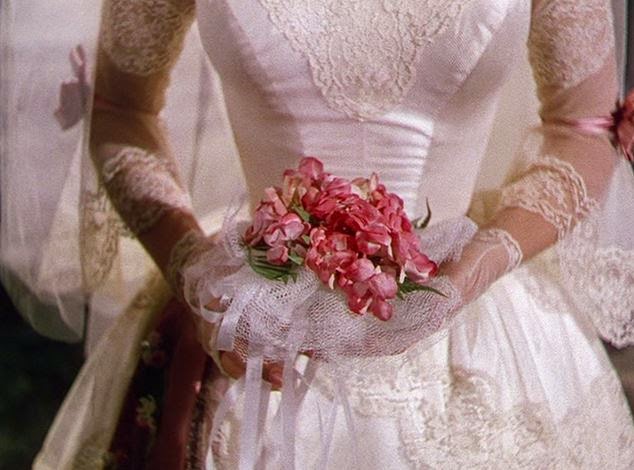
The romance between Peck and Ann Blyth really is a threesome, for we sense the strong presence of director Raoul Walsh in their scenes.  Despite his lusty testosterone-driven fights with belaying pins (I gotta get me one of them, so handy), his scenes with Ann Blyth are delicate and deep.  This shot of her bridal bouquet held at her waist as she, reluctant and heartbroken, is dressing for her marriage to Carl Esmond (she agrees to marry him to save Peck and his crew) is surprising.  A close-up on the flowers at her corseted waist, then pulled back to see the whole dress.  There is a feminine sensibility to this scene that I find touching, though I wonder if Mr. Walsh would balk at that.

In no scenes is she “taken” by Gregory Peck in abrupt embraces or rough kisses as we might see in other films where the damsel in distress is really just a prop, despite Peck's attitude of wild and lusty freedom to do pretty much what he wants.  Their attraction is mutual and they woo each other with patience and determination. There are too many obstacles for them to simply fall in love.  One senses the director’s appreciation not simply for Marina's sensuality, but for the actress playing her, perhaps expressed as well here by columnist Gene Handsaker who was allowed to watch a bit of the filming:

“Lord, what an actress!” the carpenter beside me breathed almost reverently.  We’d just watched Ann Blyth, as a Russian countess of long ago, burst into a dungeon full of chained men.
She rushes up to Gregory Peck, one of the prisoners, and swears that she still loves him.  She embraces him.  Her face is away from the camera, but there are tears, real tears, in her eyes.

Then she gets good news that will free Peck.  Annie rushes back up the dungeon steps, her back to the camera.  But from where the carpenter and I are watching, we can see her grinning excitedly at this wholly imaginary good news.

All of a sudden I remember a definition I once heard: Good acting is not acting at all.  It’s being…

The director often accused by actors of being difficult to work for was remembered more kindly by Ann Blyth in her interview with Eddie Muller (who called her remarks “generous”) on stage at the Castro Theatre in San Francisco in 2006, the transcript of which is quoted at The Evening Class blog (see below).

He was just a wonderful character, a devil-may-care kind of fellow.  He knew what he wanted and he was very short in his direction and if he didn't get it he'd just say, "Cut, let's try that again."  There wasn't too much "do it again."  He just had a wonderful way of getting the work done.  No fuss about it.

This estimation of Walsh may be more than just being “generous” or her customary habit of not badmouthing coworkers, but we could assume reflected her own serious approach to her work before the camera.  In a radio interview with host Casper Citron at WOR in New York City, November 1992, Ann noted:

I think you can work a scene to death.  I really do think that sometimes the first or second take …if you’ve rehearsed well and if the people you’re working with interact well with you, it seems to me that you should be able to do pretty much all that you can do, certainly within four takes—because they’re going to be covered from different angles as well.  So, you really do get other chances…Indeed, if an actor doesn’t come well-prepared, then I think many times it doesn’t matter who the director is.

…You have to know pretty much how you want to approach a role, and certainly to have input from a good director is most important. But you have to be prepared.

…I’ve always felt strongly about the roles that I’ve done and I’ve always felt that when I went to the set that I was going to be so prepared so that whatever the director decided to do, I would certainly have a say in how to approach a role.

There were other elements that might have given Walsh and Ann common ground: they were both Irish Catholics and both native New Yorkers.  Bryan Forbes, who plays the young seaman recalled in Raoul Walsh: the True Adventures of Hollywood’s Legendary Director by Marilyn Ann Moss that Walsh--the buddy of such tough guys as Humphrey Bogart, Errol Flynn, James Cagney, and John Wayne--put a fine box on the set of TheWorld in His Arms.  “Anyone who swore in …the demure Ann Blyth’s presence…had to put money in it.”

One scene which shows Walsh’ judiciousness is when Gregory Peck is captured by Carl Desmond, who orders him to be whipped.  Peck’s shirt is torn open at the back, and the resident torturer (every bad guy has one), starts the job of whipping Peck, but the camera quickly shifts to Ann Blyth’s reaction.  Obviously, Mr. Peck is not really going to be tortured on camera; that is not possible, so the best option to show the cruelty of the moment is to show the reaction of one who is our proxy in the experience.  Ann’s tragic face is enough to make us feel the horror because she feels it.  We don’t really need to see Peck flayed alive.

This is a primary difference in the approach of drama between theatre and film.  Theatre is unselfconscious about using illusion to tell the story, whereas filmmakers are more self conscious about illusion and prefer to straightjacket the audience’s experience in what has come to be accepted as “reality,” though there is nothing real about film reality.  Here Walsh relies with admirable confidence on Ann’s ability to carry the message of the scene without needing to resort to the sadistic and, in the end, unrealistic, image of Peck bleeding, flinching and wincing over an experience that is not really happening.

The last scene in the film is one of its most passionate, where Ann stands at the ship’s wheel, steering the sleek schooner into the twilight while Gregory Peck stands behind her, his hands covering hers.  Anthony Quinn is about to ask for his cut of Alaska, but John McIntire wisely says that Peck is not interested in Alaska at the moment, "not while he has the world in his arms.”  And we see that Ann Blyth is not just a damsel in distress or prop, but a fellow adventurer, and a woman deserving to be his whole world.

Raoul Walsh is in the scene too.  He frames them against the darkening sky, with the wind billowing against the long elaborate skirt of the wedding dress for her aborted wedding to the bad guy.  That heartbreaking, gorgeous Russian theme song swoops down upon us, sad and lovely and ecstatic.  They are more than smiling, they are grinning, all alone in each other’s company despite having a ship full of his crew, Anthony Quinn and his crew, Ann’s faithful servants, and a seal named Louise. 

Ann says something. We can’t hear because that gorgeous music is making us tear up, and Peck leans in close to her, because, apparently, he didn't hear it either.  She repeats, and he laughs, and she laughs.  It is a joyous moment showing their enjoyment of each other, and so much more sensuous than the clichéd fadeout kiss.

It looks quite impromptu and natural.  She could have said, “You’re on my foot,” or “I brought a peanut butter sandwich for lunch.”  We don’t know, and it’s best left to our imagination.

I cannot believe that glorious tune was not released as a single, with lyrics.

In July 1952 The World in His Arms had its premiere at several military bases in Alaska, the outpost where the Cold War brought nuclear adversaries toe to toe.  Ann toured at these bases making personal appearances and performing.

At one base, two shows were scheduled, but not all the servicemen could be accommodated, so a third show, beginning at midnight, was held for them.  According to Kaspar Monahan of the Pittsburgh Post-Gazette, the performers…

…proceeded to put on their best performance of this tour….But the next day, Ann Blyth and her fellow performers were so tired they could hardly walk to the mess hall for their breakfast.

Alice Hughes of the Reading Eagle reported that the press and entertainers traveled by military transport planes from base to base, and that, “We were given instructions on how to put on the harness and the folded parachute in case of a need to jump.”  The group of 75 including 23 entertainers, included Joyce Holden, Jeanne Cooper, Lori Nelson, Claudette Thornton, Audrey Goetz, male crooner Robert Monnet, comic Buddy Hackett, and Palmer Lee and Kathleen Hughes, both of whom we last saw with Ann in Sally and St. Anne, discussed here.

The bases ranged from the far-flung desolate Adak Island to the Arctic Circle.  “Annie, as we came to call Miss Blyth,” reported Howard Pearson for the Deseret News Magazine (Salt Lake City) sang for audiences ranging from 30 men to over 4,000. 

Clyde Gilmour of the Vancouver Sun was disposed to forgive her for not dishing gossip on the folks back in Hollywood. 

…her guileless and sunny honesty and her lack of theatrical razzle-dazzle are almost legendary in a profession that includes more than its share of strutting poseurs and egomaniacs…has been mesmerizing everybody right and left with her radiant smile and her mellow Irish voice.

Ann Blyth had hoped upon her return to Hollywood to begin The Student Prince in a greatly anticipated rematch with Mario Lanza, with whom she had starred in The Great Caruso, but this was not to be—at least not yet, and not with Mario Lanza.  More on that next month.

Have look here for other reviews of The World in His Arms I've enjoyed very much by our friends Laura of Laura’s Miscellaneous Musings and Kevin Deany of Kevin’s Movie Corner.

The movie is fortunately available on DVD, in a transfer really stunning for it's gorgeous colors and sharp cinematography.  Really a beautiful, beautiful-looking film.

The World in His Arms was one of the last films she made under her seven-year contract for Universal-International.  Come back next Thursday when we turn back the clock to 1944, when a 15-year-old Ann Blyth made her first two movies under that contract, Chip off the Old Block and The Merry Monahans.


This year-long series on Ann Blyth’s career has reached the halfway point.  I’ve enjoyed working on these posts more than I can tell you.  Several of you have asked about the possibility of turning this series into a book.  I’ve decided to proceed with that, to be available sometime next year.

Diana and Constance Metzinger over at Silver Scenes are hosting an MGM Blogathon June 26-29, and have graciously asked me to re-post my essay on Mrs. Miniver.  That will be up this Sunday, the 29th.

See you next Thursday for more Ann Blyth.

*********************

Daytona Beach Morning Journal November 9, 1951, syndicated column by Gene Handsaker.

Deseret News Magazine, (Salt Lake City) August 31, 1952, pp. 16-17, article by Howard Pearson.
          

Moss, Marilyn Ann.  Raoul Walsh: The True Adventures of Hollywood’s Legendary Director (University Press of Kentucky, 2011).

Pittsburgh Post-Gazette, July 2, 1952, p. 16, “Time Hangs Heavy for Servicement on Bleak Adak Island.”

Reading (Pennsylvania) Eagle, June 28, 1952, article by Alice Hughes, p. 5.

The Spokesman Review (Idaho), May 30, 1952, p. 3.

St. Joseph (Missouri) News-Press, December 16, 1951, syndicated column by Louella Parsons, p. 4D.


WOR (New York City) radio interview with Ann Blyth, Bill Hayes, and host Casper Citron, November 14, 1992.  
************************
THANK YOU....to the following folks whose aid in gathering material for this series has been invaluable:  EBH; Kevin Deany of Kevin's Movie Corner; Gerry Szymski of Westmont Movie Classics, Westmont, Illinois; and Ivan G. Shreve, Jr. of Thrilling Days of Yesteryear.

***************************
UPDATE:  This series on Ann Blyth is now a book - ANN BLYTH: ACTRESS. SINGER. STAR. -

*********************
The audio book for Ann Blyth: Actress. Singer. Star. is now for sale on Audible.com, and on Amazon and iTunes.

Also in paperback and eBook from Amazon, CreateSpace, and my Etsy shop: LynchTwinsPublishing.


 "Lynch’s book is organized and well-written – and has plenty of amusing observations – but when it comes to describing Blyth’s movies, Lynch’s writing sparkles." - Ruth Kerr, Silver Screenings

"Jacqueline T. Lynch creates a poignant and thoroughly-researched mosaic of memories of a fine, upstanding human being who also happens to be a legendary entertainer." - Deborah Thomas, Java's Journey

"One of the great strengths of Ann Blyth: Actress. Singer. Star. is that Lynch not only gives an excellent overview of Blyth's career -- she offers detailed analyses of each of Blyth's roles -- but she puts them in the context of the larger issues of the day."- Amanda Garrett, Old Hollywood Films

"Jacqueline's book will hopefully cause many more people to take a look at this multitalented woman whose career encompassed just about every possible aspect of 20th Century entertainment." - Laura Grieve, Laura's Miscellaneous Musings''

"Jacqueline T. Lynch’s Ann Blyth: Actress. Singer. Star. is an extremely well researched undertaking that is a must for all Blyth fans." - Annette Bochenek, Hometowns to Hollywood


Ann Blyth: Actress. Singer. Star. 
by Jacqueline T. Lynch

The first book on the career of actress Ann Blyth. Multitalented and remarkably versatile, Blyth began on radio as a child, appeared on Broadway at the age of twelve in Lillian Hellman's Watch on the Rhine, and enjoyed a long and diverse career in films, theatre, television, and concerts. A sensitive dramatic actress, the youngest at the time to be nominated for her role in Mildred Pierce (1945), she also displayed a gift for comedy, and was especially endeared to fans for her expressive and exquisite lyric soprano, which was showcased in many film and stage musicals. Still a popular guest at film festivals, lovely Ms. Blyth remains a treasure of the Hollywood's golden age.


Thursday, January 9, 2014

Mr. Peabody and the Mermaid - 1948


Mr. Peabody and the Mermaid (1948) is a whimsical tale of true love, wherever you happen to find it—in a fantasy, or your wife.  Or both.

Another long post.  Go long.  I'll hit you in the end zone.

Ann Blyth was still in production on Another Part of the Forest (1948) –which we’ll discuss in a later post—when she was given over to the mad scientist ministrations of makeup genius Bud Westmore to attach a four-foot long mermaid’s tail to her lower body. 
 State Archives of Florida, Florida Memory, http://floridamemory.com/items/show/8893

These were very busy and prolific years for her, from 1948 to 1952.  Half the 32 films she made in her entire career were in just this four-year period, when one production rolled right on into the next.  After Mr. Peabody and the Mermaid, that summer she was slated for location shooting in Utah for her first western, Red Canyon (1949).  Her career was thriving, with what must have been a gratifying variety of roles to display her freshness and versatility.

Ann was 19 years old when the film was made, and William Powell was 55, but the 36-year difference between them did not really make for any awkwardness in the crush the mermaid and the man had for each other on screen, mainly because the crush was so innocent and so was the mermaid. 

For his part, William Powell strolled through his character’s screen midlife crisis with the panache and bemused sophistication of The Thin Man, with that sly humor that uses discretion as a springboard to irony.  He’s perfect in the role.

And in real life, Mr. Powell’s wife, former actress Diana Lewis, who we saw here in Cry Havoc (1944), was 27 years his junior.  So much for impossible age differences.

As for any possible off-screen awkwardness, that was apparently dispelled by the good humor of both leads.  An article by Sheilah Graham in 1949, in a half-mocking, half-admiring tone, noted that Ann Blyth “a devout churchgoer with an innocent smile, peach blossom skin and a wolf-whistle figure” was known at this stage of her career for being shy about kissing too passionately onscreen, or at least, “refuses point blank to go all-out.” 

Mr. Powell, as discreet as his character, Mr. Peabody, apparently handled her discomfort as well any of his own, by remembering first and foremost that they were making a comedy.

Ann said in the interview, “He was kidding all of the time.  I was always afraid he was going to make me laugh as he started to kiss me.  It was such whimsical make-believe that I wasn’t embarrassed when I had to kiss him.”

Mr. Powell’s problems about their age difference ultimately had more to do with his age than hers; he had to carry the mermaid around a lot, which was a remarkable, and exhausting, feat for a man of his years.

The Montreal Gazette felt that William Powell was good but should have been better, but thought Ann “…wears the fishtail as if born to it, gives the just the right suggestion of an untutored but not unknowing denizen of the deep.  It’s her best performance.”  I think they were wrong about Mr. Powell, but Miss Blyth earned the praise.  It’s interesting reading the different reviews how critics seemed not to know how to take this movie.  It was such an offbeat charmer that I don’t think they could categorize it into any familiar pigeonhole.

The New York Times, however, (in a review NOT written by the easily irritated Bosley Crowther) called Mr. Powell’s work “an engaging and highly polished performance” and noted of Ann, “Her costuming places her beyond criticism.”  It’s signed T.F.B., and whoever he was, that’s as stylish a piece of leering as I’ve ever read.

Now, about that costuming.  The effort it took to make the film is as delightfully whimsical as the story.  William Powell may have caught his mermaid fishing, but makeup man Bud Westmore had to create her from scratch.

Photo credit unknown at this time.  I think that's Bud Westmore.

First, you need a young woman, about 5’2”, who doesn’t weigh very much because everybody, not just William Powell, is going to have to carry her around a lot when she’s wearing the tail.  Just as fish are immobile when they are “beached”, so is Ann Blyth when she’s wearing her fish tail—which, despite its inconveniences, she apparently didn’t mind too much.  She recalled in a 2006 interview with Eddie Muller (referred to in our intro post here):

“The good part about that was that I got to be carried around all day long.  Everyone was so good to me on that movie.”


You drop the cooperative girl on a table and get your mad scientist buddies to make a mold of her body by smooshing clay or Play-Doh or Silly Putty, or whatever you have in the junk drawer, from her torso to her toes. 

Photo credit unknown at this time.

Once you’ve got that done, you start covering her with plaster.  

Thus is an actress turned into an arts and crafts project. 

According to an article by Gene Handsaker in the Milwaukee Journal, the fish tail cost $23,000 to make.  (Life magazine says $18,000.)  “Ann lay on a sort of operating table for three hours while being molded in clay and plaster for the four foot mermaid tail of sponge rubber, she told me on the set of Another Part of the Forest.

“To each scale of Ann’s tail will be sewn a glass jewel for further sparkle—some 4,000 jewels in all…The upper part of this, the biggest rubber ‘appliance’ ever made for a movie, will blend into her torso in a chaste, piscatorial nude effect—if U-I can get that past the Johnston office.”

This “piscatorial nude effect” has to do with the fact—if you can call it a “fact” when we’re talking about a mythical creature—that a mermaid’s upper body is that of a human woman, so there’s a running gag in the movie about covering the mermaid’s naked breasts. 

State Archives of Florida, Florida Memory, http://floridamemory.com/items/show/8894

But teasing the censors is the last thing on the agenda.   First, we still have to finish our mermaid.  Once you have the sponge rubber tail, then you’ve got to wrestle it onto the cooperative young woman.  Can’t have been easy to slide into. 
 State Archives of Florida, Florida Memory, http://floridamemory.com/items/show/149884

You need help.  A team of three is good.  Hoist the girl in the air between you and yank that tail onto her.  This pit crew is also available for hire.  Can’t get into those tight jeans anymore?  These boys are professionals.  They know what they’re doing.  Having trouble wrestling your wiggling five-year-old child into a snowsuit?  Just give them a call. 
Ed and Whitey McMahan carry M'lady to the set.
 State Archives of Florida, Florida Memory, http://floridamemory.com/items/show/8892

Then, as we mentioned, the young woman can’t walk in this thing, so she has to be carried like Cleopatra by obliging handsome slave boys to her watery home.  Where she is unceremoniously dumped in the drink.  This is likely not a good time to tell people you have to go to the bathroom.

One more thing.  Lead weights were placed in the bottom of the tail by her feet, some references say 30 pounds, some say 50 pounds—to keep the rubber tail, and the person wearing it, from floating to the surface of the water.  Sounds as ominous as stories of mobsters fitting their victims with “cement shoes”. 

Here are more photos from Life magazine, February 1948.

Newt Perry and Ann
 State Archives of Florida, Florida Memory, http://floridamemory.com/items/show/149882

Once the actress looks like a mermaid, she’s got to be trained to swim like one.  Here’s where Newt Perry and the team from Weeki Wachee Springs in New Port Richey, Florida, come in.  Weeki Wachee Springs was one of those roadside tourist attractions long before we had fast food chains lining every stretch of highway, before expensive theme parks and innumerable corporate-owned enterprises were devised to part you from your money.

Established in the fall of 1947 by Newt Perry, it wasn’t long before Universal-International came in December to build a special set onto Perry’s showcase of “mermaids.”  They were just local high school girls—not in mermaid costumes—frolicking under the water doing tricks and demonstrating scenes of, as the book Weecki Wachee Springs by Maryann Pelland and Dan Pelland notes, “eating, drinking, and even typing underwater.”  Perry devised a system for the beauties to remain under water for longer periods by sneaking breaths of compressed air through rubber hoses.
Newt Perry and Ann
 State Archives of Florida, Florida Memory, http://floridamemory.com/items/show/149879

Most of these photos are from the State Archives of Florida as displayed on the FloridaMemory.com site.  Newt Perry also trained Navy frogmen, helped out on several Tarzan films, and taught his nephew to swim—who was Don Schollander, 1964 and 1968 Olympic Gold Medalist.  A champion swimmer himself, Mr. Perry knew his stuff.

According to author Tim Hollis in Glass Bottom Boats & Mermaid Tails:Florida’s Tourist Springs, “Perry coached Ann Blyth in the proper techniques of underwater breathing, and according to all reports, she was a quick study and a natural athlete.  Though she performed the necessary water close-ups, her acrobatic swimming in most of the long shots was done by the Weekiwachee regulars, primarily Nancy Tribble.”
Mermaid doubles Nancy Tribble and Flo Wilkinson with Ann.
 State Archives of Florida, Florida Memory, http://floridamemory.com/items/show/149877

According to gossip columnist Hedda Hopper, “Between scenes she swam and dived just for the heck of it, while Powell, fully dressed, clung to a rope and shivered.” 
Ann does her own swimming here.
 State Archives of Florida, Florida Memory, http://floridamemory.com/items/show/8897

The cast of Mr. Peabody and the Mermaid arrived in February 1948, and filmed some of the underwater scenes here, and some back at Universal in a water tank.  Andrea King, who played the rival for the affections of Mr. Powell—a rival, as it turns out, for his wife and his mermaid—is quoted on a website devoted to her career as recalling the weather in Florida that February to be cold and rainy, and much of the cast fell ill, including trouper William Powell, though, “you never would have known it.”

Back at Universal to finish up some water scenes between her and Ann Blyth—including a spectacular fight scene we’ll discuss below—Miss King recalled that though the tank was supposed to be heated, the water heater malfunctioned and the water was quite cold in the tank.  “So we tried anyway for about half an hour, but Annie and I just went numb.  I think she got terribly sick after that.”
 State Archives of Florida, Florida Memory, http://floridamemory.com/items/show/149881

And now, the movie…


Directed by Irving Pichel, written by Nunnally Johnson, adapted from the novel Mr. Peabody and his Mermaid.  I lead off with the title card here because this graphic of a mermaid, so coyly curled up with the credits, is the only time you will really ever see a mermaid naked from the waist up in this movie.  Ann Blyth is artfully covered by the edge of a pool and a fortunate camera angle, by a robe, by seaweed, by her flowing curly blonde hair, by a bubble bath, and by her own expressive arms.

William Powell plays Arthur Peabody, a man about to turn 50 years old, a fact which surprises him and depresses him.  He is also just recovering from a long bout of flu, so he and his wife have taken off to restore his health at a Caribbean paradise where it’s warm.


Irene Hervey is his wife, wry and understanding, and we can see from the outset that theirs is a good marriage, with comfortable bantering. 

She is no shrew from whom he is trying to escape, indeed, the only “other woman” he leers at in this entire movie is her, when she is partially hidden from view and he does not at first realize the legs he’s ogling are his wife’s.  She looks good in a bathing suit.  His demonstrated attraction to his wife also takes the smarmy edge of his “romance” with the much younger mermaid.


Andrea King is a visitor to the vacation villa, a singer and performer who blatantly chases after Powell with la-de-da joie de vivre, perhaps with no real design on him except for the fact she’s bored and there apparently seems to be a lack of other men.  And he really is charming.

Clinton Sundberg, who we’ve all seen in minor kindly “everyman” roles—I think my favorite is Judy Garland’s bartender pal in Easter Parade—here gets a larger role as a publicity man for the villa, one of the few Americans on this British protectorate, who is cynical, funny, and even surprisingly a little sinister.  There’s a running gag about his doctor forbidding him to drink or smoke anymore, and how miserably Mr. Sundberg copes with this.

Art Smith, seen at the beginning and the end of the movie, is the psychiatrist to whom Irene Hervey takes Mr. Powell to get him over this mermaid fantasy.  Mr. Smith is an especially understanding fellow, who, like Powell, also likes to fish and is amazed he could have caught a mermaid on a 12-thread line.  A wonderful old character actor (though actually younger than William Powell), he was one of the unfortunate victims of the infamous blacklisting in the 1950s when Elia Kazan threw him to the wolves. 

I won’t go play-by-play with the plot, but here are some delightful scenes to mention: At the beginning of the film when William Powell sits in the waiting room of the psychiatrist’s office and a small boy stares at him, asking his mother, “What’s the matter with him, Mommy?  Is he crazy?”

I like that it’s snowing outside in the city, which gives a great contrast to the sunny paradise he retreats to, representing a rebirth of spirit.  It would have been lovely to have the film in color, but it still manages to take us away to tropical splendor without it. 

Almost the moment he arrives, he hears a musical trilling from some far distance—he alone hears it and we presume it is the fabled siren’s call—but he suspects no mermaid, even when he takes a sailboat to a deserted rocky key and finds an ornamental hair comb.  We will soon see it belongs to the mermaid, whom he hooks on his fishing line.


The fishing scene is good; it takes time and plays out nicely, building suspense.  He hooks the tail of what he presumes to be a large sport fish.  From what we see of the tail, it could be a marlin or a swordfish, or a tuna.  Even in just these scenes of exploring, sailing, fishing—indeed, struggling to land a big fish—William Powell is already exorcising the demons of turning 50.  He’s already proving to himself that life is still exciting and he’s still man enough with strength and vigor to enjoy it.

He manages to pull the fish close enough to grasp its tail and flip it into the boat.  He’s won the fight.  Hemingway would be proud.

Then he is astonished to discover at its other end is a pretty young woman.

No more astonished than the dazed mermaid is to discover herself in a boat with a strange two-legged creature.


At first, the mermaid is only a fishing prize to him, and he gleefully carries her into the rented vacation villa as a specimen he hopes to produce before scientists.  She’s a bit faint and peaked lying on his bed, then he realizes this creature needs to be in water, so he fills the tub, while she looks around his room with the wonder of someone who’d never been on land before.  Right at this moment to us, Ann Blyth as the mermaid stops being a myth or a plot contrivance, but a person with whom we can identify, and that goes a long way towards our caring about the relationship between her and Mr. Powell.  Moreover, she is mute, so our compassion rises for this lost soul in a strange place.
At first, Powell has no romantic notions about her, though he warms from regarding her as a fishing trophy to referring to himself as “your old Uncle Arthur” when he swiftly becomes her caretaker.  He is giddy not with love (even when his robe slips from her bare shoulders when she slides into the tub and grins at him from under the water), but in anticipation of the fame and notoriety his accomplishment in landing her will bring—and in a celebratory mood gets a bit tipsy by the time his wife comes home.

Irene Hervey, though she has teased her husband about turning 50, nevertheless is jealous over his attention to Andrea King at the party the night before.  She suspects the splashing she hears in her tub is Miss King, but when she opens the door to confront the other woman, all she sees is an enormous fish tail protruding from a bubble bath.  It seems the mermaid, with childish curiosity, gotten into the toiletries.

Miss Hervey thinks her drunken husband has played a joke on her, and she wants that fish out of her tub.  I like the scene when she’s on the phone talking to a man she’s met at the party (she’s been making friends too) while William Powell carries the mermaid down the stairs.  He’s had a little too much to drink and, in the doghouse with his wife, so he carries the mermaid outside intending to release her back into the ocean. 

But he gets tired hefting her.  “You’re no guppy.”  (One of my favorite lines.)  He sits on the edge of the enormous ornamental fishpond to rest, with the mermaid in his lap, and finally takes a long look at her.  His fishing trophy, his scientific discovery are only a popped balloon—popped by his wife—and he now regards the mermaid in a second look, a second chance at a first crush.

“You don’t want to go back in the sea, do you?  It’s so big, and you’re so pretty.” 

He lightly kisses her, off to the side of her mouth, and the astonished mermaid, uncomprehending eyes wide open, is gobsmacked.  Trying to figure this out, she parts and closes her lips as if to taste the kiss he’s left there.  She likes the sensation and wants to kiss again.

He leaves her in the fishpond, half-pet, half-mistress.

William Powell is so entertaining and so sweet in his role, which is basically comic, but lends it such skillful depth and poignancy. 

Ann Blyth’s work here is luminous and captivating.  It is a non-speaking role, but there is remarkable and touching eloquence in the way her eyes roam over his face, as if trying to read him, trying to understand his words and his facial expression.  Middle-aged Mr. Peabody is wondrous and fascinating to her, and her unlikely crush for him alone adds another level to the comedy, and the poignancy.  We can see why he might take a fancy to her, but her radiant and achingly silent adoration of him is charming.
The funniest scene in the movie is when Mr. Powell heads to a women’s clothing store in town to purchase some sort of top for his mermaid.  His befuddled awkwardness sets the stage for a terrific scene, and he plays the straight man for Mary Field, whom you’ve probably seen uncredited in a zillion movie walk-on parts.  Here she gets a good role as the primly officious clerk, who delights in her soliloquy sales pitches to the uncomfortable Mr. Powell.  She sounds like a Banana Republic or J Peterman catalog description gone amuck. 

She displays a sweater, “Light as a whisper, gay as a sunbeam, wearing it will be an emotional adventure spangled with the moon glow of twilight.”  (I swear, if just one sales clerk ever spoke to me that way, I’d buy everything in the store.  I am so heartily sick of, “How you guys doin’?” when I am not a guy, and they never know the answer when I ask a question and too lazy to find out.  They discuss their personal lives in grating voices with coworkers and I am just a shadow who hands them money when they've paused to notice me.  Oh, for the days of professional sales help.  Call me ma’am, just once, please.)

Miss Field continues her merry prattle, “A gay spectrum of springtime hues—fuchsia, purple almond, banana, marshmallow, peach dream and licorice!”

Mr. Powell replies, “Would you be good enough to tell me something?”
Miss Field: “Enchanted.”  (I love her over-the-top playfulness with proper speech.)
Mr. Powell: “Whatever became of blue?”

She finds he is going to be trouble, especially when he wants to know if someone can swim in her sweaters.

“May I ask is the young lady’s prejudice against swimming in a swimming suit quite deep-seated?”  (One of my all-time favorite lines.  I just love her.  In a way, her intonation and enunciation reminds me of a reformed Eliza Doolittle when she is carefully trying to explain to Freddy Eynsford-Hill that, “Them she lived with would have killed her for a hat-pin, let alone a hat.”  Her careful stroking of the difficult language as if to tame it.)

Mr. Powell just realizes he could buy his mermaid a two-piece swimsuit instead of a sweater and she could just wear the top part.  But Miss Field, Saleswoman of the Year, insists they do not sell half of a bathing suit.  She holds one up, “The diaper model.  Provocative, n'est–ce pas?”  (She’s straight-faced, slam-dunk hysterical.)

Nobody in the movie calls these two-piece suits a bikini, but the name, as well as the design, was still quite new.  They arrived in 1946, about a year and a half before this movie went into production, and were named by the designer for the Bikini Atoll in the South Pacific, where the U.S. conducted its first peacetime nuclear test explosions.  He wanted the swimsuit to similarly bear (or is that bare?) the reputation of an intense "reaction".

Mr. Powell buys three bikinis, and next we see him sitting by the fishpond, separating the panties from the bras with delicate thoroughness as the mermaid solemnly watches. 

He gently begins his lecture: “Darling, I don’t want to offend you, but you’re not dressed for company.”  (Another favorite line.)  He tries to explain modesty to her, but she is uncomprehending. 

She plucks one of the bras he has displayed on the edge of the pond for her perusal, and she places it on top of her head.  She has no idea what to do with it.


He stretches a bra across his own chest to demonstrate, but she’s not interested.  She wants attention.  She wants him to kiss her again, but he won’t and gently remonstrates her, too, that she must also stop eating the expensive rare tropical fish in the fishpond.  The camera cuts over to a neat lineup of fish skeletal remains on the side of the pool.  He wants her to eat canned sardines instead.

She is upset and starts to tear up (and for me, as silly as this scene is, it’s as heartbreaking as when you see a toddler’s face fall when he is told “no”).  She just wants to be loved.  She just wants this wonderful male two-legged creature to talk sweetly to her again and leave soft kisses on the side of her mouth.

He comforts her and is amazed by her.  “My age means nothing to you, does it?”  She explores his face with her adoring eyes, and now he’s a goner, pleasantly lost in the first flush of his second spring.

But the mermaid can also be quick to anger.  She does not like Andrea King messing with her male two-legged creature.  She hisses when Mr. Powell talks about Miss King.  Here Ann Blyth is dubbed (not for the last time in her career—but we’ll get to The Helen Morgan Story eventually).  According to a syndicated article in the St. Petersburg Times, Gene Fowler, Jr., assistant producer, could not find a suitable sound for a mermaid snarl, so they took a crew to the San Diego Zoo and found the sound they wanted from an irritable ocelot.  They recorded him on tape, and the sound of the ocelot snarl, played backwards, is apparently what we hear on screen.

When Andrea King stops by, the mermaid spies on her overt flirtation with Mr. Powell and becomes jealous.  When Miss King teasingly strips off her evening gown and dives into the fishpond in her unmentionables, the mermaid sneaks up on her in the murky depths of the pool, and grabs her.  There’s a vigorous fight underwater between them, no doubles here—it’s really Ann and Andrea in an oxygen-deprived soggy girl fight—and the mermaid bites her leg.  Andrea can kick her way to the surface, but Ann’s got 30 to 50 pounds of lead weights in her tail keeping her nicely submerged.


In the middle of the night, Powell hears the mermaid’s trilling, and sneaks out to the pond to find her sitting on the edge of the pool in Miss King’s gown as a trophy (Miss King, terrified, has run off without it), which she wears like a debutante to impress him.  With great tact and understanding, he compliments her appearance, and she clings to his hand, kissing it.


But his wife is fed up with him, sure that he’s carrying on with Miss King, so she leaves him.  When she disappears, the local authorities think he murdered her, and now poor Mr. Powell has to get the mermaid back to the ocean and get back his wife.

A nice shot here when the mermaid overhears Powell telling the sardonic Clinton Sundberg that he’s in love with a mermaid, and she responds silently with a brilliant, ecstatic smile.  The only thing better than your male two-legged creature telling you he loves you, is hearing him talk about how much he loves you to somebody else.


Ann Blyth has some clever and remarkable stunts to perform underwater, most especially the fight scene, but also a bit where she swims around an enormous castle-like structure, where she cries underwater into a handkerchief and blows her nose, and gathers up her comb collection when Mr. Powell tells her they have to leave this place.

Their adventure culminates on a rock at sea, with the British authorities after them.  It is a tragic moment when he sees he cannot stay with the mermaid, and must let himself be taken back to the land.  He reunites with his wife, and gives her a present: one of the mermaid’s ornamental combs.

I think the above–mentioned New York Times reviewer hit the nail on the head when it comes to the ending of this movie: “Mermaids are not good subjects for cinematic comedy, since they just can’t settle down and live happily ever after.”

True, for though we may be happy for the Peabodys’ reunion, there is a sense of sadness that we don’t know what happened to the mermaid, and wonder if she will ever find another male two-legged creature to love her.

Ann Blyth and William Powell parted with a happier mood.  In the 2006 interview with Eddie Muller, referred to in our intro piece and posted on The Evening Class blog transcript of the event, she recalled of Powell:

He was so dear, tender…I had asked him for a picture at the end of the movie and he took several lines from the movie and wrote them on the picture.  Actually he taped it to the picture and said, "I like you.  I like you very much."


You can watch Mr. Peabody and the Mermaid currently here at YouTube.

Come back next Thursday when we jump eleven years later to 1959 and a new medium—television—for Ann Blyth’s first of five appearances on the western Wagon Train.  It’s The Jenny Tannen Story, where she has a dual role of a cold, bitter woman, and the young daughter who travels across the continent to see her.  This one’s dedicated to your friend and mine, the Caftan Woman, for her particular fondness for this episode.  It was during the filming of this episode that Ann was surprised by Ralph Edwards on This Is Your Life.  We'll talk about that too.


____________________________


Evening Class blog, July 28,2007, transcribed interview of Eddie Muller with Ann Blyth at the Castro Theatre, San Francisco, July 2006.

FloridaMemory.com website, Florida Photographic Collection of the State Archives of Florida.

Hollis, Tim.  Glass Bottom Boats & Mermaid Tails: Florida’s Tourist Springs, (Mechanicsburg, PA, 2006) p. 99.

Life magazine, February 9, 1948, pp. 91-94.

The Milwaukee Journal, article by Gene Handsaker, December 18, 1947; article by Sheilah Graham, August 22, 1949, p. GS1.

The Montreal Gazette, October 23, 1948, p. 21.

The New York Times, review by T.F.B., August 14, 1948, p. 6.

Ocala (Florida) Star Banner, April 14, 1981, p. 10A

Pelland, Maryann and Dan Pelland.  Weecki Wachee Springs (Charleston, SC., Chicago, Portsmouth, NH, San Francisco, 2006), p.7

St. Petersburg (Florida) Times, December 10, 1947, p. 14; April 4, 1948, p. 34

Youngstown (Ohio) Vindicator, syndicated article by Hedda Hopper, March 8, 1948, p. 16.


 UPDATE:  This series on Ann Blyth is now a book - ANN BLYTH: ACTRESS. SINGER. STAR. -

*********************
The audio book for Ann Blyth: Actress. Singer. Star. is now for sale on Audible.com, and on Amazon and iTunes.

Also in paperback and eBook from Amazon, CreateSpace, and my Etsy shop: LynchTwinsPublishing.


 "Lynch’s book is organized and well-written – and has plenty of amusing observations – but when it comes to describing Blyth’s movies, Lynch’s writing sparkles." - Ruth Kerr, Silver Screenings

"Jacqueline T. Lynch creates a poignant and thoroughly-researched mosaic of memories of a fine, upstanding human being who also happens to be a legendary entertainer." - Deborah Thomas, Java's Journey

"One of the great strengths of Ann Blyth: Actress. Singer. Star. is that Lynch not only gives an excellent overview of Blyth's career -- she offers detailed analyses of each of Blyth's roles -- but she puts them in the context of the larger issues of the day."- Amanda Garrett, Old Hollywood Films

"Jacqueline's book will hopefully cause many more people to take a look at this multitalented woman whose career encompassed just about every possible aspect of 20th Century entertainment." - Laura Grieve, Laura's Miscellaneous Musings''

"Jacqueline T. Lynch’s Ann Blyth: Actress. Singer. Star. is an extremely well researched undertaking that is a must for all Blyth fans." - Annette Bochenek, Hometowns to Hollywood


Ann Blyth: Actress. Singer. Star. 
by Jacqueline T. Lynch

The first book on the career of actress Ann Blyth. Multitalented and remarkably versatile, Blyth began on radio as a child, appeared on Broadway at the age of twelve in Lillian Hellman's Watch on the Rhine, and enjoyed a long and diverse career in films, theatre, television, and concerts. A sensitive dramatic actress, the youngest at the time to be nominated for her role in Mildred Pierce (1945), she also displayed a gift for comedy, and was especially endeared to fans for her expressive and exquisite lyric soprano, which was showcased in many film and stage musicals. Still a popular guest at film festivals, lovely Ms. Blyth remains a treasure of the Hollywood's golden age.


Related Products