IMPRISON TRAITOR, PEDOPHILE, AND CONVICTED FELON TRUMP.
Showing posts with label Hugh Beaumont. Show all posts

Friday, March 20, 2026

Ward Cleaver's World War II heroism


Ward Cleaver sat sipping coffee with his wife, June, in their suburban kitchen and mentioned, “When I was in the Seabees, I got into a fight over a picture of Lana Turner.”  


It’s not something we expect of Ward, but little droplets of his life through the series, before he came The Man in the Gray Flannel Suit and his children’s go-to guy for getting them out of trouble, were fascinating.  More than his children realized, he was the epitome of the Greatest Generation and what happened to them after the war.


This is my entry into the 12th Annual Favourite TV Show Episode Blogathon, hosted by Terence over at his wonderful A Shroud of Thoughts blog.  I look forward to this blogathon every year because it gives me a chance to showcase performances by actors from classic films who took guest spots, or sometimes took their entire careers, over to the small screen.

Hugh Beaumont, who played Ward Cleaver, the father on Leave it to Beaver (1957-1963), was one such actor who began his film career in 1940 (we covered his role in The Blue Dahlia – 1946 here), and played a variety of supporting roles in big films, starring roles in B-movies, and lots of uncredited parts.  He was in his late forties when Leave it to Beaver gave him steady work, made him a household name, and for generations afterward, made him the number one dad on TV.


One of the most well-remembered shows of the era—largely because succeeding generations have grown up with reruns, featured Beaumont, Barbara Billingsley as his wife, June; Tony Dow played their older boy, Wally… “and Jerry Mathers as The Beaver.”  The show was well-written, often quite funny, and Jerry Mathers was probably one of the most natural child actors of the day.  The boys were average kids revealing the world of postwar childhood to their occasionally baffled elders, and each episode ended with some kind of lesson—but often not for the boys, rather, for their parents.  This represented a sea change in TV sitcoms and reflected the growing importance, and perhaps coddling, of The Baby Boomers.  (Though to be accurate, Wally, who was supposed to be 13 years old when the show started in 1957, would have been born during World War II, and therefore, technically not a Boomer.)

When television dawned in the living rooms of (some) American homes at the end of the 1940s and early 1950s, popular shows were geared more to the Greatest Generation, the ones who were buying the TV sets.  After a day of work, they would unwind with comic Milton Berle on The Texaco Star Theater, Jackie Gleason on The Honeymooners, or the brilliant, Your Shows of Shows with Sid Caesar, Carl Reiner, Imogene Coca, and a cast that couldn’t be beat.

These were mostly sketch comedies, but even The Honeymooners, which could be considered a sit-com, did not feature children in the cast.  These were shows for grownups, the stars were their contemporaries, and though kids could enjoy them, the shows did not spotlight their experience, their world.

As the fifties progressed, more family sit-coms appeared, but even Make Room for Daddy, centered more on star Danny Thomas than on his children.  One could say Robert Young of Father Knows Best, at least got equal time with his kids, mostly.  By the time Leave it to Beaver appeared in the fall of 1957, television began more and more to showcase, and to market to, the young Boomers.


Hence, we have Ward Cleaver, a likable, intelligent man with a likable intelligent wife, taking a backseat to the adventures of their kids. We don’t know much about Ward and June.  Hints drip out once in a while about her boarding school, his growing up on a farm, their meeting in college.  They have social engagements only once in a great while with friends they otherwise never discuss.  


The wonderful boor Fred Rutherford, who works in Ward’s office, is seen more as a pain in the neck than a friend. 

Even Beaver and Wally never seem to know much about their parents and are always surprised they had a life before the kids came along.  The Boomers usurped the Greatest Generation in part due to their parents’ doting on the kids, and also living in the moment after what were likely difficult childhoods in the Great Depression and the world blowing up when they came of age.  They were forward-looking people, who wanted orderly quiet now, and as a result, unless their children were persistent in asking about “the old days,” they might never know.


As a child, I liked the boys and their exploits—though it annoyed me that they were such terrific liars.  Nice boys, to be sure, but in each episode, they lied about something and thereby needing to be rescued by dad.  Unlike their parents, we got to meet all the kids’ friends (and most of them really funny).  Oddly, all the kids’ friends were backstabbers.  Truly, a strange dynamic at work here.  (Although all Larry Mondello would have to do would be to enter a room and I’d crack up.)


I was drawn more to the adults.  I even liked Fred Rutherford.  I liked Mrs. Rayburn, the principal.  I still do.  She’s one of my favorites on the show.

I especially liked Ward and June.  I think I felt sorry for him with his several reminisces of having a strict, somewhat mean-sounding father, and so he went over backwards to try to be lenient with his sons.  Ward actually resembled my father a little, though in personality was nothing like him.  They were both tall, lean, and had the same haircut.  My father served in the South Pacific during World War II, and so did Ward. 

Ward served in the U.S. Naval Construction Battalions, called “CB” or Seabees.  Formed in 1942, it supported Navy and Marines, and is now the U.S. Naval Construction Forces.

Ward’s mention of getting into a fight over a photo of Lana Turner was in season 6, episode 29, “Eddie's Sweater.” 

In “The Visiting Aunts” (December 18, 1958, season 2, episode 13),  Ward recollects wryly of Aunt Martha and her friend, whose husband is always referred to as “The General,” came to their wedding and was surprised that June was marrying a Seabee, as if that wasn’t good enough for an Army man.


In “The Perfect Father” (March 14, 1958, season 1, episode 22), Ward puts up basketball hoop over the garage for the boys.  He muses “I must have put up hundreds of those all over the South Pacific when I was in the Seabees.”  June teasingly responds, “I guess we all contributed to victory in our own way.”

June, we learn in “Mother’s Day Composition” (April 30, 1960, season 3, episode 31), volunteered at a USO during the war and served coffee and donuts. This was not quite as impressive as Beaver’s friend Richard’s mother, who was a WAC private, then a corporal, and eventually became a captain. In “Kite Day” (June 10, 1961, season 3, episode 37) we learn his father flew a P-38 in the war.  Beaver scoffs, “Ah, those are so old, they don’t even make models of them anymore.”

So much for past glory.  Even Eddie Haskel (Ken Osmond was great in this memorable role) suffered shame when in “Summer in Alaska” (May 9, 1963, Season 6, episode 33), Wally recalls that when they were kids, Eddie bragged that his father was a three-star general in the war, but they found out otherwise when they discovered Mr. Haskel’s air raid helmet in a closet, proving he was a civilian air raid warden during the war. 

During the war, anyone doing his bit was considered patriotic, but to the kids growing up later in peacetime, only the most heroic actions would be worth bragging about.  We come to “Beaver’s Hero” (April 9, 1959, season 2, episode 28), when the boys discover the secrets of their father’s wartime footlocker.


Mr. Willet (played by Wendell Holmes) is Beaver’s substitute teacher (Miss Landers is sick) and he tells the class about the world war. Wally asks The Beav, “Which world war?”

Beaver replies, “You mean there was a lot of them?”

“There’s two of them that I heard about.”

Beaver responds, “I think it was the one that President Eisenhower was in.”

“Yeah, that’s the one Dad was in, too.”

Beaver asks his mother, “Was Dad and Mr. Eisenhower in the same war?”

June says yes and Beaver replies, “It’s something having your father in the same war with the president.”

This, his ignorance, I found stretching credulity as a child, as those of us who had parents in World War II certainly knew about the war, because being only 20 or 25 years ago was still part of the social memory.  Also, we watched Combat when we were kids and took turns playing Vic Morrow and Rick Jason.  I can recall wearing plastic World War II-style helmets and throwing plastic grenades over a fence into a neighbor’s yard, and the bunch of us running to “hit the dirt” on someone else’s front lawn, covering our heads and making “ka-pow” noises.  When it was safe to stand, we had to climb over the fence into the neighbor’s yard to retrieve the plastic grenades.  Something which I never saw Vic Morrow or Rick Jason do, by the way.

So there were times I found Wally and Beav’s self-involved ignorance rather frustrating.  But, to continue…

Back in class, Judy Hensler (played by Jeri Weil), brags that her father was a hero who flew his own plane in World War II.  Gilbert’s uncle was a Marine sergeant who was “almost a general.”

(I like how the teacher calls the kids by their surnames and “ladies and gentlemen.”  I didn’t run into that until college.)

Beaver tells the kids his father was a hero, that he has a trunk in the garage full of guns and grenades, “and all kinds of stuff he took off of enemy guys.”  Judy accuses him of being a liar, which makes her very smart, because he is.


Wally and Beaver look at the trunk in the garage with the Seabees insignia. Their mascot emblem was a fighting bumblebee with a machinegun, a wrench, and a hammer.  Wally assumes the reason the bumblebee is carrying a hammer is so that if they “miss the guys with the gun, then they can hit him with a hammer.” There are photos of young June pasted on the lid of the footlocker, starlet photos of Barbara Billingsley.  Beaver has to be told that this is his mother and that she was ever that young.

He finds a T-square and thinks it’s a sword.  There is a tripod for surveying, that he thinks is the “bottom of some kind of machine gun,” and a transit, which Beaver thinks is a gun barrel.  With each item, Beaver spins a fantasy narrative, but Wally has his doubts, and Ward interrupts. He laughs at an old photo of himself the boys have dug out of the trunk.  He and a buddy, both bearded, are wearing grass skirts on some South Pacific island base and mugging for the camera.  My dad had a couple silly photos of his pals, too. He sent a grass skirt home to my mother.  I still have it. Generations have used it for costumes. My sister labeled the bag it’s in, “Mother’s Grass Skirt,” which, provocative-sounding, makes me laugh every time I see it.

“How many guys did you kill in the war, Dad?”  Beaver asks, finally getting to what is the meat of the matter for him.

Ward tells him he didn’t kill anyone. Explains the Seabees, and that his primary job was building airfields and bases.

Beaver wonders, disappointed, “Gee, Dad, was all you did in the war was see if the ground was level?”

Ward answers, with a somewhat weary tone in his voice, remembering, “I sure did a lot it, Beaver.  Acres and acres.”

Now Beaver has a dilemma; his friends will know he is a liar, and also find out that his dad was not a war hero, which is probably the bigger shame for him.  He tells Wally, “How was I supposed to know that all Dad did in the war was measure dirt.”

Mr. Willet calls and asks Beaver to bring his father’s war souvenirs to class, but not to bring anything dangerous.  “You’d better check with your father.”  Good idea.

To help cover for the Beav, Wally writes a false letter from Ward to June, dating it from the war period, to document his bravery, which is typically funny. It’s not the first phony note Wally has written for him.  “Dear Mom…”

“Wally, he calls her June.”

Wally writes Ward’s position from Wake Island, because he cannot spell Guadalcanal.  He writes how Ward captured 65 prisoners, and the general said, “Good goin’, Ward.”

Ultimately, Beaver decides not to use it and throws it away.  Ward finds the letter and calls Mr. Willet to explain, and the teacher, with great delicacy, decides to change the focus of the class to the Louisiana Purchase and move off World War II.  Nice guy.


Ward tells Beaver, “There were thousands of us in the service who weren’t heroes.”

Beaver answers, “Yeah, but a guy likes to think his father was.”

“Well, you see Beaver, they put a man where they thought he could do the best job.  Now, I was an engineer, so I could do a better job with tools than I could with guns.  There were lots of fellows in the Seabees who were heroes, but I just didn't happen to be one of them.”

Beaver responds, considerately, “You know, Dad, I’ll bet you were the best dirt leveler in the whole Seabees.”

I’ll bet he was, when he wasn’t hanging up basketball hoops for his bearded buddies.

Hugh Beaumont was actually a Methodist minister, who was a conscientious objector during World War II, and served as an Army medic.  As mentioned previously on this blog, Lew Ayres, who was also a conscientious objector, volunteered for the U.S. Army Medical Corps and served as a medic and chaplain’s aide in the South Pacific under fire, earning three battle stars. I don’t know if Beaumont served stateside or overseas. Even during the run of Leave it to Beaver, he served part-time in various churches as a lay minister.

Richard Deacon, our beloved Fred Rutherford, also served in the U.S. Army Medical Corps, and had studied medicine in college before turning to acting.


Too bad the school principal, Mrs. Rayburn wasn’t in this episode.  Doris Packer, who played her, served in the U.S. Women’s Army Corps, a WAC like Richard’s mother.  She entered as a private and reached the rank of Technical Sergeant.

The war touched everyone in that generation, in one way or another. Most of them put it aside pretty quickly and moved on, just as they'd put the Great Depression behind them, like Ward and June, in their comfortable suburban home, trying to make the kids' childhoods easier than theirs, and two boys who didn’t know how lucky they were.


Have a look at some other terrific posts in the 12th Annual Favourite TV Show Episode Blogathon over at A Shroud of Thoughts.

*******************************


My new non-fiction book, CHILDREN'S WARTIME ADVENTURE NOVELS - The Silent Generation's Vicarious Experience of World War II -- is now available in eBook here at Barnes & Noble, Apple, Kobo, and a wide variety of other online shops.

Or here from my Shopify store if you want to buy direct from me and avoid the big companies.

And it is here in eBook, paperback print, and hardcover, from Amazon.

It is also here in paperback from Ingram.

And here in hardcover from Ingram.

From Cherry Ames, to Meet the Malones, from Dave Dawson to Kitty Carter - Canteen Girl, the Silent Generation spent their childhood immersed in geopolitical events through the prism of their middle grade and young adult books.  From the home front to the battlefield, these books are a window on their world, and influenced their hard-working, conformity-loving generation. 

Buy this or any of my books online here at Bookshop.org.


Thursday, April 18, 2019

The Blue Dahlia (1946)


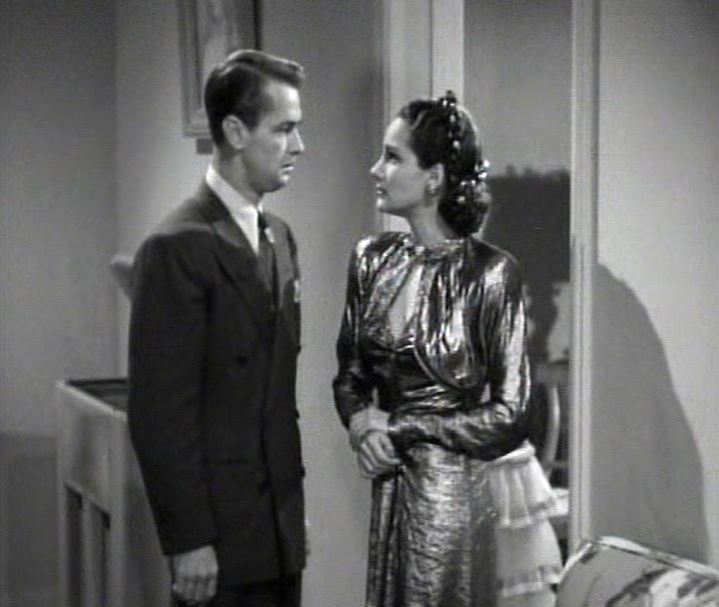
The Blue Dahlia (1946) is a story of betrayal. Alan Ladd is a returning war vet in this film noir who arrives in Los Angeles fresh off the bus with his two war buddies, played by Hugh Beaumont and William Bendix. Ladd is the hero of the piece, if one can term the chief protagonist of a film noir a hero, but his pals are as important to rounding out his character and even driving the plot.


Ladd is not so much an homme fatale in this film as would be, say, Howard Da Silva, who plays a charming and venial nightclub owner, because Da Silva is the only person in the film with the mystique, not just the brutish quality, of evil. Ladd is more a victim who plods his way blindly through a web of betrayal until by the end of the movie, we really don’t see him as much a hero as just the last man standing. But the studio banked on his mystique when paired with Veronica Lake, who is not so much a femme fatale here as another survivor on a dark journey, though perhaps better equipped by nature for survival.

The three war buddies part company early in the film and we are not given the indication that they will see much of each other in postwar life, though Hugh Beaumont and William Bendix will be joined at the hip because Bendix has suffered a serious head wound which has left him fresh out of the VA hospital with headaches, confusion, and memory loss. Hugh Beaumont, the steadier, responsible, quiet member of the group has taken it upon himself to take charge of Bendix and be his keeper. It is a thankless job as any caretaker can tell you, and just why he feels a sense of responsibility towards Bendix we are never told but it is probably the only example of self-sacrifice in a movie that is so rife with betrayal.

The only other example of altruism is perhaps found in the character played by Veronica Lake, who meets Alan Ladd when he is in trouble.  She is, we assume, attracted to him but keeps at a levelheaded distance partly because she is still entangled with a mobster husband and partly because Alan Ladd wants it that way. It is a kind of sacrifice. Later, she will confront Howard Da Silva, her mobster husband from whom she is estranged, for Ladd’s sake.

Veronica Lake does not get much screen time but she will represent Alan Ladd's future, we, again, assume, as the movie ends on a happier note that it began, which is certainly not the norm for film noir

The movie begins on a truly, inexplicably sad note. The Three Amigos enter the postwar world with a sense of apprehension. This was common to veterans; we see this in other movies including The Best Years of Our Lives (1946), which we've covered in several blog posts, and Till the End of Time (1946), which we will cover some time, but these fellows do not articulate the reasons for their sense of doom. Hugh Beaumont has a reason to feel glum, perhaps he foresees a rough road of responsibility for William Bendix and his medical troubles and is stealing himself for a life as his guardian. Bendix, with a hair-trigger temper to boot, is tough to manage. Of the three former Navy flyers, he alone continues to wear his bomber jacket. The other men are dressed in suits they somehow managed to find in the postwar clothing shortage.

When they park themselves at a bar for a parting drink, Bendix remarks to Ladd, "Lucky stiff, at least you've got a wife to come home to." And we see Hugh Beaumont try to discreetly shut him up, something Beaumont will have to do several times during this movie. There is some secret we don’t know.

Alan Ladd says only "Here's to what was." And when they part, Hugh Beaumont, apparently the watchman for all of them (no wonder he became Beaver’s dad), asks Ladd, "Don't you think you ought to call her before you go home?"

Alan Ladd remarks with a mysterious, defeated smile, "Maybe."


It is a foreshadowing that Alan Ladd's home life is not all that it should be.  We have a great deal of foreshadowing this movie, it is like bread crumbs scattered in the forest and it helps us to keep our trail, it helps us to find our way. It is a writer's device to point to whom he wants us to trust and not to trust. There are no red herrings here or tricks, but it will take you until the end of the movie to find out who the real murderer is. There are several plausible witnesses because there is just so much betrayal. The writer is Raymond Chandler, which is as fine a pedigree a film noir movie could get.

Alan Ladd goes to his wife's home, a swank hotel and bungalow complex that seems perhaps a bit more than his allotment checks could have paid for and he stumbles upon a late afternoon cocktail party in her apartment. The alcohol is flowing, someone is playing “Accentuate the Positive” on a piano and people are dressed to the nines, people with dubious integrity, seemingly without a care in the postwar world.

We receive more telegraphing of clues when Alan Ladd goes to the desk clerk and asks for his wife's apartment and we see the bellhops and the desk clerk exchange arch expressions as if they did not know that his wife was married and we may assume that she has been carrying on with others. Alan Ladd knows nothing of this and walks into the party. His wife, played by Doris Dowling in her fourth film, is completely surprised, prickly, jittery, not knowing how to welcome him, especially when she has her lover in the apartment, Howard Da Silva.


Da Silva is as smooth and articulate a bad guy as ever graced a film noir. He runs a local nightclub called the Blue Dahlia and his calling card is to present guests and lady loves with massive arrangements of the large blue flowers. When Alan Ladd from behind a door sees his wife with her arms around Da Silva, kissing him, Ladd interrupts and slaps Da Silva across the mouth. Da Silva graciously backs down and leaves. We will later discover, as he discusses with his partner in his club, that he is perfectly willing to let Alan Ladd's wife return to her husband because he is tired of her.

It’s easy to get tired of the demanding, constantly angry, constantly drinking Doris Dowling. She taunts Alan Ladd for striking Howard Da Silva, "You’re a hero. A hero can get away with anything."

There is an inference of self-entitlement which would still go against the grain of the newly postwar country. Ladd, who plays scenes with a great deal of control and an appropriate sense of weariness, retreats to the bedroom where he has only just begun to unpack and he sees two photos in a double frame.  One is his service photo and on the other is a portrait of their deceased son, Dickie. Dickie died while still a baby. He contemplates the photo; she had never sent him one.

When the guests leave, hustled out, they are alone and Ladd tries to get her to put down her drink, which seems to be attached her hand, so that they can talk. Her fit of temper returns and she announces in a flippant manner that she is her own woman, that she can do what she wants and see who she wants. He becomes angry and she replies I could tell you something that would hurt you plenty. She regrets immediately saying it but he presses her and in another fit of temper she confesses that their son did not die of diphtheria as she had written to him but that he was killed in a car crash. She had brought the baby to a party because she did not want to stay home; she was drunk and wrecked the car and Dickie died.

Ladd needs no more info. He takes the photos and prepares to leave her for good, but for one moment he pulls out his service revolver and she thinks he's going to kill her but he says that she is not worth it and he tosses it to the couch and he leaves in the pouring film noir Los Angeles rain.

The story is told with a great deal of cutting back and forth between different characters and action occurring simultaneously that is fast-paced and this is what makes the movie successful. There are only so many ways you can tell a story, even something as complicated and intriguing as a murder mystery, but for film noir it is not so much the story but how stylistically it is told that makes the genre unique and memorable.

We have a reference to the postwar housing shortage when Bendix phones and relates that he and Beaumont scored an apartment ahead of nineteen other guys because it is Beaumont’s old apartment and the landlady liked him. See?  Having good manners and being responsible pays off.

Doris Dowling will later phone Bendix at their new flat and confess Ladd has walked out on her. Why this bothers her is unknown, as she seemed pretty well through with Ladd, but Bendix, who is emotional and impulsive, leaves in the rain and shows up at her swank hotel and bungalow complex to talk with her, and waits in the bar.  She is there, but neither knows who the other is or that they had just spoken to each other on the phone, and we have the beginnings of a pickup.

The rain continues to pound down, and during the evening, Bendix, as well as Da Silva will show up at Dowling’s apartment.  The house detective played by Will Wright is always lurking around, spying on the action, so we know what he knows.

It is more foreshadowing, for when a murder has been committed, we see there are several suspects, but the only thing we're sure of is that it wasn't Alan Llad because when he left, she was still alive.

William Bendix eventually returns home to the apartment he shares with Hugh Beaumont, soaked to the skin from the rain, dazed, clearly troubled and doesn't remember much of what he's done in the past couple of hours.

Meanwhile Alan Ladd hitchhikes and gets picked up by Veronica Lake. We get a little bit of foreshadowing about Veronica Lake, too. Her portrait is at Howard Da Silva's nightclub and we are told that the they split up not because of a woman but because she didn't like his shady dealings, and Da Silva’s the partner confesses that she's evidently a wonderful woman and both agree that she is far too good for Howard Da Silva. So by the time we meet Veronica Lake we are already disposed to understand she is no gun moll. She is true blue and maybe this is the first bit of good luck Alan Ladd runs across. However, there is no romance. They say goodbye, they meet again, they say goodbye, and both discover separately that the police are after Ladd for murder.

The movie is successful at keeping us off balance and what is going to happen and who was going to end up with who. We only know for sure that Alan Ladd is not a murderer and that Veronica Lake is a nice person. As Hugh Beaumont says of him, "Whatever's the right thing to do, Johnny'll do it."

Alan Ladd's journey through this movie is pretty much based on how other people react to him. His wife does not want a life with him. When he discovers is wanted by the police, he runs into a couple of petty thieves who take him to a flophouse to hide out for a fee and they stab him in the back as does the fellow who runs the flophouse played by Howard Freeman. Freeman betrays Ladd by going through his belongings and asks for shakedown money to hide him from the cops.

Will Wright keeps coming back and he shakes down everybody he can: Howard Da Silva, William Bendix and Hugh Beaumont.  Everybody betrays everybody:  When Howard Da Silva's partner and another thug kidnap Alan Ladd, beat him up and take him to a cabin in the woods, the bad guys betray each other. Interestingly, Doris Dowling provides an ironic bit of wifely fealty by writing on the back of the portrait of their baby some secret info about Howard Da Silva (betraying her lover posthumously, quite a parlor trick).

Alan Ladd has seen enough by half of the movie that when he runs into Veronica Lake again, he confesses his suspicion of her and how "your timing’s good." She tells him "you'll have to trust me." But, of course, he can't he can't trust anybody, not in this movie.

Alan Ladd, in one sense, is even betrayed by his old buddies. He goes to their apartment and they want to hide him. Bendix wants to take it on the lam with Ladd, and Beaumont, who was an attorney before the war, suggests turning himself in. Alan Ladd is shocked to realize both his buddies think he actually did commit murder. He is angered by that sense of betrayal. How could they know him so well and yet think he would stoop to murder?!

The loose ends come together when the police captain, played by Tom Powers, interrogates all and sundry at Da Silva’s office in his night club. Bendix recalls the events he had forgotten on the rainy night of his blackout, and now he thinks he’s the murderer. Will Wright is suspected because he was always lurking around, he had opportunity – though motive is never made clear to us.

At the movie’s beginning, Mr. Wright takes a role similar to many he held over his long career – a cantankerous and possibly shifty coot, but as the movie progresses, we see it is the role of a lifetime for him. He is treated as over the hill and past his prime by the cops and others, a has-been from the word go, but we are told he is 57 years old and for those of us in that neighborhood, it is a bit stinging to think that could have been seen as over the hill, especially since he looks much older. In real life, Mr. Wright was actually 52 years old at the time. Ouch.

Alan Ladd returns, performs an irrelevant party trick to clear William Bendix from the charge of murder, and we realize the cops have already cleared Ladd and found their man.  I’ll give you a break for once and not spoil it, but it’s hardly a shock.
 

We're not sure what's going to happen with Alan Ladd and Veronica Lake. They meet warily one last time by her convertible waiting to say goodbye again (check out the B gasoline ration sticker and our previous post on the subject here), and the only signpost we are given that it might not be goodbye permanently this time is because William Bendix and Hugh Beaumont, who are waiting for him, give up and walk away to the nearest bar. Alan Ladd may or may not catch up with them later.


Neither Alan Ladd nor Veronica Lake may be ready for a relationship at this time but unlike most film noir movies, this movie ends with the hope of a new life of something better. Much has been written about Lake’s and Ladd's screen partnership and I actually preferred them in other roles in other movies. I think Veronica Lake was brilliant in Sullivan's Travels (1941) and in I Married a Witch (1942), discussed here, and So Proudly We Hail (1943) here.  I think Alan Ladd was brilliant in Shane (1951), discussed here. I don't think they reached their full potential with each other.

I wouldn't say they were a case of being mismatched, it isn't that. They were interesting to watch as a pair but I think the reticence their characters showed each other in this movie is something of a metaphor for their ability to connect with each other as actors. Their meetings were always intriguing, their goodbyes were less than dramatic. Film noir had a way of making the main characters somehow distant and inaccessible and mystery was part of the genre. We weren't really supposed to know them that well. They weren't supposed to be people with whom we could feel entirely comfortable. Alan Ladd, with all his ambivalence and aloofness came to be well-known as a film noir hero.  Like the character he plays in this movie, Ladd was more or less thrown into it and stuck with it and he had to endure it until something else came along.

The most burdened person, and most unexplained and therefore mysterious, in The Blue Dahlia, for my money, is Hugh Beaumont. There should have been a Veronica Lake for him.

Be sure to check out the other terrific blogs and their entries in the Classic Movie Blog Association blogathon: Femme/Homme Fatales of Film Noir.  

*********


Related Products