IMPRISON TRAITOR, PEDOPHILE, AND CONVICTED FELON TRUMP.
Showing posts with label Nazis. Show all posts

Thursday, November 28, 2024

Photoplay magazine, November 1941 - Mr. and Mrs. America and all the ships at sea...


The November 1941 issue of Photoplay magazine features lovely Claudette Colbert, photographed by Paul Hesse, in warm autumn tones.

BUT FIRST, A COMMERCIAL!!!

We interrupt this blog post to give you the astounding (well, maybe not astounding) news of a Black Friday Sale starting...well, yesterday, actually, and running until this Sunday...that will get you half off my eBooks when you visit my Shopify store here.  Bypass the big online merchants and buy direct from the author.  It's a nice idea, or so thinks the author.  All my books (eBook form only) -- fiction, nonfiction -- are half price until Sunday.  So far, I have 18 eBooks up on the site.  Please take a look...and a early Merry Christmas to you!

Now, back to our regularly scheduled blogpost already in progress...


The magazine is a manual of gossip of romances among the Hollywood community, reviews of movies, and lots of photos of stars provide a lush and lightweight publication all for ten cents.  

It does, however, feature an interesting editorial by Managing Editor Ernest V. Heyn defending the industry from the notoriously Nazified Senator Burton K. Wheeler (R-Montana) and Senator Gerald K. Nye (R-North Dakota) whose America First Committee were against all bad representations of Nazism, and accused the film industry of being communist and run by Jews.  Any negative portrayal of the Nazis was regarded by these two fascists as being warmongering.  

As the editorial begins somewhat incredulously, "Who would have thought six months ago that Wendell Wilkie would have to be called in by the Motion-picture industry to defend Hollywood against the accusations of war propaganda by the Wheelers and Nyes?"  

With admirable spirit and a light, almost humorously wry touch, Editor Heyn stands up for the industry and his magazine and introduces a companion article by columnist Walter Winchell, then recently appointed Lieutenant Commander in the U.S. Naval Reserve, to write about some of the Hollywood rank and file who joined the service.  We were still a few weeks away from Pearl Harbor and so we were a peacetime Navy that he describes, but it is telling to see how many men were willing to compromise or even give up their film careers in anticipation of what might be coming.

We could use such courage, practicality, and foresight today to stand up to authoritarianism, at home and abroad.  Dictatorship does not look good on us.

Among those already enlisted then were Ensign Wayne Morris; Lieutenant Douglas Fairbanks, Jr.; Commander Wallace Beery; Lieutenant Robert Montgomery; and writer-producer Lieutenant Commander Gene Markey.

Winchell was famous for his staccato delivery on the radio with..."Good evening, Mr. and Mrs. America, and all the ships at sea..."  So long ago, but it might have been yesterday.

The issue does not provide the typical Thanksgiving salutation (with stars posed with turkeys), but I will add it here: for those Americans out there celebrating the holiday, may I wish you very Happy Thanksgiving!


************

***************

My new non-fiction book, CHILDREN'S WARTIME ADVENTURE NOVELS - The Silent Generation's Vicarious Experience of World War II -- is now available in eBook here at Barnes & Noble, Apple, Kobo, and a wide variety of other online shops.

Or here from my Shopify store if you want to buy direct from me and avoid the big companies.

And it is here in eBook, paperback print, and hardcover, from Amazon.

From Cherry Ames, to Meet the Malones, from Dave Dawson to Kitty Carter - Canteen Girl, the Silent Generation spent their childhood immersed in geopolitical events through the prism of their middle grade and young adult books.  From the home front to the battlefield, these books are a window on their world, and influenced their hard-working, conformity-loving generation.


Sunday, October 28, 2018

Long Live Democracy - Casablanca (1942)


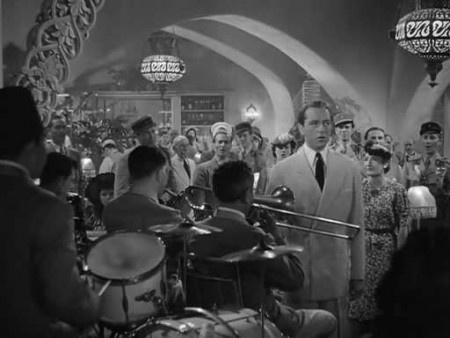
A pivotal moment in the film Casablanca (1942) occurs when Major Strasser and the other Nazis are drowned out in their singing of “Die Wacht am Rhein” by everybody else in the café singing “La Marseillaise.” It is a stirring scene, and one that never fails to bring some of us to tears. It has been reported that the much of cast in that scene were brought to tears as well. In one of those almost supernatural moments when art really does reflect life, the desperate European refugees in the café were played by actors who actually were European refugees. It is a spine-tingling moment of reality in an otherwise not very realistic film.

We revisit Rick’s Café Americain with the bulk of this essay having been previously posted on this blog in 2007, the first year of Another Old Movie Blog.  A great deal has changed in the world since then, though the most comforting aspect of our love of classic films is that the world we explore in them never changes.  We can visit a place and time and it is ever the same, and ever fresh.

Casablanca has become larger than life for us, a film whose reputation has grown with the decades. It will likely always be a favorite for its witty dialogue, its charismatic actors, and its fast-paced plot. It has the irresistible veneer of glamour in an otherwise dark and frightening time.

But, even those of us who love the film cannot overlook the fact that Victor Laszlo and Ilsa Lund would not have played a cat-and-mouse game of hidden threats over cocktails with Nazi officers in French-occupied Africa. The Nazis would have taken both of them into custody the moment they arrived in Casablanca, tortured them, and filmed their corpses with newsreel cameras. The movie would have been over in ten minutes. No cocktails, no white dinner jackets, no game of hide and seek with omnipotent “papers” that will set them free.

In this respect, Casablanca could be called an escapist film, because it gives us heroism and hope, redemption, a fairy tale of intrigue. The most fanciful scene in the movie, carrying this fairy tale along, is the scene with “La Marseillaise” trumping “Die Wacht am Rhein.”

And in that same scene, ironically, we see the real truth of the film, not always recognized, but there. S.Z. Sakall, who plays Carl, fled Hungary in 1939. His three sisters didn’t make it and died in a concentration camp, along with other relatives.

Madeleine LeBeau, pictured above, who played Yvonne, who pines for Rick and who is fought over by the Nazi soldier and the French soldier; and her then real-life husband Marcel Dalio, who played Emil, the gambling room croupier, both escaped from Nazi-occupied France through Lisbon, just as in the film. Reportedly, the visas they obtained for Chile were forgeries, but they managed to arrive in the U.S. through hastily arranged temporary Canadian passports.

Curt Bois, who played the pickpocket, fled Germany in the early 1930s. Helmut Dantine, who played the young Bulgarian man losing at the gambling tables, whose wife beseeches Rick to help them, fled Austria. Dantine was an Austrian who was put into a concentration camp after the Anschluss. He was arrested for leading an anti-Nazi youth movement. He was then nineteen years old.

Mr. Leuchtag, who practices his English by asking his wife the time, “What watch?” was played by Ludwig Stössel, another Austrian who fled after the Anschluss.

Ilka Grünig, who played Mrs. Leuchtag and replies “Ten watch,” escaped Germany in the early 1930s after the Nazis came to power.

Even the Nazis were played by actors who escaped real Nazis. Richard Ryen, who played Colonel Heinze, was a Hungarian-born actor who was actually expelled by the Nazis from Germany. Hans Twardowski, who played the Nazi officer who fights with the French soldier over Yvonne, fled Germany in the early 1930s.

Even Major Strasser, played by Conrad Veidt, escaped the SS, who pursued him for anti-Nazi activities, and he fled to England where he became a British citizen and supported Britain’s war effort with his salary.

There were actually very few American-born actors in the cast of Casablanca and not all of the rest were refugees, but a good many of them were. This gives the film a legitimacy that certain fanciful elements of the script did not.

When you watch the “La Marseillaise” scene, think of the refugee actors with genuine tears in their eyes, and remember that the Nazi regime had not yet been defeated at the time this film was made. It was not known then if they would be.

It was certainly never imagined that we’d be fighting them in our own country in the next century.  This is why we must vote on Tuesday.  At the very end of the “La Marseillaise” clip, Madeline LeBeau shouts, “Vive la démocratie,” and it is almost drowned out by the jubilant crowd triumphing over the smug, cruel Nazis in a nightclub songfest.  But it’s there, and it’s the whole point of the song.  


Vote for every Democrat on the ballot next Tuesday, in all local, county, and national categories.  Voting is no longer an expression of political opinion in this country; it's a chess game.  The politicians know that, and so do the pundits.  The voter has yet to realize how we are being played, and we must use our vote -- while we still have it -- to block the machinations of our impending doom.  Halting the progress of a corrupt and vile administration that now controls the executive branch, both legislative houses, and the Supreme Court can only be done now by making the Republican Party, which has ceased to be the Republican Party, fear more for their jobs than they fear the evidently powerful influence of a shameless grifter, the NRA, and the Russians from whom they have accepted bribes, and indeed, several corrupt members of their party, whom they’ve chosen to embrace and blindly support in the unholy name of holding power.  


When I think of the “La Marseillaise” scene in Casablanca, I also think of my father, who, still in his early twenties, left his wife and baby and fought in the South Pacific during World War II for over three long years.  No furloughs, no coming home until it was over.  When I was young, we watched Casablanca together, and he surprised me by belting out the French national anthem during this scene in his powerful, resonant bass voice.  He really had a very good voice, sounding a lot like Tennessee Ernie Ford only with a New England accent, but we used to tease him because he could not remember the words to anything. But like an automaton, he launched into “La Marseillaise” without any effort, and I think he even surprised himself that he remembered it.  

He explained, in that somewhat reluctant way all men of his generation did when talking about the war, that when he was stationed for a bit in that island-hopping campaign on the French colony of New Caledonia, they were required to stand at attention for the raising of the French flag and playing of their anthem in camp, as well as the American.  He also related the mournful tradition of answering roll call in their memory for pals who had just been killed.  The Vichy government was chased off the island and like the struggle in Casablanca, became Free French. Their symbol is on the paper money above, a souvenir my father brought home.

My father and his surviving comrades; and my mother, who was Rosie the Riveter in a war plant making parts for PT boats, thought their job was done on V-J Day.  

I mourn as much for the memory and the inspiration of that generation as I do for the future of this country if we do not remember the lesson that was so easily absorbed in Hollywood films of the 1940s:  The authoritarian fascists were the bad guys.  Frank Capra explained that to us, if we didn’t know already, in Prelude to War (1942).

How many Trump supporters and apologists would root for Bogart, Henreid, and Bergman today?  How many would look at those refugees with loathing that filled the Café Americain?  How many would turn Madeleine LeBeau away at the border today?


We already know from surveys done that many Millennials cannot even name who fought in that war and on which sides.  Right and wrong has become lost, and history, which should be a compass, has become a muddle.

Fans of classic films inevitably adore them for a world that is, among other things, rife with moral clarity.  We have lost that in our society, probably for many reasons, but one of the things I admire most about classic films is the courageous idealism.  It seemed to stream from the directors.  Frank Capra, a conservative Republican such as they used to come in this country, gave us Meet John Doe.  William Wyler, who gave us Mrs. Miniver; and the man who directed Casablanca, Michael Curtiz, were refugees, as was Billy Wilder.  John Ford, like Wyler and Capra, served in the military during World War II.  They had no patience for Nazis.  Ford would have punched them in the face.

Frank Capra & John Ford

The word Nazi is not bandied about carelessly when it is used correctly.  It is the word Republican that has lost its meaning.  The Grand Old Party surrendered and became complicit to survive in a more vicious environment, like the capitulating French Vichy government.  

When you vote on Tuesday, remember that Hitler was elected to office, and that was the last election.  He killed democracy in Germany.  Putin is angling for the same result here  by remote control and he has already lined the pockets of several Republicans to that end.  Unlike the troubled conquered countries in World War II, we will have no one to save us.  We have to do it ourselves.  There have never been higher stakes than this coming election.

Vote Democrat on Tuesday.  If the Republican Party regains its soul in having lost the election, that will be for the benefit of all of us, because nobody, including intelligent Liberals, want a one-party government, even one of Liberal Democrats. We need the vibrancy of differing opinions and perspectives.  

But first, we have to rid ourselves, democratically, of the traitors to our democracy who gerrymander precincts; who scrub voters off the registration lists; who cheat to deny the vote to African Americans, Mexicans, and Hispanics and other minorities; who attack the free press and shout that truth is not the truth, who praise Nazis and even become them. Vote Democrat.

Vive la démocratie.  Long live democracy.


Thursday, August 17, 2017

Punching Nazis in the Face - The Best Years of Our Lives - 1946


The Best Years of Our Lives (1946) is rich with profound and moving scenes.  The current events of the past week bring to mind the scene with Ray Teal in the drugstore.  He is, as we learn by his conversation, a far-right fanatic, one of those who believed President Roosevelt started the war, and that the Nazis were the good guys. 

Harold Russell stops in the drugstore to visit Dana Andrews, who works behind the counter as a soda jerk.  Ray Teal notices Harold Russell’s prosthetic hooks:


He says, “Terrible to see a guy like you that had to sacrifice himself, and for what?”


Harold Russell responds, “’And for what?’  I don’t get you, Mister.”


“We let ourselves get sold down the river.  We were pushed into the war.”


“Sure, by the Japs and the Nazis.”


“No, the Germans had nothing against us.  They just wanted to fight the Limeys and the Reds.  And they would have whipped them, too, if we didn’t get deceived into it by a bunch of radicals in Washington.”


“What are you talking about?”


Ray Teal taps his newspaper, likely a publication that fans his views and his inbred ignorance, and strokes his arrogance.  “We fought the wrong  people, that’s all.  Just read the facts, my friend.  Find out for yourself why you had to lose your hands.  And then go out and do something about it.”


Dana Andrews, who has been listening, interrupts.  “You’d better pay your check, Brother, and go home.”


Ray Teal, insulted, fires back to the hired help, “Well, who do you think you are?”


“Pay the cashier right over there.”


Ray Teal huffs, “That’s another thing.  Every soda jerk in this country’s got an idea he’s somebody.”


Teal goes to the cashier.  Homer follows him, wanting to pursue Teal's meaning.  “Look here, Mister what are you selling anyway?”


Teal proudly, stubbornly announces, “I’m not selling anything but plain, old-fashioned Americanism.”


Homer replies, angrily, “Some Americanism.  So we’re all a bunch of suckers, hey?  So we should have been on the side of the Japs and the Nazis, hey?”


Teal taps his folded newspaper, “Again, I say, just look at the facts.”


Homer blows up, they argue.  Homer wants to punch him, but can’t because of his prosthetic hooks.  So Dana Andrews sails over the lunch counter to break up the fight, and punches the American Nazi in the face.  It is a satisfying thing to watch.  

It will not change Teal’s views, however.  We probably know that even though we never see him again in the movie.  We can imagine he will avoid Andrews on sight from now on, and feel himself to be a victim, not just of Dana Andrews, but of a society where his dumbass and putrid views are polar opposite to what the Constitution prescribes. 

Neither do we see any resulting lawsuits against Andrews for the assault, but then the movies like to end arguments with punches, and end bad guys with instant death; the courtroom that should be the final arbiter usually isn't dramatic enough for Hollywood.

It is a brave and prescient scene for the day, acknowledging that not all Americans were united about the war, and that being anti-Nazi was going to have to be a stance we would need to continue to take if we wanted to keep ourselves free.


The bitter scene is followed by a tender, touching scene, as Homer notices the flag pin that fell off Teal’s lapel and landed in the floor.  Homer picks up the flag pin with remarkable dexterity with his hook, and puts it in his jacket breast pocket, near his heart.

Dana Andrews may have landed the punch, but Homer saved democracy by scooping it up off the dirty floor and protecting it.

Thursday, July 14, 2016

The Mortal Storm - 1940


The Mortal Storm (1940) is about fascism.  It is about young love—and fascism.  It is about family values—and fascism.  It is about career dreams—and fascism.  We may consider these ideals to be separate from fascism, even opposing, but they are not.  So many people in the course of history have woven them together at their own peril.

For the next few weeks, we’re going to be talking about fascism, a particularly appropriate theme with the coming of the Republican Party convention and the rise in the media and in American politics of Donald Trump.  He is a fascist.  Too many people perhaps equate the word fascism with something old-fashioned, belonging to the twentieth century, and think it is a foreign aberration, since Adolf Hitler made it his slogan and source of power.  They might think that use of the word today is cliché and overused, but it is as powerful and meaningful a word and a strain of political thought today as it ever was from the 1920s through the 1940s.  It is with us still, and the most poisonous aspect of fascism is it becomes chameleon-like.  We do not see it for what it is, unless we force ourselves to concentrate and look.

Classic films forced us to look at fascism.  During World War II, of course, the films were patriotic, and even propagandist, and it was very easy to pick out the villains in the movies because they were wearing Nazi uniforms.  But in that strange, tense era just before our involvement in World War II, the studios utilized their art and their industry with courage not seen today, and with a social conscience not seen today, they examined fascism.

Because of so many screen Nazi bad guys, we may have come to believe that fascism is a product of Europe, and is as out of sync with the modern world as high waisted trousers, fedoras, and clip-on earrings. The movies we’re going to examine will take us out of that notion, and into an interesting exercise of where we must look to examine how fascism starts, how it spreads, and what do we do about it?

Along with The Mortal Storm, in future weeks we will be discussing Address Unknown (1944) here, Keeper of the Flame (1942) here, Storm Warning (1951) here, and Seven Days in May (1964) here.  This brings us up to the 1960s, when our world became far more interested in the Cold War against communism, and the space race, and the dizzying parade of social ills and revolutions.  But fascism remained, always there, like a smoldering ember at a campfire that has been carelessly left, and will start a forest fire if the prevailing winds allow it.

TheMortal Storm (1940), was produced by MGM, with great trepidation.  We were not at war with Germany yet (indeed we would not go to war with Germany until two days after they already declared war on us in December 1941), and the studio was wary about producing a movie that could be considered inflammatory.  The German market was especially important to Hollywood, and offending the German government could be disastrous when it came to distribution of the film in Europe.  Moreover, the studio heads were sensitive about pushing the subject of fascism when, as most of them were of Jewish heritage, were afraid to appear as if they were politicizing their product.  It had been their practice, as most of them were European immigrants to this country, to assimilate to their new country and to adapt to its culture, its language, and even, if necessary, to concede to its long-standing prejudices.

We may recall from these previous posts (part 1 and part 2), that Gentleman’s Agreement (1947) was avoided by many studios and was finally produced by Darryl F. Zanuck of 20th Century Fox—a major studio head who happened to be not Jewish, but who had guts, and took on the story.

We may applaud MGM for moving forward with The Mortal Storm, risks and all, but their fears were justified.  The German government under Adolf Hitler was incensed that this film was made, and banned that and any future MGM movie from being shown in Germany.  That MGM was blacklisted by the Nazis may have been worn as a badge of courage by the studio in future years when the war was going on, but at the time it was seen as a misfortune.

However, the film is quite mild by today’s standards, at least of depicting the savagery of Hitler’s regime.  It is still a powerful movie, and that is because it deals with people.  Ideals, and political jargon are bandied about, of course, and people take sides, but first and foremost it is a movie about a single family and what happens to them when forces beyond their control knock on their door and take over their lives.  It is gentle, and it is scary.

Frank Morgan plays a university professor in Germany.  The year is 1933.  Irene Rich is his wife.  Her two grown sons by a previous marriage are played by Robert Stack and William T. Orr. They are very close to their stepfather, Frank Morgan, and when the film opens with Morgan’s 60th birthday celebration, they take him aside to give him their present personally and to thank him for being such a wonderful father to them.

From Mr. Morgan’s marriage to Irene Rich there are two younger children, a daughter played by Margaret Sullavan, and a son barely in his teens played by Gene Reynolds.  At the university where Mr. Morgan teaches, a surprise celebration in his lecture hall greets him when his students and the other members of the faculty, who clearly respect him and love him very much, present him with a gift and sing Gaudeamus Igitur in his tribute (which is pretty impressive watching the cast sing it in Latin).  We’ve heard the song in zillions of old movies and cartoons whenever a scene is set at a college. It’s like playing “California, Here I come,” or “The Sidewalks of New York.”

Two of those students are played by Robert Young and James Stewart.  Mr. Young, Mr. Stewart, and Miss Sullavan have been friends since childhood.  When these two gentlemen come home with the family to have a birthday dinner for Mr. Morgan, we see that Robert Young is even closer to Margaret Sullavan, and impetuously asks her to marry him.  With his exuberance, and the whole family watching, he makes it difficult for her to say no and she accepts.  Everyone in the family is jubilant, except for James Stewart, whose expression ever so slightly falls to the floor and we see that he has harbored an unspoken affection for Margaret.

But the birthday party turns on its head when we hear from the radio that Adolf Hitler has just been elected Chancellor of Germany.

Fascism, in its most vile form, is brought to a nation in a democratic election.  There is nothing so virulent a germ as a political movement which serves to appeal to the most base, crude, and ignorant in a society, inflating them with a power they do not have, and then taking it away like a shell game. Alexis de Tocqueville, nineteenth century historian who made many keen and valuable observations on America in its formative years noted especially of our eagerness to follow the mob, despite our boasts of individual freedom:

In times of equality, no matter what political laws men devise for themselves, it is safe to foresee that trust in common opinion will become a sort of religion, with the majority as the prophet.

Robert Young, Robert Stack, and William T. Orr are overjoyed at the radio announcement and celebrate, saying that Hitler will bring the country back to greatness.  He will make Germany great again.

James Stewart has no political convictions; he still seems to be reeling by the idea that Margaret Sullavan is going to marry somebody else.  Frank Morgan and his wife are hesitant to be quite as jubilant as the boys. They hope for the best, but as a university professor, Morgan is unimpressed with Hitler’s designs on the country and his methods for achieving greatness.  Morgan is a man devoted to logic, and this is all too illogical for him.

But there is more to his concern.  We come to find out later in the film that Frank Morgan is Jewish.

In the movie his Jewish heritage is never mentioned by name, he is instead called “non-Aryan,” and at first we may think this is MGM pulling a punch, trying not to get too ethnic, too personal, too political.  It probably was. But time tends to leave a patina, on ideas as well as on objects, and I think perhaps that “non-Aryan” sounds here more inclusive of all the millions of people who suffered under Hitler’s regime.  

When people who deny the Holocaust, or just as perverse, people who do not deny it, but who simply prefer not to think about it, hear the figure of 6 million Jews being murdered, I wonder if they forget that also there were at least 9 million non-Jewish citizens of the Soviet Union murdered in death camps, and nearly 2 million non-Jewish Poles, and millions of other people whom the Hitler regime regarded as non-entities: Gypsies (properly referred to now as Roma), non-Jewish Czechs, Serbs and other peoples of occupied Europe, and people within Germany who protested including Catholic priests, Protestant ministers, Jehovah’s Witnesses, the infirm, the mentally challenged, convicts, and homosexuals—a variety of targets in addition to the millions of suffering Jews.

It is staggering.  And because it is staggering, the human mind recoils, unless the heart is brave and the mind has a bigger conscience than it has a fear of discomfort.  Only a moron and a coward would deny the Holocaust, and though we may equate the Holocaust with fascism, we must remember that fascism did not start there.

“Non-Aryan,” means everybody who was not considered to be “us.”  And fascism resulted in millions of “thems.”  Us and them.  That’s where it always starts.

The movie moves swiftly from this point, with Robert Young, Robert Stack and William T. Orr becoming more immersed in the Nazi culture, wearing uniforms, giving the Nazi salute, and their boyish jubilation has turned to stern, dogmatic, and slavish obedience to their new leader. (Look for a young Dan Dailey as an especially vicious Nazi youth leader.)  Hitler has given them an identity, and they draw apart from their family because of it.  They become distant with Frank Morgan, and Robert Young’s preoccupation with his new Nazi youth organization duties has left Margaret Sullavan alone and puzzled at the change in him.


James Stewart, who has come to the university to learn veterinary medicine, has grown up on a farm on the outskirts of town.  His mother is our favorite Maria Ouspenskaya, who seems to see no werewolves in the vicinity.  Young Bonita Granville is their hired girl, and Bonita has a crush on James Stewart.  Before the movie is over, she will be terrorized by Nazi thugs trying to get information out of her about where James Stewart is hiding.

Stewart has pulled away from his university pals; he wants none of this Nazi business.  When he sees them beating up an old teacher, James Stewart runs to his aid, and Margaret Sullavan helps. She refuses to stop seeing Stewart as friends, even though Robert Young warns her to stay away from him, not so much because of romantic jealousy, but because Stewart is getting a name for himself as an enemy of the state.  It does not take much to be an enemy of the state.  James Stewart has made no political speeches, he assiduously avoids talk of politics at every turn; he just wants to be left alone.  But he will not join the boys in their Nazi youth organization, and this makes the boys furious.  He will not play with them, so now James Stewart has stopped being “us,” and has started to be “them.”


Frank Morgan, formerly beloved by one and all, has become an even more serious “them.”  He is not political either, but he was born to be a “them,” because he is a non-Aryan.  He is sent to a concentration camp.

James Stewart and Margaret Sullavan show the most courage and the most moxie of anyone in the movie because of their stubborn refusal to be one of the gang, because they defend a victim of that gang, and because Miss Sullavan openly claims her heritage.  When she hears Robert Young disparage non-Aryans, she calls them “my people,” though her mother most certainly is Aryan and if she wanted to, Margaret Sullavan could be safe even in this Nazi regime, by denying her father and ignoring her Jewish heritage. She breaks off with Robert Young.

An exciting climax builds when, after Frank Morgan dies in the concentration camp (which must have been at least surprising, if not shocking, to audiences of the day), she, her mother, and her young brother try to escape from Germany as James Stewart has already done before them.  Mother and younger brother make it, but Margaret is held at the border.  Stewart comes back for her and leads her through a treacherous mountain pass, with Robert Young and the boys on the chase. Just Stewart and Sullavan are skiing down a wintry slope approaching the Austrian border, the patrol under the orders of Robert Young, shoots Margaret Sullavan down like a dog.

Mr. Stewart scoops her up in his arms and continues to ski for the border, but she dies before he can reach it.

That had to be equally strong stuff for the audiences of the day.  The Nazis here are not punished, they are not foiled.  World War II is barely six months old, and it would be another year and a half before we became involved.  This is a tragedy we cannot reach.  Is it any of our business?  Some Americans on the sidelines (and in the movie theaters) said yes, some said no, some were cheering for the Nazis and resented them being presented as the bad guys.

Robert Young has always impressed me with his sensitive acting ability, I think I like him better in dramas than in comedies, though he could certainly do both well.  Here he is not so much a brainwashed Nazi, as someone who is trying to convince himself that he hasn’t made a mistake, and his pride is too great to admit that he could be wrong. 

We see this so often today.  People so slavishly devoted to an idea, or political party, or a candidate, and refuse to entertain any niggling doubt that might indicate they are wrong in their choice, that there are holes in the story they want to believe.

Robert Young does still love Margaret Sullavan, and we can see he is choked up and appalled by her murder (he even helped her earlier by finding out what camp her father was taken to), but we do not know if this is going to change him and make him step back from being a Nazi.  It probably won’t.  He would have to admit he was wrong.

Robert Stack is also appalled by his half-sister’s murder, and he is the most sensitive to the horror of it.  It’s possible he would step back from being a Nazi if he could, but he is too weak.  It is not his pride that keeps him in the grip of fascism; it is his weakness.

The younger brother, William T. Orr, is the one most flagrantly dogmatic about fascism, to the point where he does not mourn his sister’s murder.  He slaps Robert Stack in the face for entertaining thoughts that they have made a mistake.  Orr has embraced fascism out of lack of maturity, a lack of intelligence, and because of the sensational high it gives him, and he is perfect fodder for the new regime.

Frank Morgan, before he is taken to the death camp, refuses to submit to Nazis, not because he is a non-Aryan, but because he is a teacher and a scientist and in both professions truthfulness is more important than fashion, or should be.  He takes umbrage about the concept of racial purity in his lecture hall when students protest when he insists that the blood of different races is the same.

“Scientific truth is scientific truth, unchangeable and eternal.  It cannot be altered to suit the politics of the hour or the clamor of immature hoodlums.”

Later he will say, “I’ve never prized safety for my children, I’ve prized courage.”

These are great lines.  They are just as apropos today.  We began this year with this post on the relevance of classic films today, particularly as we examine how our society is buffeted in turbulent times.  I mentioned Donald Trump as both an aberration of our time, and a consequence of it.  I admit, I did not think he would get this far, that the media would have raised him to the level of a celebrity; or that the party of Abraham Lincoln, of Teddy Roosevelt, of Dwight D. Eisenhower would have embraced this pig.  But fascism has its mysterious and confounding allure.  We cannot depend on modern films to tackle the subject.  They are too busy with juvenile stories.  Luckily, we have classic films.


Come back next week when we discuss Address Unknown here with Paul Lukas. This time, we see the allure of fascism not to impetuous youth, but to an educated and cultured man in middle age, and two immigrant American families that are touched by long-reaching ideology from a foreign source, caught in its web even from the supposed safety of American shores.

**********************


My audio book version of Ann Blyth: Actress. Singer. Star., narrated by Toni Lewis, is now for sale on Audible.com, and on Amazon and iTunes.


*********
Jacqueline T. Lynch is the author of Ann Blyth: Actress. Singer. Star. and Memories in Our Time - Hollywood Mirrors and Mimics the Twentieth Century. Her newspaper column on classic films, Silver Screen, Golden Memories is syndicated nationally.

Monday, May 4, 2009

Horror Movies - May 1945

Newsreel footage of the Nazi concentration camps were “generally received by audiences in silence or with muttered expressions of outrage,” according to the New York Times May 2, 1945. It was the first time these films were shown, and the first time the most of public had become aware of the mass exterminations.

The film was shot by Army Signal Corps cameramen accompanying the Allied armies now pouring over the Rhine and liberating these camps at Nordhausen, Buchenwald, Ohrdruf, and Hadamar as they went.

“…Piles of the dead, pitiful specimens of the ‘living dead,’ the crematoriums in which victims were disposed of and other bodies exhumed from graves for identification…”

Some of the reels were preceded by warnings to the audience not to look “if you are susceptible to gruesome sights.” Most people, thankfully, are sensitive to cruelty, but many in these audiences still had the courage and the determination to look.

“There were no indications that many persons took refuge in shutting their eyes, and the response apparent in theaters indicated that the patrons were determined to see.”

Radio City Music Hall opted out of showing the newsreels, where the manager explained that he did not want to shock or sicken the large proportion of women and children among his patrons.

Adolf Hitler, who evidently feared criminal punishment worse than he feared hell, committed suicide only a couple days before, and what was left of the Nazi military government would surrender in another five days. V-E day followed next, a wild day of celebration over much of the world, but these newsreels of the death camps put perhaps even the celebrations into perspective.

For many after seeing these newsreels, as for the astonished and disgusted Allied soldiers who stumbled horror-stricken upon the extermination camps, it was not so much “hurray for us, we’re number one!” like fans of champion sports teams who overturn cars in a “Bizarro World” simulation of V-E Day. For these liberators of the camps, and the sensitive audiences in the movie theaters watching the newsreel, it would always be a spine tingling, sweat-soaked realization of what the world would have been like if we had lost.

“They are probably the most frightful pictures of death and woe ever exhibited in American newsreels.”

Before television, before the Internet, movie theaters were more than just a place of escapism. They were the spirit of their communities, and a gathering place for shared human experience, and sometimes even the conscience of the neighborhood that led the blood drives and the bond rallies and the Red Cross donations.

And the feature films that followed the newsreels and the B-movie, and the cartoon ever after this would have a bit more realistic viewpoint to them, a grittiness borne of wretched experience, a cynicism the result of innocence lost. Even the old movie monsters like Dracula and the Wolf Man seemed like foolish creatures from fairy tales.

We had seen real monsters now. There was no comparison.

Thursday, March 22, 2007

Mrs. Miniver and Propaganda

Reviews of “Mrs. Miniver” almost always mention the word “propaganda” in the first line. I find this odd, since just about every film made during World War II that mentioned the war was propaganda of a sort. This includes films made not only by the United States, but by every nation with a film industry at the time.

Made after World War II began in Europe, but before the United States became involved, “Mrs. Miniver” was supportive of the Brits against the Nazis and included the stock characters of plucky but somewhat buffoonish under classes supporting the noble, good looking and well-lit upper classes, nothing unusual in films of the time. What was dangerous for the industry was the taking of sides.

Director William Wyler frankly stated his support for US involvement in the war and that making this film was his contribution to that effort. By the time the film was released, the United States was at war, with no further need for the industry, politicians or public to be squeamishly neutral. Perhaps what sealed “Mrs. Miniver” as propaganda for all time was the famous “Wilcoxon speech” penned reportedly by Wyler and Henry Wilcoxon, who played the vicar, who delivers the speech at the end of the film. The speech was championed by President Franklin Roosevelt, broadcast on radio, printed in magazines, used to define our mission. Winston Churchill lauded the film. Had the politicians not taken the film to their hearts, perhaps “Mrs. Miniver” would have come down to us only as a sentimental movie of the British home front, and not branded with that loaded title of “propaganda.”

If most English housewives did not apprehend Nazi soldiers in their kitchens like Mrs. Miniver did, there were still many homes on the European continent where such soldiers were equally unwelcome, but not so easily subdued. We sometimes forget today, and perhaps younger film buffs never realize, that the angst depicted in those films was real. Fear breeds chauvinism, which breeds propaganda. Any mention of war is apt to be viewed as political. Even documentaries can be slanted. But, these films were never intended to be documentaries, only stories reflective of their times.

These days the US has been at war for four years, and there are very few films out which address this situation, even in passing. The danger again, just as it was before we entered World War II, is appearing to take a political stance. By even mentioning it, we are seeming to take a viewpoint, which carries risk. It is easier to say nothing. One wonders what film buffs sixty years from now will learn about our era in a time when war fills the nightly news, but not the movie theaters.

Related Products