IMPRISON TRAITOR, PEDOPHILE, AND CONVICTED FELON TRUMP.
Showing posts with label Jack Lemmon. Show all posts

Monday, September 2, 2024

Happy Labor Day!


Thursday, January 10, 2019

Ten Classic Film Actors and Actresses from Your State


Dear Edna May Oliver, a formidable talent, and clearly fearless and unrepentant in her poses, is one of my favorite Massachusetts girls.

How about a game to start off the new year?  Name any 10 actors and actress from your state (or country, or Canadian province as the case may be).  Either list them in the comments below, or post them to your own blogs and come back and give me the link to your post so I can share it here.

I'm from Massachusetts, so here's my picks from my home state:

Edna May Oliver
Bette Davis
Eleanor Powell
Thelma Todd
Agnes Moorehead
Charles Bickford
Wendell Corey
Charles Farrell
Jack Lemmon
Lewis Stone

*******************
Here's a roster from New Jersey over at Kate Gabrielle's place. 

A team of greats from Missouri over at Terence's A Shroud of Thoughts blog.

Here at Hamlette's Soliloquy you'll find a top-notch gang from Iowa.

Update:  So far we have...
Massachusetts
New Jersey
West Virginia
Georgia
New York
(and specifically, Queens, and NYC)
Ontario, Canada
Kansas
Missouri
Alaska
Iowa

So far that's 9 U.S. states, and 1 Canadian province.  Keep them coming!


Thursday, December 20, 2018

Office Christmas Party - The Desk Set and The Apartment


No one ever sings, “Oh, there’s no place like the office for the holidays…” but that is where we visit this Christmas, the office parties in two movies: The Desk Set (1957) and The Apartment (1960).

These movies, made a few years apart in the “Man in the Gray Flannel Suit” (another movie) era of America’s booming economy on the shoulders of big business, reflect an age where large companies truly had a paternalistic hand in the lives of their employees.  It was the era of pensions, medical coverage, and moving up the ladder to covet the corner office.  Men benefited more than women in this old boys’ environment; they created the glass ceiling, but independent women, too, made careers in this fast-paced if regimented world.  Some, like Katharine Hepburn in The Desk Set rose to positions of responsibility and authority; some, like Shirley MacLaine, who failed her typing test and could not meet the requirements of a clerical worker, were relegated to the bottom rung as elevator operators.  Both women became involved in office romances and both ill-used by them.

For both men and women, in an era when suburbia was the ultimate goal and haven, the office remained the focus of their social contacts. 


The Christmas party scenes in these movies were all-out bacchanalias, where unleashed Yuletide revelry revealed the wanton excesses of the most regimented office worker.


Jack Lemmon’s corporate insurance office houses over 31,000 employees in New York City.  His desk on the 19th floor is among rows of others in a seemingly endless pattern that illustrates the orderliness, the discipline, and the drudgery of their work.  Though the theme of The Desk Set, made three years earlier, is the introduction of a computer to replace office workers, the only reference made to computers in The Apartment is Lemmon’s joke at the Christmas party that drunken office workers are being ritually sacrificed and punched full of holes like the computer punch cards of the day.

On his desk is a phone, in-basket, and a large electric adding machine that makes a racket like a machine gun while performing calculations.  The transformation of his office from quiet soulless cavern to party central begins when we see a group of telephone operators abandon their switchboards when one of them yells, “There’s a swingin’ party on the 19th floor!”


Suddenly, we are on the 19th floor where riotous dancing on desks to a tribal chant of “Jingle Bells” and couples kiss in semi-private corners and the alcohol flows freely into paper cups from the break room.  

In The Desk Set, Katharine Hepburn’s department, the research room of a television network in what was really the RCA building has its own Christmas tree with presents exchanged by her staff: Joan Blondell, Dina Merrill, and Sue Randall.  Just as at Jack Lemmon’s office, the daily grind is called off this last working day before Christmas.  Each department has its fling, and the workers wander from one office to another like night club table hoppers.  Spencer Tracy, a visiting efficiency expert who is slated to bring a large computer to Hepburn’s research department, notes the obvious, “Nothing very much gets done around here today, does it?”


They present him with a long scarf of his old school colors, and their party is interrupted by phone calls asking for the names of Santa’s reindeer and Christmas trivia.  A piano is hauled up from one of the studios and Kate sings a verse of “Night and Day” while Spencer accompanies her on bongo drums.  I love her snorting laugh. The corks pop, the champagne flows into paper cups, and the office is the place to celebrate Christmas in a way no one does at home.


But in both movies, the celebration is rocked by sadness.  In the middle of his party, a slightly tipsy Jack Lemmon discovers that Shirley MacLaine, whom he loves, is romantically involved with his boss and having trysts in Lemmon’s own apartment.  He drowns his sorrows in a bar that Christmas Eve, and returns home to discover Shirley there, unconscious from a suicide attempt.  He saves her life, with the help of the doctor next door, and spends a quiet Christmas Day tending to her and worrying about her.  


In The Desk Set, their gaiety is a little forced, because when they return to work after the Christmas holiday, they know that Spencer Tracy will have his computer system installed by then, and they fear for their jobs.  “I understand thousands of people are losing their jobs because of these electronic brains.”

The enormous blinking, buzzing, punch card spitting EMERAC may mean the death knell for their careers and a cozy office life of doing work by hand, being able to work at their own pace, eating, drinking, and smoking in their office as if it were their living room at home, and the loss of a sense of ownership of their office.  EMERAC will rule the roost when they return.

It predicts the future in the American workplace in that respect, but from her worries about her career, Kate drifts to another worrisome topic, the romance with exec Gig Young that seems to go nowhere after years.  In the end, Spencer Tracy will shake up her world in more ways than one; and Jack Lemmon and Shirley MacLaine have also, in a crazy way, been brought together by the office.


Holiday office parties tend not to be carried on with such wild abandon these days, most are likely nothing more than pizza in the break room during lunch hour.  In what has been termed our “gig economy,” millions will spend the Friday before Christmas alone at their computers in a home office, a library or coffee shop, on an iPad or a phone at a mall food court, wistfully thinking about the line, “There’s a swingin’ party on the 19th floor!”

From my home office to yours, Merry Christmas!

Thursday, April 7, 2016

Evolution of the Classic Film Fan


Jack Lemmon arrives home late at night to his New York City apartment, a second-floor walk-up in an ancient brownstone.  It’s a cold, misty night in the late autumn.  He pops a TV dinner in the oven, and when it’s ready, he drops the hot aluminum foil slab on his coffee table and parks himself in front of the TV.  He is cheered by the prospect of Grand Hotel (1932) being broadcast, but is fed up with commercial sponsor interruptions by the announcer, and flicks channels (surprisingly, on an early cable manual remote dial), runs through a western and another show that do not hold his interest, before he lands back on Grand Hotel and finally gives up at yet another commercial.  He snaps off the TV, and it blips into a single white spot, as if the cathode ray tube has been engulfed in a cosmic black hole.

Had his character, C.C. Baxter ever seen this, then 28-year-old movie, before?  Or had he only heard of it?  He is clearly excited at the prospect of seeing it as the announcer trumpets the names of the cast, including Joan Crawford and Lionel Barrymore.

Most of us recognize this scene from The Apartment (1960).  It always fascinated me as possibly one of the first depictions of the old movie buff.  Today we discuss the evolution of the classic film fan, which, as we’ve mentioned on this blog before, was a result of television.

January 25, 1957

In this previous post we took a playful look at some pages of TV Guide from 1976 and the old movie listings.  Here are a few much older pages from the 1950s and 1960s.  Though there were only a few channels then, there was still a lot of time to fill on this new medium, and movies from decades past were pulled out of the vault and used as filler.

But it was also an exciting era of entertainment in a new format.  Dramas, many of them live, featured stars and character actors of Hollywood’s Golden Age.   We might wonder how they felt about sharing the airwaves with old movies featuring their much younger selves?   Here was graphic proof that they had aged—not something helpful in promoting a current career in middle age.  (Catch Claude Rains in an episode of The Naked City below, and Gloria Swanson starring in her own program.)  It's difficult enough to compete against other actors, but to compete against one's younger self?


November 9, 1960


February 8, 1955


The studios were breaking up or had broken up by this time, and the broadcast rights to these movies were sometimes held by no one connected with the making of them.  Certainly, none of the actors received residuals.

But it must have seemed amazing that these old movies—which most studio execs back in the day could never have imaged would have a life beyond the vault—were now being shown to a new generation.  A few “art house” movie theaters across the country might chime in with a retrospective  on a particular film or star, but none of these venues could claim the huge audience numbers of a single night of television.

The 1960s, so forward, fast-moving, and futuristic, was not a particularly nostalgic period, though we see on this TV Guide page an early documentary series, Hollywood and the Stars.  Most remarkably, though, have a look at Silents Please, a program which showed silent movies and listed the credits.


October 7, 1963


October 3, 1962

Most Baby Boomers, though having benefited from the Late Late Show, the Million Dollar Movie, etc., since the 1950s, would recall the 1970s and the curious nostalgia boom as the mechanism that really launched a generation of old movie buffs. 

That’s Entertainment! (1974) had a huge hand in launching it.  Originally intended as a television special for the 50th anniversary of MGM, producer and director Jack Haley, Jr. and the studio execs decided to gamble on a feature release, and its popularity surprised everyone and led to a soundtrack album of highlights.  (I don’t really remember, but I think it could have been one of the first albums I ever bought.) The tag line “Boy.  Do we need it now.” was both an acknowledgement of the fatigue over the political and social upheaval over the past several years, and a slap in the face to modern movie makers, whose style and subject matter were vastly different from the classic era.  It was one of the highest grossing films of the year.  

Aha.  There was a market for this old-time stuff.

The clips are wonderful, but some of the film's most powerful moments are the introductions to each segment hosted by stars of the Golden Age on the run-down sets of the back lot.  These scenes of aging star reviving warm memories of elegance -- on a dilapidated set rotting away -- hammer home the lure of nostalgia like nothing else.

Here is a clip of the festivities and roll call of the stars from the 1974 premiere.  These stars need not have worried about competing with their younger selves anymore. That was water over the bridge.  They could look back safely, and even enjoy being in the limelight for one more special evening.

And for the first time, their fans shouting at them as they walked the red carpet were not their contemporaries -- they were young enough to be their children and grandchildren.

But some modern movie makers, perhaps spurring the nostalgia era, perhaps capitalizing off it, paid tribute to Hollywood’s golden age.  What’s Up Doc? (1972) was a modern film, but a direct tribute to the screwball classics of decades past.  Paper Moon (1973) was not a parody, but a slice of life of Depression-era America, filmed in black and white.  The Sting (1973), decidedly in color, a planned art deco palette.  Young Frankenstein (1974)—also filmed in glorious black and white— represented the most common tribute to classic film in this era—the parody.  Add to this Neil Simon’s The Cheap Detective (1978), a knockoff on Casablanca (1943) and The Maltese Falcon (1941).

During this era we can thank The Carol Burnett Show for making us laugh with superb old movie parodies.  Parodies, and kitschy merchandise (Betty Boop was reborn as key rings and coffee mugs long before anybody thought of rebroadcasting the old cartoons.) fed the old movie nostalgia boom, and a few slim books that tried to cram names and facts if not a deep understanding or analysis of film at this time.


Such books include Richard Lamparski’s Whatever Became Of…? series, and Jerry Lang and Gösta Viertel’s Who Is That? and many others.  These were photo-filled books, lightweight, without much depth to them, but certainly a kind of survey course for newcomers.   Most had little substantive narrative, with a reliance on cliche, and sometimes, as in the case of Who Is That?, an awkward handling certainly in the "separate but equal" gallery of “Negro Actors” along with a roster of vamps and bad guys.  These high school yearbook-style books at least put a name to the face, long before IMDb gave us movie credits.  In all these ways, serious and spurious, the decade was waking up to classic films.


One could argue the chicken-and-egg scenario: did these items feed off the merchandising craze of the nostalgia boom, or did it create it?

Critics and film historians Pauline Kael and Jeanine Basinger wrote contemplative essays on classic film, and colleges began film appreciation courses.  Leonard Maltin published his first book of reviews, which would be updated for the first time during the decade, and, of course, Robert Osborne’s  Academy Awards annual became bibles in the homes of movie buffs.

The term "film noir" came into popularity in the 1970s.  

Those of us who were around then, educating ourselves on classic film from public library encyclopedias and biographies, and many late nights in front of the cathode ray tube, welcomed these and That’s Entertainment and it’s sequel.  It was fun to be reminded of great musicals in an era where they were dying and we were told they would never come back because they were too expensive, but mostly too corny.  Its success, and that teasing moniker, “Boy. Do We Need It Now.” seemed to legitimize our love of old movies.

Television remained our main source for classic film, and in an era where old movies were often shown on primetime, we recall that the very first showings on TV of Gone With the Wind (1939) in 1976 (engendering a famous Carol Burnett parody), and The Sound of Music (1965) in 1975 were huge events and received the highest ratings of the era.  Subsequent yearly showings continued to reap great ratings and became annual favorites for new generations.

Interesting that The Wizard of Oz (1939), another film that received a huge boost from TV and probably would have been forgotten without it, really took off with the advent of color TV, where its special effects could be better appreciated.

I don't believe The Wizard of Oz has been shown on broadcast TV in years.


Another TV tribute—and I’d love to see how many remember this—was the series run on PBS stations called Matinee At the Bijou  in 1980 and ran for five years.  It was probably a first for showing in each episode a cartoon, a short subject, and a serial or “B” movie.  Rudy Vallee was brought out of retirement to sing the show’s theme song.  It was a real treat for the old movie fan to have access to these less prestigious examples of the studio era.  All well and good to celebrate Casablanca, but for the serious film buff, the giants do not tell the whole story, nor satisfy our yen for what else is in the vault.

On the horizon—a tsunami.  The VHS cassette.  Old movies were now being produced in video format to be purchased for home use.  To be sure, collectors of 16mm print films had enjoyed a select assortment of classic films, shorts and cartoons for decades (and some still prefer them), but the VHS cassette offered a less expensive alternative that was easier to use, required less equipment, and a larger variety of movies.  Icing on the cake was the ability to actually record on blank video tape at home.  Now the Late, Late Show offerings were funneled into our private collections.

Watching a particular movie anytime you wanted.  Mind blowing.  A Flintstones-era  “on demand” TV.

And THEN came the movie rental shop.  And “please rewind.”

DVD, of course, was the next big advancement, and Blu-ray, but even before this came on the scene, what I think was more profound to the evolution of the old movie buff and the perpetuation of familiarity with classic films to a new generation was the American Movie Classics channel, and its hosts Bob Dorian and Nick Clooney.   It ran from 1984 to 2002 and was our go-to network for classic movies.  Since AMC (now called American Movie Channel) abandoned classic film programming in 2002, there is always that reference to their going to the “dark side” and fears that one day Turner Classic Movies might follow their example. 

TCM, launched in 1994, I think we can all acknowledge, has been a giant in the appreciation of classic film.  No other TV source has promoted the wide array of studio era films—from features, to shorts, documentaries, live events such as the TCM Film Festival and the TCM Classic Cruise.  We may scorn its drifting into modern films, and the trite “let’s movie” slogan, but TCM is a haven for classic film buffs in a way no other venue has been, not since the old neighborhood movie house from the teens to the late 1950s.  Robert Osborne has earned the respect and love of millions of classic film fans for many reasons, most especially for the dignity with which he presents the movies, for the way he represents us.  Not since the “Boy. Do We Need It Now.” has the appreciation of classic films been raised to the level of esteem it deserves.

We may have reached a climax of sorts—for, as discussed in the first part of this series here, the demographic of the Millennials do not get their entertainment from cable television.  With few classic films shown on broadcast TV these days, younger generations are not apt to be introduced to classic film just by switching the dial, as we were, if they do not subscribe to TCM.

But there are some interesting new venues to promote classic films.  Blogs and websites certainly, but also the growing experiment of showing old movies in cinemas for special releases, allowing fans to see their favorites once again on the big screen.

There are also some intriguing home-grown programming—such as Dana Hersey, who hosted The Movie Loft on Boston-area TV-38 in the 1980s is launching an Internet classic movie streaming channel. Other hosts of online podcasts demonstrate that being a classic film fan is continually evolving according to the technology that allows us to appreciate old movies.  No longer content to be “programmed to”, the classic film fan is now taking the reins and doing the programming.  We'll talk about that more later in the year.

Come back next month, Thursday, May 5th, for part 5 of this series when we discuss the TCM Classic Film Festival.

Come back next week for our regularly scheduled programming—the CMBA “Words! Words! Words!” Blogathon.  My entry is the use of letters in old movies.  Please join us next Thursday for this fun blogathon.

Part 1 of the year-long series on the current state of the classic film buff is here: A Classic Film Manifesto. 


****************************

"Lynch’s book is organized and well-written – and has plenty of amusing observations – but when it comes to describing Blyth’s movies, Lynch’s writing sparkles." - Ruth Kerr, Silver Screenings

"Jacqueline T. Lynch creates a poignant and thoroughly-researched mosaic of memories of a fine, upstanding human being who also happens to be a legendary entertainer." - Deborah Thomas, Java's Journey

"One of the great strengths of Ann Blyth: Actress. Singer. Star. is that Lynch not only gives an excellent overview of Blyth's career -- she offers detailed analyses of each of Blyth's roles -- but she puts them in the context of the larger issues of the day."- Amanda Garrett, Old Hollywood Films

"Jacqueline's book will hopefully cause many more people to take a look at this multitalented woman whose career encompassed just about every possible aspect of 20th Century entertainment." - Laura Grieve, Laura's Miscellaneous Musings

"Jacqueline T. Lynch’s Ann Blyth: Actress. Singer. Star. is an extremely well researched undertaking that is a must for all Blyth fans." - Annette Bochenek, Hometowns to Hollywood


Ann Blyth: Actress. Singer. Star.
 
by Jacqueline T. Lynch

The first book on the career of actress Ann Blyth. Multitalented and remarkably versatile, Blyth began on radio as a child, appeared on Broadway at the age of twelve in Lillian Hellman's Watch on the Rhine, and enjoyed a long and diverse career in films, theatre, television, and concerts. A sensitive dramatic actress, the youngest at the time to be nominated for her role in Mildred Pierce (1945), she also displayed a gift for comedy, and was especially endeared to fans for her expressive and exquisite lyric soprano, which was showcased in many film and stage musicals. Still a popular guest at film festivals, lovely Ms. Blyth remains a treasure of the Hollywood's golden age.


The eBook and paperback are available from Amazon and CreateSpace, which is the printer.  You can also order it from my Etsy shop. It is also available at the Broadside Bookshop, 247 Main Street, Northampton, Massachusetts.

If you wish a signed copy, then email me at JacquelineTLynch@gmail.com and I'll get back to you with the details.

**************************
My new syndicated column SILVER SCREEN, GOLDEN YEARS, on classic film is up at Go60  or check with your local paper.

Thursday, May 10, 2012

It Happened to Jane - 1959


“It Happened to Jane” (1959) leaves you with a warm, fuzzy feeling about small towns, lobsters, and trains. The leads Doris Day and Jack Lemmon are delightful in their chemistry, their comedy, and their ability to convey poignancy in their seemingly hopeless financial -- and romantic -- situation. Ernie Kovacs gives a tour-de-force performance as a greedy railroad owner with the aplomb of Snidely Whiplash.


The real star, many would agree, is the location shooting. Set in the fictional coastal Maine town of Cape Ann, it was really shot in the Connecticut River Valley town of Chester, Connecticut. Have a look at my Tuesday’s New England Travels blog for photos of what shooting locations in the movie look like today. Not a lot has changed in 50 years.

By the way, in this movie they sometimes refer to a nearby town called High River. In reality, Chester’s neighbor is Deep River.

In Dan Widener’s “Lemmon - A Biography” (NY: Macmillan Publishing Co., 1975), Jack Lemmon is quoted as recalling “It Happened to Jane” as “…a charming picture made when you could still do charming films.” (p.162).

This comment boils down, I think, the essence of the appeal this movie has for viewers today. It seems to document a time for us when childhood summers were lush and long, and Norman Rockwell-type towns were idealized.

It also documents for us, unwittingly, the beginning of the age when railroad companies began to cut down their service in an effort to force passengers away so that they could eventually drop passenger service as being less profitable than carrying freight. We discussed this on Monday’s post in “The Out of Towners” (1970) -- which graphically demonstrates the hell of train travel when it hit rock bottom in the last days when railroad companies were privately owned and bent on scuttling themselves. What happened next was the founding of Amtrak, and a new era in passenger train service.

This Saturday the 12th marks the 5th annual National Train Day in celebration of our national railroad. Have a look here for events and information.

The beginning of the end of private railroads -- that led to Jack Lemmon’s and Sandy Dennis’ hysterically horrible train ride -- all starts, it seems, over ten years earlier with Doris Day and her lobsters.

She has a mail order lobster business, and ships her stock -- via train -- to restaurants and country clubs in big cities far away. She receives the disastrous news that her latest shipment of lobsters never reached their destination because the railroad company suddenly cut back on staff to receive and process them. They are shipped back, dead by this time, to her small village.

Among the villagers you may recognize the voice, if not the face, of Parker Fennelly, who plays Homer the depot agent. He grew up in Maine, so his Down East accent is authentic. He was Titus Moody on Fred Allen’s “Allen’s Alley.”

Mary Wickes has a too-small role as the town switchboard operator and want-to-be “newspaperman”. I think my favorite line of hers is when she gets up in the middle of the night to answer a call on the switchboard with the greeting, “I’m warning you, Stupid!”

It’s Jack, frantic, and trying to reach Doris for the 100th time.

Doris Day is a widow with a small son and daughter. Her son is played by Teddy Rooney, Mickey’s boy in real life. Jack Lemmon is her childhood friend and would-be boyfriend. Their relationship is warm, sweet, and supportive, but there is a wall between them that is quite subtle and beautifully played.

As kids, they were a trio -- the third member being the lively, spirited boy, Hank, who grew up to marry Doris. Jack, we hear, was the first to propose -- when they were 12. But Hank, who could charm the birds out of the trees, beat his time. Her husband, now deceased, still casts a long shadow over Jack. One senses the shy boy never got over Doris, and never got over being second best to a more colorful, more dynamic, more charming pal.

Jack is the local small-town lawyer and routinely defeated candidate for selectman. He becomes Doris’ ally and advocate when she attempts to sue the railroad for damages.

The railroad is personified for us by the ramshackle steam train, “the Old 97”, and by the less cozy and not at all darling image of Ernie Kovacs, who plays the miserly mogul bent on squeezing every last dollar he can find. He’s terrific in the role, and one suspects it must have been a part he really enjoyed. He huffs and puffs and threatens to blow everyone’s house down. He bullies his enormous staff, who desert him one by one when his strong-arm tactics to revenge himself on a certain Maine widow with two children becomes too much to stomach. He brandishes cigars, calls women “broads” and is so much a railroad man that he sleeps in a bedroom nook that looks like a sleeper compartment.

One of his flunkies is Casey Adams, who’ll you’ll remember as the goofy husband in “Niagara” (1953) covered here. In later years, Adams went by his real name, Max Showalter. Like the rest of the cast, he was quite taken with the Chester, Connecticut filming locations. He eventually came back and settled in the Chester area in an old farmhouse.

(Goodspeed Opera House on the Connecticut River, photo by JT Lynch)

When he died, he left his collection of film and theatre memorabilia to the famed Goodspeed Opera House (pictured here just up the river in East Haddam) and the newly established Max Showalter Center for Education in Musical Theatre.

Doris Day thought that Chester was a “regular Garden of Eden” -- in an interview with Joe De Bona in the Bridgeport, Connecticut Sunday Herald of July 29, 1962 -- “…although there were too many lobsters in the picture to suit me.

“I don’t like lobsters much, and in that picture with Jack Lemmon and Ernie Kovacs, I was in the lobster business. When they -- the lobsters -- looked at me with those beady eyes! Ugh! But I sure am crazy about Connecticut.”

Doris and Ernie wrangle legally about the railroad’s responsibilities until he cuts off service to the town, leaving them stranded. Though Mr. Kovacs’ character is obviously a silly cartoon, we note in Monday’s post on the train sequence in “The Out of Towners” (1970) and the establishment of Amtrak, that it was the goal of privately owned railroad companies to diminish passenger service in favor of more profitable freight lines.

“You can’t continue to run roughshod over the consumer,” he is advised. Oh, yes, he can.

“Every time one of your crummy commuters gets on my train it costs me four cents!”

Mr. Lemmon has a good line which he says with all the cynicism of his later character in “The Out of Towners” - “The distance between the right and the practical is a shame to the human race.”

The news about the lobsterwoman and the railroad magnate spreads in the media. Steve Forrest, a reporter from New York, is sent to get her story. She takes him on a tour of her town, and we get a history lesson on the composite past of small-town New England, in and around actual historic buildings in Chester, Connecticut, the stand-in for her fictional Maine village. A tour inside the quiet church, inside the town Meeting House, where we later return for town meeting. Actual Chester residents play the townspeople.

“Do you know where you are?!” Jack chastises the townspeople for abandoning the good fight in support of Doris, reminding them of their forefathers, who believed in Revolution.

When they need coal to run the train, they all scavenge some from their own coal bins. You may recall that in mid-20th century most homes and businesses in this country were heated by coal.

Steve is big city boy, a smooth operator and he falls for Doris. She is charmed by him, and flattered by the attention. The dazed, sickened expression on Jack Lemmon’s face when it hits him that he’s in a recurring nightmare of losing Doris to another man is really quite sad.

Another fun aspect to the film is the several real-life celebrities who get cameos when Steve brings Doris to New York. His scheme is to get her on the then popular TV game shows and panel shows to raise money for her legal defense against Mr. Kovacs.

Dave Garroway plays himself, as does Robert Paige of the “The Big Payoff, and Garry Moore, host of “I’ve Got a Secret”. His panel of Bill Cullen, Jayne Meadows, Henry Morgan and Betsy Palmer try to guess Doris’ secret, which flashed on the screen is “I’m Fighting the Meanest Man in the World.”  This segment of the movie cements the slower-paced 1950s world with a dose of real popular culture.

Meanwhile, Jack, left at home with the kids, is flipping out of his mind with jealousy. So frustratingly chaste is his relationship with Doris, that when he sleeps over her house to mind the kids while she’s gone, he fidgets for sleep on her couch. Apparently occupying her bed even when she’s not there is too forward for Jack. Or the censors.


We note the real-life locations in Tuesday’s New England Travels, but here we catch a clue to our Connecticut location with the presence of the television crew from WTIC- Channel 3, the CBS Hartford station.

Jack eventually comes into his own as the hero of the day in a last-minute suspenseful train run on “Old ‘97”, Doris is a genuine heroine to the nation of TV fans, and even Ernie turns out to be a hero in the end.


Despite Miss Day’s dislike of lobsters, I like their family pet, Sam the Lobster, who watches TV with the kids.  Mr. Lemmon makes a mad dash a couple of times to get him back to the water and his holding pen before he dies. He’s right up there with the seagull from “This Happy Feeling” and Samantha the Goose from “Friendly Persuasion” as my among my favorite animal actors. Lassie is all well and good, but I’ve always been more interested in character actors than stars.

Have yourself a happy National Train Day this Saturday. Make your next trip by train, and support the future of passenger rail service in this country.

(The blogger spends some quality time with an old friend.)


Or, just celebrate by cuddling up to a train.

One that isn’t moving.

Monday, May 7, 2012

The Out of Towners - 1970


“The Out of Towners” (1970) is historically important. Yeah, I said it. Historically Important. Maybe not like the Declaration of Independence, but in its own way it shows us a moment frozen in time, a movie whose plot is driven by cause-and-effect circumstances that -- unknowingly -- will lead to an unexpected future for rail travel in the US.

Those of us interested in history, I mean REALLY interested are not so much fascinated by what happened the day the Bastille was stormed, or the day Pearl Harbor was bombed -- but what happened the day before -- of what it was like in  a world about to change  We like to look for clues in the wind of what we know happened next. “The Out of Towners” shows us what happened, almost literally, the day before the United States established a national railroad, called Amtrak.

(Springfield, Mass, photo by JT Lynch)

Welcome to our annual love-fest of all things trains as related to movies. This year’s 5th annual National Train Day is this coming Saturday the 12th. Today we’ll have a look at the train sequence from “The Out of Towners”, and Thursday we’ll cover “It Happened to Jane” (1959). Both movies feature Jack Lemmon in starring roles, and both show us what happened to train service in this country in the late 1950s and 1960s to lead to its collapse -- and the final rescue by an (unusually) bipartisan Congress to save the day and save passenger rail service in this country.

(If you look really hard down those tracks heading east you can see Boston.  Look harder.  They're waving at you.  I swear, you need glasses.  You can't see 80 lousy miles?  Photo by JT Lynch.)

It’s a very important story and a modern phenomenon of politics and popular culture. Of course, these movies are not documentaries, so what they reveal to us is largely unintended, which I think makes that revelation all the more natural and valuable. If you really want the nuts and bolts history lesson of a nation that was built on trains and finding itself on the brink of losing them, have a look at the very informative video “Amtrak - The First 40 Years - 1971-2011” directed and produced by Richard W. Luckin, 2011. The first few minutes of this film is currently on YouTube here.

“Run, Gwen, Run!”

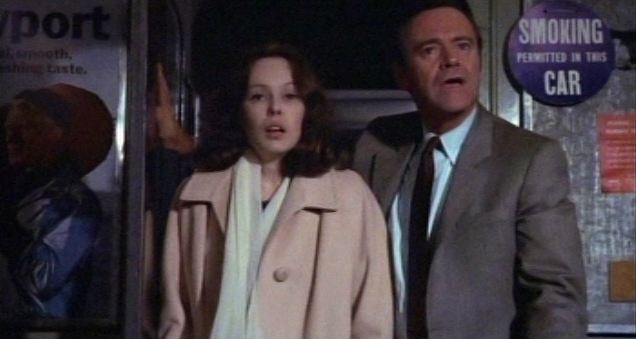
“The Out of Towners” is a hoot, start to finish. Jack Lemmon and Sandy Dennis are a couple from Ohio flying to New York City where Mr. Lemmon is to have a job interview, expecting to be transferred to the New York office of his company. Their travel is disrupted all along the way by the most outrageous incidents. For now, we’ll just stick to the train sequence.

Which is best appreciated when you understand what was happening to rail travel in the 1960s. Passenger service declined for many reasons, but foremost of which:

It was allowed to decay, purposely, by the railroad companies.

Passenger service increasingly became less profitable for the railroads, which were all privately owned before Amtrak. Freight and mail contracts helped pay for passenger service, to a degree, but by the late 1950s and early 1960s, railroad executives wanted to get rid of their passenger service as unprofitable. They were not allowed to just stop it, the Department of Transportation would have had a few things to say about that, so they purposely refused to invest in maintenance and upkeep, they limited service, and cut out amenities. Train travel in the late 1960s, on most railroads, was a far cry from the glory days of the 1930s through the 1950s. Service was unreliable, cars were in disrepair, food was not so great, in an effort by the railroad executives to drive passengers away. They made train travel miserable, so that they could report there was not enough ridership to continue providing passenger service.

Private industry does not always have the public’s best interest at heart. Have you noticed?

Push came to shove, and the American public pulled off a grass roots drive to force the issue in Congress, demanding that passenger service be saved. Congress, fearful of the eventual necessity of “socializing” freight travel, never mind passenger service, enthusiastically responded. Signed into law by President Richard M. Nixon, it was the birth of Amtrak.

The first decade was rough, as a lot of traditional routes had to be scrapped in an effort to focus money and attention on the handful of routes that could be saved. Gone was the City of Los Angeles, gone was the Midnight Special from Alabama to Ohio, gone was the Montreal Limited and a number of routes. Equipment was hodgepodge and funding was an annual battle.

All transportation in this country is subsidized by the government. Airports, highways, they do not pay for themselves. There is no profit. They have the benefit of a solid trust fund to support them. Amtrak, however, must fight for funding constantly.

Four decades later, more routes have been added, train cars are climate controlled, quiet, comfortable, and the food is good. Trains connect not just cities in the northeast, but downtowns. Trains reach areas in the Midwest and West that are not easily accessible by airports, or sometimes even by highways. A single high-speed route, the Acela, is top notch and growing in popularity.

Trains are the most economically efficient, and most environmentally advantageous way to move large numbers of people. Though we are still far behind Europe and Asia in the development of high speed rail service and commuter rail, this is where our future lies, because with the rising cost of fuel, and the congestion of highways and airspace, we have no choice.

We old movie buffs tend to wax nostalgic about trains as we see them in 1940s movies, but trains are no longer just a nostalgic image. They are the (rail) road to the future.

Which makes Jack Lemmon’s travails in “The Out of Towners” so ironic. This movie was released the year before Amtrak came into being. The movie, directed by Arthur Hiller, written by Neil Simon, shows a grittiness in its urban shots, both in Boston and in New York. We are entering a less colorful, more cynical modern world, yet the grittiness contrasts with how the travelers appear, not just Mr. Lemmon and Miss Dennis, but the sea of extras around them. Take a good look. All the men in suits. The ladies in dresses, and white gloves. More ladies, like Sandy Dennis, are going without hats, and many of the men are, too, but most people still dressed for travel. People in this film are slow to let go of their formality, have not become as inelegant as their train service.

Their flight to NYC is diverted, because of fog, to Boston. It is night, and Mr. Lemmon needs to be in NYC by early the next morning for his important business meeting. They grab a cab to South Station and try to get the next train to New York.

They just miss it, and one of my favorite lines is when Jack, panting, hollers, “Did you see that train?”

Sandy replies, “I didn’t see anything. I was running.”

A laconic red cap with the typical stereotyped “ayuh” New England accent informs them they can catch the train at the next stop in Longview. Back for another cab ride, and they finally get on board the train by the skin of their teeth.

Notice the logo on the side of the train. In this last year before Amtrak, the trains are still privately owned, and this one is the good old New York, New Haven, and Hartford Railroad. We had a brief visit on this train when we covered “This Happy Feeling” (1958) here. The NY, NH & H had actually merged with Penn Central in 1968, but the Penn Central went bankrupt in 1970, the year this movie was released. It joined Amtrak in 1976.

The train is monstrously overcrowded, and they must wait two hours in line to get to the dining car, where all the food is gone. All that’s left is peanut butter sandwiches and nothing to drink except clam juice and tonic water, “But they ain’t cold.”

I once heard a joke, something about clam juice being what New Englanders drink when they’re hung over. I can’t vouch for that. I’ve never had clam juice, and I’ve never been hung over.

(Note guy sleeping in luggage rack to the right.  Now that's an overcrowded train.)

The conductor, punching tickets, replies to Jack, with a typical stereotyped New England “ayuh” accent, “This train runs empty six nights a week, ‘cept when the New York airport is fogged in. Then they fly ‘em up to Boston. Then we could use four more cars.”

“Why don’t you put on four more cars?” Lemmon asks.

“Ain’t got four more cars. Nobody takes the train anymore. Everybody’s in a hurry.”

The state of American railroads in the late 1960s boiled down in a couple of lines of dialogue.

The cheerful waiter who seems bothered by nothing, even amused by the chaos, is played by Johnny Brown, whom you might remember from “Rowan & Martin’s Laugh-in.”

Conductors, I am happy to report, still wear those neat hats and still punch tickets. Some of them still sing, “Worcester-Albany-Buffalo and all points we-est. All bo-a-a-rd!.” You know you’re on a northeast train when they pronounce Worcester properly. I’ve heard it butchered south of DC.

You also know you’re getting closer to New England if New England clam chowder is on the menu. I once had a discussion in a dining car with an elderly gentleman from upper New York state about Manhattan vs. New England chowder. He was for the former. We agreed to disagree.

Check out the regional menus here.   Chicken Tortilla soup on the Texas Eagle run. Southern catfish on the City of New Orleans.

We get a look at a less than resplendent South Station in Boston, likewise a run-down, dark and dirty Grand Central in NYC. The stations, like the train service, were falling apart, not maintained by the railroads. Grand Central was due to fall to the wrecking ball, a prize sought by developers, until some New Yorkers, Mrs. Jacqueline Kennedy Onassis among them, fought to save and restore the Grand Central Terminal. Today, it is as magnificent a train station as you will ever see. (Though it does not currently serve Amtrak, which goes to Penn Station across town. Grand Central serves the commuter lines like Metro North.)

(Washington, D.C. - Union Station, JT Lynch photo)

Many train stations, like the train routes of old, have undergone a renaissance in the past few decades, among them Washington D.C.’s Union Station and the Union Station in Los Angeles.

(Cincinnati - Union Station, JT Lynch photo)

Here’s some shots of the magnificent station in Cincinnati, with its beautiful Art Deco façade and inside, an enormous mural surrounding the dome in vivid colors.


(Cincinnati - Union Station, photo by JT Lynch)

Most of these re-born stations have shops and services, and in the case of Cincinnati, a city historical museum inside. They have become more than just a place to pick up a newspaper or book a ticket.


(Cincinnati - Union Station, photo by JT Lynch)

But Jack Lemmon and Sandy Dennis trudge through a man-made hell of run-down infrastructure that is as horrifying as it is terribly funny. The future of train travel, or indeed, any kind of travel, looked bleak in “The Out of Towners”. It just goes to show, past is always prelude, but not always revealing of what is going to happen next.  What happened next was Amtrak.

Come back Thursday when we discuss “It Happened to Jane”, which shows us the beginning of this era of railroad decline. Jack Lemmon is a bit younger here, much more idealistic, and helps Doris Day fight off greedy railroad executive Ernie Kovacs to save the train that serves their coastal Maine village.

This movie was actually shot in Chester, Connecticut, as well as in Hartford. Visit my New England Travels blog tomorrow for photos of what the locations in the movie look like today.

(The blogger waits to board.  Photo by JT Lynch)


Related Products