IMPRISON TRAITOR, PEDOPHILE, AND CONVICTED FELON TRUMP.
Showing posts with label William Bendix. Show all posts

Thursday, November 11, 2021

Cover Up - 1949


Cover Up (1949) is a quite enjoyable example of Christmas Noir—if we can play with calling it a subgenre.  It has some lighthearted aspects like Lady on a Train (1944), which we’ll discuss in weeks to come, and a grim mystery that toys with symbols of Christmas as its backdrop not unlike Lady in the Lake (1947), which we covered here in this previous post.


Though I’m usually content to experience each season in its turn and prefer not to rush the holidays—Thanksgiving does not deserve to be given the bum’s rush—this year I’m hoping to tackle a roster of yuletide-related movies as early as—now—to lead up to a new book for the new year: Christmas in Classic Films, which will be a collection of essays from this blog.  More on that in weeks to come.


Cover Up can also be likened to Alfred Hitchcock’s Shadow of a Doubt (1943) with its mysterious murderer casting a sinister shadow over a homey small town.  However, in Cover Up, the murderer is not an outsider like Uncle Charlie come to town; murder is already afoot when the dogged insurance investigator arrives on the train.  He is played by Dennis O’Keefe, and he meets a nice girl here, too, who like Teresa Wright, will grow chillingly aware of danger to her family.  She is Barbara Britton, lovely and understated, with a little more polish than “Young Charlie.”


Though the film has elements similar to all these movies, it is still its own unique creation.  It manages to be both an intriguing and unsettling mystery and a charming, even wistful, tribute to Christmas. 


It begins lightheartedly enough, with Dennis O’Keefe and Barbara Britton in a “meet-cute” aboard a train as they arrive at the same small town.  It is her town, and she arrives home to spend Christmas with her family. She carries the requisite armload of wrapped presents, which she repeatedly drops, and Mr. O’Keefe, who has already eyed her approvingly on the train, rushes to lend a hand.  They next board a bus from the train station to go downtown and the bus driver, a townie whom Britton knows, sets up the story for us by sharing with her the big news: one of the town’s most prominent citizens has committed suicide. The camera lingers only slightly on O’Keefe’s expression at the news, and we assume he knows something about it. 


We don’t know if Miss Britton has been away at college, or has just taken an extended trip.  Her family meets her at the bus stop with enthusiasm: Mother, Dad, and kid sister Ann E. Todd, a fresh-faced child actress in one of her last film roles.  We saw her in Roughly Speaking (1945) and My Reputation (1946) discussed in these previous posts.


Miss Britton introduces O’Keefe to them, and when he says he is staying at the hotel on business and will be in town only a short while, Dad invites him to come to their house in the evening to visit.  An extraordinarily friendly invitation to a stranger, but we are meant to see them as an all-American family with small-town virtues.


There is, however, a degree of small-town vice here as well.  The bus driver has intimated that the man who committed suicide was not well liked.  As the movie progresses, we learn that everybody hated his guts.  When Mr. O’Keefe checks in at the sheriff’s office – we learn then that he is an insurance investigator, not unlike my hero, Johnny Dollar—he has no suspicion that the death was anything more than a suicide, but his company has sent him here to fill out the proper paperwork on the insurance with the coroner’s report.  His first inkling, and ours, that there might be more to this death is the deliberately and glibly stonewalling attitude of the sheriff, played by William Bendix.  Bendix is great in the role, with a knife-edge of sinister smugness and wry humor. We discussed Bendix’s work here in The Blue Dahlia (1946).


Sheriff Bendix is coyly uncooperative about the details of the death and it takes O’Keefe’s stubborn cleverness to ferret out that the victim was shot with a Luger, which is obviously a pistol that not too many people in a small town would have.  It is also missing.  Though, as it happens, the sheriff pulls one out of his desk drawer.  When O’Keefe asks the smart aleck but not just hypothetical question to Bendix, “I don’t suppose you killed Phillips, did you?” he gets no direct answer and we wonder if perhaps the aloof sheriff is a murderer.


The hints and clues begin to unwind, accompanied by the trappings of Christmas.  Bendix is wrapping presents at his desk when O’Keefe’s routine filling out of forms turns into suspicious interrogation.  Bendix rarely meets O’Keefe’s eye, he just puffs on his pipe and his sausage fingers delicately and patiently seal wrapping paper around a small box.  Over by the window is a spindly table-top tree.  O’Keefe moves toward it, fingers a small present on the table under the tree absently, as if he is thinking of something else.  Bendix remarks, “Why don’t you forget about it?  Go on home, visit your folks for Christmas.”


O’Keefe replies, slipping from his confident tough guy mode, “Sounds great, Sheriff, only I don’t have any folks and my home is wherever I happen to hang my hat.”  There is a brief, rather pained look on his face.  He puts the present back under the tree, as if he is refusing a place at the table at Christmas, as if he doesn’t belong.  Then through the film noir blinds at the window he spies Barbara Britton come out of a shop across the street, and tells the sheriff he has a reason to stay.  The sheriff thinks he means the murder case, but we see that is only half of it.


He buys a compact at the jewelry store, has it wrapped, but is there also to question the jeweler, who found the body.  The jeweler and his wife are uncomfortable with the interrogation, and we see that everyone O’Keefe talks to is on edge but thoroughly pushing the party line that the death was a suicide. There appears to be a great conspiracy afoot.


O’Keefe’s next stop is the town undertaker—a dour fellow in typical comedy relief, who tells him that there were no powder burns on the body.  The suicide is looking more and more like murder.


O’Keefe takes up the invitation to stop at the house where Barbara Britton’s family lives, and surprisingly, the compact is a gift not for Britton, but for the younger sister, Ann E. Todd.  It’s a cheery home with a fireplace, Mother and Dad, played by Helen Spring and Art Baker, in easy chairs, and a comically more-dour-than-the-undertaker maid played by Doro Merande.  O’Keefe gives sleuthing the night off, he thinks, and takes the already smitten Miss Britton to the movies.


We learn gradually, as happens in small towns, that most people not only know each other, but are in some way connected.  Barbara’s good friend, played by Virginia Christine, is the niece of the dead man.  She was to inherit his wealth as his only relative.  She was away the night of the killing as that was the evening she eloped against his wishes.  Russell Arms plays her new husband, of whom the uncle disapproved.  Arms had minor roles in several films until he eventually found work in television and became familiar in living rooms across the country as one of the stars of Your Hit Parade.


It looks like Russell, who has a bit of a temper and a chip on his shoulder, could have killed Uncle, and Virginia certainly looks uncomfortable, as if she is covering for him.


Barbara Britton drives O’Keefe around on his errands—like scouting out the murder scene at Uncle’s house, and when O’Keefe mentions his quest for a Luger, she innocently and happily blurts out that her father would lend him his Luger.


Daddy’s got a Luger pistol?


O’Keefe, who has come to like the family, and love Barbara, is anguished that it might be her father whom he is tracking, and slowly, her eyes on the road as she is driving, we see cold realization on her face that she just implicated her father in a murder.


They are being tailed everywhere by the sheriff, who seems to emerge from the shadows and remains, if only by his teasing attempts to thwart O’Keefe and send him down the wrong paths, to be the main suspect.


Christmas enters again in a climactic scene as the town prepares to light an enormous tree in the town square, an annual event.  The town’s beloved doctor does the honors every year, and the family bustles off, amongst gently falling snowflakes to take part.  O’Keefe tags along, part of him succumbing to the nostalgic joy of celebrating Christmas with others in a town he confesses he has grown to like, a frank nod to the fact that Christmas is as lonely for some people as it is happy for others.  But something else plays on his mind: all around him are suspects and he grows uncomfortable that the idyllic community has dirty secrets and nefarious doings.


They wait for Doc to arrive, and the bustle and hum of the crowd grows louder in anticipation, but at the last moment, word arrives that the old Doc, who has retired and moved to another town, has passed away this evening.


Dad gives the announcement at the tinny microphone, and there is shock and sadness.  But Doc would have wanted them to continue with the tradition, so the tree is lighted and Christmas goes on, whether or not anyone feels like it.  We all know that even the Grinch could not stop Christmas from coming.


At home, Barbara finds Dad’s Luger pistol and hides it in her purse.  When ferrying O’Keefe on another errand, he asks for a match (he chain smokes throughout the movie), and is comfortable enough in their relationship to reach for her purse, which she grabs defensively, saying she has no matches in there.  He knows she is hiding something—oh, great, another suspect.  She will eventually plead with him to drop the case, but Dad, who refuses to be protected, is stoic and prefers to let things play out.  He is a lucky man to have not only his daughter try to cover for him, but is maid as well.  Doro Merande burns his easily identifiable old beaver coat, an eerie holocaust in the snow, when it seems to be implicated in the murder, at least according to a phony trap O’Keefe planted in the local paper to smoke out the murderer.


Small clues are dropped for us here and there so that, unlike in many other mystery films and books we are not meant to know what the investigator is thinking or doing behind the scenes, it is enjoyable to be able to view the case playing out while we look over Dennis O’Keefe’s shoulder, knowing as much as he does. 


There taut moments, and warmhearted ones.  Christmas not only appears as a backdrop like the street corner Santa Claus in some scenes, or as a prop, like William Bendix’s “business” with wrapping presents, but is ultimately the reason for the “cover up,” which actually is larger than O’Keefe has anticipated.  The conspirators knew the murderer would be revealed, they just wanted to delay it until after the holiday, as O’Keefe incredulously discovers, “so that a town could have a Merry Christmas.”


It sounds corny, but when O’Keefe and Barbara Britton walk off, with the sheriff and Dad looking after them, and “O, Come All Ye Faithful” swelling up before the end credits, it seems like an actually satisfying ending.  It’s delightful to note that Dennis O’Keefe, with a childhood training in vaudeville and writing skits, co-wrote the screenplay.  Less happily, we might also recall that, like his character in this movie, he really was a chain smoker and died too young at 60 years old of lung cancer.


The biggest mystery in the story is actually why the family’s living room Christmas tree is fully decorated when O’Keefe first visits the home, and then on a later visit is in the process of being decorated.  Perhaps the person in charge of continuity had a little too much eggnog.


For more on Cover Up, have a look here at these posts by your friends and mine, Paddy Nolan Hall aka the Caftan Woman, and Laura at Laura’s MiscellaneousMusings, and Vienna at Vienna’s Classic Hollywood.

********************

Jacqueline T. Lynch is the author of Ann Blyth: Actress. Singer. Star. and Memories in Our Time - Hollywood Mirrors and Mimics the Twentieth Century. Her newspaper column on classic films, Silver Screen, Golden Memories is syndicated nationally.  Her new book, a collection of posts from this blog - Hollywood Fights Fascism - is available here on Amazon.


Thursday, April 18, 2019

The Blue Dahlia (1946)


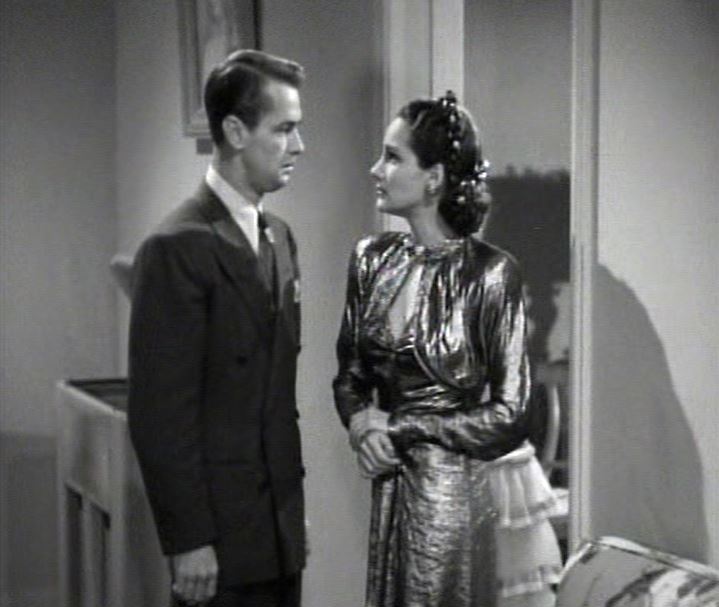
The Blue Dahlia (1946) is a story of betrayal. Alan Ladd is a returning war vet in this film noir who arrives in Los Angeles fresh off the bus with his two war buddies, played by Hugh Beaumont and William Bendix. Ladd is the hero of the piece, if one can term the chief protagonist of a film noir a hero, but his pals are as important to rounding out his character and even driving the plot.


Ladd is not so much an homme fatale in this film as would be, say, Howard Da Silva, who plays a charming and venial nightclub owner, because Da Silva is the only person in the film with the mystique, not just the brutish quality, of evil. Ladd is more a victim who plods his way blindly through a web of betrayal until by the end of the movie, we really don’t see him as much a hero as just the last man standing. But the studio banked on his mystique when paired with Veronica Lake, who is not so much a femme fatale here as another survivor on a dark journey, though perhaps better equipped by nature for survival.

The three war buddies part company early in the film and we are not given the indication that they will see much of each other in postwar life, though Hugh Beaumont and William Bendix will be joined at the hip because Bendix has suffered a serious head wound which has left him fresh out of the VA hospital with headaches, confusion, and memory loss. Hugh Beaumont, the steadier, responsible, quiet member of the group has taken it upon himself to take charge of Bendix and be his keeper. It is a thankless job as any caretaker can tell you, and just why he feels a sense of responsibility towards Bendix we are never told but it is probably the only example of self-sacrifice in a movie that is so rife with betrayal.

The only other example of altruism is perhaps found in the character played by Veronica Lake, who meets Alan Ladd when he is in trouble.  She is, we assume, attracted to him but keeps at a levelheaded distance partly because she is still entangled with a mobster husband and partly because Alan Ladd wants it that way. It is a kind of sacrifice. Later, she will confront Howard Da Silva, her mobster husband from whom she is estranged, for Ladd’s sake.

Veronica Lake does not get much screen time but she will represent Alan Ladd's future, we, again, assume, as the movie ends on a happier note that it began, which is certainly not the norm for film noir

The movie begins on a truly, inexplicably sad note. The Three Amigos enter the postwar world with a sense of apprehension. This was common to veterans; we see this in other movies including The Best Years of Our Lives (1946), which we've covered in several blog posts, and Till the End of Time (1946), which we will cover some time, but these fellows do not articulate the reasons for their sense of doom. Hugh Beaumont has a reason to feel glum, perhaps he foresees a rough road of responsibility for William Bendix and his medical troubles and is stealing himself for a life as his guardian. Bendix, with a hair-trigger temper to boot, is tough to manage. Of the three former Navy flyers, he alone continues to wear his bomber jacket. The other men are dressed in suits they somehow managed to find in the postwar clothing shortage.

When they park themselves at a bar for a parting drink, Bendix remarks to Ladd, "Lucky stiff, at least you've got a wife to come home to." And we see Hugh Beaumont try to discreetly shut him up, something Beaumont will have to do several times during this movie. There is some secret we don’t know.

Alan Ladd says only "Here's to what was." And when they part, Hugh Beaumont, apparently the watchman for all of them (no wonder he became Beaver’s dad), asks Ladd, "Don't you think you ought to call her before you go home?"

Alan Ladd remarks with a mysterious, defeated smile, "Maybe."


It is a foreshadowing that Alan Ladd's home life is not all that it should be.  We have a great deal of foreshadowing this movie, it is like bread crumbs scattered in the forest and it helps us to keep our trail, it helps us to find our way. It is a writer's device to point to whom he wants us to trust and not to trust. There are no red herrings here or tricks, but it will take you until the end of the movie to find out who the real murderer is. There are several plausible witnesses because there is just so much betrayal. The writer is Raymond Chandler, which is as fine a pedigree a film noir movie could get.

Alan Ladd goes to his wife's home, a swank hotel and bungalow complex that seems perhaps a bit more than his allotment checks could have paid for and he stumbles upon a late afternoon cocktail party in her apartment. The alcohol is flowing, someone is playing “Accentuate the Positive” on a piano and people are dressed to the nines, people with dubious integrity, seemingly without a care in the postwar world.

We receive more telegraphing of clues when Alan Ladd goes to the desk clerk and asks for his wife's apartment and we see the bellhops and the desk clerk exchange arch expressions as if they did not know that his wife was married and we may assume that she has been carrying on with others. Alan Ladd knows nothing of this and walks into the party. His wife, played by Doris Dowling in her fourth film, is completely surprised, prickly, jittery, not knowing how to welcome him, especially when she has her lover in the apartment, Howard Da Silva.


Da Silva is as smooth and articulate a bad guy as ever graced a film noir. He runs a local nightclub called the Blue Dahlia and his calling card is to present guests and lady loves with massive arrangements of the large blue flowers. When Alan Ladd from behind a door sees his wife with her arms around Da Silva, kissing him, Ladd interrupts and slaps Da Silva across the mouth. Da Silva graciously backs down and leaves. We will later discover, as he discusses with his partner in his club, that he is perfectly willing to let Alan Ladd's wife return to her husband because he is tired of her.

It’s easy to get tired of the demanding, constantly angry, constantly drinking Doris Dowling. She taunts Alan Ladd for striking Howard Da Silva, "You’re a hero. A hero can get away with anything."

There is an inference of self-entitlement which would still go against the grain of the newly postwar country. Ladd, who plays scenes with a great deal of control and an appropriate sense of weariness, retreats to the bedroom where he has only just begun to unpack and he sees two photos in a double frame.  One is his service photo and on the other is a portrait of their deceased son, Dickie. Dickie died while still a baby. He contemplates the photo; she had never sent him one.

When the guests leave, hustled out, they are alone and Ladd tries to get her to put down her drink, which seems to be attached her hand, so that they can talk. Her fit of temper returns and she announces in a flippant manner that she is her own woman, that she can do what she wants and see who she wants. He becomes angry and she replies I could tell you something that would hurt you plenty. She regrets immediately saying it but he presses her and in another fit of temper she confesses that their son did not die of diphtheria as she had written to him but that he was killed in a car crash. She had brought the baby to a party because she did not want to stay home; she was drunk and wrecked the car and Dickie died.

Ladd needs no more info. He takes the photos and prepares to leave her for good, but for one moment he pulls out his service revolver and she thinks he's going to kill her but he says that she is not worth it and he tosses it to the couch and he leaves in the pouring film noir Los Angeles rain.

The story is told with a great deal of cutting back and forth between different characters and action occurring simultaneously that is fast-paced and this is what makes the movie successful. There are only so many ways you can tell a story, even something as complicated and intriguing as a murder mystery, but for film noir it is not so much the story but how stylistically it is told that makes the genre unique and memorable.

We have a reference to the postwar housing shortage when Bendix phones and relates that he and Beaumont scored an apartment ahead of nineteen other guys because it is Beaumont’s old apartment and the landlady liked him. See?  Having good manners and being responsible pays off.

Doris Dowling will later phone Bendix at their new flat and confess Ladd has walked out on her. Why this bothers her is unknown, as she seemed pretty well through with Ladd, but Bendix, who is emotional and impulsive, leaves in the rain and shows up at her swank hotel and bungalow complex to talk with her, and waits in the bar.  She is there, but neither knows who the other is or that they had just spoken to each other on the phone, and we have the beginnings of a pickup.

The rain continues to pound down, and during the evening, Bendix, as well as Da Silva will show up at Dowling’s apartment.  The house detective played by Will Wright is always lurking around, spying on the action, so we know what he knows.

It is more foreshadowing, for when a murder has been committed, we see there are several suspects, but the only thing we're sure of is that it wasn't Alan Llad because when he left, she was still alive.

William Bendix eventually returns home to the apartment he shares with Hugh Beaumont, soaked to the skin from the rain, dazed, clearly troubled and doesn't remember much of what he's done in the past couple of hours.

Meanwhile Alan Ladd hitchhikes and gets picked up by Veronica Lake. We get a little bit of foreshadowing about Veronica Lake, too. Her portrait is at Howard Da Silva's nightclub and we are told that the they split up not because of a woman but because she didn't like his shady dealings, and Da Silva’s the partner confesses that she's evidently a wonderful woman and both agree that she is far too good for Howard Da Silva. So by the time we meet Veronica Lake we are already disposed to understand she is no gun moll. She is true blue and maybe this is the first bit of good luck Alan Ladd runs across. However, there is no romance. They say goodbye, they meet again, they say goodbye, and both discover separately that the police are after Ladd for murder.

The movie is successful at keeping us off balance and what is going to happen and who was going to end up with who. We only know for sure that Alan Ladd is not a murderer and that Veronica Lake is a nice person. As Hugh Beaumont says of him, "Whatever's the right thing to do, Johnny'll do it."

Alan Ladd's journey through this movie is pretty much based on how other people react to him. His wife does not want a life with him. When he discovers is wanted by the police, he runs into a couple of petty thieves who take him to a flophouse to hide out for a fee and they stab him in the back as does the fellow who runs the flophouse played by Howard Freeman. Freeman betrays Ladd by going through his belongings and asks for shakedown money to hide him from the cops.

Will Wright keeps coming back and he shakes down everybody he can: Howard Da Silva, William Bendix and Hugh Beaumont.  Everybody betrays everybody:  When Howard Da Silva's partner and another thug kidnap Alan Ladd, beat him up and take him to a cabin in the woods, the bad guys betray each other. Interestingly, Doris Dowling provides an ironic bit of wifely fealty by writing on the back of the portrait of their baby some secret info about Howard Da Silva (betraying her lover posthumously, quite a parlor trick).

Alan Ladd has seen enough by half of the movie that when he runs into Veronica Lake again, he confesses his suspicion of her and how "your timing’s good." She tells him "you'll have to trust me." But, of course, he can't he can't trust anybody, not in this movie.

Alan Ladd, in one sense, is even betrayed by his old buddies. He goes to their apartment and they want to hide him. Bendix wants to take it on the lam with Ladd, and Beaumont, who was an attorney before the war, suggests turning himself in. Alan Ladd is shocked to realize both his buddies think he actually did commit murder. He is angered by that sense of betrayal. How could they know him so well and yet think he would stoop to murder?!

The loose ends come together when the police captain, played by Tom Powers, interrogates all and sundry at Da Silva’s office in his night club. Bendix recalls the events he had forgotten on the rainy night of his blackout, and now he thinks he’s the murderer. Will Wright is suspected because he was always lurking around, he had opportunity – though motive is never made clear to us.

At the movie’s beginning, Mr. Wright takes a role similar to many he held over his long career – a cantankerous and possibly shifty coot, but as the movie progresses, we see it is the role of a lifetime for him. He is treated as over the hill and past his prime by the cops and others, a has-been from the word go, but we are told he is 57 years old and for those of us in that neighborhood, it is a bit stinging to think that could have been seen as over the hill, especially since he looks much older. In real life, Mr. Wright was actually 52 years old at the time. Ouch.

Alan Ladd returns, performs an irrelevant party trick to clear William Bendix from the charge of murder, and we realize the cops have already cleared Ladd and found their man.  I’ll give you a break for once and not spoil it, but it’s hardly a shock.
 

We're not sure what's going to happen with Alan Ladd and Veronica Lake. They meet warily one last time by her convertible waiting to say goodbye again (check out the B gasoline ration sticker and our previous post on the subject here), and the only signpost we are given that it might not be goodbye permanently this time is because William Bendix and Hugh Beaumont, who are waiting for him, give up and walk away to the nearest bar. Alan Ladd may or may not catch up with them later.


Neither Alan Ladd nor Veronica Lake may be ready for a relationship at this time but unlike most film noir movies, this movie ends with the hope of a new life of something better. Much has been written about Lake’s and Ladd's screen partnership and I actually preferred them in other roles in other movies. I think Veronica Lake was brilliant in Sullivan's Travels (1941) and in I Married a Witch (1942), discussed here, and So Proudly We Hail (1943) here.  I think Alan Ladd was brilliant in Shane (1951), discussed here. I don't think they reached their full potential with each other.

I wouldn't say they were a case of being mismatched, it isn't that. They were interesting to watch as a pair but I think the reticence their characters showed each other in this movie is something of a metaphor for their ability to connect with each other as actors. Their meetings were always intriguing, their goodbyes were less than dramatic. Film noir had a way of making the main characters somehow distant and inaccessible and mystery was part of the genre. We weren't really supposed to know them that well. They weren't supposed to be people with whom we could feel entirely comfortable. Alan Ladd, with all his ambivalence and aloofness came to be well-known as a film noir hero.  Like the character he plays in this movie, Ladd was more or less thrown into it and stuck with it and he had to endure it until something else came along.

The most burdened person, and most unexplained and therefore mysterious, in The Blue Dahlia, for my money, is Hugh Beaumont. There should have been a Veronica Lake for him.

Be sure to check out the other terrific blogs and their entries in the Classic Movie Blog Association blogathon: Femme/Homme Fatales of Film Noir.  

*********


Related Products