IMPRISON TRAITOR, PEDOPHILE, AND CONVICTED FELON TRUMP.
Showing posts with label Jackie Coogan. Show all posts

Thursday, March 6, 2014

The Buster Keaton Story - 1957


The Buster KeatonStory (1957), is a film made perhaps too soon, and which many fans of Buster Keaton would agree should never have been made at all.  It is an example of one of the most unrealistic biographies produced by Hollywood, bearing very little fact in the story.  But it is an interesting attempt at trying to portray the life of a giant of the early days of the film industry in an era where that giant, Buster Keaton, was only just beginning to be rediscovered by a new generation.

The bright spots of this story are Donald O’Connor, who plays Buster Keaton and Ann Blyth, who is a fictional character, a sort of composite of his wives.  She has a fictional name and a fictional back story.

The film began shooting in June 1956, a very busy year for Ann, who was 27 years old when this film was made, but, incongruously, her film career was actually winding down.  There would be only one more year after this.
In March 1956 she appeared as a guest on the Perry Como television show, and in May, she appeared on The Ed Sullivan Show, Mother’s Day, May 13, 1956 as a recipient of Sullivan’s Mother of the Year Awards (along with fellow recipients Betty Grable, Deborah Kerr, Betty Hutton, Rosemary Clooney and June Allyson).  A bevy of beautiful moms.


By August, it was reported that she had to cancel a singing engagement at the Sahara Hotel in Las Vegas, slated for September, because MGM, to which she was under contract at the time, ordered her back to start another film as soon as The Buster Keaton Story for Paramount was finished up. 

Her work in The BusterKeaton Story was understated and solid, but apart from the acrobatic final scene, which we’ll get to, seemed not much of a challenge.  From The Schenectady Gazette in an article by Louise Boyka from May 1957: “Attractive Ann Blyth does much to keep up the caliber of the film with her high quality acting and personal appeal." 

But Ann’s sincerity could not help the basic faults of this film, which suffered a loss of credibility through the clumsy handling of the film’s producers
With so much fictional in this movie about such a remarkable figure in film history, viewing it will quickly become an exercise in frustration.  This is not the place to go looking for the truth about Buster Keaton.  There are documentaries, such as the excellent Buster Keaton - A Hard Act to Follow (currently here on YouTube), but the best source on Buster Keaton’s genius are his own films.  Happily, many have been restored and make up some of the finest comedies made of the silent era.  That he was an exceptionally talented man, and brilliant, though down-to-earth storyteller cannot be denied, but The Buster Keaton Story ignores his genius and slides into lazy cliché.  We have the beginning of the down and out vaudevillians trudging through the snow to the theatrical boardinghouse where Buster is fighting for food as a child in a scene which we will later recognize from one of his movies. 

Though the film does lean heavily on Buster’s drinking to supply the drama and the tension, it does not really go into the reasons for his drinking.  In the movie, we are told that sound films have destroyed the silent era, and have left him without a job.  We even have a reference to John Gilbert’s professional demise because his voice was no friend to the microphone, a myth which has been proven false, but which is one of the clichés that the film perpetuates.

Written by Sidney Sheldon and Richard Smith, produced by them, and directed by Sheldon, the main fault of this movie is the script.  It is rife with clichés and so full of inaccuracies that the embarrassment Buster Keaton apparently felt at its premiere and the critical hammering the film received, giving both the careers of Ann Blyth and Donald O’Connor a black eye, is really the fault of the script and the production.  The direction was lackluster. 

And I can’t help but wonder what Peter Lorre was doing in this film as a belittling director.  It was a role that could have been played by anyone, so much so that it feels odd to have a man of such strong screen presence and a notable history of quirky roles play it.

Cecil B. DeMille has a cameo playing himself, and Jackie Coogan plays the silent star Elmer Case, but I think that’s it for the greats of the silent era.  Richard Anderson, an actor I’ve always liked, has the thankless role of the boring nice man who doesn’t get the girl.

Buster’s real-life parents also get bit roles.

Rhonda Fleming has a fun and flashy role as a snobby starlet, complete with liveried chauffer and hounds on a leash.  She turns Buster’s head for a while. 

Donald O’Connor’s work in the film, despite the material, is good.  He handles the drama with subtle intensity, and most especially the physicality of Buster Keaton, very well.  Mr. O’Connor is an old vaudevillian himself, and when he speaks of Buster’s childhood on the road, we can imagine he knows all about that.  He was a vaudevillian from his childhood.

He performs and re-creates a few of Buster’s famous stunts for indeed, most of Buster’s gags were actually stunts and I can think of no other dancer, no other actor who could have played Buster Keaton as well as Donald O’Connor.  He was the most acrobatic young dancer/actor in Hollywood at the time, able to do things neither Gene Kelly nor Fred Astaire could ever do.  It is this kind of athleticism needed to portray Buster Keaton, who was sublimely athletic.

Buster Keaton served as a technical advisor on the film and in her book on her husband, Buster KeatonRemembered, Eleanor Keaton writes, “For eight weeks Buster helped Donald with the comedy sequences, and he had wonderful time working with him.  However, the finished film  The Buster Keaton Story was awful.”  On the particularly difficult illusion of diving through the brick wall from Sherlock Jr, she writes, “Donald did an admirable job executing this risky stunt...  It was a very dangerous stunt.”

There are two elements of Buster Keaton’s real life that would’ve made a very interesting movie had that movie been made.  When it comes to his drinking, Buster Keaton was spurred on by two great heartbreaks.  One was the fact that his studio, The Buster Keaton Studio, set up for him by producer Joseph Schenck, whose sister-in-law, Natalie Talmadge, Buster Keaton married, was taken from Buster because he had a tendency to go over budget on his elaborate films.  Buster was put under the thumb of producers and writers writing gags for him, and when he came to work for MGM, his creativity was stifled and he became frustrated.  He was paired on screen with larger-than-life lovable motor-mouth Jimmy Durante.  Buster was now a second banana, and miserable.

The second great sadness of Buster’s life was his first marriage to Natalie Talmadge, with whom he had two sons.  Talmadge was a spendthrift who went through Buster’s money and quickly lost all affection for him.  When they divorced, she refused to allow her sons to see him, and even changed their surname to her maiden name.  She bore such a hatred for Buster the rest of her life that she refused to allow his name mentioned in her presence.

At the time The BusterKeaton Story was made, both Natalie Talmadge and MGM were still alive and had lawyers and would’ve come down hard on this film if it had come anywhere close to vilifying them.  So we have no mention of Buster’s first wife and unhappy marriage, and we have no mention of MGM.  The studio he works for is lamely called Famous Studio and the bad guys are sound pictures.

There is a scene in the movie where Ann Blyth’s character, a casting director for Famous Studio (kudos to the film for placing a woman in a position of responsibility and authority, which was common in the early days of film), falls in love with Buster, who barely knows she’s alive.  After one of his drunken benders, she bails him out of jail and marries him when he is too drunk to realize it.  The scene seems far-fetched, but it does have some basis to reality.  Buster’s second wife, a nurse at the sanitarium where he was being treated for alcoholism, actually did marry him under similar circumstances, and Buster would later remark that he could not remember the ceremony.

The greatest part of Ann Blyth’s fictional character resembles Buster Keaton’s third wife, a young Hollywood dancer named Eleanor Norris and with whom he was happily married for twenty-six years until his death in 1966.  Eleanor was a supportive and stable influence on the real Buster Keaton and Ann Blyth’s stoic endurance of Buster’s foibles, her understanding and kindness make her more Eleanor-like than any of his other relationships, but she is not really Eleanor. 
The real Buster and the real Eleanor Keaton on This is Your Life.

Donald O’Connor was able to match Buster’s quirky difficult social interaction with people that made him sometimes come off as rude, and mimicked his physical jerks quite well.  You can spot the little tricks of habit throughout the film.

There are two particularly fine scenes between Ann Blyth and Donald O’Connor.  One is when he has reverted to drinking after his latest failure, and she struggles to guide him to the couch, where he flops, mumbling about episodes from his past.  She kneels beside him, trying to soothe him, and they talk over each other, their words overlapping in a heartbreaking inability to reach each other.

The truest and most delightful part of the film comes at the very end when Buster decides to revive his vaudeville act where he is free to create.  He does not make much money, but he is overjoyed to be making people laugh.  Ann Blyth is standing in the wings, and he grabs her impulsively and pulls her on stage with him to re-create a famous skit that he has performed many times, and with which she is familiar.  His real-life third wife Eleanor also performed such skits with Buster in later years in Europe and on television.

This skit performed in pantomime is Buster’s true medium.  They play a husband and wife who arrive home in the wee hours of the morning after celebrating too much on New Year’s Eve.  They are both a bit tipsy and exhausted.  They prepare to go to bed, but as Buster’s fumbles and hurts himself on a chest of drawers, Ann wearily stretches out on the floor and falls asleep. Donald as Buster discovers her there and through a series of acrobatics, physics and applied geometry has to get her into bed while she is completely unconscious.  He has to move her dead weight.
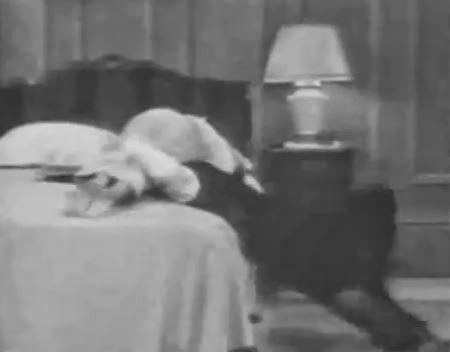
It is a funny skit and, for me, the only laugh out loud moments of the movie.  I can imagine Donald and Ann working through the scenario in rehearsals.  They must’ve been laughing their heads off.  Especially funny is one moment where he holds her in his arms and is trying to figure out a way to get her on the bed such that her head goes with the pillows and her feet go in the proper direction, but he can’t figure out how to do it.  So he sits down on the bed and attempts to throw her over his head, hoping she will land in the right position, but he doesn’t toss her high enough and she flops right on his neck, strangling him. 
When he extricates himself and stands, she lies limply over his shoulder like a towel.  It’s very well done and really requires a great deal of athleticism from both of them.

The film did make money and earned $50,000 for Buster Keaton as technical advisor, with which he and his wife were able to buy a comfortable home.  Moreover, it brought more notice to this great artist’s place in film history, and those are two things for which we as film fans can be happy.  Watching this to learn more about the real Buster Keaton’s life or work is fruitless. 

However, for those fans of Ann Blyth and Donald O’Connor, watch it simply for their last pairing on film.  They work well together.  They look like old friends who understand each other and it is a very pleasant thing to see them when you remember Ann got her start in film in a series of four musicals for Universal and Donald O’Connor was her first co-star.  We’ll talk about them down the road.
Here they are six years earlier at the premiere of Harvey in 1950, taken from a newsreel of the event.
And just because I like it, here's a clip from 12 years earlier of their duet from Chip Off the Old Block  (1944):


Our friend Robby Cress notes some location shooting from this film at his Dear Old Hollywood post.


On April 3, 1957, Buster was surprised by Ralph Edwards and the merciless This is Your Life show, in which Donald O’Connor appeared, dressed in his Buster outfit, to wish him well.  The program was part of the film’s publicity efforts.  Watch it here onYouTube, but jump to 24:00 minutes because it is the second half of the video.  The first half belongs to Laurel and Hardy. (We mentioned Ann Blyth’s turn as honoree/victim of This is Your Life two years later in 1959 in this previous post.)

Come back next Thursday when we travel back to 1949 and a trip to Ireland with Ann, Bing Crosby, and Barry Fitzgerald in Top o’ the Morning.

**************
Buster Keaton A Hard Act to Follow (Thames Television, 1987)

Keaton, Eleanor, and Jeffrey Vance. Buster Keaton Remembered (NY: Harry N. Abrams, Inc. Publishers) 2001, p. 38

Schenectady Gazette, May 17, 1957, article by Louise Boyka, p. 19.

This is Your Life, Ralph Edwards Productions, April 3, 1957

The Warsaw (Indiana) Times-Union, August 3, 1956, syndicated article by Harrison Carroll, p. 5.

*****************************

This week marks the seventh anniversary of Another Old Movie Blog.  Thank you so much for the pleasure of your company.

UPDATE:  This series on Ann Blyth is now a book - ANN BLYTH: ACTRESS. SINGER. STAR. -

*********************
The audio book for Ann Blyth: Actress. Singer. Star. is now for sale on Audible.com, and on Amazon and iTunes.

Also in paperback and eBook from Amazon, CreateSpace, and my Etsy shop: LynchTwinsPublishing.


 "Lynch’s book is organized and well-written – and has plenty of amusing observations – but when it comes to describing Blyth’s movies, Lynch’s writing sparkles." - Ruth Kerr, Silver Screenings

"Jacqueline T. Lynch creates a poignant and thoroughly-researched mosaic of memories of a fine, upstanding human being who also happens to be a legendary entertainer." - Deborah Thomas, Java's Journey

"One of the great strengths of Ann Blyth: Actress. Singer. Star. is that Lynch not only gives an excellent overview of Blyth's career -- she offers detailed analyses of each of Blyth's roles -- but she puts them in the context of the larger issues of the day."- Amanda Garrett, Old Hollywood Films

"Jacqueline's book will hopefully cause many more people to take a look at this multitalented woman whose career encompassed just about every possible aspect of 20th Century entertainment." - Laura Grieve, Laura's Miscellaneous Musings''

"Jacqueline T. Lynch’s Ann Blyth: Actress. Singer. Star. is an extremely well researched undertaking that is a must for all Blyth fans." - Annette Bochenek, Hometowns to Hollywood


Ann Blyth: Actress. Singer. Star. 
by Jacqueline T. Lynch

The first book on the career of actress Ann Blyth. Multitalented and remarkably versatile, Blyth began on radio as a child, appeared on Broadway at the age of twelve in Lillian Hellman's Watch on the Rhine, and enjoyed a long and diverse career in films, theatre, television, and concerts. A sensitive dramatic actress, the youngest at the time to be nominated for her role in Mildred Pierce (1945), she also displayed a gift for comedy, and was especially endeared to fans for her expressive and exquisite lyric soprano, which was showcased in many film and stage musicals. Still a popular guest at film festivals, lovely Ms. Blyth remains a treasure of the Hollywood's golden age.


The eBook and paperback are available from Amazon and CreateSpace, which is the printer.  You can also order it from my Etsy shop. 

If you wish a signed copy, then email me at JacquelineTLynch@gmail.com and I'll get back to you with the details.

Thursday, January 14, 2010

The 1950s Princess - Part 1

For the next three posts, concluding next Thursday, we’ll discuss what could be a social phenomenon, or maybe just a passing fad…the 1950s princess.

Three films we’ll use to examine our '50s princesses are Roman Holiday (1953), The Swan (1956) here, and Anastasia (1956) here. There are similarities, and there are differences, but there may yet be a thread that links the three films, the three stars, that possibly has to do with the last years of a lumbering paternal Hollywood machine, and society at large in the last decade or so before feminism became a social force.  Maybe you have some thoughts about this.  I look forward to your comments.

The three princesses are Audrey Hepburn, Grace Kelly, and Ingrid Bergman, icons of that decade. One would obviously note at this juncture that Grace Kelly distinguished herself among this group by actually becoming a real princess, but that is not the only instance where make-believe blurred with reality in these three films. There is cozy melding of fantasy with reality, rather than usurping it, that may determine the uniqueness of the 1950s princess, something apart from any other kind of Cinderella story from films of previous decades.  We never go too deeply into fantasy.

It could be said that the 1950s was an era obsessed with princesses. The coronation of Queen Elizabeth II in 1953 marked a profound response by media and fascinated commoners around the world newly linked by fast developing communications technology.

What part the backwash of World War II could have had in this fascination is intriguing. There are several factors to consider. First, in the United States at least, there was a fairy tale aspect to the swarm of returning veterans building suburban dream houses for sweethearts who had waited for them, women who had now left the grind of the war plant to set up housekeeping in long planned for and idealized homes of their own with modern gadgets. Peacetime at the end of several years of hardship, worry, and terror, was the happy ending. Americans have always been addicted to happy endings.


Home, and the children who followed in the happy ending, were considered primarily feminine concerns, a woman’s realm, but the post-War woman seemed determined to avoid being the kind of household drudge she may have regarded her mother. Gadgets and modern appliances were part of the modern woman’s campaign to keep her station elevated, but there was something more. It had to do with fashion, and icons, which perhaps had to do with advertising.

The 1950s were a time of breakneck manufacturing, selling, and advertising. Cars were big, and women’s skirts were long and full. The new muscular economy brought forth a woman with an idealized feminine wardrobe, elements of which, like the cinched waist and full skirt dress, petticoats and evening gowns which allowed for bare shoulders, had not been seen for nearly 100 years, when such styles would have been comfortable at any mid-19th century cotillion. 

Or, as one ad in the New York Times in November of 1951 described a "breathtaking" nylon tulle dress, "feminine allure of bared shoulders, sculptured waists, skirts that whirl forever." 

Other elements in 1950s society were forward-looking, modern, Atomic Age. Women’s fashions, however, were receding to a romantic past. For a time, even the tiara became standard decoration from brides to debutantes. And these princesses had princess phones.

Roman Holiday sets us in this post-War paradoxical world, with a modern princess from a fictional country. The country is never named, even to give it a fictional name, and this adds, curiously, to the film’s realistic veneer. We may well imagine it is one of any number of small locales in Europe previously unknown to Americans until the GIs came through. Names of countries we, in our self-absorbed manner, never bothered to learn.

The film begins with a kind of Citizen Kane jolt of realism with a pseudo-newsreel opening. Audrey Hepburn, as Princess Ann, attends various functions on a European tour to promote trade for her tiny country.

The movie was filmed on location in Rome, and this is one of the best things about Roman Holiday. It has all the adventure of the many location films produced in the 1950s and afterward, but there’s a subtle post-war European just-getting-back-on-their-feet quality to this film. It’s not just a travelogue; it’s a look into ordinary lives that are not terribly hip despite the Vespa scooters.

Like our cliché American not needing to know which country the princess comes from because we will likely be ignorant of it anyway and who cares (when Grace Kelly married Prince Rainier III of Monaco, Americans went scrambling for their atlases), is the occasional reference to the Italian lire as being extremely devalued compared to the American dollar. On a few occasions, Gregory Peck flips through large bank notes worth thousands of lire and notes with a smirk it is worth about a dollar and a half. Such commercial observations brings the fairy tale and the travelogue to a halt.

Its being shot in black and white probably adds to this suggestion of realism compared to later films of this similarly lighthearted vein shot in Italy, like Three Coins in the Fountain (1954) and Summertime (1955), which were more like picture postcards with a plot.  (Ten-year-old Jackie Coogan remarked on a visit to Rome and an audience with the Pope in 1924 that Rome was "the best place in the world for shooting pictures, after Hollywood."  Out of the mouths of babes.)

But the realism in Roman Holiday is occasionally delicately swept aside by the fairy tale. Audrey Hepburn plays the reverse of Cinderella. She is a princess overburdened by the responsibility of representing her tiny country and runs away to escape her troubles and wander the city as an ordinary person. Her tour guide is Gregory Peck, who is partly her fairy godfather and partly her charming prince. By the end of the film, Miss Hepburn’s character changes from a sad girl to a sadder-but-wiser woman of authority. The story is at turns funny, romantic, occasionally breathtaking.

Some elements of realism in the story are hidden, part of the backdrop of which we, in our own innocence, may not be aware. For instance, some of the royalty attending the embassy ball were real minor European royalty, wearing their real jewels. At the end of the film, many of the journalists introducing themselves at the press conference were actually working European journalists playing themselves, not actors. It may not be important to the story that we know this, but knowing it adds depth to the legacy of this movie and the blurring of reality.

Most of film is populated by some terrific Italian character actors, such as Paolo Carlini, who plays the barber who cuts Audrey Hepburn’s hair, turning her long, girlish tresses into a short, modern, 1950s style. Audrey is not just a princess, she’s a modern princess, a 1950s princess.

There are many delightful moments in the film which have director William Wyler’s imprint on them: when Hepburn loses her shoe in the receiving line and her anxious staff must find a graceful way to retrieve it for her. We see that royalty, like William Wyler, lives in a world where attention to detail is foremost, and perfection is a subtle quality sometimes to be worked at, and sometimes only chanced upon.

But the ball is dreary for a young person. Retiring for the evening in the ornate bedroom of her country’s Roman embassy, Audrey stands on the enormous bed, moping and brushing her hair, dressed in a voluminous and somewhat old-fashioned nightgown, looking like a pouting child, “I hate all my nightgowns and all my underwear, too.”

It is the first line we hear her speak after several minutes of princessly posturing for the public in her finery, and most charmingly disarmed, we are clued in immediately to the troubled mindset of this young woman.

She is overwhelmed and overtired, depressed and anxious, ready for a breakdown, as every moment in her life is booked up. Her youth, her charm is perhaps her beleaguered country’s ace in the hole. She is sent on the public relations tour, doing the work of seasoned diplomats, but completely unarmed for the rigor of being both politician and icon.

Margaret Rowlings plays the Countess, her lady in waiting who has the charge of Audrey and, like the rest of the staff, plays her role with splendid warmth and tightly controlled comedy. Needing to get the nearly hysterical girl calm, she first pleads,

“Control yourself, Ann.” Then she barks, “Your highness!” not as a gesture of respect, but as a reminder to Audrey of her station in life and duty. It comes as a slap in the face. 

The phrase "your highness", as much as it is a respectful grand gesture, will always carry a glint of dismal foreboding in all these three films, a reminder of the limitations of being a princess.

She is remorseful, “I’ll bow, and I’ll smile, and I’ll improve trade relations!” but asks if she can keep just one light on when the doctor gives her a sedative and puts her to bed, like a child again. But, the child will run away, as children sometimes will, (and something princesses occasionally seem to do, as we’ll see in our next two posts) dressed and clutching her white gloves, before the sedative knocks her out, and will return in 24 hours a princess of maturity and authority.

Mr. Peck is a journalist, one of the typical movie newshounds who chases stories and is always hard up for cash. He discovers the now tranquilized and loopy Audrey Hepburn on a bench, takes her home to sleep it off, and only discovers the next day that the street person is a princess. He intends to exploit her for the story of a lifetime, and so this leads to both romance and screwball comedy.

But if this had been filmed in the 1930s, the golden age of screwball comedy, we likely would have had a different story. We would have had a studio back lot Ruritanian setting, not the real streets and warm velvet night of Rome. We would have had more Cinderella and less trade relations. We would have had a different ending. This is the 1950s when life, and especially princesses, has to be taken more seriously. After World War II and the atomic age, you can’t really go back to fairy tales and believe them.

More great moments: The funny bit when loopy Audrey, being taken home by him, is about to knock on a neighbor’s door and he grabs her wrist just in time.

“Is this the elevator?” she wonders at his dingy one-room apartment with sleepy dignity. She speaks with precise diction, and gentle awareness of her difference to people who are not royal.

“I’ve never been alone with a man before, even with my dress on. With my dress off, it’s most unusual.” Her line is delivered in a manner not coquettish, just pondering, which makes it all the funnier.

When Mr. Peck tosses the now sound asleep Audrey off his bed and onto a smaller, hard couch, it is a funny slapstick moment. So much for chivalry. When the next morning he discovers he has harbored a princess, he awakens her with a respectful implied request for her to admit her identity.

“Your royal highness?”

“Yes, what is it?” she sleepily responds, and we sense Peck’s triumph because he’s now sitting on the story of the year. In a way, we share his glee, because she is a real princess, and we hear the soft mist of some middle European folk theme playing in the background, which we associate with the young princess. She is who she is. As royalty, she is her own destiny.

When at last she is aware and jumps at his voice, she learns she has spent the night in his room. A look of indecision, concern, alarm, melting into a sort of naughty glee as she erupts with a luminous smile and an infectious giggle. Princesses are humble as they are proud. It is a joyful surprise when we learn they are also human. They are one of us.

But we don’t really want them to be one of us. We want them to be special, perhaps only so we may exploit them.

Another interesting play on reality versus fantasy is that throughout their day’s adventure together of sightseeing in Rome, Mr. Peck pretends not to know she is a princess, and allows her to pretend not to be one. Ostensibly, his motive is to catch her with her guard down, but as the day progresses, it becomes a kind of courtesy they extend to each other, not to shatter their pleasant outing with the hard truth. This is much better than if she had revealed at the beginning she is a princess out for a spree. It is a secret we share with both of them separately. We, too, want to see her let her hair down, but we don’t want to see her hurt.

More fun moments: the cleaning woman played by Paola Barborni berating Audrey in Italian for her loose morals, having found her wrapped in a towel in Gregory Peck’s bathroom. Also the janitor, who suspiciously frowns at Mr. Peck when he thinks Audrey is a prostitute.

Though the movie is less concerned with the setting than the plot, we do get glimpses of the Trevi Fountain, the Spanish Steps, the Coliseum. We get a more profound view of what it is like for a princess, who never carries money, to have her hair cut or buy an ice cream. She is helpless in the real world, princesses are. We have to take care of her, shelter her. Keep her as an inspiration, a muse, but never let her do for herself. Keep her from being independent, but for her sake or for ours? How many sheltered 1950s American suburban princesses brooded over the same thing about themselves?

Her first independent action, in having her hair cut, is to change her own appearance. She wants to be different, even if only the illusion of being different.

Eddie Albert is wonderful as Peck’s beatnik photographer buddy. He joins them on their madcap spree around Rome, taking secret candid photos of the princess living her dream of escape.

The climax of the movie occurs that evening when they attend a dance on a river barge. Her country’s secret service, having been dispatched to find her, suddenly catch up with her. A brawl erupts in the tradition of slapstick mistaken identity plots, and Miss Hepburn and Mr. Peck escape by jumping into the river and swimming away.

A sweet romantic moment becomes instantly erotic when they climb out of the water, sit on the riverbank, dripping wet, laughing over their adventure, and suddenly kiss. Instead of the usual movie violins swelling, and throwing their arms around each other for another kiss, reality sets in. They pull part, staring at each other, droplets of water dripping down their faces, surprised at what they have done, and the fantasy takes another realistic turn. There are consequences.

Back in his apartment, she is in his paisley bathrobe, primping in his bathroom, waiting for her clothes to dry, where the disapproving cleaning woman had earlier accused her of naughty things. Gregory Peck has changed into dry clothes, a freshly knotted tie around his neck, because real men wear ties.

They listen to a radio bulletin about the sick princess. The palace has issued a fake report hiding the fact that she is missing. It seems a modern touch, this simple spin doctoring, this manipulation of the media. It is her first inkling that people are worried about her, that others might suffer for what she has done.

They turn the radio off, because each still wants to protect the other, and make the fairy tale last a little longer.

We learn the Princess has been taught to cook, and sew, and clean, and iron as part of her education. “I just haven’t had a chance to do it for anyone.” She never will as a princess, unlike her American suburban princess counterparts.

They nearly confess both their love for each other and their real identities, embracing with longing and desperation, but with an ultimate self discipline that keeps them from doing either. What they share will end forever the moment they talk about it, and they know that.

He takes her back to the embassy in a car, and it is a leaden goodbye, until they kiss again in a farewell that grows tragic. When she greets her staff, and they remonstrate her for running away, she demonstrates instantly that she is now in charge, and is no longer their charge.

“Were I not completely aware of my duty to my family and my country, I would not have come back tonight, or indeed, ever again.” Her commanding voice shakes at the last bit with barely repressed emotion. She dismisses them, not with haughtiness, but with the authority that is her birthright, that she has discovered, ironically, by running away from it.

She is left alone in her room with its baroque accoutrements, walking in a stately manner to the window, not galloping there as a curious child like she did only the day before.

Another fun moment is when photographer Eddie Arnold shows up at Peck’s room and they review all the candid photos, thinking up funny cut lines. But, Gregory Peck now changes his mind about publishing a tabloid story about the runaway princess. He wants to forget it.

Arnold pleads, “She’s fair game, Joe. It’s always open season on princesses.”

What might have been written as a comic line carries a hard and unsavory truth to it. Princess Diana would one day discover that, too.

Perhaps the grandest moment of the film is the end, when all the press meet in the ballroom of the embassy where the Princess will hold a press conference. She shows up, her staff in tow, no longer in her fairly princess evening gown, but dressed for business, a 1950s variation on the Juliet cap planted on the top of her short hairdo, a modern stateswoman.

She is shocked to discover Gregory Peck is a journalist, but when she makes a general, but probing, remark about faith among nations and trust among people, Mr. Peck responds in code that she has nothing to fear from him, and he will keep their secret. “We believe that your highness’ faith will not be unjustified.”

Comforted by his gesture of gentlemanly discretion, the Princess deviates from the script when she admits that her favorite city on her tour has been Rome, “I will cherish my visit here as long as I live.” It is a grand declaration, and a personal one. Then, alarming her staff, she presses the flesh with the (real) journalists, just so she can touch Peck one last time. Mr. Albert slips her the candid photos in an envelope. He will keep their secret, too.

“So happy, Mr. Bradley,” giving her standard greeting to Gregory Peck that she had earlier mocked as being one of the most tiresome things she had to say as princess, but there is more meaning in it this time. She gently shakes his hand.

For all its dignity, it is one of the most romantic moments in the film.

Then she moves down the line, and we see him swallow with emotion. The press, captivated, applauds her act of humanness. She has won them over with a handshake. She has done her diplomatic mission by being what people want her to be: a Princess, and yet one of them. A fine line to walk.

She walks off with her staff after one last look. All the press filter away, but Peck remains solidly at the barrier rope, looking blankly ahead. Then he turns and makes his slow walk down the grand ballroom, his footsteps echoing, a mixed expression of pain and pride on his face, pride for what she is. A princess, with a special destiny. They will never see each other again. It is a perfect ending.

Had this been filmed in earlier decades, they might have ended up together, either she giving up her throne or he being discovered to secretly have been a prince all along. Or, a combination of the two. After all, Britain’s King Edward VIII gave up his throne for the woman he loved a generation earlier, but still got to remain a Duke. Having one’s cake and eating it, too.

Had the movie been made in later decades, we might have none of the nobility (not of bloodlines but of spirit), or the heartbreak of self denial. Self denial has long been out of fashion.

Come back next Monday for Part 2 of the 1950s Princess when we have a look at Grace Kelly in The Swan here, which she made while, unknown to her colleagues on set, she was being secretly courted by a prince.

A Warner Pathe newsreel on events leading to the wedding in Monaco is another example of the melding of fantasy and reality; it’s curiously reminiscent of the fake newsreel of Audrey Hepburn’s good will tour of Europe at the beginning of Roman Holiday.

*********

Jacqueline T. Lynch is the author of Ann Blyth: Actress. Singer. Star. and Memories in Our Time - Hollywood Mirrors and Mimics the Twentieth Century. Her newspaper column on classic films, Silver Screen, Golden Memories is syndicated nationally.

Tuesday, June 5, 2007

The Kid - 1921

“The Kid” (1921), Charlie Chaplin’s first feature film, ties together episodic bits in the life of an orphaned child and the Little Tramp who raises him. What ties the flow of funny or heartbreaking short scenes together is Chaplin’s wonderful sense of place. The slum these two characters live in is a world unto itself, and they are survivors in this world that is not supposed to be funny, but frequently is.

Their streets are mean and dirty. Their flat is crumbling about them, and their food looks like just so much garbage in a steaming wash tub. There is nothing meager, though, about their sense of purpose in surviving poverty, and their attachment to each other.

Charlie Chaplin’s character, and the world he lives in, is equal parts honor and larceny, but underhandedness only in a sense of survival because that it what it takes to survive. The kid, played by Jackie Coogan, breaks windows with rocks so that Chaplin, a street peddling glazier, may repair them to support them both.

When a bratty kid steals Coogan’s toys, given to him by the kind lady who later turns out to be his natural mother, Coogan thrashes the brat in a fistfight. Chaplin’s pride in his boy soon turns to thoughts of self preservation when the brat’s old brother, a bully played by Charles Reisner, threatens to beat up Chaplin if Coogan wins the fight. Chaplin, in comedic timing worthy of a true champion admonishes Coogan with a quick, “You wicked boy,” and plants his foot on Coogan’s chest to keep him from winning.

Inevitably, the bully wants to fight Chaplin anyway, and the voluminous padding under Reisner’s tight turtleneck making him look a little like the Michelin Man tells us he is a strong and powerful fighter. We need not fear for Chaplin, however, because underhandedness is his code of honor, and he repeatedly clunks the bully with a hidden brick.

We see trickery at work as well in the flophouse (no politically correct homeless shelter in 1921), where Chaplin tries to sneak Coogan in without paying extra for him. Chaplin pays for a cot in a barn of a room lined with other sleeping men and hides Coogan successfully, until Coogan, raised by him to be good as well as sneaky, after a snuggle and a kiss, slips out of bed and onto his knees for a quick bedtime prayer, and they are caught, and he must pay extra. A nice touch is the thin, pitiful jets of gaslight being turned down by the proprietor, and then later frantically turned on again by Chaplain when he realizes his boy is missing.

Edna Purviance plays the woman who abandoned the kid as a baby and who, now a successful performer, pines for her lost son. That they are eventually reunited, all three in Purviance’s mansion is meant to satisfy the audience and resolve Chaplin’s and the kid’s hopeless future, but her mother’s love is not so meaningful to us as the anxious moments earlier in the film when the orphan asylum authorities try to remove the kid from Chaplin’s care. Coogan is removed, kicking and crying and dropped into the truck bed the way a dogcatcher rounds up a stray dog. Young Coogan is handled and manhandled so much in this film, it’s a wonder he lived to grow up.

When Coogan is taken from him, Chaplin struggles bodily with the authorities and when they restrain him, his expression thrown like a dart at the camera is one of animal pain and fear. Chaplin expertly, with one deep look into his stricken face, illustrates our deepest sick fears, our worst nightmares about losing our children, and cuts to the heart.

In a vigorous chase over rooftops, with the asylum vehicle driving the street below to show perspective of height, Chaplin escapes the authorities and leaps to the truck bed, reunited with his boy with a clinch of a hug and a desperate kiss, and charges at the driver in a physical threat to leave them alone. That his lithe, graceful little form, so successfully used to comic effect can be actually threatening as he stamps his feet at the intimidated asylum officer, is somehow touching.

Chaplin was very good at exploiting his abilities, and at exploiting the emotions of the audience, who were always right in his pocket.

Sponsored link:
Charlie Chaplin Movies

Related Products