IMPRISON TRAITOR, PEDOPHILE, AND CONVICTED FELON TRUMP.
Showing posts with label George Coulouris. Show all posts

Thursday, December 1, 2022

Lady on a Train (1945)


Lady on a Train
(1945) is the first in our Deanna Durbin Christmas movie twin-pack (come back next week), but though it has a noir title and features a murder mystery, it is decidedly not a noir movie, unlike Christmas Holiday of the previous year, which did not have a noir title but was noir as heck.

Got it?

Just to throw us another curveball, Deanna’s a blonde in this one.  How do they expect us to keep up?


This post is part of the countdown to Christmas coinciding with the launch of my newest book, 
Christmas in Classic Films.

Keeping up with Miss Durbin is a challenge for everyone in this movie, as she breezes through the screwball scenarios like the madcap heiress she is, and has a bit of comic relief to help her: the wonderfully befuddled Edward Everett Horton as the head of her father’s New York business office, “Haskell of the New York Office” as he proudly identifies himself. When Deanna arrives from California to spend Christmas with her aunt, whom we never see, Mr. Horton is charged with taking charge of her.  Fat chance.

The action charges off the blocks from the beginning: on a train pulling into Grand Central, Miss Durbin glances up from the mystery novel she is reading to see a murder committed in the window of one of the brick buildings that border the railroad line into the city.  When our old pal William Frawley, who plays the desk sergeant, gingerly decorating a tiny Christmas tree at the local station house, refuses to believe her, she tries to enlist the help of the writer of the mystery story she had been reading.  He is played by David Bruce, who had a minor role in Christmas Holiday.

Mr. Bruce is a little wacky himself, a self-absorbed, constantly distracted writer with a glib and perennially unimpressed secretary played by Jacqueline deWitt, and a jealous society dame fiancée played by Patricia Morison.


Following him to a newsreel theater (yes, there were such things), the pesky Miss Durbin suddenly discovers the identity of the man who was murdered—a wealthy scion who lived in seclusion on Long Island and is reported to have died by falling off a stepladder while decorating his Christmas tree.  (I know this isn’t a noir, but have you ever heard of anything so un-Christmas-y?)  Deanna knows this isn’t so; his body must have been dragged back to his mansion.  She is more determined than ever to follow the mystery, whether she gets anyone to help her or not.

Playing Nancy Drew, she sneaks out to the mansion, arriving in time for the reading of the will.  Elizabeth Patterson is the old auntie, the disapproving and controlling family matriarch. The family mistakes Deanna for a nightclub singer whom the rascally old man was dating, and are worried she’s there for her piece of the pie.  All are surprised that the nightclub singer has inherited everything.

Wonderfully goofy/smarmy Dan Duryea is one nephew and stalwart Ralph Bellamy is his brother.  There is sneaking around the house to explore for clues, a clever sight gag where she pretends to be a covered-up chair to escape groundskeeper Allen Jenkins, who is truly sinister in this movie.  She finds the old man’s slippers with blood on them, knowing he was killed wearing them.  A clue!  Proof she can show to the police!  She steals the slippers, but sinister George Coulouris, a nightclub owner who has caught on to her, sends Mr. Jenkins after her to get back those slippers.  Mr. Coulouris constantly carries around a limp white cat which he continually pets.  It doesn’t seem like an affectionate act; more like a nervous habit.

Wait a minute, time for a spot of Christmas.  There is a large tree in Miss Durbin’s hotel suite (a tree in everyone’s suite, apartment, mansion, office, etc.), and she sings “Silent Night” over the telephone to her father in California, a leisurely loving version while she is lying on her bed.  In the other room, Allen Jenkins is waiting to kill her for the slippers.


The movie is really a lot of fun, and it is stunning that the fast-paced screwball aspect of the plot is balanced by a very suspenseful mystery.  Danger lurks at every turn, and the tension ratchets up in odd moments.  We get a big laugh at a clever line, and then a bit of a fright.

Deanna gets trapped into pretending she’s actually the nightclub singer she said she was at the theme nightclub “The Circus.”  There is a clever bit with a two-way mirror which Durbin will later have to smash to escape.  Caught into performing when Dan Duryea shows up, along with the rest of his dour family, as well as the hapless befuddled writer and his snooty fiancée, Durbin sings, “Give Me a Little Kiss” in a low, sultry manner.  She teases and flirts with male customers, including the writer, boldly infuriating Patricia Morison.  Deanna almost accidently starts to fall for the writer, and he is stunned to find himself captivated by her. David Bruce is very likeable in the role and after a while, becomes her partner and protector in the search for the murderer, and he actually seems to be a pretty good detective, for a mystery writer.  He certainly gets beat up enough to be a real detective.

On Christmas Eve, among the nightclub hijinks there is a keepaway game with the slippers and the fast-moving plot stops long enough again for Deanna to sing “Night and Day,” this time in her upper register, unleashing a bit of her operatic chops.  Beautiful camera work lovingly follows her, and when she locks eyes with David Bruce, we know she is seducing him.  It’s not teasing now, she really wants this man.

Because her singing in this movie is at realistic moments, i.e., in a nightclub or to her father as a Christmas greeting over the phone, the film doesn’t have that launching-into-song-for-no-reason feeling of a musical.

We end up in the writer’s apartment, where Deanna is hiding out from the bad guys chasing her.  She is in his bed wearing his jammies, while he’s on the couch.  When Miss Durbin wakes, she fondly gazes at the snoring Mr. Bruce and asks his secretary, “Does he always snore like that?”

The secretary, deadpan, responds, “I am his secretary.” 

The ever-capable secretary serenely and with no end of humor attempts to cover for them when Haskell of the New York Office shows up.  She puts his robe over her clothes and says “Good morning, darling.”

That secretary’s a good egg.

It’s Christmas Day and after another melee, they end up in jail, but Dan Duryea bails her out.  Hmm, not sure that’s a good idea.  Is she safe with him?  Mr. Bellamy comes to bail her out, too. She sees a newsboy with the headlines showing the real nightclub singer was murdered.

Somebody in the old man’s family doesn’t want to share the inheritance. 

Duryea takes Durbin to the company warehouse—where the old man was murdered.  It occurs to her that he killed him.  Luckily, Ralph Bellamy shows up and they fight. Very cleverly, we are taken into the room where the murder was committed, the suspense builds and the screwball comedy is frittered away like a dying laugh.   A light shines from a suddenly passing train.

Deanna is in danger.  One of the brothers is the murderer, and she is trapped.  David Bruce finally shows up, almost bungles things, but luckily, has brought the police with him.

Cut to another train compartment, with Deanna reading another beloved mystery book, but this time, the writer is sitting across from her, in his jammies, wishing she would finish.  The soundtrack bleeding away from the rhythmic thunder of train wheels to a few cords of “The Wedding March” tells us they are married and on their honeymoon.  Impatient, he blurts out the name of the murderer to her, spoiling the story.  Her annoyance fades as the penny drops, and she rings for the porter to make up their berth.

Lady on a Train is not the acting challenge for Deanna Durbin that Christmas Holiday was the year before (which we're going to have a look at next week), but she gets to show that she was brilliant in comedy.  She clearly had a sense of the absurd. A strikingly beautiful young woman, with certainly a lovely singing voice, Durbin could have rested on those laurels alone, but fortunately for us, she, or someone at the studio, was willing to attempt more.

Christmastime was the setting of the story, but Christmas was not necessary to the telling of the story, which in turn, had no message of yuletide sentiment.  It was released in August 1945, so even cashing in as a Christmastime movie was not the point.  Beyond just about every room having a tree, we might not even remember it is Christmas Eve and Christmas Day.

Deanna Durbin doesn’t seem to recall it either; Haskell of the New York Office does her shopping for her.

***********

Come back next week for another tale with Deanna Durbin in Christmas Holiday (1944)!  It's a film noir Christmas.

************

Jacqueline T. Lynch is the author of Ann Blyth: Actress. Singer. Star. and Movies in Our Time - Hollywood Mirrors and Mimics the Twentieth Century and Hollywood Fights Fascism.  Her latest book is Christmas in Classic Films. TO JOIN HER READERS' GROUP - follow this link for a free book as a thank-you for joining.

Thursday, August 24, 2017

For each man, his own hands - Watch on the Rhine - 1943


Watch on the Rhine (1943) is a tale of resistance against fascism and the price of commitment.  In its drawing-room intrigue on the showdown between Nazis, enablers of fascism, those who resist, and those who are completely naïve about the evil forces around them, it focuses on the motivations, regrets, and fears of a single resistance fighter.  Paul Lukas, who won the Academy Award for his sensitive portrayal, is asked by Lucille Watson, his American mother-in-law, who gives his family refuge, about why he must always sacrifice for the cause against fascism?  Why not leave the job to somebody else?

“But why must it always be your hands?”

He answers, “For each man, his own hands.  He has to sleep with them.”

A day of reckoning comes to each person, for different reasons, and at different times.  What we see today in American society commonly, and not so furtively called The Resistance is also a fight against fascism, but it is taking the form of a social movement, with brave public protests, and sometimes with casualties, but for everyone there is a price to pay.  Watch on the Rhine has always been one of my favorite movies, and one of the aspects of the movie which I find so fascinating is the treatment of the Paul Lukas character.  He is both a hero, and a fanatic, and yet he is a most mild-mannered gentleman, loving and kindly to his wife and children, rather beaten and weary in middle-age, and by his own admission, fearful.  He is an unlikely hero, and his very gentleness and empathy, his being haunted over his resistance activities and what harm they do to his family makes him a very compelling character. But he has a backbone of steel and snaps into action like someone who never questions his own motives.

We have discussed Watch on the Rhine in previous posts: in this one centered on George Coulouris’ villain who is the greatest threat to Paul Lukas, and in this post on American idealism.

Ann Blyth performed with the original Broadway cast (not in the film), with Paul Lukas, George Coulouris, Lucille Watson, Frank L. Wilson, and Eric Roberts.  In my book on Ann’s career, Ann Blyth: Actress. Singer. Star., I go into more detail on the stage play and its impact on American theatre – it was a tremendous hit.  The eloquent script was by Lillian Hellman, and its director, Herman Shumlin, also directed the 1943 film.

We meet the resistance fighter in the very first moments of the movie. He does not look anything like a fighter of Nazis. He is a timid, shuffling family man, shepherding his wife and three children to the United States border with Mexico. They are coming to the United States as refugees from a war-torn Europe. They are nervous about going through customs. We see among the stack of passports stamped by the official that four are identical, and the top one is different from the others. That one is a United States passport because his wife, played by Bette Davis, is an American citizen. The first thing he says when they step over the line into the United States, “And now you are in your own land, Sara, and that is good.” 

Just as the hero of the story does not look like a hero, the bad guys do not look like typical Hollywood Nazis. George Coulouris is a dapper Romanian ex-diplomat. We see him mostly in evening dress, and he is charming, well educated and well spoken. This movie shows us that the real evil are not the Nazis in uniforms, but the parasites among them who use those who are more powerful to get money, favoritism, and some of that power for themselves. Eventually, we get to see the local Nazi ringleader played by Kurt Katch, but he is not a smartly dressed in a commandant’s uniform. He is sloppily dressed in an old sweater playing poker. So far nobody looks as they should.

But he is really quite sinister because he is soulless and crafty. He sits in an office in the German Embassy in Washington, D.C. The Nazis are in the American homeland, close to the center of government. They are close to the bankers, the industrialists who support the regime. This Nazi shuffling cards is far more dangerous to our government than Panzer units.

We then see, in comparison, that George Coulouris is just a pawn. He is most certainly a danger to Paul Lukas, but he is fighting for his own rank and survival as well in a world of fascism. As we noted in our series of posts last summer (The Mortal Storm (1940),  Address Unknown (1944),  Storm Warning (1951),  Keeper of the Flame (1942), and Seven Days in May (1964)) that fascism is cannibalistic. Fascists always eat their own. We may see the correlation in our own time with the co-dependent, but adversarial relationship between Trump and Bannon, between Trump and Mitch McConnell, between Trump and every conservative Republican who needs him to put forth their agenda, but who will inevitably be stabbed in the back by him and possibly even share his fate if they do not shed their complacency.

The play, and the movie, is an examination of America’s innocence and naïveté not just about evil and our impending doom, i.e., entering the war, but the evil whirlwind that created it.

Complacency is the greatest evil in the movie. One of its representations is in the lovely Geraldine Fitzgerald, who plays George Coulouris’ wife, who hates him on principle but who puts up with him for much too long, until it’s almost too late. They sit in the garden as guests of Lucille Watson, themselves refugees from Europe, and Geraldine says, “I just lie still now and hope... Maybe something good will happen.”

There is the complacency of Lucille Watson and her son played by Donald Woods, who will have put Bette Davis and Paul Lukas in danger simply by having a sneak like George Coulouris in their home and giving him shelter; aid and comfort to the enemy, if you will, but also by not resisting. They have embraced American isolationism. They have not taken the moral step of resisting evil.

Paul Lukas resists evil at every turn, because he is practical and knows that fascism will devour his children and others if he does not fight it, and also because he is an idealist who believes that the world can be better. It is the fascinating picture of a sane fanatic, though he does worry, “Maybe now I am sick, too.”  He has risked all to fight the Nazis, given up his engineering career, put his family in danger numerous times, they must always be on the run, and are often hungry. Is this the picture of a responsible husband and father, a protector and provider? He struggles with this dilemma.

There is, despite its sober message, a great deal of humor in this movie, and inspiration. But it is the discussion of one’s personal commitment to ideals that is most interesting to me. There is much food for thought in this movie.

The play and the screenplay are very neatly and intricately constructed. The cast are all splendid. The arrangement of the characters on screen to show their power struggles, their weaknesses in relationship to each other is excellent work by Director Shumlin, and it is quite interesting to see that though this is his first motion picture, he was as adept at understanding the perspective of the camera as he apparently was the power of stage blocking.

We can also incidentally note that Lucille Watson was a conservative Republican and Bette Davis was a liberal Democrat, but they could both contribute their talent to this noble Hollywood film that challenges American ideals and American commitment.

When Paul Lukas remarks to Lucille Watson that each man must decide for himself the level of his own commitment, “for each man his own hands. He has to sleep with them,” Donald woods replies, “I guess that’s how we should all feel. But you have a family. Isn’t there someone else who hasn’t a wife and children?”

Lukas replies, “Each could find his own excuse. Some have bullet holes. Some have fear of the camps, and many are getting old. Each could find a reason; many find it. My children are not the only children in the world, even to me.”

There were at least three radio versions of this play and movie of which I am aware. The first, which contains only scenes, is part of the 15 minute Treasury Star Parade promoting the selling of war bonds. The host is Fredric March. Paul Lukas and Mady Christians, who played the Bette Davis role on Broadway, play their characters and also have a brief interview with Fredric March. It was done during the road show of Watch on the Rhine in 1942 after it closed on Broadway and just before the motion picture was made.

Another version was made for Screen Guild Theater October  1, 1944 to promote the film. It stars Paul Lukas, Bette Davis, Lucille Watson, George Coulouris, and Donald woods, who all appeared in the movie.

Yet another version was made for Academy Award Theater August 7, 1946 again with Paul Lukas as the only member of either the original Broadway play or the movie to appear in this particular cast.

The play, when it was first produced in 1941 before we entered World War II, was a lightning rod for discussion on our susceptibility to fascism, not just homegrown Ku Klux Klan clowns and German-American Bund rallies, but also brought speculation on our possible insidious adoption of authoritarianism to which Europe seemed so susceptible. Would foreign agents be able to introduce that kind of corruption here, using our own isolationism, our apathy and disinterest for political intrigue against us? The banker, the industrialist, the press, sit like automatons around the poker table and watch the soulless Nazi deal them cards. 

Lucille Watson and Donald Woods play host to a viper in their midst. Geraldine Fitzgerald stays with her husband, knowing he is evil, because standing up to him is too unpleasant. Then Paul Lukas, Bette Davis, and three kids straggle into the room after an exhausting journey of possibly 7,000 miles, thinking they are on a holiday in America, the safest place on earth. It would be difficult to pick out who in this cast of characters is the most gullible of all.  One by one, each in his or her own way, become resistors.  We don’t know the end of that story.

The play, incidentally, was produced again in Washington, D.C., this past February at the Arena Stage with Marsha Mason in the Bette Davis role.  Read the review here by John Stoltenberg.  The first paragraph indicates this story is still relevant:

Whatever this play meant to Broadway audiences when it debuted in 1941, just prior to America’s entry into a war of resistance to fascism abroad, what matters now is what it means to audiences just as America has entered a war of resistance to fascism here at home. Does Lillian Hellman’s principled script—now in a praiseworthy production on the waterfront at Arena Stage—stand the test of time? Does it warrant viewing, in other words, as a Watch on the Potomac?

Judging from audience response on opening night, the answer is yes.

"Watch on the Potomac," indeed.

Thursday, April 16, 2015

George Coulouris - Villain in Watch on the Rhine (1943)


George Coulouris is a sublime villain, supremely important to Watch on the Rhine (1943), so charming in his lazy gentlemanliness, so pitiable in his bad luck and bad moves, and so treacherous in his motives.

The character he plays, a blasé Rumanian count, and a refugee from Europe and his own failed enterprises, is one of playwright Lillian Hellman’s most simple, and yet most brilliant creations.  He is not a blustering fascist—in this anti-Nazi drawing room drama that would stand out like tacky décor, and besides, the bold and courageous resistance fighter Paul Lukas plays is too clever to let himself get too near a real storm trooper-type.  Coulouris is dangerous because he is not an instigator, not a brainwashed (or brain dead) Nazi; he is on the second tier of evildoers—an opportunist.  As Lukas (and Lillian Hellman) describes his ilk: “Some of them were, up to a point, fastidious men.  For these we may someday have pity.  They are lost men.  Their spoils are small.  Their day is gone.”

This is my entry in The Great Villain Blogathon hosted by those evil villains at Speakeasy, Shadows & Satin, and Silver Screenings blogs. 


Watch on Rhine began as a tremendously successful Broadway play.  I discuss more about it in my upcoming book on Ann Blyth, who had a minor role in that play as a child.  The play’s producer and director, Herman Shumlin, went to Hollywood to cast the adult roles because throughout the Great Depression that’s where a lot of the best stage-trained actors went.  He didn’t want Hollywood stars, necessarily, he wanted stage veterans.  In February 1941, he came back with three heavy-hitters: Paul Lukas; Lucile Watson, who would play the acerbic matriarch; and George Coulouris.  Interestingly, he wanted Henry Daniell, but Daniell wasn’t free (he appears in the film as Baron Von Ramme).

Before we get to the film, we need to appreciate the overwhelming respect this play received when it was produced in 1941-1942.  I think in the decades that followed the film lost its strength for a modern audience that regards it as sentimental propaganda, a museum piece of a more gullible era.  Sometimes one of our worst sins is our condescension about the past.  Add to this the changes in the script that gave a larger role to Bette Davis—I’m afraid she tends to take too much of the spotlight in her scenery-chewing.  But the original play hit the theatre world like a storm.  The emotion of the day for the Broadway play was genuine.

Here is one review:

I want to tell you that I believe the finest, most deeply moving play that has been written in America in years is at Ford’s Theater this week…I say it because it is each man’s high duty to inform his fellow-men when he finds, or thinks he finds, something very true, very beautiful, very important.

Watch on the Rhine is all these things to me.  And it was obvious when the curtain fell on the opening performance that it had these qualities to many others, too.

There was the testimony of the applause which continued until the desperate theater manager turned on the bright house lights.  There was the testimony of many tear-filled eyes…With humor and with tenderness, with logic and with occasional poetry, Lillian Hellman has written this play.  And Herman Shumlin has produced it not as a theatrical businessman presents plays.  He has staged it, quite obviously, with love and with great reverence…I do not like to use the word ‘great,’ particularly about a play whose theme is so close to the headlines that our viewpoint may unconsciously be distorted.  Only years can tell that.

But certainly it casts a spell which, for a time at least, transforms a theater into a rare and holy place where the heart is touched, elated, ennobled. – Louis Azrael, Baltimore News-Post.


In an unusual move, Warner Bros., in securing the rights to the play, allowed Herman Shumlin to direct (this was his first movie, and he made only one other); and allowed Paul Lukas, George Coulouris, Lucile Watson, as well as Frank Wilson, who played the butler, to come with Shumlin as part of the deal.  Paul Lukas would win an Academy Award for his performance, and Lucile Watson was nominated for Best Supporting Actress.

George Coulouris, originally from the U.K., had a Shakespearean background, and then met up with Orson Welles’ troupe and began a long and very distinguished career in film, stage, TV, radio alternating between noble characters and villains.  That he was adept at both says a lot for how he plays his character in Watch on the Rhine.  We understand him, and can even sympathize as we despise him. 

The intelligent script by Hellman gives all the characters a great forum, and this is what makes a great script.  No character is wasted, they are all necessary and everything they say matters.

We meet Coulouris coming down to breakfast on the terrace of Lucile Watson’s palatial family home outside Washington, D.C.  He is married to Geraldine Fitzgerald, and we see their marriage is rocky.  He snipes at her, accuses her of being too fond of Donald Woods, the son of the house.  In a moment, he greets his hostess Lucile Watson with old-world European charm, and we settle in to the intriguing world of a professional houseguest in the home of a rich patron.

Later, he goes to the German Embassy for an evening gala and a late-night card came.  This scene was written by Dashiell Hammett, to whom Hellman handed off the screenplay chore as she was busy with another commitment.  I like Hammett’s additions for the most part, he opens the story up to all of Washington.  However, some of the strength and verve of the stage play is also watered down in the process, which is a shame.  I suppose it’s a tricky line to walk.

Here at the card game, like a player showing his hand of cards, we are shown the various “face cards” in the arena of fascist villains: Blecher, a cold, sneering bully, referred to as a butcher, who runs the game and the show.  He is the head bad guy to whom his agents report.  He is shrewd and ruthless.  Ironically, this ultra Nazi swine is played by Kurt Katch, born an Eastern European Jew and a veteran of the Yiddish theatre.  He comments on the others and introduces them to us: Baron Von Ramme, played by Henry Daniell is “contemptuous of us, but chiefly because we are not gentlemen.  Would be satisfied enough doing the same things or worse under some stupid Hohenzollern.” 

Then there is the money-grubbing publisher of the American Nazi newspaper, and Chandler, the American oil man who wants to sell to the Axis; the mysterious Oberdorff, played silently by Rudolph Anders who seems the most evil simply because we, and Blecher, know nothing about him.  He is a question mark. 

Then Blecher comes to Coulouris, whom he dismisses as a man who sells things “but at the moment you have nothing to sell.”

He will soon, when Paul Lukas and his family show up, and he suspects from the moment he meets Lukas that here is a man the Nazis would like to get their hands on.  With very little prospects and at the end of the road, it is inevitable that a man like Coulouris will want to sell Lukas to the Nazis, but how we get to that point is intriguing.


In some scenes between them, even though the room is full of other characters, it seems as if we are watching a two-man play. They spar and take each other’s measure carefully in polite conversation.  Lukas, fresh from a daring escape and having been wounded in a previous mission, is the more emotionally brittle.  Coulouris comes off as suave, with the panache of a former diplomat who has learned early not to commit himself, who deals with life with a shrug of his shoulders, a man in evening dress with no neck to stick out.

His behavior is privately more unstable with his wife, alternately pleading and threatening her, but to the others, he maintains his British Public School manners and his Continental charm.  He is good at bridge, knows the right things to say.  He is apolitical, out for himself, but he feels more distaste for freedom fighters than for fascists because he understands the latter.  But he comes to admire Paul Lukas, if not for his political stance, then for his resiliency.  After the scene where he blackmails Lukas in return for not turning him over to the Nazis, Coulouris remarks after Lucile Watson and Donald Woods have left the room:


“The New World has left the room.  I feel less discomfort with you.  We are Europeans, born to trouble and understanding…They’re young.  The world has gone well for most of them.  For us, we’re like peasants…work, trouble, ruin.  But no need to call curses on the frost.  There it is.  There it will be again, always, for us.”

But he is no peasant and has never worked hard at anything.  It is only in his imagination that he identifies with the sorrows of European peasantry.  In a sense, he does have a master, too: the Nazis that have taken over all Europe.

In his final scene, we finally see his fear and panic as Paul Lukas, who despite his ill health is still a man of action, points a gun in Coulouris’ face and angrily tells him, “There is no substance to you.”  He both accuses, and mourns for Coulouris, because the blasé count, though he is frightened about dying now, he will have forgotten all about it in the morning if Lukas lets him get away. 

We know this is true, because George Coulouris, for all his benign charm, the salon and sidewalk café façade, has shown us his empty heart from the beginning.  We can’t write him off as just another bad guy.  He could be our houseguest, a friend or relative who could stab us in the back to save himself.  As Bette Davis says, “We have seen them in so many living rooms.”

Please have a look at the other entries in The Great Villain Blogathon here.

********************************

My book on Ann Blyth's career—Ann Blyth: Actress. Singer. Star. will be published on June 18th.  I’d like to invite any blogger—film blogger or book blogger—to participate in a blog tour. I’ll be looking for blogs to schedule publicity-oriented posts beginning Monday, June 1st. The last day will be June 17th. If anyone wants to pick a day, please let me know so I can coordinate with others. Think of it as a kind of blogathon. On your day, you can post a review of the book (I’ll have ARCs – advanced reading copies - available in PDF form which I’ll email to you that you can read on your computer), or you can do a Q&A with me, or I can just send you a 250-word excerpt of the book, or you can just post the cover and a link to the Amazon page, if you will. Just a little something to spread the word. I will be posting here every day from June 1st through the 18th and I’ll be linking to your blogs, pushing traffic to you.

Among those 17 bloggers who participate, I’ll throw your names in a hat and pick five winners who will receive a print book of Ann Blyth: Actress. Singer. Star. when it is published on the 18th.  The rest will receive an eBook file in whichever format you choose: ePub, Mobi, or PDF (Note, the ARC copies will not have the index).


Thursday, January 2, 2014

The Year of Ann Blyth - Intro to the Series


This post begins what, by default, I’m calling The Year of Ann Blyth—because I’m going to be writing about the career of actress Ann Blyth for pretty much the entire year. 

About as simpleminded as calling another blog about old movies Another Old Movie Blog.

I’m not terribly clever.

This is also going to be a series, by default, about acting in the 20th century. Actors, from the beginning of the trade, have struggled to find work, struggled in their performing to find fulfillment in self-expression, and then struggled to find the next job. The 20th century, for the first time in the history of theatre, exploded with new outlets for actors beyond the proscenium. “The theatre” became “the media”.

Movies, radio, television—our entertainment industry became America’s greatest export to the world, for better and for worse.  I want to examine this watershed century in the acting profession and the media through the career of one actress, and am particularly drawn to Ann Blyth for different reasons; including that she moved comfortably between the different media and excelled at each, and because long after she performed in her last movie she continued to work when it suited her, on television and most especially, the stage, including plays, musicals, concerts, night clubs and cabaret.  Throw in a few TV commercials, and you can see she tagged all the bases. 

And something else...something intangible and perhaps only evident when you stack her performances on a timeline: if you know Ann Blyth only through her frothy MGM musicals, you don't know Ann Blyth.  In dramas she has morphed into the epitome of hateful, sensual, heartbroken, and shamed.  If you know her only as the demon teen Veda in Mildred Pierce, you don't know Ann Blyth.  The same colossal greedy train wreck of a girl who spit invective at Joan Crawford and smacked her in the jaw also performed a night club act to enthusiastic crowds in Las Vegas, bringing them to tears with the sentimental "Auld Lang Syne" and sang at the California state fair.  If you only know her from The Helen Morgan Story or melodramas, you are missing her genuine gift for screwball comedy.  Sinking herself intellectually, just as much as emotionally into these roles, she swims against the powerful and unrelenting current of studio typecasting . 

The scene of her debut was radio variety and drama, the true child of the 20th century that, with few exceptions, became orphaned long before the century was over.  It trained her to use her voice, not only as a singer, but as a character.

As Gary Merrill’s character says in All about Eve: It’s all theatre.

This intro post to the series is going to take a while.  You might want to call in sick to work. 

Ann Blyth’s career is interesting for its length—she began at six years old on radio; for its diversity—she leapfrogged from radio to Broadway to Hollywood before she became an adult, then jumped into a variety of screen roles in that common struggle not to be typecast, and continued, during and after raising her family, to appear on television and the stage.  Along with her seemingly effortless versatility, most especially laudable is her ability to successfully keep in perspective her career and private life—yet nothing is simple about the way we weave our lives, particularly for someone who juggled so much even from a very young age.

Her ambition certainly, but also her self-discipline and work ethic, perhaps sense of responsibility to her mother, to directors, fellow performers, her husband and children, her faith--must have been enormous. 

Ann Blyth has been described in the press that always looks for catch phrases, slug lines and labels, as a devout Catholic, and she herself would credit her faith as being of major importance in her life.  Being labeled a Nice Girl by the press eager to call her something was probably better than getting tagged “The Oomph Girl” or “The Dynamite Girl”, which Ann Sheridan and Alexis Smith, respectively, hated, but I wonder if it may have sometimes been a detriment.  We’ll talk about that in a later post.  She has also been called reserved (to the point of driving some interviewers crazy over her reticence to speak ill of coworkers), serene, “the calmest person in Hollywood.”

Interviewer Clyde Gilmour of the Vancouver Sun wrote with humorous exasperation that Blyth, “is one of the sweetest gals any columnist could ever hope to talk with—and one of the most difficult to interview.  No matter what you ask her, all she does is smile and nod and chuckle and utter a series of gentle dove-like murmurs indicating her total satisfaction with every phase of human existence on this planet.”

That one cracked me up.

In her senior years, celebrated as a veteran of old Hollywood at benefits or being interviewed at film festivals, Ann Blyth is invariably described as elegant, classy, drawing awed remarks on her still stunning beauty.  Even more thought-provoking is her character and the career choices she’s made.

Ralph Waldo Emerson said, “The only person you are destined to become is the person you decide to be.”

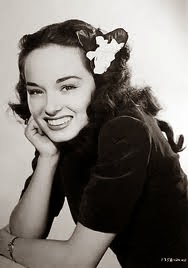
Look at the photo above, which is striking for its sweetness of attitude—we may notice the girl is quite pretty, but there is more to read in the glance she gives the camera.  A slight lowered tilt of the head, a calm, level gaze that invites as much as it withholds from the viewer.  She's studying us as much as we are studying her.  An actor’s audition headshot, or a publicity photo from her Broadway turn in Watch onthe Rhine?  I don’t know.  But you can see the girl in this photo, young Ann, is carefully tended. 

She was the gently-bred daughter of an Irish immigrant, a mother she adored.

For this year-long series, I’m not going to dwell on Ann Blyth’s personal life too deeply, rather touching upon her private life only as it bears upon her career.  Nor am I going to proceed in chronological order, for I want to present this series as snapshots of moments.  We’ll be leaping back and forth across the years like time travelers playing hopscotch.

But today we need to start at the beginning, if only for a foundation from which to leap first.   She was born in Mt. Kisco, New York in 1928, but never actually lived there.  Mrs. Blyth was visiting her sister at the time of Ann’s birth.  (Her name was Anne, but lost the ‘e’ on Anne when she went to Hollywood.  Ann remarked in an interview that her surname also once carried an 'e' on the end.  Perhaps for a previous generation?  Silent vowels are easily misplaced in transit if they are not firmly affixed.)  Ann grew up in a fourth-floor walkup by the river in the Lower East Side of Manhattan, a world narrowed to her mother and a sister who was some ten years her senior (her father left the family when she was still a child), and a few city blocks.  They struggled financially.  Her mother took in washing to make ends meet.  (One columnist would later write that Mrs. Blyth once worked for actor Joseph Cotten as a housekeeper.)

In an interview quoted by author Karen Burroughs Hannsberry in Femme Noir-Bad Girls of Film, Ann recalls a "rather meager" childhood:

The fact that my father left my mother with two daughters to raise is, of course, something many families and children have to face...My mother faced it, as indeed anyone who knew her and loved her felt she would.  And she always saw to it that my sister and I had enough to eat, and clean, pretty clothes on our backs--but I know that it wasn't easy for her.

Ann’s very early desire to sing and perform, and perhaps a precocious talent for both, led Mrs. Blyth to seek outlets for her daughter, which led to auditions and lessons, and soon, jobs.  Ann began singing and reciting on New York’s WJZ (on the NBC Blue Network) at six years old in the middle of the Depression.  She was one of the regular gang for several years on a children’s program called Coast to Coast on a Bus, where the bus "conductor" was Metropolitan Opera announcer Milton Cross...
“Coast-to Coast on a Bus—The White Rabbit Line jumps anywhere, anytime!”
It was a show to discover talented children. Future Metropolitan Opera star Risë Stevens appeared here, and other kids on the bus included Billy and Florence Halop, Billy and Bobby Mauch,Walter Tetley and Jackie Kelk.  They sang songs and hymns and recited poetry, and picked up guest “passengers” along the way.  Other shows she did were The Sunday Show, Our Barn, and Jean Hersholt's  Dr. Christian program.  (On the other network, little Beverly Sills, future opera star, was also doing a kids’ show.)  WJZ also gave us Little Orphan Annie, Amos n' Andy, and Death Valley Days

A teenage boy working as a pageboy in the same NBC building while little Ann was working at the microphone in one of the studios would meet her for the first time only many years later in California.  His name was James McNulty, her future husband.  Kismet, you might say.  (Yeah, we'll get to that movie down the road.)

Of these early years, Ann gives us a brief glimpse in an article syndicated in newspapers and published in a collection of stories of faith conquering adversity, edited by Dr. Norman Vincent Peale, and published as FaithMade Them Champions. (The chapter is posted at the SE Entertainment blog here.)

“Mother worked very hard and her tiny body wasn't nearly as big as her heart.”

Mrs. Blyth was Ann’s cheerful emotional rudder, her advisor, and her close companion.  It’s interesting that for someone who did not come from a show business background that Mrs. Blyth, with apparently no “stage mother” temperament, was still able to guide her daughter through a world that was strange to both of them.

From an interview with The New York Times in 1952: "Life was one big struggle then, but mother managed somehow to keep me in parochial school and later in professional school.  She provided me with singing and dramatic lessons besides."
Ann was given minor children’s roles with New York’s San Carlo Opera Company, in Carmen, Pagliacci, and LaBoheme, where she was introduced to the colorful and irresistibly larger than life storytelling world of opera.  She became a lifelong fan.  The opera company performed during these years at the Gallo Opera House on West 54th Street, and Ann’s world stretched a little wider, all the way uptown.  (The opera house later became the site of the disco era’s Studio 54 nightclub.)

She had some small parts in minor plays, along with her radio work, and actor, later agent, Richard Clayton, who knew Ann as far back as their New York casting days and appeared on different radio shows with her, recalled for interviewer Sue Chambers in 1954 how the stage mothers of other kids at auditions would look pityingly at Ann, “the quiet, skinny little girl effacing herself in the corner.  But when the time came to read for the part, the other kids didn’t have a chance.”

But there were other jobs she did not get, and the Depression rolled on while she attended parochial school, later dramatic and singing lessons at the Professional Children’s School (then at Broadway and 61st Street), and stood before the mic in the radio station.  

“When I tried for something better and failed, she would smile her wonderful warm smile, put a pert new feather in my hat, and together we'd go to St. Boniface's to pray.

‘Just have faith, my darling,’ she'd say cheerfully as we walked home in the fading light. ‘Something better will come.’  And it did.  It came so fast it was like riding a giant roller coaster clear to the top.  We two looked out over the whole world.”

Ann was called to the principal’s office at school.  Usually a heart-stopping moment for any kid.  Her fate was behind the door, literally.

Herman Shumlin and Lillian Hellman were there, asking if she would read for a part in Miss Hellman’s new play Watch on the Rhine.  Ann Blyth was 12 years old.


Watch on the Rhine Playbill, September 1941, author's collection.

She did not know anything about the famous producer-director or the famous playwright, but she passed the auditions and spent the next year at the Martin Beck Theatre on West 45th Street (renamed the Al Hirschfeld Theatre in 2003) as her world now included Broadway.  Any Broadway play would have been a feather in her cap and a terrific notch on her résumé, but Watch on the Rhine was a major theatre event and its illustrating the danger of foreign fascism on American soil in the home of one sheltered family made it one of the most meaningful productions of the era.  Brooks Atkinson’s review in The New York Times lauded the power of that play to glaringly reflect the current political climate which inspired it.

“Lillian Hellman has brought the awful truth close to home…Curious how much better she has done it than anybody else by forgetting the headlines and by avoiding the obvious approaches to the great news subject of today.”

Watch on the Rhine Playbill, September 1941, author's collection.

Cast members included Paul Lukas, Mady Christians, Lucile Watson, and George Coulouris.  (Lukas, Watson, and Coulouris would, of course, reprise their roles in the 1943 film.)  It was a monumental play, and if Ann, who turned 13 during its Broadway run, was not mature enough to fully appreciate the political message, she must certainly have been impressed by the prestige the production garnered.  Especially when she, along with other cast members, was invited to the White House to meet President Franklin Delano Roosevelt. 

She could also appreciate that, as author Hannsberry quotes, "It meant that for the first time in years, my mother wouldn't have to work so hard."
Postcard advertising the play, author collection.  Ann Blyth is in the top right photo.

Here are some photos of the production as published by Life magazine in April 1941.

Watch on the Rhine Playbill, September 1941, author's collection.


Watch on the Rhine Playbill, September 1941, author's collection.

The show closed in February 1942; afterward it toured for nine months across the country, and Ann joined the touring company.  It was during this period they gave a command performance for the President and had dinner at the White House.  She recalled for The New York Times in 1952, "I was so excited that I still can't tell anyone anything coherent about it.  I still have a souvenir, though, which the President gave me--a beautiful green match box which has a ship embossed upon it with FDR worked onto the boat."

At the age of 14, her world grew wider still with every train stop in towns and cities across the continent.  Finally, they played the Biltmore Theater in Los Angeles, where Henry Koster, a director for Universal, saw her and she was given a screen test.  By the time she performed with the touring company in San Francisco, Ann was signed to the Universal studio.

Gossip columnist Hedda Hopper spread the word in February 1943: "Henry Koster has little Ann Blyth...who was so good in Watch on the Rhine...when talking to her, he discovered she could also sing."

Her first four films, all released in 1944, were a series of small roles in B-musicals (which we’ll discuss in later posts), and then the big break when she was allowed to test for Mildred Pierce at the Warner Bros. studio.  (We’ll cover her role in that film, also, in a later post.) 

It was five days after wrapping this major film that Ann Blyth experienced an horrific event, and would spend her remaining teen years in a most heartbreaking series of personal challenges.

Her mother took Ann and some friends up to the Lake Arrowhead area in the San Bernardino Mountains to have a few days’ holiday in the snow in April 1945.  Ann was injured in a toboggan accident.  From her article on the incident in Faith Made Them Champions:

“One minute we were sailing down the hard-packed icy hillside like snow birds, then there was a crash and I fell on my back with a sickening thud.”

She was 16 years old.  She had fractured her spine.

“I didn't cry out.  The feeling was too big for that.  Involuntarily, from long habit, my spirit reached out for faith and halting prayers rose to my lips.” 

First newspaper reports called it a “near-fatal accident.” 

At the hospital, the doctors were grave; my back was broken.”

She was told she might not walk again.

“At first, I couldn't look at my mother.  When at last I raised my head, I was startled.  Those warm, hazel eyes under her crown of auburn hair were actually smiling.

‘Have faith, my darling,’ she said.  ‘You'll walk.’”

Ann spent several months flat on her back in a body cast.

“I concentrated on high school work, determined to graduate with my studio class.  But still there were those long periods of just lying down.  The busy, exciting world I had known faded away and my life slowed down to little things.”

It may be at this period that Ann learned her later-to-be-celebrated patient demeanor.  From a 1953 Miami News article she was: “…long noted as the most serene actress in town…”

“A visit with her is like taking a tranquilizer pill,” according to a producer interviewed for an article syndicated in the Miami News in 1957.

“Miss Blyth is a singularly soothing young lady to have around,” noted an article in The New York Times from 1952, that called her “serene and almost childlike.”

And something else, a faith in which she’d been trained since childhood began to evolve into a source of strength that would take her into adulthood.

“I found myself blessed, for a new sense of prayer began to unfold to me.  Now there were not the busy times of telling Him what I needed, but rather, times of listening communion, of gathering strength, when my human strength and courage seemed to ebb away.”

After seven months, she was freed from the body cast, put into a steel back brace from her neck to her lower back, and allowed to take a few steps.  She spent several months in and out of her wheelchair, in therapy (which included swimming in Joan Crawford’s pool) and finally did graduate with her studio school class in her wheelchair. 

Years later, her teacher at the Universal schoolhouse, Mrs. Gladys Hoene (pronounced "Haney"), was interviewed on what it was like to teach at the studio school by the syndicated columnist Bob Thomas, who noted that so many child stars had unhappy adult lives.  Mrs. Hoene agreed, having seen first-hand the pressures faced by child stars and the peculiar circumstance of playing roles “that are far apart from reality.  You can’t expect them to have a down-to-earth attitude toward life.”
Publicity still from Universal Studios in front of schoolhouse. 
I believe Ann is 2nd from right, with Sabu just to the right.  Can you name the others?

Mrs. Hoene was prompted to “tell tales out of school,” as it were, on her former students.  She recalled that, “When Ann and Donald O’Connor were put together, they could cut up,” but she put Ann, who was reportedly one of her favorite students, in a different category than the other kids who might grow to unhappy adults.

“I think the exception is Ann Blyth…I would stake everything I had on her chances of success.”

She was not speaking of career success.  Nor did Ann, apparently, regard career success as her only yardstick on happiness, though she certainly remained very keenly ambitious and loved to work.

“Now, at last, my life was again the same.  Only, not quite the same.  I found within me an immense gratitude for simple things.  An acute appreciation of all I might have lost, all the things I had accepted unconsciously before.”

There was a bright, shining moment during her convalescence when she was nominated for an Academy Award for Best Supporting Actress for MildredPierce (a heck of a get well card), and she attended the Oscars ceremony with her mother, a sublime evening of personal triumph they both shared.  The studio arranged for a special gown to be made for her which would hide her back brace.  The gown was pink, made of pre-war bengaline silk.

 Ann & Mrs.Blyth at Grauman's Chinese Theater, March 1946,
from a newsreel of the 1945 Oscars
What anguish Mrs. Blyth endured over Ann’s injury and long recovery anyone can only imagine, but the dark days were left behind by the renewed prospect of Ann’s return to good health and a bright future as a Hollywood actress. 

In April 1946, gossip columnist Louella Parsons remarked, "Ann is extremely ambitious.  Her career comes first in her life, and I think you'll see that she'll go far...I couldn't look at the sweet young face of Ann Blyth without feeling that she was something very special, and is not the ordinary girl.  She's well bred, quiet...."

This happy, hopeful time was cruelly brief, and in turn, eclipsed by another, greater tragedy.

Four months after the Oscars, over a month after Ann was finally allowed to remove the back brace for good, only a few weeks after her returning to work on a new movie, Mrs. Blyth died of cancer in July 1946. 

Ann was 17 years old, less than a month shy of her 18th birthday. 

Despite sympathy from those around us, grief is inevitably an agony faced alone, even for the very young.  The very depth of our mourning isolates us.  Fortunately, her mother’s sister and brother-in-law around this time gave up their home in Connecticut and moved out to California to help during the family crisis, and stayed.  As guardians and parent-figures her aunt and uncle thereafter had a huge supportive part in her life.  Ann dealt—forever after would deal—with the loss of her mother through the prism of her religious faith.

“There was an aching emptiness.  Until it came to me, almost in a revelation, that she had not left me.  She had prepared me for her going as she had prepared me for everything else I'd met in life.

Reaching out again for my faith came the assurance that she would be by my side in every good, beautiful, and true experience, wherever I might go; a part of every decision, every success and every happiness –for they all stemmed from her inspired teaching.  They would become the flowers of the mustard seed of faith she had placed in my heart.”

Now we jump ahead several decades.  Have a look below at the video taken at the Castro Theatre in San Francisco July 6, 2006 for a special screening of Mildred Pierce.  Miss Blyth is interviewed on stage by Eddie Muller.  She is 77 here, elegant, classy, gentle, stunningly beautiful, and delightfully funny.  She’s slaying her audience.  Note how effortlessly she launches into imitations of co-star Butterfly McQueen and director Michael Curtiz.  She's good with accents; we can imagine the first accent she ever learned to mimic as a child may have been her mother’s Irish brogue.  Her mother was Nan Lynch of Dublin.  (‘Tis a grand name, to be sure, but I’m sorry to say I have no reason to believe we are related.)

Note how, at the very end of the video, she is prompted to sing a line from Kismet’s “Baubles, Bangles and Beads” – the strength and loveliness of her voice, the almost startling power of it.  We have to marvel at the still prodigious talent of a lady who, we sense, as Emerson said, became the person she decided to be.


Consider as well that, unlike everyone else in that theater, Ann Blyth has just watched the screening of Mildred Pierce not as a favorite classic noir, but something more akin to a home movie of herself as a teenager only weeks before her life so shockingly changed.  The other actors on screen were all friends and colleagues—and all of them, down to little Jo Ann Marlowe who played her younger sister Kay, are all gone.  They are ghosts on the giant screen.  A thousand people in the theater have watched the intimacy of her, a solitary survivor, watching her own past.

The whole interview is not recorded on this video, but you can read a bit more of the conversation in a transcript of the interview at Michael Guillen’s blog The Evening Class.  Part 1 is here, and part 2 is here.

Come back next Thursday, and we’ll talk about Ann Blyth’s underwater adventure, which included a four-foot long fish tail with lead weights in it to make her sink, in Mr. Peabody and the Mermaid (1948).

 ________________________________________


Dunning, John. On the Air: The Encyclopedia of Old-Time Radio (NY: Oxford University Press, 1998), p. 162.
The Evening Class blog, July 28, 2007

The Film Daily, July 24, 1946, p. 2.

Hannsberry, Karen Burroughs.  Femme Noir - Bad Girls of Film (Jefferson, NC: McFarland & Co. Inc.) pp. 32-33.

Ladies Home Journal, article by Cynthia McAdoo Wheatland & Eileen Sharpe, "Young Hollywood at Home", February 1957, p. 104.
Life Magazine, April 14, 1941, pp. 81-84.

Los Angeles Times, July 23, 1946, p. A8; also August 12, 2013, article by Susan King.

Miami News June 26, 1953, p. 6A; November 23 1957, p. 10B
The Milwaukee Journal, syndicated article by Sue Chambers, May 1, 1954, p. 3

Muller, Eddie.  Interview on stage with Ann Blyth, Castro Theatre, San Francisco, July 6, 2006.
The New York Times, article by William Brownell, October 12, 1952, p. X5.

Peale, Dr. Norman Vincent, ed. Faith Made Them Champions (Guidepost Associates, Inc., 1954).

The Radio Annual, 1944, p. 732.

SE Entertainment blog, August 5, 2012.

Spokane Daily Chronicle, syndicated article by Dorothy Roe, July 29, 1955, p. 11.

St. Petersburg Times, syndicated article by Hedda Hopper, February 18, 1943; syndicated article by Louella Parsons April 21, 1946, p. 39.
The Tuscaloosa News, syndicated article by Bob Thomas, May 11, 1955, p 5.

Universal Studios Entertainment Tumblr site.

The Vancouver Sun, article by Clyde Gilmour, June 28, 1952, p. 45


UPDATE:  This series on Ann Blyth is now a book - ANN BLYTH: ACTRESS. SINGER. STAR. -

*********************
The audio book for Ann Blyth: Actress. Singer. Star. is now for sale on Audible.com, and on Amazon and iTunes.

Also in paperback and eBook from Amazon, CreateSpace, and my Etsy shop: LynchTwinsPublishing.


 "Lynch’s book is organized and well-written – and has plenty of amusing observations – but when it comes to describing Blyth’s movies, Lynch’s writing sparkles." - Ruth Kerr, Silver Screenings

"Jacqueline T. Lynch creates a poignant and thoroughly-researched mosaic of memories of a fine, upstanding human being who also happens to be a legendary entertainer." - Deborah Thomas, Java's Journey

"One of the great strengths of Ann Blyth: Actress. Singer. Star. is that Lynch not only gives an excellent overview of Blyth's career -- she offers detailed analyses of each of Blyth's roles -- but she puts them in the context of the larger issues of the day."- Amanda Garrett, Old Hollywood Films

"Jacqueline's book will hopefully cause many more people to take a look at this multitalented woman whose career encompassed just about every possible aspect of 20th Century entertainment." - Laura Grieve, Laura's Miscellaneous Musings''

"Jacqueline T. Lynch’s Ann Blyth: Actress. Singer. Star. is an extremely well researched undertaking that is a must for all Blyth fans." - Annette Bochenek, Hometowns to Hollywood


Ann Blyth: Actress. Singer. Star. 
by Jacqueline T. Lynch

The first book on the career of actress Ann Blyth. Multitalented and remarkably versatile, Blyth began on radio as a child, appeared on Broadway at the age of twelve in Lillian Hellman's Watch on the Rhine, and enjoyed a long and diverse career in films, theatre, television, and concerts. A sensitive dramatic actress, the youngest at the time to be nominated for her role in Mildred Pierce (1945), she also displayed a gift for comedy, and was especially endeared to fans for her expressive and exquisite lyric soprano, which was showcased in many film and stage musicals. Still a popular guest at film festivals, lovely Ms. Blyth remains a treasure of the Hollywood's golden age.


Related Products