IMPRISON TRAITOR, PEDOPHILE, AND CONVICTED FELON TRUMP.
Showing posts with label Carl Esmond. Show all posts

Thursday, July 21, 2016

Address Unknown - 1944


Address Unknown (1944) is a very artistic examination of the consequences of fascism. The cinematography creates an otherworldly palette of light and shadow, of angles, of unbalanced screen images that is poetic and visionary. Classic films took on the subject of fascism and planted the nightmare on an everyday familiar world with everyday people we could relate to, unlike modern films which might tackle the grand subject of good versus evil and place it in an imaginary futuristic or superhero setting. The characters in classic films were unable to escape their circumstances with special powers or an arsenal of apocalyptic weaponry. They had only their brains, their courage, and their conscience.

This the second film in our series on classic films’ depiction of fascism. We covered The Mortal Storm (1940) last week here. With Donald Trump’s Faustian rise to become the official Republican Party nominee for President this past week, the subject of fascism is one we need to examine very closely, not as a history lesson per se, viewed safely from a distance, but as a very personal blueprint on how to fight it in our midst—with brains, courage, and conscience.

Address Unknown came late in the war, and so was not so much a warning of the consequences of what was going on in Nazi Germany – though certainly, Hollywood likely felt the subject still worth pursuing morally and financially. The interesting thing about the movie is it shows very little of jackbooted Nazis, the sneering villains of most wartime patriotic fare. It is instead a psychological nightmare of one man’s seduction, and the price he pays for going over to the dark side. As such, it is not a flag-waving, drum-beating story, but a mature, contemplative tale that, unfortunately as we see today, is timeless.

Paul Lukas stars as a German-born art dealer who has lived in San Francisco for many years. He is married to Mady Christians, and they have five sons. Four of the boys are school-age, the oldest, played by Peter van Eyck, is a young man and works in the art gallery with his father.

Morris Carnovsky plays his longtime partner in the gallery, also originally from Germany. Mr. Carnovsky is a widower with a grown daughter played by K.T. Stevens. Stevens, and Mr. Van Eyck, have known each other since childhood, are romantically involved and intend to be married.

The story begins with the partners toasting each other on a sunny terrace in San Francisco, grateful for their life in America, and secretly celebrating because they think that Lukas’ son and Carnovsky’s daughter are about to name the day of their wedding. These old friends look forward to having their families united. It is also something of a farewell celebration, because Paul Lukas is slated to take his family back to Germany for a period of time to do business for their art gallery. Lukas will buy paintings in Europe and ship them back to Carnovsky in San Francisco to be sold in their gallery. Paul Lukas’ eldest son, Van Eyck, is going to remain in America to work at the family business. However, Carnovsky’s daughter, Miss Stevens, is going to go to Europe with Paul Lukas his family to study acting.

The fathers are disappointed when the young people announce that they are not going to set a date for their wedding. They are going to wait until Stevens returns from Europe and then decide on their plans. It is a great letdown, and the mood of the story changes with this first announcement.

In Europe, Paul Lukas will meet Carl Esmond, a local baron who will seduce Lukas with the lure of the brand-new Chancellor Adolf Hitler.  Mr. Esmond is educated, erudite, and hardly a Nazi thug. But he approves of the order and discipline that Hitler is bringing to Germany, the pride Hitler appears to be instilling in young people, and even though Esmond is a nobleman, the kind of person Hitler hated, he takes the view that Germany is progressing for the good. He will make Germany great again. We last saw Carl Esmond as they bad guy bullying Ann Blyth into a forced marriage in The World in His Arms (1952), and here as the Nazi officer in Resisting Enemy Interrogation (1944).

Mady Christians, whose film career was winding down (she died in 1951) was reunited with Paul Lukas in this picture. You may recall we mentioned her as playing opposite Lukas on Broadway in Watch on the Rhine in the same role that Bette Davis took in the 1943 movie of that play. We briefly mentioned it in the intro to the Ann Blyth series, but a more in-depth look at that play can be found in my book, Ann Blyth: Actress. Singer. Star.


Mady Christians, like Mr. Esmond, originally hailed from Vienna, and there are a number of German cinema actors in this movie to give it credence. There are also a few old Hollywood character actors who are fun to pick out, including Amory Parnell as a busybody mailman – who has a much more important role in this movie that we might realize later – and Frank Faylen plays a smart alec journalist.

Paul Lukas, just on the strength of his performance in the film Watch on the Rhine, for which he won an Oscar®, is one of my favorite actors. Address Unknown really shows his range, particularly when you compare it to the hero he played in Watch on the Rhine. That film showed a man courageous, committed, but deeply torn by his commitment and what his actions were doing to his family in his effort to fight fascism. He declares what he does for a living, “I am an antifascist.”

In Address Unknown, he plays a man who falls under the spell of fascism, which leads to his own doom. His work here is meticulous and we can always see the range of emotions playing on his very expressive face. His joy at the thought of his son marrying his partner’s daughter; his disappointment when they hear the marriage is to be delayed; his amused, eye-rolling attitude over his young sons, who, all born in the United States, are going to run into culture shock when they go to Germany with him because there will be no baseball there. He is a proud and indulgent father, an attentive and kind husband, and a loyal and affectionate friend to his partner. He is a good man. Because he is a good man, he seduction into the Nazi creed is all the more painful for us to watch. It is easy for us to dismiss bad guys and morons as bad guys and morons, but when we come across a gentle soul who turns evil and is corrupted either because of a lack of will, or a desperate need to be flattered, we are faced with an even stronger message of right and wrong.

That is the particular achievement of this movie. It does not serve up platitudes, and it does not show things in black and white, but there are still clear demarcations between right and wrong, and like people walking on a footpath in the woods, following a marked trail, if we keep our eyes open we can see them, clearly. If we are careless and do not pay attention, we turn the wrong way and get lost.

How this tale is told in this introspective and intelligent examination is largely through stylistic imagery. The director here is William Cameron Menzies, and the film has a wonderful mosaic of extreme close-ups, off centered positioning of the subject, and stark lighting. We begin the movie with extreme close-ups of Paul Lukas and Morris Carnovsky toasting each other, and it almost looks like a scene out of Citizen Kane (1941) and a similar kind of cinematography here. The movie is quite visually stunning, and it turns this simple story to one of deep psychological horror.

When Paul Lukas and his family get settled in Munich, he receives a letter from his partner Carnovsky in San Francisco. Lukas is delighted to receive the letter because already he is homesick for America. 

Carnovsky asks, “Who is this Adolf Hitler?... I do not like what I hear of it.”

This movie is about an exchange of letters. It is based on a novel of the same name where the plot is told through the exchange of letters between these two men.

Paul Lukas can hardly answer Carnovsky, because he is still new to Germany, does not really know much about Hitler himself, but almost immediately his ability to reply to this question is stifled by Carl Esmond. Esmond encounters Paul Lukas and a friend in a local ratskeller that Lukas knew from days gone by. Lukas looks around; it is quiet and forbidding and he says the place has changed from the happy place he knew as a youth, but he can’t put his finger on it. He has read the letter aloud, and Esmond, with cool authority, tells him about Hitler’s virtues.  We see Lukas’ expression turn from curiosity, to being flattered that the great Baron is sharing a table and sharing his knowledge and giving him attention, but Lukas is embarrassed that his friend in America has asked this question and put him in an awkward position when he has read it aloud.

Carnovsky in San Francisco gets a letter from Lukas telling him that Hitler is good. Oh yes, he’s done some bad things, storm troopers breaking windows and being thugs, but essentially we have to take the good with the bad. Carnovsky and Lukas’ son, Van Eyck are surprised to get such a letter. Van Eyck immediately expresses concern about Miss Stevens.

We are back in Vienna when Miss Stevens shows up at “Uncle” Paul Lukas’ house in Munich. She enters at the end of a long shadow. She warmly greets him and he is pleased that she has come. She has taken the stage name of Stone because it is shorter and will look good on a marquee. The Baron is there when she visits and he notices that her monogram on a purse does not match her last name of Stone. When she has left the room to visit with her “Aunt” Mady Christians, the Baron asks Paul Lukas about the monogram, and Lukas gushes that Stone is just a stage name, that her real name is Eisenstein.

The Baron says the one word that puts fear into the heart of Paul Lukas. He asks, “Jewish?”

For the first time, we realize that Morris Carnovsky and his family are Jews. This is not a fact that has ever distressed Paul Lukas in the past, but suddenly it changes things. We see the expression on Lukas’ face. He is uncomfortable, he is embarrassed. The Baron warns him about such an association and leaves. The camera settles on Lukas for a moment, again his face registering a changing parade of emotions. He is like a child who is fretting, pouting and resentful that his party has been spoiled. There is a shot about table height looking up at Lukas and his grim expression tells us he has reached a decision. He turns off the table lamp. We are left in darkness by his hand.

In San Francisco, Carnovsky gets a letter, “We must, for the present, discontinue writing each other. You will understand, I know, that it is impossible for me to be in correspondence with one of your race.”

Van Eyck reads the letter over “Uncle” Morris Carnovsky’s shoulder. “What in the world is he talking about? He must be insane.”

Carnovsky is more forgiving. He understands that Lukas is only writing this letter because of the censorship that is going on in Germany at the moment. He must say the right thing or he will get into trouble. Carnovsky is hurt, but he understands. But he brightens, he tells his partner’s son that there is another way that they can freely send letters and not have to worry about the censors. He will send a letter to Lukas hand-carried by a friend who is an American journalist.

Our old friend Frank Faylen is the wiseguy journalist, who sits in the office of a Nazi bureaucrat, where Paul Lukas works at a new job – he has apparently given up being an art dealer. Faylen is unimpressed by the officious Nazi gatekeepers and lower-level management of this government office, and bluffs his way in to see Paul Lukas. You may remember Faylen most from his role as Ernie the cabdriver in It’s a Wonderful Life (1946). He cheerfully gives Lukas the letter, but Lukas dismisses him arrogantly.

Back in San Francisco, Carnovsky, now desperate to clear the air and understand Lukas’ intention, writes one more time saying that he understands there is censorship, but that he needs some word of reassurance from Lukas that everything is all right in their friendship. “But there is so much madness in the world, I need a word of reassurance.” The simple word he requests Lukas to send back is “yes.”

Lukas’ answer is no.

Van Eyck has had enough. He wants K.T. Stevens to come home now. Her father reminds him that she’s up for new job in Berlin as a leading lady and he doesn’t want to cable her and spoil her big night. They will wait to contact her.

We go to Berlin, where her play is being rehearsed.  It is a religious theme and she is to recite the words from the Beatitudes, Christ’s words from the Gospel of Matthew. During rehearsal a Nazi official tells the director the following lines are censored:

Blessed are the meek, for they shall inherit the earth.

Blessed are the peacemakers, for they shall be called the children of God…

…and other lines from the Beatitudes. Disobedience is treason.

On opening night, the feisty Miss Stevens decides to say the forbidden lines. The censor stops the show and demands the director to come out but Stevens courageously defends the director saying that she was the one who made the decision to put those lines back in.

The smarmy little censor announces to the audience that the actress’ name is not Stone, but rather Eisenstein. In a moment we hear murmurs in the audience, and soon shouting, of the word, “Juden!”

Stevens, who was brought up in America, not only finds this all a bit too ridiculous to swallow, but she is proud of her heritage and will not back down. It ends in a mob scene, in a chase and she is on the run.

Eventually, a hunted outlaw, she will make her way to Munich and her “Uncle” Paul Lukas’ home. Brownshirts are fast on her heels. When he answers the door and sees it is her, he will not let her in. She has been hurt and she’s bleeding from her hand, and she leaves a bloody handprint on his wall as he closes her out.  She’s shot on his doorstep.

Carnovsky gets a curt letter in San Francisco, “Heil Hitler. Your daughter is dead.”

Carnovsky sits, sobbing, utterly destroyed, while Van Eyck gently pats his shoulder. We see a close-up of Van Eyck’s hand in ministering comfort and then pulling back, forming into a fist. A subtle symbol that’s important later.


Back in Germany, Mady Christians has just had another baby, another son. At the christening, Baron Carl Esmond congratulates her on having so many sons, thereby doing her duty. The parents smile to their guests, but when they are alone with the baby, we see their marriage is on the rocks. Mady Christians is disgusted with Paul Lukas. She dislikes the change in him, and she is horrified at his having turned away Stevens in her hour of need. She intends, when the baby is able to travel, that she will take her sons away to Switzerland.

Things have definitely turned sour for Paul Lukas. He starts receiving more letters and cables from San Francisco, but he doesn’t understand the messages. They mention painters and artwork but the notes seem to be written in a kind of code. He can’t make sense of them. We see that the censors picking up on this code are starting to make things a bit hot for Paul Lukas. He is being watched. The Baron questions Lukas’ loyalty to Germany. Lukas is helpless and floundering. He tries to defend himself. He tries to write back and pleads with Carnovsky to please stop writing him because he’s in terrible trouble. Every letter he gets puts him deeper and deeper under suspicion.

We have seen throughout the course of this movie the great psychosis that is fascism. He is seduced by falseness, by flattery, by a sense of power, by being told he is better than other people, but it is a double-edged sword. By propping up a fascist government, one very easily – and over very little provocation, almost in the blink of an eye – can become its victim. Fascism is invariably cannibalistic. Lukas has become terrified. He has become paranoid. He is now an enemy of the state he once was so proud to join. It is difficult to walk that line. This is why inevitably fascist governments fall, but of course, not until they do great damage on a civilization.

Lukas writes to his son instead and begs him to stop Carnovsky from sending any more messages. He writes, “You must go to any lengths, as you are my son.”

It’s an interesting line. We imagine perhaps Lukas means that Van Eyck should kill Carnovsky. As you are my son.  Fascism demands ultimate loyalty.

The Baron is convinced that Lukas is a spy. When he confronts Lukas, the mail comes again and Lukas is nearly sick with worry when a letter arrives from San Francisco. He really isn’t doing anything wrong, obviously. He is not a spy. He has been a loyal member of the Nazi party and done everything they asked him to do. He wanted the prestige they gave him. He wants to be a good citizen of the Third Reich. But they don’t believe him. His intentions are irrelevant. He is under suspicion. To be under suspicion is to be automatically guilty. There is no due process here. To be slow to answer is to be guilty.

Mady Christians takes their children and leaves for Switzerland. Lukas gives her a letter to send to Carnovsky, begging him to stop sending any more letters. She is stopped at the border, but she is allowed to pass because she is no threat to the Third Reich. The Baron comes to warn Lukas for the last time, and Lukas, in desperation tells him that the letter his wife brought to Switzerland is the proof that he never wanted Carnovsky to write to him. He is told that ironically the letter was confiscated and destroyed. He has no proof.

We end this interesting movie with two grim scenes. Lukas stands outside the door of his home, an expression of deep horror etched on his face at approaching thugs coming to get him. He will be going to a concentration camp. Or murdered.

Then we go to San Francisco where Carnovsky reads a letter from Lukas that has been returned to him marked “address unknown” on the envelope. He is puzzled. Van Eyck is standing near him, watching him.

Spoiler time. The whole post has been a spoiler, but sometimes to be blunt is more necessary than to tease. 

Carnovsky tells Van Eyck that he hasn’t written to Lukas in months, that he didn’t write this letter to him. He stopped when Lukas originally asked him to send no more letters.

We see Van Eyck’s face. He wrote the letters. He wrote them to implicate his father and to purposely put his father in danger. He wants revenge over the death of his fiancĂ©e. He wants to kill the monster that the Nazis created.

It’s a cautionary tale of sorts—beware the company you keep—but so artistically framed that we are not bludgeoned with lessons and morals. The lessons and morals are obvious.

Unless one is the kind of person to whom lessons and morals are not obvious, and they are the real perpetrators of fascism, not the ones in power, but ones keeping them there.  And they are, ultimately, its victims as well. Eventually.  But some weak-willed, weak-minded souls are only too happy to vote against their own best interests.

When you deny rights to others, you’re next.

Come back next week when we take on Storm Warning with Ginger Rogers, Ronald Reagan, and Doris Day. Part 8 of our series on the current state of the classic film fan follows the first Thursday in August. Our look at fascism in classic films will continue with two more movies in August, where we bring the curse to America.

*********************


My audio book version of Ann Blyth: Actress. Singer. Star., narrated by Toni Lewis, is now for sale on Audible.com, and on Amazon and iTunes.


Thursday, June 26, 2014

The World In His Arms - 1952

The World in His Arms (1952) is unabashedly, unexpectedly sensual, often boisterous and sometimes savage, but over all, romantic.  It manages to be all this without really teasing the Production Code, which is the miracle of it.  The movie stands on all familiar conventions of adventure stories and of romance stories--in this case, the romantic triangle.  But in this film, the triangle is made up of two leads with exciting screen chemistry--and their director, whose thumbprint is on every frame, bringing the characters close to us, keeping it intimate.

It is, on its surface, a swashbuckling sea picture—and indeed, its seagoing action scenes, including a race between two schooners, is among the most thrilling and best ever filmed—but director Raoul Walsh’s creative rendering makes this movie appeal to both fans of action/adventure movies and fans of romance stories.  His celebrated skill in framing shots and selective editing-as-you-go filmmaking makes this a fast-paced movie where no sensation lingers too long, but where one experience after another hits us like a fresh and stinging and exhilarating sea spray.  Like any good storyteller, he knew what buttons to push.

Ann Blyth was 23 years old when she appeared in this film as an escaping Russian countess—escape sets the scene for many Walsh movies.  Handsome Gregory Peck is a New England sea captain, a rascal transplanted to the Pacific coast where he runs between Alaska, where he and his crew harvest seal pelts, and San Francisco, where he sells them and spends his money on saloon girls like Andrea King, whom we saw as Ann’s human rival in Mr. Peabody and the Mermaid (1948), discussed here.  Miss King seems to have recovered from being bitten in the leg by Ann in that film, because she walks okay and even dances a little.

But we don’t see too much of the saloon gals, for very soon Ann Blyth invades Mr. Peck’s manly world of fistfights and clubbing seals as a damsel in distress, escaping from a forced marriage to Carl Esmond, whom we saw here as the Nazi head officer in Resisting Enemy Interrogation (1944).  Even though he’s a Russian Prince, he’s still a Nazi here, calculating, viciously cruel, and unable to rid himself of his Prussian bearing and German accent.


Raoul Walsh’s damsels in distress are never really so helpless that they don’t take an active part in their own salvation.  Ann’s Countess Marina has strong survival instincts, brains, courage, and a sense of responsibility to her few faithful retainers.  She goes after Gregory Peck as the best hope for her to get herself and her staff to Sitka, Alaska (which I think was not called Sitka, but New Archangel at this time period) and the Russian colony headed by her uncle, played by Sig Ruman, who we last saw here in Only Angels Have Wings (1939).  Also unable to handle a Russian accent, and cozy enough to resemble a figure from an operetta, Mr. Ruman is not her best choice for refuge, as we will see.  Carl Esmond has everybody in his power. 

Mr. Peck has an adversarial relationship with the Russians.  He is their chief competitor in the sealing business, and they regard him as a pirate encroaching on their territory in Alaska waters.  The movie takes place in 1850, when the Russians had already had a strong foothold in Alaska for more than a century.  Though Peck has no love for the Russians, Miss Blyth, at first pretending to be one of Andrea King’s saloon girls to attract him, soon becomes his whole world as he loses his heart, and nearly loses his ship and his life. 

About the only thing bogging this film down a little is the sporadic brawling that seems to start with little provocation.  Peck and his men become more interesting when their bravado, and their enjoyment of a good fight, is directed to a sense of purpose—the final rescue scene is quite exciting.

John McIntire, who keeps popping up as a favorite in this series on Ann Blyth, is Gregory Peck’s right-hand man, wry, comic, Bible-quoting, with Shakespearian delivery.  At one point he whacks Gregory Peck on the skull with a belaying pin, purely in the name of friendship.  It's a guy thing.

Bill Radovich is Ogeechuck, a barrel-chested native, chief pilot, and a cross between a barroom bouncer and Curly Howard. 

Anthony Quinn plays the captain of a rival schooner, a loud, boisterous thief who steals cargo, shanghais crews, whose playful exchanges with Peck sometimes end up with one or both of them getting hit on the head with a belaying pin.  It is such an obnoxious character, one can imagine Quinn might have had a lot of fun playing him.

Eugenie Leontovich has a small role as Ann’s chaperone and lady in waiting, and has the distinction of speaking with the most authentic Russian accent in this film.  No wonder, this esteemed stage actress grew up in Imperial Russia and escaped the Revolution when she fled to Paris.  Other members of her family, loyal to the Czar, were not so lucky.  She has a cute bit when, appalled by the odor of Bill Radovich, who has a habit of keeping fish in the hood and pockets of his coat, and whom she is constantly shooing away, turns up as her hero at the end of the movie.  He and the rest of Gregory Peck’s men disguise themselves as Russian Orthodox priests during an attempt to rescue Ann Blyth.  Madame Leontovich recognizes Mr. Radovich by his smell, is greatly relieved that help is at hand, and there is a twinkle in her eye when he winks at her.

Gregory Gay is Ann's loyal adviser and trustee, who is terrorized by teasing saloon girls.

Hans Conreid stands out as a harried hotelier who must endure the chaos Gregory Peck’s gang brings to his fancy hotel.

A few favorite scenes:  The schooner race between rivals Peck and Quinn, with fabulous cinematography by Russell Metty.  Rear screen projection is used sparingly, most of this is the real thing and it feels like we’re on board.

Ann Blyth, the well-bred and refined countess, educated in London and Paris, tries to copy the showy dress and common manners of the saloon girls because she thinks that’s the kind of woman Gregory Peck wants.  She never throws herself at him, rather merely dangles herself in his presence.  The throwing goes to Anthony Quinn, who picks her up roughly and smothers her with unwelcome kisses, and when Peck demands her release, Quinn tosses Miss Blyth to him.

Catch her expression when she lands in Peck’s arms.  Her surprise and discomfort has melted into coy pleasure. 

The scene on the hill above San Francisco, after they have spent an evening on the town together, and he loosens her hair from its tight bun.  Hairdo undoing may be an image corresponding to a woman’s undoing, but it’s also one of the most romantic gestures in storytelling.  You may already know she’s standing on a box for their kissing scene.  Ann frequently had to stand on a box for romantic scenes as many of her partners were quite tall.  She might not have had a career without that box.

Another sublimely romantic scene is when Gregory Peck takes her aboard his moored ship to show her around.  The ship is called The Pilgrim of Salem.  He is originally from Salem, Massachusetts, though his friends and enemies alike here on the Barbary Coast call him The Boston Man.

She puts her hands on the ship’s wheel and says, "She's lovely." 

He puts his hands atop hers, “And she always obeys me.”

“Perhaps because she likes the touch of your hand,” she replies, looking down with satisfaction at his hand covering hers. 

“She ought to; I’m in love with her.”

Modern films with love scenes showing two people writhing in bed are not more erotic than this scene under the night stars, so astonishing in its simplicity and effectiveness.

Most especially lending a mood of almost unbearable longing is the theme song, composed by longtime Universal Studio score composer Frank Skinner that sounds like an old Russian folk tune, sweeping and mournful and heartbreakingly beautiful.  It serves as the leitmotif of the film that resurrects the lovers’ passion in pivotal moments, and conjures the pain of hoping against all hope.

In one scene, Mr. Peck takes Miss Blyth to a restaurant run by Russian ex-pats, where she requests the song from a strolling violinist and hums to it, explaining its words.  She gets to speak a little Russian in the movie.  In the Cold War environment in which this film was made (more on that in a bit), there is a romantic nostalgia for the Imperialist Russia, yet equating the harshness of the regime to modern Soviet totalitarianism.  They are the villains, until they join the Americans and become “good Yankees” themselves.  They are all a microcosm of the world on this coast.  The Aleut native, McIntire the Nova Scotian, Peck the New Englander, Quinn is Portuguese, and Irish, Chinese, and Russians abound. 

In this movie, Peck has a business maneuver afoot to buy Russian Alaska for several millions, exploit its riches and boot out Russian control.  That would happen 17 years after this movie takes place, with or without Gregory Peck.  We may muse that when the movie was released in 1952, Alaska was still a territory, it's riches still barely exploited, and was not a state until 1959.

Peck’s seal harvesting business, incidentally, is strangely handled in this movie.  The scenes with the seals on the beach is rear-screen projection, and no clubbing of the seals is actually seen.  John McIntire gives a young seaman a lesson on conservation—the Russians are decimating the seal population by not carefully culling the herds of only the “bachelors” and instead taking all the female seals and cubs.  We see the men of the schooner land on the beach and herd seals, clubs in hand.  Next, we see them back on board, neatly stacking the skinned pelts.  The brutality of the killing is never seen.  I’m not sure if Raoul Walsh pulled a punch here, or if the studio just got squeamish.  It’s as if the seals, like in a cartoon, just unzipped their pelts, relieved to be rid of the hot fur coat, and walked away.

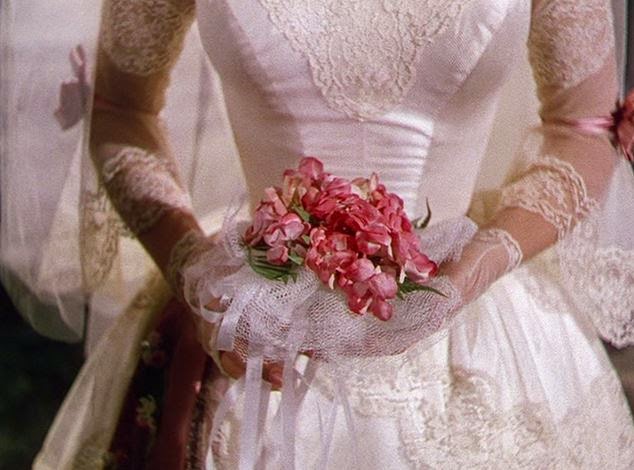
The romance between Peck and Ann Blyth really is a threesome, for we sense the strong presence of director Raoul Walsh in their scenes.  Despite his lusty testosterone-driven fights with belaying pins (I gotta get me one of them, so handy), his scenes with Ann Blyth are delicate and deep.  This shot of her bridal bouquet held at her waist as she, reluctant and heartbroken, is dressing for her marriage to Carl Esmond (she agrees to marry him to save Peck and his crew) is surprising.  A close-up on the flowers at her corseted waist, then pulled back to see the whole dress.  There is a feminine sensibility to this scene that I find touching, though I wonder if Mr. Walsh would balk at that.

In no scenes is she “taken” by Gregory Peck in abrupt embraces or rough kisses as we might see in other films where the damsel in distress is really just a prop, despite Peck's attitude of wild and lusty freedom to do pretty much what he wants.  Their attraction is mutual and they woo each other with patience and determination. There are too many obstacles for them to simply fall in love.  One senses the director’s appreciation not simply for Marina's sensuality, but for the actress playing her, perhaps expressed as well here by columnist Gene Handsaker who was allowed to watch a bit of the filming:

“Lord, what an actress!” the carpenter beside me breathed almost reverently.  We’d just watched Ann Blyth, as a Russian countess of long ago, burst into a dungeon full of chained men.
She rushes up to Gregory Peck, one of the prisoners, and swears that she still loves him.  She embraces him.  Her face is away from the camera, but there are tears, real tears, in her eyes.

Then she gets good news that will free Peck.  Annie rushes back up the dungeon steps, her back to the camera.  But from where the carpenter and I are watching, we can see her grinning excitedly at this wholly imaginary good news.

All of a sudden I remember a definition I once heard: Good acting is not acting at all.  It’s being…

The director often accused by actors of being difficult to work for was remembered more kindly by Ann Blyth in her interview with Eddie Muller (who called her remarks “generous”) on stage at the Castro Theatre in San Francisco in 2006, the transcript of which is quoted at The Evening Class blog (see below).

He was just a wonderful character, a devil-may-care kind of fellow.  He knew what he wanted and he was very short in his direction and if he didn't get it he'd just say, "Cut, let's try that again."  There wasn't too much "do it again."  He just had a wonderful way of getting the work done.  No fuss about it.

This estimation of Walsh may be more than just being “generous” or her customary habit of not badmouthing coworkers, but we could assume reflected her own serious approach to her work before the camera.  In a radio interview with host Casper Citron at WOR in New York City, November 1992, Ann noted:

I think you can work a scene to death.  I really do think that sometimes the first or second take …if you’ve rehearsed well and if the people you’re working with interact well with you, it seems to me that you should be able to do pretty much all that you can do, certainly within four takes—because they’re going to be covered from different angles as well.  So, you really do get other chances…Indeed, if an actor doesn’t come well-prepared, then I think many times it doesn’t matter who the director is.

…You have to know pretty much how you want to approach a role, and certainly to have input from a good director is most important. But you have to be prepared.

…I’ve always felt strongly about the roles that I’ve done and I’ve always felt that when I went to the set that I was going to be so prepared so that whatever the director decided to do, I would certainly have a say in how to approach a role.

There were other elements that might have given Walsh and Ann common ground: they were both Irish Catholics and both native New Yorkers.  Bryan Forbes, who plays the young seaman recalled in Raoul Walsh: the True Adventures of Hollywood’s Legendary Director by Marilyn Ann Moss that Walsh--the buddy of such tough guys as Humphrey Bogart, Errol Flynn, James Cagney, and John Wayne--put a fine box on the set of TheWorld in His Arms.  “Anyone who swore in …the demure Ann Blyth’s presence…had to put money in it.”

One scene which shows Walsh’ judiciousness is when Gregory Peck is captured by Carl Desmond, who orders him to be whipped.  Peck’s shirt is torn open at the back, and the resident torturer (every bad guy has one), starts the job of whipping Peck, but the camera quickly shifts to Ann Blyth’s reaction.  Obviously, Mr. Peck is not really going to be tortured on camera; that is not possible, so the best option to show the cruelty of the moment is to show the reaction of one who is our proxy in the experience.  Ann’s tragic face is enough to make us feel the horror because she feels it.  We don’t really need to see Peck flayed alive.

This is a primary difference in the approach of drama between theatre and film.  Theatre is unselfconscious about using illusion to tell the story, whereas filmmakers are more self conscious about illusion and prefer to straightjacket the audience’s experience in what has come to be accepted as “reality,” though there is nothing real about film reality.  Here Walsh relies with admirable confidence on Ann’s ability to carry the message of the scene without needing to resort to the sadistic and, in the end, unrealistic, image of Peck bleeding, flinching and wincing over an experience that is not really happening.

The last scene in the film is one of its most passionate, where Ann stands at the ship’s wheel, steering the sleek schooner into the twilight while Gregory Peck stands behind her, his hands covering hers.  Anthony Quinn is about to ask for his cut of Alaska, but John McIntire wisely says that Peck is not interested in Alaska at the moment, "not while he has the world in his arms.”  And we see that Ann Blyth is not just a damsel in distress or prop, but a fellow adventurer, and a woman deserving to be his whole world.

Raoul Walsh is in the scene too.  He frames them against the darkening sky, with the wind billowing against the long elaborate skirt of the wedding dress for her aborted wedding to the bad guy.  That heartbreaking, gorgeous Russian theme song swoops down upon us, sad and lovely and ecstatic.  They are more than smiling, they are grinning, all alone in each other’s company despite having a ship full of his crew, Anthony Quinn and his crew, Ann’s faithful servants, and a seal named Louise. 

Ann says something. We can’t hear because that gorgeous music is making us tear up, and Peck leans in close to her, because, apparently, he didn't hear it either.  She repeats, and he laughs, and she laughs.  It is a joyous moment showing their enjoyment of each other, and so much more sensuous than the clichĂ©d fadeout kiss.

It looks quite impromptu and natural.  She could have said, “You’re on my foot,” or “I brought a peanut butter sandwich for lunch.”  We don’t know, and it’s best left to our imagination.

I cannot believe that glorious tune was not released as a single, with lyrics.

In July 1952 The World in His Arms had its premiere at several military bases in Alaska, the outpost where the Cold War brought nuclear adversaries toe to toe.  Ann toured at these bases making personal appearances and performing.

At one base, two shows were scheduled, but not all the servicemen could be accommodated, so a third show, beginning at midnight, was held for them.  According to Kaspar Monahan of the Pittsburgh Post-Gazette, the performers…

…proceeded to put on their best performance of this tour….But the next day, Ann Blyth and her fellow performers were so tired they could hardly walk to the mess hall for their breakfast.

Alice Hughes of the Reading Eagle reported that the press and entertainers traveled by military transport planes from base to base, and that, “We were given instructions on how to put on the harness and the folded parachute in case of a need to jump.”  The group of 75 including 23 entertainers, included Joyce Holden, Jeanne Cooper, Lori Nelson, Claudette Thornton, Audrey Goetz, male crooner Robert Monnet, comic Buddy Hackett, and Palmer Lee and Kathleen Hughes, both of whom we last saw with Ann in Sally and St. Anne, discussed here.

The bases ranged from the far-flung desolate Adak Island to the Arctic Circle.  “Annie, as we came to call Miss Blyth,” reported Howard Pearson for the Deseret News Magazine (Salt Lake City) sang for audiences ranging from 30 men to over 4,000. 

Clyde Gilmour of the Vancouver Sun was disposed to forgive her for not dishing gossip on the folks back in Hollywood. 

…her guileless and sunny honesty and her lack of theatrical razzle-dazzle are almost legendary in a profession that includes more than its share of strutting poseurs and egomaniacs…has been mesmerizing everybody right and left with her radiant smile and her mellow Irish voice.

Ann Blyth had hoped upon her return to Hollywood to begin The Student Prince in a greatly anticipated rematch with Mario Lanza, with whom she had starred in The Great Caruso, but this was not to be—at least not yet, and not with Mario Lanza.  More on that next month.

Have look here for other reviews of The World in His Arms I've enjoyed very much by our friends Laura of Laura’s Miscellaneous Musings and Kevin Deany of Kevin’s Movie Corner.

The movie is fortunately available on DVD, in a transfer really stunning for it's gorgeous colors and sharp cinematography.  Really a beautiful, beautiful-looking film.

The World in His Arms was one of the last films she made under her seven-year contract for Universal-International.  Come back next Thursday when we turn back the clock to 1944, when a 15-year-old Ann Blyth made her first two movies under that contract, Chip off the Old Block and The Merry Monahans.


This year-long series on Ann Blyth’s career has reached the halfway point.  I’ve enjoyed working on these posts more than I can tell you.  Several of you have asked about the possibility of turning this series into a book.  I’ve decided to proceed with that, to be available sometime next year.

Diana and Constance Metzinger over at Silver Scenes are hosting an MGM Blogathon June 26-29, and have graciously asked me to re-post my essay on Mrs. Miniver.  That will be up this Sunday, the 29th.

See you next Thursday for more Ann Blyth.

*********************

Daytona Beach Morning Journal November 9, 1951, syndicated column by Gene Handsaker.

Deseret News Magazine, (Salt Lake City) August 31, 1952, pp. 16-17, article by Howard Pearson.
          

Moss, Marilyn Ann.  Raoul Walsh: The True Adventures of Hollywood’s Legendary Director (University Press of Kentucky, 2011).

Pittsburgh Post-Gazette, July 2, 1952, p. 16, “Time Hangs Heavy for Servicement on Bleak Adak Island.”

Reading (Pennsylvania) Eagle, June 28, 1952, article by Alice Hughes, p. 5.

The Spokesman Review (Idaho), May 30, 1952, p. 3.

St. Joseph (Missouri) News-Press, December 16, 1951, syndicated column by Louella Parsons, p. 4D.


WOR (New York City) radio interview with Ann Blyth, Bill Hayes, and host Casper Citron, November 14, 1992.  
************************
THANK YOU....to the following folks whose aid in gathering material for this series has been invaluable:  EBH; Kevin Deany of Kevin's Movie Corner; Gerry Szymski of Westmont Movie Classics, Westmont, Illinois; and Ivan G. Shreve, Jr. of Thrilling Days of Yesteryear.

***************************
UPDATE:  This series on Ann Blyth is now a book - ANN BLYTH: ACTRESS. SINGER. STAR. -

*********************
The audio book for Ann Blyth: Actress. Singer. Star. is now for sale on Audible.com, and on Amazon and iTunes.

Also in paperback and eBook from Amazon, CreateSpace, and my Etsy shop: LynchTwinsPublishing.


 "Lynch’s book is organized and well-written – and has plenty of amusing observations – but when it comes to describing Blyth’s movies, Lynch’s writing sparkles." - Ruth Kerr, Silver Screenings

"Jacqueline T. Lynch creates a poignant and thoroughly-researched mosaic of memories of a fine, upstanding human being who also happens to be a legendary entertainer." - Deborah Thomas, Java's Journey

"One of the great strengths of Ann Blyth: Actress. Singer. Star. is that Lynch not only gives an excellent overview of Blyth's career -- she offers detailed analyses of each of Blyth's roles -- but she puts them in the context of the larger issues of the day."- Amanda Garrett, Old Hollywood Films

"Jacqueline's book will hopefully cause many more people to take a look at this multitalented woman whose career encompassed just about every possible aspect of 20th Century entertainment." - Laura Grieve, Laura's Miscellaneous Musings''

"Jacqueline T. Lynch’s Ann Blyth: Actress. Singer. Star. is an extremely well researched undertaking that is a must for all Blyth fans." - Annette Bochenek, Hometowns to Hollywood


Ann Blyth: Actress. Singer. Star. 
by Jacqueline T. Lynch

The first book on the career of actress Ann Blyth. Multitalented and remarkably versatile, Blyth began on radio as a child, appeared on Broadway at the age of twelve in Lillian Hellman's Watch on the Rhine, and enjoyed a long and diverse career in films, theatre, television, and concerts. A sensitive dramatic actress, the youngest at the time to be nominated for her role in Mildred Pierce (1945), she also displayed a gift for comedy, and was especially endeared to fans for her expressive and exquisite lyric soprano, which was showcased in many film and stage musicals. Still a popular guest at film festivals, lovely Ms. Blyth remains a treasure of the Hollywood's golden age.


Thursday, February 21, 2013

Resisting Enemy Interrogation - 1944


“Resisting Enemy Interrogation” (1944) is an intriguing film partly because of what it accomplishes, and partly because of what it represents.  It was a training film made by the Army Air Corps, but tells a story so skillfully that it was nominated for an Academy Award for best feature-length documentary.  Some well-known Hollywood stars appear in it, and some unknowns who later became stars.
This post is part of the Fabulous Films of the 1940s Blogathon hosted by the Classic Movie Blog Association.  Please visit the other blogs listed here at the CMBA website for more great films of the Forties.
“Resisting Enemy Interrogation” is a short film, only just over an hour, that shows a bomber crew being captured by the Germans.  The film begins with the narrator, Lloyd Nolan, who will also appear later on in the film as a US debriefing officer.  Nolan drones the comfortable opening words, “Tired of it all, gentlemen?” 
The camera pans on a pleasant pastoral scene, but an undercurrent of tension soon begins to filter through and we are brought to an interrogation camp in this idyllic countryside where the men of this crew, and us by proxy, will be put through a very serious test.  How much will they reveal to the enemy? 
 
The film was made by the US Army Air Corps First Motion Picture Unit (or FMPU).  We’ll discuss more about this unique unit of World War II American forces next week.  Hundreds of films were made by this unit, some were for raising morale, some were meant for recruitment, but most were like “Resisting Enemy Interrogation”, training films.
One of the marvels of US participation in World War II was our country’s speedy production of war materials (we had a lot of ground to make up when our enemies had spent a generation preparing for war), and also our speedy preparation of fighting troops.  We took hundreds of thousands of civilians with no military experience and en mass turned them into warriors.  Urgency and survival compelled us to act quickly.  One of the best tools for doing this turned out to be film.
The young people who became our fighting forces were the first generation to have grown up watching movies.  What better device to teach them?  This was a new tactic for teaching, not only for the military, and would lead to the use of multi-media in education ever afterward.
“Resisting Enemy Interrogation” was not just a series of do’s and don’ts.  It had a story, and what may be surprising to the audience is that the Germans here are not presented as bombastic, evil, stupid stereotypes.  They are the tricky enemy, to be sure, with no good intent.  But we look over their shoulders watching their efforts to deceive the Americans; we spend as much time observing their viewpoint as their captives'.  Their calm sleuthing is set against the Americans’ anxiety.  It makes for a fascinating story. 
 
As the American crew is led to their captivity, they are warned by co-pilot Don Porter, “We will not talk.”  He reminds them they are to provide to the enemy only their name, rank, and serial number.  As the movie unfolds, we see the many devious ways the Germans have of extracting more information from them—using trickery, kindness, intimidation, and even using simple small talk as a way of furthering how much information they acquire.
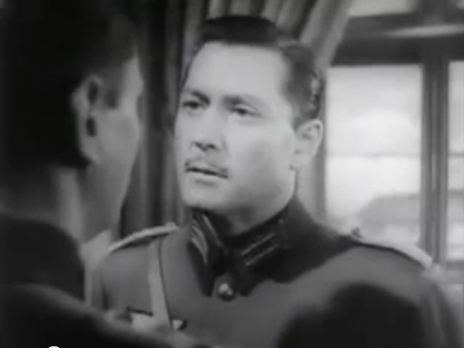
The German head of command, played by Carl Esmond, whom you may have seen in dozens of films and TV, is a clever, mannered chap who is teaching a new officer (and us) about interrogation.  He remarks, “Just as there is no such thing as an innocent question, there is no such thing as a valueless statement.”
Anything the American men say can be useful to the enemy.  One by one, through the course of this film, we see how they are tricked.  If we found ourselves in the same situation we might be fooled in the very same way.  It all seems so innocent.
Like many of FMPU’s films, this had a cast largely of unknowns, some of whom would later become more familiar to us.  Don Porter plays an officer in the downed bomber crew, easy going, and genuinely surprised to be given a nice room and treated royally by his captors.  Later in the film when Commandant Esmond primes the pump by dropping hints that he already knows all about the bomber’s mission, Porter shrugs, figures, oh, well, if it’s common knowledge—and spills facts.
Kent Smith plays a German officer who was raised in the US, and so with his knowledge and his comfortable camaraderie with the American boys, tricks them into trusting him.
Hans Twardowski has minor role as a German Red Cross representative, also out to trick the men into filling out Red Cross forms that ask too much information.  You may remember him from “Casablanca” as a Nazi soldier.
James Seay plays the bomber crew Captain, most stalwart of the group, yet even he slips up and gives information he has no idea he’s giving.
Arthur Kennedy is a standout in the film as a cocky crewmember who thinks he’s going to outwit the Germans by giving them false info, but they are onto him and twist his words so that they find out the truth.  Kennedy gives a raw performance as man who is clearly rattled by these mind games.
It’s interesting to watch the Germans cleverly sort out the mystery of where the downed bomber came from, and where it was going.  By putting together small bits of information the men have unwittingly given them in unguarded moments, the Germans discover where the next raid of American bombers is likely to come from and where their next target is to be. 
When that next bomber mission occurs, the Nazis are waiting for them.  They shoot down most of the squadron of planes.  The footage, simulated obviously, of the American planes being shot down is not what that first generation of boys who grew up on movies would have ever expected to see.  It is brutal, with planes on fire, with machinegun fire ripping through crews, and images of blood spurting from the heads and faces of pilots and gunners.  The lesson about not talking is driven home graphically.
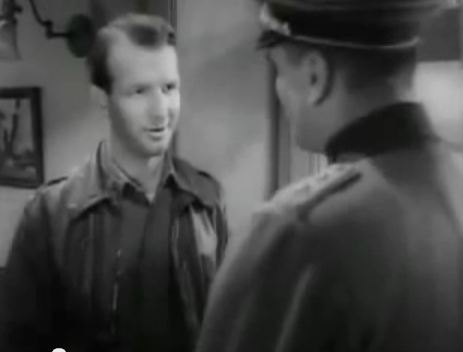
Only a few crews from this mission limp home.  They are debriefed by Lloyd Nolan, and bewildered over how the mission could have failed so badly. 
Rand Brooks has a small part as an American  back at the base, who grimly makes the accusation, “Somebody talked!”
George O’Hanlon, whom you might remember from a bunch of “Joe McDoakes” shorts also appears back at the base.  Mel Torme has a bit part as a pilot, though I confess I didn’t spot him.
Craig Stevens plays a returning pilot back at the base as well, interrogated by Lloyd Nolan after the disastrous mission.  Nolan, in that wonderfully edgy, serious tone that makes you pay attention to him no matter how quietly he is speaking, calms the men and tells them that the only information they are ever to give is their name, rank, and serial number.  Above all, don’t talk.
 
Then he looks right into the camera, right at us.  “Don’t talk.  Don’t talk.  Don’t talk.”
We may never talk again.
The FMPU was comprised of men from all the different Hollywood studios.  Some of them were not actually in the Army Air Corps, like Nolan, and like occasional guest actor Guy Kibbee.  The others who were, ranged from actors, writers, directors, cameramen, many of whom served their entire hitch here in Hollywood, and others who went on combat missions photographing the war, or to serve in other units.  More on that next week.
I’m not certain at this time the military rank of the men who performed in this film or many other FMPU training films.  I do believe Arthur Kennedy was a sergeant.  I believe Craig Stevens was a corporal.  Sgt. David Rose, incidentally, composed the music score for this film.
The AMC channel broadcast a documentary in 1997 made by Gregory Orr Productions called
“Hollywood Commandos”, about the First Motion Picture Unit, and we’ll be discussing that next Thursday.
“Resisting Enemy Interrogation”, now in the public domain, can be watched here on YouTube.

Related Products