IMPRISON TRAITOR, PEDOPHILE, AND CONVICTED FELON TRUMP.
Showing posts with label Whit Bissell. Show all posts

Thursday, October 22, 2020

The Turning Point - 1952


The Turning Point (1952) depicts a government committee’s investigation of organized crime. In film noir style, it becomes a kind of anti-crusade, a bleak tale of shattered illusions, of mobsters who get away with pretty nearly everything just by seeing how far they can go, of cops on the take, and a romantic triangle that blows up into bits.


This is our entry into the Politics on Film Blogathon hosted by the Classic Movie Blog Association.
  Have a look here at more participating blogs.


Edmond O’Brien plays the head of the investigating committee, a college-educated, idealistic, and unimpeachable hero out to crush the gangsters and their tenacious reach into law enforcement and politics.  Though he states he has no political ambitions himself, nailing the crime syndicate would be his ticket to fame and almost any future political office he wants.


William Holden is his boyhood pal, now a cynical and savvy reporter who will follow the doings of the do-gooders and spare them as little mercy in his crusty observations as he does the mobsters.  The two of them are 1950s men in the gray flannel suits, better educated than their fathers, and considered to be more successful, certainly with more polish. But rather than easier, their lives seem even more complicated.


Alexis Smith also has considerable polish.  She is also college-educated, and comes along with Edmond O’Brien as his gal Friday.  She holds a kind of secretary’s position, we gather, but she is seen more often pouring coffee than taking notes, and hosting cocktail parties for the committee.  Holden sizes her up with a sexist if not exactly misogynistic attitude, noting at once that this apparently high-class society dame might be slumming.  He senses phoniness.  She challenges his self-superiority and his cynicism with her own well-pointed remarks and a withering glance or two, getting him only to admit that as a reporter, he only points out the problems of life and never the solutions.


Tom Tully plays Edmond O’Brien’s father, a tough cop.  Tom Tully is one of those wonderful character actors equally adept as playing lovable as playing hard-edged and sarcastic.  Mr. O’Brien invites his dad to help in their investigation, counts on it, but Tully begs off, wanting no part of politics or some high-tone committee holding meetings in a swank hotel ballroom.  He says he’s just a cop and wants nothing more than that until they pension him off.  O’Brien insists that he wants an honest cop like Dad on his side.
 

But Tully is a cop on the take.


William Holden, who always seems to be giving everybody the side-eye, suspects this almost immediately and spends a good deal time tailing Mr. Tully, who is working directly at the pleasure of the head mobster, played by Ed Begley, who is so effective in these kinds of blustering, snide roles.  Tully got involved with the mob years earlier when he wanted more money to send his boy Edmond to college.  So we have the irony of Edmond’s superior education and supposedly superior morals bought with dirty money.


Tailing Tully brings us some wonderful location shots of the more run-down neighborhoods of Los Angeles (though the movie is evidently supposed to be set in some fictional Midwest town). There is a great sequence on the Angel’s Flight funicular, which we covered in this previous post.


Don Porter is also one of Ed Begley’s boys, as is Danny Dayton.  Even Whit Bissell, whom we see briefly when Tully goes to ask for some official records to be photo-stated, is also on the take when he rats to the mobsters that Tully has copied some info on them he shouldn’t have.

The result is Ed Begley putting out a hit on Tom Tully, and also having the mobster who shoots Tully to be killed in turn.  Nobody left to implicate him.  Anybody’s expendable, according to Begley.


William Holden, along with his cynicism for do-gooders as to how much good they do, now carries the burden of keeping the knowledge from Edmond O’Brien that his father is a crook.  Holden confronted Tully and gave him a chance to go straight by getting the info on Begley, for which Tully was murdered, and for which Holden now feels responsible.  If that wasn’t enough to carry on his plate, Alexis Smith shows up at his apartment to confront his arrogant detachment, and when he takes her on another tailing of bad guys, pretty soon she’s pouring his coffee as his gal Friday. Alexis is smart, and fearless, and honest with herself and others, and he likes that.  It’s a role Alexis plays so well, her intelligence and her elegance is part of her sexiness.  Pretty soon he has another burden; he’s betraying his best buddy.

Edmond O’Brien, who declares, “I’d rather nail one crooked cop than a hundred hooligans,” will eventually be crushed to find out his dad is one.  In the meantime, his dad has been murdered.


Edmond also catches Alexis with her head on William’s shoulder, but he asks no questions.  Some things can keep, or maybe he doesn’t really want to know.

One standout feature of the movie is the televised committee hearings conducted by Edmond O’Brien as he deposes the lesser figures in the crime syndicate in order to get at the top.  This is based on the Senator Estes Kefauver hearings on organized crime from 1950 and 1951 as a special committee of the United States Senate.  This was for forerunner of all the televised investigations that would become part of our social zeitgeist through the decades: the Army-McCarthy Hearings, Watergate, right up through the Impeachment of Donald Trump. 


Such TV hearings make us familiar with the individuals of our legislature, make household names of senators from states other than our own, and become part of pop culture.  We may expect that the trajectory of his political career will only rise for Edmond O’Brien after this. (Two other films released this same year of 1952 also featured Kefauver-like committee hearings: The Captive City and Hoodlum Empire, so we can imagine the impact that first-ever live TV hearing made on America.)


Carolyn Jones stands out in her debut film performance as a comic gangster’s “moll” being questioned by the exasperated Edmond O’Brien.


One of the witnesses blurts out the information that a company owned by Ed Begley will yield documents pointing to his guilt, and while O’Brien and his men prepare to follow this lead, Begley arranges an intricate setup of a gas explosion and fire that will destroy the building, and the apartments above it. When one of his men questions him going that far, murdering a bunch of residents in the building just to cover his tracks, Begley sneers, “You wouldn’t think we’d do it?  That’s what makes it good.  I don’t think a jury would believe it either.”  Pushing evil to the extreme to dare people to believe their own eyes is another tactic used infamously today.

Walking among the bodies of innocent victims after reaching the blast too late, Edmond O’Brien is disgusted, defeated, and he wants to give up, but Holden urges him to continue.  He tells him about his father’s being a crooked cop and makes the frank, and in spite of himself, idealistic viewpoint, “Even allowing for the apathy of the people and their lack of integrity and their occasional lack of intelligence, and that’s the fact that they all want desperately to believe in a certain majesty of the law.  And for people like you and me, the greatest crime in law is the lack of faith in the law, and that’s when we join hands with the hoodlums.  If they can convince us of the uselessness of knocking out crime, the difficulty, the fact that personal sacrifices may be too great, then we might as well hand over the city and the state and the nation, too…”

Then O’Brien and Holden shift gears to separately track down the girlfriend of the mobster who shot his father, because she has more info that would nail Ed Begley and she wants to talk.  Adele Longmire is great in her brief scenes. It’s a suspenseful search, but we find ourselves in the bowels of boxing arena (which is actually the Olympic Stadium in L.A.) where Holden is hunted by an assassin, played by Neville Brand.


Alexis catches up to him, but he pushes her away just the gun trained on him is fired.  Edmond O’Brien shows up too late again, and though we are certain by now that there is enough evidence on Ed Begley to bring the racketeers to justice, we don’t see that happen in front of us, and we are left with an ambiguous ending also for what future Edmond and Alexis are going to face.  The individual stories of the trio are brushed aside, made almost irrelevant in the wake of the enormity of political intrigue.

The Turning Point can be seen, at least for now, on YouTube if you want to have a look.

Have a look at the other great blogs participating in the Classic Movie Blog Association’s Politics on Film Blogathon.

************

Jacqueline T. Lynch is the author of Ann Blyth: Actress. Singer. Star. and Memories in Our Time - Hollywood Mirrors and Mimics the Twentieth Century. Her newspaper column on classic films, Silver Screen, Golden Memories is syndicated nationally.  Her next book, a collection of posts from this blog - Hollywood Fights Fascism - is available for pre-order here on Amazon.


Thursday, November 15, 2018

The Desperate Hours - 1955


The Desperate Hours (1955) brought the escaped convict genre to suburbia. That’s where everyone else was headed in the 1950s, and the house in the neighborhood is as much a character in this film as the three outlaws and the family they terrorize.

This is our entry into the Outlaws blogathon hosted by the Classic Movie Blog Association. Please check out this link to read some other great blogs on this sinister subject.

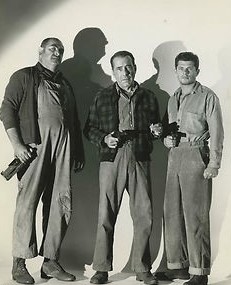
In The Desperate Hours, Humphrey Bogart plays the lead bad guy in his second-to-last film and the very last bad guy role he was to play in movies. He shows he’s still got it.

Dewey Martin plays his younger brother who has broken out of prison with him. The third member of their gang is played by Robert Middleton, who is arguably the most frightening member of the trio.

The movie begins with an audience perspective shot as we move down a suburban subdivision. There are lawns and trees, children, a dog or two, people walking on sidewalks. It is deceptively peaceful. The camera moves very quickly to one particular home on the block. If the house looks familiar to you from the outside that’s because two years later, Beaver Cleaver lived here. The television sitcom Leave It to Beaver (1957-1963) used this exterior for the Cleaver home.

Fredric March is the head of the clan, doting father and husband and executive, who works “downtown,” a place which with the settlement of suburbia has become more distant and vaguer to us.

Martha Scott is his wife; Mary Murphy is his grown daughter; and the wonderful Richard Eyer, who as we’ve seen was such a standout in films here like Friendly Persuasion (1956) and here in Slander (1957), plays his young son.

Though we see the family gathered together for a cheerful, if rushed, breakfast, it is not all idyllic on the home front. Fredric March does not approve of his daughter’s latest boyfriend, a hotshot young lawyer played by Gig Young. She is rebellious and they argue in the car when he drives her to work “downtown.”

Young Richard no longer wants to kiss his father goodbye when he leaves for school; he’s too man for that now and he does want to does not want to be known by a nickname anymore. He’s an All-American boy, pretty much goes his own way and his sudden streak of independence, while cute in this scene, is going to prove to be a greater problem later on when he tries to rebel against their captors.


The story was written by Joseph Hayes from his novel and his original script which was performed on Broadway at the Ethel Barrymore Theatre from February to August 1955, the film’s release year. For some years thereafter, it was a popular summer theatre play and the two-level set which was required to tell the story of showing the family in different rooms with the bad guys was always a challenge and always a hit on stage. We take things for granted like a two-story house in the movies, but on stage we appreciate more the architectural skill it takes to build and to work on a two-level open set.

The Broadway version was directed by actor and director Robert Montgomery. Karl Malden played Fredric March’s role as the suburban husband and father, and Paul Newman played the Humphrey Bogart role. We can imagine that the younger gangster in the mid-1950s might have carried a more sinister suspense story because the brothers would have been contemporaries and because they might have appeared more violent and impetuous.


Though Bogart is a generation older than his brother played by Dewey Martin, we can accept them as brothers and accept that Bogart, even though famed for playing dangerous criminals, serves a different function in the screen version. His is rather like a parallel to Fredric March, than to his partner younger brother.  Like March, he is the head of his family, or his gang, and he sometimes has trouble keeping them in line. Fredric March bristles at his daughter’s romance, believing her to still be a kid. Humphrey Bogart is stumped when later in the film his brother rebels not just against his authority but against the whole way of life in which his big brother has raised him.

Bogart and his gang have chosen this house at random, which is certainly an eerie aspect about the story, it could have been any home—maybe even yours. Bogart’s reason for choosing this house was that Richard Eyer has left his bicycle on the front lawn. Bogart knows he would be able to make the family more fearful and more easily cooperative if they have to protect children. This tells us that he has some experience and logic in his craft, and also that he would prefer not to have any trouble if he could avoid it. He intends to hole up here until he can arrange for a former girlfriend to bring them money to escape.  But he also wants to go after the deputy sheriff responsible for putting him in prison.

Arthur Kennedy plays the deputy sheriff, who is the only one among the police officials to take the news of the jailbreak seriously, feeling certain that Humphrey Bogart is coming straight for him. He is not so paranoid as he is analytical, just as logical as Bogart or Fredric March is in this scenario. There is an attempt to turn the story into more or less a triangle to include the efforts of the police to trace Bogart’s whereabouts. This is obviously not something that would have been easily done on stage where the whole story was pretty much set in the home.

Note Bogart’s disgust when he sees that March, whom he resents for his middle-class respectability, has only $800 in his bankbook.  In that era, it would have represented probably something like three or more months’ wages saved.  That may not be terrific in Bogart’s eyes—he’s after all the marbles—but today when it is estimated that only about 18 percent of Americans have three-to-five months’ savings in the bank, then this family is doing okay.

The movie also gives us a lot of familiar faces to pick out in the crowd, Ray Teal as the state police detective, Alan Reed (Fred Flintstone) is another officer, Ray Collins, Simon Oakland will also play police officials, Whit Bissell plays a pensive and intellectual FBI agent. Beverly Garland plays the teacher who drops by and in front of whom March must pretend to be bringing home drinking buddies to cover for her seeing the bad guys. Joe Flynn plays a panicky motorist taken hostage, and poor Walter Baldwin plays the junkman in the greatest danger of all of them.


Shortly after father and daughter leave for work, and Junior’s off to school, mom Martha Scott begins her housecleaning. She brings along a portable radio into every room to listen to music and, of course, to give us the opportunity to hear the news bulletins about the escaped convicts. Later on in the movie, Humphrey Bogart will smash the radio in a fit of anger.

It is interesting that even though this film was released in 1955, we see no television set in the home. It is more than likely that by the mid-1950s, a middle-class home such as this would have a television. I’m not sure why they don’t include one, either because it didn’t figure into the plot, or because the film industry was still chafing with resentment over its new competitor and didn’t want to acknowledge its existence?  Though Fredric March drives an older model car, the movie is not set in the late 1940s—Gig Young’s flashy sportscar alone tells us that.

We might think today that the TV would be a better place than the radio for news bulletins, but this was long before 24-hour news and also it was an era where news broadcasts were infrequent and brief. There were usually only one or two news programs lasting all of about 15 minutes from the 6 o’clock to the 7:30 time frame in the morning, and it was much the same in the early evening from 6 o’clock to about 7:30. We might have one or two news programs 15 minutes in duration. Television news did not really come of age until the 1960s, and much of that, sadly, was launched in the aftermath of the Kennedy assassination. Newspapers were still king of the news--even of bulletins, with the ability to produce "extras" several times a day.

Robert Middleton, the large hulking Neanderthal of the bad guys with one presumes the IQ of a child, plays with Richard Eyer’s toys in his room and break some of them in frustration when he smacks his head while looking out the window.  He fumbles with a toy bank that looks like a little safe, and he cannot open it. At one point he takes a toy gun and blasts it around the house until Humphrey Bogart tells him knock it off. In one scene—one of director William Wyler’s touches, while Bogart is terrorizing Martha Scott in the foreground, in the background we see Middleton drinking from a milk bottle and spilling it down his chest (just as the boy will do later).  These images of the buffoon are only half-comic.  They also point to Middleton’s mental instability, which is the most dangerous thing about him. These fellows had been in prison, we don’t know for how long, but it’s possible that television would have been a complete novelty to them. I imagine if Robert Middleton’s character was so enthralled by Richard Eyer’s toys, then he might have enjoyed CaptainVideo or Hopalong Cassidy.

Bogart snidely says of Middleton to Martha Scott, “Crude, ain’t he?”

Bogart is commanding in his sneering, angry role, indeed, it is a role he has played many times. There is stubble on his face and over the phone he calls his gun moll “Doll,” like a man from another era, and he is supposed to be. He has no place in modern society.


His younger brother, Dewey Martin, feels this more acutely than Bogey. He is more wide-eyed at the appearance of the house, and at the nubile young daughter. At first, when he enters the daughter’s bedroom while she is at work and sees her canopy bed, he touches the frills on the canopy and brushes his face seductively on them.  It is an image which causes us to think he will present a sexual threat to her, but when he meets the girl and examines the whole house more closely, there is an unexpected change in him.  He is strangely awed and respectful of this world and its people.

Interestingly, the scene with her canopy bed reminds me of the scene in Wyler’s other film The Best Years of Our Lives (1946) when Dana Andrews wakes after a drunken night in Teresa Wright’s canopy bed, and he amusedly blows on the canopy’s frills, surprised to find himself in such a feminine haven.

When father and daughter come home from work, and Junior comes home from school, the entire family is held hostage and they are moved from room to room at gunpoint. In some scenes, it even looks as if they are camping in their own home as they try to stay together.

Martin seems more than attracted to daughter Mary Murphy; there is a shy, almost boyish crush he exhibits for her. Bogart notices the attraction and jokes that when they leave, they will take the daughter with them as a hostage just as a present for his younger brother. It is a chilling moment.

But the brother protects the girl from Robert Middleton, who is a far greater danger not only to her but everyone in the house, even to Bogey, because he is so undisciplined and so mentally unstable.

The real terror in the film comes from the sudden destruction of the blessed normality of their everyday lives. They live in a world of 1950s conformity, and though it may get a little stale sometimes, they know they are safe there. Their safety has been shattered not necessarily by three escaped convicts, one of them with a gun, but that the normality is gone and the unknown has entered their lives.

One gun becomes two as Bogart discovers that the family keeps a pistol in the house. This evens up the score a little and makes Bogart happy because Middleton has the other one.

But there is an even greater danger to Bogart than Robert Middleton’s instability. It is his younger brother. Dewey Martin doesn’t want to take over his brother’s life of crime anymore. When Bogart tells him to stick with him, that he got them out of prison and he will take care of him, that he taught him everything he knows – a common manipulation used by the heads of families to keep the younger in line – Dewey Martin disgustedly replies, “You taught me everything, except how to live in a house like this.”

If Dewey Martin was not dissatisfied with his life in prison, he certainly is now because he sees a glaring comparison to how his life has gone. This is a nice home, with a nice family. If Mary Murphy’s beau, Gig Young, is not welcomed by her parents, then what chance would he have? Even though he respectfully calls her, “Miss,” and calls Fredric March, “Sir.”


The family has its own struggles, its own splinters and breakdowns, and coming together. Unfortunately for Fredric March, who tries to shepherd his family through this terrible experience and proves himself to be courageous and very intelligent in how he manages to outmaneuver the bad guys, his greatest handicap is also his greatest treasure – his family. Neither his daughter nor his son obey his explicit instructions and they mess things up, even his wife rebels and throws a monkey wrench into the works. At some point we have to wonder if March just wants to throw his hands up and yell, “All right then, go get yourself killed! I’m sick of talking to you people!”

But he doesn’t. At one point when he is allowed to leave the house on a mission for the bad guys, he stumbles onto the dragnet by the cops who have traced Bogart’s whereabouts, and he has to plead with them to allow him to go back in to mediate the situation because he doesn’t want them shooting up his house and killing his entire family. They reluctantly agree, but give him a gun. He empties it of all the bullets. He takes it with him. The cops think he’s nuts, but we see in the course of his last gambit that he is more clever than anybody.

It is an intricate and interesting movie and fast-paced but I won’t linger too much on the heroics of the family. This blogathon is about outlaws. In the tradition of classic films, none of these outlaws comes to a good end.

We may not mourn Robert Middleton, he’s just too scary and too bad, and has already committed one murder right before our eyes.

Dewey Martin has the greater share of our sympathy and how he meets his end is entirely accidental and tragic because he is escaping his brother and a life he does not want.

Bogart plays his cards all the way to the end, and it’s just March and Bogart at the end. March has outsmarted him because he has managed it so that Bogart holds the gun with no bullets in it.

When March has his own gun, Bogart sneers, “You ain’t got in you.”

March growls, “I’ve got it in me. You put it there.”

Then March does something so effective and perhaps even cruel, to get back at Bogart. Having heard the news about Bogart’s brother’s death – which Bogart doesn’t know – March tells him how his brother died and he sneers and shouts, “You did it! How do you like it?”

This is really the end of Humphrey Bogart. Yes, he has a few more minutes in the film, and yes, he rushes out into the police spotlights and drops down on their front lawn only a few feet from the boy’s bicycle that had brought him to the house in the first place, but it was really upon hearing of the death of his brother, the end of his family, and the collapse of his authority that kills him.


Some may say that Bogart was a little too old to play this role, especially if they had seen Paul Newman play it on Broadway, but this is a different interpretation. Movies are different from plays. We wouldn’t have had all the cops in the play, we wouldn’t have all the bicycles, the milk delivery trucks and the sound of crickets in the evening. We wouldn’t have had March’s bewildered office staff in front of whom he has to pretend, we wouldn’t have had the roadhouse where Dewey Martin tries to escape. We wouldn’t have had the town dump where Robert Middleton commits a cruel and vicious murder.

Bogart was in his element in this role because Bogart was in his own world. Hollywood at this time took its gangster movies from the faux city streets of its backlot and soundstages, to a wider and somehow more complex world on a backlot suburbia. The Cleavers would move into that house – on television of course – and the conformity of suburbia would cover over Bogart, Dewey Martin, and Robert Middleton, like a blanket of snow, masking the ugliness, but not obliterating it.

The 1950s introduced us to new bad guys – psychos, rebellious youth, juvenile delinquents. They would be more at home here in suburbia. They could not be gotten rid of so easily, like the crabgrass on the lawns of the middle-class homeowners; they were rooted and endemic.


Please visit the Outlaws blogathon hosted by the Classic Movie Blog Association for more great entries on bad guys in film.

Thursday, October 2, 2014

Brute Force - 1947


Brute Force (1947) remains a giant among prison movies.  Visually stunning, it has a noir foundation on which is hung an unusually sensitive (for noir) study of men trapped by their circumstances, their sins, their weaknesses, their fears, their anger, and even by their ability, those that still have it, to feel the pain of those around them.

Burt Lancaster heads a sterling cast, even the most minor character is vivid and memorable in this film.  That’s what happens when you have a crisp, literate, and biting script, and most especially, a director and cinematographer who freely turn what could have been a stiff sort of docudrama, or clichéd melodrama—how most prison stories tend to be filmed—into unabashed art.  We are treated to a generous array of stunning close-ups and interestingly framed shots that tell us volumes about the men, especially since they are in a setting where they are close-mouthed, unlikely to tell us everything that’s going on inside them.

Expository dialogue goes to the administrators in the prison.  We have Richard Gaines, so dependable in officious roles as the severe, pompous superintendent, always pressuring the anxious, ineffectual warden, played by Roman Bohnen.  The warden complains of cutbacks in funding, that the prison is overcrowded, that the men need job training…all of which the superintendent balks at, saying what the men need is more discipline. 

The soft voice of the head of the prison security force, played by Hume Cronyn, belies his sadistic nature.  The little man enjoys the fear he excites in the hardened men, most of them much larger and physically imposing—but Cronyn wields power he’s swiped in a vacuum of leadership, tortures them physically and psychologically, and he has Ray Teal following behind him with a billy club like a human swagger stick.

The cast is a feast of favorite character actors, like Sam Levene, and Charles McGraw in one of many uncredited roles that filled the first several years of his film career. 

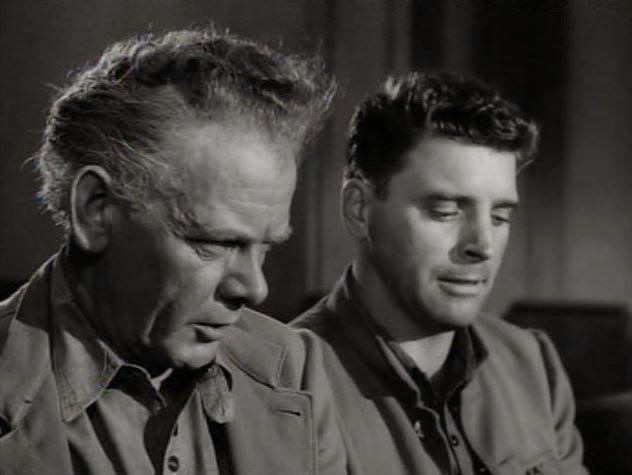
The wonderful Charles Bickford is the level-headed old timer, who breaks up fights in the prison among the other cons, and bides his time until his hoped-for parole.


Sir Lancelot sings calypso rhymes he makes up on the spot to narrate what he sees, as either a funny jest, or a warning, or a requiem for yet another dead prisoner.

There’s Jack Overman as one of the cellmates, an easygoing, simpleton ex-fighter.  One of my favorites, he has a bigger role here for once.  We’ve seen him in a non-speaking minor role in Once More, My Darling (1949) here, and also in Swell Guy (1946) here.  Sadly, Mr. Overman died in late 1949 at only 32 years old.

His cellmates include Whit Bissell, as a small-time embezzler, a sad, brittle fellow who, obsessed his shallow wife, played by Ella Raines in a flashback segment, fearing losing her love, steals from his employer to buy her a mink coat. 

John Hoyt is a stylish grifter, mainly in phoney stocks, a man-about-town with a charming easy-come, easy-go attitude.  I love his line, “I wonder who Flossie’s fleecing now?”

Howard Duff, in his first film, is a former soldier who took the rap for Yvonne De Carlo, an Italian woman he falls in love with during the war.  She has murdered her father to save Duff, but though he takes the blame to save her, I don’t believe his current imprisonment is for that crime.  He remarks about always wanting to get back to Italy to see her, but “one rap led to another.”

The best lines, and probably the best role of the film happily goes to Art Smith, who plays the prison doctor.  He’s just as fatalistic as the cons, and drinks heavily to dull the pain of this miserable place.  It's a terrific performance.   

But unlike the weak warden Roman Bohnen, who gives in to the bullying Richard Gaines and the devious machinations of Hume Cronyn, Mr. Smith is still a man of strong conscience.  He gets into shouting matches with them all, gets right in their faces and bleeds his anger and sarcasm all over them.  Again and again, they slap him down.

Burt Lancaster, whose character as the leader of his cell, and one of the most respected by the other prisoners for his toughness, is beautifully lit, if you can call his deadly cold glare and vicious snarl beautiful. 

We first see him standing in the prison yard in the pouring rain, but with his soaking wet shirt tucked neatly into his soaking wet prison trousers, he strides back to his cell, his shoulders straight, his head held high with an air of nobility.  Though he has just come out of solitary confinement, he is not broken.  He is angrier, and more charismatic to us and to the other prisoners, than ever.  The other men light his cigarettes as a mark of his leadership.  The only one who ranks him is Charles Bickford, who freely reaches into Lancaster’s prison jacket in another scene and swipes a match from Burt’s shirt pocket to light his own cigarette.  Burt lets him, hardly noticing, as if the older man could be his father and is allowed such liberties.

Because this is a setting of confinement, much of the film has the feeling of theatre, and the action that takes place is muted and judicious, until the very end of the film when we have the attempted prison break.  Director Jules Dassin and writer Richard Brooks have the perfect marriage of script and cinematography, where each supports the other, and the pace of the movie flows beautifully, building tension, and then releasing it a bit at a time in unexpected moments of black humor, and when, where the men watch the 1947 comedy The Egg and I starring Fred MacMurray and Claudette Colbert, it seems surreal.

Ann Blyth, like the few other women in the cast, save for the officious and severe secretary of the warden, is shown in flashback.  The women on “the outside” show us what the men’s lives were like before they went to prison.  There has always been a debate as to whether the flashback scenes with the women are necessary to the film.  Some critics and viewers feel they are fitting to the story, and others feel they slow the story down and detract from the intensity of the prison scenes. 

Even director Jules Dassin apparently did not want to use the flashback device.  Author Alan K. Rode in his biography of Charles McGraw, Charles McGraw: Biography of a Film Noir Tough Guy, reveals that Dassin gave in to producer Mark Hellinger and the studio brass to include the four flashback scenes that show women who have influenced the lives of some of the men in the cell.  He quotes Dassin:

“Truly, the film is demeaned by the inclusion of ‘the women.’  I had to choose between not making the film and yielding to having the women nonsense.  Many years later when I looked at the film…I do not forgive myself.”

I don’t know how screenwriter Richard Brooks felt about the women scenes, but I’m inclined to think Mr. Dassin’s dislike of them might be, in part, a director’s usual, and quite understandable, bristling at having to shoot the film to someone else’s vision.

On another note, Mark Hellinger had to fight toe-to-toe with the Breen office because the MPAA wanted to censor many of the films violent scenes, a reference to marijuana, and even to exclude the word “cancer” when referring to Ann Blyth’s diagnosis because the very word was upsetting to the public.  Perhaps Hellinger threw Breen a bone when he has the doctor, Art Smith, reassure Burt Lancaster that, “These days, cancer doesn’t have to mean death at all.”

That’s another reason why Burt has to bust out of prison.  There’s a time element to Ann’s needed operation.

Others have suggested that the flashbacks represent a societal misogyny, or some statement to the effect that these are regular Joes who’ve been led astray by dames.  Again, here I disagree.  They show the men, more than the women, to be flawed.  Though John Hoyt has his car, his gun, and his gambling winnings stolen by a floozy, he was obviously willingly, knowingly taking chances in an underworld game of roulette, and the odds were against him this time.  He shrugs it off, amused and unrepentant.

Whit Bissell’s wife’s cooling ardor for him, and her greed for the mink coat which she clearly treasures more than her husband, leads to his downfall, but she did not force him to embezzle, had no idea he was doing it.  Bissell was not led astray, he was a fool who turned to thievery, and his obsession with his wife was such that it leads to his suicide when Hume Cronyn tells him (whether true or not) that his wife is divorcing him.  “I get quite a kick out of censoring the mail.”

Howard Duff’s taking the rap for Yvonne De Carlo does not make her a villain, her act of love is to protect him; his was to protect her.  But thinking this paints Duff as a hero wrongly placed in prison is also erroneous.  He is not in prison for assuming the guilt for her murder of her father; he plainly tells us he’s had other “raps” since.  Besides, he would have been incarcerated in a military prison were that so.  Look at the scene where he, John Hoyt and Jeff Corey go after a “stoolpigeon” prisoner with blowtorches, forcing him to be crushed in a stamping machine.  Look at their expressionless faces.  These regular Joes are killers. 

We could probably dispense with their flashback scenes (indeed, Anita Colby as Hoyt's floozy girlfriend never even gets any lines), but the one with Burt Lancaster and Ann Blyth I think is important to the film.  We don’t know if Lancaster has committed murder on the outside, but we see he is tied in with a gang he gives orders to, and probably is involved in something more like bank robbery.  Just before he leaves on another “job,” he stops by the house where Ann Blyth lives, an invalid in a wheelchair.  Lancaster hands a caregiver an envelope with money, “See that she doesn’t need anything.”

Ann is at first asleep, then he wakes her, and in their tender scene shows us that Lancaster is tired of running, that this will be his last job, and then he will come back to her for good.  He tells her that when he met her, he was a guy who “found the first important thing in his life.”  She doesn’t know what racket he’s in, but she senses he is troubled.  She wants to help him, wishes she weren’t sick so that she could help him.

“There are all kinds of sick people, Ruth.  Maybe we could help each other.”  The scene is gentle, affectionate, somewhat sad.  Ann’s character is not a gun moll, she’s a sweet, decent girl who trusts him.  This is important because it bolsters the visual image we already have of Burt Lancaster in the film as more a wounded animal than a psychopath.  

Indeed, at the very end of the movie when he is shot in the prison escape, he rears back with a single roar of pain and rage, like an animal in a trap, cut short as he fires several rounds into the guard who wounded him.  Bookending his cold expression of anger through most of the film is the softened, relaxed look of tenderness on his face when he sees her sleeping, and at the very desperate end when he sees that the escape plan has failed, and he looks for a moment like he could cry.

We need this scene with Ann Blyth, maybe all of “the women” scenes, not to remind us that the men are human, but because we are.  We can’t root for criminals to break free from jail, not unless we have some emotional stake in their success.  Without emotion, it becomes as academic as a watching the outcome of a dog race, and without the betting.

Interestingly, their scene ends with the camera remaining focused on Ann after Burt has left the room, tears welling in her eyes, heartbroken, frustrated, and fearful.  Dassin's touch, or Hellinger's?

One wonders what private demons she might have faced in the brief scene.  She was eighteen years old.  In the previous two years she had spent several months really in a wheelchair as a result of her spine injury, and her mother really died of cancer, both discussed in our intro post to this series.  Life's coincidences are occasionally macabre.

Producer Mark Hellinger may have had yet another reason for putting Ann Blyth and Burt Lancaster together.  He had hired her for Swell Guy (1947), and him for The Killers (1946).  They were two of Universal’s most talented up and coming stars, and he may have wanted to turn them into a team.  According to syndicated gossip columnist Dorothy Manners who wrote this in May 1946:

Mark Hellinger, always good for a bright idea, said to me, “Where are those swell romantic teams that used to make the fans goggle-eyed over their love scenes…It’s time the love team is revived on screen,” and Mark is the boy who is going to do it with his two young stars, Ann Blyth and Burt Lancaster…he wants to make three or four with Ann and Burt.  This Blyth girl is the real star stuff—young, tempestuous and definitely a screen personality.  If you saw her as Mildred Pierce’s daughter, you know what I mean.

Having played in her previous two films as young women of dubious, or downright evil, character, her role as the kindly, gentle Ruth in Brute Force would be the first important break in a string of roles that could have left her typecast, and farther away from ever doing the musicals she hoped to make.  But Ann Blyth was not done with bad girls yet: A Woman’s Vengeance (1948), discussed here, and Another Part of the Forest (1948), discussed here, were on the horizon.  She’s in Brute Force all of only about three or four minutes, but her scene is indelible, and does more for Burt Lancaster’s character than the awe the other prisoners show for him.

Their romantic team never did materialize.  Both went on to other films, and Mark Hellinger, who might have made a pet project of bringing them together again on screen, tragically died about six months after Brute Force was released.

Come back next week to Katie Did It (1951), a movie I can’t find, and a few thoughts about that and on Ann’s career as we round the corner and head for the home stretch on this series.


*************************
Milwaukee Sentinel, May 31, 1946, syndicated column by Dorothy Manners, p. 4.

Rode, Alan K.  Charles McGraw: Biography of a Film Noir Tough Guy, (McFarland, 2007), p. 32.


****************************
As  most of you probably know by now, this year's TCM Classic Cruise will set sail (proverbially) in October, and one of the celebrity guests is Ann Blyth.

Ann will be doing a couple hour-long conversation sessions, and will also be on hand for a screening of Mildred Pierce.

Have a look here for the rest of the schedule and events with the other celebrity guests. Unfortunately, the cruise is booked, so if' you're late, you can try for the waiting list.

I, sadly, am unable to attend this cruise, but if any reader is going,  I invite you (beg you) to share your experiences and/or photos relating to Miss Blyth on this blog as part of our year-long series on her career.  I'd really appreciate your perspective on the event, to be our eyes and ears.  Thanks.
****************************
 THANK YOU....to the following folks whose aid in gathering material for this series has been invaluable:  EBH; Kevin Deany of Kevin's Movie Corner; Gerry Szymski of Westmont Movie Classics, Westmont, Illinois; and Ivan G. Shreve, Jr. of Thrilling Days of Yesteryear.  And thanks to all those who signed on as backers to my recent Kickstarter campaign.  The effort failed to raise the funding needed, but I'll always remember your kind support.
***************************
TRIVIA QUESTION:  I've recently been contacted by someone who wants to know if the piano player in Dillinger (1945-see post here) is the boogie-woogie artist Albert Ammons. Please leave comment or drop me a line if you know.
****************************
UPDATE:  This series on Ann Blyth is now a book - ANN BLYTH: ACTRESS. SINGER. STAR. -
*********************
The audio book for Ann Blyth: Actress. Singer. Star. is now for sale on Audible.com, and on Amazon and iTunes.

Also in paperback and eBook from Amazon, CreateSpace, and my Etsy shop: LynchTwinsPublishing.


 "Lynch’s book is organized and well-written – and has plenty of amusing observations – but when it comes to describing Blyth’s movies, Lynch’s writing sparkles." - Ruth Kerr, Silver Screenings

"Jacqueline T. Lynch creates a poignant and thoroughly-researched mosaic of memories of a fine, upstanding human being who also happens to be a legendary entertainer." - Deborah Thomas, Java's Journey

"One of the great strengths of Ann Blyth: Actress. Singer. Star. is that Lynch not only gives an excellent overview of Blyth's career -- she offers detailed analyses of each of Blyth's roles -- but she puts them in the context of the larger issues of the day."- Amanda Garrett, Old Hollywood Films

"Jacqueline's book will hopefully cause many more people to take a look at this multitalented woman whose career encompassed just about every possible aspect of 20th Century entertainment." - Laura Grieve, Laura's Miscellaneous Musings''

"Jacqueline T. Lynch’s Ann Blyth: Actress. Singer. Star. is an extremely well researched undertaking that is a must for all Blyth fans." - Annette Bochenek, Hometowns to Hollywood


Ann Blyth: Actress. Singer. Star. 
by Jacqueline T. Lynch

The first book on the career of actress Ann Blyth. Multitalented and remarkably versatile, Blyth began on radio as a child, appeared on Broadway at the age of twelve in Lillian Hellman's Watch on the Rhine, and enjoyed a long and diverse career in films, theatre, television, and concerts. A sensitive dramatic actress, the youngest at the time to be nominated for her role in Mildred Pierce (1945), she also displayed a gift for comedy, and was especially endeared to fans for her expressive and exquisite lyric soprano, which was showcased in many film and stage musicals. Still a popular guest at film festivals, lovely Ms. Blyth remains a treasure of the Hollywood's golden age.


***************************
A new collection of essays, some old, some new, from this blog titled Movies in Our Time: Hollywood Mimics and Mirrors the 20th Century is now out in eBook, and in paperback here.


Related Products