IMPRISON TRAITOR, PEDOPHILE, AND CONVICTED FELON TRUMP.
Showing posts with label Frank Sinatra. Show all posts

Friday, May 20, 2022

Young at Heart at the beach


Young at Heart
(1954) gives us a glimpse of an idyllic beach scene on the Connecticut shore in the 1950s.  To be sure, it is mostly of Hollywood origin, or at least, California, but if the beach is not in the right location, the warm and lovely nostalgia of the beach is genuine.


This is my entry to the Fun in the Sun Blogathon, hosted by the Classic Movie Blog Association.  Have a look at some great posts on this topic here.


The movie Young at Heart is a remake of Four Daughters (1938), which we covered previously in this post.  In that original story, widowed Claude Rains heads a family of four girls, played by the Lane sisters plus Gail Page, and all are musicians.  May Robson plays the auntie matriarch who lives with them.  The girls’ suitors have picked out their choices among the daughters, but all the young beaus have competition with the newcomer: handsome and happy-go-lucky Jeffrey Lynn.  But an even newer newcomer, a dour, sarcastic and self-pitying John Garfield swoops in to really disrupt things and his love for Priscilla Lane nearly tears the family apart.

We see the beginnings of the rift and a change from a lighthearted first part of the movie to a more serious and even tragic second part at a family picnic in a secluded country glen.  Here we see the sisters are really all interested in the same man. 
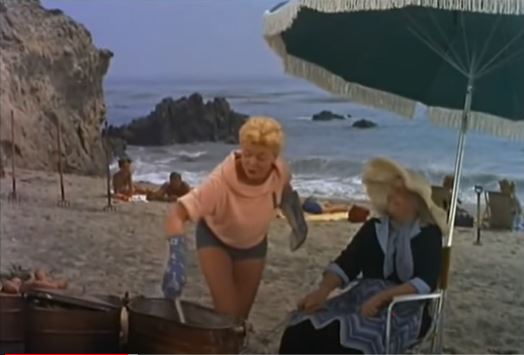

In Young at Heart, this scene is transported to the beach.  Robert Keith plays the Claude Rains role of the dad, Ethel Barrymore in a charming mixture of regal and down to earth plays the May Robson role.  Here the sisters number only three instead of four: Elisabeth Fraser, Dorothy Malone, and Doris Day.  Doris plays the lead Priscilla Lane role.  The boyfriends are with the family at the beach, and the heartthrob who will cause unspoken jealousy among the sisters is played by Gig Young in the Jeffrey Lynn role.

Frank Sinatra plays the John Garfield role in this movie, but this scene is just before he makes his first entrance in the film, so we don’t know yet how he’s going to upend the family.  Even without him, the seeds of discontent are already sown, making the day at the beach bittersweet.


With an almost nuclear-powered sunny disposition, Doris Day is the most lighthearted of the group and fails to see her sisters’ yearning for the man she playfully cavorts with in the surf.  Doris gets to sing two songs during this nearly 10-minute beach sequence. 

For those of us who live close enough to a coast to have spent pleasant days on the beach, the movie image of sand and sea, of wave-kissed rocks and sunshine reflecting off the constantly moving ocean is familiar and almost personal, like someone with a movie camera somehow entering our brains and capturing a memory.  Some sensations experienced going to the beach are really timeless and there is a distinct and powerful comfort about that.


But we may sense that some aspects of this scene are not timeless, and that perhaps going to the beach in the 1950s was a little more do-it-yourself, simple, and perhaps with a slower pace of life.   Yes and no.  We don’t see any arcades or water parks or concessions, or even bathhouses with facilities on this beach, but there were beaches back then and even before – though not all – with plenty of tourist amenities. 

That this beach is not crowded and there is plenty of space between the actors and the extras in the background should not be taken that beaches were not crowded in the 1950s.  Of course, they were.  But not all were, and even in these modern times, I have been to New England beaches that were just as unspoiled and unpopulated as this one in the movie seems to be.

So that is not quite it, either.  There must be something else that evokes the strong feeling of nostalgia for a 1950s beach in this film.  Is it because there are no loud radios playing?  Maybe, but we see Doris singing along to a portable record player.  We don’t see too many record players at the beach these days.  

Is it because nobody’s in a bathing suit and they come lounging on the sand in their clothes?  Maybe.  No sunscreen?  Maybe.  


It could just be that the clam digging and the large pots with New England clambake accoutrements – corn on the cob, potatoes, etc., are not seen quite as much now as in the old days, or campfires on the beach, or gathering driftwood to fuel the fires.

There is a noticeable lack of people taking selfies or scarfing packaged junk food snacks.  No one is being divebombed by seagulls for a few Cheetos. 


I get a kick out of Alan Hale, Jr., who plays the suitor of Dorothy Malone, talking about his sudden idea of what a great thing it would be “buying this strip of beach, tearing down all the bungalows on the highway and putting up some hotels, a whole string of them.” 

She responds, “Whoever heard of a string of hotels along the beach in Connecticut?”

There are some hotels here and there on the Connecticut coast, and were, too, in the 1950s, but not enough perhaps to make Alan Hale, Jr.’s dream come true.  Instead of hotels today there are more likely to be a few condominiums, but the geography doesn’t always allow for development.  Working harbors, saltwater marshes here there, and far more protected areas than there used to be.  Thank heaven.


I think what I really like about this beach sequence is the work of the sound technicians.  Behind all the dialogue, behind Doris’s songs and the “orchestration” that seems to bloom from her portable record player, is the omnipresent, lazy, rhythmic sound of the waves rushing to the shore.  The seacoast is not a quiet place.  The sound of the surf is eternal.
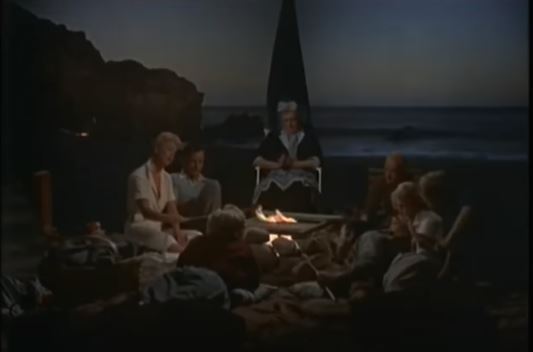

The bright, almost blinding daylight of the first part of the sequence becomes a peaceful twilight with the family around the campfire, and Doris still singing, toasting marshmallows.  The large beach umbrella that sheltered Ethel Barrymore earlier in the day has been folded up.  You can almost feel the refreshing cooler breeze off the ocean, almost feel chilled by it.  It is an idyllic ending to the sequence, a calm before the storm.  A day at the beach is a respite, time to enjoy, to reflect, and to make a memory that will last through days to come.  A beach memory may mark epochs in our lives, just as it does in the movie.

Visit the CMBA website here for more Fun in the Sun Blogathon.

    ********************

Jacqueline T. Lynch is the author of Ann Blyth: Actress. Singer. Star. and Memories in Our Time - Hollywood Mirrors and Mimics the Twentieth Century. Her newspaper column on classic films, Silver Screen, Golden Memories is syndicated nationally.  Her new book, a collection of posts from this blog - Hollywood Fights Fascism - is available here on Amazon.

Thursday, January 19, 2017

The House I Live In - 1945


Have a look at the short The House I Live In (1945).  We start a new year of blogging today, and a new era tomorrow.  We're going to accentuate the positive this year, look for hope in the darkness, and maybe finding it in each other. 

I'm with Frank, I don't like Nazi creeps, either, especially ones that call themselves Americans.  But there is yet an overwhelming tenor of decency and fairness and compassion in this country that even the worst monsters among us can't defeat.  I like the way he grins, looks the mob of kids in the eye ("you have to be carefully taught") and calls them Nazis, hoping they'll challenge him.

"Religion makes no difference, except maybe to a Nazi or somebody as stupid."  Great line.  Lump the Nazis with stupid people.  Call a spade a spade.  Trample all over their self-superiority.  There were plenty of people in this country who would have seen this short in the theaters in 1945 and thought that Hollywood was overstepping its bounds, preaching a liberal message. 

To borrow another classic movie reference, the bad guys are coming into town at high noon tomorrow.  Let's meet them at the train.  Don't forget to grin when you challenge them by calling them Nazis or somebody as stupid, and hit them with unwavering, unrelenting truth.  They hate that.  They have no defense against truth, except more lies, and we've heard them all by now.  If they cannot feel shame for their words or their deeds, then make them feel aggravation that respect, let alone cooperation, will be denied them.  Let them know the apologists and excuse-makers among them will be held equally accountable as the instigators.  Force them to look into the mirror of their depravity. 

And don't forget to grin.

This year we'll be covering a lot of movies with plucky heroes - in classic films they come in the form of the average joe, the little guy - and they come to us in comedies as well as dramas.  We'll be spending a good part of the summer with musicals - an art form as unabashedly exuberant as any known to man. We're going to examine this house we live in, and clean it up a little.

See you next Thursday, when we'll discuss a plucky Pat O'Brien who helps to stop a run on Walter Huston's bank in the coincidentally named American Madness (1932). 

Monday, January 9, 2012

The Chicago Theatre


The Chicago Theatre, so grand and magnificent a building it was dubbed “the Wonder Theatre of the World” at its opening in 1921. The first of its kind, it became a prototype for a generation of “movie palace” theater construction. It stands today as a reminder of that era of remarkably beautiful buildings.

French Baroque, the theater features murals, a replica of the Arc de Triomphe sculpted on its State Street side. The grand lobby, five stories high, is modeled after the Royal Chapel at Versailles. The grand staircase is reminiscent of the Paris Opera House. One wonders if anything on stage could be half so diverting as the venue?

Movies were the order of the day, and “The Sign on the Door” was the debut flicker with Norma Talmadge on October 26, 1921, accompanied by a 50-piece orchestra in the pit, and a thundering Wurlitzer pipe organ.

A showcase not just for movies, live entertainment shared the auditorium with bands such as Duke Ellington’s and Benny Goodman’s.

Then, as we have noted with so many of these theater histories, the 1970s came. Then the 1980s. They brought disuse, decay, but this theater managed to escape the third D - demolition. The Chicago Theatre was restored and reopened in 1986. Frank Sinatra performed at the gala reopening, and the future for this theater finally seemed as bright as its past.

For more on the Chicago Theatre, including detail and photos on its spectacular interior, have a look at this website.

Monday, August 16, 2010

Lester Colodny's Hollywood Memoir


Lester Colodny learned many things in the course of his career, such as Frank Sinatra did not like to rehearse. Mr. Colodny found this out by attempting to direct him in a commercial.

Mr. Colodny also found out that several chimpanzees let loose on live television is not a happy situation. He discovered this as an associate producer for “The Today Show”. Host Dave Garroway, whose idea it was, must have seen his error immediately as the chimps assaulted Mr. Garroway and the rest of his stunned cast, including Frank Blair, Jack Lescoulie, and a very young, beautiful, and horror-stricken Florence Henderson.

In his recently published memoir, “A Funny Thing Happened - Life Behind the Scenes: Hollywood Hilarity and Manhattan Mayhem” (SciArt Media, publisher) written by Mr. Colodny with Susan Heller, an amazing career of twists and turns, often under the silliest of circumstances, is chronicled by this now 85-year-old gentleman who currently directs community theatre in New England.

Lester Colodny has been a writer of plays, ad copy, of news précis, and screenplays. He stumbled into acting and stumbled into Mae West, touring with her show “Diamond L’il”. He worked as a literary agent, a talent agent, and director of television commercials. He won an Emmy Award for a special with Jack Benny he wrote, directed and produced. He won several “Clio” awards for his unique “Xerox” commercials. He created the television show “The Munsters”.

He recounts a Hollywood party where Rod Steiger and Lee Marvin endured a spectacular fistfight. Colodny worked with, and partied with, and shares his memories of such Hollywood luminaries as Lana Turner (whom he dated), Cary Grant, Lucille Ball and Desi Arnaz (and several other party crashers that would be a name-dropper’s paradise), Jerry Lewis, and the Beatles, among a score of others.

He would also direct another commercial with a very young Richard Dreyfuss.

For more on my interview with Mr. Colodny, have a look here at my New England Travels blog, and here at my Tragedy and Comedy in New England blog. To order your copy of this unique memoir by a very funny guy, have a look here at the SciArt Media website.

Thursday, June 12, 2008

The Man with the Golden Arm (1955)

“The Man with the Golden Arm” (1955) is such a product of its time that it is fascinating that the movie can still remain so powerful. There is a fable-like quality to the film that seems to transcend the decades between then and now, during which we have learned in more detail the horrors of drug addiction, the criminality of the drug world, and the hopelessness of a life of dependence. More sophisticated films in after years have given us valid, accurate information, a more realistic presentation, and an intense experience; but they have not always given us a reason to really care about the characters and see ourselves in them.

Perhaps it is simply the nature of more realistic films to narrow the focus on a particular character and set of circumstances. We are shown a lifestyle, a neighborhood quite possibly dissimilar to the lives and environments of most of the audience. Therefore, the movie, no matter how engrossing, becomes a film about “them.”

Likewise, along this vein, a modern film might focus on a particular economic class, i.e., the wealthy Hollywood addicts whose addiction is emblematic of their super-charged and privileged lifestyle. Or, we might be shown the lower class junkie scratching for survival in a dangerous world of gangs. If the film becomes focused on an economic class, it also gets focused on race. More and more, peeling away the layers and focusing on a narrow viewpoint, it becomes a story about “them.”

“The Man with the Golden Arm”, though certainly considered gritty and realistic for its day, and attracted some controversy, nevertheless opens the story outward rather than focuses inward, and the Runyonesque characters lend a kind of “everyman” quality to Frankie Machine and his neighbors. It’s not so much about “them” as about everybody.

The film is shot on a set, but while probably its attempt at realism would have been better served with location shooting, even this adds to the fable quality of the story. Here, in this tight little neighborhood, Frank Sinatra returns from a six-month prison term with a new set of drums and high hopes for a better life. He has kicked a heroin habit and learned a new trade in jail, and intends not to return to his old lifestyle as a card sharp working for the local tough guys.

We see, perhaps even sooner than the optimistic Frankie does, that he is being drawn into his old life and habits that will lead to disaster. Frank Sinatra, in one of his best roles, plays the part with compassion and sensitivity. Eleanor Parker is good in an ugly role as his clinging wife, who wants him to remain as a card dealer in the illegal game down the block, is threatened by his talk of pursuing a career as a drummer in a big band, and wants him to remain tied to her. She is in a wheelchair, her injury caused by an auto accident with a drunk Frankie at the wheel. His guilt is part of the reason he turned to drugs, and her continuing to manipulate his guilt will drive him back to the local drug pusher. We learn early in the film that she is faking her injury, only one of a number of people surviving by playing angles in this depressed little world.

Eleanor Parker, whom most likely remember as the elegant and subtly treacherous Baroness in the “The Sound of Music” (1965) had a versatile career. Scrambling out of the B-movie jungle in the late 1940s, she seemed to hardly ever play the same type of role twice, and she digs her fingernails in on this role. Though manipulative, her character is probably as much a victim of her own ignorance in a world where survival skills are based on what you can take from others.

Kim Novak plays the woman Frankie would most like to be with, were he not duty-bound to remain with a dependent wife who needs him. She works in a local dive, supports a lazy, dependent, alcoholic boyfriend, and though as much a product of this grim world as Parker’s character, she looks beyond it, and shows Frankie the encouragement and support he needs to get off on the right foot. More than just the long-suffering woman behind the man type of role, this is one of the few strong female roles in the 1950s when damsels in distress, neurotics, or fallen women were the usual fare. Novak holds Frankie’s future in her hands, and eventually she sees this and takes responsibility. She and Frankie are the heroes because of the risks they take and the courage they display.

Arnold Stang is Frankie’s squirrelly sidekick, a simple chump whose particular survival skills are a knack for petty thievery and a true gift for friendship. He also, if helplessly, tries to steer Frankie from old habits, because he loves him. Stang is ironically believable in this role, considering it is such a cartoon.

Darren McGavin plays the smarmy drug pusher, who first got Frankie hooked and wants him back. He and Novak, though they are both the cleanest-looking and best dressed people in the film, are at opposite poles, and they work on Frankie from opposite motives, the devil and the angel on either of his shoulders.

That Frankie appears to be his only customer in the neighborhood makes us wonder a bit what Mr. McGavin did while Frankie was in jail.

Another star in film, besides Sinatra and Novak, is the penetrating score by Elmer Bernstein, played by Shorty Rogers and his Giants. We hear the blare of the trumpets in a jazz nightmare whenever Frankie is about to fall off the wagon. The use of the music to indicate what is going to happen is a trigger to the audience that also seems to belong to this era. We don’t see too much of this thing anymore, except in horror or suspense films, i.e., the swimmer-is-about-to-be-attacked-by-the-shark music in “Jaws.”

A couple scenes from the film illustrate the fable quality in a rather sweet way. One is when Sinatra and Novak stand before an appliance store window. Male and female mannequins are set up in a modern kitchen display, the sort of 1950s suburbia heaven that people from Frankie’s neighborhood might hardly dare believe is real. Sinatra and Novak pretend a make-believe scenario and dialogue for the mannequin couple, and we see that Frankie is reaching, innocently if earnestly for not just a better life, but a nicer one. His anticipation over his upcoming audition for a band is not just about hitting it big and striking it rich. One imagines he would make a lot more money dealing cards for the racket, where he is famed as “The Man With the Golden Arm.” He doesn’t want that anymore. That’s all his self-interested wife wants for him, but he wants more for himself, and her, and his little buddy Arnold Stang.

The other moment in the film is the well-known cold turkey withdrawal scene. Having hit some setbacks, Frankie turns to heroin again, and seeks Novak to give him money for a fix. By this time, Novak wants something better too, has found the guts to search for it, and so kicks out her lush boyfriend, moves away to a different apartment, and tries to get on with her life. When Frankie finds her, we see she has a metal lunchbox and her street clothes indicate she’s not working in a dive anymore. She challenges him to get through his withdrawal and get off the heroin, and locks him in her apartment so that he can.

Frank Sinatra’s intense scene that follows, with him bouncing off the walls in agony, is impressive. The scene, like most of the film, is a fable of humanity, and losing it, and finding it, more than it is of drug addiction. An unexpectedly sweet moment, keeping the fable on track, is when Frankie collapses shivering to the floor and Novak, covering him with blankets chokes a broken prayer, and seeing that the blankets are not helping, crawls on top of him to warm him with her own body.

Maybe is it these moments of helpless innocence that make a fable out of subject matter that is so sad and so ugly. The film has no triumphal ending, only a glimmer of hope, a sense of peace, of calm after tragedy, but that is enough. Mr. Sinatra’s and Miss Novak’s characters don’t really seem to be asking for much.

Related Products