IMPRISON TRAITOR, PEDOPHILE, AND CONVICTED FELON TRUMP.
Showing posts with label June Preisser. Show all posts

Thursday, July 11, 2024

Strike Up the Band - 1940


Strike Up the Band
(1940) is a rollicking pastiche of M-G-M Americana, which is probably a genre, but at the very least, a profitable theme for the studio.  Two of its prize properties, Mickey Rooney and Judy Garland, are back for their fourth paring, and once again, prove they can do no wrong.  The question is whether the studio wanted to make a teens in the Depression coming-of-age movie, a barn musical, a patriotic endorsement of our nation in that stick your fingers in your ears and go la-la-la period between the start of World War II in September 1939 and our eventual entry in December 1941—or just a nostalgic, warm, family comedy?  With nothing to lose, the studio decided to make it all of the above.
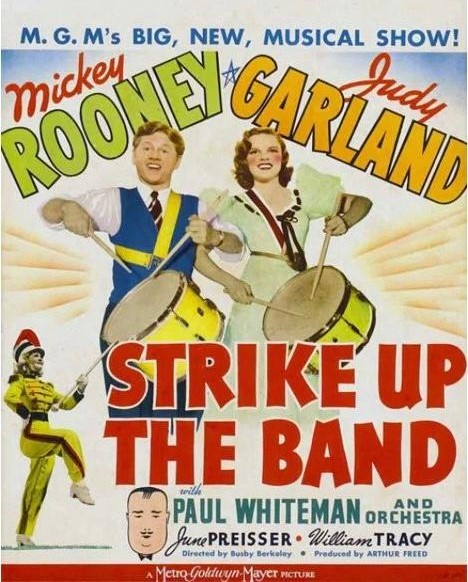

As for the family in family comedy, the few parents we see include Mickey’s widowed mother, whom he insists he will make “a queen” and June Preisser’s rich parents, who will bankroll Mickey’s ultimate success, which is very convenient.  Most of Mickey and Judy’s high school gang talk of parental rules but seem to run their own lives pretty well, to the point that the most important adults in their sphere are the school principal, played by Francis Pierlot, a longtime vaudevillian and stage actor whose film career in his senior years must have surprised and gratified him; and the real-life big band leader Paul Whiteman.


Mr. Whiteman’s orchestra played an important role in the 1920s when the well-mannered and sophisticated jazz of the era evolved into swing music in the early 1930s (Bing Crosby and Rudy Vallee were among those who had their start with him). By the time this movie was made, one could say that, though he had a noted place in the history of early twentieth-century American music, his best years were behind him.  American kids going to the grand party for rich June Pressier’s 18th birthday (How could they afford those rented tuxedos?) would have been thrilled to be listening and dancing to the famous Paul Whiteman’s orchestra; however, they probably had more Dorsey, Miller, and Kyser records at home and were probably wondering when the “boogie-woogie” would start.


Mickey and his pals play in the school band, which is dull and uninspiring to them, but the scene gives us an oh-so-brief comic glance at the disapproving, spinsterish music teacher played by Virginia Sale, who had a long career playing much older character parts.  She was the sister of vaudevillian comic Chic Sale.  She also wrote and played in a one-woman show called American Sketches, with which she toured from the 1930s through the 1950s, including a stint over in Europe to perform for the troops during World War II. 


Mikey Rooney, born in a trunk and growing up on a soundstage, was by now a veteran movie star, not just a movie actor, and could do this role in his sleep.  It does, however, give him a chance to exhibit yet another talent for us—he was a very good drummer, and his solo pieces in this movie are terrific.


Mikey’s dilemma in the movie is that he wants to be a big band leader but his sainted mother wants him to be a doctor.  Money is tight (or as Mikey says, “When’s bank night?”), so we don’t know how she thinks this is going to happen, but Mikey dreads disappointing her.  Still, on the sly, and with a polite, clean-scrubbed rebellious streak, he organizes his buddies on the all-male school band into a dance orchestra.  They want to perform at parties and dances and raise money to go to Chicago to audition for Paul Whiteman and get rich and famous.


Every big band needs a girl singer, and this is where Judy Garland comes in.  Judy is, as always, wonderful, multi-talented, tears your heart out with a look and a lyric, and seems to grow in her powers with each movie she makes at this period.


We are treated to Gershwin tunes and different settings, from the imaginative but weird fantasy where a bowl of fruit becomes an orchestra via stop-motion animation, to a spirited conga number in the high school gym, to a very long and overly produced finale that gives us—either as an afterthought or perhaps a cherry on top—the image of martial bands, Mikey in a white naval uniform, and a salute to the flag.  Clearly, the studio wanted to make sure, even in the last moments of the film, that all bases were covered.


Mikey’s solution to his problem dovetails with Judy’s problem—which is the effervescent June Preisser, the (as we mentioned in this previous post) “eye-rolling junior vamp” with the rolling acrobatic moves that always astound but that never seem to fit in with a musical number.  June’s making eyes at Mikey makes Judy miserable.  Judy pines after Mikey, but the fool never seems to notice.


Pining after Judy is the really funny and quite endearing Larry Nunn as Willie, a boy who is a freshman to their senior grade.  Larry Nunn had a brief movie career—this film was probably his best work—and died tragically at only 49.  Young Willie provides the dramatic crisis in the film when he is injured and requires an operation.  The gang turns over their earnings to him and, as we see in the melodrama play they perform as a fundraiser, virtue is its own reward.


A word about the melodrama, a Gay Nineties spoof called “Nell of New Rochelle.”  I think this is my favorite part of the whole movie, partly because of the silliness, and partly as a tribute to a long-ago form of entertainment.  It’s part of our American theatrical heritage.  When this movie was made, the Gay Nineties was only fifty years ago.  I say “only” because I have now reached the senior citizen stage of my life and to me, the 1990s was last Thursday, and the 1970s was the week before that. 


The spoof also gives William Tracy, one of Mickey’s pals, a spotlight role as the villain of the piece.  His overly made-up and sneering, sinister overtures to virginal Judy is a stark contrast to his somewhat goofy teen personality, always worried about whether or not he is on the outs with his girlfriend, Annie, played by Margaret Early.  Young Mr. Tracy’s most prominent role was likely the jokester junior shop clerk in The Shop Around the Corner, made the same year of 1940 (see this previous post.)


The silliness of this “mellerdramer” also served as an inspiration to me when, a couple decades ago, I directed a similar kind of show for my local community theater called “The Face on the Bar-Room Floor,” and we incorporated many of the gags in this spoof:  the counting of the chimes of the town clock always being wrong, using many of the same songs:  “She Is More to be Pitied Than Censured,” “After the Ball, “ “Father, Dear Father,” etc., and when the unfortunate child, like Willie in the movie, died and suddenly bore a white gown and cardboard angel wings, instead of “flying” him on a wire, we brought out two gum-chewing, bored-looking stagehands to hoist him on their shoulders and parade him off to “heaven.”  The audience loved it.  That community theatre show remains a warm and wonderful memory that returns to me when I see this spoof in Strike Up the Band.


A few other favorite moments: 


When June Pressier, new student, confidently slinks into the classroom, causing Margaret Early to whisper to Judy Garland, “She’s touched it up,” referring to June’s being a dyed blonde—Judy, half admiring and half dreading a competitor murmurs simply, “Yeah.”  It’s a quiet moment, and in moments like these and when she is singing the comic but plaintive, “I ain’t got nobody and nobody’s got me,” in the library is when Judy is at her most powerful, commanding the screen far more than in the frenetic moments when—one suspects at the insistence of Busby Berkeley—her forceful eye-popping enthusiasm is nothing more than a theatrical ploy.  It does not draw us in like the real acting does.


We might also note in the library scene a brief Charles Smith sighting as the boy who’s looking for a book on the fall of the Roman Empire.   We also see Charles in the above-mentioned The Shop on the Corner.


I also like Willie’s pathetic and funny marriage proposal to Judy just before his mother calls to tell him it’s his bedtime, and the long-suffering Willie’s remark to Judy, when he sees that Mikey has snubbed her again, “Just give me the word, Mary, and I’ll slug him,” and “Some birds just got to be shot twice before they stop flying.”


At some point between the high school dance and the big gig in Chicago, the kids have graduated from high school, but we never see the ceremony and it seems of secondary importance to their quest for fame and fortune.  It’s a world of homespun advice from Mom, played by Ann Shoemaker who offers in her society lady diction, “The top of the ladder is very appealing, and for my sake, be careful how you climb that ladder, because that’s very important, too.” 


Paul Whiteman offers his own advice, or something about dying and drumming, “When we get to the last eight bars of the big tune—the last thing to stop is our rhythm.”


It’s a world of neckties and sweater vests, and it’s a nice place to visit, and I wouldn’t mind living there, too.


 *******************

Our greatest gift from the Greatest Generation was freedom from fascism. Relive, and celebrate, how evil was faced, discussed, dramatized...and fought. Classic films were Hollywood's weapon.

Get your copy of my book Hollywood Fights Fascism here at Amazon in print or eBook, or FREE here for a limited time at Barnes & Noble, Apple, Kobo, and a variety of other online shops.

  ************

Jacqueline T. Lynch is the author of Ann Blyth: Actress. Singer. Star. and Movies in Our Time - Hollywood Mirrors and Mimics the Twentieth Century and Hollywood Fights Fascism and Christmas in Classic Films. TO JOIN HER READERS' GROUP - follow this link for a free book as a thank-you for joining.


Thursday, December 4, 2014

Babes on Swing Street, and Bowery to Broadway - 1944


Babes on Swing Street and Bowery to Broadway, both released in 1944, are examples of the old studio system as both an incubator for talent, and a factory assembly line devoted sometimes more to quantity than quality. They were the last two musicals Ann Blyth would appear in for many years as her career took a sharp dramatic turn with far more challenging roles. It is astounding to think after Bowery to Broadway, in which she appeared only a few minutes at the end of the film, that her next project would be Mildred Pierce for Warner Bros., and an Academy Award nomination.

We covered her first two films under her new Universal contract, Chip off the Old Block and The Merry Monahans, also released in 1944, here. Lightweight musical comedies featuring teen stars, they were a good start for the young Ann Blyth, new to pictures, though she was coming to Hollywood with the impressive pedigree of a prestigious Broadway show under her belt, Watch on the Rhine. It was likely this reputation as a serious child dramatic stage actress, the prestige of that show, her own prettiness and demure demeanor that caused the casting directors to launch her film career in the persona of a sophisticate, a rich girl, a nice girl, or all three. Another factor to her being cast as the all-American girl everyone wanted as a friend or daughter was her soprano singing voice.

Jack Ano, in his introduction to Hollywood Players: The Forties aptly puts it:

The Hollywood definition of “class” knew no boundaries and there was nothing ritzier at the time than a soprano. Gloria Jean, Mary Lee, Ann Blyth, Susanna Foster, Kathryn Grayson, and Gloria Warren, at various times, served as the junior league Deanna Durbins…

As mentioned in a previous post, though MGM grabbed the “lion’s” share of attention when it came to so-called “backyard musicals,” it was really Universal that produced more teenage talent. When Deanna Durbin abandoned ship, the void was filled not by a single replacement, but by a cadre of young adults. The ritzy sopranos listed above were joined by Grace MacDonald, Donald O’Connor, and Peggy Ryan, and The Jivin’ Jacks and Jills. We’ve noted in the post on Chip off the Old Block and The Merry Monahans that the dance/comedy team of O’Connor and Ryan was something special and couldn’t be beat.

By the time Ann Blyth arrived at Universal to make the duo a trio, several movies were put into production at once to use Donald O’Connor as much as possible before he entered the army. It was a quick splash into movie making for the newcomer, but Ann felt, “It was an incredible and enriching experience.”


Babes on Swing Street (a cheeky coincidence but no relation to MGM’s Babes in Arms, Babes on Broadway, etc.), starred Peggy Ryan and Ann (sans Donald). Except for the old one-reeler comedies with Zasu Pitts and Thelma Todd (or others), I can’t think of a female team given top billing together. To be sure, this was more B movie than A list, and the predominantly youthful cast and focus on ambitious teens “making good” (are young people encouraged to “make good” anymore or just make money?), the critics who bothered to review the film dismissed it as “one of those minor league musical affairs…”

Directed by Edward C. Lilley, the movie lasts just over an hour, and though brief, is stuffed with songs, gags, and a plot somewhere in there if you look hard enough. Peggy Ryan is the president of kids’ club at the local settlement house where teens meet to play ping pong and get off the streets.

They are also all very talented singers, musicians, and tap dancers, and want to “make good.” A music academy (headed by our old pal Ian Wolfe) will give ten of them partial scholarships if they can come up with the rest of the tuition.

Ann hangs out at the settlement house, too, but she’s a rich girl who lives with a domineering aunt, played by Alma Kruger, and befuddled uncle, played by Leon Erroll. Her attempts to help the kids are constantly rebuffed by the resident heartthrob played by Billy Dunn, who resents her for her wealth. Why she’s stuck on this unpleasant boy, and why he suddenly turns around and falls for her at the end is never really clear. He just does. Probably because she’s the soprano.

Ann uses the word, “solid” as a compliment to prove she is hep, as do others in the movie to remind us these teens are in the groove. They’re not groovy; they’re just in the groove.

The gang decides to open a nightclub for teens to raise the funds. Ann donates her aunt’s empty rental property, a hall, and the kids scramble getting tables, food, aided by swell grownups Kirby Grant, Ann Gwynne, and Andy Devine, who plays Peggy Ryan’s father. We mentioned in this previous post on Ann’s stage career that Mr. Devine played her pop, Cap’n Andy, in Showboat on tour in the 1970s.

June Preisser has a flashy role as the eye-rolling junior vamp (which was her stock in trade, no matter what studio she roamed or what teen couple she tried to break up), and demonstrates astounding skill, as usual, in her ability as an acrobat and contortionist, with rolling flops on stage that seem to indicate she was without vertebrae. June was actually older than the other kids, something like 23, already a wife and mother when she made this film, some eight years older than Ann Blyth, but with her cute looks and cherubic grin, she played young. Her junior Mae West number: “I’ve Got a Way with the Boys.”

She is Ann’s rival for Billy Dunn’s affections, but, interestingly, nobody is paired with Peggy Ryan, despite her being the lead. A comedienne hardly catches a romantic break, though she could do much more than comedy. (I like her handling of the line, “Lay off the sarcastics.”

“You mean sarcasm.”

“I like sarcastics. It sounds more…sarcastic.”)

Peggy, with three dance numbers, is showcased more than the other kids. Her routines here are not quite as athletic as her slam-dunk partnerships with Donald O’Connor, but demonstrate her really fine versatility in balletic, tap and comic novelty dancing.

One number she sings and dances is a parody of a Russian folk dance, in deference perhaps to our wartime allies. Why critics seemed to write off this prodigious talent as mere clowning, or why Universal didn’t widen her range of roles, I don’t know, but Peggy Ryan was one of the most talented performers of the era.

Ann sings “Peg O’ My Heart” backed by a male chorus, demonstrating a pretty voice, but nowhere near the range or power she developed down the road. We don’t see much of the other acts, which are filler, except for Sidney Miller as a wise guy emcee who does imitations of Hollywood stars, including Katharine Hepburn, complete with calla lily.

The movie ends with the finale and everybody on a stage much too large to accommodate this rented hall, and this must mean the kids have “made good.”

You can see the entire movie free on the Vimeo site here. Below, the trailer.


Bowery to Broadway turns the reins over to the grownups, though Susanna Foster, Peggy Ryan, Donald O’Connor, and Ann Blyth all have brief roles in specialty acts. Jack Oakie and Donald Cook are the stars. They are competitors and later partners in producing shows from…the Bowery to Broadway. You’ll remember Donald Cook as Ann’s father in Our Very Own (1950), covered here.

It’s a passing parade of years story of vaudevillians and impresarios stealing acts from each other, spanning from about 1900 to about 1930. Everybody on the Universal lot showed up for a scene or two in this one: Maria Montez, Leo Carrillo, Andy Devine, Evelyn Ankers, Thomas Gomez (our old favorite, who appeared with Ann in Swell Guy here and who squires around Louise Allbritton as Lillian Russell), Snub Pollard, Walter Tetley—who, like Ann, performed on the Coast to Coast on a Bus radio show as achild in New York, see our intro post.


Most reviews were disparaging. Syndicated columnist Harold V. Cohen:

Universal has put a lot of people into Bowery to Broadway and virtually nothing else. In talent, or at least in the abundance of talent, it goes sky-high. In originality and imagination, it hits rock-bottom.

Buck Herzog of the Milwaukee Sentinel thought the movie:

…is a rambling musical…there can be little in the story that can termed refreshing, much of it being a rehash of shopworn cinema situations. But there is music, glittering production scenes…

It is a hodgepodge, and the material is familiar, but I think that is what makes the movie enjoyable. These are the good old days, even the sad times, and nostalgia works when parody is teasing, but not mean or condescending. Most of these theatrical show movies are really valentines to the art and era, and especially poignant when you know that many of the actors in such movies began in vaudeville. Or even, like Ann, had hit “the big time” on the legitimate Broadway stage. They are, in a sense, paying homage to their own roots.


A charming scene were Lillian Russell leads an impromptu sing-a-long with “Under the Bamboo Tree,” and another bright spot in the film is the comic patter between Ben Carter and Mantan Moreland, whose fortunes rise to become owners of a Harlem night club. In a really funny routine, their old vaudeville act really, they finish each other’s sentences with impeccable timing. At one point when Donald Cook and Jack Oakie are down and out, and Mr. Carter and Mr. Moreland offer to loan them money, flush with success and driving their own big convertible, a rare scene for African American performers in a movie from this era.


Susannah Foster was riding a crest of popularity from her best role as Christine opposite Claude Rains in the 1943 Phantom of the Opera, but her film career would be brief, and after taking time to study in Europe to improve her operatic voice, an expected and desired comeback never happened.


We get a little bit of everything here: the footlights, the neon, the headlines from Variety and Billboard, the Lambs Club, the star treatment, the bum’s rush, a tossed garter, a tragedy. Frank McHugh and Rosemary DeCamp are a pair of hoofers, who struggle for years to make “the big time.” They never make it. In one of the most poignant scenes, they overhear a producer for whom they’ve auditioned call them “old hat—they don’t belong here.” Dejectedly, they ponder the lights of Broadway out a window in an empty hallway, when an elevator operator asks them,

“Going up?”

Frank McHugh shakes his head, “Going down.”


We see them next struggling to run a children’s dance school in their apartment. One little girl is particularly terrible. She has no rhythm and does everything opposite to what the other kids do. She’s about as coordinated as an elephant. She’s their daughter.

You have to laugh. The one thing they want more than being on Broadway is seeing their kid succeed, but a pirate with a peg leg is a better dancer. But the husband-and-wife team of McHugh and DeCamp is really the spirit of the movie, the joy of performing and the broken hearts that result from rejection. At one point Jack Oakie, on the outs with his partner, is fed up with producing shows because he has been shoved into the position of bean counter, and the gloss of the modern shows has no heart like the old time variety. Rosemary DeCamp puts his misery succinctly, “It’s just business, not show business. Not the part that gets under your skin. The all-night rehearsal, the put it together, pull it apart.”

But the years pass, and finally Oakie and Cook decide to reunite and stage a new show, nothing high falutin’ or artsy, just good old fashioned entertainment, (I love the line, “It’ll make Blossom Time look like a one-night stand.” The Sigmund Romberg hit ran a year and a half in the early twenties.) They have a new singer they found in some theater amateur hour and give her a chance. She turns out to be McHugh and DeCamp’s ungainly daughter, now grown up and pretty as a picture—and not a dancer at all, but a singer. She is Ann Blyth.

Mom and Pop are fit to bust with pride to see their kid’s name in lights, even if still chagrined that she can’t dance. You’ll remember, by the way, that Rosemary DeCamp also played her mother in The Merry Monahans.
Also appearing in their great new show are Donald O’Connor and Peggy Ryan performing the parody of a Gay Nineties cad and the tragically duped woman lured by his promise of wealth, “He Took Her For a Sleigh Ride in the Good Old Summertime.” It’s a funny and fun number, but the dancing is merely just a gentle soft shoe here. O’Connor is especially humorous with his careful rolling R diction as a “mellerdramer” villain, complete with waxed handlebar mustache.

Ann is given the spotlight in the finale with the frothy production number, “Sing What’s in Your Heart.” She enters on a throne, with a chorus of springtime nymphs around her.

An interesting scene shows Jack Oakie and Donald Cook in the plush lobby of the Broadway theater in which their big show is going on, and as they head up a grand staircase, we see large portrait paintings of whom we might assume to be great theatrical headliners of the past.


Look closely. One is of Donald O’Connor, and one is Ann Blyth, which looks like a version of one of her publicity stills of the time.

Bowery to Broadway had been on YouTube for a time, and a possibly gray market DVD might be found, otherwise you’re out of luck.

Interestingly, Ann is billed with the stars and ahead of others in the cast with larger roles (she’s really only in this movie for a matter of minutes), which I think signals the fact that Universal, in disbanding their Jivin’ Jacks and Jills youth unit, were putting all their chips on Ann as someone who could grow beyond a teen performer. Three movies were released one after another in successive months: The Merry Monahans in September 1944, followed immediately by Babes on Swing Street in October, and the last, Bowery to Broadway in November.

Then she had a screen test over at Warner’s for a new Joan Crawford movie: Mildred Pierce. The leap from teen nice girl soprano to the glossy Noir and one of the screen’s most nasty characters is astounding, and we can attribute it to Ann’s tenacious and insightful agent named Al Rockett who got her a screen test; an indulgent star who offered to make the test with her: Joan Crawford; and that screen test.

According to an article in Photoplay, January 1956, Mr. Rockett fought for the test and told Warner’s “Throw the toughest scene you have at her.” It was the confrontation scene where Ann slaps Joan.

The director, Michael Curtiz, was convinced. Ann won an Academy Award nomination for the role of Veda Pierce, at seventeen years old, the youngest person to receive the honor up until that time.

Twelve years later, Ann did another screen test for Michael Curtiz, also for Warner Bros. She was not considered a likely candidate for this role, either, perceived as being too sweet, but agent Al Rockett came through again, and she was allowed to test. Lightning struck twice, and Ann blew everybody away with her screen test. She won the lead in The Helen Morgan Story. It would be her last movie.

We’ll talk about it next Thursday.


©Jacqueline T. Lynch, 2007-2014. All rights reserved. If you're reading this on a site other than Another Old Movie Blog, please be aware that this post has been stolen and is used without permission.

*******************************
Ano, Jack, introduction to Hollywood Players: The Forties by James Robert Parish and Leonnard DeCarl (New Rochelle, NY: Arlington House, 1976), p. 14.

Dick, Bernard F. City of Dreams – The Making and Remaking of Universal Pictures (University Press of Kentucky, c. 1997) pp. x, 129

Milwaukee Sentinel, December 23, 1944, review by Buck Herzog, p. 6; February 16, 1945 review by Buck Herzog, p. 6.

Photoplay, January 1956, “Her Guardian Angel Kissed Her” by Maxine Arnold, p. 82.

Pittsburgh Post Gazette, December 25, 1944, review by Harold V. Cohen.

********************************
THANK YOU....to the following folks whose aid in gathering material for this series has been invaluable:  EBH; Kevin Deany of Kevin's Movie Corner; Gerry Szymski of Westmont Movie Classics, Westmont, Illinois; Ivan G. Shreve, Jr. of Thrilling Days of Yesteryear; and actor/singer/author Bill Hayes.  And thanks to all those who signed on as backers to my recent Kickstarter campaign.  The effort failed to raise the funding needed, but I'll always remember your kind support.
Delete
****************************
UPDATE:  This series on Ann Blyth is now a book - ANN BLYTH: ACTRESS. SINGER. STAR. -
*********************
The audio book for Ann Blyth: Actress. Singer. Star. is now for sale on Audible.com, and on Amazon and iTunes.

Also in paperback and eBook from Amazon, CreateSpace, and my Etsy shop: LynchTwinsPublishing.


 "Lynch’s book is organized and well-written – and has plenty of amusing observations – but when it comes to describing Blyth’s movies, Lynch’s writing sparkles." - Ruth Kerr, Silver Screenings

"Jacqueline T. Lynch creates a poignant and thoroughly-researched mosaic of memories of a fine, upstanding human being who also happens to be a legendary entertainer." - Deborah Thomas, Java's Journey

"One of the great strengths of Ann Blyth: Actress. Singer. Star. is that Lynch not only gives an excellent overview of Blyth's career -- she offers detailed analyses of each of Blyth's roles -- but she puts them in the context of the larger issues of the day."- Amanda Garrett, Old Hollywood Films

"Jacqueline's book will hopefully cause many more people to take a look at this multitalented woman whose career encompassed just about every possible aspect of 20th Century entertainment." - Laura Grieve, Laura's Miscellaneous Musings''

"Jacqueline T. Lynch’s Ann Blyth: Actress. Singer. Star. is an extremely well researched undertaking that is a must for all Blyth fans." - Annette Bochenek, Hometowns to Hollywood


Ann Blyth: Actress. Singer. Star. 
by Jacqueline T. Lynch

The first book on the career of actress Ann Blyth. Multitalented and remarkably versatile, Blyth began on radio as a child, appeared on Broadway at the age of twelve in Lillian Hellman's Watch on the Rhine, and enjoyed a long and diverse career in films, theatre, television, and concerts. A sensitive dramatic actress, the youngest at the time to be nominated for her role in Mildred Pierce (1945), she also displayed a gift for comedy, and was especially endeared to fans for her expressive and exquisite lyric soprano, which was showcased in many film and stage musicals. Still a popular guest at film festivals, lovely Ms. Blyth remains a treasure of the Hollywood's golden age.

***************************
A new collection of essays, some old, some new, from this blog titled Movies in Our Time: Hollywood Mimics and Mirrors the 20th Century is now out in eBook, and in paperback here.


Related Products