IMPRISON TRAITOR, PEDOPHILE, AND CONVICTED FELON TRUMP.
Showing posts with label Charles Bickford. Show all posts

Thursday, January 10, 2019

Ten Classic Film Actors and Actresses from Your State


Dear Edna May Oliver, a formidable talent, and clearly fearless and unrepentant in her poses, is one of my favorite Massachusetts girls.

How about a game to start off the new year?  Name any 10 actors and actress from your state (or country, or Canadian province as the case may be).  Either list them in the comments below, or post them to your own blogs and come back and give me the link to your post so I can share it here.

I'm from Massachusetts, so here's my picks from my home state:

Edna May Oliver
Bette Davis
Eleanor Powell
Thelma Todd
Agnes Moorehead
Charles Bickford
Wendell Corey
Charles Farrell
Jack Lemmon
Lewis Stone

*******************
Here's a roster from New Jersey over at Kate Gabrielle's place. 

A team of greats from Missouri over at Terence's A Shroud of Thoughts blog.

Here at Hamlette's Soliloquy you'll find a top-notch gang from Iowa.

Update:  So far we have...
Massachusetts
New Jersey
West Virginia
Georgia
New York
(and specifically, Queens, and NYC)
Ontario, Canada
Kansas
Missouri
Alaska
Iowa

So far that's 9 U.S. states, and 1 Canadian province.  Keep them coming!


Thursday, October 2, 2014

Brute Force - 1947


Brute Force (1947) remains a giant among prison movies.  Visually stunning, it has a noir foundation on which is hung an unusually sensitive (for noir) study of men trapped by their circumstances, their sins, their weaknesses, their fears, their anger, and even by their ability, those that still have it, to feel the pain of those around them.

Burt Lancaster heads a sterling cast, even the most minor character is vivid and memorable in this film.  That’s what happens when you have a crisp, literate, and biting script, and most especially, a director and cinematographer who freely turn what could have been a stiff sort of docudrama, or clichéd melodrama—how most prison stories tend to be filmed—into unabashed art.  We are treated to a generous array of stunning close-ups and interestingly framed shots that tell us volumes about the men, especially since they are in a setting where they are close-mouthed, unlikely to tell us everything that’s going on inside them.

Expository dialogue goes to the administrators in the prison.  We have Richard Gaines, so dependable in officious roles as the severe, pompous superintendent, always pressuring the anxious, ineffectual warden, played by Roman Bohnen.  The warden complains of cutbacks in funding, that the prison is overcrowded, that the men need job training…all of which the superintendent balks at, saying what the men need is more discipline. 

The soft voice of the head of the prison security force, played by Hume Cronyn, belies his sadistic nature.  The little man enjoys the fear he excites in the hardened men, most of them much larger and physically imposing—but Cronyn wields power he’s swiped in a vacuum of leadership, tortures them physically and psychologically, and he has Ray Teal following behind him with a billy club like a human swagger stick.

The cast is a feast of favorite character actors, like Sam Levene, and Charles McGraw in one of many uncredited roles that filled the first several years of his film career. 

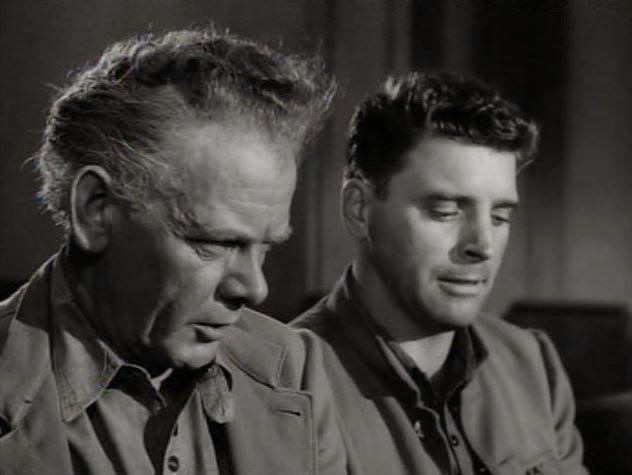
The wonderful Charles Bickford is the level-headed old timer, who breaks up fights in the prison among the other cons, and bides his time until his hoped-for parole.


Sir Lancelot sings calypso rhymes he makes up on the spot to narrate what he sees, as either a funny jest, or a warning, or a requiem for yet another dead prisoner.

There’s Jack Overman as one of the cellmates, an easygoing, simpleton ex-fighter.  One of my favorites, he has a bigger role here for once.  We’ve seen him in a non-speaking minor role in Once More, My Darling (1949) here, and also in Swell Guy (1946) here.  Sadly, Mr. Overman died in late 1949 at only 32 years old.

His cellmates include Whit Bissell, as a small-time embezzler, a sad, brittle fellow who, obsessed his shallow wife, played by Ella Raines in a flashback segment, fearing losing her love, steals from his employer to buy her a mink coat. 

John Hoyt is a stylish grifter, mainly in phoney stocks, a man-about-town with a charming easy-come, easy-go attitude.  I love his line, “I wonder who Flossie’s fleecing now?”

Howard Duff, in his first film, is a former soldier who took the rap for Yvonne De Carlo, an Italian woman he falls in love with during the war.  She has murdered her father to save Duff, but though he takes the blame to save her, I don’t believe his current imprisonment is for that crime.  He remarks about always wanting to get back to Italy to see her, but “one rap led to another.”

The best lines, and probably the best role of the film happily goes to Art Smith, who plays the prison doctor.  He’s just as fatalistic as the cons, and drinks heavily to dull the pain of this miserable place.  It's a terrific performance.   

But unlike the weak warden Roman Bohnen, who gives in to the bullying Richard Gaines and the devious machinations of Hume Cronyn, Mr. Smith is still a man of strong conscience.  He gets into shouting matches with them all, gets right in their faces and bleeds his anger and sarcasm all over them.  Again and again, they slap him down.

Burt Lancaster, whose character as the leader of his cell, and one of the most respected by the other prisoners for his toughness, is beautifully lit, if you can call his deadly cold glare and vicious snarl beautiful. 

We first see him standing in the prison yard in the pouring rain, but with his soaking wet shirt tucked neatly into his soaking wet prison trousers, he strides back to his cell, his shoulders straight, his head held high with an air of nobility.  Though he has just come out of solitary confinement, he is not broken.  He is angrier, and more charismatic to us and to the other prisoners, than ever.  The other men light his cigarettes as a mark of his leadership.  The only one who ranks him is Charles Bickford, who freely reaches into Lancaster’s prison jacket in another scene and swipes a match from Burt’s shirt pocket to light his own cigarette.  Burt lets him, hardly noticing, as if the older man could be his father and is allowed such liberties.

Because this is a setting of confinement, much of the film has the feeling of theatre, and the action that takes place is muted and judicious, until the very end of the film when we have the attempted prison break.  Director Jules Dassin and writer Richard Brooks have the perfect marriage of script and cinematography, where each supports the other, and the pace of the movie flows beautifully, building tension, and then releasing it a bit at a time in unexpected moments of black humor, and when, where the men watch the 1947 comedy The Egg and I starring Fred MacMurray and Claudette Colbert, it seems surreal.

Ann Blyth, like the few other women in the cast, save for the officious and severe secretary of the warden, is shown in flashback.  The women on “the outside” show us what the men’s lives were like before they went to prison.  There has always been a debate as to whether the flashback scenes with the women are necessary to the film.  Some critics and viewers feel they are fitting to the story, and others feel they slow the story down and detract from the intensity of the prison scenes. 

Even director Jules Dassin apparently did not want to use the flashback device.  Author Alan K. Rode in his biography of Charles McGraw, Charles McGraw: Biography of a Film Noir Tough Guy, reveals that Dassin gave in to producer Mark Hellinger and the studio brass to include the four flashback scenes that show women who have influenced the lives of some of the men in the cell.  He quotes Dassin:

“Truly, the film is demeaned by the inclusion of ‘the women.’  I had to choose between not making the film and yielding to having the women nonsense.  Many years later when I looked at the film…I do not forgive myself.”

I don’t know how screenwriter Richard Brooks felt about the women scenes, but I’m inclined to think Mr. Dassin’s dislike of them might be, in part, a director’s usual, and quite understandable, bristling at having to shoot the film to someone else’s vision.

On another note, Mark Hellinger had to fight toe-to-toe with the Breen office because the MPAA wanted to censor many of the films violent scenes, a reference to marijuana, and even to exclude the word “cancer” when referring to Ann Blyth’s diagnosis because the very word was upsetting to the public.  Perhaps Hellinger threw Breen a bone when he has the doctor, Art Smith, reassure Burt Lancaster that, “These days, cancer doesn’t have to mean death at all.”

That’s another reason why Burt has to bust out of prison.  There’s a time element to Ann’s needed operation.

Others have suggested that the flashbacks represent a societal misogyny, or some statement to the effect that these are regular Joes who’ve been led astray by dames.  Again, here I disagree.  They show the men, more than the women, to be flawed.  Though John Hoyt has his car, his gun, and his gambling winnings stolen by a floozy, he was obviously willingly, knowingly taking chances in an underworld game of roulette, and the odds were against him this time.  He shrugs it off, amused and unrepentant.

Whit Bissell’s wife’s cooling ardor for him, and her greed for the mink coat which she clearly treasures more than her husband, leads to his downfall, but she did not force him to embezzle, had no idea he was doing it.  Bissell was not led astray, he was a fool who turned to thievery, and his obsession with his wife was such that it leads to his suicide when Hume Cronyn tells him (whether true or not) that his wife is divorcing him.  “I get quite a kick out of censoring the mail.”

Howard Duff’s taking the rap for Yvonne De Carlo does not make her a villain, her act of love is to protect him; his was to protect her.  But thinking this paints Duff as a hero wrongly placed in prison is also erroneous.  He is not in prison for assuming the guilt for her murder of her father; he plainly tells us he’s had other “raps” since.  Besides, he would have been incarcerated in a military prison were that so.  Look at the scene where he, John Hoyt and Jeff Corey go after a “stoolpigeon” prisoner with blowtorches, forcing him to be crushed in a stamping machine.  Look at their expressionless faces.  These regular Joes are killers. 

We could probably dispense with their flashback scenes (indeed, Anita Colby as Hoyt's floozy girlfriend never even gets any lines), but the one with Burt Lancaster and Ann Blyth I think is important to the film.  We don’t know if Lancaster has committed murder on the outside, but we see he is tied in with a gang he gives orders to, and probably is involved in something more like bank robbery.  Just before he leaves on another “job,” he stops by the house where Ann Blyth lives, an invalid in a wheelchair.  Lancaster hands a caregiver an envelope with money, “See that she doesn’t need anything.”

Ann is at first asleep, then he wakes her, and in their tender scene shows us that Lancaster is tired of running, that this will be his last job, and then he will come back to her for good.  He tells her that when he met her, he was a guy who “found the first important thing in his life.”  She doesn’t know what racket he’s in, but she senses he is troubled.  She wants to help him, wishes she weren’t sick so that she could help him.

“There are all kinds of sick people, Ruth.  Maybe we could help each other.”  The scene is gentle, affectionate, somewhat sad.  Ann’s character is not a gun moll, she’s a sweet, decent girl who trusts him.  This is important because it bolsters the visual image we already have of Burt Lancaster in the film as more a wounded animal than a psychopath.  

Indeed, at the very end of the movie when he is shot in the prison escape, he rears back with a single roar of pain and rage, like an animal in a trap, cut short as he fires several rounds into the guard who wounded him.  Bookending his cold expression of anger through most of the film is the softened, relaxed look of tenderness on his face when he sees her sleeping, and at the very desperate end when he sees that the escape plan has failed, and he looks for a moment like he could cry.

We need this scene with Ann Blyth, maybe all of “the women” scenes, not to remind us that the men are human, but because we are.  We can’t root for criminals to break free from jail, not unless we have some emotional stake in their success.  Without emotion, it becomes as academic as a watching the outcome of a dog race, and without the betting.

Interestingly, their scene ends with the camera remaining focused on Ann after Burt has left the room, tears welling in her eyes, heartbroken, frustrated, and fearful.  Dassin's touch, or Hellinger's?

One wonders what private demons she might have faced in the brief scene.  She was eighteen years old.  In the previous two years she had spent several months really in a wheelchair as a result of her spine injury, and her mother really died of cancer, both discussed in our intro post to this series.  Life's coincidences are occasionally macabre.

Producer Mark Hellinger may have had yet another reason for putting Ann Blyth and Burt Lancaster together.  He had hired her for Swell Guy (1947), and him for The Killers (1946).  They were two of Universal’s most talented up and coming stars, and he may have wanted to turn them into a team.  According to syndicated gossip columnist Dorothy Manners who wrote this in May 1946:

Mark Hellinger, always good for a bright idea, said to me, “Where are those swell romantic teams that used to make the fans goggle-eyed over their love scenes…It’s time the love team is revived on screen,” and Mark is the boy who is going to do it with his two young stars, Ann Blyth and Burt Lancaster…he wants to make three or four with Ann and Burt.  This Blyth girl is the real star stuff—young, tempestuous and definitely a screen personality.  If you saw her as Mildred Pierce’s daughter, you know what I mean.

Having played in her previous two films as young women of dubious, or downright evil, character, her role as the kindly, gentle Ruth in Brute Force would be the first important break in a string of roles that could have left her typecast, and farther away from ever doing the musicals she hoped to make.  But Ann Blyth was not done with bad girls yet: A Woman’s Vengeance (1948), discussed here, and Another Part of the Forest (1948), discussed here, were on the horizon.  She’s in Brute Force all of only about three or four minutes, but her scene is indelible, and does more for Burt Lancaster’s character than the awe the other prisoners show for him.

Their romantic team never did materialize.  Both went on to other films, and Mark Hellinger, who might have made a pet project of bringing them together again on screen, tragically died about six months after Brute Force was released.

Come back next week to Katie Did It (1951), a movie I can’t find, and a few thoughts about that and on Ann’s career as we round the corner and head for the home stretch on this series.


*************************
Milwaukee Sentinel, May 31, 1946, syndicated column by Dorothy Manners, p. 4.

Rode, Alan K.  Charles McGraw: Biography of a Film Noir Tough Guy, (McFarland, 2007), p. 32.


****************************
As  most of you probably know by now, this year's TCM Classic Cruise will set sail (proverbially) in October, and one of the celebrity guests is Ann Blyth.

Ann will be doing a couple hour-long conversation sessions, and will also be on hand for a screening of Mildred Pierce.

Have a look here for the rest of the schedule and events with the other celebrity guests. Unfortunately, the cruise is booked, so if' you're late, you can try for the waiting list.

I, sadly, am unable to attend this cruise, but if any reader is going,  I invite you (beg you) to share your experiences and/or photos relating to Miss Blyth on this blog as part of our year-long series on her career.  I'd really appreciate your perspective on the event, to be our eyes and ears.  Thanks.
****************************
 THANK YOU....to the following folks whose aid in gathering material for this series has been invaluable:  EBH; Kevin Deany of Kevin's Movie Corner; Gerry Szymski of Westmont Movie Classics, Westmont, Illinois; and Ivan G. Shreve, Jr. of Thrilling Days of Yesteryear.  And thanks to all those who signed on as backers to my recent Kickstarter campaign.  The effort failed to raise the funding needed, but I'll always remember your kind support.
***************************
TRIVIA QUESTION:  I've recently been contacted by someone who wants to know if the piano player in Dillinger (1945-see post here) is the boogie-woogie artist Albert Ammons. Please leave comment or drop me a line if you know.
****************************
UPDATE:  This series on Ann Blyth is now a book - ANN BLYTH: ACTRESS. SINGER. STAR. -
*********************
The audio book for Ann Blyth: Actress. Singer. Star. is now for sale on Audible.com, and on Amazon and iTunes.

Also in paperback and eBook from Amazon, CreateSpace, and my Etsy shop: LynchTwinsPublishing.


 "Lynch’s book is organized and well-written – and has plenty of amusing observations – but when it comes to describing Blyth’s movies, Lynch’s writing sparkles." - Ruth Kerr, Silver Screenings

"Jacqueline T. Lynch creates a poignant and thoroughly-researched mosaic of memories of a fine, upstanding human being who also happens to be a legendary entertainer." - Deborah Thomas, Java's Journey

"One of the great strengths of Ann Blyth: Actress. Singer. Star. is that Lynch not only gives an excellent overview of Blyth's career -- she offers detailed analyses of each of Blyth's roles -- but she puts them in the context of the larger issues of the day."- Amanda Garrett, Old Hollywood Films

"Jacqueline's book will hopefully cause many more people to take a look at this multitalented woman whose career encompassed just about every possible aspect of 20th Century entertainment." - Laura Grieve, Laura's Miscellaneous Musings''

"Jacqueline T. Lynch’s Ann Blyth: Actress. Singer. Star. is an extremely well researched undertaking that is a must for all Blyth fans." - Annette Bochenek, Hometowns to Hollywood


Ann Blyth: Actress. Singer. Star. 
by Jacqueline T. Lynch

The first book on the career of actress Ann Blyth. Multitalented and remarkably versatile, Blyth began on radio as a child, appeared on Broadway at the age of twelve in Lillian Hellman's Watch on the Rhine, and enjoyed a long and diverse career in films, theatre, television, and concerts. A sensitive dramatic actress, the youngest at the time to be nominated for her role in Mildred Pierce (1945), she also displayed a gift for comedy, and was especially endeared to fans for her expressive and exquisite lyric soprano, which was showcased in many film and stage musicals. Still a popular guest at film festivals, lovely Ms. Blyth remains a treasure of the Hollywood's golden age.


***************************
A new collection of essays, some old, some new, from this blog titled Movies in Our Time: Hollywood Mimics and Mirrors the 20th Century is now out in eBook, and in paperback here.


Thursday, July 21, 2011

Calamity Jane Pt 2 - "The Plainsman" - 1937


“The Plainsman” (1937) never lets an absence of fact stand in the way of telling us a good story. Director Cecil B. DeMille is in his element here, treading on history and myth with great flourish. Here Calamity Jane is part of the tapestry of the American West and not just a freak show refugee. We can thank Mr. DeMille for this, for if he bends the truth a bit, he at least makes the attempt, and most certainly Jean Arthur makes the attempt, at showing Calamity Jane to have angst and tenderness, humor and compassion, which were most certainly part of her character as much as the men’s clothes and bullwhip.

Other parts of her character were eliminated, such as the drinking and raucous behavior that occasionally landed her in jail in real life, and this is a shame, because we might have learned more about Calamity Jane if she had been allowed to be more than just Wild Bill Hickok’s girlfriend.

Not that DeMille’s Calamity Jane was fooling audiences at the time. The review in the New York Times by Frank S. Nugent charges DeMille with “taking history by the tail and throwing it out the window." I particularly like the line “ you frontier authorities will probably be confounded, and will confound Paramount for telling you the sweetest story ever told about Wild Bill and Calamity Jane...the changes that time and Jean Arthur have wrought! She doesn't chaw tobacco anymore. She doesn't cuss. She doesn't run around with the boys. She just talks low and husky, is cute when she's being tomboyish, and she loves Wild Bill so much, she almost faints when the Indians start torturing him..."

In “The Plainsman” Calamity Jane is one of the trio of American West icons. Wild Bill Hickok, played by Gary Cooper, helps his pal Buffalo Bill Cody, played by James Ellison (who we’ll meet up farther down the trail in “The Texan and Calamity Jane” as her new prospective boyfriend), deal with a Cheyenne uprising and the scoundrels who sold them repeating rifles.

The movie starts in Washington, D.C. towards the end of the Civil War, where President Abraham Lincoln discusses the proposed transcontinental railroad. He wants the frontier to be made safe for the plow. Then he excuses himself from the meeting because he’s going to Ford's Theater. We covered what happened at the theater that night in this previous post on “Prince of Players” (1955).

Before we get too far, we might as well just forget picking out historical inaccuracies. There are too many of them. Suffice it to say in any movie about Calamity Jane, approach it as entertainment and not as a documentary on her life. Very little of what you see is probably true.

After Abe’s left the room some unscrupulous arms manufacturers conspire to sell rifles to the Indians because with the Civil War winding down, they are not going to make such huge profit anymore. The man they have dealing directly with the Indians is Charles Bickford. Though he's the head bad guy, we don't see that much of him in this movie. We get a bigger impression of his smarmy toady Jack McCall, played by reliable smarmy guy Porter Hall. He seems to bump into Gary Cooper a lot.

When we meet Wild Bill he is at the river landing in St. Louis, about to board a riverboat. He has just been discharged from the Army, and he runs into his old pal and fellow scout Buffalo Bill Cody and Cody’s new bride played by 19-year-old Helen Burgess (whose career was sadly cut short when she died of pneumonia the following year).

DeMille gives us one of his patented scenes of history that is a feast for the eyes. The camera leisurely moves over an enormous steamboat, and more extras than you can possibly count all moving busily in this bold young city on the Prairie. There are calls of “Mark Twain!" from the river navigators plumbing the depths, and most of you I'm sure know this is where the writer, Mark Twain, chose his pseudonym. We take it all in, and that's what Mr. DeMille meant us to do.

In a minute, we meet Herself, Calamity Jane. Not standing out in the crowd, only one of the Western menagerie. She is hitching a team of horses to her stagecoach. She wears loose buckskin trousers and shirt, and an army kepi. And, what appears to be quite red lipstick. Her short hair is brushed back off her face in a manner similar to the longish hair of Gary Cooper and Buffalo Bill Cody, making all three of them sort of resemble each other.

We might interject here that according to Calamity Jane, the Woman and the Legend by James D. McLaird (University of Oklahoma Press, 2005) which we referred to in our first post on this Calamity Jane series on Monday here -- the real Calamity Jane had dark hair and was tall, at about 5'9" and about 170 pounds, which one of her contemporaries recalled many decades later, was “all frontier muscle." (Page 112.) Whether this is a picture of her in her 40s or her 20s, we don’t know, but it’s of course drastically different from the blonde, delicate-looking Jean Arthur who stood about 5'3".

But there is something in Arthur's characterization that seems so natural. Particularly when you compare it to other actresses who've played Calamity Jane that appeared more affected and stagey.

We see Jean Arthur hitching up her team, climbing on the stagecoach, and throwing her whip. She does it with a natural athletic gracefulness quite different to many actresses in the role whose stomping around in hands-on-hips postures is done deliberately to look to mannish. She seemed perfectly at ease with what she's doing and this is the chief accomplishment in Jean Arthur's work.

Author James D. McLaird quotes from a play written by Thomas Newson in 1878, only a couple of years after the incident in 1876 when Wild Bill Hickok was shot by Jack McCall (I know this is a movie spoiler, but it's also history). Playwright Newson describes the character Calamity Jane in his stage directions: “Her movements are all free and unstudied, yet in no sense unbecoming. Her conversation is animated. She imitates no one; is an original in herself; despises hypocrisy; and is easily melted to tears. She is generous, forgiving, kind-hearted, sociable, and yet when aroused, has all the daring and courage of the lion or the devil himself..." (p. 103). This seems to be Jean Arthur’s take on her as well.

Calamity Jane was in her mid-20s, and she was already a celebrity, having dime novels and plays written about her. The darker side of Calamity Jane, her alcoholism, which caused her more than once to be thrown into jail for rowdy behavior is not mentioned in the novels or the play. That behavior, the other side of the coin, is left to the newspaper journalists of the day to illustrate in dry, ironic observations of the heroine of the plains, the so-called Queen of the Prairie. We are missing that description in this movie and in the rest of the movies in this series.

Jean Arthur carries no such baggage, and yet there is that angst about her which make us sense there is more to her than just buckskin leggings. There are certain aspects of the real Calamity Jane that are suggested in this movie. That they are only suggested and not portrayed is, of course, in part to do with the Production Code of the day. But, the Code was not entirely the obstacle of keeping the truth about Calamity Jane from the public. The truth is nobody really knew the truth, and the truth was made up of a lot of little slivers of fact, that never quite came together -- not in the media, and they never quite came together for Martha Jane Canary, and maybe that's what tortured her.

We get a few hints. While Jean is hitching up her stagecoach, a man walks by and flirts with her briefly and she returns his greeting in a friendly way. We see she has many men friends without needing to chase them. Gary Cooper is the one she wants. When she and Cooper first greet other, we see that she is crazy for him, plants a kiss on him which the disdainful Mr. Cooper wipes off and he insinuates that she is “a woman that has a fellow in every stage station and a beau in every cavalry troop west of the Missouri.” Through the Production Code gauze we are being told that she is promiscuous, which she was. She was also for periods of time, a prostitute, and in this movie a few times she uses the word “mopsy” to refer to a mistress or prostitute. Only a low woman would know such a western saloon word.

But this is the West and as Cooper tells Buffalo Bill Cody's frightened bride, “There's no Sunday west of Junction City. No law west of Hay City, and no God west of Carson City.”

Though Cooper shrugs off Miss Arthur's affection, he carries a pocket watch with a picture of the two of them. She wears around her neck a set of beads that he once gave her.

General George Armstrong Custer gets a cameo. He's going after a band of Cheyenne warriors, and Ellison and Cooper are recruited as scouts. Ellison must leave his wife and their very dusty cabin.  Jean shows up to take her in hand, and look out for her.

Holding up curtains against her waist, Jean replies that it's pretty enough to be worn as a dress. Mrs. Cody asks, “Why Calamity, do you ever wear dresses?"

“I might if I had one," Jean answers affably. As we mentioned in part one, Calamity Jane did wear dresses just as much she wore buckskin, and Arthur's delighted reaction to wearing one of Mrs. Cody dresses, getting a kick out of seeing the skirt twirl, shows us she is not presented as someone who needs to be taught to be a woman (as in later movies about her), but as a woman who was product of her environment and that is at least refreshing. Credit should be given to Cecil B. DeMille, despite the otherwise artificial aspects of her character in this movie, for presenting her as a person in a time and a place where Calamity Jane was after all, accepted.

It was rather the eastern newspapers, the eastern writers, who made much of her, who turned her into one-part heroine and three-parts curiosity or sideshow freak. The Western journalists took her for what she was, good and bad and made no great fuss over her in a world where there were plenty of other wild characters. She is no more outlandish in her buckskin than Cody or Custer or the Cheyenne.

Except for that part where the Cheyenne warriors try on the ladies hats that Jean gives them to distract them from capturing Mrs. Cody. They capture her instead.

Gary Cooper comes to her rescue, and when they are held captive together awaiting torture, we see how lovesick she is, and he finally admits begrudgingly that he loves her, now that he’s going to die anyway. Jean can't stand to watch Gary Cooper being hoisted over flames, so she tells the chief where the small band of soldiers is headed, which saves Gary Cooper's life, but dooms the men of an infantry squad.

Mr. Cooper sends her for help, and he heads out for the ambush, joining the troop under siege. His pal Buffalo Bill Cody is one of the members. It's another one of DeMille's dramatic scenes with the besieged men are fired upon from all angles by the Cheyenne who have the new repeating rifles, thanks to the unscrupulous arms manufacturers. And Charles Bickford. And Porter Hall.

She goes off, brings back Custer, the cavalry comes in saves the day. Gary Cooper still has a score to settle with Charles Bickford and when he finally catches him and his gang, he holds them up in the saloon for the military authorities to come and take them into custody. While they're waiting, they play poker.

Here is where we get the famous scene (or a CB’s version of it) where Wild Bill Hickok was murdered by Jack McCall. It seems something of a travesty to have Porter Hall gunning down Gary Cooper, doesn't it?

History buffs know that Gary Cooper is going to die when Mr. DeMille shows us a close-up of his last poker hand. A combination of aces and eights in five card draw. It is popularly called “the dead man's hand,” supposedly because this was the hand held by Wild Bill when he was murdered on August 2, 1876 at Saloon Number 10 in Deadwood, South Dakota.

However, there are different versions of what this hand of poker actually comprised. In this version and the many versions of the story, he's holding black suits -- ace of spades, ace of clubs, a pair of black eights and the king of spades. Nobody really knows if that's what he was holding and other versions of the story had him holding different cards.

While in Deadwood, Calamity Jane has left stagecoach driving to become a bartender, which she really did on occasion. She’s still using her bullwhip against bullies and people who don’t pay their bar tab. Check out the scene with a mechanical cocktail shaker. One imagines Mr. DeMille found that a tag sale somewhere, pining for the right movie to use it.

When Wild Bill is gunned down, Calamity Jane rushes to hold him in her arms and gives him one last kiss that he can't wipe off. In the play written about her so soon after this incident, Calamity does more than mourn for Wild Bill; she goes after his killers.

Calamity Jane was still in her early 20s at the time this event happened. How remarkable that she could become an icon of the Wild West when she was still a very young woman -- and over an event which she really had no great part.

Martha Jane Canary herself, though she made an unsuccessful attempt at selling stories of her life in pamphlet form in wild west shows in her later years, was one of the few people to fail to profit off Calamity Jane.

In 1902, the year before her death, according to author McLaird, she reportedly gave an interview to a newspaper where she said that she and Wild Bill Hickok were to be married in a few days, when Wild Bill was murdered. Maybe she started believing the stories.

Facts very quickly became irrelevant in the forming of Calamity Jane's fame. Rather, it seemed the case of detractors wanting to paint her as a ridiculous person, admirers wanting to make her far more angelic than she was, and the fascination of the public for the great adventure at the American West represented.

Women were part of that great adventure. They were wives and schoolteachers. They were captives and orphans, and sometimes they were what the eastern towns would consider to be the scourge of society. And Calamity Jane represented all of this, all rolled into one person. There is a temptation, particularly in the 20th century, to define Calamity Jane in feminist terms. But she confounds even that reasoning. She was just who she was, and the fact that she never fit in and defied explanation was perhaps the irresistible draw to this hapless misfit.

What would she have thought if she saw herself getting the star treatment in the movies? When Jean Arthur played this role she was at the top of her game or soon would be. Calamity Jane in this movie was an equal to the characters of Wild Bill Hickok and Buffalo Bill Cody. They were the dynamic trio, they were the Mod Squad of the 19th century. Although she may be quaint and odd in her buckskin and her bullwhip, she is not a sidekick or comedy relief. Indeed, as previously mentioned Jean Arthur plays her with a kind of sensitivity we don't get to see from later portrayals of Calamity Jane in the 1940s and 1950s.

“The Plainsman” was not the first occasion we see Calamity Jane in the movies. According to James D. McLaird, the first known film was in 1915, “In the Days of ’75 and ‘76”, locally produced in Nebraska. She and Wild Bill were married in that one.

He notes the first nationally distributed film that featured Calamity Jane starred William S. Hart and Ethel Gey Terry in 1923, but that no print of this movie exists. So “The Plainsman” is the earliest major motion picture to feature the character of Calamity Jane in existence, and this a starring role by one of Hollywood's major actresses of the day.

In his excellent biography, Jean Arthur, The Actress Nobody Knew (Limelight Editions, New York 1997), author John Oller notes that Mr. DeMille's first choice for Calamity Jane was Mae West (p.94).

Let’s all consider that a moment and choke on our coffee.

But, C.B. was pleased with Jean Arthur's dedication to the role. Apparently, she wanted to play the role without makeup, and with close cropped hair, but the studio apparently wouldn't let her get too scruffy.

In The Autobiography of Cecil B. DeMille, edited by Donald Payne (Prentice-Hall Engelwood Cliffs, New Jersey 1959), the director notes that he was pleased with Jean Arthur, particularly by how she learned to use the 10 foot bullwhip “as competently as Calamity Jane did when she was driving a stagecoach. I offered my wrist is a convenient target for the curling end of the whip during Jean’s practice sessions. The wrist for a lash marks for days; but Calamity herself would have applauded the skill of her portrayer.”

Mr. Oller in his book on Jean Arthur also notes the coincidence that Jean Arthur's mother was a child in Deadwood, South Dakota at the time Wild Bill Hickok and Calamity Jane were living there.

In what was certainly part of promotion for the film, and perhaps part defense of playing the notorious social outcast, Jean Arthur wrote an essay called “Who Wants to Be a Lady?” for Screen and Radio Weekly, (quoted by Oller, p.p. 96-97) which was published September 20, 1936. Noting that Calamity Jane lived her own life the way she chose in the environment and circumstances that presented themselves to her, “really emancipated women are always natural, because they do what they want to do. They are not dulled with ‘culture,’ either, because there's nothing false or ‘put on’ with them. They may be smart and well-informed, but they are not stuffy. Because of this there are thousands of emancipated women who don't wear slacks, smoke or drink cocktails, a type, clerk, keep house, raise children.

"Doing what they want to do, they are emancipated without knowing it.”

Emancipated, or deeply troubled, a victim of her time and circumstance or survivor of it, or just her own worst enemy, Calamity Jane means many things to her many interpreters. Come back next Monday when Calamity Jane slides from stardom and becomes queen of the B-movies in “The Texan Meets Calamity Jane” and “Calamity Jane and Sam Bass.”

Related Products