
“Resisting Enemy Interrogation” (1944) is an intriguing film
partly because of what it accomplishes, and partly because of what it
represents. It was a training film made
by the Army Air Corps, but tells a story so skillfully that it was nominated
for an Academy Award for best feature-length documentary. Some well-known Hollywood stars appear in it,
and some unknowns who later became stars.
This post is part of the Fabulous Films of the 1940s Blogathon hosted by the
Classic Movie Blog Association. Please
visit the other blogs listed here at the CMBA website for more great films of
the Forties.
“Resisting Enemy Interrogation” is a short film, only just
over an hour, that shows a bomber crew being captured by the Germans. The film begins with the narrator, Lloyd
Nolan, who will also appear later on in the film as a US debriefing officer. Nolan drones the comfortable opening words, “Tired
of it all, gentlemen?”
The camera pans on a pleasant pastoral scene, but an
undercurrent of tension soon begins to filter through and we are brought to an
interrogation camp in this idyllic countryside where the men of this crew, and
us by proxy, will be put through a very serious test. How much will they reveal to the enemy?

The film was made by the US Army Air Corps First Motion Picture
Unit (or FMPU). We’ll discuss more about
this unique unit of World War II American forces next week. Hundreds of films were made by this unit,
some were for raising morale, some were meant for recruitment, but most were
like “Resisting Enemy Interrogation”, training films.
One of the marvels of US participation in World War II was
our country’s speedy production of war materials (we had a lot of ground to make
up when our enemies had spent a generation preparing for war), and also our
speedy preparation of fighting troops.
We took hundreds of thousands of civilians with no military experience
and en mass turned them into warriors.
Urgency and survival compelled us to act quickly. One of the best tools for doing this turned
out to be film.
The young people who became our fighting forces were the
first generation to have grown up watching movies. What better device to teach them? This was a new tactic for teaching, not only
for the military, and would lead to the use of multi-media in education ever
afterward.
“Resisting Enemy Interrogation” was not just a series of do’s
and don’ts. It had a story, and what may
be surprising to the audience is that the Germans here are not presented as
bombastic, evil, stupid stereotypes.
They are the tricky enemy, to be sure, with no good intent. But we look over their shoulders watching
their efforts to deceive the Americans; we spend as much time observing their
viewpoint as their captives'. Their calm sleuthing
is set against the Americans’ anxiety. It
makes for a fascinating story.

As the American crew is led to their captivity, they are
warned by co-pilot Don Porter, “We will not talk.” He reminds them they are to provide to the enemy
only their name, rank, and serial number.
As the movie unfolds, we see the many devious ways the Germans have of
extracting more information from them—using trickery, kindness, intimidation,
and even using simple small talk as a way of furthering how much information they
acquire.
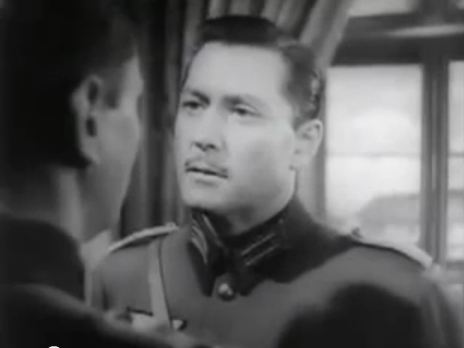
The German head of command, played by Carl Esmond, whom you
may have seen in dozens of films and TV, is a clever, mannered chap who is
teaching a new officer (and us) about interrogation. He remarks, “Just as there is no such thing
as an innocent question, there is no such thing as a valueless statement.”
Anything the American men say can be useful to the
enemy. One by one, through the course of
this film, we see how they are tricked.
If we found ourselves in the same situation we might be fooled in the
very same way. It all seems so innocent.
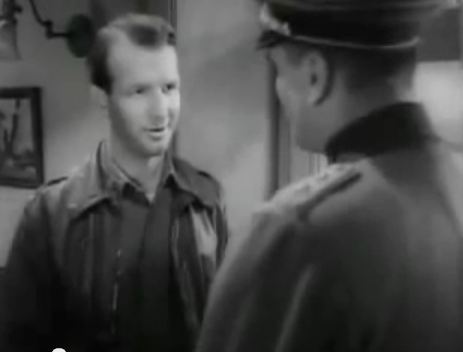
Like many of FMPU’s films, this had a cast largely of
unknowns, some of whom would later become more familiar to us. Don Porter plays an officer in the downed
bomber crew, easy going, and genuinely surprised to be given a nice room and
treated royally by his captors. Later in
the film when Commandant Esmond primes the pump by dropping hints that he
already knows all about the bomber’s mission, Porter shrugs, figures, oh, well,
if it’s common knowledge—and spills facts.

Kent Smith plays a German officer who was raised in the US,
and so with his knowledge and his comfortable camaraderie with the American
boys, tricks them into trusting him.
Hans Twardowski has minor role as a German Red Cross
representative, also out to trick the men into filling out Red Cross forms that
ask too much information. You may remember
him from “Casablanca” as a Nazi soldier.

James Seay plays the bomber crew Captain, most stalwart of
the group, yet even he slips up and gives information he has no idea he’s
giving.

Arthur Kennedy is a standout in the film as a cocky
crewmember who thinks he’s going to outwit the Germans by giving them false
info, but they are onto him and twist his words so that they find out the
truth. Kennedy gives a raw performance
as man who is clearly rattled by these mind games.
It’s interesting to watch the Germans cleverly sort out the
mystery of where the downed bomber came from, and where it was going. By putting together small bits of information
the men have unwittingly given them in unguarded moments, the Germans discover
where the next raid of American bombers is likely to come from and where their
next target is to be.
When that next bomber mission occurs, the Nazis are waiting
for them. They shoot down most of the
squadron of planes. The footage,
simulated obviously, of the American planes being shot down is not what that
first generation of boys who grew up on movies would have ever expected to
see. It is brutal, with planes on fire, with
machinegun fire ripping through crews, and images of blood spurting from the
heads and faces of pilots and gunners. The
lesson about not talking is driven home graphically.
Only a few crews from this mission limp home. They are debriefed by Lloyd Nolan, and
bewildered over how the mission could have failed so badly.

Rand Brooks has a small part as an American back at
the base, who grimly makes the accusation, “Somebody talked!”
George O’Hanlon, whom you might remember from a bunch of “Joe
McDoakes” shorts also appears back at the base.
Mel Torme has a bit part as a pilot, though I confess I didn’t spot
him.

Craig Stevens plays a returning pilot back at the base as well,
interrogated by Lloyd Nolan after the disastrous mission. Nolan, in that wonderfully edgy, serious tone
that makes you pay attention to him no matter how quietly he is speaking, calms
the men and tells them that the only information they are ever to give is their
name, rank, and serial number. Above
all, don’t talk.

Then he looks right into the camera, right at us. “Don’t talk.
Don’t talk. Don’t talk.”
We may never talk again.
The FMPU was comprised of men from all the different
Hollywood studios. Some of them were not
actually in the Army Air Corps, like Nolan, and like occasional guest actor Guy
Kibbee. The others who were, ranged from
actors, writers, directors, cameramen, many of whom served their entire hitch
here in Hollywood, and others who went on combat missions photographing the
war, or to serve in other units. More on that next week.
I’m not certain at this time the military rank of the men
who performed in this film or many other FMPU training films. I do believe Arthur Kennedy was a
sergeant. I believe Craig Stevens was a
corporal. Sgt. David Rose, incidentally,
composed the music score for this film.
The AMC channel broadcast a documentary in 1997 made by
Gregory Orr Productions called
“Hollywood Commandos”, about the First Motion Picture Unit, and we’ll be discussing that next Thursday.
“Resisting Enemy Interrogation”, now in the public domain,
can be watched here on YouTube.

