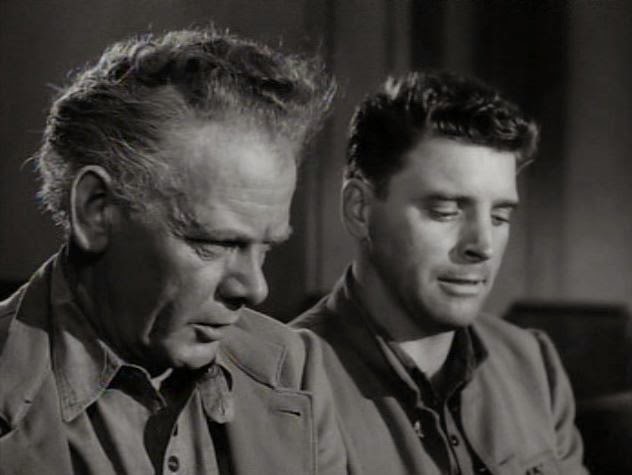
Red Canyon (1949) was
Ann Blyth’s first Technicolor picture, first and only big-screen western, first
time she received both top billing and name above the title. She was 19 years old and had hit her stride.

It was a pinnacle of a kind, and the beginning of new
trail. After a string of six heavy
dramas that gave her intense roles to prove herself a major up and coming
actress, her last film before Red Canyon,
Mr. Peabody and the Mermaid, which we covered here, was a complete change
that charmed the public and clued-in the studio that Ann was also athletic, and that her beauty was as much an asset to selling a film as her
acting skill. Her trim body, also, could lend
itself to more than posing in a crisp Noir wardrobe.
It also reminded studio that she was young. In those dramas, from Mildred Pierce through Another
Part of the Forest, Ann’s characters were increasingly poised, knowing,
sophisticated, and wore a mantle of worldly experience even though in real life
she was still some years away from being old enough to vote. Her characters were restless, mean, sad,
tragic.
Mr. Peabody and the
Mermaid, because of her fanciful character and its exotic costuming, her
silent communication through her expressive face, and the joyful
silliness of the plot, actually managed to re-set the clock on her screen
sophistication. She was suddenly much younger
again. For the next several films she
would play more innocent ingénues, most of them in comedies, and this one western.

In Red Canyon, she
plays the spirited tomboyish daughter of George Brent on a late nineteenth
century homestead in the west. Brent is
a self-made man who runs a stagecoach line and a prosperous ranch, where he
breeds and trains bloodstock for racing.
His prize horse is a great white stallion, his hope for winning an
upcoming race, and he won’t let Ann near him, which infuriates her. She wants to ride him.
George Brent has third billing here, and in that inevitable
bittersweet Hollywood turnstile, no longer playing the romantic lead. That job goes to Howard Duff, pulled away
from a string of Noirs for his first romantic lead, and also his first
western. There would be many more westerns
for him after this. (Ann would have to
wait for TV’s Wagon Train, in which
she appeared in five episodes—we’ve discussed them all this year—to appear in
more western stories.)

Mr. Duff plays a saddle tramp trying to capture a wild black
stallion hereabouts known as Black Velvet (which was the film’s original
working title). Duff travels under an
assumed name to distance himself from his no-account relatives. That would be our old friend John McIntire,
who played in so many of Ann’s films, as Duff’s wily outlaw pa. Lloyd Bridges is his sneering no-account
brother.
Their gang steals horses, and
many years ago made a raid on George Brent’s ranch, which resulted in the
shooting death of his wife.
Jane Darwell, fussy and bossy as ever, plays George Brent’s
sister, who has helped to raise Ann and is determined to make a lady of her,
“If I have to break every bone in your ornery body to do it.”

We open on Ann’s birthday, when her pa and auntie present
her with a gift of women’s duds. Ann examines
them with a wariness borne of not wanting to be changed by anybody, and a
genuine fear of that metal rat-trap-looking thing called a bustle. One look at the whalebone corset, and she
bolts, climbing out the window.
Later, at the barbecue to celebrate her birthday, Ann
appears in her feminine finery to the general approval of the crowd, including
several would-be suitors. They present
her with an armload of gifts—the kind she likes—lariats, riding crops, saddles,
bullwhips.
Bullwhips?

Catch the scene where she enters the outdoor party by
walking down a flight of simple wooden stairs from her second-floor veranda, as
the hem of her dress ripples down the steps and she gains confidence with every
compliment. By the time she’s reached
the bottom step, she’s the belle of the ball. As we’ve stated before on other films where
the lady makes her entrance on a staircase, this is really the way to join a
party. A much-used device for showing
off the heroine, but dang, it works every time.
Ladies, if you’re going to try this at home, all you need is
an open staircase and a killer dress.
But make sure you don’t trip and take a header down the flight of stairs;
it puts a damper the whole effect.
James Seay, another horse breeder and potential suitor for
Ann, remarks she is “Prettier than a string of blue-nosed trout.”
This is apparently a compliment, because she is
pleased. One of the fun things about
this movie is it is chock-full of euphemisms of the kind our western pioneers
were evidently so fond. Jane Darwell
cracks off a string of them, starting with “flapdoodle” to describe the layers
of feminine undergarments to which she introduces Ann.
About the only one in the movie who does not use euphemisms
is George Brent, probably because, as we are told, he is originally from
Massachusetts. We in Massachusetts are
not imaginative enough to compare a pretty young girl to a string of blue-nosed
trout.
We prefer cod, anyway.
The champion user of euphemisms in a particularly cussed
manner is Edgar Buchanan, who plays Brent’s stagecoach driver.
The cod is the state fish of Massachusetts.
Mr. Buchanan is as big a teller of tall tales, and vain a
man as you can get, trying to cover his nearsightedness, which will prove a
danger to him and others.
Cape Cod is in Massachusetts. Oh…forget it.

Buchanan’s speech is so tangled up in the most outlandish
and complicated blustering euphemisms that I’m surprised he could remember half
his lines. I’d love to see the outtakes;
they're real tongue-twisters and he had to have messed up sometimes.
Tired of driving the stagecoach for Mr. Brent, Buchanan
invites himself to be Howard Duff’s partner in catching the wild stallion, and
voila, we have instant comic sidekick.
He is of no help, as comedy relief seldom is.

Ann’s first meeting with Mr. Duff is contentious, were he
leaves her without a horse in the desert, and she catches up to him at a pond,
coyly suggests they strip off and go swimming, and then steals his clothes and
his horse. Not a promising start to the
romance, but gradually they each find something in the other they can respect. Duff
stands up to her father, which she admires.
Ann is a better trainer for Black Velvet than Duff. His bullying tactics to train the horse, once
he’s caught him, only get him thrown off and lying in the dirt with a wrenched
back, and the horse escapes from him. Ann finds Black Velvet on the trail, where he
is caught by a rope snagged on a limb.
The sudden jerk brings the poor horse crashing to the ground.
Ann’s gentle manner with Black Velvet goes over big with the
horse. She frees him, and leads him back
to Duff, the horse trotting along beside her, happy as a puppy because she’s so
purty and talks nice to him. Duff’s
astonishment is a hoot, but, to his credit, he lets her take over the job of
training the horse without any ego. He
later tells her, “I would have been whipped.
Black Velvet’s too tough for me.”

Ann has an ulterior motive, she wants to ride Black Velvet
in the upcoming horse race and beat the pants off her father, who won’t let her
ride his white stallion, and says things, like, “You’d better realize you’re a
girl,” as if that were a bad thing.
Ann looks well on a horse and her confident riding is impressive. She looks quite skilled and comfortable, even
in the exciting shots where she is riding at a speedy gallop, leaning over the horse’s
great neck, her hair flying. I suppose
we must credit the Hollywood studio training system for teaching a girl from
Manhattan to ride like that.

Since this is a Technicolor film, her hair has been
lightened to a reddish brown. I guess
dark hair is only for black and white films.
For a tomboy, she wears a most vivid shade of red lipstick, similar in
hue to the big red first letters in the words of the title. You can’t waste Technicolor, you’ve got to
make the most of it. Likewise, the title
Black Velvet becomes Red Canyon.
Westerns are really meant for color film stock, anyway. A city scene artfully filmed in black and white can evoke a
strong range of powerful emotions, but with an open range of small scrub, a
gray palette does not distinguish detail as well as color. Outside a closed set, there is less ability
for the cinematographer to manipulate conditions. In black and white, the western prairies look as
desolate as the moon, but color film brings out depth and warmth to the rugged
landscape, stark, challenging to the body and soul, and utterly majestic.

Howard Duff displays a quiet strength in this film, a virile
self-confidence with an absence of swagger; he looks comfortable. A likeable loner; if we never get to know him
well it is not because he is complicated, but because he keeps his own
counsel. He faces down his conniving
outlaw father and treacherous brother, as well as George Brent, who dismisses
him as a saddle tramp. Though his
romance with Ann is tentative; there are no fireworks between them, in part due
his reticence about getting involved with the girl who was made motherless by
his outlaw family—nevertheless, their scenes together are genuine and reticence
is natural to both their characters. He is
living down the burden of his family name; she is discovering her womanhood.
Duff (in real life some 15 years older than Ann Blyth, but doesn't seem it) looks like he belongs to this landscape, as if he is a
part of it. George Brent does not; he
still carries the aura of a transplant.
That, too, is natural.

Possibly the biggest star of the film are the uncredited horse
wranglers. The two great, spirited
stallions, and especially the herd of wild horses under the lead of Black
Velvet must have taken an extraordinary amount of handling. The camera work, too, is very good, with long
and close shots sweeping over the backs of the galloping herd of wild horses.
One scene is a bit unsettling, when Howard Duff captures
Black Velvet by forcing him to leave the refuge of a small, narrow canyon by
starting a brush fire. No wonder the
horse doesn’t like him.

By the end of the film, we have a horserace, a showdown, and
a shootout. Most surprisingly, Howard
Duff and Ann Blyth decide to return the horse to the wild, and our last shot is
not the usual happy couple pressing their cheeks together, but of a magnificent
black horse tearing across the open range, rejoining the wild herd of which he
is the leader.
The movie was filmed at Kanab, Utah, which was enjoying what
was touted in the local press as the birth of a Hollywood-rival in location
shooting. (Howard Duff’s film with
Yvonne DeCarlo Calamity Jane and Sam Bass (1949), which we covered here, with the same director and producer: George
Sherman and Leonard Goldstein, would use the same racecourse and scenery the
following year.). Locals appeared as
extras. The Deseret News noted in October 1948:
During the past
summer, southern Utah hotels, eating houses, stores and workmen reaped a rich
harvest from the movie people on location around Kanab and Cedar City. At the former site, Ann Blyth, Jane Darnell
[sic] and George Brent captivated the citizens during their stay while filming Black
Velvet.
The excitement of seeing Hollywood stars in their midst was
accompanied by the thrill of knowing their part of world was getting attention,
as the Deseret News recorded at the
time of the film’s premiere in March 1949:
Red Canyon is a
picture that’s worth thousands to Utah in the form of publicity. Many who see the film when it is shown in
theaters across the country will want to visit the region in which it was made…
Whether tourists thereafter clamored to get to the Kanab
region, or only occasional film companies looking for sagebrush and scenery,
but for one afternoon and evening in March 1949, Salt Lake City held the
spotlight for the premiere of Red Canyon.


On the morning of Wednesday, March 16th, stars Ann Blyth,
Howard Duff, Edgar Buchanan and Chill Wills, along with producer Leonard
Goldstein, arrived at the train station on the Union Pacific Streamliner. The mayor welcomed them, and they appeared on
a live radio broadcast right there on the depot platform for the Breakfast in Hollywood program. Among their personal appearances was to ride
in parade through town the next afternoon along with the Downtown Days Queen—part
of the Downtown Days festival run by the Retail Merchants Bureau of the Salt
Lake Chamber of Commerce.
The evening of the 17th was capped by the
premiere showing of Red Canyon at the
Utah Theater, with an overflow crowd going to the Capital Theater. After the movie, the stars appeared on stage,
with Chill Wills acting as emcee. Ann
sang. The Deseret News commented:
The little Blyth girl
especially won the plaudits with three songs which showed she is versatile in
several fields of entertainment. She
left little doubt of her singing ability after she sang “Galway Bay” as her
final selection.
Well, it was St. Patrick’s Day, after all.
If any of our readers attended that event, or know someone who was an extra, I'd love to hear from you.
If any of our readers attended that event, or know someone who was an extra, I'd love to hear from you.
The next day, the afternoon of Friday, the 18th,
it was the train back to Hollywood for the actors, leaving Salt Lake City with
only its Downtown Days queen to maintain the magic of celebrity.
For Ann, the following
week brought another celebrity experience when she attended the Academy Awards
as a presenter, handing out the Sound Recording award. The host was Robert Montgomery, with whom she
was now working in Once More, My Darling, which we covered here.
It was her second appearance
at the Academy Awards; you’ll remember her first was three years earlier as a
Best Supporting Actress nominee for Mildred
Pierce. She had been a newcomer
then; and if presenting the Sound Recording award was less exciting than being
nominated, it signaled that she was part of the Hollywood establishment
now.
As you can see by the screen caps, this was recorded off the Encore Westerns channel. I don't believe Red Canyon was ever released in VHS or DVD, but you can probably find a gray market copy. Please correct me if I'm wrong.
Come back next Thursday when we return to Ann Blyth’s first
year of filmmaking, before any thought of Oscars, and the 1944 release of her
final two teen musicals from Universal: Babes
on Swing Street and Bowery to
Broadway.

To all our American readers:
Happy Thanksgiving.
©Jacqueline T. Lynch, 2007-2014. All rights reserved. If you're reading this on a site other than Another Old Movie Blog, please be aware that this post has been stolen and is used without permission.
©Jacqueline T. Lynch, 2007-2014. All rights reserved. If you're reading this on a site other than Another Old Movie Blog, please be aware that this post has been stolen and is used without permission.
***************************
Bonham Daily Favorite
(Bonham, Texas) – November 18, 1951-
“Tiny Ann Blyth Proves Durable in Film Roles,” p. 2.
Deseret News, October
1, 1948 – “Movie Makers Turn Eyes to Utah” by Olive W. Burt, p. M1; March 18,
1949, “Red Canyon and Stars Win Plaudits at Premiere,” p. F-3; March 2, 1949,
p. B1; March 17, 1949, p. B1; March 15, 1949, p. A8; November 11, 1948, “Kanab
Runs Hollywood Close Second of Movies,” p. F-3.
Wiley, Mason and Damien Bona. Inside Oscar - The Unofficial History of the Academy Awards. (NY: Ballantine Books, 1986), p. 187.
Wiley, Mason and Damien Bona. Inside Oscar - The Unofficial History of the Academy Awards. (NY: Ballantine Books, 1986), p. 187.
************************
THANK YOU....to the following folks whose aid in gathering material for this series has been invaluable: EBH; Kevin Deany of Kevin's Movie Corner; Gerry Szymski of Westmont Movie Classics, Westmont, Illinois; and Ivan G. Shreve, Jr. of Thrilling Days of Yesteryear. And thanks to all those who signed on as backers to my recent Kickstarter campaign. The effort failed to raise the funding needed, but I'll always remember your kind support.

****************************
UPDATE: This series on Ann Blyth is now a book - ANN BLYTH: ACTRESS. SINGER. STAR. -

Also in paperback and eBook from Amazon, CreateSpace, and my Etsy shop: LynchTwinsPublishing.

"Lynch’s book is organized and well-written – and has plenty of amusing observations – but when it comes to describing Blyth’s movies, Lynch’s writing sparkles." - Ruth Kerr, Silver Screenings
"Jacqueline T. Lynch creates a poignant and thoroughly-researched mosaic of memories of a fine, upstanding human being who also happens to be a legendary entertainer." - Deborah Thomas, Java's Journey
"One of the great strengths of Ann Blyth: Actress. Singer. Star. is that Lynch not only gives an excellent overview of Blyth's career -- she offers detailed analyses of each of Blyth's roles -- but she puts them in the context of the larger issues of the day."- Amanda Garrett, Old Hollywood Films
"Jacqueline's book will hopefully cause many more people to take a look at this multitalented woman whose career encompassed just about every possible aspect of 20th Century entertainment." - Laura Grieve, Laura's Miscellaneous Musings''
"Jacqueline T. Lynch’s Ann Blyth: Actress. Singer. Star. is an extremely well researched undertaking that is a must for all Blyth fans." - Annette Bochenek, Hometowns to Hollywood

Ann Blyth: Actress. Singer. Star.
by Jacqueline T. Lynch
The first book on the career of actress Ann Blyth. Multitalented and remarkably versatile, Blyth began on radio as a child, appeared on Broadway at the age of twelve in Lillian Hellman's Watch on the Rhine, and enjoyed a long and diverse career in films, theatre, television, and concerts. A sensitive dramatic actress, the youngest at the time to be nominated for her role in Mildred Pierce (1945), she also displayed a gift for comedy, and was especially endeared to fans for her expressive and exquisite lyric soprano, which was showcased in many film and stage musicals. Still a popular guest at film festivals, lovely Ms. Blyth remains a treasure of the Hollywood's golden age.
UPDATE: This series on Ann Blyth is now a book - ANN BLYTH: ACTRESS. SINGER. STAR. -
*********************
The audio book for Ann Blyth: Actress. Singer. Star. is now for sale on Audible.com, and on Amazon and iTunes.
The audio book for Ann Blyth: Actress. Singer. Star. is now for sale on Audible.com, and on Amazon and iTunes.

Also in paperback and eBook from Amazon, CreateSpace, and my Etsy shop: LynchTwinsPublishing.
"Lynch’s book is organized and well-written – and has plenty of amusing observations – but when it comes to describing Blyth’s movies, Lynch’s writing sparkles." - Ruth Kerr, Silver Screenings
"Jacqueline T. Lynch creates a poignant and thoroughly-researched mosaic of memories of a fine, upstanding human being who also happens to be a legendary entertainer." - Deborah Thomas, Java's Journey
"One of the great strengths of Ann Blyth: Actress. Singer. Star. is that Lynch not only gives an excellent overview of Blyth's career -- she offers detailed analyses of each of Blyth's roles -- but she puts them in the context of the larger issues of the day."- Amanda Garrett, Old Hollywood Films
"Jacqueline's book will hopefully cause many more people to take a look at this multitalented woman whose career encompassed just about every possible aspect of 20th Century entertainment." - Laura Grieve, Laura's Miscellaneous Musings''
"Jacqueline T. Lynch’s Ann Blyth: Actress. Singer. Star. is an extremely well researched undertaking that is a must for all Blyth fans." - Annette Bochenek, Hometowns to Hollywood

Ann Blyth: Actress. Singer. Star.
by Jacqueline T. Lynch
The first book on the career of actress Ann Blyth. Multitalented and remarkably versatile, Blyth began on radio as a child, appeared on Broadway at the age of twelve in Lillian Hellman's Watch on the Rhine, and enjoyed a long and diverse career in films, theatre, television, and concerts. A sensitive dramatic actress, the youngest at the time to be nominated for her role in Mildred Pierce (1945), she also displayed a gift for comedy, and was especially endeared to fans for her expressive and exquisite lyric soprano, which was showcased in many film and stage musicals. Still a popular guest at film festivals, lovely Ms. Blyth remains a treasure of the Hollywood's golden age.
***************************

A new collection of essays, some old, some new, from this blog titled Movies in Our Time: Hollywood Mimics and Mirrors the 20th Century is now out in eBook, and in paperback here.