IMPRISON TRAITOR, PEDOPHILE, AND CONVICTED FELON TRUMP.
Showing posts with label Marjorie Reynolds. Show all posts

Thursday, October 28, 2021

Halloween -- Musicals and Monsters


Halloween is missing from the roster of holidays celebrated in musical numbers from Holiday Inn (1942).  At the time the film was made, Halloween was barely clawing its way out of the era of time-honored street urchin vandalism of petty theft and streetcar derailment to something different – an adult-supervised, tamer holiday of parties, party favors, and treats.  By the time the Boomers were kids, trick-or-treating exploded across suburbia.

Today, it’s the second-largest holiday of consumer spending in United States, with the National Retail Federation predicting that this year Americans will spend more than $10 billion on Halloween.  This is amazing considering the economy’s fragility while still dealing with a pandemic, and even more so that this is an increase of some $8 billion over last year.  So far, consumer spending on Halloween is still behind the level of Christmas—but for how long?

The single day of Halloween has become a season of a month or even more of decorating indoors—and most dramatically—outdoors.  One wonders if this is merely yet another example of the arrested emotional development of Boomers, Gen-X-ers, and Millennials not so much yearning for the fun times of childhood, but being oblivious to the fact that they might have to actually grow up at all. 

I confess a monstrous craving for candy corn this time of year (similar to the unaccountable monstrous craving I get for candy conversation hearts as Valentine’s Day approaches), so perhaps, like most of us, I have become well trained by the retailers. Though we joke about pumpkin-spice everything this time of year, at least that’s innocuous compared to the severed heads and skeletal displays of sometimes questionable taste on the neighbor’s lawn.

For classic film buffs, society’s growing enthusiasm for Halloween has led to that transfer of movies-as-holiday props such as we see during the approach of Christmas.  Christmas is a holiday wrapped up in nostalgia as much as consumerism, and for fans of old movies, this means dragging out not only decorations, Christmas music, and favorite recipes—but also the retrieval from our own vaults of Christmas movies to watch during December.  To be sure, Turner Classic Movies is there for a reliable backup, but we who have amassed our private stock of movies without which Christmas wouldn’t be Christmas really don’t rely on it, do we?


Holiday Inn
is a teasing, tantalizing hybrid of holidays as Bing Crosby, Fred Astaire, Louise Beavers, Marjorie Reynolds, and Walter Abel parade through the calendar.  Most classic film buffs watch it during Christmastime, and are familiar with the tale that the song “White Christmas” was created for the movie and become an almost instant hit, now a national treasure.  Other songs written specifically for the movie include “Be Careful, It’s My Heart” for Valentine’s Day, “Happy Holidays” (for those smug, hypocritical fools who think saying “Happy Holidays” is somehow a sacrilegious insult to Christmas, a Bing Crosby recording should be played over and over as an answer to their foolishness), and “You’re Easy to Dance With,” which has no holiday connotation at all.

If precious filmstock was being devoted to non-holiday musical numbers, then why, we might wonder, could they not have filled that gap in the movie between Independence Day and Thanksgiving with a Halloween song?  Irving Berlin actually did write a couple that might serve:  “Down Where the Jack O’ Lanterns Grow” written sometime around World War I about a rural love nest and not particularly spooky.  I would vote for “The Haunted House,” a really cute ragtime ditty you can listen to here on YouTube:


As for giving September a little attention, perhaps a Labor Day sequence could have been thrown in with Berlin’s song “And Father Wanted Me to Learn a Trade” written sometime in the middle 19-teens.  We do have that burst of industrial war worker footage montage during the Independence Day sequence, so factory work had achieved a nobility not seen since. 

Also for the war, Irving Berlin wrote the pleasant if unintentionally comical “I Paid My Income Tax Today” which you can listen to here:


Maybe Bing Crosby and Fred Astaire would have a tougher time putting across Income Tax Day in their musical romp.

But it is on the calendar.

It does feel like something of a wrench for us these days to have no Halloween in Holiday Inn, but likely nobody missed it in 1942.  Halloween was strictly for kids.  For the grownups, there were scarier monsters afoot, and they came home to us when as partway through the filming of the movie, Pearl Harbor was bombed.


But classic movie fans, partly as a celebration of Halloween, have revived the popularity of the Universal monsters: Frankenstein, The Wolf Man, Dracula, et al.  Because of Halloween and our movies-as-holiday props habit, monsters walk the earth again, at least once a year.

********************

Jacqueline T. Lynch is the author of Ann Blyth: Actress. Singer. Star. and Memories in Our Time - Hollywood Mirrors and Mimics the Twentieth Century. Her newspaper column on classic films, Silver Screen, Golden Memories is syndicated nationally.  Her new book, a collection of posts from this blog - Hollywood Fights Fascism - is available here on Amazon.

Thursday, June 28, 2012

Holiday Inn - 1942 - Leon Belasco


It’s such a small part, but the flower shop proprietor in “Holiday Inn” (1942) is one of those classic film characters that stands out for no other reason than perhaps the eloquence of the moment.


In this case, the eloquence is purely physical communication. He has no lines. Marjorie Reynolds, trying to show off and impress Walter Abel, treats her boss -- Mr. Belasco -- like an underling, directing him to fill a last-minute order.


Leon Belasco is the silent shopkeeper, at first appalled at her nerve, then anxious that she might blow it and lose a customer, then pleased that she has succeeded in making a sale, and then hustles to do what she has condescendingly commanded. It’s a pantomime lasting a few seconds, but it is indelible. I can’t go into a flower shop today without thinking of him.

You may have seen Leon Belasco in dozens of film or TV shows, usually bit parts as a waiter or cab driver. He was a dealer in Rick’s gambling parlor in “Casablanca” (1943). He usually had few or no lines. Like so many bit players, he was just there.

Monday, February 21, 2011

Happy Presidents Day

Happy Presidents Day, for those of us in the U.S.   Happy retail sales.  Happy day off. 

Others are more reverent.  Here, Connie Milligan, clearly a Lincoln groupie, celebrates her favorite Commander-in-Chief all year long with a modest shrine.  Below. Fred, Majorie, and a resentful Bing, pay homage to One Number in a pastiche of Washington clichés and American history via Irving Berlin.

(Remember to scroll down to the bottom of the page to mute the music so you can hear the video.)

Thursday, February 12, 2009

Abraham


Lincoln’s Birthday, having been usurped by the all-purpose Presidents Day, is no longer the block on the calendar it once was, but with the many references to President Abraham Lincoln during the inauguration of President Barack Obama, Honest Abe seems to be more in the news than ever.

The connection between Lincoln’s legacy in popular history as it pertains particularly to African-Americans remains at the front of his memory. Today on the 200th anniversary of Lincoln’s birth, we have this clip below from “Holiday Inn” (1942) to examine one Hollywood interpretation of that relationship.

The clip is cringeworthy camp. I can remember broadcast television showings where this scene was omitted, and not just to fit in more commercials. It is, after all, a bit uncomfortable to watch. Leaving it out may make watching this otherwise lighthearted froth of a movie less offensive, but leaving it out is a lie. By watching the scene carefully, we can learn a bit more about a wartime era when our armed forces were still segregated, when popular entertainment leaned heavily on exaggerated stereotypes.

The song is pleasant, another one of Irving Berlin’s patriotic tributes to his adopted country that make up this movie. As illustrated by the photo above, it was also released on a 78rpm. Listen only to the song and you have a stirring tribute in a big band flourish, and Bing Crosby’s steady baritone.

Open your eyes to watch the film clip, and you must really open your eyes to some other things. The stars in blackface, giving it their all as it once was performed in hokey minstrel shows from the 19th century up through the middle 20th century in vaudeville. The chorus in “mulatto” makeup and costumes meant to turn Holiday Inn into a cartoon plantation setting where happy slaves evoke the name of their savior, Abraham.

The only thing more ridiculous looking than Bing Crosby in this scene is the unfortunate Marjorie Reynolds, who bounds out like Harriet Beecher Stowe’s “Topsy” having just ingested some mind-altering substance. It may be laughable, but becomes all the more embarrassing when one realizes this performance is not meant as an insult, but intended as good-natured parody. The condescension in this scene does not seem to be apparent to Bing or Marjorie, the chorus, or the director or studio.

We see it. Many others saw it as well in the era when the film was made; not everyone was so blind. This kind of entertainment was already on its way out. The explanation in the plot for the use of blackface was to hide Marjorie Reynolds from being recognized by Fred Astaire, but the “cover story” if you will, is just to give credence to a typical Lincoln’s Birthday minstrel routine that was now becoming passé. This scene is a museum piece in more ways than one. The “Abraham” number was reused as an instrumental piece in “White Christmas” (1954) some 12 years later, for a fast-paced dance featuring Vera-Ellen. A big production number in “White Christmas” also salutes the days of minstrel shows. Nobody wears blackface.

But keep watching the original “Abraham”. Louise Beavers turns the scene on its ear. The warmth and sincerity she exudes singing to her children is what makes Bing and Marjorie all the more silly. She has dignity, and this was Abraham Lincoln’s great gesture to his fellow Americans of every race, the idea that human beings were born with innate dignity, and nobody could take it away from them, even if they took away their freedom. People can only give up their dignity willingly, which is what Bing and Marjorie are doing in this scene.

No matter that Miss Beavers has only a couple lines to sing in a movie that is a musical; no matter that one line includes the word “darky.” She’s got dignity to spare, which is good because Bing and Marjorie can really use some help to save this number.

I like to think that director Mark Sandrich saw that too, and that was his intention, this striking and moving comparison between the black lady and the white stars in blackface. Perhaps not, perhaps he was as blind to the dignity as he was to the indignation. But the studio left the scene in, and now so does cable television.

Have a look at the clip of “Abraham” below. Enjoy the song, but don’t close your eyes.

Monday, December 31, 2007

New Year's Eve at "Holiday Inn" (1942)

“Holiday Inn” (1942) gives us a brief New Year’s Eve scene, which though released during the first year of our involvement in World War II, gives us no indication of any war theme or trouble brewing for the new year.

Except for the Independence Day scene where a musical montage shows us fighting men, factory war production, Douglas MacArthur, and President Franklin Delano Roosevelt, most of this film is blissfully unaware of the war overseas, or gas rationing, food ration stamps and points. Among the inn’s guests, there is conspicuously not a uniform in sight.

The film begins on Christmas Eve, in what is evidently the year 1940, and there are actually three Christmas Eves that occur before the conclusion. In the New Year’s Eve scenes, which must be as 1941 turns into 1942, there is not a mention of the catastrophic Pearl Harbor bombing with brought us into the war only some three weeks previously to the donning of paper hats.

But paper hats there are galore in Bing Crosby’s new Holiday Inn which celebrates its grand opening in this New Year’s Eve party. There are a few tuxedos among the guests, a few furs, but most of the men are dressed in suits, and among the women there are even knit tops with skirts, as if the more austere war years have indeed made their presence known even if not openly discussed in the movie. Fred Astaire, who makes a drunken arrival after being left by his dance partner and fiancée, looks overdressed in his top hat, white tie and tails. The similar absence of elegant Easter finery in the Easter sequence of this film was discussed last April in this entry.

The New Year’s Eve scene begins with newspaper clippings that tell of the opening of the Inn, and Bing and Marjorie Reynolds sing “Come to Holiday Inn” to a full house.

If the traffic noise affects you
Like a squeaky violin,
Kick your cares down the stairs
And come to Holiday Inn.

The Inn’s cook, Mamie, played by Louise Beavers wears an enormous chef’s hat, and when her poker-faced kids are not taking part in the floor show dressed as Father Time and Baby New Year, they are shadowing her wherever she goes. Miss Beavers in real life did not like to cook, despite playing cooks and servants throughout her film career, and very prudently married a man who was a chef.

Bing and Marjorie, along with Mamie and the kids, and a few hired waitresses, hide out in the kitchen, help themselves to some food, and sing “Kissing the Old Year Out.” They do not actually kiss the old year out, in fact, nobody does. We hear the shouts of Happy New Year from the other room, and Bing and Marjorie get back out onto the dance floor, where everybody is dancing and Fred shows up a little drunk and despondent. When he dances with Marjorie, he decides she is his new dance partner and his new love. Bing and Fred spend the rest of the movie stealing her away from each other.

The drunken dance number Fred Astaire performs with Marjorie Reynolds is quite stunning in its athleticism. To continually stumble, wobble, and nearly collapse but not quite would likely take more energy than to do the dance properly. He does fall spectacularly on the floor at the end, perhaps helped by what is reported as his having taken several drinks of bourbon before each take of this number to help him play it convincingly.

No one says, “Don’t you know there’s a war on?” Everybody says “Happy New Year!”

Thursday, November 29, 2007

New England Sleigh Ride

At the end of “White Christmas” (1954), the first few flakes of long-awaited and hoped for snow finally fall. No sooner have Bing Crosby and Danny Kaye spied the snowflakes floating down like a benediction on this Vermont soundstage, er, landscape, that a sleigh cruises by. Bing and Danny cheerily wave and shout to the driver, but neither wonders how a sleigh can move on what must have been only an eighth of an inch of snow. Yet, we hear no scraping of the metal runners on the road, no clawing of clumps of dirt in the drive. This is because it is snowing, and when it snows in New England, New Englanders ride in sleighs. Ayuh.

In “Holiday Inn” (1942), Bing’s other New England country hotel outing, Marjorie Reynolds arrives at Holiday Inn in a sleigh. This is because it is winter, and Holiday Inn is in Connecticut. This sleigh happens to be a taxi. In New England, taxis in the winter are sleighs. How do I know? The movies tell me so.

In “Christmas in Connecticut” (1945), Barbara Stanwyck arrives at her fiancé’s Connecticut home by sleigh, again a taxi. Again, there is only about an eighth of an inch of snow on the ground. In a little while Dennis Morgan arrives by sleigh, and a little while after that, Sydney Greenstreet arrives, also by sleigh. Later on when Miss Stanwyck and Mr. Morgan, who have taken a liking to each other, sneak away from a party at the local town hall to be alone, they naturally go for a sleigh ride. This is New England. In winter, we ride in sleighs, got it? There is one conveniently parked by all the automobiles. They ignore the cars and steal the sleigh. They get arrested for sleigh-knapping, which is a serious offense in these parts.

Being a New Englander myself, I can vouch for the veracity of this sentimental Hollywood version of New England. If I had a nickel for every sleigh I see driving around in the winter on city streets, I’d be a millionaire. Not just city traffic, mind, but the interstate highways are veritably clogged with them. Driving those horses like gosh all hemlock, not signaling when they change lanes. Sweet Betsy from Pike, it’s maddening.

You think summertime traffic coming off Cape Cod at the end of a weekend is rough? Try coasting over the Bourne Bridge in a sleigh in the wintertime, only to find yourself behind a line of sleighs ahead of you as far as the eye can see. You think Route 1 from Connecticut to Maine is bumper to bumper in the summer? Try it in December, my friend. You’ll be huddling under your buffalo robe in your sleigh, moodily sipping from your flask and becoming more foul-mouthed by the minute as you wait in traffic. But the movies never show that ugly part, do they? No, they go for pure fantasy.

That’s all for this week. Have a nice weekend. See you Monday. I’m off to wax my runners.

Wednesday, November 21, 2007

"Franksgiving"

In the Thanksgiving scene in “Holiday Inn,” Bing Crosby plays a recording of himself singing “I’ve Got Plenty to Be Thankful For” while he dejectedly plays with his food, an enormous turkey and all the trimmings. Louise Beavers, who plays his cook, Mamie, sets the feast before him, and then berates him for letting Fred Astaire steal Marjorie Reynolds away.

Wondering if he is really going to eat all that food by himself, and wondering if Mamie and her tagalong children are going to get to eat any of it, is only part of the viewer’s preoccupation with this scene. The other distracting mystery is the brief black and white animation which prefaces this scene, wherein a cartoon turkey sitting on a calendar page suddenly hoists himself up and walks over to the highlighted Thursday the week before. No sooner has he settled himself down, that the box marking the fourth Thursday in November is highlighted as Thanksgiving, and he must hoist himself up again, with no small ruffling of the feathers, to waddle down to the Thursday he had previously occupied. The turkey is repeatedly teased in this manner, and so are we, until he finally shrugs denoting his confusion.

Younger viewers may think that Thanksgiving is all about the Pilgrims and all that, but modern Thanksgiving is also about commerce, in so far as it leads into the holiday shopping season. President Franklin D. Roosevelt, still trying to jump start us out of the Depression, in one of his many grab you by the socks legislative moves, pushed Thanksgiving 1939 up a week, to the third Thursday of November. This was intended to extend the holiday shopping season. Most Americans followed the President’s lead, but interestingly, many New Englanders refused to follow suit and continued to celebrate Thanksgiving on the fourth Thursday. They called the Thursday before “Franksgiving.” New Englanders, particularly those residing in Massachusetts, always took a rather proprietary view of Thanksgiving, and until roughly about the late 1940s it was a much bigger holiday in New England than Christmas ever was.

The dispute over which was the real Thanksgiving Day continued in 1940 and 1941, and afterward Congress capitulated to tradition and voted to return Thanksgiving Day to the fourth Thursday of November. The reference to this in “Holiday Inn” is one of those small but interesting Zeitgeist moments to watch for in old Hollywood films.

Wednesday, August 22, 2007

Tex Rides with the Boy Scouts (1937)

“Tex Rides with the Boy Scouts” (1937) stars Tex Ritter, his horse “White Flash”, and features Marjorie Reynolds, who later went on to a better role in “Holiday Inn” (1942) opposite Bing Crosby.

The movie begins with a kind a newsreel feel to it with the announcer voice over telling us a bit about the history of the Boy Scouts. In this short, Tex, and his two bumbling pals Stubby, played by Horace Murphy and Pee Wee, played by Snub Pollard, stumble upon a Boy Scout camp near to where some bad guys are hiding stolen gold.

You have to be a pretty confident guy to hang out with pals named Pee Wee and Stubby, or else just desperate for friends. Tex has an easy time winning over the Scouts, because he lets on he is a former Scout himself. The lead Scout, a freckled, overly enthusiastic youth named Buzzy, who says things like “Jiminy Crickets!” has a big sister, played by Marjorie Reynolds. “Sis” does little more than pout in Tex’s direction, so there is little love interest in the film. Just as well, because that’s sissy stuff.

Tex wears an enormous ten-gallon hat, sings a bit, and says things like “mosey.” There is a smattering of stereotype in the form of the Chinese laundry man named Sing Fung, played by Phillip Ahn, who actually says, “No tickee, no washee.” There is some swell riding, a shootout on horseback where nobody loses their hats, and some fisticuffs. Only the bad guys smoke, and there’s no cussing. Just bad acting and bad writing.

The real charm of this film is a brief but lovely segment where Tex gets to sing “Red River Valley” at a barn dance. His band, and the dancers before us, girls in print dresses and men in the best clothes they could find, look utterly genuine, like the kind of people you would see in a rural dance in Depression-era America. It is remarkably unaffected and natural, and all too brief. Tex also sings “The Girl I Left Behind Me,” and the crowds erupts into a square dance. It is sweet and somehow touching.

The only unnatural part of the scene is when “Sis” enters in a gown she might wear to New York City’s Rainbow Room. Then the rest of the short crumbles back to awkward melodrama when young Buzzy gets shot by the bad guy.

After the local sawbones patches the boy up, Tex asks, “Who shot you, son?” After a dramatic, almost eternal pause (young Buzzy, played by Tommy Bupp, has learned to milk it), Buzzy accuses the bad guy in some mumbled additional plot exposition.

Tex and the Boy Scouts prevail in this Grand National picture, Marjorie Reynolds went on to better things, and alls well that ends well.


Sponsored Link:
Tex Ritter Movies

Thursday, April 5, 2007

Easter Parade

“Easter Parade” (1948) set in 1911-1912, showcases Irving Berlin’s Tin Pan Alley hits, and one hit of the Great Depression, which was the song “Easter Parade.” The film opens on the day before Easter, and just as Fred Astaire’s spending spree to buy flowers, a hat, and a stuffed bunny for Ann Miller indicate, it once was really the busiest shopping day of the year.

When Ann dumps Fred for bigger things (just as the aforementioned lout Lee Bowman in “My Dream is Yours”) Fred snatches Judy Garland from the gutter pretty much as Jack Carson snatches Doris Day in “My Dream is Yours,” and pushes her to become his new singing and dancing partner.

They rehearse for the first time on Easter Sunday, and she gets a glimpse of the Easter Parade and the beautiful people strolling home from church to see and be seen.

Judy Garland is clearly Fred Astaire’s equal in dancing, and she makes one of his most delightful partners. Their “A Couple of Swells” routine is now classic. Two people in shabby clothes and blacked out teeth never looked so good. The rolling backdrop behind them as they sing “we’ll walk up the avenue” reprises the Easter Parade theme of strolling along with the swells.

Another fun number is “Girl On A Magazine Cover,” which displays elegant fashions and a riot of colors. It’s interesting to note how many of these old-time magazines (Redbook, Harper’s, etc.) are still being published.

Judy, his protégé, makes good and their act is a success. That they fall in love is of course inevitable, and she reverses the roles at the end of the film on the following Easter Sunday by presenting Fred with a top hat “bonnet”, flowers, candy, and a live rabbit, singing to him the song “Easter Parade.” The final shot is Judy and Fred strolling down Fifth Avenue with the wealthy fashion setters, in nice clothes and no blacked-out teeth.

Irving Berlin, responsible for this and all the songs in the film, emigrated to the US from Russia with his family in 1893. Jerome Kern, asked of his opinion of Berlin’s place in American music famously replied, “Irving Berlin IS American music.” Berlin was one of our most prolific, and most patriotic, songwriters. That he celebrated secular aspects of Christmas and Easter so successfully may be due to his realization that compromise, rather than exclusion, is the true American trait. Or, it may due to his being a Jewish man who was happily married to a Roman Catholic woman, which upset both their families, and he learned firsthand the benefits of compromise that sometimes leads to the development of a new, shared heritage. The American secular holiday created just such a new, shared heritage, including an Easter with flowers, fashions, candy, and songs, and movies which celebrated them.

That’s it for this week. See you next week, and Happy Easter.

Wednesday, April 4, 2007

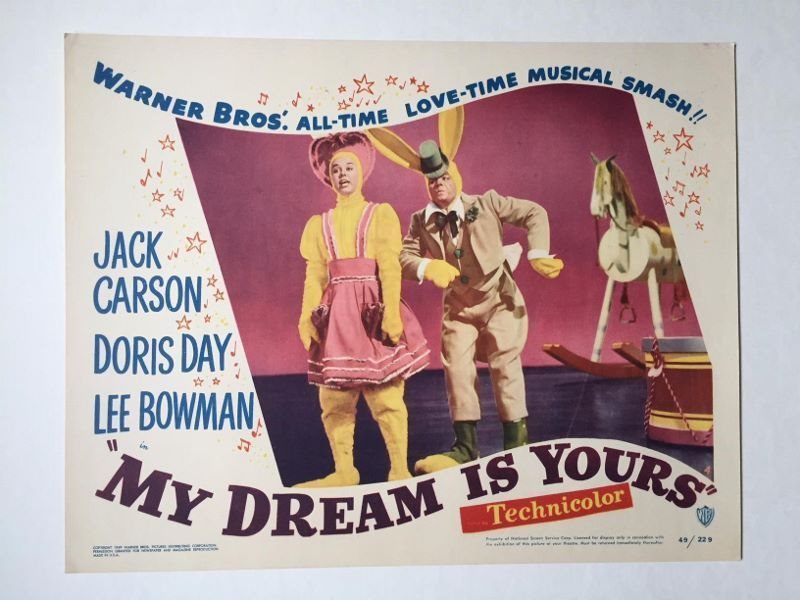
My Dream Is Yours (1949)


In My Dream is Yours (1949), we have a film which spoofs radio advertising, the music business, agents, and really has no Easter message at all, except for the small Easter celebration toward the end of the film when single mom Doris Day’s uncle is seen dyeing colored Easter eggs for her son Freddie, and Freddie gets stuffed bunnies from all the grownups. Doris Day and Jack Carson sing a musical number with Bugs Bunny in an animated sequence, which is Freddie’s dream. Day and Carson are dressed as Easter bunnies. Even Tweety, who must have had a good agent, has a cameo. 


Even beyond the animated sequence, the film is awash in color, in the pastel gowns in the all-female orchestra on S. Z. Sakall’s radio program. Eve Arden, whose sassy sense and smart mouth foreshadow her success on radio with Our Miss Brooks is vivid with her red hair and yellow jacket. In another scene she wears green slacks, the color jumps off the screen. Among the ladies there are green hats, blue dresses, pink blouses. The message may not be fashion, but it certainly is color. The drab war years are over. 


The plot is typically simple. Arrogant radio singer Lee Bowman dumps agent Jack Carson to go on to bigger things. Carson replaces him with nobody Doris Day and spends much of the film trying to arrange her first big break. Doris falls for the lout Bowman, but in the last moments realizes good guy Jack Carson, who adores her son, is the one to be with. A fun aspect to this film are the many shots of post-war Los Angeles, some location shooting, and some rear-screen projection, of street scenes and landmarks including the Brown Derby and the Copacabana. 


Another point to remember in these post-war Easters is that gas rationing of the war years was over. Sugar rationing is over. Clothing rationing is over. The urge to celebrate, not just victory, but the return to a normal life is what makes a huge difference in how the celebration of secular Easter has come down to us. During the war, we had a brief glimpse of Bing Crosby and Marjorie Reynolds singing “Easter Parade” as they left a small country church in Holiday Inn (1942). They are dressed simply and modestly for church, but there is no opulence. When Fred Astaire greets them on the porch of the inn, he is not wearing a top hat or carrying an Easter lily. It is a sweet, but not a splashy segment. By 1949, Easter, like the eggs in the color bath, got a bit splashy. 
_____________
Jacqueline T. Lynch is the author of Ann Blyth: Actress. Singer. Star. and Memories in Our Time - Hollywood Mirrors and Mimics the Twentieth Century. Her newspaper column on classic films, Silver Screen, Golden Memories is syndicated nationally.  Her new book, a collection of posts from this blog - Hollywood Fights Fascism - is available here on Amazon.

Related Products